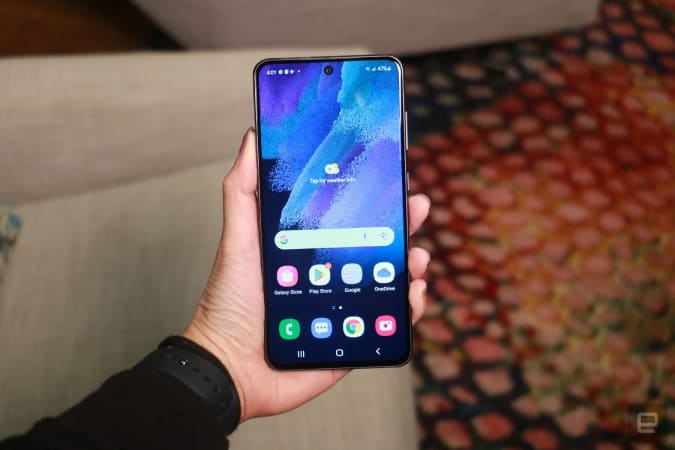
After its president TM Roh teased "the most noteworthy S series device we've ever created", Samsung is announcing today when we can learn more. The next Galaxy Unpacked event, which is the company's first this year, will happen virtually on Wednesday, February 9th at 10am ET (7am PT). You'll be able to watch the event on Samsung's website, though Engadget will also have our own livestream with a pre- and post-show Q&A to discuss the news.
Samsung is expected to unveil the next S-series flagship then, and if it doesn't drastically change the naming standard it's been using for the last few years, we should be seeing the Galaxy S22. Based on the rumor mill, there might not be many huge upgrades in the next-gen product. The most significant improvement could be an onboard slot for the S Pen and a blockier design, which would spell the death of the Note line.
Other reports suggest the new Ultra variant might start out with less RAM than last year's model, offering 8GB at the base level compared to the S21 Ultra's 12GB. There could also be a 50-megapixel camera on the regular S22s, up from the S21's 12-megapixel sensors.
We won't know the full details until Samsung officially confirms them come February 9th. You can tune in to the company's stream directly, but if you want to chat and react live with us before and after the show, come join us on the Engadget YouTube channel instead. It should be an illuminating time.
Sony's recent soundbars have been tailored to high-end users, but the company now has something aimed more at those who just want an upgrade from their TV's built-in speakers. The company has unveiled an HT-S400 soundbar that offers a few tricks while keeping the price down to $300. While it's a 2.1-channel system, it offers virtual surround sound (S-Force Pro Front Surround, in Sony-speak) to provide more immersive audio for your movies and shows. It's a fairly powerful system for the class, too, with a rather large 130W wireless subwoofer contributing to a total 330W of output.
The bar unsurprisingly offers tight integration with recent Sony TVs thanks to settings integration and wireless audio support. You can stream other Bluetooth audio, too. And while it's not clear how well Sony's clarity- and voice-optimized speaker designs work in practice, you may appreciate the options for both HDMI ARC and optical audio.
The HT-S400 will be available in April 2022. That's a long time to wait for a soundbar like this, but it might be justifiable if you either live in the Sony ecosystem or just want an alternative to lower-end soundbars from companies like Samsung and Vizio.
It's not always easy to find deals for the Nintendo Switch, so this latest bargain might be worth a look. Woot is selling the blue-and-red LCD model for $280 to Amazon Prime members, or $20 below the official price. The company's return policy isn't the same as Amazon's, but you'll have until February 28th to take advantage of the discount.
In a sense, the hardware is almost incidental here. You're buying a Switch for the games, which now include many classics ranging from launch-era titles like Legend of Zelda: Breath of the Wild to the recent Metroid Dread. Popular third-party games like Fortnite are available, too. Still, Nintendo's system is a great fit if you want TV and handheld gaming from one device — or just want a console with a particularly kid-friendly game selection.
There aren't many catches, but they're worth noting. You won't find some blockbuster multi-platform games like the Call of Duty series, and the Switch's 2017-era processing power won't wow you like a PlayStation 5 or Xbox Series X might. We'd add that it's also a question of whether or not this is the right Switch for you — the Switch OLED offers markedly improved display quality, battery life and tabletop gaming for $350, while the $200 Switch Lite is a bargain if you're just interested in portable use. At $280, though, the standard LCD Switch represents a good balance between features and price.
Follow @EngadgetDeals on Twitter for the latest tech deals and buying advice.
Samsung has revealed what it calls the "industry's first" all-in-one fingerprint security chip (IC) for payment cards. The S3B512C chip reads biometric information via a fingerprint sensor, stores and authenticates data with a tamper-proof secure element (SE) and analyzes it with a secure processor. While primarily designed for payment cards, it could also be used for "student or employee identification, membership or building access," the company said.
Samsung
Mainly, though, the new chip could make it easier for banks and others to make biometric payment cards. The solution performs in line with Mastercard's latest security specifications for payment cards, while also conforming to international security standards (CC EAL 6+) for "protecting high-value assets against significant risks," according to Samsung.
Last year, Samsung announced that it was collaborating with Mastercard on a biometric scanning payment card with a built-in fingerprint reader. It said at the time that the tech would "adopt a new security chipset from Samsung's LSI business" rather than using Mastercard's tech, so the new S3B512C chipset appears to be what it was referring to.
The chip could also allow for "faster and safer interactions when making purchases," Samsung notes. It removes the need for a PIN code and even uses anti-spoofing technology to block fraudulent methods like artificial fingerprints.
It seems absurd that in 2022, people are still swiping cards and signing for purchases. Given Samsung's manufacturing chops and influence, however, the chip has the potential to make biometric payment cards more mainstream. Samsung didn't mention any launch customers or other details.
With Samsung scheduled to announce its next Galaxy S flagships in February, a new leak suggests the company may have a pricing change planned for its high-end phone lineup. Per a tweet spotted by Android Police from WinFuture’sRoland Quandt, European pricing for the Galaxy S22 series will start at €849, with the base models of the Galaxy S22 Plus and Ultra slated to cost €1049 and €1249, respectively. Effectively, this means in 2022 Samsung’s Galaxy S lineup will cost just as much as it did in 2021. What’s more, Quandt’s tweet suggests the company will continue its practice of charging a €50 premium for a storage bump on the standard and Plus models.
Whoever said S22 series was to be cheaper, didn't think of Covid, parts shortages and inflation.
What may change is that Samsung could tweak the base model Ultra variant to offer less value than its predecessor. In Europe at least, the €1249 Galaxy S22 Ultra will ship with 8GB of RAM, according to Quandt, and cost the same amount as money as the entry-level Galaxy S21 Ultra, which features 12GB of RAM. Consumers in Europe will reportedly need to pay a €100 premium to get the S22 Ultra with 12GB of RAM and 256GB of internal storage. It’s not clear if Samsung will implement the same pricing strategy in the US. As Android Police points out, a separate leak earlier this month suggested the company could charge an extra $100 stateside for every model in the Galaxy S22 lineup. As always, we’ll have to wait until the company shares official pricing information before we know just how much it will cost to own the latest Galaxy S phones.
Things are looking brighter for Valve’s Steam Deck and its potential game library. On Friday, the company announced titles that depend on Epic’s Easy Anti-Cheat (EAC) software can now run on the portable. Valve said adding Steam Deck support to titles that utilize EAC is “a simple process.” Developers won’t need to update their SDK version or make other time-consuming changes. With Valve adding BattlEye support through its Proton compatibility layer for Linux late last year, the company said, “this means the two largest anti-cheat services are now easily supported on Proton and Steam Deck.” In practice, that should mean more of your favorite games will work with Valve’s handheld when it launches next month.
Of course, it’s one thing for Valve to make it easy for developers to ensure their games run without issue on Steam Deck and a completely separate thing for them to do the necessary work to ensure compatibility. To that point, when Valve announced BattlEye support in December, it said all developers had to do was contact the company to enable the software for their title. And yet it’s still unclear whether some of the most popular multiplayer games on Steam that utilize BattlEye and EAC, including titles like Rainbow Six Siege and PUBG, will work on day one of Steam Deck’s availability. Valve has tried to address some of that uncertainty with its recently announced Deck Verified program. This week, Valve added 67 titles to the database, 39 of which should run without issue on the device.
After multiple delays, Dying Light 2 will finally arrive on February 4th. If you haven’t had a chance to purchase a PlayStation 5 or Xbox Series X/S yet, developer Techland is making the decision of whether to buy the game now or later easy. In an announcement spotted by Eurogamer, the studio shared this week it will provide free current-gen upgrades to those who buy Dying Light 2 on PlayStation 4 or Xbox One.
What that means is that you’ll have the chance to play the game with improved graphics at a later date. Like many recent PS5 and Xbox Series X/S releases, Dying Light 2 will ship with multiple rendering modes, thereby allowing you to configure the game to prioritize either graphical fidelity or better performance.
If you want the best possible graphics, you can choose between separate “Quality” and “Resolution” modes. As you can probably tell from the name, the latter will attempt to render the game at 4K. Less obvious is the Quality mode, which adds raytracing to the experience. And if all you want is a smooth framerate, the included “Performance” mode will render Dying Light 2 at 60 frames per second or greater. You can see the different modes in action in the video above.
The news comes in the same week Techland announced the cloud version of Dying Light 2 for Switch will be delayed by up to half a year. The studio said it made the decision to push back the release to ensure it could provide the best possible experience to Nintendo fans.
Sony Pictures Classics has picked up the rights to an animated movie entitled A Winter’s Journey, which will be made in part using the PlayStation game-creation tool Dreams. According to Deadline, the film will blend live actors with CG and hand-painted animation and is an adaptation of Franz Schubert's set of 24 songs for voice and piano called Winterreise. It tells the story of a lovelorn poet who embarks on a dangerous journey that takes him across mountains and snow in 1812 Bavaria.
Dreams was originally created by Media Molecule, the studio behind LittleBigPlanet, for the PS4. The studio pitched it as a way to create "art, movies and video games" from the start, and we once described it as "an engine, learning suite and distribution platform rolled into one." Since then, people have been using it to create their own games, realistic renders of nature, immersive experiences of their favorite movies, among other things. A Winter’s Journey, however, will reportedly be the first time Dreams will be used on a feature film.
The movie has yet to get a release date, but shooting is expected to start in June in Wrocław, Poland, with actors that include John Malkovich and Jason Isaacs. It'll likely take some time before it's ready to premiere. As for Dreams itself, it's currently on sale in the US PlayStation Store for $10, and it includes a rotating list of the most creative games made using the tool.
In the face of daily pandemic-induced upheavals, the notion of "business as usual" can often seem a quaint and distant notion to today's workforce. But even before we all got stuck in never-ending Zoom meetings, the logistics and transportation sectors (like much of America's economy) were already subtly shifting in the face of continuing advances in robotics, machine learning and autonomous navigation technologies.
In their new book, The Work of the Future: Building Better Jobs in an Age of Intelligent Machines, an interdisciplinary team of MIT researchers (leveraging insights gleaned from MIT's multi-year Task Force on the Work of the Future) exam the disconnect between improvements in technology and the benefits derived by workers from those advancements. It's not that America is rife with "low-skill workers" as New York's new mayor seems to believe, but rather that the nation is saturated with low-wage, low-quality positions — positions which are excluded from the ever-increasing perks and paychecks enjoyed by knowledge workers. The excerpt below examines the impact vehicular automation will have on rank and file employees, rather than the Musks of the world.
THE ROBOTS YOU CAN SEE: DRIVERLESS CARS, WAREHOUSING AND DISTRIBUTION, AND MANUFACTURING
Few sectors better illustrate the promises and fears of robotics than autonomous cars and trucks. Autonomous vehicles (AVs) are essentially highspeed wheeled industrial robots powered by cutting-edge technologies of perception, machine learning, decision-making, regulation, and user interfaces. Their cultural and symbolic resonance has brought AVs to the forefront of excited press coverage about new technology and has sparked large investments of capital, making a potentially “driverless” future a focal point for hopes and fears of a new era of automation.
The ability to transport goods and people across the landscape under computer control embodies a dream of twenty-first-century technology, and also the potential for massive social change and displacement. In a driverless future, accidents and fatalities could drop significantly. The time that people waste stuck in traffic could be recovered for work or leisure. Urban landscapes might change, requiring less parking and improving safety and efficiency for all. New models for the distribution of goods and services promise a world where people and objects move effortlessly through the physical world, much as bits move effortlessly through the internet.
As recently as a decade ago, it was common to dismiss the notion of driverless cars coming to roads in any form. Federally supported university research in robotics and autonomy had evolved for two generations and had just begun to yield advances in military robotics. Yet today, virtually every carmaker in the world, plus many startups, have engaged to redefine mobility. The implications for job disruption are massive. The auto industry itself accounts for just over 5 percent of all private sector jobs, according to one estimate. Millions more work as drivers and in the web of companies that service and maintain these vehicles.
Task Force members John J. Leonard and David A. Mindell have both participated in the development of these technologies and, with graduate student Erik L. Stayton, have studied their implications. Their research suggests that the grand visions of automation in mobility will not be fully realized in the space of a few years.15 The variability and complexity of real-world driving conditions require the ability to adapt to unexpected situations that current technologies have not yet mastered. The recent tragedies and scandals surrounding the death of 346 people in two Boeing 737 MAX crashes stemming from flawed software and the accidents involving self-driving car-testing programs on public roads have increased public and regulatory scrutiny, adding caution about how quickly these technologies will be widely dispersed. The software in driverless cars remains more complex and less deterministic than that in airliners; we still lack technology and techniques to certify it as safe. Some even argue that solving for generalized autonomous driving is tantamount to solving for AGI.
Analysis of the best available data suggests that the reshaping of mobility around autonomy will take more than a decade and will proceed in phases, beginning with systems limited to specific geographies such as urban or campus shuttles (such as the recent product announcement from Zoox, an American AV company). Trucking and delivery are also likely use cases for early adoption, and several leading developers are focusing on these applications both in a fully autonomous mode and as augmented, “convoy” systems led by human drivers. In late 2020, in a telling shift for the industry from “robotaxis” to logistics, Uber sold its driverless car unit, having spent billions of dollars with few results. The unit was bought by Amazon-backed Aurora to focus the technology on trucking. More automated systems will eventually spread as technological barriers are overcome, but current fears about a rapid elimination of driving jobs are not supported.
AVs, whether cars, trucks, or buses, combine the industrial heritage of Detroit and the millennial optimism and disruption of Silicon Valley with a DARPA-inspired military vision of unmanned weapons. Truck drivers, bus drivers, taxi drivers, auto mechanics, and insurance adjusters are but a few of the workers expected to be displaced or complemented. This transformation will come in conjunction with a shift toward full electric technology, which would also eliminate some jobs while creating others. Electric cars require fewer parts than conventional cars, for instance, and the shift to electric vehicles will reduce work supplying motors, transmissions, fuel injection systems, pollution control systems, and the like. This change too will create new demands, such as for large scale battery production (that said, the power-hungry sensors and computing of AVs will at least partially offset the efficiency gains of electric cars). AVs may well emerge as part of an evolving mobility ecosystem as a variety of innovations, including connected cars, new mobility business models, and innovations in urban transit, converge to reshape how we move people and goods from place to place.
TRANSPORTATION JOBS IN A DRIVERLESS WORLD
The narrative on AVs suggests the replacement of human drivers by AI-based software systems, themselves created by a few PhD computer scientists in a lab. This is, however, a simplistic reading of the technological transition currently under way, as MIT researchers discovered through their work in Detroit. It is true that AV development organizations tend to have a higher share of workers with advanced degrees compared to the traditional auto industry. Even so, implementation of AV systems requires efforts at all levels, from automation supervision by safety drivers to remote managing and dispatching to customer service and maintenance roles on the ground.
Take, for instance, a current job description for “site supervisor” at a major AV developer. The job responsibilities entail overseeing a team of safety drivers focused in particular on customer satisfaction and reporting feedback on mechanical and vehicle-related issues. The job offers a mid-range salary with benefits, does not require a two- or four-year degree, but does require at least one year of leadership experience and communication skills. Similarly, despite the highly sophisticated machine learning and computer vision algorithms, AV systems rely on technicians routinely calibrating and cleaning various sensors both on the vehicle and in the built environment. The job description for field autonomy technician to maintain AV systems provides a mid-range salary, does not require a four-year degree, and generally requires only background knowledge of vehicle repair and electronics. Some responsibilities are necessary for implementation — including inventorying and budgeting repair parts and hands-on physical work—but not engineering.
The scaling up of AV systems, when it happens, will create many more such jobs, and others devoted to ensuring safety and reliability. Simultaneously, an AV future will require explicit strategies to enable workers displaced from traditional driving roles to transition to secure employment.
A rapid emergence of AVs would be highly disruptive for workers since the US has more than three million commercial vehicle drivers. These drivers are often people with high school or lower education or immigrants with language barriers. Leonard, Mindell, and Stayton conclude that a slower adoption timeline will ease the impact on workers, enabling current drivers to retire and younger workers to get trained to fill newly created roles, such as monitoring mobile fleets. Again, realistic adoption timelines provide opportunities for shaping technology, adoption, and policy. A 2018 report by Task Force Research Advisory Board member Susan Helper and colleagues discusses a range of plausible scenarios and found the employment impact of AVs to be proportional to the time to widespread adoption. Immediate, sudden automation of the fleet would, of course, put millions out of work, whereas a thirty-year adoption timeline could be accommodated by retirements and generational change.
Meanwhile, car-and-truck makers already make vehicles that augment rather than replace drivers. These products include high-powered cruise control and warning systems frequently found on vehicles sold today. At some level, replacement-type driverless cars will be competing with augmentation-type computer-assisted human drivers. In aviation, this competition went on for decades before unmanned aircraft found their niches, while human-piloted aircraft became highly augmented by automation. When they did arrive, unmanned aircraft such as the US Air Force’s Predator and Reaper vehicles required many more people to operate than traditional aircraft and offered completely novel capabilities, such as persistent, twenty-four-hour surveillance.
Based on the current state of knowledge, we estimate a slow shift toward systems that require no driver, even in trucking, one of the easier use cases, with limited use by 2030. Overall shifts in other modes, including passenger cars, are likely to be no faster.
Even when it’s achieved, a future of AVs will not be jobless. New business models, potentially entirely new industrial sectors, will be spurred by the technology. New roles and specialties will appear in expert, technical fields of engineering of AV systems and vehicle information technologies. Automation supervision or safety driver roles will be critical for levels of automation that will come before fully automated driving. Remote management or dispatcher, roles will bring drivers into control rooms and require new skills of interacting with automation. New customer service, field support technician, and maintenance roles will also appear. Perhaps most important, creative use of the technology will enable new businesses and services that are difficult to imagine today. When passenger cars displaced equestrian travel and the myriad occupations that supported it in the 1920s, the roadside motel and fast-food industries rose up to serve the “motoring public.” How will changes in mobility, for example, enable and shape changes in distribution and consumption?
Equally important are the implications of new technologies for how people get to work. As with other new technologies, introducing expensive new autonomous cars into existing mobility ecosystems will just perpetuate existing inequalities of access and opportunity if institutions that support workers don’t evolve as well. In a sweeping study of work, inequality, and transit in the Detroit region, Task Force researchers noted that most workers building Model T and Model A Fords on the early assembly lines traveled to work on streetcars, using Detroit’s then highly developed system. In the century since, particularly in Detroit, but also in cities all across the country, public transit has been an essential service for many workers, but it has also been an instrument facilitating institutional racism, urban flight to job-rich suburbs, and inequality. Public discourse and political decisions favoring highway construction often denigrated and undermined mass transit, with racial undertones. As a result, Black people and other minorities are much more likely to lack access to personal vehicles.
“Technology alone cannot remedy the mobility constraints” that workers face, the study concludes, “and will perpetuate existing inequities absent institutional change.” As with other technologies, deploying new technologies in old systems of transportation will exacerbate their inequalities by “shifting attention toward what is new and away from what is useful, practical, and needed.” Innovating in institutions is as important as innovating in machines; recent decades have seen encouraging pilot programs, but more must be done to scale those pilots to broader use and ensure accountability to the communities they intend to serve. “Transportation offers a unique site of political possibility.”
A bunch of new tech sales cropped up at the start of the week for things like robot vacuums, game controllers and more, and many of them are still around today. A trio of iRobot devices remain discounted, with the most affordable of the bunch coming in at $179. Some of Amazon's Fire tablets are up to 50 percent off, while Xbox's Elite Wireless Series 2 controller is back down to $140. Here are the best tech deals from this week that you can still get today.
iRobot Roomba j7+
The new Roomba j7+ is $250 off right now and down to $599 at both Amazon and Wellbots. The higher-end Roomba s9+ is also $250 and down to $850. The former just came out at the end of last year and has 10x the suction power of a standard Roomba plus advanced obstacle avoidance, which means it will avoid things like pet poop more easily than other models. The s9+, on the other hand, has 40x suction power and a more corner-friendly design. Both also support automatic emptying and come with clean bases, too.
The Roomba 694 is down to $179, or $95 off and a return to its record-low price. It earned a spot in our best budget robot vacuums guide thanks to its strong cleaning power, on-device button controls and handy companion mobile app.
Apple's 8-core GPU iMac is down to $1,399, or $100 off. This is the latest 24-inch, M1 iMac that we gave a score of 89 for its speedy performance, stunning display and impressibly thin design.
A number of Amazon Fire tablets are on sale, with some of the best deals being on the Fire HD 8 and HD 8 Plus, both of which are 50 percent off. The Fire 7 tablet is 30 percent off and down to $35 as well. We think the Fire HD 8 slabs are the better ones to get since they have improved designs, USB-C charging, long battery lives and decent performance.
Microsoft's Elite Wireless Series 2 controller for Xbox remains on sale for $140, or $40 less than usual. If you want to treat yourself (or someone else) to a fancy gaming accessory, this is a good option. It comes with six thumbsticks, four paddles, two D-pads, a charging dock, a carrying case and a USB-C cable, and its battery can last up to 40 hours on a single charge.
The Galaxy Buds 2 are down to $100 right now, or $50 off their normal price. We gave them a score of 84 for their improve sound quality, adjustable ambient sound mode, comfortable design and support for wireless charging.
Samsung's latest smartphone, the Galaxy S21 FE, is officially available and starting to ship and Amazon throws in a $100 gift card if you order the handset through the online retailer. We briefly tested the FE at CES 2022 and called it "last year's flagship without the frills," and it includes a 5-nanometer processor, a 120HZ display, a 32-megapixel front-facing camera, a larger battery and more.
The Samsung T7 Touch SSD in 1TB is down to a record low of $140 right now. That's even better than the price it was during the holiday shopping season last year. We like the drive's compact design, fast speeds and built-in fingerprint reader for extra security.
Engadget readers can get a total of two free audiobooks when signing up for Libro.fm, the audiobook subscription service that supports local bookstores. Similarly to Audible, a Libro.fm membership costs $15 per month and gives you one audiobook credit per month, plus 30 percent off any audiobooks you buy á la carte.
This massive Sony OLED set is $2,000 off right now, bringing it down to a record low of $6,000. It includes features like Cognitive Processor XR, Motion Clarity, HDMI 2.1 for gaming, Acoustic Surface Audio+, Dolby Vision and more.
Elgato's Ring Light is cheaper than ever at $150 on Amazon. Online content creators like game streamers will probably get the most out of this gadget, but it could be useful if you need better lighting for Zoom calls too. It has a 2500-lumen output, onboard brightness and color temperature controls and integration with Elgato's Stream Deck.