After debuting the first "1-inch" mobile camera sensor with the 12S Ultra last year, Xiaomi is back with a familiar-looking successor but with some significant upgrades. The new Xiaomi 13 Ultra packs not three but four rear Leica cameras, with the 23mm OIS (optical image stabilization) main camera using the same "1-inch" 50-megapixel Sony IMX989 sensor, but now with variable aperture to toggle between f/1.9 and f/4.0 for different artistic takes.
The remaining three cameras do ultra-wide (12mm, f/1.8, 122-degree FOV), periscopic 5x zoom (120mm, f/3.0, OIS) and the new 3.2x zoom (75mm, f/1.8, OIS) for sharp portraits with more bokeh. These all use the new 50-megapixel 1/2.51-inch IMX858 sensor, which claims to offer the same noise reduction, all-pixel focus and DOL-HDR performance as its 1-inch cousin. If true, this would ensure a more consistent image quality across all four cameras, which had been a big challenge for smartphone makers previously. On the other side of the phone, the punch-hole selfie camera remains at 32 megapixels.
As with recent flagship phones, it comes as no surprise that the Xiaomi 13 Ultra is powered by Qualcomm's Snapdragon 8 Gen 2 processor, with up to 16GB of LPDDR5X RAM and up to 1TB of UFS 4.0 storage. The device also supports USB 3.2 with up to 5Gbps of transfer speed — 10x faster than the 12S Ultra — and up to 4K 60Hz of DisplayPort video output. The slightly larger 5,000mAh battery is complemented by a 90W charger, which reaches 100-percent charge in 35 minutes. You can also use it with Xiaomi's 50W wireless charger, when you're not in a rush. But if you do run out of juice, the new "Hibernation mode" can apparently stretch the final 1-percent battery into 60-minute standby or a 12-minute call, thanks to Xiaomi's very own P2 and G1 co-processors.
While the AMOLED display still comes in at 6.73 inches wide with the same 3,200 x 1,440 resolution, this time it's a new LTPO panel supplied by CSOT (a TCL subsidiary). This supposedly benefits from a new C7 luminous material with a more precise 12-bit color depth, along with a peak brightness of 2,600 nits (or up to 1,300 nits in high brightness mode), better viewing angles and lower power consumption. You get Dolby Vision support as well.
Xiaomi
As with its predecessor, the Xiaomi 13 Ultra features IP68 rating for dust- and water-resistance. In addition to its metallic unibody, the device also consists of a second-generation nano-tech material with anti-bacterial properties and UV resistance. Internally, it touts a new loop-shaped vapor cooling chamber, which uses multiple liquid channels to supposedly dissipate heat three times faster than a conventional design. This is mainly to keep the phone cool while shooting 4K videos.
The company also implemented a dual-wing cellular antenna module, which apparently offers a 58-percent boost in signal reception across all bands. As a bonus, the symmetrical antenna layout should reduce interference from hands, and there's also a new dedicated 5G antenna which apparently boosts the n78 band's signal by 100 percent.
Xiaomi
The Xiaomi 13 Ultra is already available for pre-order in China, starting from 5,999 yuan (around $870) for the 12GB RAM with 256GB storage model, all the way to 7,299 yuan (around $1,060) for the 16GB RAM with 1TB storage option. Color-wise, you can choose between olive green, black and white. For an extra 799 yuan ($120), you can get the "Xiaomi 13 Ultra Professional Photography Kit" which includes a camera grip attachment (with a physical shutter button) and a special phone case — one that lets you attach the included 67mm filter ring adapter and lens cap.
Engadget understands that the Xiaomi 13 Ultra will reach international markets at some point (except for the white version, sadly), so stay tuned.
This article originally appeared on Engadget at https://www.engadget.com/xiaomis-13-ultra-features-four-leica-tuned-cameras-132616095.html?src=rss
Samsung is replacing its Free app on Galaxy devices with a client that's more focused, if also a little familiar. The company is launching a beta News app that, somewhat like its Apple equivalent, concentrates on top headlines (here organized into morning and evening briefings) as well as customizable feeds. Unlike many other news apps, though, you can also listen to podcasts.
The app will reach US-based Galaxy hardware in the weeks ahead, and will automatically replace Free if it's already installed. You can otherwise download it from Samsung's Galaxy Store. The news will initially come from "trusted partners" that include Axios, Huffington Post (formerly a sibling brand of Engadget) and Sports Illustrated. More outlets and additional features are coming, Samsung says.
The change may create a few hassles. Free combined news with Samsung TV Plus channels and casual gaming. Now, you'll have to go to separate apps to access that content. However, the News app may be considerably more useful if you're catching up on the day's events, or want to listen to a recap during the commute home.
There's no mention of a paid service comparable to Apple News+, which offers access to some subscription-only news sources as well as magazines. However, the strategy isn't all that different. Samsung is shifting its attention to services at a time when the phone market is grim — you may be more likely to stick to your Galaxy phone (and pay for content on it) if services like News prove appealing.
This article originally appeared on Engadget at https://www.engadget.com/samsungs-news-app-brings-daily-headlines-and-podcasts-to-galaxy-devices-130108893.html?src=rss
Niantic, which is perhaps most known for developing Pokémon Go, is working on an augmented reality version of Monster Hunter for Android and iOS devices. The company has teamed up with Capcom to create what it calls a "real-world hunting action RPG" entitled Monster Hunter Now. Similar to Pokemon Go and Niantic's other titles, including the now-defunct Harry Potter: Wizards Unite, players will have to walk around with their phones to find monsters to battle. They can also team up with friends and strangers and use the materials they gather to craft weapons and armor.
We have opened an official Twitter account for Real-world hunting action RPG "Monster Hunter Now" from Niantic and Capcom which announced today! Service is scheduled to begin in September 2023!
According to Polygon, Niantic and Capcom have revealed at a press briefing that the game will be free to play, with in-app purchases. It will feature simplified combat comparable to Pokémon Go's and will have players swiping and tapping on their phone screens. Players can fight battles one-handed in portrait mode, but they can also battle monsters in landscape mode if they want to replicate the Monster Hunter experience they're used to on PCs and consoles.
While the franchise is known for challenging players with battles that could last for more than five minutes, though, the maximum battle time for the mobile game will only be 75 seconds. Sakae Osumi, a Niantic senior producer at its Tokyo studio where the game is being developed, said the company wants to encapsulate Monster Hunter's fun battles within a shorter window of time. Long, drawn-out battles aren't ideal for mobile games where you're supposed to walk around anyway. That said, Monster Hunter Now will come with a feature that will allow players to tag monsters they encounter with a paintball so that they could battle them at home, either on their own or with friends. Their Palico companions could automatically tag monsters, as well, even if the app isn't open.
Niantic is now accepting sign-ups for the game's closed beta testing, which will begin on April 25th. If all goes well, and testing is a success, Monster Hunter Now will officially launch sometime in September this year.
This article originally appeared on Engadget at https://www.engadget.com/niantic-is-developing-an-augmented-reality-monster-hunter-action-rpg-091557321.html?src=rss
Just like that, a new Harry Potter game is on its way. On Monday, WB Games revealed Harry Potter: Quidditch Champions, a title the Hogwarts Legacy publisher is billing as a “fast-paced, competitive multiplayer” game that will be available on PC and consoles. According to the company, Unbroken Studios, best known for its work supporting the recently delayed Suicide Squad: Kill the Justice League, has been working on Quidditch Champions for the past “several years,” making the sport’s absence from Hogwarts Legacy make a lot more sense.
"Harry Potter: Quidditch Champions is a complete, standalone Quidditch experience," a newly published FAQ says of the project, noting fans will need an online connection to play the game. "It engages players in the sport of Quidditch and other broomstick adventures alongside friends in a competitive, multiplayer setting." The FAQ additionally states J.K Rowling was not involved in the creation of Quidditch Champions, and that the game is not a direct adaption of any of the existing Harry Potter books or films.
For the past few years, Rowling has been controversial for her transphobic views. Ahead of the release of Hogwarts Legacy, some fans chose not to buy or play the game for that reason. In addition to a new game, WB Games parent Warner Bros. Discovery is working on a new live-action adaption of all seven books in the Harry Potter series. Quidditch Champions does not have a release date. For now, WB Games is accepting signups for “limited” playtests.
This article originally appeared on Engadget at https://www.engadget.com/harry-potter-quidditch-champions-will-take-the-wizarding-worlds-broomstick-sports-online-223736680.html?src=rss
GameStop is running a buy-one-get-one (BOGO) sale on select console games. The deal covers unopened Switch, PlayStation and Xbox games, including popular titles like Octopath Traveler 2, Forspoken, The Legend of Zelda: Skyward Sword HD and many others. The deal applies to online and in-store purchases.
Nintendo Switch owners can apply the BOGO deal to Bayonetta 3, Xenoblade Chronicles 3, Fire Emblem Warriors: Three Hopes, Octopath Traveler 2, Skyward Sword HD (a chance to revisit a remake of an older Zelda game ahead of the Tears of the Kingdom launch next month), Mario Strikers: Battle League, Mario Golf: Super Rush and Pokémon Brilliant Diamond and Pokémon Shining Pearl.
PS5 owners can choose from Forspoken, The Callisto Protocol (Day One Edition), Valkyrie Elysium, Deathloop, Call of Duty: Vanguard and Battlefield 2042. Meanwhile, if you own an Xbox Series X / S, the deal is good for The Callisto Protocol Day One Edition, Gotham Knights, Marvel’s Midnight Suns, Saints Row: Criminal Custom Edition, NHL 23 and Madden 23.
If you have more than one console, you can mix and match the BOGO games between platforms. Although GameStop hasn’t announced an end date for the sale, the retailer’s fine print notes that prices may change and the offer is only good while supplies last. If you aren’t sure where to start, you can browse Engadget’s picks for the best Switch, PS5 and Xbox games for 2023.
This article originally appeared on Engadget at https://www.engadget.com/gamestops-buy-one-get-one-free-sale-includes-popular-ps5-and-nintendo-switch-games-213055962.html?src=rss
Former Halo scribe Joseph Staten has joined Netflix’s burgeoning gaming division. On Monday, Staten tweeted that he will serve as the creative director on a new AAA game and original intellectual property from the streaming giant. “In my work life, there’s nothing I love more than collaborating with others to build worlds filled with iconic characters, deep mysteries, and endless adventures,” Staten wrote on Twitter. "So today, I'm thrilled to announce that I've joined Netflix Games as Creative Director for a brand-new AAA multiplatform game and original IP. Let's go!"
So today, I'm thrilled to announce that I've joined @Netflix Games as Creative Director for a brand-new AAA multiplatform game and original IP. Let's go! 2/2
The announcement comes less than two weeks after Staten announced his departure from Microsoft. Before joining the tech giant in 2013, he worked as a writer and director of cinematics on Bungie’s first three Halo games. Staten later helped write and co-direct Destiny, but left the studio before the game’s release in 2014. Following his return to the Microsoft fold (Bungie was a Microsoft studio before it went independent in 2007), Staten worked as senior creative director on the Xbox Game Studios team for a number of years before moving to 343 Industries in 2020 to assist in the development of Halo Infinite. This past January, Microsoft reassigned Staten away from 343 at the same time it cut “at least” 95 jobs at the troubled developer.
On Monday, Staten said the game he’s working on at Netflix would be a “multiplatform” release. To date, the company’s gaming strategy has primarily centered around obtaining mobile publishing rights to respected indie titles like Into the Breach and Terra Nil. Funding the development of a multiplatform AAA game is significantly more ambitious.
This article originally appeared on Engadget at https://www.engadget.com/halo-veteran-joseph-staten-is-making-a-aaa-game-for-netflix-173502368.html?src=rss
After launching its .Swoosh web3 platform in November, Nike is ready to unveil its first set of digital collectibles today. The company has announced the Our Force 1 (or OF1) series of "virtual creations" will be available to a select group with invitations on May 8th, while general access opens on May 10th. You can choose to buy one of two boxes — "Classic Remix" or "New Wave," and each will cost you $19.82 either way. You'll have to have an account on the Swoosh website and have minted your ID to get one of these, though.
Now to be clear, these aren't actual shoes you'd be getting. You're paying for a digital box to start, and you won't know what design you got either. On an undisclosed date after May 10th, Nike will reveal all the OF1 boxes at the same time, though you'll have the option of not opening the box and leaving it as a virtual Schrodinger's cat situation. Swoosh members will be alerted when that day comes, and each box comes with a 3D file that you can use to, say, export to other platforms (if compatible) and more.
There are over 100,000 "Nike Virtual Creations" in the OF1 collection, and they're mostly based on the Air Force 1. If you picked a Classic Remix box, you'll get a "favorite, classic archive AF1 released from 1982 to 2006" or "a more unique, custom AF1 with a nostalgic twist." Those who select New Wave will receive a "classic archive from 2007 or later" or "an expressive, custom AF1 with a more futuristic twist." There are also four designs from the winners of the company's previous "Your Force 1" contest that are in the mix across both types of boxes.
Like Nike explained when it launched .Swoosh, these digital collectibles aren't just for online use. "In the near future," the company said, it "will introduce other new utilities and benefits... such as exclusive physical products or experiences."
Since its launch, .Swoosh has seen over 330,000 accounts created and on April 18th, about 106,453 members will be chosen at random to receive virtual posters via Airdrop. This will allow them early access to buying an OF1 box. Nike said its DEI and SC+I partners will be included in this Airdrop, along with "those who participated in the #OurForce1 challenge and/or registered at our .Swoosh Session tour stops." If you're a major Nike fan and are willing to part with $20 for a digital collectible with the possibility that it might get you early access to future product drops, you can register at swoosh.nike to be eligible to buy an OF1 on May 10th. Only those who have already minted their IDs before April 12th will be considered for early access.
This article originally appeared on Engadget at https://www.engadget.com/nike-launches-our-force-1-collection-of-digital-shoes-with-real-world-perks-160030487.html?src=rss
My dad bought me Breville’s Juice Fountain for a very specific purpose: to recreate the horse’s neck cocktail he’d enjoyed on a snowy evening at the High West distillery saloon in Utah. The drink calls for a quarter ounce of ginger juice, and if you’ve ever seen a knotty clump of said root, it doesn’t look like it would contain much liquid. That’s where the Fountain comes in – it extracts a waterfall from seemingly parched produce like it’s squishing grapes.
I make ginger juice in bigger batches, getting about five liquid ounces from eight ounces of ginger. Weight-to-volume conversions aside, that’s a pretty great ratio. It lasts a week or two in the fridge, so I can get a lot of horse’s necks out of a juicing session. The cocktail itself is bright, warming and spicy – and possibly my favorite tipple.
But I’m not drinking as much these days, so I’ve been using the Juice Fountain for healthier stuff that doesn't have bourbon in it… like straight juice. At first, I turned to the internet for recipes, but pretty quickly learned that throwing in whatever sounds good tends to have the best results. Carrot, ginger, lemon and orange together make something sweet and zesty that tastes and looks like a sunrise. Apple, kale, celery and lemon make a vivid green drink that reminds me of spring and feels like you’re drinking a cup of vitamins — if a cup of vitamins were delicious.
Photo by Amy Skorheim / Engadget
The appliance has two speeds: high for harder vegetables and low for softer fruit. Besides picking a speed, the only prep you need to do is to wash all ingredients and remove the peel and pith on citrus — no need to scrape the skin off ginger or remove the stalks from kale. Apples can even go in whole, as long as they fit down the impressively wide chute (though I usually core mine, out of an irrational cyanide paranoia).
Once the fruits and vegetables go in, the Fountain transforms them into juice in seconds, absolutely obliterating them with what I can only assume is a tiny jet-engine. Seriously, it sounds like an aircraft readying itself for takeoff; this is a daylight hours-only kind of machine. The motor is so powerful and the mesh/graters so robust that just the weight of a carrot or cucumber itself is usually enough to run it through the extractor. Even leafy kale only needs a light push from the plunger.
So yes, it does a great job of getting the most out of each piece of produce, but juicing still isn’t cheap. A big bunch of organic carrots and a few oranges quickly turn into a lovely neon drink, but there might be $6 worth of produce swimming in that cup. But hey, if it means my kid will drink eight ounces of a kelly green apple/kale concoction and ask for more, it’s worth it in my book.
When I first saw it, I was convinced the Fountain would be something I’d use once and never again after the tedium of washing its various intricate parts. And it does break down into quite a few pieces (seven to be exact), but taking it apart and putting it back together is completely intuitive. I don’t think I looked at the instructions since the first disassembly.
Cleaning the components isn’t hard either – as long as you do it immediately. If you wait until the pulp bits and juice spray have hardened, you’ll have to put in some muscle and fuss to get it sparkly again. The hardest part to wash is probably the mesh-and-grate extraction basket. Breville supplies a scrub brush for the job, but I promptly lost that. Turns out a standard dish brush and warm, soapy water do a great job of removing apple, carrot and all other remnants. A few of the parts are dishwasher safe, but others aren’t. I figure if I have to hand-wash some, I may as well do them all.
Photo by Amy Skorheim / Engadget
The only other thing that gave me pause was the pulp. Liquid health pours from one side of the machine, but a pile of fluffy plant matter kicks out the other. The first time I saw it I had to wonder what the heck I was supposed to do with all of that. I tried a few muffin recipes that call for juicer pulp, but they didn’t turn out well. (I blame my baking skills, not the directions.) I still believe I’ll find something that works, but I have to experiment more.
So far, my favorite solution is adding the fluff to my weekly batch of breakfast smoothies. My advice if you do the same: don’t include any ginger pulp – if you do, it’ll be the only thing you taste. Citrus leftovers are also pretty overbearing and bitter. Fluff from apple, celery and carrots have the most neutral flavor and go nicely in a morning shake. Of course, I still always have way more byproduct than I could possibly use, so I just compost the rest.
At $180, it’s not the cheapest kitchen appliance you can buy, but it’s far from the most expensive. Even though mine was a gift, I feel like it’s worth its price tag. Design-wise, the Fountain follows the silvery, matte aesthetic Breville tends to give its kitchen appliances, a look that’s neither too modern or overly retro. It has lovely curves and a graceful, tower-like profile. But thanks to the aforementioned jet engine, the Fountain isn’t small. My tiny kitchen has no space to store it on the countertop, so when it’s not doing its juice thing, it lives up in a cupboard. Honestly, it’s a pain to get down. But I’m happy (and healthier) every time I do.
This article originally appeared on Engadget at https://www.engadget.com/breville-juice-fountain-plus-irl-150059913.html?src=rss
It was after a particularly grueling session with The Legend of Zelda: Breath of the Wild that I started to wonder: When did developers stop putting cheats into their games to help the less talented among us get through the tricky bits? When I was a kid, a little bit of Up Down Left Right A and Start together, and a little older, a little /~noclip saved me no end of bother. These days, if you look for cheats for any modern game online, the best you’ll get is to be sassily told to “git gud.”
Sorry, a little context: I play games, but I’m not a Gamer, or a Nintendo Person, so in 2023 I resolved to remedy this. So many discussions at work fly past me because while I’ve heard of Cliff Bleszinski and Hironobu Sakaguchi, I couldn’t tell you their oeuvre without Googling. Part of my self-education was to watch every Zero Punctuation compilation to speedrun the last decade of games development. Another part was to seek out some classic games that I’d never played through ignorance, weakness, or my own stupid fault.
The first step on this journey only required me to go to the bookshelves in my living room, ironically. I bought my Pokémon Go-loving wife a Nintendo Switch at the start of 2020 so she could play Let’s Go Pikachu!. Not long after, a friend handed me their copy of Breath of the Wild and said I should give it a play. But it’s been sitting on my bookshelf for three years, as I subconsciously resisted the urge to give it a go. This, I’ll admit, is because I’ve always had the notion that Nintendo games are Hard Work.
And that was my belief up until a month ago, when I thought I’d better try Breath of the Wild before Tears of the Kingdom came out. I figured I’d give it half an hour, the smallest of toes dipped into the world, so that I could say I’d tried and that it wasn’t for me. And before you can say “I need to be up at seven in the morning for work,” it was long past midnight. Since then, Breath of the Wild has consumed my every waking moment. It is, without a doubt, one of the most engrossing and immersive games I have ever played, despite my frustrations.
Nintendo
It’s why I felt compelled to write this, because I want to spread the gospel to non-gamers who might feel similarly like they’ve missed the bus. Especially since we can hope that the older game might fall in price as people seek out its replacement. Or, given the current situation with Nintendo persistently keeping the prices of its older first-party games high, at least it won’t get any more expensive. But, to undermine my own argument, I’d say that if Tears of the Kingdom is half as good as Breath of the Wild, it’ll probably be the first game that’s worth the $70 fee Nintendo’s trying to push consumers into accepting.
Despite its age (it is from 2017, after all), Breath of the Wild feels cutting-edge, and part of that is how deep it is. When I started playing, I worried that it would be yet another soulless open-world grind-a-thon, a feeling not soothed by the presence of Far Cry-esque towers you need to conquer to open up areas of the map. But the one thing that this game has that sets it apart from its genre-mates is a level of curation that continues to surprise me.
It plays out on a sprawling map, but it never feels like you’re traversing through an empty void. The density of what’s available means that, despite spending a month or so covering just half of Hyrule (I’ve only recently reached Goron City), I never stop finding new stuff. And there are some assets that have been reused, like the standard template for enemy camps, but you never feel that they’ve been copy-pasted to pad out the space. This Hyrule feels hand-made, with every detail sweated beyond any player’s comprehension.
Even a philistine like me can appreciate the level of craft, not just in its layout, but how it has been built. Take the chemistry engine, which seems like such a simple idea you wonder why it hasn’t been a part of open worlds forever. By giving each material its own properties, you can take advantage of more than just weight physics to help you solve puzzles. Thanks to YouTube, once I understood how Shock Traps worked, I was able to start making real progress in the shrine quests that put you face to face with a particularly murderous killbot.
And the game’s critical path is left so completely wide open as to almost not matter at all, giving you total freedom. Rather than giving you a set series of missions, you unlock the main quest line after the first hour, and then can tackle it in any way you wish. I’ve seen more than a few Straight To Ganon speed runs where expert players take a bare-footed Link to defeat the title’s big bad within minutes of being able to leave the tutorial area. I love, too, how the landscape gently nudges you toward the safer areas where you can level up before you’re let loose on the harsher climates of, say, Death Mountain.
Nintendo
This works so well that when you’ve gotten a little way along you start picking up weapons that aren’t total garbage. Recently, I was cornered by a Guardian Stalker, very much a one-hit kill villain you can only ever hope of running out of view from. But, trapped in the North Lomei Labyrinth, I had no option but to try and fight without dying. And I managed to hack off its legs, one by one, until it flopped on its side, unable to shoot me with its laser. The feeling of exhilaration and satisfaction after so many deaths, was one for the ages. You don’t need to git gud in the grindy sense, you just need to spend enough time in the world to gently, naturally evolve how you play the game until things get easy.
And this is when I realized there was a good reason developers don’t put cheats into their games any more. Because a good title, like Breath of the Wild, rarely prescribes how you navigate and solve its world. If you’re not a fighter, you can devote your energies to stealthily circumnavigating your foes. When you grasp the game’s physics engine, you can use a well-placed remote bomb to send a venom-spitting Lizalfo hurtling down the side of a cliff. The only thing I can’t do yet is take on a Lynel – the game’s super-tough mini-boss – and not get rinsed, because I’m not sure I’ll ever learn the art of parrying.
Now, that may be deficiency enough that I never actually finish the game, since that’s rarely an impediment to getting to the fun bits. Take the shrine quests, which (mostly) offer the most enjoyable physics puzzles since Portal, give or take the aforementioned combat trials. Part of this is because the puzzles can be hard but are never unfairly-formatted, and there’s almost always a solution that’ll come to mind if you just walk around for long enough. The fact there’s no time limit or villain trying to force you to hurry up helps matters considerably.
I have gripes, but they’re all mostly nitpicks. The Switch’s hardware limitations means that the game’s draw distance can sometimes be a problem. If you’re looking for a spot out of sight of enemies to land your glider on, it can only be once you’re inches from the ground that it’ll finally render a camouflaged Lizalfo. And Nintendo’s policy of never being entirely open with the player to encourage experimentation means you’ll need to have some YouTube tutorial channels bookmarked to help you navigate some of the more baffling bits.
Simon Parkin’s essay about Breath of the Wild in The New Yorker quoted original series creator Shigeru Miyamoto, who described Hyrule as a “miniature garden you can put into a drawer and revisit any time you like.” And this speaks to something I’ve found about the game, that it’s less of a video game and more of a place that you can choose to visit. This vast, pastoral paradise, which you can roam around on foot, climbing mountains or on horseback. A land only spoiled by the regular appearance of a zombified enemy crawling up out of the ground to ruin your reverie.
In a way, as much as I enjoyed having No Man’s Sky as my lockdown game of 2020, I wish I’d been braver and tried Zelda back then. I’d have rather spent time inside Miyamoto’s miniature garden, now lovingly tended by Hidemaro Fujibayashi and Eiji Aonuma. And I think I’m going to have to try and get this finished as quickly as possible so that I’m ready to continue my journey in Tears of the Kingdom.
This article originally appeared on Engadget at https://www.engadget.com/how-this-non-gamer-fell-in-love-with-the-legend-of-zelda-breath-of-the-wild-123054845.html?src=rss
Cooking via “sous vide” might sound complicated and intimidating, but it’s actually a lot easier than you might think. French for “under vacuum,” “sous vide” simply translates to immersing vacuum-sealed food in a temperature-controlled water bath until the food is cooked to your liking. Instead of worrying about whether a steak is medium rare or whether that chicken breast will be dry, you can just dial in your desired temperature, wait a few hours, and you’ll get perfect results without the guesswork.
Though sous vide cooking was once the province of professional cooks with expensive equipment, affordable options are now widely available. Wand-like immersion circulators have made sous vide cooking accessible to home chefs for several years now. And, like a lot of kitchen tools now, many sous vide devices even have companion apps and WiFi connectivity that make the process even more automated. If you’re curious about giving sous vide cooking a go, we’ll walk you through the process of choosing the right machine for you and share some of the tips and tricks we’ve learned through our own experiments.
How to pick a smart sous vide machine
If you’re going to choose a sous vide machine, we definitely recommend getting a smart one, which means it either has Bluetooth or WiFi capabilities (or both). That’s because this often adds a whole lot more features than you might otherwise have. We suggest getting models with a companion app that will help you set up and monitor your sous vide temperature remotely. Bluetooth-only models work when you're within 30 to 40 feet of the cooker, while those with WiFi let you supervise your food from anywhere in your home, or as long as you're on the same network. We also tend to prefer apps that come with recipes already on it, especially if you’re new to sous vide cooking and need some help getting started.
Other factors to consider
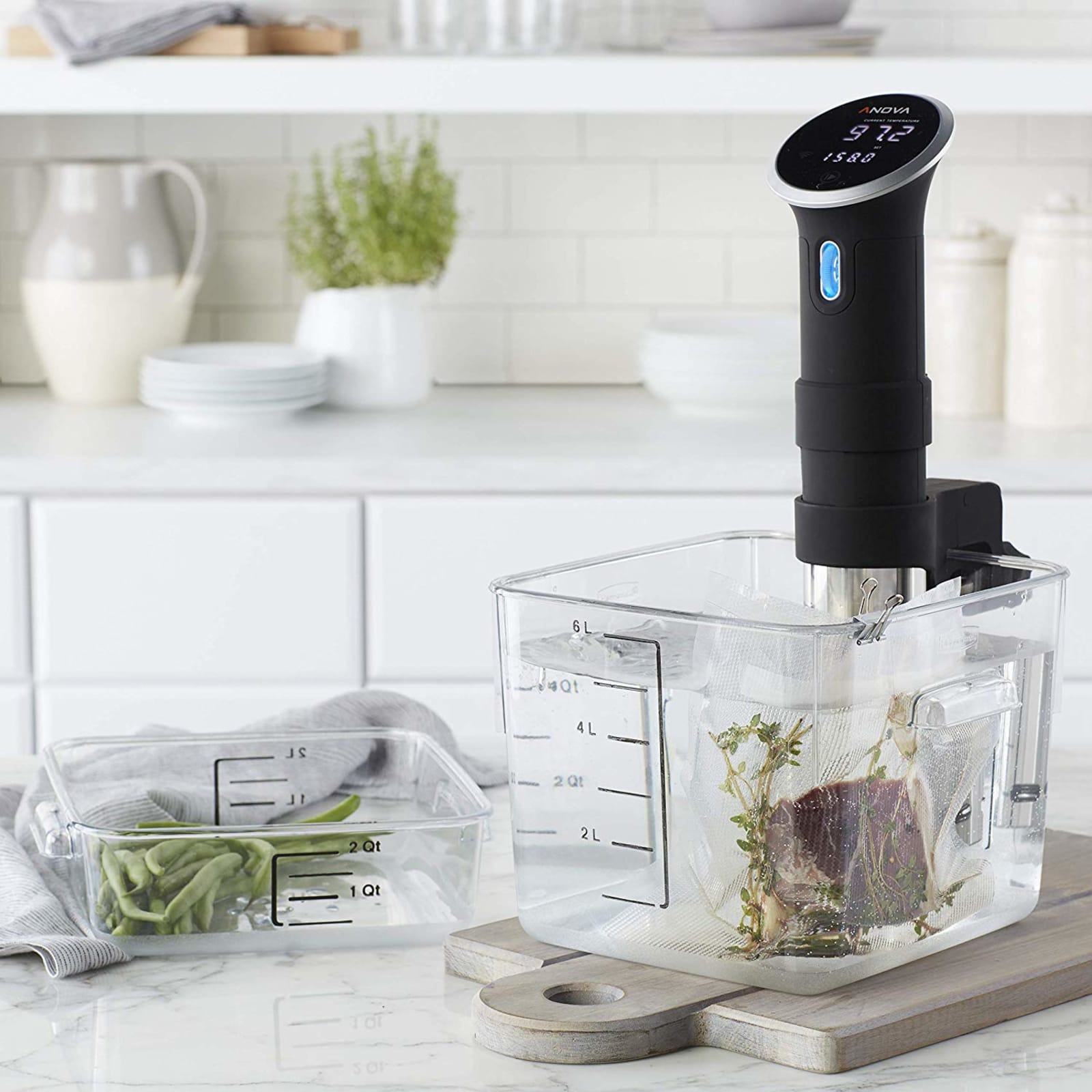
At a minimum, the other items you need to cook sous vide are a large metal pot (big enough to fill with water) and zipper-lock freezer bags to put the food in. Alternatively, you can use reusable silicone bags such as these from Stasher. Rather than using a vacuum sealer to get rid of air, you would use the water displacement method: Immerse the bagged food in the water while partially unsealed, and water pressure will push the air through the opening. Once everything is mostly underwater, you can seal the bag and it'll stay submerged.
If it still floats, you can stick one or two spoons in the bag, and that will hopefully weigh things down. (J. Kenji Lopez-Alt from Serious Eats also suggests using a large binder clip attached to the bottom of the bag along with a heavy spoon.) If you're concerned about water getting in the bag, you can attach the bag tops to the pot with binder clips, thus keeping the bag upright.
If you're really serious about sous vide, you might want to invest in some specialty equipment. Instead of pots, for example, you could opt for large restaurant-grade plastic containers by Cambro or Rubbermaid. Not only is plastic a better insulator than metal, but there's generally more space for more food, which is handy when you're cooking for a crowd.
Whether you use a pot or a plastic container, it's best to cover the vessel with plastic wrap when cooking for long periods, to keep evaporation to a minimum. Some companies, like Chefsteps, offer custom silicone pot lids that are made specially to accommodate their sous vide cookers. Alternatively, Lopez-Alt offers a much cheaper and more ingenious solution: cover your water in ping pong balls. They'll slow down evaporation.
Additionally, while zipper-lock bags work well for most tasks, it's still not a bad idea to get a vacuum sealer along with thicker plastic bags designed specifically for sous vide. For one, this lets you sous vide vegetables or braised meats, which typically require a higher temperature. (Zipper-lock bag seams might fail when it's that hot.) This also lets you freeze a bunch of food, vacuum seal them and sous vide packets straight from the freezer, which is convenient for batch cooking.
You likely already have this at your disposal, but another handy tool is a good skillet to sear your meat. That sous vide device might be able to cook your steak to medium rare, but it won't be able to brown it. A cast iron skillet, on the other hand, will. You could also consider a torch like the Bernzomatic TS8000, and we've seen others use a Searzall — but a cast iron skillet is far more affordable than either option. Of course, if you have a grill, you can use that too.
There are other miscellaneous items that could prove useful. Lopez-Alt likes having a pot lid organizer immersed in the container to help separate several submerged bags. If you want to make custard, yogurt or breakfast cups with your sous vide cooker, you should get yourself some mason jars too.
One more indispensable item worth considering: a trivet to rest your water vessel on so you don't destroy your countertop.
Sous vide recipe resources
Since affordable sous vide cookers have been in the market for a few years now, there’s no shortage of recipes and guidelines online to help you figure out what to do with your newfangled kitchen gadget. The links below are some of our favorites, though bear in mind that a lot of this is based on personal taste. Your mileage may vary.
It only makes sense that the maker of one of the most popular sous vide machines also has a deep library of sous vide recipes. If you're ever at a loss as to what to make via sous vide, simply peek at this website, where you can search for recipes from professionals and amateurs alike.
We've mentioned it several times here already in this guide, but Serious Eats truly is a remarkably useful resource for all things sous vide. Its guide to sous vide steak is a favorite among Engadget staffers, as is its take on slow-cooked sous-vide style eggs, which results in some of the best eggs I've ever had.
Years before making the Joule, Chefsteps made a name for itself as a cooking school with a heavy emphasis on food science, tech and molecular gastronomy. That's probably why the sous vide recipes from Chefsteps are some of the more creative ones we've seen. One recipe, for example, teaches you how to make that perfect chicken breast along with the perfect accompaniment for said chicken breast — perhaps a crunchy apple fennel salad and a buttery carrot puree. Other favorite recipes include wonderfully tender salmon filets, juicy pork chops and Chefsteps' own interpretation of the "sous vide egg bites" you sometimes find in certain Starbucks shops.
This is actually a cookbook from the people behind the Nomiku WiFi sous vide machine (which has since been discontinued), but the recipes in it will work with any sous vide device. Not only does it have beautiful photographs, but it also offers fantastic recipes like jerk chicken wings, duck confit and chocolate pots du creme.
Aside from immersion circulators like the ones mentioned here, you could also opt for multi-purpose appliances that offer sous vide-like functions. Several Instant Pots, for example, offer such a feature. Unfortunately, however, they do not circulate the water like the aforementioned immersion circulators, and the temperatures aren’t quite as precise (which is a definite downside if you need something cooked to a specific temperature). But if you don’t really care about that, or you just want to dabble occasionally in sous vide, this might be a viable option.
If you’re dead set on a multi-tasking appliance and you have the money to spend, consider the Anova Precision Oven. Thanks to its use of steam, you can indeed use it to cook foods via sous vide but without the need for plastic bags. It also uses a fan to circulate the moist air around the food and a probe thermometer helps keep foods at a precise temperature. And, of course, the Precision Oven can be used as a regular oven as well, and is great for baking breads and bagels. It is, however, quite expensive at $700 and takes up a lot of counter space.
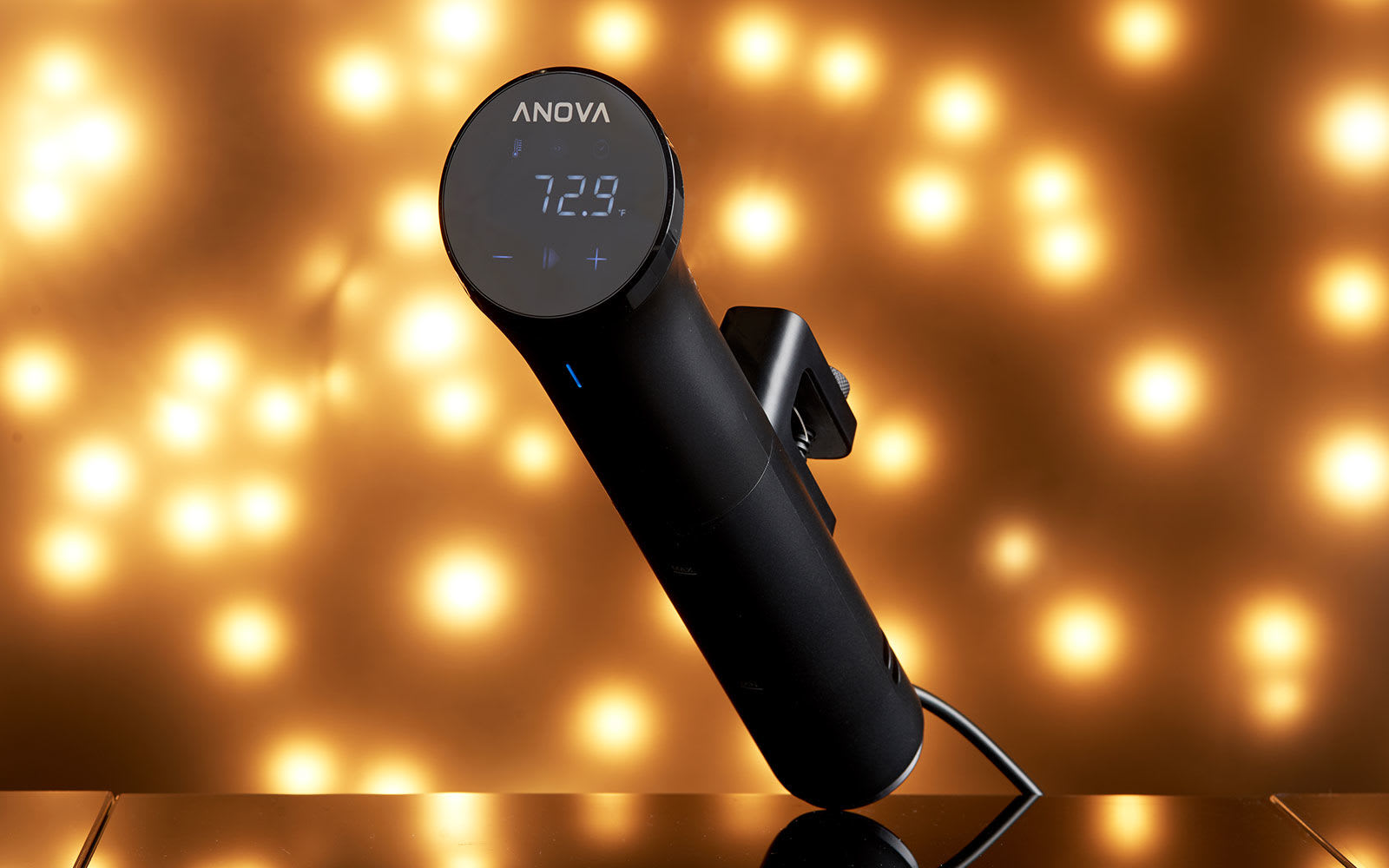
Images: Will Lipman for Engadget (Anova / holiday light background)
This article originally appeared on Engadget at https://www.engadget.com/smart-sous-vide-guide-151821790.html?src=rss