The Morning After: Apple is reportedly closer to adding no-prick glucose monitoring tech to its Watch

Bloomberg sources claim Apple’s quest for no-prick blood glucose monitoring is now at a "proof-of-concept stage" and good enough that it could come to market once it's smaller. The technology, which uses lasers to gauge glucose concentration under the skin, was previously tabletop-sized but has reportedly advanced nearer to an iPhone-sized prototype.

It’s been in the works for a long time. In 2010, when Steve Jobs headed up Apple, the company bought blood glucose monitoring startup RareLight. But no-prick monitors are a challenge. In 2018, Alphabet's health subsidiary, Verily, scrapped plans for a smart contact lens that tried to track glucose using tears.

– Mat Smith

The Morning After isn’t just a newsletter – it’s also a daily podcast. Get our daily audio briefings, Monday through Friday, by subscribing right here.

The biggest stories you might have missed

Spotify's new AI DJ will talk you through its recommendations

The DJ uses OpenAI to tell you about the songs it chooses for you.

Generative AI is absolutely everywhere right now, and that includes Spotify. Its latest feature, simply called DJ, kicks off a personalized selection of music playing that combines Spotify’s well-known personalization tools, like Discover Weekly, as well as the content that populates your home screen, all with some AI tricks. The feature rolls out today across Spotify Premium in the US and Canada.

Continue reading.

Notion's AI editor is now available to anyone who wants writing help

The company only began testing Notion AI late last year.

Last November, Notion, the popular note-taking app, began testing a built-in generative machine learning algorithm dubbed Notion AI. Now it’s ready for launch. Notion said anyone, including free users, can start using its AI-powered writing assistant. More than two million people signed up for the waitlist for the alpha version and, according to the company, most testers weren’t asking it to write blog posts and marketing emails from scratch. Instead, they were using it to refine their own writing. As a result, the company decided to “completely redesign” Notion AI to make it more “iterative and conversational.” The new version of the tool will generate follow-up prompts until you’re satisfied with its results.

Continue reading.

Twitter’s 2FA paywall is a good opportunity to upgrade your security practices

The platform could become less secure – but that doesn't mean you have to be.

Twitter announced plans to pull a popular method of two-factor authentication for non-paying customers last week. Starting March 20th, if you don’t want to pay $8 to $11 per month for a Twitter Blue subscription (hi, that’s me!), you’ll no longer be able to use text message authentication to get into your account. There are still some options to keep your account secure. Software-based authentication apps like Duo, Authy, Google Authenticator and the 2FA authenticator built into iPhones either send you a notification or, in the case of Twitter, generate a token to complete your login, or you can use hardware-based security keys that plug into devices. We walk you through the options if you want to stick around on Twitter.

Continue reading.

Uber puts a cute lil ride tracker on the iPhone lock screen

The app now supports iOS 16's Live Activities feature.

Uber

Uber has rolled out an update for its iPhone app that shows whether it's time to head out the door and meet the ride you ordered. You even get a cute car icon moving along to illustrate it. The company has launched support for Live Activities, an iOS 16 feature that puts real-time events from compatible apps on top of the lock screen and on the iPhone 14 Dynamic Island when your device is unlocked.
Continue reading.

Apple's Mac Mini M2 and M2 Pro models get their first Amazon discounts

Mac Mini computers with M2 and M2 Pro are the cheapest way to get Apple's latest processors, and now Amazon is sweetening the deal a bit more. The entry-level 256GB Mini M2 is on sale at $580 for a savings of $19 over the regular price, while the 512MB Mini M2 is $770, or $29 off. And if it's the 512 Mini M2 Pro model you're seeking, it can be found at $1,250, netting you a $49 discount. These appear to be Amazon's new normal prices, but they're less than we're seeing at Apple's Store.

Shop Mac Mini M2 and M2 Pro on Amazon

The Mac Mini is tiny but mighty, with the M2 model easily powerful enough for productivity chores and multitasking. The M2 Pro, meanwhile, is a low-key content creation demon, beating the Mac Studio's M1 Max version and on par with the MacBook Pro 14-inch with M2 Max.  

On top of that, you get killer connectivity, with two Thunderbolt 4 USB-C connections, HDMI 2.0 (with 4K 240Hz and 8K 60Hz output), two USB-A ports, a headphone jack and gigabit Ethernet (upgradeable to 10 gigabit). The M2 Pro model adds two additional USB-C ports, making it even more useful for creatives with a ton of accessories.

The Mac Mini M2 won't replace your gaming machine, but it can handle nearly everything else you throw at it. We wouldn't recommend the overpriced storage or RAM upgrades either, as the M2 is much more efficient with RAM than typical PCs. Still, if you're looking for a cheap but powerful Mac, this is the way to go. 

Raspberry pi project directory

Raspberry pi project directory Utkarsh Dafe Thu, 02/23/2023 - 15:50

Can you please provide us the link to download the project directory for age and gender detection using raspberry pi? The link you had provided is not working.


James Webb telescope captures ancient galaxies that theoretically shouldn't exist

The James Webb Telescope has been giving us clearer views of celestial objects and exposing hidden features since it became operational last year. Now, according to a study conducted by an international team of astrophysicists, it may also completely change our understanding of the cosmos. 

Upon looking at images taken by the telescope near the Big Dipper, the scientists found six potential galaxies that formed just 500 to 700 million years after the Big Bang. That they could be almost 13 billion years old wasn't what makes them odd, though, it's that they could have as many stars as the Milky Way according to the team's calculations. The scientists explained that they should not exist under current cosmological theory, because there shouldn't be enough matter at the time for the galaxies to form as many stars as ours has. 

What the scientists saw in the images is a few fuzzy but very bright dots of light that look red to our instruments, indicating that they're old. Joel Leja, one of the authors of the study, told Space that scientists typically expect to see young and small galaxies that glow blue when peering into the ancient universe, since they appear to us as "objects which have just recently formed out of the primordial cosmic soup." (Don't forget that it takes time for light to reach Earth, so we're essentially looking back in time when we view telescopic images.) 

"We looked into the very early universe for the first time and had no idea what we were going to find. It turns out we found something so unexpected it actually creates problems for science. It calls the whole picture of early galaxy formation into question," Leja said. James Webb previously captured images of even older galaxies that formed around 350 million years after the Big Bang. But they're tiny and don't challenge our knowledge of astrophysics. 

For these six galaxies to appear old and massive means they were forming hundreds of stars a year shortly after the Big Bang. In comparison, the Milky Way only forms around one to two new stars every year. Further, these potential galaxies are about 30 times more compact in size than ours despite having as many stars. 

The scientists admit that there's a possibility that the fuzzy red dots they saw are something else, such as faint quasars or supermassive black holes. They could also be smaller in reality compared to the projected size the scientists got from their calculations. The team needs more data and to verify their findings through spectroscopy, but they think they could have official confirmation sometime next year

Samsung is readying its own smartphone-to-satellite communication platform

There was speculation that Samsung could use smartphone-to-satellite technology in its Galaxy S23 much like Apple has for the iPhone 14, but that didn't happen in the end. Now, the company has unveiled a new standardized 5G NTN (non-terrestrial network) modem that will enable two-way communication between smartphones and satellites. The technology will allow users to send and receive calls, text messages and data without the need for a cellular network, and will be integrated into Samsung's future Exynos chips.

The aim is to allow people in mountains, deserts or other remote areas to communication with others in critical situations. 5G NTN conforms to 3rd Generation Partnership Project (3GPP Release 17) standards, meaning it works with traditional communication services from chip manufacturers, smartphone makers and telecoms.

Samsung

However, Samsung indicated that the tech could eventually be used to transmit high-definition photos and even video, on top of texts and calls. It simulated the tech using its Exynos Modem 5300 platform "to accurately predict satellite locations and minimize frequency offsets caused by Doppler shift," the company said. That will help pave the way for hybrid terrestrial-NTN networks "in preparation for the arrival of 6G," said Samsung VP Min Goo Kim. 

At CES 2023, Qualcomm unveiled Snapdragon Satellite, technology that would allow smartphones to send messages when no cellular signal is available. It'll work in smartphones that have both the Snapdragon 8 Gen 2 chipset and X70 modem system, plus some additional radios. Since Samsung's Galaxy S23 has both chips, it was thought the device may offer satellite communication technology to match Apple's iPhone 14. 

However, Samsung mobile experience VP TM Roh said it wasn't the best moment, as satellite functionality is still fairly limited. "When there is the right timing, infrastructure and the technology is ready, then of course for Samsung Galaxy, for our mobile division, we would also actively consider adopting this feature as well," he told CNET in an interview.

The Roland SH-4d is a groovebox disguised as a synthesizer

A lot of Roland's recent instruments, that aren't just rehashes of classic gear, take an "everything and the kitchen sink" approach. Sampling and drum synthesis? Why not. Presets numbering in the thousands — plural? Of course! A dedicated vocal effect section and phantom power for running a condenser mic? Would be silly not to. The SH-4d follows the same basic formula, it has basically any feature you could want, and few you wonder who would want them, but sticks it in a box focused synthesis and sound design (mostly).

Unlike most of Roland's newer fare though, the SH-4d has plenty of hands-on controls. There's a full two octave keyboard, 16-step sequencer buttons, four faders and 32 knobs. It even has motion controls for some reason — You can actually pick up the synth and tilt it to change parameters. I'm not sure what the appeal of that is, but you know what, I'm just glad to see Roland adding controls instead of stripping back more.

Under the hood is a robust sound engine with 11 oscillator types, ranging from emulations of classic analog sounds from Juno-106 and SH-101, to metallic FM tones, PCM samples and 31 different wavetables. There's a multi-mode filter, an amp envelope, and LFO and a multi-effects engine with 93 different options, including nine reverb types and five choruses. The 128 x 64 LED screen isn't the sharpest, but it's definitely an improvement on the somewhat archaic seeming displays on the Verselab and TR-6S

Based on the demo clips, it seems like the instrument is leaning heavily into Roland's legacy as a cornerstone of techno, house and other electronic dance music. But it's it will likely be versatile enough to work for other genres as well. As long as you're pairing it with other instruments.

But the SH-4d doesn't stop at sound design. There's also a five track, 64-step polyphonic sequencer with motion recording and three different playback modes. The first four tracks can control any of the 11 oscillator models, The fifth is a dedicated rhythm track that can play back a selection of 439 different samples and virtual analog waves. 

The sequencer and rhythm section turn the SH-4d into more of a groovebox than a synth, which has kind of been Roland's specialty over these last few year. But its interface definitely screams synthesizer, which is a welcome change from the menu-divey affairs the company has been pumping out recently. 

At nearly four pounds and over a foot wide, not to mention almost eight inches deep, the SH-4d isn't super portable, but it can be powered four AA batteries none the less. You can also power it with a standard USB-C charger like you might use for your phone, which is nice. Plus, at least you know it won't eat up too much desk space. The Roland SH-4d will be arriving sometime in March for $650.

Uber puts a ride tracker on the iPhone lock screen

Uber has rolled out an update for its iPhone app that gives you the capability to see at a glance whether it's time to head out the door and meet the ride you ordered. The company has launched support for Live Activities, an iOS 16 feature that puts real time events from compatible apps on top of the lock screen and on the iPhone 14 Dynamic Island when your device is unlocked. 

Uber's take on Live Activities is a window that includes the live progress of a ride, its latest estimated time of arrival and the trip status, such as whether your driver is already waiting for you and if the ride has been completed. It also shows the vehicle type and the license plate number of the ride you're waiting for. As MacRumors notes, Apple announced that Uber would support Live Activities at WWDC last year, and the feature has been in testing in select regions over the past months. This is a wide release that gives you access to the feature anywhere in the world. A company spokesperson also told the publication that the Uber Eats app will support Live Activities in the coming months.

In addition to Live Activities, Uber has updated its app to simplify the homescreen experience, as well. It has a new Services tab where you can find all of the company's services available in your city, as well as a new Activity Hub that tracks past and upcoming rides and Eats orders. 

Mercedes-Benz's next-generation car OS is built around paid software bundles

Mercedes-Benz is developing a new in-house operating system to power its next generation of electric vehicles. Announced today at an event the automaker held in California, Mercedes said MB.OS – short for Mercedes-Benz Operating System – will deliver enhancements in safety, automated driving and navigation.

The automaker is working with several partners to build its new software stack, including NVIDIA, Luminar and Google. Mercedes will lean on NVIDIA for the company’s software, data and AI expertise. The GPU maker's Orin chipset will also power the first generation of electric cars Mercedes builds based on its upcoming Mercedes Modular Architecture (MMA) platform. The automaker expects the first MMA EV to arrive by mid-decade.

Mercedes-Benz

As for Luminar and Google, the former will provide Mercedes with its LiDAR technology, while the latter will work with the company to build a branded navigation experience incorporating features from Google Maps. In the meantime, Mercedes is partnering with Google to bring the company’s “Place Details” data to all cars that sport the latest version of its MBUX infotainment system. You can use the integration to look up a local business, find out when it opens, and see photos of the inside and what other Google users have to say about it. Mercedes plans to open MB.OS to other partners as well, including TikTok, Zoom and even Angry Birds developer Rovio.

All MMA EVs will ship with the hardware needed for Level 2 automated driving. Mercedes is also working with NVIDIA and Luminar to offer Drive Pilot, a Level 3 automated driving system. The software will arrive later this year in 2024 EQS and S-Class models. Naturally, MB.OS will also enable Mercedes to deliver over-the-air updates, allowing it to add new features to existing cars.

The company isn’t shy about the fact that some upgrades may cost a one-time fee or come as part of a subscription package. In fact, Mercedes has already announced a handful of software bundles it will offer to owners of cars with MB.OS. MB.Connect, for instance, will bring together the company’s navigation, entertainment and communication features in one package. Other bundles, such as MB.Charge, will provide customers with priority access to Mercedes-Benz charging stations. The automaker says it will allow drivers to explore and buy upgrades for their Benz online, through the Mercedes mobile app and directly from the car.

“The company is confident that this strategic approach to software and hardware development will be the basis for lifetime revenues as well as additional contributions,” Mercedes said, adding it expects software revenue from bundles like MB.Connect to contribute “a low-to-mid single-digit billion euro figure” to its bottom line by mid-decade.

FCC chair proposes rules to reduce scam robotexts

The chair of the Federal Trade Commission has proposed new rules to tackle the scourge of text message scams. If the agency's commissioners approve the rules at a meeting in March, providers would have to block robotexts that are "highly likely to be illegal," chair Jessica Rosenworcel said in a statement.

The FCC has yet to publish the full text of Rosenworcel's proposal. If adopted, it will force providers to block text messages that appear to be from numbers on a do-not-originate list. They include unused, invalid and unallocated numbers, as well as those that government agencies and "other well-known entities" say they don't send texts from. Messages from these numbers "are highly likely to be illegal and no consumer would want to receive them," an FCC statement reads.

Moreover, providers would have to block texts from entities that the FCC flags for sending illegal robotexts. The proposed rules state that providers would additionally need to expand National Do Not Call Registry protections to include texts to prevent consumers from receiving unwanted marketing messages.

“Missing packages that don’t exist; confirmation of payments that didn’t happen; links to shady websites; and truncated ‘wrong number’ messages from strangers. These scam robotexts are a part of everyday life for too many of us,” Rosenworcel said. “I’m asking my colleagues to join me in adopting the first FCC rules to focus on shutting down scam texts. But we’re not stopping here. Because we are going to keep at it and develop more ways to take on this growing consumer threat.”

The robotext proposal follows measures the FCC has taken to stamp out robocalls. Both issues are on the agenda for the FCC's open meeting next month, along with other items like a proposed framework "for increased collaboration between terrestrial mobile network operators and satellite service providers" to bolster phone service in areas where it is lacking. That could could come in useful for life-or-death situations in remote areas. Certain devices, such as the iPhone 14, now offer satellite connectivity for emergency use.

Digital Replica of Antique Weather Monitoring Instrument

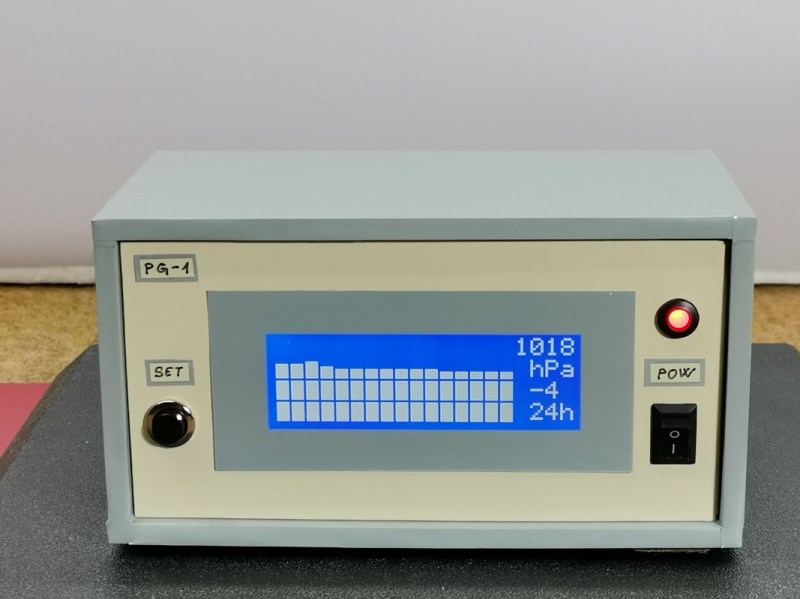
Computers and digital sensors have allowed for the collection and aggregation of data barely possible to imagine to anyone in the instrumentation scene even sixty years ago. Before that, things like weather stations, seismometers, level sensors, and basically any other way of gathering real data about the world would have been performed with an analog device recording the information on some sort of spool of paper. This was much more tedious but the one thing going for these types of devices was their aesthetic. [mircemk] is back to bring some of that design inspiration to a digital barometric display.

The barometer is based around an Arduino Arduino Nano and a relatively large I2C display to display the captured data. It also uses a BME 280 pressure sensor board, but the technical details of this project are not the focal point here. Instead, [mircemk] has put his effort in recreating the old analog barographs, which display barometric data on a spool of paper over time, on the I2C display. As the device measures atmospheric pressure, it adds a bar to the graph, displaying the data over time much as the old analog device would have.

We’ve discussed plenty of times around here that old analog meters and instrumentation like this recreation of a VU meter are an excellent way of getting a more antique aesthetic than is typically offered by digital replacements. Adding in a little bit of style to a project like this can go a long way, or you can simply restore the original antique instead.

Hack a Day 22 Feb 21:00