Blue Origin pins last summer's NS-23 rocket failure on a faulty engine nozzle

Blue Origin now has an explanation for the booster failure that cut a New Shepard flight short last September. Jeff Bezos' company has determined that a "thermo-structural failure" in the NS-23 rocket's engine nozzle was to blame. Operational temperatures for the nozzle climbed higher than expected following cooling system design changes, creating fatigue that misaligned the thrust and activated the crew capsule's escape system.

Engineers are already taking "corrective actions" that include redesigning the combustion chamber and operating conditions. Blue Origin has also tweaked the nozzle design to improve its structural integrity. The capsule wasn't damaged and will fly again, Blue Origin says.

The company says it hopes to resume flights "soon," but hasn't provided an exact date. It intends to restart operations by re-flying the research payload from the aborted mission. The Federal Aviation Administration has to accept the incident findings before Blue Origin can move forward.

There's plenty of pressure on Blue Origin to address the issues. The company recently obtained a NASA contract to fly a science mission to Mars using its yet-to-launch New Glenn rocket, and has been pushing for a lunar lander agreement. The sooner Blue Origin can prove that its rocketry is trustworthy, the sooner it can secure customers that include governments and space tourists.

Rivals are facing problems of their own. Relativity Space's first 3D-printed rocket failed to reach orbit earlier this month. SpaceX, meanwhile, has yet to successfully fire all of Starship's engines at the same time. That's not including past problems like Rocket Lab's setbacks. Private spaceflight remains difficult, and Blue Origin is just the latest to illustrate that fact.

This article originally appeared on Engadget at https://www.engadget.com/blue-origin-pins-last-summers-ns-23-rocket-failure-on-a-faulty-engine-nozzle-195714293.html?src=rss

Levi’s will ‘supplement’ human models with AI-generated fakes

Levi’s is partnering with an AI company on computer-generated fashion models to “supplement human models.” The company frames the move as part of a “digital transformation journey” of diversity, equity, inclusion and sustainability. Although that sounds noble on the surface, Levi’s is essentially hiring a robot to generate the appearance of diversity while ridding itself of the burden of paying human beings who represent the qualities it wants to be associated with its brand.

Levi Strauss is partnering with Amsterdam-based digital model studio Lalaland.ai for the initiative. Founded in 2019, the company’s mission is “to see more representation in the fashion industry” and “create an inclusive, sustainable, and diverse design chain.” It aims to let customers see what various fashion items would look like on a person who looks like them via “hyper-realistic” models “of every body type, age, size and skin tone.”

Levi’s announcement echoes that branding, saying the partnership is about “increasing the number and diversity of our models for our products in a sustainable way.” The company continues, “We see fashion and technology as both an art and a science, and we’re thrilled to be partnering with Lalaland.ai, a company with such high-quality technology that can help us continue on our journey for a more diverse and inclusive customer experience.”

Lalaland.ai

Levi’s claims, “AI will likely never fully replace human models for us” (note the qualifying “likely”). But I can’t help but see this as the first step in a dystopian slow walk toward automating the industry. As AI-generated “photography,” art and writing grow ever more convincing, we would be naive to take corporations at face value when they insist moves like this are about PR-friendly principles like celebrating diversity and looking out for the environment. At the very least, it’s awfully convenient that those high-minded motives also let them mass-produce something that previously required hiring people.

Levi Strauss reportedly began a 12-to-19-month process of cutting around 800 jobs — almost 20 percent of its corporate workforce — last year. It was part of a restructuring plan to save about $75 million to $100 million annually.

This article originally appeared on Engadget at https://www.engadget.com/levis-will-supplement-human-models-with-ai-generated-fakes-190011557.html?src=rss

France bans TikTok (and Candy Crush) from government phones

It's no shock to see another country banning TikTok from government phones, but France is taking the restrictions a step further. Le Mondereports the French government is banning "recreational" apps like TikTok, Twitter, Netflix and even Candy Crush from public servants' devices. The apps represent cybersecurity risks that could jeopardize data for both the employees and the administration, according to the office of public service minister Stanislas Guerini.

The government hasn't provided an exact list of banned apps. However, Guerini said certain there could be some exceptions for the sake of necessary communication. This won't prevent a social media team from posting content, in other words. The ban takes effect immediately, but the penalties for defying the rule can be decided at the "managerial level," Guerini's office says. The approach doesn't affect personal devices.

The clampdown comes after the US federal government, dozens of states, Canada, the European Commission and the UK have banned TikTok on their workers' devices. In those cases, the rationale has been similar: officials are worried the Chinese government could collect data about important individuals, spread propaganda and compel ByteDance (TikTok's parent company) to hand over sensitive information.

TikTok has repeatedly denied collaborating with the Chinese government. In testimony before a House committee yesterday, CEO Shou Chew said ByteDance was "not an agent of China" and that American user data wouldn't be accessible to staff in other countries by the time a migration project wraps up later this year.

The French policy, however, isn't aimed at any one country or app category. Instead, it represents a general concern that entertainment apps may put government data at unnecessary risk. That's not so hot for employees hoping to watch Netflix during lunch, but it may reassure politicians worried employees might inadvertently expose info through their social media accounts.

This article originally appeared on Engadget at https://www.engadget.com/france-bans-tiktok-and-candy-crush-from-government-phones-170434409.html?src=rss

OpenAI says a bug leaked sensitive ChatGPT user data

OpenAI was forced to take its wildly-popular ChatGPT bot offline for emergency maintenance on Tuesday after a user was able to exploit a bug in the system to recall the titles from other users' chat histories. On Friday the company announced its initial findings from the incident.

In Tuesday's incident, users posted screenshots on Reddit that their ChatGPT sidebars featured previous chat histories from other users. Only the title of the conversation, not the text itself, were visible. OpenAI, in response, took the bot offline for nearly 10 hours to investigate. The results of that investigation revealed a deeper security issue: the chat history bug may have also potentially revealed personal data from 1.2 percent of ChatGPT Plus subscribers (a $20/month enhanced access package). 

"In the hours before we took ChatGPT offline on Monday, it was possible for some users to see another active user’s first and last name, email address, payment address, the last four digits (only) of a credit card number, and credit card expiration date. Full credit card numbers were not exposed at any time," the OpenAI team wrote Friday. The issue has since been patched for the faulty library which OpenAI identified as the Redis client open-source library, redis-py.

The company has downplayed the likelihood of such a breach occurring, arguing that either of the following criteria would have to be met to place a user at risk:

- Open a subscription confirmation email sent on Monday, March 20, between 1 a.m. and 10 a.m. Pacific time. Due to the bug, some subscription confirmation emails generated during that window were sent to the wrong users. These emails contained the last four digits of another user’s credit card number, but full credit card numbers did not appear. It’s possible that a small number of subscription confirmation emails might have been incorrectly addressed prior to March 20, although we have not confirmed any instances of this.

- In ChatGPT, click on “My account,” then “Manage my subscription” between 1 a.m. and 10 a.m. Pacific time on Monday, March 20. During this window, another active ChatGPT Plus user’s first and last name, email address, payment address, the last four digits (only) of a credit card number, and credit card expiration date might have been visible. It’s possible that this also could have occurred prior to March 20, although we have not confirmed any instances of this. 

The company has taken additional steps to prevent this from happening again in the future including adding redundant checks to library calls, "programatically examined our logs to make sure that all messages are only available to the correct user," and "improved logging to identify when this is happening and fully confirm it has stopped." The company says that it has also reached out to alert affected users of the issue.

This news follows a costly public faux pas committed by Google's rival Bard AI in February when it incorrectly assured Twitter that the JWST was the first telescope to image an exoplanet, as well as revelations that CNET had surreptitiously used generative AI to write financial explainer posts (a week before laying off a sizable chunk of its editorial department). Whether OpenAI will suffer the same market-based repercussions as its competitors remains to be seen. 

This article originally appeared on Engadget at https://www.engadget.com/openai-says-a-bug-leaked-sensitive-chatgpt-user-data-165439848.html?src=rss

The next game from the makers of ‘Genshin Impact’ arrives in April

The next game from the makers of Genshin Impact has a release date. Honkai: Star Rail — a turn-based, space-fantasy, tactical RPG — arrives on April 26th. In addition to previously announced PC and mobile availability, developer HoYoverse announced today that a PlayStation (PS5 / PS4) version is coming “later.”

Although much is unknown about Honkai: Star Rail, we do know it trades in Genshin Impact’s Breath of the Wild type of open-world action for turn-based combat. Based on its trailers, it looks like a visual spectacle with an anime-esque art style and a cast of memorable characters. 

The story, set in the same universe as Honkai Impact 3rd, follows a protagonist with an implanted Stellaron (mysterious life forms that respond to the world’s desire to advance) on a quest to discover the truth about the “Cancer of All Worlds.” It begins at a tutorial level on Herta Space Station before moving on to snow-covered Jarilo-VI and other diverse worlds.

The free-to-play game will use gacha (item and character-based loot boxes) for monetization. It’s rated T for Teen and will be available for PC (standalone installation or the Epic Games Store), iOS and Android. That PS5 / PS4 version will arrive at an unknown later date.

This article originally appeared on Engadget at https://www.engadget.com/the-next-game-from-the-makers-of-genshin-impact-arrives-in-april-165030309.html?src=rss

Twitter may let you hide the fact you pay to use Twitter

Do you like the features that come with Twitter Blue, but not the image it conveys of an Elon Musk superfan? There might be a solution in the near future. As Boing Boingnotes, developer Alessandro Paluzzi claims to have spotted Twitter testing an option to hide the Blue checkmark on your profile. Unless you write a very long tweet or otherwise flaunt Blue-only features, other users might never know that you're paying for perks. You'd still need to verify your government ID to use the features.

Twitter isn't available for comment as it disbanded its communications team after Musk's purchase. The test comes as Twitter says it will start removing legacy verified checkmarks on April 1st. In November, Musk called legacy checkmarks "corrupt" and said the social network would remove them in the months ahead. 

#Twitter keeps working on the ability to control everything related to account verification and identity by adding the option to show or hide your blue checkmark on your profile 👀 pic.twitter.com/6uTjBON21N

— Alessandro Paluzzi (@alex193a) March 21, 2023

There are reasons you might want to hide the checkmark besides humility or embarrassment, of course. You may not want to give the impression that your tweets represent the views of your employer. And if you share the same name as a celebrity, you might not want to risk confusing users.

There's no guarantee Twitter will make the checkmark-hiding option widely available. If the company presses ahead, though, this might (further) diminish the value of the blue tick by making it inconsistently visible. On top of this, Twitter now has gold and grey checkmarks for business and government accounts respectively — those are the true upper-echelon badges.

This article originally appeared on Engadget at https://www.engadget.com/twitter-may-let-you-hide-the-fact-you-pay-to-use-twitter-160015039.html?src=rss

Apple's AirPods Pro drop back to $200, plus the rest of the week's best tech deals

It's Friday, which means it's time for another roundup of notable discounts on good tech. Among the highlights, Apple's AirPods Pro are back down to $200, tying the best price we've seen for the iPhone-friendly noise-cancelling earphones. Amazon has dropped the Kindle Paperwhite down to $100, which is $5 above that e-reader's all-time low, while Samsung is running another sale on various storage devices. We're also seeing discounts on Anker USB-C chargers, Asus' ROG Zephyrus G14 gaming laptop and Apple's AirTags, among others. Here are the best tech deals from this week that you can still get today.

Apple AirPods Pro

Apple's AirPods Pro are once again down to $200, which is a deal we've seen a few times before but still matches the lowest price we've tracked. We gave these noise-canceling earphones a review score of 88 last year and they're currently the "best for iOS" pick in our guide to the best wireless earbuds. While their battery life and call quality could be better, the AirPods Pro still deliver a good, mostly neutral sound profile, impressive noise cancellation and a host of features that make them easy to use with other Apple devices.

Amazon Kindle Paperwhite

Amazon's Kindle Paperwhite is back down to $100, which is $5 more than the e-reader's all-time low but still $40 off its typical going rate. The Paperwhite itself remains a strong value, with a sharp and relatively spacious 6.8-inch e-ink display, a light and waterproof design with a USB-C port, a smooth front lighting system that keeps the screen easy on the eyes and access to Amazon's massive e-book library. 

We gave the "Signature Edition" of the Paperwhite a review score of 97 in late 2021. That model includes more storage space (32GB instead of 8GB), Qi wireless charging support and a slightly improved front light, but it's otherwise identical to the Paperwhite, and its upgrades probably aren't worth the extra cost for most.

It might be worth paying a little bit extra for the Kindle Paperwhite Kids, however, which is currently on sale for $110. That variant is marketed towards children, but it comes with the same hardware, plus a case and a longer two-year warranty. If you are buying for a kid, it also includes a year of Amazon's Kids+ content service. This model is about $45 off its typical street price as of this writing.

Anker 715 USB-C Charger

While not an all-time low, this deal brings Anker's highly compact 715 Charger about $10 below its usual street price. This is a travel-friendly USB-C charger capable of delivering 65W of power, which is enough to charge many phones, tablets and even smaller laptops at full speed. Just note that it only has one port; if you often need to charge multiple devices at once, consider Anker's 736 Charger, a three-port, 100W charger that's currently down to a new low of $52.49. 

Samsung Evo Select

A range of Samsung storage gear is on sale this week. For one, Samsung's Evo Select is a U3- and V30-rated microSD card that's plenty quick for most casual needs, be it handling 4K video or expanding a Nintendo Switch's storage. It's backed by a 10-year limited warranty as well. The 128GB and 512GB models are down to $12.49 and $40, respectively, both of which represent all-time lows.  

Samsung 980 Pro SSD

Next up, the 980 Pro is a speedy PCIe 4.0 SSD that's suitable for a modern gaming PC or expanding the storage of a PlayStation 5. Its 1TB model is on sale for $80, which is an all-time low. If you need a higher capacity, the 2TB model is a couple dollars above its lowest price at $160. 

If you're buying for a PS5 specifically, note that you'll have to pair the drive with a heatsink. For those willing to pay a bit extra for a simpler setup, Samsung sells a version of the 980 Pro with an integrated heatsink, the 1TB model of which is currently down to $100. Either way, it's worth making sure the drive's firmware is up-to-date, as some users previously reported issues with certain Samsung drives that have since been fixed.

Although the 980 Pro is technically an older model in Samsung's lineup, not everyone needs the speed increase of a PCIe 4.0 drive for everyday PC use. For those people, SK Hynix's Gold P31 is a well-reviewed, power-efficient option among PCIe 3.0 drives, and its 1TB model is about $35 off its usual going rate at $72. For those upgrading an older PC from a slow HDD, meanwhile, Crucial's MX500 is a 2.5-inch SATA drive we recommend; that one's 4TB model is currently down to an all-time low of $215.

Samsung T7 Shield

Finally, Samsung's T7 Shield is a more ruggedized version of the top portable drive pick in our guide to the best SSDs. It's not the absolute fastest portable drive you can buy, with read/write speeds rated up to 1,050/1,000 MB/s, but it should be fast enough for most needs, and its rubberized, IP65-rated exterior should help it survive frequent travel. Both the 1TB and 2TB models are down to all-time lows at $80 and $140, respectively.

WD My Passport Portable SSD

If you don't specifically need a ruggedized portable SSD, WD's My Passport drive will get you slightly faster read and write speeds, plus a longer five-year warranty. (The T7 Shield comes with a three-year warranty.) This drive's 1TB and 2TB variants are both down to all-time lows, at $85 and $138, respectively. If those happen to run out of stock, SanDisk's Extreme Portable SSD is a very similar performer; it's down to a low of $90 for a 1TB model and $140 for a 2TB model.

Apple iPad

Apple's 10.2-inch iPad is back down to $250 at Target, which matches the tablet's all-time low and represents a roughly $25 discount from its usual street price. This is the budget pick in our guide to the best iPads, and we gave it a review score of 86 back in 2021. Its thick bezels, non-laminated display and lack of a USB-C port give a much more dated look than other iPads, but for casual use, it's still quick and comfortable enough. As a bonus, it's also the last iPad to have a headphone jack. 

If you want a more modern design, the 10.9-inch iPad is also back to an all-time low of $400. That one still lacks a laminated display and support for Apple's best keyboard and Pencil stylus, but it feels much more like an iPad Air, and its landscape-oriented webcam is far more convenient for video calls. We gave this model a review score of 85 last October.

Amazon Echo Show 8

Amazon's Echo Show 8 is on sale for $75, which is $5 more than the all-time low we saw during the holiday season but still about $20 less than the 8-inch smart display's usual street price. We gave the Echo Show 8 a review score of 87 when in launched in 2021, and we currently recommend it as the best smart display for Alexa users in our guide to the best smart home gadgets. If you have a bunch of smart home devices that make use of Amazon's voice assistant, this is still the best blend of size, price and performance in the Echo Show lineup. If you aren't beholden to Alexa, though, note that Google's Nest Hub will naturally play better with Google services like Gmail, Google Calendar and YouTube.

Apple Watch SE

The Apple Watch SE is a stripped-down but less expensive variant of the Apple Watch Series 8, the top pick in our guide to the best smartwatches. We gave the latest model a review score of 89 last September, calling it "the best smartwatch $250 can buy," but right now the 40mm variant is on sale for $220, which is within a dollar of the device's all-time low. 

Compared to the Series 8, the SE has a slightly smaller display that isn't always-on, and it lacks premium features like an ECG monitor, skin temperature sensor and blood oxygen sensor. It runs on the same processor, however, and it can still do all the core functions expected of an Apple Watch, including heart-rate monitoring, notifications and fall detection. If you're buying a smartwatch for the first time, or if you're upgrading from an older Apple Watch and want to save some cash, the SE is a superb value. Just remember that this is an iPhone-only affair.

Apple Mac Mini M2

A configuration of Apple's recently refreshed Mac Mini with an M2 chip, 8GB of RAM and a 512GB SSD is on sale for $700, which is $100 off Apple's list price and an all-time low. We gave the variant with a beefier M2 Pro chip a review score of 86 in January; this model won't be as powerful as that, but it's still a good buy for those who only need a macOS desktop for everyday web browsing and lighter work. The Mac Mini itself is still compact and quiet, while this model gets you two Thunderbolt 4 ports, two USB-A ports, an HDMI port, an Ethernet jack and a headphone jack. As always, you can't upgrade the Mac Mini's internals after you buy it, so it's likely worth buying a model with more RAM, storage or that M2 Pro chip if you plan on doing development work or heavy media editing and must have this smaller form factor.

Asus ROG Zephyrus G14

Asus' ROG Zephyrus G14 is the top pick in our guide to the best gaming laptops, and a configuration with a Ryzen 9 6900HS CPU, Radeon RX 6700S GPU, 14-inch 120Hz display, 1TB SSD and 16GB of RAM and is currently down to $1,100 at Best Buy. That matches the lowest price we've seen. 

This 2022 iteration of the G14 will be on the way out in the coming months, but at this price, last year's model is still a good value for playing modern games in a QHD resolution at a solid frame rate. Like prior G14s, this is a gaming laptop that stands out for not sacrificing the "laptop" part of the equation: Its keyboard and trackpad are comfortable, it has ample ports, its battery can last around 10 hours when you aren't gaming, and at 3.6 pounds, it won't feel like a total anchor in a backpack. We gave the notebook a review score of 85 last year.

Google Pixel 7

Google's Pixel 7 remains one of the better values on the Android phone market, and right now an unlocked 128GB model is on sale for $449, which is the lowest price we've seen. We gave this 6.3-inch handset a review score of 90 last October. While there are faster flagships out there, the Pixel 7 still offers a top-tier camera, pleasing build quality, a crisp OLED display and a clean version of Android that's still due two more years of OS updates and four more years of security updates. 

Google is expected to launch a Pixel 7a phone in the next couple of months that may be very similar to this, but at this price, the Pixel 7 remains a strong value. The excellent Pixel 7 Pro, which has a larger screen and even better camera system, is also on sale for $749, though that's a price we've seen several times in recent months.

If you're looking for a Google smartwatch, meanwhile, the company's Pixel Watch is down to $299, a $40 discount that matches the lowest price we've tracked. That one has a particularly stylish design and useful health tracking features, but be warned that its battery life is lacking compared to other top wearables.

Apple AirTag (4-pack)

A four-pack of Apple's AirTag trackers is on sale for $90, which isn't an all-time low but still comes out to a $10 discount and marks the best price we've seen since the holidays. The AirTag is the "best for iPhones" pick in our guide to the best Bluetooth trackers, as it leverages Apple's extensive Find My crowd-sourcing network and ultra-wideband wireless tech to locate lost items accurately. 

Unlike similar devices from Tile or Chipolo, an AirTag annoyingly lacks a built-in adhesive or key ring hole, but there are various accessories you can buy to address that gap. It's also worth noting that bad actors have used AirTags to track people without their content, though Apple has made at least some strides toward addressing those concerns. If you use the device for its intended purpose, it should be effective. 

Follow @EngadgetDeals on Twitter and subscribe to the Engadget Deals newsletter for the latest tech deals and buying advice.

This article originally appeared on Engadget at https://www.engadget.com/apples-airpods-pro-drop-back-to-200-best-tech-deals-this-week-154133672.html?src=rss

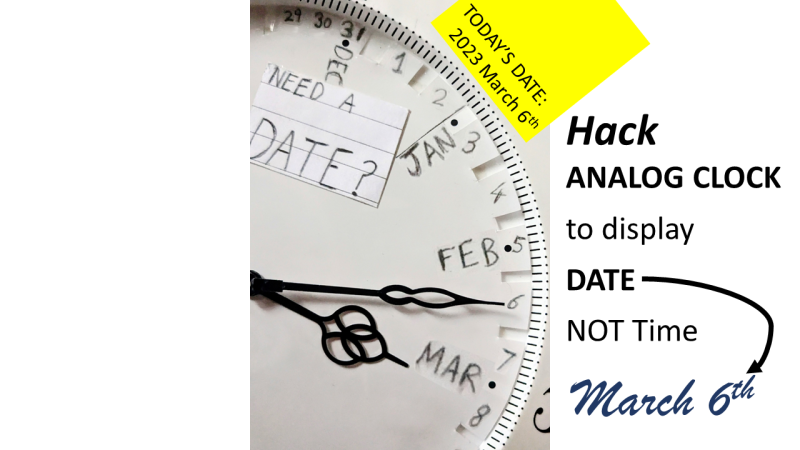
Low-Power Challenge: Making an Analog Clock Into a Calendar With a 50-Year Life

You have to be pretty ambitious to modify a clock to run for 50 years on a single battery. You also should probably be pretty young if you think you’re going to verify your power estimates, at least in person. According to [Josh EJ], this modified quartz analog clock, which ticks off the date rather than the time, is one of those “The March of Time” projects that’s intended to terrify incentivize you by showing how much of the year is left.

Making a regular clock movement slow down so that what normally takes an hour takes a month without making any mechanical changes requires some clever hacks. [Josh] decided to use an Arduino to send digital pulses to the quartz movement to advance the minute hand, rather than let it run free. Two pulses a day would be perfect for making a 30-day month fit into a 60-minute hour, but that only works for four months out of the year. [Josh]’s solution was to mark the first 28 even-numbered minutes, cram 29, 30, and 31 into the last four minutes of the hour, and sort the details out in code.

As for the low-power mods, there’s some cool wizardry involved with that, like flashing the Arduino Pro Mini with a new bootloader that reduces the clock speed to 1 MHz. This allows the microcontroller and RTC module to run from the clock movement’s 1.5 V AA battery. [Josh] estimates a current draw of about 6 μA per day, which works out to about 50 years from a single cell. That’s to be taken with a huge grain of salt, of course, but we expect the battery will last a long, long time.

[Josh] built this clock as part of the Low-Power Challenge contest, which wrapped up this week. We’re looking forward to the results of the contest — good luck to all the entrants!

Amazon sale knocks the Kindle Paperwhite down to $100

If you're on the market for a new e-reader, Amazon's latest discounts on Kindles may have exactly what you've been looking for at a lower-than-expected price. Key among the sale items is the Kindle Paperwhite, which is down to $100. That's only $5 more than its record-low price, and it's the same price as the standard Kindle, which doesn't have as many extra features as the Paperwhite.

While we did not review the Paperwhite, we did test the Paperwhite Signature Edition, which is only different thanks to its auto-adjusting front light, higher storage capacity and its wireless charging capabilities. You should get a very similar experience going with the regular Paperwhite, and it should be a great one. The latest version of Amazon's ubiquitous e-reader has a 6.8-inch, 300 ppi glare-free screen with 17 front LEDs, including a new adjustable warm light that will make it easier to read in dark environments (and after a full day of staring at a computer screen).

The design of the Paperwhite hasn't changed drastically over the years, but Amazon has refined it. This model's screen is flush with its bezels, giving it a cleaner look, and it's also IPX8-rated, so it won't be in danger if it takes an accidental dunk in the pool or bathtub. This Paperwhite also has Audible support, so if you have audiobooks through the Amazon-owned outlet, you can listen to them directly from your Kindle as long as you have a pair of Bluetooth headphones to do so.

It's worth mentioning that the Kids version of the Paperwhite is also on sale for $110, and we sometimes recommend this model even for adults. You're getting the same hardware as the non-kids model, along with a longer warranty and a protective case. The Kids version is also touted to have no ads, but that's only if you stick to the kid-friendly UI that's preinstalled on the e-reader.

Also included in this sale is the new Kindle Scribe, which is down to a new all-time-low price of $290. The Scribe is Amazon's first jump into the e-ink tablet space, and the model on sale includes 16GB of storage and a basic pen. As a tablet, the Scribe is a basic but fairly well-executed device: there's little to no latency when writing on the display, there are a decent number of brush options to choose from and you can organize multiple notebooks pretty easily. As an e-reader, it's a little on the large size with its 10.3-inch display, but the screen is crisp and responsive and we like the wider side bezel that makes the device easier to grip.

You can't actually take notes in the margins of Kindle books on the Scribe, but you can add sticky notes to your books and jot down ideas that way. And if you like the idea of keeping your notes on the same device that holds most of your reading material, the Scribe will be a good option for you. That goes for those who have big Kindle e-book libraries, but also those who have PDFs and ePUBs they want to mark up, too, as the Scribe supports a number of different file types.

Follow @EngadgetDeals on Twitter and subscribe to the Engadget Deals newsletter for the latest tech deals and buying advice.

This article originally appeared on Engadget at https://www.engadget.com/amazon-sale-knocks-the-kindle-paperwhite-down-to-100-150513073.html?src=rss

UK watchdog no longer thinks Microsoft’s Activision Blizzard merger is a threat to console competition

The UK is softening its objections to Microsoft's buyout of Activision Blizzard. The Competition and Markets Authority (CMA) has revised its findings and determined that the merger won't lead to significantly reduced competition in the console space. While the evidence remains the same, the watchdog now finds that Microsoft's ownership of franchises like Call of Duty would "not materially affect" Sony's ability to compete with PlayStation systems. Microsoft could "degrade" the PlayStation's appeal, the CMA says, but Sony's platform has a strong-enough catalog that the damage would be limited.

The Authority also reconsidered its view that Microsoft might benefit from shutting out Call of Duty's PlayStation audience. More recent Microsoft data suggests the company could suffer substantial losses in "any plausible scenario" by making the game franchise Xbox-only or offering exclusive perks, according to the CMA. Not enough gamers would switch from PlayStation to Xbox to make that strategy work, in other words.

The CMA makes clear that the updated findings don't change its concerns about cloud gaming services. In February, the regulator said Microsoft represented up to 70 percent of the worldwide cloud gaming market, and completing the Activision Blizzard purchase could harm gamers who can't afford an expensive console or PC.

We've asked Microsoft and Sony for comment. Activision Blizzard tells Engadget in a statement that the CMA now has an "improved understanding" of the console market, and that Microsoft already has solutions in place for remaining issues. Activision maintains that Sony is only trying to "protect its dominance" by contesting the acquisition.

Sony has long opposed the deal and calls it a "threat to our industry" that could hurt the quality of Call of Duty on PlayStation. Microsoft has made a number of concessions in hopes of clinching the Activision Blizzard takeover, including 10-year multi-platform promises for Call of Duty as well as arrangements to bring games to rival cloud platforms.

The UK overseer's change of heart doesn't overcome resistance to the merger in other countries. The US Federal Trade Commission is still suing to block the union, and points out that Microsoft made future titles like Redfall Xbox-exclusive on consoles despite assurances to European Union officials. Objectors can also comment on the findings before the end of March. However, the new stance still improves Microsoft's chances of completing the acquisition — a major regulatory body just dropped its main point of contention.  

This article originally appeared on Engadget at https://www.engadget.com/uk-watchdog-no-longer-thinks-microsofts-activision-blizzard-merger-is-a-threat-to-console-competition-140206114.html?src=rss