The best 2-in-1 laptops for 2023

The perfect hybrid machine that’s just as good a tablet as it is a laptop still doesn’t exist. But throughout last year, companies like Microsoft, Apple and Google continued to improve their operating systems for machines that do double duty. Windows 11 has features that make it friendlier for multi-screen devices, while Android has been better optimized for larger displays. Plus, with the rise of ARM-based chips for laptops, especially Apple’s impressive M series, prospects for a powerful 2-in-1 with a vast touch-friendly app ecosystem is at an all-time high.

Even the best 2-in-1 laptops still have their limits, of course. Since they’re smaller than proper laptops, they tend to have less-powerful processors. Keyboards are often less sturdy, with condensed layouts and shallower travel. Plus, they’re almost always tablets first, leaving you to buy a keyboard case separately. (And those ain’t cheap!) So, you can’t always assume the advertised price is what you’ll actually spend on the 2-in-1 you want.

Sometimes, getting a third-party keyboard might be just as good, and they’re often cheaper than first-party offerings. If you’re looking to save some money, Logitech’s Slim Folio is an affordable option, and if you don’t need your keyboard to attach to your tablet, Logitech’s K780 Multi-Device wireless keyboard is also a good pick.

While we’ve typically made sure to include a budget 2-in-1 laptop in previous years, this time there isn’t a great choice. We would usually pick a Surface Go, but the latest model is still too expensive. Other alternatives, like cheaper Android tablets, are underpowered and don’t offer a great multitasking interface. If you want something around $500 that’s thin, lightweight and long-lasting, you’re better off this year looking at a conventional laptop (like those on our best budget PCs list).
Chris Velazco / Engadget

When you’re shopping for a 2-in-1, there are some basic criteria to keep in mind. First, look at the spec sheet to see how heavy the tablet is (alone, and with the keyboard). Most modern hybrids weigh less than 2 pounds, with the 1.94-pound Surface Pro 9 being one of the heaviest around. The iPad Pro 12.9 (2022) and Samsung’s Galaxy Tab S8+ are both slightly lighter. If the overall weight of the tablet and its keyboard come close to 3 pounds, you’ll be better off just getting an ultraportable laptop.

See Also:

You’ll also want to opt for an 11-inch or 12-inch screen instead of a smaller 10-inch model. The bigger displays will make multitasking easier, plus their companion keyboards will be much better spaced. Also, try to get 6GB of RAM if you can for better performance — you’ll find this in the base model of the Galaxy Tab S7+, while this year’s iPad Pro and the Surface Pro 8 start with 8GB of RAM.

Finally, while some convertible laptops offer built-in LTE or 5G connectivity, not everyone will want to pay the premium for it. An integrated cellular radio makes checking emails or replying to messages on the go far more convenient. But it also often costs more, and that’s not counting what you’ll pay for data. And, as for 5G — you can hold off on it unless you live within range of a mmWave beacon. Coverage is still spotty and existing nationwide networks use the slower sub-6 technology that’s barely faster than LTE.

Best overall: Surface Pro 9 (Intel)

There’s no beating the Surface series when it comes to 2-in-1s. They’re powerful, sleek tablets running an OS that’s actually designed for productivity. The Surface Pro 9 is Microsoft’s latest and great tablet, and it builds upon the already excellent Pro 8. It features speedy 12th-gen Intel CPUs and all of the major upgrades from last year, including a 120Hz display and a more modern design. It’s the best implementation of Microsoft’s tablet PC vision yet.

Don’t confuse this with the similarly named Surface Pro 9 with 5G, though, which has a slower ARM processor and inferior software compatibility. Built-in cellular is nice and all, but the Intel Pro 9 is a far better PC.

Like most of the other convertible laptops on this list, the Pro 9 doesn’t come with a keyboard cover — you’ll have to pay extra for that. That’s a shame, considering it starts at $1,000. Microsoft offers a variety of Type Covers for its Surface Pros ranging from $100 to $180, depending on whether you want a slot for a stylus. But at least they’re comfortable and well-spaced. You can also get the Surface Slim Pen 2 ($130) for sketching out your diagrams or artwork, which features haptic feedback for a more responsive experience.

Best for Apple users: 12.9-inch iPad Pro

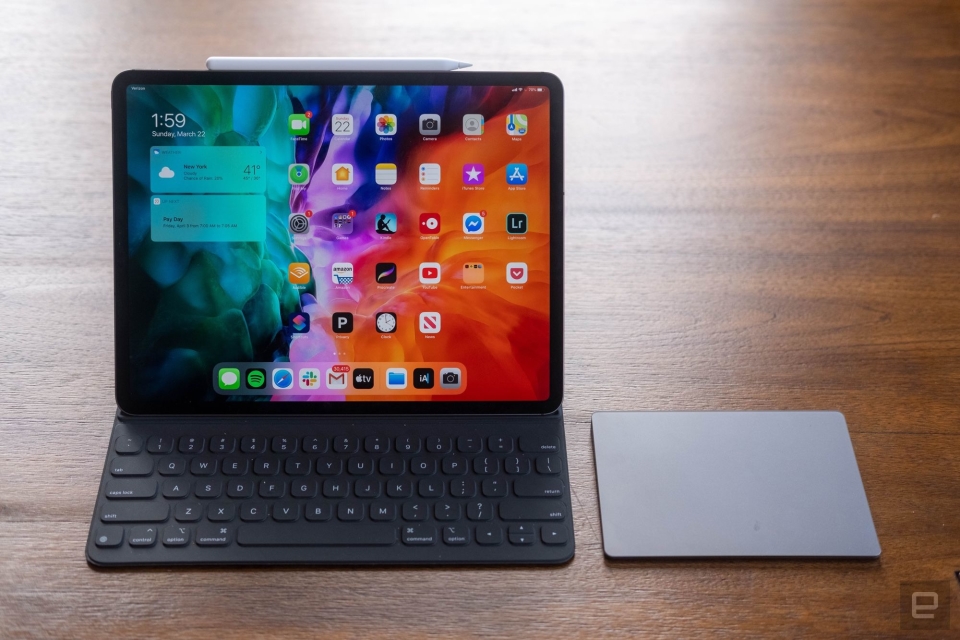
If you’re already in the Apple ecosystem, the best option for you is obviously an iPad. The 12-inch Pro is our pick. Like older models, this iPad Pro has a stunning 12.9-inch screen with a speedy 120Hz refresh rate, as well as mini-LED backlighting. This year, it includes Apple’s incredibly fast M2 chip and more battery life than ever before.

Apple’s Magic Keyboard provides a satisfying typing experience, and its trackpad means you won’t have to reach for the screen to launch apps. But it’ll also cost you an extra $300, making it the most expensive case on this list by a lot. The iPad also lacks a headphone jack and its webcam is awkwardly positioned along the left bezel when you prop it up horizontally, so be aware that it’s still far from a perfect laptop replacement. Still, with its sleek design and respectable battery life, the iPad Pro 12.9 is a good 2-in-1 for Apple users.

Best for Android users: Samsung Galaxy Tab S8+

While Windows is better than iPadOS and Android for productivity, it lags the other two when it comes to apps specifically designed for touchscreens. If you want a tablet that has all the apps you want, and only need it to occasionally double as a laptop, the Galaxy Tab S8+ is a solid option. You’ll enjoy watching movies and playing games on its gorgeous 12.4-inch 120Hz AMOLED screen, and Samsung includes the S Pen, which is great for sketching and taking notes. The Snapdragon 8 Gen 1 chip and 8GB of RAM keep things running smoothly, too.

Last year, Samsung dramatically improved its keyboard case, making the Tab an even better convertible laptop. You could type for hours on this thing and not hate yourself (or Samsung). The battery life is also excellent, so you won’t need to worry about staying close to an outlet. The main caveat is that Android isn’t great as a desktop OS, even with the benefits of Android 12L. And while Samsung’s DeX mode offers a somewhat workable solution, it has plenty of quirks.

Read our Full Review of Samsung Galaxy Tab S8+ 2-in-1 Laptop

Cherlynn Low contributed to this report.

This article originally appeared on Engadget at https://www.engadget.com/the-best-2-in-1-laptops-for-2023-155052641.html?src=rss

Google Meet now offers 1080p video calls

Google Meet is rolling out 1080p resolution to give users a crisper image on their next video call. The update brings the company in-line with its competitors, Zoom and Microsoft Teams, who already offer calls in full HD. Previously, the best quality you could get on a Google Meet video call was 720p. 

The update has limited reach, as it's web-only for now, requires a camera with 1080p capabilities and is limited to two-person meetings. It's also only available for paid Google Meet versions, such as Google Workspace Business Standard or Plus and Enterprise Starter, Standard, Plus and Essential. Google One subscribers can also access the higher resolution if they have at least 2TB of storage on their device.

Qualifying customers will have to upgrade their resolution on Google Meet manually, as it's off by default. The process is pretty simple: When you login to a new Google Meet video call, a popup will appear from the change button (labelled with three vertical dots) stating, "Let people see you in full HD" alongside information about the update. You can then choose to turn it on or dismiss the notification. Either way, you can change your resolution at any time by clicking that button, then settings, video and finally choosing from the resolution dropdown choices.

The option for higher resolution calls follows other recent Google Meet updates, like emoji reactions and automatic transcriptions

Google Meet will roll out 1080p resolution for customers with rapid release domains in the next two weeks and for those with scheduled release domains by May 19th. 

This article originally appeared on Engadget at https://www.engadget.com/google-meet-now-offers-1080p-video-calls-114023670.html?src=rss

Infineon and Schweiner join Forces to improve Silicon Carbide Automotive Solutions

Infineon and Schweiner join Forces to improve Silicon Carbide Automotive Solutions

Infineon Technologies and Schweizer Electronic are collaborating to develop a way to embed Infineon’s 1200 V CoolSiC chips directly onto printed circuit boards (PCB), in order to increase the efficiency of chips based on silicon carbide. This move is aimed at increasing the range of electric vehicles and reducing overall system costs. By embedding a 48 V MOSFET in the PCB, both companies have already demonstrated a 35% increase in performance, with Schweizer contributing to this success through its innovative p²Pack® solution.

Staff Thu, 04/27/2023 - 16:55
Circuit Digest 27 Apr 12:25

The Morning After: ‘The Legend of Zelda: Tears of the Kingdom’ first impressions

One of the most anticipated games of the year is almost here. Legend of Zelda: Tears of the Kingdom may seem to feature the same basic graphics, map layout and general mechanics as its predecessor, Breath of the Wild, but it breaks new ground with Link’s new skills – Ascend (shooting to the ceiling), Recall (rewinding time for an item), Fuse (combining items and weapons for countless effects) and Ultrahand (building machines). These can seemingly help fight enemies or get you from A to B. I’m now pretty excited for May 12th. Check out all of our impressions from a 75-minute playthrough.

– Mat Smith

The biggest stories you might have missed

LG launches a new SuperSlim Gram laptop with a 15-inch OLED display

'Black Mirror' returns in June with its 'most unpredictable season yet'

Japan's ispace confirms Hakuto-R failed its lunar landing

Amazon knocks up to 41 percent off Govee smart lights

Palantir shows off an AI that can go to war

Microsoft rolls out iOS support for Phone Link syncing to all Windows 11 users

The Morning After isn’t just a newsletter – it’s also a daily podcast. Get our daily audio briefings, Monday through Friday, by subscribing right here.

Beats Studio Buds+ leak on Amazon with a May 18th release date

The earbuds will have a transparent design option.

Amazon

What are Nothing Ear 1s? Beats might release its next-gen Studio Buds model on May 18th. MacRumors spotted an Amazon listing that showed images and details for Apple's Beats Studio Buds+. The earbuds, listed for $170 or $20 more than the current model, will have a transparent option that puts their internal components on display, similar to Nothing's design. The Studio Buds+ microphones are three times larger than the current model's and have a more powerful processor. Those components enable 1.6 more active-noise canceling power and a transparency mode.

Continue reading.

'Indiana Jones 5' will feature a de-aged Harrison Ford for the first 25 minutes

The technology used old LucasFilm footage of Ford for accuracy.

The news that LucasFilm's Indiana Jones and the Dial of Destiny would feature a de-aged Ford came at the end of last year, but an interview with director James Mangold in Total Film just revealed it will be for almost a fifth of the film's running time. The news of Ford's extended return to his 30s comes a few months after Disney, which produced the movie alongside LucasFilm, announced it had built an AI that could make an actor appear older or younger with relative ease at the end of last year. The researchers behind the AI noted it would only work with real people if there were images available of the person in those poses and lighting at a younger age.

Continue reading.

UK regulator blocks Microsoft's Activision Blizzard merger over cloud concerns

Regulators say it'll hand Microsoft too much power.

The UK’s antitrust regulator, the Competition and Markets Authority, has announced it will block Microsoft’s purchase of Activision Blizzard. The CMA said the deal risks creating a monopoly player in cloud gaming. It added that, if the deal concluded, Microsoft would have a market share of between 60 and 70 percent, an “incentive to withhold [Activision Blizzard] games from competitors and substantially weaken competition in this important growing market.”

Continue reading.

Tile's latest accessory helps track your cat

It's a modified Tile sticker with a silicon collar attachment and costs $40.

Tile

The $40 Tile for Cats tracker from Life360 is a modified version of the Tile Sticker with a silicon collar attachment and 250-foot Bluetooth range. The idea is to give you peace of mind that your cat is somewhere in the house, and then help you figure out exactly where the sneaky floof is hiding. The attachment can stretch up to 1.7 times without breaking and is water resistant, so it'll continue to function even if hit with a few drops.

Continue reading.

This article originally appeared on Engadget at https://www.engadget.com/the-morning-after-the-legend-of-zelda-tears-of-the-kingdom-first-impressions-111530176.html?src=rss

Ubo - The Open-Source Smart Pod Built for Privacy and Customizability

Ubo - The Open-Source Smart Pod Built for Privacy and Customizability

Engineer Mehrdad Majzoobi’s new Raspberry Pi based smart home device – Ubo the Smart Edge Pod is about to launch. The Ubo features an integrated display, speakers, microphones, webcam, sensors and many more features.

Staff Thu, 04/27/2023 - 16:11
Circuit Digest 27 Apr 11:41

Brazilian court bans Telegram for failing to hand over data from neo-Nazi groups

Telegram might soon disappear from Brazilian app stores after a federal court in the country has issued a temporary ban against the messaging service. Judge Wellington Lopes da Silva has ordered Google and Apple to remove the app from their stores and for mobile carriers to block access to it for failing to hand over complete user data from two neo-Nazi group chats. Telegram will also have to pay a fine worth almost $200,000 a day until it's able to give authorities data from the groups believed to have been used to incite attacks on schools in Brazil. 

According to The New York Times, the group chats were found on the phone of a teenager accused of committing two school shootings in November, which left three dead and 13 people injured. Authorities said they saw murder tutorials, bomb-manufacturing instructions and violent videos in those group chats, in addition to Nazi content. Brazilian justice minister Flavio Dino said: "The so-called antisemitic movement is acting in these networks. And we know that this is at the base of violence against our children, our teens."

Judge da Silva explained that Telegram only handed over information on the administrator of a channel named the "Brazilian Anti-Semitic Movement." It failed to give authorities information on members of that group and any data from another channel called "Anti-Semitic Front." The service reportedly said that the groups had been deleted and that it couldn't recover any information, but that wasn't enough to justify not complying with the court's subpoena to the judge

The Brazilian Supreme Court previously banned Telegram for failing to freeze accounts spreading disinformation ahead of last year's presidential elections. However, the ban was reversed in just a couple of days, and Telegram blamed its noncompliance to lost emails. 

This article originally appeared on Engadget at https://www.engadget.com/brazilian-court-bans-telegram-for-failing-to-hand-over-data-from-neo-nazi-groups-100853097.html?src=rss

The Ayaneo 2S will give the Steam Deck and ASUS ROG Ally some serious competition

In a new presentation, Ayaneo has confirmed that its upcoming Ayaneo 2S Steam Deck-like handheld consoled will be powered by an AMD chip identical to the one in the ASUS Rog Ally, The Verge has reported. The AMD Ryzen 7000 chip is likely the Ryzen 7 7840U, a chip that's supposed to be nigh on the same as the AMD Z1 Extreme found in the Ally. The Ayaneo 2S will also come with a three-pipe cooler and other improvements. 

The Ayaneo 2S looks identical to the Ayaneo 2 we reviewed earlier this year, but has improvements under the hood that address some our key complaints. Namely, the new 7000 series processor with Radeon 780M graphics offers "substantial performance gains in the low TDP 8-15W gold range" compared to the 6800 in the current model. 

That could mean improvements in battery life, which we called "mediocre" in the Ayaneo 2. Aya has also promised slightly reduced temperatures with the Ryzen 7000 processor as well. On top of the new chip, Aya says the console will have an improved fingerprint sensor, a more colorful screen, smoother triggers and a case that's easier to open.

Along with the new Ayaneo 2S, the company is also promising upgrades to existing handhelds. The Ayaneo Air will get a free speaker upgrade, and Ayaneo 2 and Ayaneo Geek buyers will receive a free cooling module that can lower temperatures by 12 degrees. 

The company may offer Ayaneo 2 buyers a future motherboard upgrade as well, and Ayaneo Air Plus buyers will automatically be updated from the 6800U to the 7000 series chip if they haven't received it yet. Offsetting that good news a bit is that Aya indicated it will end its free lifetime warranty plan for the original Ayaneo Founder’s Edition and offer a voucher for a free Ayaneo 2021 instead.

The company also showed off the new Ayaneo Geek 1S, effectively a more basic Ayaneo 2 with a lower-resolution 800p screen, but packing the same Ryzen 7000 processor. The Ayaneo 2S and Geek 1s will arrive to Indiegogo at the end of April and open for orders in mid-May, with shipping set for the end of June. The free cooling and speaker upgrades also arrive in mid-May. Launch of the Ayaneo Slide we saw earlier this year is still unknown, and the Android-based Ayaneo Pocket Air will go into production in July. 

This article originally appeared on Engadget at https://www.engadget.com/the-ayaneo-2s-will-give-the-steam-deck-and-asus-rog-ally-some-serious-competition-081023214.html?src=rss

Bang & Olufsen's modular Beosound A5 portable speaker has a wireless phone charger

Portable speakers aren't really considered luxury items, unless they're made by a company like Bang & Olufsen. The Danish audio outfit is well-known for its lavish take on home entertainment gear, headphones and even Bluetooth speakers. Today, B&O is introducing its latest portable option: the Beosound A5. Built in collaboration with designers GamFratesi, the A5 combines aluminum, wood and paper fiber for a decidedly high-end take on the modern portable speaker. As is the case with all of the company's products, there's a premium price tag to match. 

Bang & Olufsen says the Nordic Weave color option is made with an aluminum top and bottom, a light oak handle and a woven paper fiber grille, inspired by "laid-back Scandinavian summers spent at the beach." There's also a black anthracite aluminum version with a dark oak handle and matching speaker cover that's meant to conjure "the aesthetic of winter woodlands." Despite the seemingly temperamental materials, the company explains that the A5 is IP65 rated water and dust proof, so you should feel free to take it outdoors. That is, of course, if you feel comfortable taking a $1,000 speaker outside.

Another notable aspect of the Beosound A5 is its modular design. B&O says it opted for this construction so that the speaker can be easily repaired with the aim of extending its life. The company also plans to sell additional covers in other materials and colors for customization. The A5 runs on B&O's Mozart software, which allows the company to introduce new features for both audio and connectivity over time — like proximity pairing that's already in the works. Mozart also allows two units to be used in a stereo setup and to integrate the A5 into a multi-room arrangement. 

Bang & Olufsen

The company says the Beosound A5 is its most powerful portable speaker thus far, thanks to a four-driver arrangement and four digital amplifiers that muster 280 watts. B&O explains that's enough to fill larger spaces with 360-degree sound. More specifically, the A5 houses a 5.25-inch woofer, two 2-inch mid-range drivers and a 3/4-inch tweeter. The speaker also offers beamforming audio tech from the high-end Beolab 90 and 50 hi-fi speakers. Bang & Olufsen says this addition "creates an immersive experience far beyond the expectations of a portable speaker." What's more, AirPlay 2, Chromecast and Spotify Connect are all options for audio playback. 

The A5 is capable of 12 hours of playtime on a charge and the top panel doubles as a wireless phone charger. Of course, topping up your handset is sure to impact battery life. Onboard controls give you access to basic audio tweaks or you can make those inside the Bang & Olufsen app. 

The Beosound A5 is available in stores and online starting today. The Nordic Weave color option costs $1,049 (£899/€999) while the Dark Oak version is $1,149 (£999/€1099). 

This article originally appeared on Engadget at https://www.engadget.com/bang-and-olufsen-beosound-a5-070038467.html?src=rss

Samsung's semiconductor business posted massive losses for Q1 2023

Samsung's earnings results for the first quarter of 2023 are in, and they're a massive departure from the same period's last year wherein it reported a steep rise in profit. The tech giant has posted a consolidated revenue of KRW 63.75 trillion (US$47.5 billion) and an operating profit of only KRW 0.64 trillion (US$477 million), mostly because its semiconductor business has (according to Reuters) reported record losses. Samsung's DS division, which operates its semiconductor and display businesses, reported a consolidated revenue of KRW 13.73 trillion (US$10.2 billion). However, it also posted KRW 4.58 trillion (US$3.4 billion) in operating losses for the first quarter.

Overall demand for memory products has been decreasing over the past months, with the division reporting only KRW 0.27 trillion (US$201 million) in operating profit for the fourth quarter of 2022. This quarter, Samsung blamed ongoing inventory adjustments, as well as the economic slowdown and the weakened customer spending that resulted from it for the decrease in overall demand. That said, the company expects demand to gradually recover in the second half of the year as customers' inventory levels get depleted.

Despite the loss in profits overall, Samsung's mobile division performed well in the first quarter. The company's MX and Networks businesses, which cover both mobile devices and telecommunication network equipment, posted KRW 31.82 trillion (US$23.7 billion) in consolidated revenue and KRW 3.94 trillion (US$2.9 billion) in operating profit. Samsung explained that while there was a low demand for smartphones overall, the market for premium devices grew year-over-year. The division's positive performance was apparently made possible by the strong sales of the Galaxy S23 series, specifically the Galaxy S23 Ultra

Going forward, the company's MX business will focus on supporting Galaxy S23 sales while boosting the marketing for its foldable phones to increase awareness about the devices before the next generation drops. Samsung is expected to unveil its next foldable devices in the second half of the year, possibly in August likes its previous launches

This article originally appeared on Engadget at https://www.engadget.com/samsungs-semiconductor-business-posted-massive-losses-for-q1-2023-053610092.html?src=rss

Facebook is still growing amid Meta’s ‘year of efficiency’

Mark Zuckerberg’s “year of efficiency” doesn’t seem to be affecting Facebook’s growth. Meta’s social network added 37 million users during the first quarter of the year, bringing total daily users up to 2.037 billion. Meanwhile, the number of daily users across the company’s “family of apps” rose to over 3 billion users for the first time in company history.

The company reported the growth in its first-quarter earnings report for 2023, the first since Zuckerberg announced the company was focusing on “efficiency” amid an economic downturn that has led the company to shed thousands of jobs. That shift seems to be showing some signs of success, as Meta reported $28.6 billion in revenue for the quarter, up 3 percent from last year and the first revenue growth in nearly a year for Meta.

Despite the boost, though, Zuckerberg confirmed that more layoffs are still scheduled to take place next month. “Even as our financial position improves, I continue to believe that slowing hiring, flattening our management structure, increasing the percent of our company that is technical and more rigorously prioritizing projects will improve the speed and quality of our work,” he said during a call with analysts.

Reality Labs also continues to take major losses, losing just under $4 billion for the quarter. That’s a bit less than the $4.3 billion the company lost last quarter, but Meta has said it expects 2023 losses for its metaverse division to top the $14.3 billion it lost last year.

During the call, Zuckerberg said the company is still prioritizing its massive investment in the metaverse, even as it increasingly turns its attention to generative AI. “A narrative has developed that we're moving away from focusing on the metaverse vision,” Zuckerberg said. “So I just want to say upfront that that's not accurate. We've been focusing on both AI and the metaverse for years now, and we will continue to focus on both.” He added that the company was preparing to launch its “next-generation consumer virtual and mixed reality device” later in the year.

Meta’s CEO also talked more about his plan to create “AI agents” and other generative AI tools for the company’s apps. “I think that there's an opportunity to introduce AI agents to billions of people in ways that will be useful and meaningful. We're exploring chat experiences in WhatsApp and messenger, visual creation tools for posts on Facebook and Instagram and ads, and, over time, video and multimodal experiences as well.”

This article originally appeared on Engadget at https://www.engadget.com/facebook-is-still-growing-amid-metas-year-of-efficiency-222320433.html?src=rss