UK citizen pleads guilty to 2020 Twitter hack and other cybercrimes

Joseph James O'Connor has pleaded guilty to playing a role in various cybercrime activities, including the July 2020 hack that took over hundreds of high-profile Twitter accounts. O'Connor, who's known by the name PlugwalkJoe online, was originally from Liverpool, but he was extradited from Spain to the US in April. If you'll recall, the perpetrators of the 2020 Twitter hack hijacked accounts owned by popular personalities, including Bill Gates, Barack Obama and Elon Musk, and promoted crypto scams under their names. In 2021, Graham Ivan Clark, the supposed teenage mastermind behind the breach, pleaded guilty in return for a three-year prison sentence. 

According to the Justice Department, O'Connor communicated with his co-conspirators in that Twitter breach regarding purchasing unauthorized access to Twitter accounts. He allegedly purchased access to at least one Twitter account himself for $10,000. In addition, he was also apparently involved in the hack of a TikTok account with millions of followers, as well as a Snapchat account, via SIM swapping. In both cases, O'Connor and his co-conspirators stole sensitive personal information from the victims and then threatened to release them to the public. While the DOJ didn't identify victims in those cases, The Guardian says they were named in press reports as TikTok star Addison Rae and actor Bella Thorne.

From March 2019 until May 2019, O'Connor was also allegedly involved in the infiltration of a Manhattan-based crypto company to steal $794,000 worth of cryptocurrency. They used SIM swapping to target three of the company's executives and successfully pulled it off with one of them. Using the compromised executive's credentials, they were able to gain unauthorized access to the company's accounts and computer systems. They then laundered the stolen cryptocurrency by transferring them multiple times and using crypto exchanges. 

O'Connor has pleaded guilty to a lengthy list of charges, including conspiracy to commit wire fraud and conspiracy to commit money laundering, both of which carry a maximum penalty of 20 years in prison. He is now scheduled for sentencing on June 23rd. 

This article originally appeared on Engadget at https://www.engadget.com/uk-citizen-pleads-guilty-to-2020-twitter-hack-and-other-cybercrimes-102634567.html?src=rss

Uber starts offering flight bookings in the UK

Uber has started offering domestic and international flight bookings in the UK and will continue rolling it out across the whole region over the coming weeks, according to the Financial Times. The company's general manager for the UK, Andrew Brem, told the publication that this is "the latest and most ambitious step" it has taken to achieve its goal to become a wider travel booking platform. 

Uber first revealed its plans to add train, bus and flight bookings to its UK app in April last year and launched the first two options a few months later. Brem said train bookings have been "incredibly popular" so far and have grown 40 percent every month since they became available, though he didn't give the Times concrete ticket sales numbers. 

For its flights, the company has teamed up with travel booking agency Hopper. The Times says Uber will take a small commission from each sale and could add a booking fee on top of its offerings in the future. It's unclear how much the company's cut actually is, but it charges its partner drivers 25 percent on all fares. As the Times notes, offering flight bookings could also help grow Uber's main ride-hailing business even further, since users are likely to book rides to and from the airport through the service, as well. 

Although flight bookings are only available in the UK at the moment, the region — one of its biggest markets outside North America — only serves as a testing ground for Uber's plans. Brem told the publication that the company is hoping to expand flight offerings to more countries in the future, but it has no solid plans yet. Uber did offer $200 chopper rides in the US back in 2019, but that service was discontinued in the midst of pandemic-related lockdowns. 

This article originally appeared on Engadget at https://www.engadget.com/uber-starts-offering-flight-bookings-in-the-uk-074558236.html?src=rss

By 2026, India's Semiconductor Market Would Reach $64 billion, says IESA and Counterpoint

By 2026, India's Semiconductor Market Would Reach $64 billion, says IESA and Counterpoint

The survey report also revealed that industrial applications and telecom stacks in the country will contribute two-thirds of the entire market share

Staff Wed, 05/10/2023 - 13:07
Circuit Digest 10 May 08:37

MediaTek's newest Dimensity chip is built for gaming phones

MediaTek has a simple answer to Qualcomm's Snapdragon 8 Gen 2 you see in many gaming phones: deliver an uprated version of last year's high-end hardware. The brand has unveiled a Dimensity 9200+ system-on-chip with improvements that will be particularly noticeable with games. You'll find higher clock speeds for the main Cortex-X3 core (up from 3.05GHz to 3.35GHz), three Cortex-A715 cores (from 2.85GHz to 3GHz) and four Cortex-A510 efficiency cores (1.8GHz to 2GHz). More importantly, the company says it has "boosted" the Immortalis-G715 graphics by 17 percent — games that were borderline playable before should be smoother.

The Dimensity 9200+ is built using TSMC's newest 4-nanometer process, potentially extending battery life and allowing for cooler, slimmer phones. The WiFi 7 support, AI processing unit and image signal processor are unchanged, although there's not much room to complain. WiFi 7 still isn't a finished standard, for example, and routers that support it are still extremely rare.

You won't have to wait long to see the first phones based on this chip. MediaTek expects the first Dimensity 9200+ phones to launch later this month, although it hasn't named customers as of this writing. The question is whether or not this refresh is enough. The Snapdragon 8 Gen 2 has only a slight edge over the regular 9200, so a higher-clocked 9200+ might emerge victorious. However, Qualcomm doesn't usually sit still — it likes to ship mid-cycle upgrades of its own.

Nonetheless, this may be an important release if you're a mobile gamer. This gives Qualcomm fresh competition in the Android gaming world. That, in turn, could lead to both more variety in phones as well as more aggressive pricing.

This article originally appeared on Engadget at https://www.engadget.com/mediateks-newest-dimensity-chip-is-built-for-gaming-phones-070007357.html?src=rss

Nordic Semiconductor's nRF5340 SoC powered Wearable Device for Parkinson's Disease Patients

Nordic Semiconductor's nRF5340 SoC powered Wearable Device for Parkinson's Disease Patients

GaitQ, a UK-based company, is preparing to launch the gaitQ Tempo, a wearable device that aims to help people with Parkinson's disease to maintain a more stable and fluid gait. The device uses two leg-worn devices and a handheld controller, employing vibrational cues to provide walk cueing for users.

Staff Wed, 05/10/2023 - 12:18
Circuit Digest 10 May 07:48

WhatsApp bug is making some Android phones falsely report microphone access

Google and WhatsApp have confirmed they are aware of a bug that makes it appear as if WhatsApp is accessing phones’ microphones unnecessarily on some Android devices. The issue first cropped up a month ago, but gained new attention after a Twitter engineer tweeted about it in a post that was boosted by Elon Musk.

An image shared by Twitter engineer Foad Dabiri appeared to show that the microphone had been repeatedly running in the background while he wasn’t using the app. He tweeted a screenshot from Android’s Privacy Dashboard, which tracks how often apps access a device’s microphone and camera.

WhatsApp has been using the microphone in the background, while I was asleep and since I woke up at 6AM (and that's just a part of the timeline!) What's going on? pic.twitter.com/pNIfe4VlHV

— Foad Dabiri (@foaddabiri) May 6, 2023

Musk retweeted Dabiri’s post, saying “WhatsApp cannot be trusted.” Incidentally, Musk is known to be a fan of Signal, and has said encrypted direct messages on Twitter could roll out as soon as this month. The company didn’t respond to a request for comment.

In a statement shared on Twitter, WhatsApp suggested it was an Android-related issue, and not a result of inappropriate microphone access by the messaging app “We believe this is a bug on Android that mis-attributes information in their Privacy Dashboard and have asked Google to investigate and remediate,” the company said.

Dabiri is not the first to notice the issue. WhatsApp blogwabetainfohighlighted the bug a month ago, describing it at the time as “a false positive” affecting owners of some Pixel and Samsung devices. They added that restarting the phone may be a possible fix. Meanwhile, Google has said little about what could be causing the discrepancy, but confirmed it’s looking into the matter. "We are aware of the issue and are working closely with WhatsApp to investigate,” a Google spokesperson said in a statement.

This article originally appeared on Engadget at https://www.engadget.com/whatsapp-bug-is-making-some-android-phones-falsely-report-microphone-access-220213592.html?src=rss

Apple's new Beats Studio headphones could support personalized spatial audio

It has been more than five years since Beats last refreshed its top-end Studio headphones, but a new model could be on the way. According to 9to5Mac, Apple is “about” to launch a set of Beats Studio Pro headphones. The new model reportedly features a custom Beats chip that promises improved active noise cancellation and transparency mode performance. For the first time, the Studio line may also feature personalized spatial audio. Additionally, 9to5Mac speculates the new model will come with a USB-C port for fast charging.

Visually, the headphones look similar to the current Studio3 model, though it appears Apple has done away with the “Studio” branding found on the side of those headphones. Based on codenames found by 9to5Mac in the internal files for iOS 16.5’s release candidate, Apple collaborated with fashion designer Samuel Ross, best known for starting the clothing label A-Cold-Wall, on the design of the Beats Studio Pro. Images the outlet found in those same files suggest Apple will offer the headphones in four colorways: blue, black, brown and white.

It’s unclear if Apple intends for the Beats Studio Pro to replace the $349 Studio3 headphones, or if the company plans to market them as a more premium offering. According to 9to5, Apple is also working on a set of Studio Buds+. They will reportedly support audio sharing, automatic device switching and Hey Siri integration. The outlet suggests both products will arrive in stores soon.

This article originally appeared on Engadget at https://www.engadget.com/apples-new-beats-studio-headphones-could-support-personalized-spatial-audio-200614057.html?src=rss

Making Music By Probing Magnetite Crystals

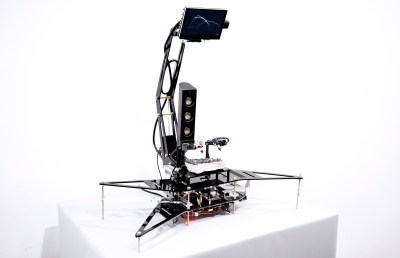
Well, noises anyway. [Dmitry Morozov] and [Alexandra Gavrilova] present an interesting electronics-based art installation, which probes a large chunk of crystalline magnetite, using a pair of servo-mounted probes, ‘measuring’ the surface conductivity and generating some sound and visuals.

It appears to have only one degree of freedom per probe, so we’re not so sure all that much of the surface gets probed per run, but however it works it produces some interesting, almost random results. The premise is that the point-to-point surface resistivity is unpredictable due to the chaotically formed crystals all jumbled up, but somehow uses these measured data to generate some waveshapes vaguely reminiscent of the resistivity profile of the sample, the output of which is then fed into a sound synthesis application and pumped out of a speaker. It certainly looks fun.

From a constructional perspective, hardware is based around a LattePanda fed samples by an ADS1115 ADC, which presumably is also responsible for driving the LCD monitor and the sound system. An Arduino is also wedged in there perhaps for servo-driving duty, maybe also as part of the signal chain from the probes, but that is just a guess on our part. The software uses the VVVV (Visual Live-programming suite) and the Pure Data environment.

We haven’t seen magnetite used for this type of application before, we tend to see it as a source of Iron for DIY knifemaking, as a medium to help separate DNA or just to make nanoparticles, for erm, reasons.

Hack a Day 09 May 21:00

Pokémon developer Game Freak is partnering with Private Divison on a new action franchise

Japanese developer Game Freak is best known for a little franchise called Pokémon, but throughout the years it has dabbled in other genres, like the strategy title Little Town Hero and the rhythm-based platformer HarmoKnight. Now, the company is betting big on a brand-new action adventure IP codenamed Project Bloom.

Game Freak is teaming up with a Take-Two Interactive publishing label called Private Division. You may not recognize the company by name, but it’s been behind a slew of well-regarded titles throughout the years, like Outer Worlds, Kerbal Space Program, Rollerdrome and OlliOlli World, among others. As for Game Freak, last year’s Pokémon Legends: Arceus proved it could handle open worlds and action-heavy gameplay. The company says Project Bloom is a “bold and tonally different” IP from its prior work.

Not much is known about the game, other than some concept art and a short video announcing the partnership between the two developers. Also, we won’t be playing this anytime soon, as the “sweeping new action-adventure game” isn’t slated for release until Take-Two's 2026 financial year, which runs from April 1, 2025, to March 31, 2026.

It might be surprising to hear that Take-Two Interactive is publishing the game, and not Nintendo, which has been Game Freak's partner on Pokémon for over 25 years. While Pokémon is co-owned by Nintendo, Game Freak is an independent developer. To that end, no gaming console has been mentioned as a home for the forthcoming title. As the game won't be released for three years, the home console landscape is likely to look different than it does now. At the very least, the long-rumored followup to the Switch should be out by then.

This article originally appeared on Engadget at https://www.engadget.com/pokemon-developer-game-freak-is-partnering-with-private-divison-on-a-new-action-franchise-200045467.html?src=rss

IBM's Watson returns as an AI development studio

Years before everyone was being impressed with the human-like text output of ChatGPT and other generative AI systems, IBM's Watson was blowing our minds on Jeopardy. IBM's cognitive computing project famously dominated its human opponents, but the company had much larger long-term goals, such as using Watson's ability to simulate a human thought process to help doctors diagnose patients and recommend treatments. That didn't work out. Now, IBM is pivoting its supercomputer platform into Watsonx, an AI development studio packed with foundation and open-source models companies can use to train their own AI platforms.

If that sounds familiar, it may be because NVIDIA recently announced a similar service with its AI Foundations program. Both platforms are designed to give enterprises a way to build, train, scale and deploy an AI platform. IBM says Watsonx will provide AI builders with a robust series of training models with an auditable data lineage — ranging from datasets focused on automatically generating code for developers or for handling industry-specific databases to climate datasets designed to help organizations plan for natural disasters.

IBM has already built an example of what the platform can do with that latter dataset in collaboration with NASA, using the geospatial foundation model to convert satellite images into maps that track changes from natural disasters and climate change.

Reimagining Watson as an AI development studio might lack the pizazz of a headline-grabbing supercomputer that can beat humans on a TV quiz show — but the original vision of Watson was out of reach for the average person. Depending on how companies use IBM's new AI training program, you may find yourself interacting with a part of Watson yourself sometime in the near future.

Watsonx is expected to be available in stages, starting with the Watsonx.ai studio in July, and expanding with new features debuting later this year.

This article originally appeared on Engadget at https://www.engadget.com/ibms-watson-returns-as-an-ai-development-studio-195717082.html?src=rss