WhatsApp test brings screen sharing to Android phones

WhatsApp's newest update takes a page out of work-centric video call platforms like Zoom and Microsoft Teams. The messaging app is in the process of rolling out a screen sharing feature that will record and display the contents of your screen with whoever is on the other end of the video call, WABetaInfo reports.

An icon of a phone with an arrow pointing out of it represents the feature and sits alongside longstanding tools like switching cameras, muting and disabling video that appear at the bottom of WhatsApp calls. Once you click the new button, a prompt appears asking if you want to "Start recording or casting with WhatsApp?" alongside a disclaimer that the company will have access to any passwords, photos or payment details you display. If you're okay with that, all that's left is to click "Start now." You can then stop sharing your screen at any time during the call.

Screen sharing is only available to select Android beta testers right now but should roll out to more users in the coming weeks. However, it might not work on older Android models, bigger group calls or with people who don't have WhatsApp's latest version downloaded. If you have an iPhone or iPad and don't feel tied to WhatsApp, Apple baked a similar screen sharing feature into FaceTime calls in January.

This article originally appeared on Engadget at https://www.engadget.com/whatsapp-test-brings-screen-sharing-to-android-phones-135041152.html?src=rss

NVIDIA's generative AI lets gamers converse with NPCs

NVIDIA has unveiled technology called Avatar Cloud Engine (ACE) that would allow gamers to speak naturally to non-playable characters (NPCs) and receive appropriate responses. The company revealed the tech during its generative AI keynote at Computex 2023, showing a demo called Kairos with a playable character speaking to an NPC named Jin in a dystopic-looking Ramen shop. 

The demo (below in 32:9, the widest widescreen I've ever seen) shows the player carrying on a conversation with Jin. "Hey Jin, how are you," the person asks. "Unfortunately, not so good," replies Jin. "How come?" " I am worried about the crime around here. It's gotten bad lately. My ramen shop got caught in the crossfire." 

Yes, the dialogue is a tad wooden; it seems like ChatGPT might have done a better job. Still, the idea is to show that you could just speak into your headset and an NPC will answer in the proper context, making for a more natural interaction than you'd usually get in such a situation. 

NVIDIA made the demo in partnership with Convai to promote ACE, which can run both in the cloud and locally (on NVIDIA hardware, natch). It uses NVIDIA NeMo for building, customizing and deploying large language models that can be customized with lore and character backstories, while using guardrails to protect against inappropriate conversations. It also deploys a speech recognition and speech-to-text tool called Riva, along with NVIDIA's Omniverse Audio2Face "for instantly creating expressive facial animation of a game character to match any speech track."

The demo was built in Unreal Engine 5 to show off NVIDIA's ray-tracing and other GPU features. The visuals are actually more compelling than the AI dialogue, though it's easy to see how the latter could be improved enormously. NVIDIA didn't announce any games that will use the tech, but Stalker 2: Heart of Chernobyl and Fort Solis will employ Omniverse Audio2Face. 

This article originally appeared on Engadget at https://www.engadget.com/nvidias-generative-ai-lets-gamers-converse-with-npcs-124552730.html?src=rss

Microsoft's Xbox Elite Series 2 controller is $35 off right now

If you're in the market for a quality controller without breaking the bank, now might be a good opportunity. Microsoft's Xbox Elite Series 2 Controller in black is 19 percent off, dropping from $180 to $145. Though it's not the lowest we've seen, it's still a decent-sized drop from its retail price. 

The Xbox Elite Wireless Controller Series 2 is a solid option for Xbox gamers, regardless of your system of choice, as it's compatible with Xbox Series X|S, Xbox One and Windows 10 or 11 devices through Xbox Wireless or Bluetooth. There's also an option to connect it with an included USB-C cord. You can swap parts like D-pads and paddles, save up to three unique profiles to the controller and explore button mapping options through the Xbox Accessories app. It also holds up to 40 hours of battery life.

Microsoft's Xbox Wireless Headset is also on sale, down from $100 to $85 — a 15 percent discount. The headphones are compatible across the same systems as Xbox's wireless controller, such as Xbox Series X|S. Additional features include auto-mute, voice isolation and up to 15 hours of battery life. The headphones have sound technologies like Dolby Atmos and Windows Sonic, with volume control dials located on the left earcup.

The wireless headset is still a good $40 more than its wired counterpart, but if free movement is important to you, the discount certainly helps. If you're looking to update all your accessories for the summer, the sale brings the total price of the wireless headset and controller to $230 — saving you $50 overall.

This article originally appeared on Engadget at https://www.engadget.com/microsofts-xbox-elite-series-2-controller-is-35-off-right-now-114033199.html?src=rss

The Morning After: Japan will try to beam solar power from space by 2025

JAXA, Japan’s NASA equivalent, has spent decades trying to make it possible to beam solar energy from space – which seems like technology for a far-future space anime. In 2015, JAXA scientists successfully beamed 1.8 kilowatts of power, enough energy to power an electric kettle 50 meters away, wirelessly. Now, a Japanese public–private partnership will attempt to beam solar energy from space as early as 2025. The project involves deploying into orbit a series of small satellites, which will beam collected solar energy to ground-based receiving stations hundreds of miles away.

While this already seems a huge step up from a kettle 50 meters away, it’s just the start of the challenge. Creating a satellite array that can generate 1 gigawatt of power – or about the output of one nuclear reactor – is estimated to cost around $7 billion with current technologies.

– Mat Smith

The Morning After isn’t just a newsletter – it’s also a daily podcast. Get our daily audio briefings, Monday through Friday, by subscribing right here.

The biggest stories you might have missed

The best DACs for Apple Music Lossless in 2023

Hitting the Books: Renee Descartes had his best revelations while baked in an oven

Meta’s Quest 3 headset could feature color cameras for more lifelike pass-through video

After a rocky start, Formula E’s Gen3 car is living up to its potential

The best Memorial Day tech sales we could find

Fire pits, wireless headphones and a pizza oven.  

It’s a national holiday, so of course Memorial Day brings a few bargains and deals so you can celebrate those who served in the military by… shopping. Notable deals include $50 off Sony's excellent WH-1000XM5 headphones, Amazon's Fire TV Stick 4K Max back at an all-time low of $35 and Apple's iPad Air down to $500.

Continue reading.

Naughty Dog says its ‘Last of Us’ multiplayer game needs more time

The studio has other games in development, including a new single-player title.

One of the most notable omissions from this week's PlayStation Showcase was anything from Naughty Dog. Many (including yours truly) expected the studio to reveal more details about its Last of Us multiplayer game, but we'll need to wait a little longer to hear more.

In a statement posted on Twitter, Naughty Dog said, "We're incredibly proud of the job our studio has done thus far, but as development has continued, we've realized what is best for the game is to give it more time." As such, it now seems unlikely we'll hear much about the game during Summer Game Fest (where Naughty Dog offered a first peek at concept art from the project last year).

Continue reading.

US judge grants final approval to Apple’s $50 million butterfly keyboard settlement

Payouts will start rolling out soon.

Engadget

A US federal court gave final approval to the $50 million class-action settlement over claims Apple knew about and concealed the unreliable nature of keyboards on MacBook, MacBook Air and MacBook Pro computers released between 2015 and 2019. Judge Edward Davila on Thursday called the settlement involving Apple’s infamous butterfly keyboards “fair, adequate and reasonable.” Under the agreement, MacBook users impacted by the saga will receive settlements between $50 and $395. More than 86,000 claims for class member payments were made before the application deadline last March, Judge Davila wrote in his ruling. However, Apple won’t have to admit wrongdoing as part of the settlement agreement.

Continue reading.

This article originally appeared on Engadget at https://www.engadget.com/the-morning-after-japan-will-try-to-beam-solar-power-from-space-by-2025-111516653.html?src=rss

NASA's SLS rocket is $6 billion over budget and six years behind schedule

NASA's Space Launch System (SLS) rocket designed to take astronauts to the moon is over budget and far behind it's original schedule, according to a scathing new audit from NASA's Inspector General. Furthermore, the report foresees "additional cost and schedule increases" that could potentially jeopardize the entire Artemis mission if problems aren't handled. 

NASA's spending on the Artemis Moon Program is expected to reach $93 billion by 2025, including $23.8 billion already spent on the SLS system through 2022. That sum represents "$6 billion in cost increases and over six years in schedule delays above NASA’s original projections," the report states. 

The SLS, which finally launched for the first time in November 2022, uses four RS-25 engines per launch, including 16 salvaged from retired Space Shuttles. Once those run out (all engines on SLS are expendable), NASA will switch to RS-25E engines being built by Aerojet Rocketdyne, which are supposed to be 30 percent cheaper and 11 percent more powerful. It also uses solid rocket boosters provided by Northrop Grumman. 

The older technology isn't helping with the budget as NASA expected, though. "These increases are caused by interrelated issues such as assumptions that the use of heritage technologies from the Space Shuttle and Constellation Programs were expected to result in significant cost and schedule savings compared to developing new systems for the SLS," the audit states. "However, the complexity of developing, updating, and integrating new systems along with heritage components proved to be much greater than anticipated." 

For instance, only 5 of the 16 engine adaptations have been completed, and scope and cost increases have hit the booster contract as well. The latter has been the biggest issue, increasing from $2.5 billion to $4.4 billion since Artemis was announced, and delaying the schedule by five years. 

The Inspector General also blames the use of "cost-plus" contracts that allow suppliers to inflate budgets more easily, instead of fixed-priced contracts. The report recommends that upcoming work be shifted to a fixed-price regime and that procurement issues be resolved, among others. NASA management has agreed to all eight recommendations. 

The Artemis moon mission project was based on the Constellation program, originally launched in 2005 with the goal of returning to the moon by 2020 and eventually, Mars. Cancellation of that project by the Obama administration was met with widespread criticism, largely because the program guaranteed jobs around the US. 

However, the NASA Authorization Act of 2010, introduced the same year, mandated construction of the SLS and requiring the repurposing of existing technology, contracts and workforce from Constellation. It also required partnerships with private space companies. SpaceX, for one, is developing its own Starship rocket system, also capable of carrying astronauts to the Moon and Mars. However, Starship exploded on its first orbital launch mission, and may not fly again soon due to issues with the self-destruct command and the considerable damage it did to local ecosystems. 

This article originally appeared on Engadget at https://www.engadget.com/nasas-sls-rocket-is-6-billion-over-budget-and-six-years-behind-schedule-091432515.html?src=rss

NVIDIA's next DGX supercomputer is all about generative AI

NVIDIA CEO Jensen Hiang made a string of announcements during his Computex keynote, including details about the company’s next DGX supercomputer. Given where the industry is clearlyheading, it shouldn’t come as a surprise that the DGX GH200 is largely about helping companies develop generative AI models.

The supercomputer uses a new NVLink Switch System to enable 256 GH200 Grace Hopper superchips to act as a single GPU (each of the chips has an Arm-based Grace CPU and an H100 Tensor Core GPU). This, according to NVIDIA, allows the DGX GH200 to deliver 1 exaflop of performance and to have 144 terabytes of shared memory. The company says that's nearly 500 times as much memory as you'd find in a single DGX A100 system.

For comparison, the latest ranking of the Top500 supercomputers lists Frontier at Oak Ridge National Laboratory in Tennessee as the only known exascale system, having reached a performance of nearly 1.2 exaflops on the Linmark benchmark. That's over twice the peak performance of the second-placed system, Japan's Fugaku.

In effect, NVIDIA claims to have developed a supercomputer that can stand alongside the most powerful known system on the planet (Meta is building one that it claims will be the fastest AI supercomputer in the world once it’s fully built out). NVIDIA says the architecture of the DGX GH200 offers 10 times more bandwidth than the previous generation, "delivering the power of a massive AI supercomputer with the simplicity of programming a single GPU."

Some big names are interested in the DGX GH200. Google Cloud, Meta and Microsoft should be among the first companies to gain access to the supercomputer to test how it can handle generative AI workloads. NVIDIA says DGX GH200 supercomputers should be available by the end of 2023.

The company is also building its own supercomputer, Helios, that combines four DGX GH200 systems. NVIDIA expects Helios to be online by the end of the year.

Huang discussed other generative AI developments during his keynote, including one on the gaming front. NVIDIA Avatar Cloud Engine (ACE) for Games is a service developers will be able to tap into in order to create custom AI models for speech, conversation and animation. NVIDIA says ACE for Games can "give non-playable characters conversational skills so they can respond to questions with lifelike personalities that evolve."

This article originally appeared on Engadget at https://www.engadget.com/nvidias-next-dgx-supercomputer-is-all-about-generative-ai-043053544.html?src=rss

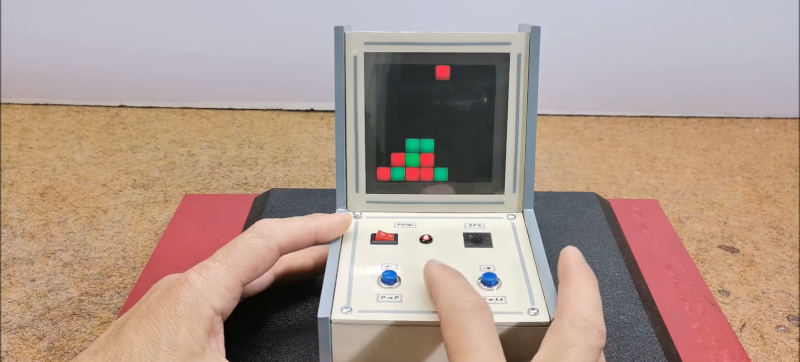
Electronic Connect 4 Console Doesn’t Use LCD

You might think that making your own electronic games would require some kind of LCD, but lately, [Mirko Pavleski] has been making his using inexpensive 8X8 WS2812B LED panels. This lets even a modest microcontroller easily control a 64-pixel “screen.” In this case, [Mirko] uses an Arduino Nano, 3 switches, and a buzzer along with some 3D printed components to make a good-looking game. You can see it in action in the video below.

The WS2812B panels are easy to use since the devices have a simple protocol where you only talk to the first LED. You send pulses to determine each LED’s color. The first LED changes color and then starts repeating what you send to the next LED, which, of course, does the same thing. When you pause a bit, the array decides you are done, and the next train of pulses will start back at the first LED.

It looks like the project is based on a German project from [Bernd Albrecht], but our German isn’t up to snuff, and machine translation always leaves something to be desired. Another developer added a play against the computer mode. This is a simple program and would be easy to port to the microcontroller of your choice. [Mirko]’s execution of it looks like it could be a commercial product. If you made one as a gift, we bet no one would guess you built it yourself.

Of course, you could play a real robot. You could probably repurpose this hardware for many different games, too.

Hack a Day 29 May 03:00

Japan will try to beam solar power from space by 2025

Japan and JAXA, the country’s space administration, have spent decades trying to make it possible to beam solar energy from space. In 2015, the nation made a breakthrough when JAXA scientists successfully beamed 1.8 kilowatts of power, enough energy to power an electric kettle, more than 50 meters to a wireless receiver. Now, Japan is poised to bring the technology one step closer to reality.

Nikkei reports a Japanese public-private partnership will attempt to beam solar energy from space as early as 2025. The project, led by Naoki Shinohara, a Kyoto University professor who has been working on space-based solar energy since 2009, will attempt to deploy a series of small satellites in orbit. Those will then try to beam the solar energy the arrays collect to ground-based receiving stations hundreds of miles away.

Using orbital solar panels and microwaves to send energy to Earth was first proposed in 1968. Since then, a few countries, including China and the US, have spent time and money pursuing the idea. The technology is appealing because orbital solar arrays represent a potentially unlimited renewable energy supply. In space, solar panels can collect energy no matter the time of day, and by using microwaves to beam the power they produce, clouds aren’t a concern either. However, even if Japan successfully deploys a set of orbital solar arrays, the tech would still be closer to science fiction than fact. That’s because producing an array that can generate 1 gigawatt of power – or about the output of one nuclear reactor – would cost about $7 billion with currently available technologies.

This article originally appeared on Engadget at https://www.engadget.com/japan-will-try-to-beam-solar-power-from-space-by-2025-214338244.html?src=rss

Portugal considers banning Huawei from national 5G networks

Portugal could become the latest country to effectively ban Huawei and other Chinese firms from participating in its 5G buildouts. As reported by Bloomberg, the government of Portugal this week recommended barring local carriers from sourcing 5G equipment from suppliers based outside of the European Union or from countries that aren’t part of the North Atlantic Treaty Organization (NATO) or Organization for Economic Co-operation and Development (OCED).

In a statement Portugal’s Higher Council for Cybersecurity shared on Thursday, the government said firms outside those jurisdictions pose a “high risk” to the security of the country’s wireless networks. The document didn’t call out Huawei specifically, but as China isn’t a member of NATO, the OCED or the EU, the company, alongside other Chinese suppliers like ZTE, would effectively be excluded from participating in Portugal’s 5G networks should the country’s cabinet approve the security council’s recommendation.

“Huawei has no prior knowledge of, and hasn’t been consulted about, this matter,” a Huawei spokesperson told the Financial Times. “Over the past two decades, Huawei has worked with Portuguese carriers to build out wireless networks and provide quality services that connect millions of people. We will continue to comply with all applicable laws and regulations, and serve Portuguese customers and partners who rely on our products and services.”

Banning Chinese companies from participating in its 5G networks would be an abrupt turnaround for Portugal, which has enjoyed close relations with the East Asian superpower for years. As the Financial Times notes, Portugal has been one of the biggest per capita recipients of Chinese investment in recent years. Altice Portugal, the country’s largest wireless carrier, signed a deal in 2018 to use Huawei equipment for part of its 5G rollout. If Portugal moves forward with a ban, it would join Canada and a handful of other European countries, including Denmark, Sweden, Estonia, Latvia and Lithuania, that have recently barred the company from participating in their 5G networks.

This article originally appeared on Engadget at https://www.engadget.com/portugal-considers-banning-huawei-from-national-5g-networks-201102160.html?src=rss

A lawyer faces sanctions after he used ChatGPT to write a brief riddled with fake citations

With the hype around AI reaching a fever pitch in recent months, many people fear programs like ChatGPT will one day put them out of a job. For one New York lawyer, that nightmare could become a reality sooner than expected, but not for the reasons you might think. As reported by The New York Times, attorney Steven Schwartz of the law firm Levidow, Levidow and Oberman recently turned to OpenAI’s chatbot for assistance with writing a legal brief, with predictably disastrous results.

A lawyer used ChatGPT to do "legal research" and cited a number of nonexistent cases in a filing, and is now in a lot of trouble with the judge 🤣 pic.twitter.com/AJSE7Ts7W7

— Daniel Feldman (@d_feldman) May 27, 2023

Schwartz’s firm has been suing the Columbian airline Avianca on behalf of Roberto Mata, who claims he was injured on a flight to John F. Kennedy International Airport in New York City. When the airline recently asked a federal judge to dismiss the case, Mata’s lawyers filed a 10-page brief arguing why the suit should proceed. The document cited more than half a dozen court decisions, including “Varghese v. China Southern Airlines,” “Martinez v. Delta Airlines” and “Miller v. United Airlines.” Unfortunately for everyone involved, no one who read the brief could find any of the court decisions cited by Mata’s lawyers. Why? Because ChatGPT fabricated all of them. Oops.

In an affidavit filed on Thursday, Schwartz said he had used the chatbot to “supplement” his research for the case. Schwartz wrote he was "unaware of the possibility that [ChatGPT’s] content could be false.” He even shared screenshots showing that he had asked ChatGPT if the cases it cited were real. The program responded they were, claiming the decisions could be found in “reputable legal databases,” including Westlaw and LexisNexis. 

Schwartz said he “greatly regrets” using ChatGPT “and will never do so in the future without absolute verification of its authenticity.” Whether he has another chance to write a legal brief is up in the air. The judge overseeing the case has ordered a June 8th hearing to discuss potential sanctions for the “unprecedented circumstance” created by Schwartz’s actions.

This article originally appeared on Engadget at https://www.engadget.com/a-lawyer-faces-sanctions-after-he-used-chatgpt-to-write-a-brief-riddled-with-fake-citations-175720636.html?src=rss