How to interface Raspberry Pi Pico W with Servo Motor using MicroPython?
This blog explores interfacing a servo motor with the Raspberry Pi Pico W using MicroPython. The Pico W is an affordable and compact microcontroller board based on the RP2040 chip, ideal for embedded systems and IoT projects.
Security researchers believe they have found a hardware exploit to unlock upgrades to a Tesla that normally require plenty of extra cash. By messing with the voltage of the infotainment system, they were able to inject their code, bypassing its normal security. That enabled them to access personal data, including GPS tracking and call logs, as well as the car’s encryption key. That, the researchers claim, could be the key to unlocking paywalled features, like the mode known as Full Self-Driving, which you presently have to pay extra to use.
That’s not the only slice of bad news on Tesla’s breakfast plate today; it also stands accused of fraud. A recent Reuters expose alleges the car company was far too generous with its range estimates, and that it had quietly set up a team to stymie range-related complaints. In the wake of that report, three Californians have proposed a class action lawsuit accusing Tesla of false advertising. If successful, the lawsuit will cover every Tesla owner in the state, which wouldn’t be as much of a problem if California hadn’t taken the EV company to its heart.
– Daniel Cooper
You can get these reports delivered daily, direct to your inbox. Subscribe right here!
The Steam Deck’s blend of power, portability and price gave new life to PC gaming handhelds, traditionally a niche within a niche. The latest kid on the block is Ayaneo’s 2S, which has just spent the last few weeks in James Trew’s firm grip while he put it through its paces. It may be more expensive than its nearest competitors, but the improved features more than make up for it. You’ll have to read the full review to learn all about the changes, but it might be time to tweak what you’re asking for on your birthday list.
Baldur’s Gate III will arrive on the PlayStation 5 on September 6, but there’s no word yet on when the title will hit the Xbox. That’s because developers Larian Studios are struggling to make the new game work for both the (powerful) Series X and (not so powerful) Series S. Until it can, the game will remain a PS5 exclusive, with developers blaming Microsoft’s insistence on feature parity for the two consoles. But I think it’s pretty gratifying that Microsoft is looking out for gamers who might not have the cash to spend big on a flagship system.
The Musk-ization of Twitter might have sparked a revolution.
X/Twitter’s implosion has created a surge of interest in alternative platforms less easily destroyed on a billionaire’s whim. Mastodon is the standard bearer for the fediverse, a decentralized network of independent servers that embrace the early web’s DIY ethos. But even Threads, Meta’s not-quite Twitter-killer, has pledged to leverage the fediverse’s open protocols. If you want to learn more, read Karissa Bell’s excellent deep dive into decentralization, federation and why you should care about this sort of thing.
18.51 million copies of Tears of the Kingdom have been sold since May.
Nintendo knows a thing or two about creating an experience you’ll enjoy enough to pay top dollar for. It’s reporting record profits in its first quarter on the back of both The Super Mario Bros. Movie and The Legend of Zelda: Tears of the Kingdom. The former is the first movie this year to break the one billion mark, while Tears of the Kingdom has sold a whopping 18.5 million copies since it launched in May.
It comes after several creators reported massive drops in income.
Patreon says it has fixed an issue that caused several high-profile creators to report massive drops in income. It appears a billing address being moved to Dublin caused a large number of transactions to be flagged as fraudulent. The company told Engadget it was working with its payment processing partners to resolve the issue and believes the currently broken patron accounts will be restored in due course.
This article originally appeared on Engadget at https://www.engadget.com/the-morning-after-tesla-jailbreak-could-enable-full-self-driving-for-free-111530274.html?src=rss
If you've been eyeing the new Google Pixel Tablet but didn't want to drop half a grand on it, today might be your lucky day. The smart home-cum-mobile device is currently having its first big sale, with its 128GB model down from $499 to $440 — a 12 percent discount. If you want a bit more storage, the Google Pixel Tablet's 256GB option is 13 percent off, dropping its price from $599 to $519.
The Google Pixel Tablet first came on the scene in June and scored an 85 in our review. We were especially impressed with its included charging speaker dock and smart home features, such as how easy it was to see no matter how light the room was (while still not being too bright). The Pixel Tablet is Google's first model with the Google Tensor G2 chip built in and has an average battery life of 11 hours. It also has an 11-inch screen with 2560x1600 resolution, giving you solid quality while on video calls or watching shows through Chromecast. Speaking of video calls, the camera is unfortunately not your friend on the Pixel Tablet, with an awkward angle only slightly improved by an auto-framing feature — but it's exclusive to Google Teams.
If you're as clumsy as I am, it might be worth looking at Google's Pixel Tablet bundle, which includes a case. The 128GB Google Pixel Tablet with a case is 10 percent off, bringing its price from $578 to $519, while the 256GB model has an 11 percent discount, dropping from $678 to $598. The cases come in an identical color to your tablet (available in Hazel, Porcelain or Rose) and fit right into the charging port without needing to remove it.
This article originally appeared on Engadget at https://www.engadget.com/googles-pixel-tablet-with-charging-speaker-gets-its-first-big-discount-094504760.html?src=rss
Last month, around 80 Google Help subcontractors employed by Accenture — who recently voted to unionize with the Alphabet Workers Union-Communications Workers of America (AWU-CWA) — found out that they will be laid off. Now, the union has filed a complaint against Alphabet and Accenture with the National Labor Relations Board (NLRB) alleging retaliatory layoffs in violation of labor laws, the AWU-CWA wrote in a press release.
"When my coworkers and I announced our union with overwhelming support, Google and Accenture management refused to acknowledge us," said general writer at Accenture and Google, Anjail Muhammad, in a statement. "A few short weeks later they announced their response — that they would be laying off dozens of employees. These jobs aren’t going away though, we’re just being asked to train our replacements abroad."
Alphabet effectively washed its hands of the issue when the layoffs were first announced, saying that "Google does not control [the contractor's] employment terms or working conditions" and that the situation was "a matter between them and their employer, Accenture." It reiterated that position to Fortune, adding that the layoffs were for savings and efficiency and no other reason, and that it "chooses its partners and staffing agencies carefully and reviews their compliance with its Supplier Code of Conduct."
In their original union application, workers listed Google and Accenture as joint employers "due to the direct role both companies play in shaping working conditions," they said in the original unionization announcement. "We had exercised our right to organize as members of the Alphabet Workers Union-CWA in order to bring both Google and Accenture, a Google subcontractor, to the bargaining table to negotiate on several key demands, including layoff protections," said senior writer and union member Julia Nagatsu Granstrom back in July.
The team, which largely works in content creation, will be reduced from 130 people to around 40. They were reportedly instructed to train replacements working from India and the Philippines. Since 2018, the majority of Google employees have been contractors.
In April, YouTube Music contractors voted unanimously to unionize, after winning a landmark legal victory with the NLRB forcing Google to the bargaining table to ratify their union contract. However, Alphabet indicated that it would still not negotiate with workers, saying it doesn't consider them as employees — meaning the issue is likely to wind up in a federal court.
This article originally appeared on Engadget at https://www.engadget.com/google-contract-workers-accuse-alphabet-and-accenture-of-violating-labor-laws-085100869.html?src=rss
At its Product Vision event in California, Fisker unveiled no less than three EVs and also announced pricing and more details of the previously teased Ronin. The new models include the Alaska electric pickup, Pear EV priced at $29,900 before incentives and the Force E, a rugged off-road version of the Ocean.
First on the docket, however, is the Ronin — a four-door supercar EV that the company teased last month. Fisker previously showed only a brief glimpse of it, promising a 600 mile range and sub-$200,000 price tag. Now, the company has unveiled it in full on the outside only (no interior shots), but CEO Henrik Fisker is still being guarded about the technology — and the price has roared way past its previous estimate.
Mike Blake / reuters
Fisker said it'll hit 60 MPH in under 2.0 seconds thanks to three electric motors delivering 1,000 horsepower via an all-wheel drive setup. As for the battery back, "we are looking to integrate the cells into the structure of the body and that will give us our goal of getting to 600 miles of range," Fisker said in a not-exactly-definitive statement. The company is giving itself some time to get there, though, citing a delivery window near the end of 2025.
The price, though, is a shocker. Fisker didn't mention it at the event, but a new reservation page says the Ronin will start at "$385,000 before any incentives," or nearly double what the company originally mentioned. Luckily, interested parties will only need to put down a $2,000 deposit which is just 0.5 percent of the purchase price.
Mike Blake / reuters
The most interesting vehicle is the Alaska electric pickup. It's based on the Ocean (and built on the same platform), but has a pickup truck bed and midgate that lowers to extend the bed into the cabin — allowing it to haul longer cargo than the shortish bed would suggest. That's much like Chevy's new Silverado EV, which it strikingly resembles.
The Alaska will start at $45,400 (it will be US-built and qualify for EV incentives) with a range of around 230 miles between charges, less than the Ocean. However, the company is promising a more expensive model that can go up to 340 miles between charges. Because it's based around the Ocean which is now in production, the company expects it to go on sale as early as December 2024 — sooner than the Pear or Ronin. Henrik Fisker is much better at designing vehicles than estimating prices and production schedules, though, so take all those numbers and dates with a large grain of salt.
Mike Blake / reuters
The Pear electric crossover will be Fisker's budget offering, coming in at under $30,000 with all-wheel drive, dual motors and range of about 300 miles. While just a bit smaller than the Ocean, it will be built on a new platform that allows a 35 percent reduction in parts and thus a lower price. It will come in five- or six-seat layouts (the latter via a front bench seat), and offers what looks like an attractive but basic interior for the price.
Other touches include a "Houdini Trunk" lift gate designed to simplify cargo loading, along with a frunk (or "froot" in Fisker's nomenclature). It also offers LED lighting and a "lounge mode" that lets you move the seats around to maximize comfort. Fisker plans to build the Pear at Foxconn's Lordstown plant so it's eligible for tax incentives, with production estimated around mid-2025. Again, treat those price and production estimates skeptically.
Mike Blake / reuters
Finally, Fisker unveiled the Force E, an offroad/adventure version of the Ocean. It comes with 33-inch off-road tires and 21-inch aluminum wheels, along with a large roof rack and wide fenders. It offers more ground clearance, front, rear and underbody skid plates, and improved offroad handling. The package is available to new buyers, but existing Ocean owners can also upgrade their vehicles, It's set to arrive in Q1 2024, with pricing to be announced around then.
This article originally appeared on Engadget at https://www.engadget.com/fisker-unveils-the-alaska-electric-pickup-and-sub-30000-pear-ev-071051468.html?src=rss
IBC India Signs MoU with Karnataka Government To Establish A New Lithium-ion Battery Plant
The company has invested Rs 8,000 Crore to set-up this mega battery production facility and an MoU has already been signed with the state government
In an effort to grow the electric vehicle industry in Karnataka in India, global battery making giant International Battery Company (IBC) and the state government have signed a contract to set-up a massive lithium-ion battery making unit.
Ilya Lichtenstein and Heather Morgan, the couple who were arrested last year for the massive 2016 Bitfinex hack involving billions of dollars of cryptocurrency, have pleaded guilty in court. Lichtenstein has admitted that he used multiple advanced hacking tools and techniques to gain entry into the cryptocurrency exchange's network. He then authorized 2,000 transactions to move 119,754 bitcoins to wallets he controlled. To cover his tracks, he said he deleted access credentials, logs and other digital breadcrumbs that could give him away. Morgan, his wife, helped him move and launder the stolen funds.
If you'll recall, the Justice Department seized 95,000 of the stolen bitcoins at the time of their arrest. Back then, that digital coin hoard was worth a whopping $3.6 billion and was the largest financial seizure in the agency's history. Authorities were able to trace more of the stolen funds after that to recover an additional $475 million worth of cryptocurrency.
According to the DOJ, Lichtenstein and Morgan used false identities to set up online accounts on darknet markets and cryptocurrency exchanges. They then withdrew the funds and distributed the bitcoins from there by converting them into other forms of cryptocurrency and keeping them in crypto mixing services. By doing so, they obfuscated the coins' sources and made them harder to trace. The couple also set up businesses in the US to make their banking activities look legitimate — Morgan had a TikTok where she talked about establishing a "multimillion dollar business" with "zero outside funding" — and they apparently used the stolen money to purchase physical gold coins that Morgan then buried.
To be precise, Lichtenstein pleaded guilty to conspiracy to commit money laundering and could spend up to 20 years in prison. Meanwhile, Morgan pleaded guilty to one count of money laundering conspiracy and one count of conspiracy to defraud the United States. Each one carries a maximum prison sentence of five years.
This article originally appeared on Engadget at https://www.engadget.com/bitfinex-hackers-who-stole-billions-in-cryptocurrency-plead-guilty-051317291.html?src=rss
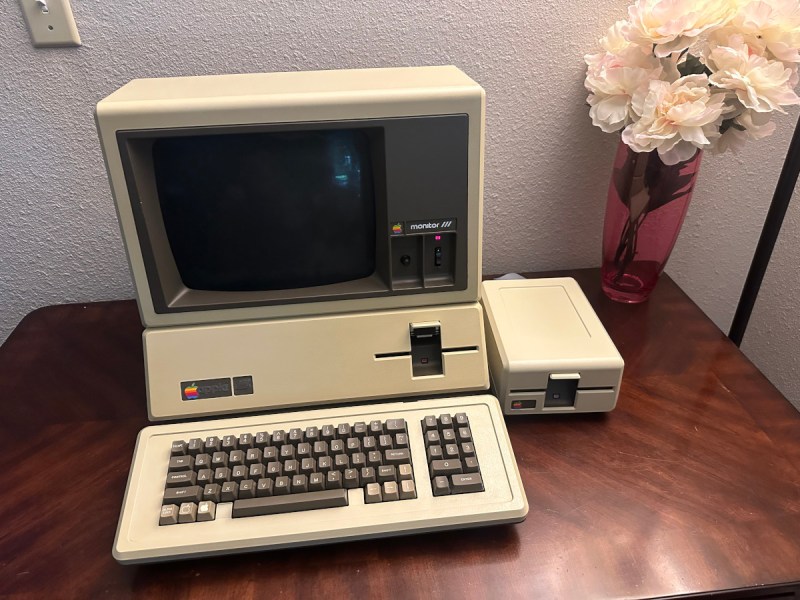
The most collectible items in the realm of vintage computers often weren’t the most popular of their era. Quite the opposite, in fact. Generally the more desireable systems were market failures when they first launched, and are now sought out because of a newly-appreciated quirk or simply because the fact that they weren’t widely accepted means there’s fewer of them. One of the retro computers falling into this category is the Apple III, which had fundamental hardware issues upon launch leading to a large recall and its overall commercial failure. [Ted] is trying to bring one of these devices back to life, though, by slowing its clock speed down to a crawl.
The CPU in these machines was a Synertek 6502 running at 1.8 MHz. With a machine that wouldn’t boot, though, [Ted] replaced it with his own MCL65+, a purpose-built accelerator card based on the 600 MHz Teensy 4.1 microcontroller in order to debug the motherboard. The first problem was found in a ROM chip which prevented the computer loading anything from memory, but his solution wouldn’t work at the system’s higher clock speeds. To solve that problem [Ted] disabled the higher clock speed in hardware, restricting the system to 1 MHz and allowing it to finally boot.
So far there haven’t been any issues running the computer at the slower speed, and it also helps keep the computer cooler and hopefully running longer as well, since the system won’t get as hot or unstable. This isn’t [Ted]’s first retrocomputing rodeo, either. His MCL chips have been featured in plenty of other computers like this Apple II which can run at a much faster rate than the original hardware thanks to the help of the modern microcontroller.
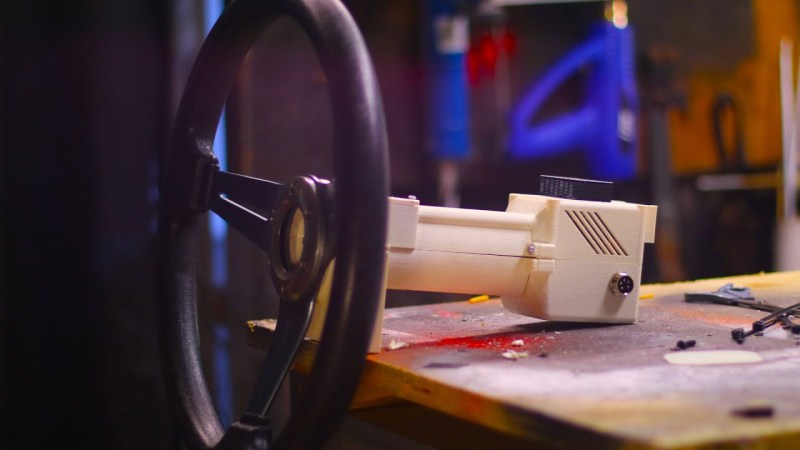
When it comes to controllers for racing games, there is perhaps no better option than a force feedback steering wheel. With a built-in motor to push against the wheel at exactly the right times, they can realistically mimic the behavior of a steering wheel from a real car. The only major downside is cost, with controllers often reaching many hundreds of dollars. [Jason] thought it shouldn’t be that hard to build one from a few spare parts though and went about building this prototype force feedback steering wheel for himself.
Sourcing the motor for the steering wheel wasn’t as straightforward as he thought originally. The first place he looked was an old printer, but the DC motor he scavenged from it didn’t have enough torque to make the controller behave realistically, so he turned to a high-torque motor from a battery-powered impact driver. This also has the benefit of coming along with a planetary gearbox as well, keeping the size down, as well as including its own high-current circuitry. The printer turned out to not be a total loss either, as the encoder from the printer was used to send position data about the steering wheel back to the racing game. Controlling the device is an Arduino, which performs double duty sending controller information from the steering wheel as well as receiving force feedback instructions from the game to drive the motor in the steering wheel.
After 3D printing a case for it and strapping it to a work bench, the initial tests proved to be promising. [Jason] can feel the motor from the power drill pushing against the steering wheel at the appropriate time. However there are some issues to work out with the prototype as the coupling mechanism between the motor and steering wheel isn’t strong enough to resist skipping and is likely to eventually break. We look forward to future videos when these issues are ironed out, but in the meantime we’d recommend taking a look at this force feedback mouse for other ways of making video game experiences more immersive.
Brave's search engine no longer requires that you jump to Bing or Google just to find photos or videos. The company has introduced image and video queries to Brave Search, helping you find media while maintaining the same levels of privacy and freedom of access. You won't have to worry about being profiled through your picture hunts, or risk missing politically sensitive content (if unintentionally) pulled from another engine's index.
You'll still have the option of continuing searches through competitors, at least for a while. Brave notes that some search features, such as filtering by aspect ratio or license, aren't ready yet. The choice helps you get the results you're looking for, so long as you don't mind using a major engine. It's more important to have a "clear alternative" than absolute feature equality, Brave argues.
Brave
Anyone can use Brave's search engine in the web, although it's set as the default in the company's browser. The firm hopes to expand its reach by asking users to contribute to an anoynmous Web Discovrey Project.
The relative newcomer launched its homegrown search in 2021, but has stood out from similarly privacy-oriented challengers like DuckDuckGo by trying to avoid the use of third-party indexes. Brave stopped using Bing's search index in May. That cut seven percent of results, but also gave Brave more control over its results.
This won't necessarily lead to a surge in market share. Brave doesn't even register in StatCtounter's browser market share statistics — it's not in a position to upset heavyweights like Chrome, Edge and Safari. However, this does eliminate a major objection if you're an enthusiast determined to minimize data collection at much as possible.
This article originally appeared on Engadget at https://www.engadget.com/braves-privacy-focused-search-engine-can-now-find-images-and-videos-211548516.html?src=rss