Ticketmaster is the victim of a cyber attack, its parent company, Live Nation, confirmed. The information stolen allegedly includes personal information from 560 million individuals, including names, numbers, addresses, and partial payment details. Hacking group ShinyHunters has demanded $500,000 in ransom money to prevent the data's sale and confirmed it held the 1.3TB of stolen data to Hackread.
In a filing with the US Securities and Exchange Commission, Live Nation stated it had "identified unauthorized activity" on May 20 and subsequently started investigating it. On May 27, "a criminal threat actor offered what it alleged to be Company user data for sale via the dark web."
Live Nation claims to be working to lower the risks posed to its customers and its own business. "As of the date of this filing, the incident has not had, and we do not believe it is reasonably likely to have, a material impact on our overall business operations or on our financial condition or results of operations," the company added. "We continue to evaluate the risks and our remediation efforts are ongoing."
Ticketmaster has faced previous breaches, including a bot attack during Taylor Swift ticket sales. The company also has a history as a hacker, illegally — and repeatedly — accessing the computer system of its rival, Songkick. Ticketmaster paid a $10 million criminal fine rather than face prosecution. However, the company's former head of Artist Services, Zeeshan Zaidi, pled guilty to conspiring to commit computer intrusions and wire fraud due to his role in the scheme.
This article originally appeared on Engadget at https://www.engadget.com/ticketmaster-hack-could-affect-560-million-users-121600931.html?src=rss
Yusaku Maezawa, the Japanese billionaire who signed up for a lunar orbit flight aboard SpaceX's Starship back in 2018, has cancelled his trip. The reason, he said in a series of posts on X, is that Starship is still in development and the "dearMoon" launch may not occur until well into the 2030s.
"I signed the contract in 2018 based on the assumption that dearMoon would launch by the end of 2023," he wrote. "It’s a developmental project so it is what it is, but it is still uncertain as to when Starship can launch. I can't plan my future in this situation, and I feel terrible making the crew members wait longer. I apologize to those who were excited for this project to happen."
I can’t plan my future in this situation, and I feel terrible making the crew members wait longer, hence the difficult decision to cancel at this point in time. I apologize to those who were excited for this project to happen.
Maezawa announced the dearMoon project with Elon Musk at SpaceX's Hawthorne factory in 2018. He reportedly paid the company in the order of low nine figures to help fund it and later selected eight other companions for the trip, including artists, photographers, YouTubers and a member of a Korean boy band.
However, Starship development was slower than expected, as has been the case with nearly every rocket development program ever. The first test flight was just a year ago, and the first fully successful launch (with the vehicle remaining intact) only took place a few months ago. The next flight is set to launch as early as June 5.
In addition, SpaceX's priorities changed drastically when NASA selected Starship for its Artemis program. That forced the company to deprioritize dearMoon, which meant it was not likely to take place until the early 2030s. Maezawa's net worth as also dropped since the 2018 announcement, as Ars Technica noted. On top of all that, the billionaire has already gone to space, having spent 12 days aboard the International Space Station.
This article originally appeared on Engadget at https://www.engadget.com/billionaire-space-tourist-cancels-lunar-flight-amid-changing-spacex-priorities-120043594.html?src=rss
The first crewed launch of Boeing’s Starliner was scrubbed less than four minutes before liftoff after a computer failed to launch the correct countdown. It’s the squillionth setback for the craft, (our math may be out a little) which should support the next generation of spaceflight. NASA says it’ll target June 5 for its next launch attempt. At this point, we’ll believe it when we see it.
ASUS knows how to make a good PC, so it’s no surprise to see its second-generation gaming handheld is an improvement on the original. Sam Rutherford has been trying out the ROG Ally X, for which only the display and chip are unchanged from the original. And while you can guess what his impression is from the headline, you should still click through to see if it’s worth buying.
Unsurprisingly, 20-year-old Facebook isn’t what young adults flock to. But bless Meta for trying to change that. In an update, Tom Alison, who heads up the Facebook app for Meta, says the service is shifting to reflect an “increased focus on young adults.” Meta executives have been trying to win over young adults for years. Mark Zuckerberg said almost three years ago he wanted to make them the company’s “North Star.”
Alison’s note makes no mention of the metaverse beyond using AI in its products (without getting remotely specific) — I’m not sure how Facebook plans to appeal to those young adults.
Dyson continues to experiment in the robot vacuum arena. The Dyson 360 Vis Nav has been available in other parts of the world for a while, but it recently came stateside to the tune of $1,200. The company claims a 360-degree vision system, with cameras and LED lights, along with suction power similar to its stick vacuum. Is it good in real life? Yes. Is it perfect? No.
This article originally appeared on Engadget at https://www.engadget.com/the-morning-after-starliners-crewed-flight-gets-scrubbed-111519077.html?src=rss
ASUS announced a trio of new releases in its ProArt line of laptops at this week’s Computex expo in Taipei. These devices are generally thinner, lighter and more portable than previous generations, though that’s where the similarities end. Let’s get into it.
The ProArt 16 is a thinner and lighter version of the ProArt Studiobook, which we absolutely loved. The refreshed design is based on the chassis found with the ROG G16, but with some crucial differences. There’s a 4K 60Hz screen and a virtual dialpad instead of the physical knob found on the Studiobook. It features a nano black coating that is said to be fingerprint-resistant.
ASUS
As for specs, it comes with AMD's all-new Ryzen AI 9 HX 370 processor that can deliver 50 TOPS of NPU performance. For added power, it also offers an Nvidia GeForce RTX 4070 GPU, for a combined 321 TOPS score. That makes it "the first AI PC of its kind built for advanced AI workflows across creativity, gaming, productivity and more," NVIDIA claims.
There's a 16-inch 4K OLED display and it can be souped up with up to 64GB of RAM and 4TB of solid-state storage. It's also a Copilot+ PC, so it has the button to call up Microsoft’s digital assistant and plenty of other AI bells and whistles like the company’s StoryCube file management software.
ASUS
The ProArt PX13 is a different beast entirely. This laptop is a 2-in-1 hybrid that’s based on the same chassis as the ROG Flow X13. It also comes equipped with an AMD Ryzen AI 9 HX 370 processor and up to an Nvidia GeForce 4060 GPU. There’s a 2.8K OLED touch display that supports HDR content. This hybrid has also been slimmed down, coming in at just three pounds.
The PZ13 is also resistant to dust and water, thanks to a rubber splash cover with an IP52 rating. It even comes with a full-size SD card reader, which is a rarity with convertibles, and a 5MP front camera with IR support and a 13MP rear-facing camera. Just like all of these ProArt laptops, this one is light at 1.8 pounds.
The ASUS ProArt P16 (H7606) is now on pre-order at the ASUS Store or Best Buy, starting at $1,900. The ProArt PX13 (HN7306) is also available for pre-order at the ASUS or Best Buy websites, while the Qualcomm-powered ASUS ProArt PZ13 will arrive in Q3 of 2024.
Steve Dent contributed to this report.
This article originally appeared on Engadget at https://www.engadget.com/asus-slimmed-down-proart-laptops-focus-on-ai-features-100831698.html?src=rss
ASUS unveiled a bunch of new laptops at this week’s Computex tech expo in Taipei, including a Zenbook refresh. The Zenbook S16 is as sleek and well-designed as ever, but comes with a spate of iterative improvements and a couple of major updates.
It's equipped with AMD's Ryzen AI 9 HX 370 processor, announced just hours ago. That chip promises improved laptop AI performance with 50 TOPS of processing power, triple AMD's previous laptop hardware. That makes it suitable for Copilot+, meaning Qualcomm isn't the only game in town for Microsoft's AI assistant.
ASUS
One thing worth pointing out is that this laptop is extremely thin and light for a 16-inch model, clocking in at just over three pounds with a thickness of just 1.1cm or 0.4 inches. The cooling system has also been revamped, with a new top vent and an ultra-thin vapor chamber. Better laptop cooling is always much appreciated.
It still features the same signature aluminum ceramic coating as found with last year’s Zenbook 14X, but ASUS changed the name of the finish to, wait for it, Ceraluminum. What a portmanteau!
There’s a 16-inch 3K OLED touchscreen with a max refresh rate of 120Hz. The 78Wh battery makes it a great option for all-day use and the six-speaker setup from Harman Kardon will certainly pump out the jams. It also supports Wi-Fi 7, includes up to 2TB of solid-state storage and can be specced out with up to 32GB of RAM.
The ASUS Zenbook S16 starts at $1,400 and is now available to pre-order at Best Buy in white or gray colors.
Steve Dent contributed to this report.
This article originally appeared on Engadget at https://www.engadget.com/the-asus-zenbook-s16-laptop-boasts-an-ultra-thin-design-and-amds-latest-ai-chip-093745114.html?src=rss
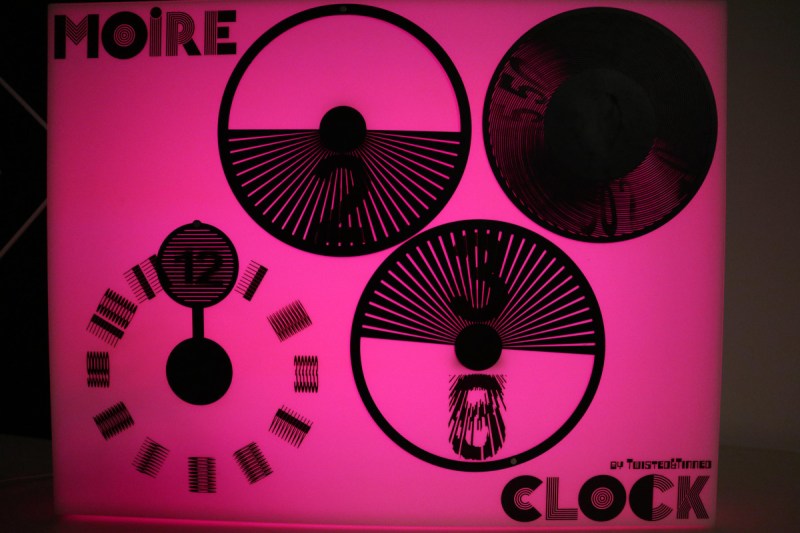
If you’ve ever seen artifacts on a digital picture of a computer monitor, or noticed an unsettling shifting pattern on a TV displaying someone’s clothes which have stripes, you’ve seen what’s called a Moiré pattern where slight differences in striping of two layers create an emergent pattern. They’re not always minor annoyances though; in fact they can be put to use in all kinds of areas from art to anti-counterfeiting measures. [Moritz] decided to put a few together to build one of the more unique clock displays we’ve seen.
The clock itself is made of four separate Moiré patterns. The first displays the hours with a stretching pattern, the second and third display the minutes with a circular pattern, and the seconds are displayed with a a spiral type. The “hands” for the clock are 3D printed with being driven by separate stepper motors with hall effect sensors for calibration so that the precise orientation of the patterns can be made. A pair of Arduinos control the clock with the high-accuracy DS3231 module keeping track of time, and [Moritz] built a light box to house the electronics and provide diffuse illumination to the display.
Microsoft's Copilot+ initiative for super-charged AI PCs is becoming more of a reality at Computex 2024. Today, AMD announced its next major chip platforms, Ryzen AI 300 for notebooks and Ryzen 9000 for desktops, which respectively target beefier laptop AI performance and fast gaming on desktops. Notably, Ryzen AI 300 chips feature a revamped neural processing unit (NPU) with 50 TOPS (tera operations per second) of AI performance, more than three times AMD's previous laptop hardware. The new desktop processors, meanwhile, are reportedly 16 percent faster than their predecessors when it comes to overall performance.
The key takeaway from these announcements is that Qualcomm is no longer the only company able to gloat about fast AI hardware for Copilot+ PCs. That initiative, which Microsoft unveiled a few weeks ago, sets a new baseline specification standard for AI PCs. Copilot+ PCs require an NPU with at least 40 TOPS of AI performance, 16GB of RAM and 256GB SSDs to qualify as Copilot+ notebooks. Microsoft also tied together long battery life with the initiative, but it's unclear if the Ryzen AI 300 chips will be able to touch the reported twenty-plus hours from Qualcomm's latest Snapdragon processors. (We're also expecting Intel to respond with more details about its Lunar Lake Copilot+ chips later today at Computex.)
AMD
So far, AMD's new laptop chips include two models: The 12-core Ryzen AI 9 HX 370, and the 10-core AI 9 365. As usual, we expect the company to fill out its lineup over the next year with mid-tier and lower-end offerings. Both Ryzen AI 9 chips reach at least 5GHz max boost speeds, and they also feature built-in RDNA 3.5 Radeon 890M and 880M graphics. According to AMD's benchmarks, the Ryzen AI 9 HX 370 is 98 percent faster than Apple's M3 chip in Blender, and it's 73 percent faster than Intel's Core Ultra 185H. (It's worth noting company tested its hardware with 32GB of RAM against Apple and Intel systems with 16GB of RAM, according to its testing footnotes.)
AMD
Powering both the Ryzen AI 300 and Ryzen 9000 chips is AMD's Zen 5 architecture, which is a "sweeping update" for the company, Senior Processor Technical Marketing Manager Donny Woligrosky said in a media briefing. He claims it offers better branch prediction (which helps with accuracy and latency), higher overall throughput and up to two times better instruction bandwidth. For regular users, that means you can expect Zen 5 systems to feel a bit more responsive and be better primed for handling large data loads.
AMD
While AMD's new AI chips are the star of the show, the company isn't leaving desktop users behind. The new Ryzen 9000 chips top out with the 16-core Ryzen 9 9950X, which edges close to the 6GHz dream with 5.7GHz boost speeds. It's a power-hungry beast though, requiring 170 watts, so more reasonable hardware nerds might want to opt for the Ryzen 9 9900X (120W TDP) or the eight-core Ryzen 7 9700X (65W). These new chips don't include NPUs like the Ryzen 8000G, but at this point, gamers and demanding PC users can make do with the raw computational power from desktop CPUs and powerful GPUs. (NVIDIA is also trying to power some AI features with its RTX GPUs, which eschews the need for a standalone NPU.)
Alongside these new desktop chips, AMD is also unveiling the X870E and X870 AM5 chipsets. They include the next-gen PC features you'd expect, including PCIe 5, USB4, WiFi 7 and DDR5. For its older AM4 hardware, AMD also unveiled the 16-core Ryzen 9 5900XT and eight-core Ryzen 7 5800XT, which can both hit 4.8GHz speeds.
We're still awaiting pricing details on AMD's new hardware, but the company says we can expect to see Ryzen AI 300 systems and Ryzen 9000 chips in July. Those new laptops include the ASUS ZenBook S 16 and Zephyrus G16, as well as the MSI Stealth A16 AI+.
This article originally appeared on Engadget at https://www.engadget.com/amd-unveils-ryzen-ai-300-cpus-for-copilot-laptops-030033575.html?src=rss
Sometimes it’s the simplest games that end up leaving you all teary-eyed and emotional.
When I first downloaded Cool Lemon Club’s The Keyper for Playdate, I didn’t have much in the way of expectations beyond a general sense that it should be pretty good, since lots of people online seemed to be recommending it. The adventure game, which is available on itch.io and the official Playdate Catalog, sees the player searching for the many different keys needed to unlock areas of the mysterious Winchester 21 building after taking over the role of caretaker. The person who formerly held the job is gone, leaving only some cryptic notes behind, and the residents are varying degrees of weird.
On its face, it seems like a pretty standard game of puzzle solving and exploration. It’s effectively frustrating throughout, as you repeatedly retrace your steps trying to navigate the Winchester 21’s several floors and labyrinthine tunnel system to find the keys and the doors they unlock. But as the plot unfolds and you uncover more of the building’s secrets, The Keyper reveals itself to be a game with a lot of heart.
Its charm lies in the strange interactions between you and the people who live in the apartments (and tunnels… and walls) of the Winchester 21. They each have their own little storylines, some of which present new mysteries and side-quests for you to take on. One of these in particular really tugged at my heartstrings, but I wouldn’t dare spoil it for you here.
The Keyper is a little dark, a little funny and just the right amount of challenging. While it does offer the option to save your progress so you can walk away from it and come back later, I’d recommend setting aside a few hours and just playing this through in one shot for the most impact. By the time you reach the end and finally figure out what’s been going on all along, the entire tone of the game has shifted into something a lot more heartwarming than it all first appears. I may even have cried a little during the final scene.
This article originally appeared on Engadget at https://www.engadget.com/the-keyper-is-a-casual-adventure-game-for-playdate-that-unexpectedly-made-me-cry-214640406.html?src=rss
After yesterday’s launch of the first crewed Starliner mission was scrubbed, NASA, Boeing and ULA made the decision to wait a few days before making another attempt. Starliner was scheduled to finally lift off on Saturday afternoon after a series of delays, but this attempt was aborted due to a last-minute issue with a ground computer system that plays a key role in launching the rocket. While NASA and partners discussed possibly flying today following their assessment of the issue, they’ve decided to hold off until the next opportunities, either on June 5 or 6.
Saturday’s launch wasn’t scrubbed due to a problem with the Starliner craft itself, but because an automatic hold was issued by the ground launch sequencer for a then-unknown reason. In a press conference later on Saturday, Tory Bruno, president and CEO of ULA explained that it came down to a problem in verifying the launch sequencer’s redundancy. There are three large computers in this system, all of which are the same so it’s “triple redundant,” Bruno said. During the system health check in the minutes before launch, one of the computers came up slow, triggering an automatic hold.
NASA said the decision to forgo today’s launch attempt was made in order to “give the team additional time to assess a ground support equipment issue.” The launch window opens again on June 5, but no target liftoff time has been announced just yet. If Starliner doesn’t fly by June 6, it’ll be set back by at least another 10 days, ArsTechnica reports, as the ULA team will need to swap out the Atlas V rocket’s batteries.
This article originally appeared on Engadget at https://www.engadget.com/boeings-starliner-has-two-more-chances-this-week-to-make-its-first-crewed-flight-184739763.html?src=rss
The newest Apple Watch is down to one of the best prices we’ve seen it go for yet, so if you’ve been thinking about upgrading, now would be the perfect time to do so. The 41mm Apple Watch Series 9 (GPS only) is $100 off on Amazon, bringing the price down to $299. There’s also a deal on the larger version (45mm), which is down to $360 from its usual price of $430. The full discounts apply to Series 9 in Midnight and Starlight, but there are varying deals on the other colors as well.
The Series 9 Apple Watch is the best Apple Watch you can get today, and our favorite smartwatch in general. It comes with some new features made possible by the S9 system-in-package (SiP) processor. With this model, Apple introduced the Double Tap gesture that allows you to carry out certain actions on the watch without touching the screen, like pausing your music. It also has on-device Siri and an improved version of “Raise to Speak” to more easily activate the assistant.
As with the other Apple Watch models, the Series 9 is water resistant and great for fitness and health tracking, though it currently doesn’t offer the blood oxygen monitoring feature that was initially touted, thanks to a patent dispute. It has an always on display with a peak brightness rating double that of the previous model, and twice the internal storage capacity.