We made it to 200 episodes folks! This week, Cherlynn, Devindra, Producer Ben Ellman and Senior Writer Sam Rutherford dive into some of the biggest tech developments since we rebooted the podcast in 2019. Remember, that was a pre-pandemic, pre-generative AI world! We also highlight a few guest interviews worth revisiting, like our chats with Bill Nye and Ann Druyan.
As for recent news, we quickly recap the OpenAI drama around Sam Altman’s ouster, discuss Google’s new Gemini AI platform, and chat about the revelation that governments are spying on our push notifications. Cherlynn also details her experience with Apple’s Personal Voice feature for iPhones and gives us a demo of her AI-generated digital voice.
Listen below or subscribe on your podcast app of choice. If you've got suggestions or topics you'd like covered on the show, be sure to email us or drop a note in the comments! And be sure to check out our other podcast, Engadget News!
Topics
It’s our 200th episode! We look back on what’s changed in tech since the show relaunched – 1:02
Sam Altman sacked and reinstated, a recap of the OpenAI drama – 44:29
Google announces Gemini AI, its answer to GPT-4 – 50:04
Microsoft upgrades Copilot with OpenAI’s GPT-4 Turbo and DALL-E 3 – 54:23
Governments are spying on push notifications, Google and Apple can’t do anything about it – 55:41
Mark Gurman reports Apple is working on revamped iPad Pros and an M3 MacBook Air – 58:02
Cherlynn’s experience with the new iOS accessibility feature Personal Voice – 58:58
Comment sections can be a place of both community and animosity, with the speed of responses presenting a moderation challenge. YouTube is attempting to find a happy balance, announcing additional comment controls for creators — most notably the option to pause comments. The company trialed the feature and is now rolling it out to everyone.
The option to pause allows for existing comments to remain visible while not allowing other accounts to submit any more. Previously, creators could only disable comments from their channel or review each one before posting. Unlike the review setting, pause stops any remarks from coming in at all, removing the risk of a pile-up or viewing negative and inappropriate comments. Basically, if someone wants to spend time on other things like video creation or activities outside of YouTube, they can do so without thinking about the viewers waiting for their responses to go live.
say hello to a new moderation setting for your channel: pause comments ⏸️
in addition to "on" and "off," you can now "pause" comments. existing comments will remain visible, new comments will be disabled, giving you more flexibility and control 🌟 more → https://t.co/wNAspRiR4spic.twitter.com/AY9MWQDsvw
YouTube has also reorganized and renamed some of the comment settings, along with adding the pause feature. Now, creators will see three choices under the comments setting: On, Pause and Off. More specific moderation options appear when comments are turned on, starting with Basic, which holds comments that might be inappropriate for review. Then there's Strict, which casts a broader net as to which comments must be reviewed first, and Hold All, which lets creators review and approve every comment before they post it publicly. Creators can also choose to have comments turned on without any of these additional filters.
This article originally appeared on Engadget at https://www.engadget.com/youtube-now-lets-creators-pause-comments-on-videos-130550321.html?src=rss
Amazon regularly makes changes to the costs and availability of its groceries. The company's latest attempt to drive more business comes in the form of a subscription plan. Prime members can now pay $10 monthly for unlimited free Amazon Fresh and Whole Foods deliveries on orders over $35. The subscription also includes unlimited 30-minute pickup orders, regardless of the amount spent.
The addition of Whole Foods is notable as any delivery from the retailer through Amazon has included a $10 delivery fee since 2021. However, Amazon Fresh grocery deliveries over $35 were already free for Prime members until early this year when Amazon added a fee for grocery deliveries under $150. The company reduced that threshold to $100 in October, with a $7 fee on Fresh orders of $50 to $100 and a $10 fee on orders below $50. So, basically, Prime members can now pay $10 each month to have the same deal they had up until January — plus the $15 monthly or $139 annually to be a Prime member.
The addition of a subscription plan follows other attempts from Amazon to drum up business for its grocery sector. In November, Amazon expanded Fresh grocery delivery and pickup to anyone, not just Prime members. Amazon is starting small with its newest offer, rolling out the subscription plan to Prime members in three US cities: Sacramento, CA, Columbus, OH and Denver, Colorado.
This article originally appeared on Engadget at https://www.engadget.com/amazon-is-trialing-a-10-monthly-grocery-subscription-for-prime-members-123559940.html?src=rss
This one-of-a-kind PS5 console was customized with the PS1’s retro gray finish, and classic quad-color PS logo. Even the DualSense controller was given a late-90s makeover, with a cute plug cover for the PS5’s front USB-C port to mimic the first-ever PlayStation’s controller.
No, this won’t go on sale. It’s a farewell gift for SIE (Sony Interactive Entertainment) President and CEO Jim Ryan, who is retiring in March 2024. At a thank-you party this week, the outgoing PlayStation boss was honored by many industry legends, including the “father of PlayStation” Ken Kutaragi, Gran Turismo’s Kazunori Yamauchi, Team Asobi’s Nicolas Doucet and, of course, Sony CEO Kenichiro Yoshida.
It was a gaming-heavy 24 hours, actually. This year’s Game Awards barraged us with new trailers and game news. Surprise, free DLC, an RPG set on an entirely procedurally generated world and a... Blade game?
— Mat Smith
You can get these reports delivered daily direct to your inbox. Subscribe right here!
The company is trying to prevent “engagement hacking.”
Meta’s latest update for Threads brings the long-awaited ability to search for topics, with tags. Although the feature is under the familiar # symbol, Threads’ tags are slightly different to hashtags. Instagram head Adam Mosseri explained Threads tags can contain spaces and special characters, and can only use a single tag per post, so choose wisely.
UK indie studio Hello Games has announced its next game, Light No Fire, which will bring the procedural generation of No Man’s Sky to an entire planet on an incredibly detailed scale. It will combine open-world exploration with multiplayer community building, set on a planet the size of Earth, apparently. Light No Fire has been in development for five years by about a dozen developers at Hello Games, but there’s no release window yet.
As Google scales up its AI battle with OpenAI and ChatGPT, the company has now admitted one demo, shown in the video “Hands-on with Gemini: Interacting with multimodal AI,” was edited to speed up the results. The interactions, too, weren’t based on voice but text input.
The demo used “still image frames from the footage and prompting via text,” rather than having Gemini respond to — or even predict — a drawing or change of objects on the table in real time. It’s all a little less impressive and comes when Google’s most cutting-edge AI models don’t differ hugely from OpenAI’s latest GPT tricks.
The official Game of the Year is finally on Microsoft consoles.
Developer and publisher Larian Studios had pledged to release the Xbox version of this year’s Game of the Year by… the end of the year and said it would reveal the exact date at The Game Awards. True to its word, Larian announced the Xbox version of Baldur’s Gate 3 is out right now.
The delay was due to a technical problem with the Series S, and the inability to make the game’s split-screen feature on the lower-powered console. However, Larian said it had a solution to support split-screen on Series X, but not Series S, and had permission to do so from Xbox bosses.
The UK is considering an investigation into Microsoft's partnership with OpenAI to decide if it has resulted in an "acquisition of control" that's subject to antitrust law, the Competition and Markets Authority (CMA) wrote today. The regulator said it's considering "recent developments," no doubt referring to the Sam Altman CEO ouster drama in which Microsoft played a large role.
"The CMA is now issuing an ITC to determine whether the Microsoft/OpenAI partnership, including recent developments, has resulted in a relevant merger situation and, if so, the potential impact on competition," it said in a news release. "The CMA will review whether the partnership has resulted in an acquisition of control — that is, where it results in one party having material influence, de facto control or more than 50% of the voting rights over another entity."
The regulator noted that the "close and multifaceted" partnership includes a multi-billion dollar investment by Microsoft, technology development cooperation and cloud services. It added that both firms have significant activities in financial and related markets, meaning their business dealings directly affect investors. It added that Microsoft was recently involved in developments related to OpenAI's governance.
When Sam Altman was fired by OpenAI's board, Microsoft stepped in to hire him, and a majority of OpenAI's staff threatened to bolt to Microsoft as well. OpenAI's board relented soon after and Altman returned as CEO. "Microsoft executives have since concluded that the current situation [with Altman back in charge] is the best possible outcome," according to a New Yorker expose on the drama.
The CMA is now seeking views on whether the partnership creates a relevant merger situation and how it impacts competition in the UK. If an investigation is launched, it would be the second one involving Microsoft in the last year, following the company's Activision Blizzard acquisition. The UK's probe had material effects on that merger, as Microsoft agreed to sell Activision Blizzard game streaming rights to Ubisoft to satisfy the CMA.
This article originally appeared on Engadget at https://www.engadget.com/the-uks-competition-regulator-is-reviewing-microsofts-links-to-openai-115248453.html?src=rss
The Fusion of AI and Robotics: DIY Hand Gesture Robot Takes Center Stage
In a dazzling display of innovation, the mixture of AI and robotics has birthed a remarkable creation: a hand gesture-controlled robot. Crafted by a tech enthusiast in a captivating DIY video, this robot embarked on a journey from conceptualization to reality through amazing design and assembly. The video chronicles the meticulous process undertaken by the creator, beginning with the design phase.
Android users can add information such as caller name, allergies, emergency contacts and preexisting medical conditions. "This is when the information you put inside your phone becomes useful to 911," Tenea Reddick, ECC director at Baltimore City Fire Department, said in a statement. "This information is available to use before the dispatch, and before the responders arrive. It saves so much time because we already know what we're responding to and what we need." The feature is especially beneficial if the person contacting 911 is unable to communicate.
For now, this feature is only available on Androids with the Personal Safety app, such as the Nothing Phone 1 and the Google Pixel 4 through Google Pixel 8 Pro. Anyone with these devices can enable the new feature by going to the "Your info" section of the Personal Safety app. From there, they can click "Emergency info access" and then "Share during emergency call."
Android and Apple's services are run by RapidSOS, a safety platform that securely shares critical information in times of crisis to over 16,000 911 and field responder agencies. Apple users can access Medical ID, a feature in the Health app that, similar to Android's Personal Safety app, stores information such as blood type, emergency contacts, allergies and preexisting medical conditions. RapidSOS shares this data with first responders, who can also determine a person's location if they call 911 in an area with Enhanced Emergency Data services. Android users have also had the ability to send location data through RapidSOS since 2018.
This article originally appeared on Engadget at https://www.engadget.com/android-phones-can-now-send-medical-data-during-911-calls-104518043.html?src=rss
Apple built more iPhone 15s in India than any past model and it plans to continue that trend. The company will shift a quarter of its iPhone production — more than 50 million phones — to the nation within the next two to three years, The Wall Street Journal reported. China would still remain the largest iPhone supplier by a good margin, though.
Foxconn and other Apple suppliers reportedly believe that the push into India has been proceeding well, so they're setting the stage for future expansion. The company proceeded slowly at first due to infrastructure problems and powerful unions that have helped set more restrictive labor rules — pushing back against 12-hour work days, for example.
India's commerce minister said at the beginning of 2023 that Apple planned to build 25 percent of its phones in the nation, but there was never any timeframe attached to that. Two to three years would represent a fairly dramatic ramp-up, considering that the iPhone 15 marked the first time it had released a model made in India on launch day.
It's also been known that Apple contractor Foxconn would manufacture more iPhone 15s than past models its facility in Tamil Nadu, India. It's part of Apple's plan to diversify manufacturing in the face of supply chain risks due to tensions between the US and China. Foxconn is currently building a plant in the southern Karnataka state expected to open in April 2024, and has another megaplant on the drawing board as well, according to the WSJ's sources.
To date, Apple has only built a small percentage of its iPhones in India, and production previously lagged behind China by up to nine months. That changed with the iPhone 14, which started manufacturing the same month as in China, and iPhone 15s built in India were available in stores at launch.
Relations between US and China are delicate at the moment, with the US recently taking measures to block access to advanced technology in the nation. Apple continues to stress the nation's importance, though, with CEO Tim Cook having traveled there twice in 2023. Apple also sells a large number of phones in China, accounting for about 19 percent of its total revenue — while stressing that all phones in sold China through authorized channels are also built in China and use local suppliers.
This article originally appeared on Engadget at https://www.engadget.com/apple-plans-to-build-more-than-50-million-phones-in-india-within-three-years-101756528.html?src=rss
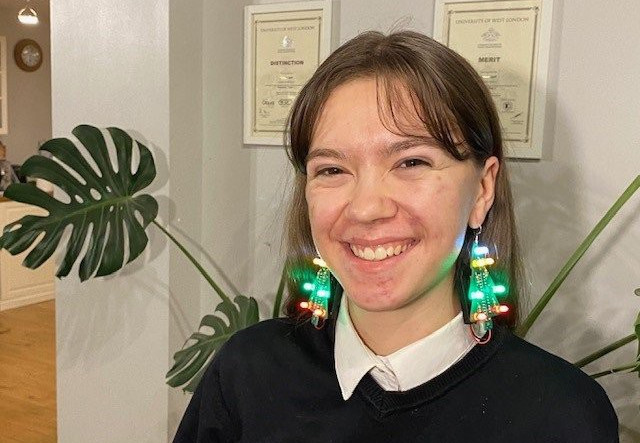
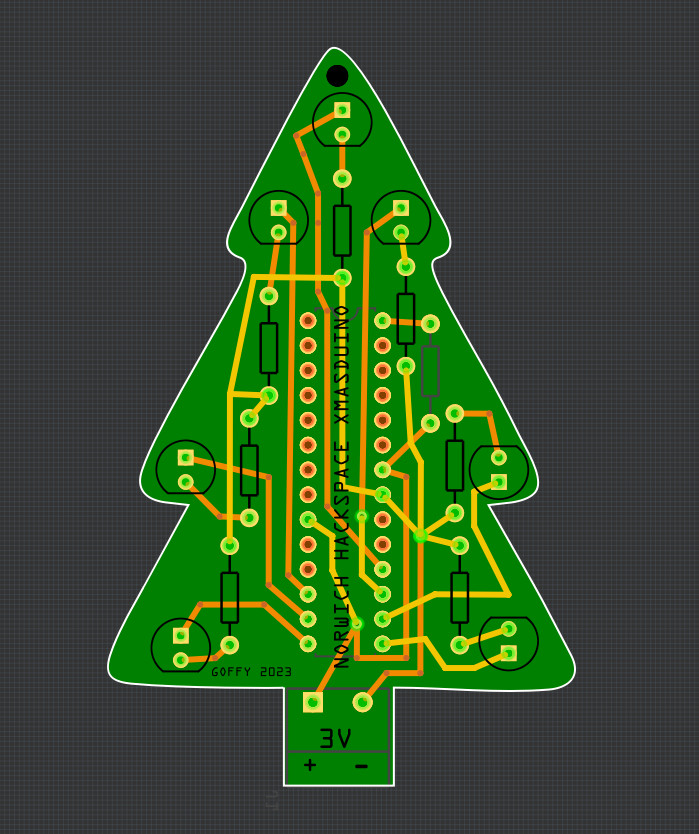
‘Tis the season for gift giving, and what better to give than a newfound love for hacking, soldering, and blinkenlights? In order to spread cheer and education at the local hackerspace, [Tom Goff] created this festive tree circuit board that can either sit in a stand to be admired, or worn as jewelry. The resistors are even designed to look like candy canes hanging from the boughs.
The brains of this festive little tree is an ATmega328P, which you probably recognize as the microcontroller that powers the Arduino Uno. Although this circuit has none of the extra bits you’d find on an Uno, not even a crystal oscillator, it can still be programmed with Arduino and use the 8 MHz internal clock.
[Tom] has provided good, thorough instructions, especially for the sticky bit of setting up the IDE to program using the 8 MHz internal clock. So even if you’re nowhere near Norwich Hackerspace, you can join in the fun. Be sure to check out the video after the break, wherein [Tom] walks through designing the PCB using Inkscape and Fritzing.
Remember the 20th anniversary limited edition PlayStation 4? No, I didn't get one, either. But what if Sony were to port that same sweet retro look from the PS1 to the PS5? Look no further than the farewell gift which SIE (Sony Interactive Entertainment) President and CEO Jim Ryan — who is retiring in March 2024 — received yesterday.
In a photo posted by Yuichi Haga, the Global Diversity, Equity, Inclusion Lead at SIE, the "one of a kind" PS5 console — not the slim model — was customized with the PS1's retro gray finish, along with the classic quad-color "PS" logo. Even the DualSense controller was given a DualShock 1 makeover, complete with a cable and a cute plug cover that goes over the PS5's front USB-C port. Ryan's team went the extra mile to make a special packaging design — one that pays homage to the PS1's box art.
Sad I won’t be around for #TheGameAwards but I couldn’t pass up the chance to go to Jim Ryan’s thank you party and be around some legends and this one of a kind “Jim Ryan” PS5 with PS1 style. pic.twitter.com/WP7qwtxDI0
At yesterday's thank-you party, the outgoing PlayStation boss was honored by many industry legends, including the "father of PlayStation" Ken Kutaragi, Gran Turismo's Kazunori Yamauchi, Team Asobi's Nicolas Doucet and, of course, Sony CEO Kenichiro Yoshida. PlayStation's BAFTA-winning indies lead, Shuhei Yoshida, was notably absent as he had to attend The Game Awards (while nabbing the "Games for Impact" award on behalf of Awaceb, the developer behind indie title, Tchia).
It's unclear as to whether us mere mortals will get to own a version of this special edition PS5, but considering that it'll be PlayStation's 30th anniversary next year, perhaps Sony will consider making one for the PS5 Slim then?