Secure and Efficient: MORNSUN's LMF1000-23BxXUH Powering Diverse Industries
MORNSUN Power presents the LMF1000-23BxXUH, an advanced addition to the 305RAC family, catering specifically to demanding industrial and outdoor environments. This semi-potted, fanless AC/DC enclosed switching power supply boasts a compact form factor of 240.00×115.00×41.00mm, offering exceptional reliability with an operating temperature range spanning from -40°C to +85°C and an impressive 95% efficiency.
[Trent M. Wyatt]’s CPUVolt library provides a fast way to measure voltage using no external components, and no I/O pin. It only applies to certain microcontrollers, but he provides example Arduino code showing how handy this can be for battery-powered projects.
The usual way to measure VCC is simple, but has shortcomings.
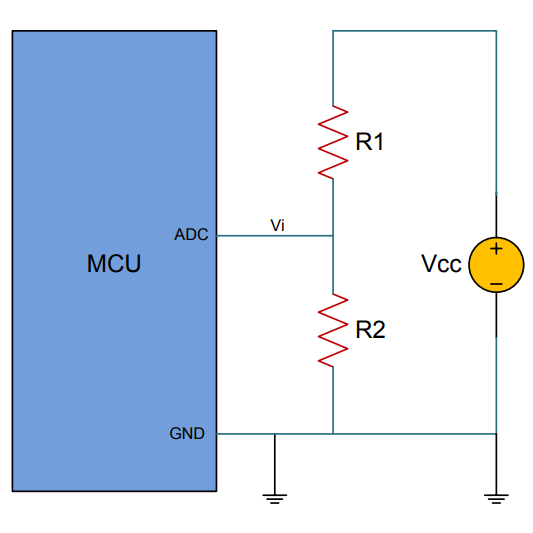
The classical way to measure a system’s voltage is to connect one of your MCU’s ADC pins to a voltage divider made from a couple resistors. A simple calculation yields a reading of the system’s voltage, but this approach has two disadvantages: one is that it constantly consumes power, and the other is that it ties up a pin that you might want to use for something else.
There are ways to mitigate these issues, but it would be best to avoid them entirely. Microchip application note 2447 describes a method of doing exactly that, and that’s precisely what [Trent]’s Arduino library implements.
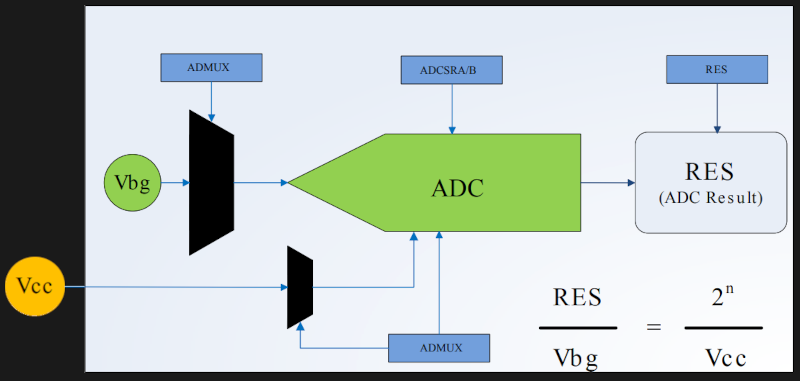
What happens in this method is one selects Vbg (a fixed internal voltage reference that is temperature-independent) as Vin, and selects Vcc as the ADC’s voltage reference. This is essentially backwards from how the ADC is normally used, but it requires no external hookup and is only a bit of calculation away from determining Vcc in millivolts. There is some non-linearity in the results, but for the purposes of measuring battery power in a system or deciding when to send a “low battery” signal, it’s an attractive solution.
Being an Arduino library, CPUVolt makes this idea very easy to use, but the concept and method is actually something we have seen before. If you’re interested in the low-level details, then check out our earlier coverage which goes into some detail on exactly what is going on, using an ATtiny84.
Global Semiconductor Market To Recover With an Annual Growth Rate of 20% in 2024, Says Analysts
Although there are some sporadic short orders and rush orders in the second half of 2023, it is still difficult to reverse the first half annual decline of 20%, thus, the semiconductor sales market is expected to still decline by 12% in 2023
When Apple introduced the Vision Pro mixed-reality headset, it had no clear release schedule and only said that the device will be available sometime early next year. According to a new report by Bloomberg’s Mark Gurman, “early next year” means as soon as February. Apple reportedly ramped up production of the headset in China over the past several weeks with the intention of getting the devices ready for consumers by the end of January. The plan is to make the Vision Pro available the month after that.
In addition to ramping up production, Apple has reportedly sent developers an email, notifying them to test their apps for the headset with the latest tools and to send their software to the company for feedback. Gurman says that’s another sign of the device’s impending release. In his report, Gurman also detailed the steps Apple is taking to launch a completely new product category. The last time the company introduced a brand new product was in 2015 when it started selling the Apple Watch, but the Vision Pro is a different beast that requires meticulous planning for its release.
Since the headset has multiple possible configurations and could be customized to meet each customers’ needs, Apple is apparently sending at least two staffers from each retail store to its headquarters for training in January. There, they’ll be taught how to attach the device’s headband and light seals, as well as how to fit prescription lenses. The Vision Pro will set customers back $3,499 when it goes on sale, but Gurman previously reported that Apple is working on a more affordable (and less powerful) version that will cost between $1,500 and $2,500.
This article originally appeared on Engadget at https://www.engadget.com/apples-vision-pro-mixed-reality-headset-could-be-available-by-february-2024-060156965.html?src=rss
DigiKey Stocks New eFuse Reference Design Product from Vishay
DigiKey, a leading global commerce distributor offering the largest selection of technical components and automation products in stock for immediate shipment, announced today that the
Following the patent dispute over the blood oxygen sensor on the Apple Watch Series 9 and Apple Watch Ultra 2, the International Trade Commission (ITC) sided with medical technology company Masimo, and ordered to halt all sales of said wearables in the US — conveniently just in time for the holidays. Apple has since filed a motion to pause this ban until its appeal is done, but earlier today, the ITC denied this request, meaning the Apple Watch ban is going ahead, unless the President decides to veto.
"A Presidential Review Period is in progress regarding an order from the US International Trade Commission on a technical intellectual property dispute pertaining to Apple Watch devices containing the Blood Oxygen feature," Apple told Engadget in an earlier statement. "While the review period will not end until December 25, Apple is preemptively taking steps to comply should the ruling stand."
The Apple Watch models affected will stop being sold on Apple.com on December 21 i.e. tomorrow, then on December 24 at Apple's retail stores, and then until stocks run out for third-party retailers like Amazon and Best Buy — which could be pretty fast given the import ban on December 26. Other models like the Apple Watch SE that don't contain a blood oxygen sensor will continue to be sold.
Masimo filed its lawsuit against Apple in 2021 over alleged violations of patents related to light-based blood-oxygen monitoring. The case originally targeted the Apple Watch Series 6, but despite the sales ban, you can continue to use the blood oxygen feature on that and other previously purchased Apple Watch models. In retaliation, Apple filed two patent infringement suits against Masimo in October 2022, claiming that the latter's own smartwatch copied Apple Watch features.
This article originally appeared on Engadget at https://www.engadget.com/itc-denies-motion-to-pause-us-apple-watch-ban-until-appeal-is-over-041608763.html?src=rss
A “Compliance Car” is a vehicle designed not to be sold in large quantities but to satisfy rules around range-wide consumption. For instance, makers of enormous, gas-belching trucks may have to offer a thrifty, gas-sipping ride to balance out the emissions numbers. One infamous example is Aston Martin’s Cygnet, a rebadged Toyota iQ with a luxury interior that sold for three times the iQ’s price. Now, imagine a company chose to make one of those vehicles intentionally. That’s the best way to describe Lexus’ new LBX, a small but luxurious, Europe-exclusive city car that you’ll love sitting in while waiting in traffic.
The LBX is a subcompact car based on the same underlying platform (GA-B) as Toyota’s Yaris Cross, its tiny crossover SUV. The Yaris Cross is a city runaround pretending to be an SUV, complete with flared wheel arches, high ride height and optional All Wheel Drive. Lexus is keen to point out that this isn’t a rebadge, and that the luxury automaker has refined every facet of its design. The wheelbase is longer and wider, the powertrain smaller and faster, with luxury kit everywhere you look. You can call this many things, but it’s not a lazy cash-grab, especially given how much of the early chatteraround this car talked about it diluting Lexus’ brand.
Photo by Daniel Cooper / Engadget
Inside, you’ll find a 1.5 liter, three-cylinder VVT-iE engine with a bi-polar Nickel Metal Hydride (NiMH) battery. That composition offers higher power density and faster response with a smaller footprint than Toyota’s own-brand hybrids, with a lighter weight which is key in such a small car. The combined total output is a restrained 136 DIN hp, which is fitting for a car designed to sit in traffic. But Lexus piqued my interest in this car by claiming that its new hybrid system offered “powerful acceleration like that of a battery electric vehicle.” Given the stately manner in which most small hybrids move, I was curious to put that claim to the test.
If you’re only accelerating to get off the line when the lights change, then you’ll find plenty to like here. It’s too much of a stretch to compare it to an EV but if you’re looking for a performant city car, it’s no slouch. It thrives in the cities, where its small-ish size, speed and driveability let you dart around corners and dive into tight spaces. But this power doesn’t run too far beyond the lights, and putting your foot down on the highway exposes this engine. No amount of sound dampening tech — and there’s a lot of it in this car — can mask the LBX’s anguished screams when you try to accelerate or put the power down going up hills.
Photo by Daniel Cooper / Engadget
Up front, it’s roomy with a comfortable driving position, while the rear bench seat is higher to offer the passengers a better view. I’m 5’ 11” and had enough headroom, but I doubt anyone taller than me would fancy riding in here for long. There’s not a huge amount of rear legroom either, so you wouldn’t want to do a long trip in one of these.
The Lexus LBX is a lot of car, too much for the role in your life that it’s intended to play, with a lot of frou-frou. Given this is a car designed for short journeys, I’m not sure it needs to have as much technology on board as it actually does. The model I tested had a digital instrument binnacle, a big central console and a heads-up display. Plus, flappy paddles so you can control your braking level and three USB-C ports in the central console. Oh, and a suite of safety tools that were so sensitive it’d erupt in a chorus of pings and bongs if I so much as glanced at the accelerator before the way in front of me was clear.
Photo by Daniel Cooper / Engadget
Lexus says the LBX is targeted at “younger, city-smart Europeans” rather than the company’s traditional, older base. The marketing is full of youths in red vinyl overcoats and Vitaly jewelry but I’m not sure that’s the demographic who’ll be interested. I’m not sure too many young, city smart Europeans could afford a car like this, or even know how to drive in the first place. Some of the recent stats have been skewed by COVID but the general trend of young people learning to drive has pointed down for a while. The company’s representatives did mention they thought another potential demographic would be empty nesters looking to downsize.
And then there’s the price, with the base model costing £29,995 (around $37,700) on the road in the UK while the fully-specced model is £40,545 (around $50,870). Nobody needs to be told if that’s a lot or not, especially given the various ways people buy new cars these days. But Lexus, knowing that it’s not going to undercut similarly high-spec city cars in the space, say that while the up-front price is higher, it’ll save drivers plenty with its fuel economy. I’m not sure how many people buy a luxury car because they’re keeping their eye on the dollars and cents.
Photo by Daniel Cooper / Engadget
Fundamentally, as much as I like the LBX, I’m unable to square its inherent contradictions as they pile up on top of one another. There are very few faults that I can pick at which are tied to just this vehicle, rather than the quirks inherent in the company’s range. But I just can’t see a world in which people would line up to buy a car that’s this over-equipped and over-specced given the environment in which it thrives.
This article originally appeared on Engadget at https://www.engadget.com/lexus-lbx-is-the-luxury-city-car-you-never-knew-you-didnt-need-230153698.html?src=rss
The next generation of Apple’s CarPlay interface has been previewed in luxury cars made by Porsche and Aston Martin. The interface, which was first announced more than a year ago at Apple’s WWDC in 2022, is expected to be released next year in select models from the luxury automakers. It builds on previous versions of CarPlay, but will notably connect with all displays in a vehicle instead of just the central infotainment screen, according to Car and Driver.
With each manufacturer partnership, there will be some matching and customization options throughout the screens. For example, the background wallpapers and knobs can mimic a car brand’s style or look. Users will be able to personalize the widgets and apps that appear on the screen, mirroring the form and functions on Apple devices. The CarPlay display will show other key elements like the speed of the car, fuel and temperature on the instrument cluster.
While Porsche and Aston Martin are the first luxury carmakers to tease their collaborations with Apple for branded CarPlay systems, there are no timing specifics regarding the launch of the tool in any specific Porsche models. Aston Martin did share that it will debut CarPlay displays on the DB12 coupe and DB12 convertible in 2024 when they go on sale. Considering Porsche is owned by VW Group, we might see a trickle-down of the latest CarPlay features into VW and Audi models down the road.
This article originally appeared on Engadget at https://www.engadget.com/aston-martin-and-porsche-showed-off-next-generation-apple-carplay-coming-to-their-cars-in-2024-220130805.html?src=rss
Amazon will no longer sell donkey-skin gelatin to California residents. A report published Wednesday by Wired states the online retailer settled with a nonprofit that filed a complaint, alleging the products violated state animal welfare laws protecting horses. Amazon denied any wrongdoing and disputed the allegations. Still, it agreed to block sales of ejiao, a traditional Chinese medicine made from donkey hide, in the Golden State.
The Center for Contemporary Equine Studies, an organization devoted to protecting horses, filed the complaint in February. It accused Amazon of violating California’s Prohibition of Horse Slaughter and Sale of Horsemeat for Human Consumption Act. The nonprofit argued donkey products should be classified as horsemeat based on the law’s language.
Ejiao is a gelatin made from soaked and stewed donkey hides. Devotees believe it treats conditions related to blood circulation, insomnia and dry cough. However, apart from one published study — funded by an ejiao maker — suggesting it can be used successfully to treat anemia, scientific research doesn’t appear to support these claims.
Animal Welfare Institute
According to the Animal Welfare Institute, ejiao’s popularity is annihilating donkey populations. “Donkeys are being stolen, transported long distances without food or water, and killed under inhumane and unsanitary conditions” to fulfill ejiao’s demand, the organization wrote. Meanwhile, a report by the Donkey Sanctuary, an advocacy group, claims workers in Tanzania battered the animals with hammers to meet quotas.
The plaintiff’s attorney believes Amazon’s settlement sets a precedent for other retailers to cease ejiao sales in California. “Amazon doesn’t settle cases it thinks it can win,” Corey Page, an attorney with the firm that represented The Center for Contemporary Equine Studies, told Wired. “This is a signal that if anyone is doing this, they are doing something illegal. If a company like Amazon decides it needs to stop sending products and promoting products that violate California law, then all other retailers should do the same.”
Amazon’s settlement language reportedly agrees to “undertake reasonable best efforts” to enact “internal measures” blocking ejiao products “so that such products will not be available for sale to California addresses.”
The error message Amazon provided when trying to order ejiao for a California address
Amazon
When I attempted to use an old (but still active, according to USPS) Los Angeles address of mine to buy an ejiao product called “Ass Hide Glue Lumps” (highlighted in a previous Wiredreport from earlier this year that drew attention to the issue), it thwarted the attempt. “Sorry, this item can’t be shipped to your selected address,” the error message read in red type. “You may either change the shipping address or delete the item from your order.”
If you’re surprised Amazon sold donkey meat in the first place (and still does outside California), consider some other “exotic” meats the retailer offers. These include whole-skinned alligator (only $195!), foie gras (duck or goose liver), kangaroo jerky and boneless snapping turtle meat.
This article originally appeared on Engadget at https://www.engadget.com/amazon-will-stop-selling-donkey-skin-gelatin-but-only-in-california-212555337.html?src=rss
We knew it was coming, but now we have a date: Bobby Kotick will officially step down as CEO of Activision Blizzard on December 29, 2023. Blizzard and King vice chairman Humam Sakhnini will also leave at the end of December, Activision Blizzard chief communications officer Lulu Meservey is out in January, and a handful of other executives will leave in March, according to an internal memo from Xbox head Phil Spencer published by The Verge.
Activision Blizzard vice chairman Thomas Tippl, Blizzard president Mike Ybarra and King president Tjodolf Sommestad will remain at the studio and report to Matt Booty, Microsoft's president of gaming content and studios. Otherwise, leadership teams across Activision, Blizzard and King will stay the same, according to the memo.
Kotick has been the head of Activision since 1991. At Activision Blizzard, he oversaw massively popular franchises including Call of Duty, Diablo, Starcraft and World of Warcraft, and once the company acquired mobile studio King in 2016, he added Candy Crush to that list. The company is a AAA powerhouse and it generated $7.5 billion in revenue in 2022.
Activision Blizzard was sued by California's Civil Rights Department in 2021 over allegations of systemic sexism, discrimination and harassment at the studio, and executives were accused of fostering a frat-house style culture. At the time, all top leadership roles at Activision Blizzard were filled by white men. The Securities and Exchange Commission filed a separate, related lawsuit against the studio a few months later. In November 2021, The Wall Street Journal reported Kotick had long ignored and helped cover up instances of sexual harassment at the studio. In response, workers at Activision Blizzard held walk-outs and demanded Kotick's resignation, but a shareholder vote in 2022 kept him in place.
Microsoft announced its intent to purchase Activision Blizzard in early 2022, lawsuits and all. The deal was valued at $69 billion, and considering the scale of both companies involved, it faced intense scrutiny from regulators in the US and the UK. The acquisition was approved in October, after 21 months of legal arguments and concessions. Microsoft is now the third-largest video game studio in the world by revenue and it's the face of the ongoing consolidation craze tearing through the industry.
Once Microsoft's purchase went through, Kotick said he'd stay on through the end of 2023. According to Bloomberg, Kotick is set to make $375 million from the acquisition, and he's expecting a golden parachute of $14.6 million.
This article originally appeared on Engadget at https://www.engadget.com/bobby-koticks-reign-at-activision-blizzard-ends-december-29-2023-194225817.html?src=rss