Some iPhone owners who filed claims in Apple’s $500 million class action settlement over battery throttling have reportedly started to receive their cuts of the payout. In 2020, Apple agreed to settle a 2017 lawsuit that accused the company of intentionally reducing older iPhones’ performance without properly disclosing to consumers that it was doing so. At the time of the settlement, it was estimated that iPhone owners would get payments of around $25 per claim. But, according to MacRumors and a direct deposit screenshot shared by one user, individual payments as high as $92 started arriving this weekend.
The settlement, which only applies to US iPhone owners, covers iPhone 6, 6 Plus, 6s, 6s Plus and SE as long as they ran iOS 10.2.1 or later before December 21, 2017, along with iPhone 7 or 7 Plus that ran iOS 11.2 or later by the same cutoff date. Claims had to be filed by October 2020. People who owned multiple models that meet these criteria were allowed to put in separate claims for each — meaning some will have a series of payments from Apple to look forward to.
If you haven’t received a payment yet, rest assured it’s probably coming soon. In a December update posted on the settlement website, it says payments should start dropping in January 2024, which lines up with reports that they’ve started to trickle in.
This article originally appeared on Engadget at https://www.engadget.com/your-payments-from-apples-batterygate-settlement-may-finally-be-on-the-way-153655660.html?src=rss
AMD always brings something interesting to CES — hopefully CES 2024 is no different. The company will livestream its press conference on January 8 at 10AM ET. It will feature AMD's chair and CEO, Dr. Lisa Su, and the company's senior vice president and GM of computing and graphics, Jack Huynh.
What we expect
Like many companies, AMD says its focus for the press conference on AI — in this case, as it pertains to personal computers. The livestream's landing page says that "AMD is powering the end-to-end infrastructure that will define the AI era, from cloud installations to enterprise clusters, AI-enabled intelligent embedded devices and PCs."
If all of that sounds very vague and boring, don't fret: While we don't know exactly what AMD plans to unveil at CES 2024, it's usually the time that the company unveils the CPUs and GPUs that will be in laptops through the coming year. We're hoping to see more of the same, and there's a high chance we'll get some desktop chips as well, in the form of new CPUs with high-end integrated graphics.
AMD unveiled a range of gear at CES 2023, including the Ryzen 9 7945HX processor, the RX 7700S and RX 7600S for thin and light notebooks and the Radeon RX 7600M XT and 7600M for high fps 1080p gaming.
We're reporting live from CES 2024 in Las Vegas from January 6-12. Keep up with all the latest news from the show here.
This article originally appeared on Engadget at https://www.engadget.com/watch-amds-ces-2024-press-conference-focused-on-ai-in-personal-computers-150016783.html?src=rss
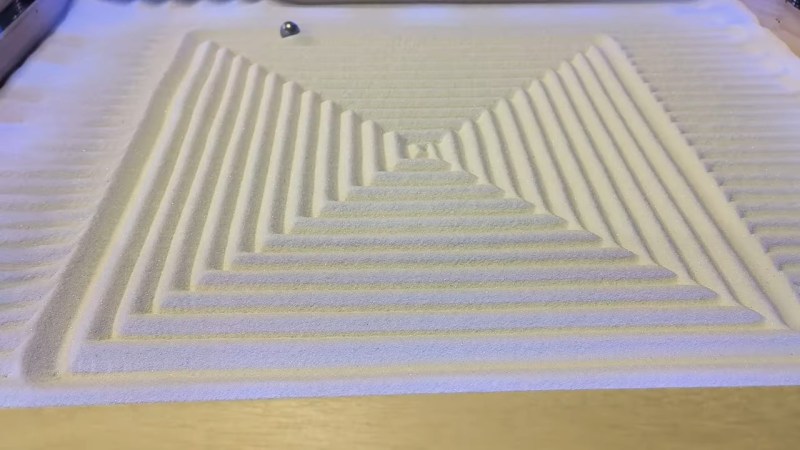
There’s nothing fun about a Sisyphean task unless you’re watching one being carried out by someone or something else. In that case, it can be mesmerizing like this Arduino-driven kinetic sand table.
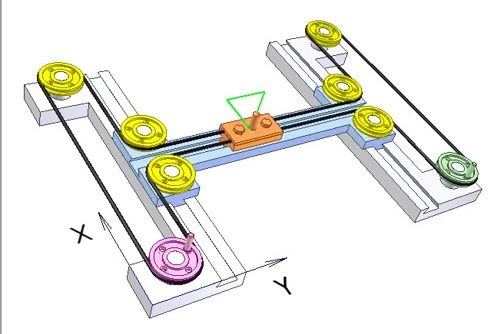
What you can’t see. Image via [thang010146] on YouTubeLike many of these builds, it all started with an ordinary coffee table from the hacker’s favorite furnitüre store. [NewsonsElectronics] opened it up and added a 3mm-thick board to hold the sand and another to hold the rails and magnets.
After designing some pieces to connect the rails and pulleys together, [NewsonsElectronics] let the laser cutter loose on some more 3mm stock. A pair of stepper motors connected to a CNC shield do all of the work, driving around a stack of magnets that causes the ball bearing to trudge beautifully through the sand.
Be sure to check out the videos after the break. The first is a nice demonstration, and the second is the actual build video. In the third video, [NewsonsElectronics] explains how they could write the world’s smallest GRBL code to swing this with a single Arduino. Hint: it involves removing unnecessary data from the g-code generated by Sandify.
Hours before sunrise on Monday morning, United Launch Alliance’s brand spankin’ new Vulcan Centaur rocket is scheduled to make its maiden flight carrying a historic passenger: Peregrine, the first American lunar lander to be sent to the moon in over 50 years. And its mission could mark a turning point in humankind’s exploration of the cosmos. Peregrine is not a NASA spacecraft, but one developed by Pittsburgh-based Astrobotic, a private company. If it survives touchdown, Peregrine will be the first commercial craft to successfully land on the moon — or any planetary body outside of Earth, for that matter.
Astrobotic is among a small group of companies that have been selected to carry out lunar deliveries for the space agency over the next few years as part of NASA’s new Commercial Lunar Payload Services (CLPS) program. Peregrine Mission 1, expected to launch January 8 at 2:18AM ET, is the first of these operations under a $79.5 million contract with the space agency. But it’s a wholly commercial endeavor, and alongside the five payloads it’ll deliver for NASA to support the upcoming Artemis missions, Peregrine will have cargo for other clients on board too, at a cost of $1.2 million per kilogram (roughly 2.2 pounds). That includes mini rovers and science instruments, collections of art and archival material, a physical “bitcoin” and, controversially, human remains.
Peregrine is headed for the moon’s nearside, the hemisphere that is always facing Earth. The 6-foot-tall, 8-foot-wide lander will (hopefully) touch down softly in a region named Sinus Viscositatis — the “Bay of Stickiness” — for the mysterious domes there that are thought to have been formed long ago by thick silicic lava. These peculiar features, called Gruithuisen Domes, don’t match up with the surrounding basaltic terrain, nor is the moon home to the ingredients so far known to give rise to silicic volcanoes.
Astrobotic
“The formation of the domes is a scientific mystery we are still working to understand,” said CLPS project scientist Paul Niles in a briefing on Thursday ahead of the launch. Peregrine will land near the domes on a patch of lunar mare, or the dark features created by hardened basaltic lava flows that we can see from Earth. The NASA payloads on board consist of a Laser Retroreflector Array (LRA), Neutron Spectrometer System (NSS), Linear Energy Transfer Spectrometer (LETS), Near InfraRed Volatiles Spectrometer System (NIRVSS) and Peregrine Ion-Trap Mass Spectrometer (PITMS). These instruments will gather data to help characterize the local environment.
“Three of our instruments will collect data on lunar volatiles using different techniques,” Niles said. “Two instruments will provide perspectives on the radiation environment at the lunar surface, helping us better prepare to send crewed missions back to the moon. We'll also learn information about the composition of the surface by evaluating its mineralogy.” Later, NASA will send another suite of instruments to the summit of Gruithuisen Domes.
As far as science deliveries are concerned, Peregrine will also carry a payload for Agencia Espacial Mexicana (AEM), the Mexican Space Agency. Its fleet of five mini rovers, each measuring just shy of 5 inches wide, will be the first Latin American science instruments to make it to the surface of the moon, according to Astrobotic. Carnegie Mellon University’s 4-pound Iris rover is hitching a ride on Peregrine too, with plans to snap photos that it’ll send back home. And the German Aerospace Center (DLR) is sending its M-42 radiation detector, which is intended to measure how much radiation a human would be exposed to on a roundtrip mission to the moon.
Among the non-science payloads, ULA’s Vulcan Centaur and Peregrine will be ferrying small portions of human remains for the space memorial companies Celestis and Elysium Space. Celestis has two separate memorial destinations planned for the trip: one, “Tranquility,” will land on the moon with Peregrine, while another, “Enterprise,” will continue on to deep space with the Centaur upper stage after it separates from the lunar lander. Flights like these that go beyond Earth’s immediate vicinity start at just under $13,000, and potential clients are given the option to send up symbolic amounts of either human ashes or DNA.
Astrobotic/ULA
One of the luminaries whose DNA is headed to the lunar surface will be 2001: A Space Odyssey co-writer and science fiction author, Arthur C. Clarke. On the Enterprise flight are the remains of several key figures from the Star Trek franchise, including series creator Gene Roddenberry, his wife, Majel Barrett Roddenberry, and their son Eugene “Rod” Roddenberry, plus Nichelle Nichols (Lt. Uhura of the original series) and her son, Kyle Johnson. Elysium has been less forthcoming about whose remains it’ll be sending.
There’s been some backlash about the idea of turning the moon into a memorial site. Navajo Nation President Buu Nygren spoke out against the upcoming mission after hearing about the plan, calling it “tantamount to desecration” for the many cultures who consider the moon to be sacred, Arizona Public Radio reported.
In response to questioning led by Reuters’ Joey Roulette during the NASA briefing on Thursday, members of the space agency repeatedly reiterated that the decision of which payloads to fly fell solely on Astrobotic. “They don't have to clear those payloads with us,” CLPS Program Manager Chris Culbert said. “These are truly commercial missions. It's up to them to sell what they can sell.”
The issue highlights one of the potential downsides to relying on contractors, and it’ll undoubtedly rear its head again as NASA leans more heavily on the commercial industry for future missions. While NASA may not be in the position to approve what payloads are included alongside its own on commercial missions, Culbert added that the teams “obviously have a lot of discussions about how the payloads fit together.”
The rest of the 20 total payloads are a mix of mementos and items representing Earth and the achievements of humanity. Astrobotic partnered with DHL to curate a “moonbox” of keepsakes that will fly with Peregrine, including items such as photographs, literature and even a chunk of Mount Everest. Hungary’s Puli Space Technologies and the UK’s SpaceBit are sending plaques to the lunar surface, while the Japanese space company Astroscale has filled a “Lunar Dream Capsule” with “185,872 messages from children from around the world.”
In addition to its rover, Carnegie Mellon created what it’s calling the “first museum on the moon.” The University’s MoonArk project, a small cylinder made up of four chambers that contain “hundreds of images, poems, music, nano-objects, mechanisms and samples from Earth,” will remain on the Peregrine lander where it can be appreciated by future visitors along with the other stationary objects on board. Similarly, Peregrine will carry the Arch Mission Foundation’s Lunar Library 2, which it calls “an ultra-durable archive of humanity.” Wikipedia is in there, as well as other major collections of Earthly information and human languages.
And, there are two bitcoin projects going to the moon with Peregrine because crypto is, apparently, inescapable: a physical bitcoin engraved with its private key, from the Seychelles cryptocurrency exchange BitMEX; and US-based BTC Inc.’s Bitcoin Magazine Genesis Plate, which includes a copy of the first block of bitcoin ever mined.
Once Peregrine reaches lunar orbit, it’ll remain there for a few weeks before making its attempt to land on the surface. That’s expected to happen on February 23. Considering the US hasn’t put a lander on the moon since the days of the Apollo mission, it’s a pretty big deal. But, it’s risky business. When it comes to moon landings, there have been far more unsuccessful attempts than successful ones. “Landing on the moon is extremely difficult,” Culbert said during NASA’s briefing. “We recognize that success cannot be ensured.”
Regardless, NASA and its commercial partners aim to keep trying, and in close succession at that. Peregrine Mission 1 will be followed by the second of NASA’s CLPS missions in February, led by Intuitive Machines. After that, there are plans for at least four more CLPS lunar launches before the end of 2024.
This article originally appeared on Engadget at https://www.engadget.com/peregrine-mission-1-heralds-the-beginning-of-the-moons-commercialization-140038460.html?src=rss
The Federal Aviation Administration (FAA) has ordered airlines to temporarily ground some Boeing 737 Max 9 planes for safety inspections after an Alaska Airlines plane lost a cabin panel during a flight on Friday with about 180 people on board. The plane, which had only been in service since November, according to the New York Times, was able to safely land back at Portland International Airport in Oregon, where it had taken off from. There were no major injuries, though the Alaska division of the Association of Flight Attendants said workers described “explosive” decompression in the cabin and reported one flight attendant sustained minor injuries.
“The FAA is requiring immediate inspections of certain Boeing 737 Max 9 planes before they can return to flight,” FAA Administrator Mike Whitaker said. “Safety will continue to drive our decision-making as we assist the NTSB’s investigation into Alaska Airlines Flight 1282.”
Immediately following the incident, Alaska Airlines CEO Ben Minicucci put out a statement saying the company would be grounding its fleet of 65 Boeing 737-9 aircraft for what it expects to be a few days as it conducts safety checks. “Each aircraft will be returned to service only after completion of full maintenance and safety inspections,” Minicucci. The FAA order extends the grounding to “approximately 171 airplanes worldwide” that are either operated by US airlines or in US territory.
Minicucci also said that the National Transportation Safety Board is investigating what happened with Flight 1282 and “we will fully support their investigation.” The plane had been on its way to Ontario, California. Reuters, citing FlightRadar24, reported that the blowout occurred at around 16,000 feet. In social media posts shared with Reuters and the NYT, passengers can be seen sitting right next to the gaping hole and the fully exposed sky.
Boeing's 737 Max was previously grounded for almost two years after fatal crashes in 2018 and 2019. All 189 people on board the plane were killed in the 2018 crash in Indonesia, and another 157 died in the 2019 crash in Ethiopia. In 2021, Boeing agreed to pay $2.5 billion in a settlement with the Department of Justice to avoid criminal charges over the crashes.
This article originally appeared on Engadget at https://www.engadget.com/faa-grounds-roughly-171-boeing-737-max-9-planes-after-a-cabin-panel-blew-out-during-flight-210331403.html?src=rss
Whether or not you’ve actively been using Threads, you may have noticed — thanks to its integration into the Instagram feed — an off-putting shift in the kinds of posts the platform has been recommending over the last few weeks. At best, you might be seeing tons of content that is of no interest to you whatsoever, or copypasta-style engagement bait. At worst? A whole lot of hate speech. In a short video shared on Friday responding to an Ask Me Anything question, Instagram head Adam Mosseri apologized for the “low-quality recommendations” proliferating on Threads and said the team is working on a fix.
“We want people to have a positive experience on Threads, and we’ve actually had some issues over the last few weeks with low-quality recommendations,” Mosseri said, “things that don’t quite violate our Community Guidelines — which is where we take content down entirely — but kind of go right up to that line. We’re working on improving it. A lot of it should be fixed at this point.” He goes on to say that while “there’s a lot more work to do,” users can “expect it to get much better over the next few weeks. Again, apologies.”
While Threads already felt cluttered with posts meant to milk engagement as new users try to generate followings on the budding social site, things have taken a palpably darker turn recently. Suddenly, ragebait seems to be front and center. Users have complained that they’re being suggested an alarming amount of hateful content, particularly posts that are outright transphobic. It’s crept into my own feeds, enough so that it feels like I’ve muted more accounts in the last two or so weeks than I previously had in six months on Threads.
Engadget asked Meta for clarification on whether the improvements Mosseri mentioned will specifically address transphobia and other forms of hate speech. In response, a spokesperson reiterated Mosseri’s comments and said, “In addition to removing content that violates our community guidelines, we're aware that some users are seeing this type of repetitive, low-quality content they may not be interested in, and we're taking steps to address it.”
This article originally appeared on Engadget at https://www.engadget.com/instagram-head-adam-mosseri-says-sorry-for-all-those-trashy-threads-recommendations-193001655.html?src=rss
Beats Fit Pro earbuds in the three newest colors have dropped back down to their best price in a deal on Amazon. The true-wireless, noise canceling headphones are 20 percent off for the Volt Yellow, Coral Pink and Tidal Blue designs, making them just $160. These popular earbuds normally go for $200, so you’d be saving $40. If those options are too vibrant for your style, there’s a 10 percent discount on other, subtler colors as well. That includes Beats Black, Beats White, Sage Gray and Stone Purple, which are all just $180 with the current deal.
Beats Fit Pro buds are a great choice for both Apple and Android users, especially if you’re looking for reliable workout earbuds. They’re among the best wireless earbuds you can get today, and our favorite for fitness. With an IPX4 water resistance rating, they’ll hold up against sweat and splashes of water, like light rain. They have comfortable silicone ear tips and secure-fit wings that are meant to keep them in position in your ear. Beats Fit Pro earbuds are also equipped with Active Noise Canceling and Spatial Audio so you can really get in the zone.
As for battery life, they achieve up to 6 hours of listening, which can be extended to as much as 24 hours with the charging case. Beats Fit Pro earbuds run on Apple’s H1 chip, and have a slew of convenient features for iPhone users, like quick pairing, hands-free Siri access and Audio Sharing with other Apple devices or Beats earbuds. That means you can sync up with your workout buddy (as long as they’re using a compatible device) for tandem listening.
Android users may not get all the extra perks, but they can still make use of the buds’ high-quality audio and on-device controls. When pairing them in the Android app, you’ll also have the option to fine tune the audio with Beats’ Fit Test. In the box, Beats Fit Pro come with a charging case in the same color as the earbuds, silicone ear tips in three sizes and a USB-C charging cable.
This article originally appeared on Engadget at https://www.engadget.com/the-beats-fit-pro-noise-canceling-wireless-earbuds-are-20-percent-off-at-amazon-160536914.html?src=rss
In November, a group of non-fiction authors filed a lawsuit accusing OpenAI and Microsoft of using other people's intellectual property without permission to train the former's generative AI technology. Now, more non-fiction writers are suing the companies for using their work to train OpenAI's GPT large language models (LLM). Journalists Nicholas A. Basbanes and Nicholas Gage are accusing the defendants of "massive and deliberate theft of copyrighted works" by writers like them in a proposed class action lawsuit.
Professional writers "have limited capital to fund their research" and "typically self-fund their projects," they said in their complaint. Meanwhile, the defendants have "ready access to billions in capital" and "simply stole" the plaintiffs' "copyrighted works to build another billion+ dollar commercial industry," they allege. Using copyrighted works is a "deliberate strategy" by the companies, the complaint reads, and not paying writers give the defendants "an even higher profit margin." The plaintiffs added that the companies could've explored alternative financing options, such as profit sharing, but have "decided to steal" instead.
Basbanes and Gage are seeking "to represent a class of writers whose copyrighted work has been systematically pilfered" by the defendants. They're seeking up to $150,000 per infringed work in damages, as well as a permanent injunction "to prevent these harms from recurring." Basbanes is a "renowned authority on the history of books and book culture." Gage, according to the CNBC, had previously worked for the Times and The Wall Street Journal.
OpenAI is contending with a growing list of lawsuits filed by creatives accusing it of using their work without permission to train its LLMs, including one by fiction authors George R.R. Martin, John Grisham and Jodi Picoult. In late December 2023, The New York Times sued the company and its biggest backer, Microsoft, for using the newspaper's articles for AI training. An OpenAI representative told us at the time that both parties were engaged in "productive conversations" and that the lawsuit was unexpected.
This article originally appeared on Engadget at https://www.engadget.com/more-non-fiction-authors-are-suing-openai-and-microsoft-103046599.html?src=rss
The US Department of Justice (DOJ) could file “a sweeping antitrust case” against Apple as soon as the first half of this year, according toThe New York Times. The report says the agency is in “the late stages” of its investigation, focusing on the company’s control over hardware and software services and how its “walled garden” approach has allegedly made it harder for rivals to compete and customers to switch to competing products.
The New York Times report says the investigation has expanded beyond what was previously reported, according to people with knowledge of the meetings. Among other areas, its scope has allegedly covered how the Apple Watch is more tightly integrated with iPhone services than rival wearables and how it locks competing platforms out of iMessage.
Executives from Beeper, which got into a public spat with Apple late last year over the iPhone maker’s blocking of the app’s iMessage integration on Android, reportedly talked with investigators. In addition, Tile, which has made Bluetooth trackers since long before the AirTag existed, allegedly sat down with the DOJ, too. The agency is said to have “had conversations with” representatives from banking and payment apps about Apple’s practice of blocking rivals from using tap-to-pay on the iPhone.
Meta also reportedly talked with investigators. The social company allegedly “encouraged” the DOJ to look into Apple’s App Tracking Transparency (ATT) privacy tool in its meetings. ATT, launched in 2021, lets users hinder advertisers’ data collection, a feature Meta said in 2022 could cost it $10 billion that year. The NYT claims investigators have also looked into Apple’s cut of digital purchases made on the iPhone, a point Spotify, Epic Games and dating corporation Match Group have been vocal about in recent years.
The federal government currently has its hands full with Big Tech antitrust cases. The DOJ is pursuing two antitrust cases against Google (one for search and another for advertising), while the FTC has sued Meta and Amazon.
This article originally appeared on Engadget at https://www.engadget.com/the-doj-is-reportedly-prepared-to-file-a-broad-antitrust-lawsuit-against-apple-213030784.html?src=rss
The Oral-B iO Series 7 smart electric toothbrush is down to $149 at Amazon after a $71 discount. That matches the best price we've seen and returns it to the low it hit for the shopping holidays last year. The deal comes as part of a larger sale in which Oral-B toothbrushes are up to 55 percent off. We named the iO Series 7 the top pick in our guide to smart toothbrushes because it hits a good balance between features and affordability (particularly if you can catch it on sale like right now).
We tested a handful of smart electric toothbrushes (in this case "smart" means app-connected) and ultimately liked this one best. It has a black and white LED screen that tells you helpful info like mode, battery life and how long is left on your two minute timer. The vibrating head is vigorous but not lip-numbing like other models we tried and the lighted ring helpfully indicates whether you're pushing too hard or not quite firmly enough.
If you want to brush while looking at your phone, you can watch an animated recreation of a set of teeth that slowly turns from blue to white as the internal sensors track the position and movement of your brush. It's a bit of a surreal experience, but I did notice my teeth felt cleaner after using this than they do with a standard brush.
This set comes with a replacement head, travel case and charging dock which you should only need to use a couple times per month. If you want something even fancier, the Oral-B iO Series 9 is also on sale. The Series numbering refers to the level of features, not the newness of the brush, so Series 9 has extra brush modes, a color LED screen and a charging travel case — all of which the Series 7 lacks. Though in my tests, I didn't find those perks were worth an additional $100.
This article originally appeared on Engadget at https://www.engadget.com/our-favorite-smart-electric-toothbrush-is-70-off-right-now-204912632.html?src=rss