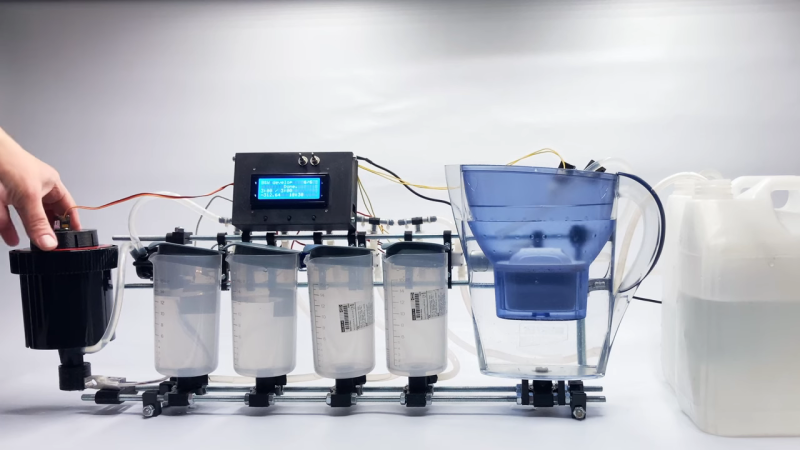
Anyone who has ever processed real analog film in a darkroom probably remembers two things: the awkward fumbling in absolute darkness while trying to get the film loaded into the developing reel, and the tedium of getting the timing for each solution just right. This automatic film-developing machine can’t help much with the former, but it more than makes up for that by taking care of the latter.
For those who haven’t experienced the pleasures of the darkroom — and we mean that sincerely; watching images appear before your eyes is straight magic — film processing is divided into two phases: developing the exposed film from the camera, and making prints from the film. [kauzerei]’s machine automates development and centers around a modified developing tank and a set of vessels for the various solutions needed for different film processes. Pumps and solenoid valves control the flow of solutions in and out of the developing tank, while a servo mounted on the tank’s cover gently rotates the reel to keep the film exposed to fresh solutions; proper agitation is the secret sauce of film developing.
The developing machine has a lot of other nice features that really should help with getting consistent results. The developing tank sits on a strain gauge, to ensure the proper amount of each solution is added. To avoid splotches that can come from using plain tap water, rinse water is filtered using a household drinking water pitcher. The entire rig can be submerged in a heated water bath for a consistent temperature during processing. And, with four solution reservoirs, the machine is adaptable to multiple processes. [kauzerei] lists black and white and C41 color negative processes, but we’d imagine it would be easy to support a color slide process like E6 too.
This looks like a great build, and while it’s not the first darkroom bot we’ve seen — we even featured one made from Lego Technics once upon a time — this one has us itching to get back into the darkroom again.
CES is the type of show where one is likely to come across all sorts of dorky, Geordi La Forge-esque smart glasses, but some do manage to include some practical features — like ViXion's auto-focus eyewear. The company, which is a spin-off of Japanese optics specialist Hoya, showed off its the ViXion01, at CES Unveiled 2024, and it's aimed at people who struggle to focus their eyes due to strain, old age or the time of day. After a quick demo, I could also see myself benefitting from it on a daily basis. I even dig the futuristic look on these glasses, which are the work of Japanese design firm, Nendo.
At the heart of the ViXion01 is its front-facing ToF (time of flight) sensor, which lets it measure the distance of your target object and quickly adjust its lenses on the go. The basic concept is similar to a University of Utah prototype that popped up at CES 2017, but ViXion managed to miniaturize and even begin to commercialize it. According to project director Toshiharu Uchiumi, his device will do wonders to enhance fine details in applications like model kit assembly or reading small print.
Photo by Richard Lai / Engadget
Initial setup was straightforward. I had to first manually slide both lenses to get a single centered image, then I moved on to the diopter adjustment dial on the right to bring each of my eyeballs into focus, which worked fine despite my myopia of around -4.5 D (you can also set this up in the app via Bluetooth 5.0 connectivity). While the ViXion01 weighs 50 grams, the main circuitry and battery housed on the right made an apparent imbalance, but I didn't have enough time to tweak my fit on the bendable left arm and nose pads.
Otherwise, it was a surprisingly pleasant experience, visual-wise. My eyesight was sharper than usual for both far and close distances (down to two inches), and I didn't feel as much eyestrain as I would usually get when looking at things up close — seemingly ideal for when I work on my Gundam models. The automatic switch between different focal distances felt swift and seamless as well.
There are some caveats, though. First off, ViXion stresses that this is not a medical device, and that you should avoid wearing it while driving or exercising — makes sense given the limited field of view due to the black rings housing the lenses. With that in mind, the 10-hour battery life should be sufficient, and then it's a three-hour charge via USB-C. It's also not waterproof, though it is rated with IPX3 water resistance, which can probably tolerate light rain or sweat.
The ViXion01 is now available for pre-order in Japan for 99,000 yen (about $690), with shipments expected to begin in February. There's no plan on an overseas launch just yet, but if that ever happens, chances are ViXion will need to come up with a wider version, anyway.
We're reporting live from CES 2024 in Las Vegas from January 6-12. Keep up with all the latest news from the show here.
This article originally appeared on Engadget at https://www.engadget.com/vixion01-glasses-reduce-eyestrain-by-doing-the-focusing-for-you-205106281.html?src=rss
LG has been trickling in news about its latest product drops at CES this year, with some first-of-its-kind headliners including its wireless transparent OLED TV, an ultra portable 4K projector and a friendly looking two-legged robot that can roam your house and watch your pets.
The 77-inch signature OLED T has turned heads with its unique "transparent" look and wireless audio and video capabilities. It's also powered by a processor that improves overall display performance and visuals by 70 percent compared to the precious gen chip, according to LG. Its OLED TV lineup is also getting bigger with the expected launch of the LG Signature OLED M4 and OLED G4 TVs. Both have Alpha 11 AI processor chips embedded in their design which are meant to up their display properties. The AI chips promise to reduce visual blurring and improve color contrasts.
There are some other big developments worth getting excited about in its display offerings — but in the gaming sphere. LG announced a 27-inch QHD OLED gaming display with an extremely fast 480Hz refresh rate.
This article originally appeared on Engadget at https://www.engadget.com/watch-lgs-ces-2024-keynote-in-10-minutes-194905188.html?src=rss
NVIDIA was one of the first big names to hold a keynote at CES 2024. If you don't have time to watch the full video but still want to find out how NVIDIA revealed its news, you can watch our supercut, which boils the event down to just under 10 minutes.
As expected, the company refreshed its lineup of graphics cards with RTX 40 Super GPUs that are slated to deliver performance boosts at lower prices. The RTX 4080 Super ($999) and RTX 4070 Ti Super ($799) are set to go on sale later this month and are said to be faster than their predecessors.
NVIDIA hasn't divulged the full specs of the latest GPUs yet, but the RTX 4070 Ti Super will have 16GB of memory, compared with the previous model's 12GB. With DLSS enabled, the 4080 Super is said to deliver twice the performance of the 3080 Ti. NVIDIA will also offer a mid-range RTX 4070 Super GPU, which will cost $599 and have 20 percent more cores than the previous version.
Given the current landscape, NVIDIA had a number of AI products to discuss too. For one thing, it's partnering with Getty Images to offer a text-to-image generative AI service that appears to include intuitive editing tools. The keynote took a look at some of NVIDIA's robotics work as well.
NVIDIA also announced several GeForce Now updates. The service will soon support G-Sync as well as day passes, which provide 24 hours of access to the paid tiers. More notable games such as Overwatch 2 and Diablo IV are on the way to the platform, which will soon open for business in Japan.
We're reporting live from CES 2024 in Las Vegas from January 6-12. Keep up with all the latest news from the show here.
This article originally appeared on Engadget at https://www.engadget.com/watch-nvidias-ces-2024-keynote-in-10-minutes-192533238.html?src=rss
The Peregrine spacecraft has experienced an ‘anomaly’ that could endanger its planned moon landing, as reported by the BBC.Astrobotic, the private company behind the project, says this anomaly prevents the spacecraft from pointing its solar panels at the sun. In other words, the vehicle can’t charge its battery. Without power, the planned lunar landing for February might have to be canceled.
Astrobotic engineers are working the problem and will provide updates as they become available. The launch itself went off without a hitch early this morning, as the issue popped up during post-launch checks after communications had been established. The team behind the launch suggest the most likely cause of the anomaly is a problem with propulsion. Unfortunately, the engineers have a limited window of time to troubleshoot and fix the issue, as the spacecraft’s battery is currently “reaching operationally low levels.” There was a short comms breakdown, but it looks like that issue has been resolved.
The company has also stated that the propulsion issue led to a "critical loss of propellant." Astrobotic has planned for a wide variety of fault scenarios and could get everything squared away before too long, but it's looking less likely by the minute. The company says it's still trying to stabilize the propellant loss, but is investigating "alternative mission profiles" and trying to save as much science and data as it can.
Peregrine is supposed to be the first American lunar lander to visit the moon in over 50 years. The United Launch Alliance’s new Vulcan Centaur rocket carried the craft out of the atmosphere. If it manages to touch down on the moon, Peregrine will become the first commercial craft to land on any planetary body outside of Earth.
Though not directly affiliated with NASA, the Peregrine launch is part of the space agency’s new Commercial Lunar Payload Services (CLPS) program. To that end, it’s supposed to deliver five payloads to the moon for NASA to help prepare for the upcoming Artemis missions. It’s also carrying a number of payloads for commercial clients at a cost of $1.2 million per kilogram. This cargo includes everything from mini rovers and science instruments to art collections and physical representations of cryptocurrency.
There’s also human remains on board, including the DNA of science fiction author Arthur C. Clarke. Peregrine is scheduled to land on the moon’s nearside, which faces Earth, on February 23, though that timeframe could change or disappear altogether. Ahead of the launch, CLPS Program Manager Chris Culbert acknowledged that a lunar landing was not guaranteed, stating that “landing on the moon is extremely difficult.”
This article originally appeared on Engadget at https://www.engadget.com/peregrine-spacecraft-experiences-anomaly-that-could-threaten-moon-landing-191221991.html?src=rss
Until now, TCL has perhaps been best known not for the quality of its TVs, but its reasonable prices. This week at CES 2024, however, the company seems like it’s trying to reintroduce itself as the sort of premium player that can could compete with the likes of Samsung, LG and Sony. The brand just debuted a new 115-inch set, the 115QM89, that it claims is the largest MiniLED TV with Quantum Dot technology.
The TV is an offshoot from TCL’s broader QM8 line, which includes premium TVs in the 65- to 98-inch range. The new set brings over some features from TCL’s previous QM8 TVs, but it adds a 6.2.2 channel speaker system that delivers a more surround sound-like home theater experience. The mega-sized screen also has a TCL AIPQ ULTRA processor that allows it to deliver higher-quality and crisper images than any of TCL’s previous TVs were capable of. Notably, too, the 115QM89 has 20,000 dimming zones, which is important for a bigger display so that shadows and highlights appear more defined, making moody movies and TV shows appear more vividly on screen.
Aside from that showstopper 115-inch TV, TCL the company debuted the premium Q6-Pro in 50- to 85-inch screen sizes, with improved local dimming for a 33 percent boost in display brightness at 600 peak nits. It also added the QM7, another Mini LED device to its lineup — which offers better processing speeds and display brightness as well as overall image quality.
In TCL’s lower-end to midrange S line, the company announced the new S5, which offers 4K UHD resolution in 43- to 85-inch screen sizes. The company also says these TVs will be 25 percent brighter than the previous generation and will offer improved color depiction thanks to that new TCL AIPQ processor. Additionally, the S5 will include HDR PRO+ along with Dolby Vision for overall improved image quality.
Lastly, TCL introduced some new S and Q class soundbars. At the top of the line, these include the S55H, a new 2.1 Channel Dolby Atmos soundbar, and the Q85H, which offers 7.1.4 Channel Dolby Atmos sound and can wirelessly connect to rear speakers for what TCL describes as a more immersive sound experience.
This article originally appeared on Engadget at https://www.engadget.com/tcl-came-to-ces-2024-with-a-115-inch-miniled-quantum-dot-tv-190047876.html?src=rss
TCL is going for different with its new pro tablet, revealed at CES 2024. There aren’t that many premium tablets beyond the annual updates from Apple and Samsung, and TCL plans to make its new 14- and 10-inch slates stand out with their display tech, featuring its next-gen NXTPAPER 3.0. It's aimed at striking a middle-ground between e-readers and tablets. It’s not about them being sharper or faster, but gentler on our very human eyes.
The TCL NXTPAPER 14 Pro’s display features heavily focus on eye comfort, with a new VersaView interface that can switch between a black-and-white reader mode and the standard tablet views. The 14-inch 2.8K display (2,880 x 1,800) features the company’s new NXTPAPER 3.0, aimed at better reflecting, literally, how the human eye reads natural paper, but on a digital display. NXTPAPER is TCL’s display tech that tries to offer a tablet experience with a paper-like reading surface. We’ve written about earlier iterations found in devices like the NXTPAPER 11 tablet and even some of its recent budget smartphones.
The company says its next family of phones – no fewer than seven, including the TCL 50 XL NTXPAPER 5G and 50 XE NTXPAPER 5G – will also feature NXTPAPER 3.0 technology. The NXTPAPER 14 Pro is powered by MediaTek’s Dimensity 8020 chip, with 12GB of RAM and 256GB of storage, which is fine if unremarkable. It’s truly all about the screen.
Photo by Mat Smith/Engadget
TCL says its NXTPAPER series continues to filter out up to 61 percent of blue light to ease the effects on users’ eyes. Version 3.0 is brighter, hitting 700 nits on the 14-inch matte display. A new Circularly Polarized Light (CPL) screen should also light up text more naturally, while being easier to read in sunlight. TCL claims this creates a reading experience closer to reading books in natural light. There’s also DC dimming, which should also lower flickering effects experienced on some lower-refresh rate screens. In tablet mode, the NXTPAPER 14 Pro can reach up to 120Hz refresh rates, and the new CPL tech also means it maintains legibility even if you’re wearing polarizing lenses.
Meanwhile, the Tab 10 NXTPAPER 5G packs some of the same display technology (NXTPAPER 3.0) but on a 10.4-inch, 2K (2,560 x 1,440) screen. And no dedicated viewing mode button. It does, however, feature 5G support.
To really make sure you get it, TCL also created an Eye Health Assistant to nag remind you to reduce screen brightness or perhaps not stare at your new tablet at midnight. The NXTPAPER 14 Pro also has a dedicated physical button for switching between three different viewing modes. The tablet’s VersaView UI means users can switch between a standard tablet mode and NXTPAPER mode.
Photo by Mat Smith/Engadget
The latter is an e-ink style (but not e-ink!) monochrome mode, which rarely features on devices headed to the US. However, this isn’t just the tablet processing the Android interface into grayscale. The interface includes stripped-down icons, like line drawings, that can still be differentiated from each other and a lot more blank space and white backdrops for reading ease. It feels like a concentration mode, which I appreciated. You’ve probably heard of the ‘hack’ of turning your smartphone system into black-and-white to make everything less compelling. This simplifies everything 2even more aggressively while ensuring that some content, like video, can still be played in full color. Swiping around the tablet, or using TCL’s stylus on the screen in both modes was fluid, and refresh rates seem much improved from the earliest NXTPAPER hardware
There are no prices for either of TCL’s new tablets yet, but the company has confirmed that the NXTPAPER 14 Pro will be coming to the US in early 2024. In the meantime, these are our reigning picks for the best tablets you can currently buy.
We're reporting live from CES 2024 in Las Vegas from January 6-12. Keep up with all the latest news from the show here.
This article originally appeared on Engadget at https://www.engadget.com/tcls-nxtpaper-14-pro-is-somewhere-between-a-tablet-and-a-giant-e-reader-190047895.html?src=rss
AMD gave the first big keynote of manytocome for CES 2024 and revealed a couple of interesting products arriving this year. Chief among those is the $329 Radeon RX 7600 XT GPU designed for entry-level gaming, going on sale on January 24th. The main takeaway is that it's designed for 1440p gaming and should be a solidly more capable GPU than the RX 7600, though we didn't see any benchmarks against its main rival, NVIDIA's RTX 4060 8GB.
The other big news is AI acceleration for the company's Ryzen 8000G desktop processors. Those chips are aimed at folks trying to build capable systems on a budget, with the fastest Ryzen 7 $329 8700G model running eight cores between 4.2GHz and 5.1Ghz, while carrying Radeon 780M graphics.
The new NPU (neural processing unit) will speed up AI tasks without hitting your CPU or GPU, enabling features like Windows Studio Effects which can blur your background during video chats, or media editing in Adobe and Blackmagic's DaVinci software.
There's a fair bit of information, but we've made it easier by trimming the announcement down to just 7 minutes, while leaving out filler and extra details — so you should be able to catch up over a cup of coffee.
We're reporting live from CES 2024 in Las Vegas from January 6-12. Keep up with all the latest news from the show here.
This article originally appeared on Engadget at https://www.engadget.com/watch-amds-ces-2024-keynote-in-7-minutes-185209130.html?src=rss
For some companies, CES 2024 has started in earnest which means we'll soon get to see major car manufacturers show off what they've been working on. One of those is Honda, with its event live streaming on YouTube on June 9 at 1:30PM ET and features Honda's global CEO and EVP Toshihiro Mibe and Shinji Aoyama, respectively.
What we expect
Honda announced back in December that its new EV series would make its worldwide debut at CES 2024. "Honda will showcase the global EV series models and several key technologies that illustrate the significant transformation Honda is currently undergoing," the company stated at the time. What's unclear is how many new cars will be on display or what types of vehicles they will be.
The upcoming reveal builds on past promises from Honda to shift toward a more environmentally friendly lineup. In 2021, Honda stated its plans to have all car sales be electric or fuel cell models by 2040. The following year, it announced an investment of five trillion yen (about $35 million) into electrification efforts over the next decade. Honda also shared its aim that, by 2030, it will have launched 30 more EV models, and EVs will make up 40 percent of its models.
Tune in to Honda's live stream below to see its new EV series for yourself.
We're reporting live from CES 2024 in Las Vegas from January 6-12. Keep up with all the latest news from the show here.
This article originally appeared on Engadget at https://www.engadget.com/how-to-watch-honda-unveil-its-new-ev-series-at-ces-2024-183012049.html?src=rss
NVIDIA had more news up its sleeve at CES 2024 beyond a slew of new GPUs. The company announced a bunch of updates for its GeForce Now cloud gaming service, including the addition of G-Sync tech and day passes for its paid subscriptions.
Cloud G-Sync support, which is coming soon, will work on displays with variable refresh rates as well as monitors that are compatible with G-Sync. GeForce Now will adjust the display’s refresh rate to match the streaming rate, in the aim of minimizing latency and stutter to deliver smoother gameplay.
If you're an Ultimate subscriber, you'll also have access to increased NVIDIA Reflex support on certain titles. Alongside a 240fps mode, Reflex (another feature designed to reduce latency) will soon support streams up to 4K resolution and at 60fps or 120fps to give players more options. In addition, Android users will soon be able to stream GeForce Now to their devices at 1440p resolution.
Starting in early February, you'll be able to check out the GeForce Now Ultimate and Priority tiers without having to sign up for one or six months out of the gate thanks to day passes. These provide 24 hours of access to the respective tier with all of Ultimate or Priority features enabled. Both tiers offer ray-tracing with Ultimate offering access to DLSS 3.5 and Reflex as well. An Ultimate day pass costs $8, while a Priority day pass will run you $4. The monthly price for each tier is $20 and $10, respectively.
Elsewhere, NVIDIA has revealed a bunch of high-profile games that are coming to GeForce Now soon. Overwatch 2 and Diablo IV are the next Activision Blizzard titles to hit the service following NVIDIA's pact with the publisher's new owner Microsoft. Three Call of Duty titles hit the service in November. The Steam versions of both Blizzard games will be available at first, though NVIDIA notes that support for the Battle.net launcher is on the way. Capcom's dinosaur shoot-'em-up Exoprimal (arriving January 18), Honkai: Star Rail from Genshin Impact developer HoYoverse and Mainframe Industries’ Pax Dei are on the way too.
Last but not least, NVIDIA is bringing GeForce Now to Japan this spring. It's doing so with the help of Japanese telecom company KDDI.
We're reporting live from CES 2024 in Las Vegas from January 6-12. Keep up with all the latest news from the show here.
This article originally appeared on Engadget at https://www.engadget.com/nvidia-is-bringing-day-passes-and-g-sync-to-geforce-now-182518914.html?src=rss