Russia is partially restricting access to Facebook. Telecom regulator Roskomnadzor says the move is in response to parent company Meta restricting the official accounts of four Russian media outlets. It said Meta was violating Russian law by doing so.
Roskomnadzor asked Meta for an explanation and to remove the restrictions on Thursday. After the company "ignored" the demands, officials decided to restrict access to Facebook, a measure Roskomnadzor says is in accordance with the law. The watchdog claims to have recorded 23 cases of "such censorship of Russian media and Internet resources by Facebook" since October 2020 (per a Google Translate version of its announcement).
The extent of these restrictions on Facebook is not yet clear. Engadget has asked Meta for comment.
Reports suggest Russia tried to spread propaganda and misinformation for weeks in the lead up to its invasion of Ukraine. According to NBC News, experts expect the level of disinformation to increase significantly.
As the invasion began on Thursday, Facebook enabled its "lock profile" tool in Ukraine to help residents protect their accounts. Twitter's Safety team, meanwhile, shared some tips in Ukrainian on how to keep accounts secure.
Right now, we’re living in a golden (micro) age of prestige TV adaptations depicting notable startup failures. In the first half of 2022 alone, we’re getting shows about the rise and fall of Uber, Theranos and WeWork all fronted by A-list talent. It’s a sign of how far the public’s tastes have changed that the travails of a tech, well, “tech” company is now mainstream entertainment.
Yesterday, I binge-watched seven of the eight episodes of Hulu / Star’s The Dropout, Disney’s adaptation of the ABC podcast series of the same name. It stars Amanda Seyfried as Elizabeth Holmes, founder of the fraudulent blood-testing startup Theranos. Holmes is currently awaiting sentencing after being found guilty of committing fraud, while Seyfried can probably expect to pick up a number of plaudits for her performance come awards season.
The series covers the broad strokes of Holmes’ life in roughly chronological order, albeit with the odd timely flashback where necessary. We meet Holmes as a WASP-y teen with dreams of Stanford, backed by her Enron-executive dad and Washington insider mom. From there, Holmes travels to China to study abroad, where she meets Sunny Balwani, her future business and life partner. When she gets to Stanford, she’s frustrated at senior academics who tell her that her biotechnology idea is unworkable, and drops out to start her own company.
Given Theranos’ penchant for secrecy, it amused me that Disney asked critics not to reveal any “surprising plot points or spoilers.” I’ll keep details to a minimum here, but obviously it’s hard to imagine a large number of people not already knowing the bones of this particular saga. In fact, since Theranos closed in 2018, it’s already been the subject of a major podcast, a book, an Alex Gibney documentary and a long-gestating Adam McKay movie in development at Apple.
Going in, I was concerned that The Dropout would suffer the same problem as The Founder, 2016’s biopic of Ray Kroc. It’s a fine film, but one that doesn’t know if Kroc is its hero or its villain, despite the stock rags-to-riches tropes it wheels out. In some scenes, he is portrayed as a try-hard who saw an opportunity and built an empire, in others, a ruthless conman who stole the business out from under the McDonald brothers. The tonal whiplash made the film offer two competing arguments, neither of which were very well-explained.
There’s no such problem here with The Dropout, with series creator Elizabeth Merriweather always being clear-eyed about Holmes’ problems. It’s almost a minor-key parody of those rags-to-riches stories, aided by the fact that Holmes’ went from riches to, uh, more riches. Moments that, in any other story, should be triumphant are undercut with dissonant music and there’s always a sense that there’s something not quite right about all of this.
Beth Dubber / Hulu
None of that would work without Amanda Seyfried’s performance which manages to sell Holmes as both a well-meaning neophyte and a cold, calculating monster. In the series' most shocking moment, Seyfried somehow makes you feel abject pity and outrage at the same time. And the show works hard to keep reminding you that this isn’t just about some elderly Republicans who got fleeced backing a boondoggle but, in a phrase repeated throughout the show; “real people.”
It helps that the show has assembled a murderer’s row of talent to appear alongside Seyfried in the series. As well as Naveen Andrews as Sunny Balwani, there’s (deep breath) William H. Macy, Elizabeth Marvel, LisaGay Hamilton, Michael Gill, Laurie Metcalf, Kurtwood Smith, Kate Burton, Michael Ironside, Nicky Endres and Anne Archer. Deserving extra praise is Stephen Fry, however, who offers some fantastic work as Dr. Ian Gibbons, the chemist who worked with Holmes at the start of her career and died by suicide during a patent dispute. Fry, towering over the rest of the cast and looking every inch the crusty academic in a world of waxen silicon valley models, acts as the warm and inviting voice of conscience when things start to hit the slide.
Disney is marketing The Dropout as a drama, but the sort of drama where the satire is razor wire sharp and the jokes are beyond morbid. Succession fans will find much to love about the series dark humor, especially the all-out fourth episode, which borrows Alan Ruck to guest as Walgreens’ executive Dr. Jay Rosan. In other places, however, the satire of both Silicon Valley and investment culture in general is far more subtle. Only in this series can two characters declare their love for each other while creating a pact for mutually-assured blackmail at the same time.
There is, rather obviously, a gendered element to the endless speculation and hand-wringing about Holmes’ motives and actions. The press never seems to need to psychoanalyze why Elon Musk and Jeff Bezos are dick-wagging with their competing space projects. Merriweather chooses to highlight this disparity, mostly through the voice of Laurie Metcalf’s Dr. Phyllis Gardner – the Stanford professor who initially told Holmes that her ideas couldn’t work. She pops up several times in the show to offer meta-commentary on what we’re watching.
One of the things the show serves to highlight is how much of an easy ride Theranos got from investors and the press. Despite refusing to justify any element of its technology, it took far too long for regulators and officials to really interrogate what was going on here. I mean, in 2015, Holmes was appointed to the board of fellows at Harvard Medical School! The scale of the fraud, the scale of the lie, became so great that most people just felt that they had to believe it.
It’s funny, I’m reminded of a story I wrote for Engadget back in 2016 which just summed up John Carreyou’s Wall Street Journal reporting. But despite just citing and quoting Carreyou’s work, I was on the receiving end of a 21-email nastygram from Theranos’ then-PR representatives. The company’s image management team jumped hard on any and all criticism. When Holmes and Balwani were charged by the SEC, I emailed that same PR person to ask if they had any comment on their previous statements. It was the most delicious “no comment” I have ever received.
A common complaint of Peak TV is that most shows could be done and dusted in a third of the time actually allowed. Despite watching almost all of The Dropout over a single day, I actually felt like the show could have been longer. There’s plenty that, by necessity, has had to be cut, glossed and generally trimmed to get things down to a tight eight hours. I could easily have watched another couple hours with more context and detail, but then I’ll admit, I am a nerd. You won’t be able to, however, since Hulu is releasing the first three episodes on March 3rd and then the rest on subsequent Fridays through the start of April. That’s a smart decision, since the first three are more or less designed as a cohesive whole, while subsequent episodes can be enjoyed individually.
Fundamentally, The Dropout is well worth your time, and Amanda Seyfried offers some truly stellar work bringing the duality of Holmes to life.
In the US, the National Suicide Prevention Lifeline is 1-800-273-8255. Crisis Text Line can be reached by texting HOME to 741741 (US), 686868 (Canada), or 85258 (UK). Wikipedia maintains a list of crisis lines for people outside of those countries.
This week we saw a number of gadgets from Lenovo, Samsung and others go on sale. Lenovo's new Smart Clock Essential with Alexa support is down to only $50 right now, while a number of Samsung Odyssey gaming monitors have great discounts. You can officially buy Samsung's latest smartphones today, too, and you'll get a credit if you go through Amazon. Plus, Roku's Streaming Stick 4K+ is 30 percent off and down to $49. Here are the best tech deals from this week that you can still get today.
Lenovo Smart Clock Essential (Alexa)
Lenovo
Lenovo's new Smart Clock Essential with Alexa support is on sale for $50 right now, or 29 percent off its normal price. This version has a slightly different design than the original, featuring pogo docking pins on the bottom, and new fabric colors. Otherwise, it does all of the things the Google Assistant-version did, only with Alexa. It also doesn't have a built-in camera, which will make it more appealing to those concerned about privacy.
Certain colors of the Apple Watch Series 7 are down to $349, or $50 off their normal price. Apple's latest flagship smartwatch earned a score of 90 from us for its slightly larger display, faster charging and handy watchOS8 features.
Samsung's 49-inch Odyssey Neo G9 mini-LED curved gaming monitor is still $500 off and down to $2,000. Yes, it's still a pricey display, but serious gamers who want a more immersive experience will find it worthwhile. It has a 5,120 x 1,440 resolution with a 240Hz refresh rate, along with high contrast ratios, bright HDR performance and support for NVIDIA G-Sync and AMD FreeSync Premium Pro. If you don't want to drop so much on one monitor, a number of other Odyssey displays are on sale, too, including the 34-inch Odyssey G5 curved monitor for $430.
Amazon's offering a $100 credit to those that order any of the three smartphones in the new Samsung Galaxy S22 lineup. All you have to do is enter the promo code on the product page before you check out, and you'll get an email after your handset ships with the details of the credit being added to your Amazon account. Those considering the Galaxy S22 have an extra incentive on top of that — $100 off in the form of an on-page coupon that you can clip, which will bring the price of the base model down to $700.
Roku's new Streaming Stick 4K+ is down to $49, or 30 percent off its normal price. In addition to 4K streaming, it supports HDR10+, a faster processor and it comes bundled with the Roku Voice Remote Pro, which lets you use voice commands to search and issue verbal commands.
The six-quart Instant Pot Max is down to a record low of $75, or half off its normal price. This multicooker has a large touch screen for easy programming, 15psi of pressure so you can experiment with canning and a sous vide cooking option.
Samsung's T7 portable SSD in 1TB is down to a record low of $110, or 35 percent off its usual rate. It's one of our preferred drives if you need something compact, speedy and compatible with a bunch of devices. We also like its aluminum unibody and its Dynamic Thermal Guard that helps control heat levels.
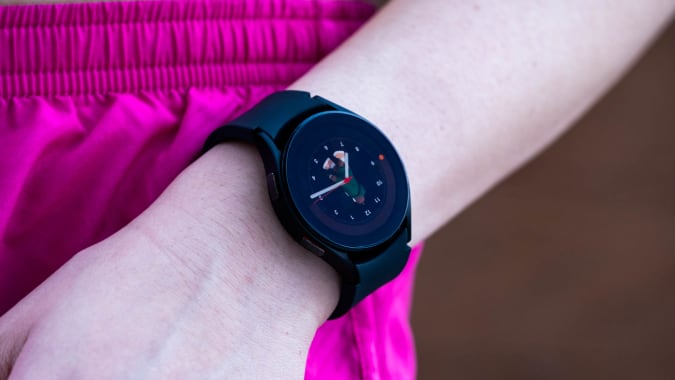
Samsung's cellular Galaxy Watch 4 models are on sale for record-low prices right now. The 40mm model is down to $220 while the 44mm version is down to $250. We consider the Galaxy Watch 4 to be the best Android smartwatch you can get and it earned a score of 85 for its bright screen, comprehensive health tracking and new Wear OS features, like downloading apps directly from the Play Store.
Samsung's 980 Pro internal drive in 2TB is 35 percent off and down to $280 — a great price for a powerful SSD that works with the PS5 (provided you have a heatsink). It has read speeds up to 7,000 MB/s, advanced thermal controls and works with Samsung's Magician Software, which lets you check its health and optimize settings as you'd like.
Prime members can get $20 off the Nintendo Switch at Woot right now. While the discount isn't on the OLED model, it's a good sale on a console that rarely sees sales like this. Just make sure to check out Woot's return policy before buying.
Eufy's baby monitor is on sale for $119, which is close to its all-time-low price. This model comes with one camera and a separate monitor display with a 5-inch 720p screen. The camera lens can pan and tilt to see most of your baby's nursery, and it can send alerts when your baby starts crying. The monitor supports two way audio and, since it's not a WiFi-connected device, the feed is secure and private.
Apple's magnetic battery pack for iPhones is down to $88, which is 11 percent off its normal price. We have seen it cheaper in the past, but this is the best price we've seen since December. The accessory attaches magnetically to the back of the latest iPhones and provides up to 15W of wireless charging.
The on-demand fitness service Alo Moves has an offer few new members that knocks 50 percent off the price of a one-year membership, bringing it down to $99. The platform has dozens of yoga, pilates, barre and strength training classes, along with guided meditations and series that help you master specific skills over the course of longer periods of time.
NordVPN's latest sale knocks the price of a two-year subscription down to just under $96, plus you'll get a free gift on top of it. The prize isn't anything physical, but rather additional subscription time on top of the two-year plan you paid for. Prizes are chosen at random, but after you make your purchase, you'll get either an extra month, and extra year or an extra two years added on to your subscription.
Apple's second-generation AirPods are down to £99 at Amazon. These don't have some of the bells and whistles that the new third-gen models do, but they remain a decent option for Apple users on a budget. We gave them a score of 84 when they first came out for their improved wireless performance and solid battery life.
Sony's WF-1000XM3 earbuds are on sale for £76, or 31 percent off their normal price. These buds earned a score of 89 for their excellent sound quality, great battery life and full-featured companion app.
Fitbit's most advanced smartwatch, the Sense, is down to £189 right now. That's not a record low, but it's still 37 percent off its usual rate. We gave it a score of 82 for its comprehensive health tracking features and big, bold display.
Strange days out here on the internet. Dangerous days, too. Facebook groups have people drinking horse dewormer in anticipation of JFK Jr’s resurrection, Instagram’s filling kids up with eating disorders and suicidal ideations, while Twitter just peals along with that irate, mosquito-pitched whine you hear right just before everything goes red. Algorithmically-elected, engagement-optimized push notifications, suggestions, tips and tricks from the hottest thinkfluencers of the minute, pop, pop, popping up unbidden and inescapable, demanding the fealty of our screens as counted by our click throughs.
But the internet today is not the internet of 13 halcyon years ago, in 2009. Nor is it now as it might be 13 years hence, in 2035. The societal divisions we currently face could deepen into outright catastrophe over the next decade because, remember kids, it’s only ever the worst day of your life so far. Then again, humanity might just buck its ingrained tendencies and come together to build a more robust, more resilient reimagining of today’s internet. One that finally exemplifies the “us” that could be if you wasn’t playin’.
What form those future public spaces eventually take is anybody’s guess… so Pew Research Center had some of the best-informed technologists in the industry give theirs. The PRC partnered with Elon University’s Imagining the Internet Center in mid-summer of 2021 to survey 862 “technology innovators, developers, business and policy leaders” in a non-scientific canvassing. They were asked, “looking ahead to 2035, will digital spaces and people’s use of them be changed in ways that significantly serve the public good?”
The results were mixed. Of those polled, 61 percent of respondents predicted that things will change for the better by 2035, though 18 percent of them argued that currently “digital spaces are evolving in a mostly negative way” (compared to just 10 percent who think its evolution is mostly positive).
Their concerns centered around four thematic problems: Humans behave selfishly when not tethered by traditional societal norms; the rate of online advancement has confounded society’s less tech-savvy members, making them more susceptible to malicious digital systems they don’t fully understand; governments are increasingly ineffective at regulating the tech industry; and, as such, trolls, scammers and Nazis continue to run amok in digital public spaces. And though few of the respondents held much confidence in society’s short term solutions, many remained hopeful that we’ll get our collective act together and start acting like grown-ups on the internet by the middle of the next decade. Three cheers for low bars.
A lack of real-life repercussions will continue to foster boorish behaviors online
Harassment, cyberbullying, and doxxing are endemic to online interaction. For example, a 2019 report from the Anti-Defamation League (ADL) found that two-thirds of US online gamers have experienced "severe" harassment with more than half reporting having been been targeted based on their race, religion, ability, gender, sexual orientation or ethnicity; and nearly 30 percent claiming they've been doxxed in an online game. Likewise celebrities, politicians, professional athletes and public figures — even the unwilling ones — are all seemingly fair game for the vitriol of online mobs.
“Toxicity is a human attribute, not an element inherent to digital life,” Zizi Papacharissi, professor of political science and professor and head of communication at the University of Illinois-Chicago, told Pew surveyors. “Unless we design spaces to explicitly prohibit/penalize and curate against toxicity, we will not see an improvement.”
“My strong sense is that the conditions and causes that underlie the multiple negative affordances and phenomena now so obvious and prevalent will not change substantially,” Charles Ess, emeritus professor in the department of media and communication at the University of Oslo, told Pew. “This is… about human selfhood and identity as culturally and socially shaped, coupled with the ongoing, all but colonizing dominance of the US-based tech giants and their affiliates. Much of this rests on the largely unbridled capitalism favored and fostered by the United States.”
The progression of internet norms is occurring too rapidly for older generations to coherently process, leaving them increasingly vulnerable to bad actors
20th Century Fox
“Transformation and innovation in digital spaces and digital life have often outpaced the understanding and analysis of their intended or unintended impact and hence have far surpassed efforts to rein in their less-savory consequences,” Alexa Raad, chief purpose and policy officer at Human Security, told Pew Research. Rick Doner, a retired emeritus professor formerly at Emory University added, “We now have a vicious cycle in which the digital innovations are undermining both the existing institutions and the potential for stronger institutions down the road.”
The effects of this can be seen in the blackbox problem, in which the decision-making processes of AIs and algorithms are obscured from the humans who built them. Wisconsin’s use of the Compas judicial sentencing software is one such example.
“One of the biggest challenges is that the systems and algorithms that control these digital spaces have largely become unintelligible,” Ian O’Byrne, an assistant professor of Literacy Education at the College of Charleston, told Pew. “For the most part, the decisions that are made in our apps and platforms are only fully understood by a handful of individuals.”
“We have ample evidence that significant numbers of humans are inherently susceptible to demagogs and sociopaths,” Randall Gellens, director at Core Technology Consulting, told Pew Research. “I see digital communications turbocharging those aspects of social interaction and human nature that are exploited by those who seek power and financial gain, such as groupthink, longing for simplicity and certainty, and wanting to be part of something big and important.”
“Better education, especially honest teaching of history and effective critical-thinking skills, could mitigate this to some degree,” Gellens noted, “but those who benefit from this will fight such education efforts, as they have, and I don’t see how modern, pluralistic societies can summon the political courage to overcome this.”
Wherein America’s gerontocracy sets out to fix a series of tubes
Elizabeth Frantz / reuters
Looking at the interactions between America’s elected representatives and the heads of various social media companies in recent years, Gellens’ prediction seems reasonable if not outright expectable. For example, hearings regarding Section 230 (which governs the liability social media companies face for their users’ posts) in October 2020 were little more than a partisan circus. Follow up hearings last April, without the CEOs in attendance, were only marginally more productive but neither event led to substantive changes in how social media companies operate or how the federal government regulates their actions.
“Laws and regulations might be tried, but these change much more slowly than digital technologies and business practices,” Richard Barke, associate professor in the School of Public Policy at Georgia Tech, commented to Pew. “Policies have always lagged technologies, but the speed of change is much greater now.”
Even when social media purveyors are caught dead to rights, there’s precious little political inertia to do anything about it. This dissonance between technology and policy has raised concerns among Pew respondents that it may lead to the weaponization of data and accelerate America’s transition to a surveillance state.
“We are in a new kind of arms race we naively thought was over with the collapse of the Soviet Union. We are experiencing quantum leaps in AI/robotics capabilities,” said David Barnhizer, professor of law emeritus and founder/director of an environmental law clinic.
“It’s like trying to negotiate a mutually-assured-destruction model with several dozen nation-states holding weapons of mass destruction,” added Sam Punnett, retired owner of FAD Research. “I’d guess many Western legislators aren’t even aware of the scope of the problem.”
Those in power have shown little interest in addressing these structural internet issues
Handout . / reuters
Between the digital world evolving faster than many of us can comfortably accommodate, the ineffectiveness of our elected officials in regulating it and the erosion of societal norms combating bad behavior, it’s little wonder why bad actors run rampant on today’s internet. There’s very little downside to doing it, noted Chris Labash, associate teaching professor of information systems management at Carnegie Mellon.
“My fear is that negative evolution of the digital sphere may be more rapid, more widespread and more insidious than its potential positive evolution,” he told Pew. “We have seen, 2016 to present especially, how digital spaces act as cover and as a breeding ground for some of the most negative elements of society, not just in the US, but worldwide.
“Whether the bad actors are from terror organizations or ‘simply’ from hate groups, these spaces have become digital roach holes that research suggests will only get larger, more numerous and more polarized and polarizing,” he continued. “That we will lose some of the worst and most extreme elements of society to these places is a given. Far more concerning is the number of less-thoughtful people who will become mesmerized and radicalized by these spaces and their denizens: people who, in a less digital world, might have had more willingness to consider alternate points of view.”
Countering this effect will take more than sending out good vibes into the ether, Labash argued. Nor will simply offering alternative spaces be enough, “it will take strategies, incentives and dialogue that is expansive and persuasive to attract those people and subtly educate them in approaches to separate real and accurate inaccurate information from that which fuels mistrust, stupidity and hate.”
On the other hand, nothing says everything has to be terrible in 2035 either
While the experts above raised a number of terrifying(ly salient) points, their predictions are in the minority of respondents to the Pew survey. The majority, as one would expect, had a much rosier outlook for the future of the internet, though not without some reservations of their own. Their overarching reactions followed the common theme that while we face significant challenges now, users, governments and companies will eventually step up to do what is necessary and socially “right,” even if done out of naked self interest.
As Jenny L. Davis, a senior lecturer in sociology at the Australian National University, pointed out, “By 2035, I expect platforms themselves to be better regulated internally. This will be motivated, indeed necessary, to sustain public support, commercial sponsorships and a degree of regulatory autonomy.”
“We need to assume that in the coming 10 to 15 years, we will learn to harness digital spaces in better, less polarizing manners,” Alf Rehn, professor of innovation, design and management at the University of Southern Denmark, added. “In part, this will be due to the ability to use better AI driven for filtering and thus developing more-robust digital governance.”
“There will of course always be those who would weaponize digital spaces, and the need to be vigilant isn’t going to go away for a long while,” he conceded. “Better filtering tools will be met by more-advanced forms of cyberbullying and digital malfeasance, and better media literacy will be met by more elaborate fabrications – so all we can do is hope that we can keep accentuating the positive.”
Social media companies, if properly motivated, could do much towards that goal, argued Internet Hall of Fame inductee and former CTO for the Federal Communications Commission, Henning Schulzrinne. “Some subset of people will choose fact-based, civil and constructive spaces, others will be attracted to or guided to conspiratorial, hostile and destructive spaces,” he replied to Pew. “For quite a few people, Facebook is a perfectly nice way to discuss culture, hobbies, family events or ask questions about travel – and even to, politely, disagree on matter politic. Other people are drawn to darker spaces defined by misinformation, hate and fear. All major platforms could make the ‘nicer’ version the easier choice.”
The problem with these sorts of solutions is that they have to be implemented by the social media companies themselves, few of whom have traditionally shown much concern for anything aside from their bottom line.
“Issues of privacy, autonomy, net neutrality, surveillance, sovereignty, will continue to mark the lines on the battlefield between community advocates and academics on the one hand, and corporations wanting to make money on the other hand,” Marcus Foth, professor of informatics at Queensland University of Technology, told Pew. Convincing these companies to act in the public good will be no easy feat, explained Chris Arkenberg, research manager at Deloitte’s Center for Technology Media and Communications.
“I do believe the largest social media services will continue spending to make their services more appealing to the masses and to avoid regulatory responses that could curb their growth and profitability,” he said. “They will look for ways to support public initiatives toward confronting global warming, advocating for diversity and equality and optimizing our civic infrastructure while supporting innovators of many stripes.” But, in doing so, Arkenberg continued, social media services may have to reevaluate their business models in the face of content moderation at scale.
Such changes could be led by the users themselves, countered Susan Price, human-centered design innovator at Firecat Studio. “People are taking more and more notice of the ways social media has systematically disempowered them, and they are inventing and popularizing new ways to interact and publish content while exercising more control over their time, privacy, content data and content feeds,” she said. “The average internet user in 2035 will be more aware of the value of their attention and their content contributions due to platforms like Clubhouse and Twitter Spaces that monetarily reward users for participation.”
Price envisions new platforms and apps touting “fairer value propositions” to set themselves apart from their competition and attract users. “Privacy, malware and trolls will remain an ongoing battleground,” she continued, “human ingenuity and lack of coordination between nations suggests that these larger issues will be with us for a long time.”
When in doubt, make more rules
Perhaps the most audacious suggestion put forth from the canvassed expert pool came from Barry Chudakov, founder and principal at Sertain Research.
“Digital spaces expand our notions of right and wrong; of acceptable and unworthy,” he exclaimed. “Rights that we have fought for and cherished will not disappear; they will continue to be fundamental to freedom and democracy. Public audiences have a significant role to play by expanding our notion of human rights to include integrities. Integrity – the state of being whole and undivided – is a fundamental new imperative in emerging digital spaces which can easily conflate real and fake, fact and artifact.”
As such, Chudakov has proposed a full conceptual framework for enacting more civil digital public spaces, a “Bill of Integrities” which would include Integrities of Speech, Identity, Transparency, Life and Exceptions. How we would enforce such a bill, whether through social norms or government policy, remains to be seen. But even though we don’t currently have all (or really, any) of the solutions to the structural problems we currently face, these challenges are not insurmountable.
“The only way we will push our digital spaces in the right direction will be through deliberation, collective action and some form of shared governance,” Erhardt Graeff, assistant professor of social and computer science at Olin College of Engineering, said. “I am encouraged by the growing number of intellectuals, technologists and public servants now advocating for better digital spaces, realizing that these represent critical public infrastructure that ought to be designed for the public good.”
“We need to continue strengthening our public conversation about what values we want in our technology,” he continued, “honoring the expertise and voices of non-technologists and non-elites; use regulation to address problems such as monopoly and surveillance capitalism; and, when we can, refuse to design or be subject to antidemocratic and oppressive digital spaces.”
The long wait is over: Elden Ring has finally arrived. FromSoftware's latest opus has received overwhelmingly positive reviews, but there are some notable issues with the RPG. For one thing, there's a problem with game save data on PlayStation 5 that's worth keeping in mind.
Publisher Bandai Namco said that if your console switches off unexpectedly while you're playing Elden Ring or you put the PS5 in rest mode, "saved data may not be saved correctly." It's working on a fix for the issue, but for now it's best for PS5 players to save their progress manually "by exiting the game regularly." Bandai Namco said your data will be saved properly when you open the menu with the Option button and select Quit Game.
For the time being, it's probably best for PS5 players to exit and restart the game after completing a major event (the bosses already seem tough enough without having to beat them twice) or visiting a site of Lost Grace checkpoint. It's an annoyance that will likely break the level of immersion, but until FromSoftware and Bandai Namco release a patch to fix the issue, exiting the game every so often is still better than losing a big chunk of progress.
The bug is especially grievous given that Elden Ring doesn't have a pause option. PS5 players might have been tempted to put their console into rest mode when they take a break, but it doesn't seem like a great idea to do that for now.
The optimization/performance on PC is just... Awful. Been reading online that lots of other people are having similar issues? Lots of random stutter and frame drops. #ELDENRINGpic.twitter.com/GVSgjRrYDn
Bandai Namco also says it's working to resolve performance issues, particularly on PC. Those include framerate drops, stuttering, Easy Anti-Cheat not launching for some Steam accounts and the mouse sensitivity being too high. The publisher didn't offer a timeline for rolling out the fixes.
Elden Ring is already a big hit. At the time of writing, Twitch streams have more than 796,000 viewers, an impressive number for a primarily single-player game in this genre. Elden Ring hit peak concurrent viewership of 910,000, according to Niko Partners senior analyst Daniel Ahmad. Elden Ring is far outpacing the peak player counts of other FromSoftware titles on Steam too. The number of concurrent players has hit a high of 764,835 — even before people have more free time to play at the weekend.
Lenovo is no stranger to gaming phones, and it appears determined to survive the all-out specs war that defines the category. Engadget Chinese reports Lenovo has shared early details of the Legion Phone Y90, its third-generation gaming handset, and storage appears to be the company's advantage. While 'base' models come with 256GB of ordinary UFS 3.1 flash storage (paired to 12GB or 16GB of RAM), the highest-end 18GB RAM model comes with a RAID 0 storage stripe that combines a 128GB SSD with 512GB of flash, much like Xiaomi's Black Shark 4 phones. You won't have to wait long for your games to load.
The 6.9-inch 1080p AMOLED screen with a 144Hz refresh rate will be familiar to second-gen Legion owners (albeit with a high 1,300-nit brightness), and the presence of a Snapdragon 8 Gen 1 chip won't surprise anyone. Lenovo has ditched the 44MP pop-up selfie camera in favor of an above-screen 16MP unit, though. You'll still find dual fans and vapor chamber cooling, and charging won't be an issue between the 5,600mAh two-battery power pack, two USB-C ports and an included 68W GaN fast charger.
There's no mention of a release date or pricing, although those might come at Lenovo's Mobile World Congress press event on February 28th. The Legion Phone Y90 initially appears destined for mainland China, but it won't be surprising if the device reaches other markets (possibly with a different name). Just don't expect it in the US — Lenovo hasn't officially released its gaming phones in the country, and there's no evidence to suggest the company will break with tradition this time around.
If you’re looking for a massive open-world game to play this weekend that isn’t Elden Ring, Horizon Forbidden West, Dying Light 2 or Cyberpunk 2077, it might be worth checking out Assassin’s Creed Valhalla. The latest entry in Ubisoft’s long-running series is free to play right now on Xbox, PlayStation, PC, Stadia Pro and Amazon Luna. You’ll get access to the full game until February 28th.
Players can take on the guise of a Viking raider named Eivor as they explore ninth-century versions of Norway and England. You can lead raids against fortresses and enemy territories, grow your own settlement and build out a version of Eivor that suits your preferred playstyle.
The free weekend arrives ahead of a paid DLC called "Dawn of Ragnarok," which Ubisoft has described as the "most ambitious expansion" in the history of the franchise. That'll arrive on March 10th.
The trial doesn’t include AC Valhalla’s expansions, but given that the main story alone can take around 60 hours or so to beat, it's unlikely you'll get that far by Monday anyway. If you want to keep Eivor's adventure going after February 28th, it's worth noting AC Valhalla is currently on sale on all platforms.
HTC's VR strategy will extend well beyond using car rides as theme parks. The company has outlined Viverse, its vision for a metaverse, and it's promising to protect children from virtual dangers in the process. Viverse itself isn't so much a holistic space so much as an "open ecosystem" joining multiple platforms together. You could socialize in VRChat, hold business meetings in Engage, collaborate in Vive Sync and unwind with "holographic" concerts in Beatday.
HTC's day-in-the-life conceptual video suggests Viverse would also be full of plenty of metaverse buzzwords. You would exercise with AR fitness data, buy wine at a virtual tasting with cryptocurrency and browse NFT art (including the "Meowna Lisa," naturally). As UploadVRexplains, though, HTC's teaser is an unusual mix of real products with purely imagined scenarios, and no practical way to link them all besides what looks like a gateway app. The company is also optimistic about the adoption of this technology — there's no NFT backlash or cryptocurrency legal headaches in this virtual world.
The parental controls might be of more value. HTC is introducing a Vive Guardian app to protect the privacy and safety of kids (and concerned adults) in VR spaces. A "Free Mode" lets you grant access to specific apps and content that children can explore on their own terms. Choose "Broadcast," however, and you can limit young ones to specific experiences (such as apps and TV shows) beamed from the companion app on your Android phone or tablet. You can see what your children are using, and they'll need permission to download content or make purchases.
Vive Guardian will be available on Google Play and Viveport, although it wasn't listed as of this writing. It will support Vive Focus, Vive Focus Plus and Vive Flow headsets.
The existence of safeguards isn't surprising when other metaverse operators have had to restrict content. Meta introduced personal boundaries in Horizon Worlds and Venues to discourage harassment, while Microsoft shut down AltspaceVR's social hub following problems with harassers. It's just a question of whether or not HTC's efforts are enough to protect users — it's not clear that you can fence off every potential threat in a given VR environment.
Catch up on all of the news from MWC 2022 right here!
If you missed the Galaxy S22 pre-order window and the perks that came with it, Amazon has another offer that sweetens the deal if you go there to buy one of the handsets. For all three models — the S22 Ultra, S22+ and S22 — you can get a $100 Amazon credit if you input the promotional code on the product page when you checkout. Look for the "extra savings" banner under the price to get the appropriate promo code for the model you're buying, and you'll get an email after your order has shipped with details of the credit being added to your Amazon account.
If you're picking up the Galaxy S22, Amazon also has a $100 coupon that you can clip on the product page before you add the phone to your cart. That means you can get the handset for $700 instead of $800, and get the $100 credit on top of that when adding the promo code at checkout.
We've had time to test all three of Samsung's latest smartphones and we've been mostly impressed. The Galaxy S22 Ultra earned a score of 89 from us; being the biggest and most expensive of the bunch, it has all of the advanced features you may be looking for in your next smartphone. Note lovers will like that Samsung brought over some signature elements of that lineup, including the built-in S Pen, and we liked its big, colorful Super AMOLED panel with its 120Hz refresh rate and Vision Booster. The phone's triple rear camera array took shots that could easily compete with those taken by the iPhone 13 Pro and the Pixel 6 Pro, and the phone's ability to handle pretty much any task we threw at it. Our biggest gripe was with its relatively short battery life: we got just more than 17 hours in our testing, which is a few hours less than last year's Galaxy S21 was able to last.
While the Galaxy S22+ and S22 aren't huge departures from last year's models, Samsung improved them in nearly every way. You're getting a more refined design, a brighter screen, improved performance and better low light image from the main camera. Both handsets earned a score of 87 from us — we liked the lovely display, solid performance and UWB support on the Galaxy S22+, and we liked the slick design, strong performance and relatively low starting price on the Galaxy S22.
Follow @EngadgetDeals on Twitter for the latest tech deals and buying advice.
If you missed previous deals to get the Roku Streaming Stick 4K+ on Amazon at a discount, don't worry: The device is currently listed for the lowest price we've seen for it on the website. You can get the streaming stick for $49, which is 30 percent off its original retail price of $70. Roku's 4K+ stick comes bundled with the company's Voice Remote Pro that gives you the ability to do hands-free voice search and to issue verbal commands, such as "Hey Roku, where's my remote?" Asking that triggers the remote to play a sound, so you can find it even if it's lost in the depths of your couch. The rechargeable remote control alone is usually a $30 upgrade.
The streaming stick that ships with the 4K+ bundle is the 2021 version of Roku's older 4K streaming device. Last year, Roku upgraded its 4K streaming stick with support for Dolby Vision HDR, giving it the capability to dynamically tweak the contrast and brightness levels for every individual frame in whatever it is you're watching. The stick also supports the HDR10+ format, which has the same ability as Dolby Vision HDR.
In addition to adding support for those formats, Roku also designed the 2021 version of the 4K streaming stick to boot up around 30 percent faster than its predecessor. The company also said that the newer stick's wireless receiver enables WiFi speeds that are twice as fast as before. Finally, the bundle gives you a couple of ways to watch movies or shows on your own without disturbing other people in your house. You can either plug in a pair of headphones into the remote's headphone jack or pair a wireless model with the Roku mobile app.
Follow @EngadgetDeals on Twitter for the latest tech deals and buying advice.