Some of Samsung’s confidential data has reportedly leaked due to a suspected cyberattack. On Friday, South American hacking group Lapsus$ uploaded a trove of data it claims came from the smartphone manufacturer. Bleeping Computer was among the first publications to report on the incident.
Among other information, the collective says it obtained the bootloader source code for all of Samsung’s recent devices, in addition to code related to highly sensitive features like biometric authentication and on-device encryption. The leak also allegedly includes confidential data from Qualcomm. The entire database contains approximately 190GB of data and is actively being shared in a torrent. If the contents of the leak are accurate, they could cause significant damage to Samsung.
According to The Korean Herald, the company is assessing the situation. We’ve reached out to Samsung for comment.
If Lapsus$ sounds familiar, it’s the same group that claimed responsibility for the recent NVIDIA data breach. In that incident, Lapsus$ says it obtained approximately 1TB of confidential data from the GPU designer, including, the group claims, the schematics and driver source code. The collective has demanded that NVIDIA open source its drivers and remove the cryptocurrency mining limiter from its RTX 30-series GPUs. It’s unclear what, if any demands, Lapsus$ has made of Samsung. The group has previously said its actions haven’t been politically motivated.
SpaceX CEO Elon Musk said some governments recently told the company to block Russian media outlets from its Starlink satellite broadband service. In a tweet he sent out early Saturday, Musk declared the company would not comply with the request "unless at gunpoint." According to Musk, the demand hadn't come from Ukraine. "Sorry to be a free speech absolutist," he added.
Starlink has been told by some governments (not Ukraine) to block Russian news sources. We will not do so unless at gunpoint.
Musk also said SpaceX would temporarily shift its priorities to focus on cybersecurity and overcoming signal jamming, a decision he noted would cause "slight delays" in the rollout of its Starship reusable rocket and Starlink V2 satellites.
SpaceX's position puts it at odds with a growing list of companies that have blocked access to Russian state media across Europe in the wake of the country's invasion of Ukraine. On February 27th, the European Union said it would ban Russian state-backed media outlets Russia Today and Sputnik for their role in spreading misinformation and "lies to justify Putin's war." Both Facebook and YouTube were quick to comply with the order, restricting access to the outlets across their European footprint.
Mildred Dresselhaus' life was one in defiance of odds. Growing up poor in the Bronx — and even more to her detriment, growing up a woman in the 1940s — Dresselhaus' traditional career options were paltry. Instead, she rose to become one of the world's preeminent experts in carbon science as well as the first female Institute Professor at MIT, where she spent 57 years of her career. She collaborated with physics luminaries like Enrico Fermi and laid the essential groundwork for future Nobel Prize winning research, directed the Office of Science at the U.S. Department of Energy and was herself awarded the National Medal of Science.
In the excerpt below from Carbon Queen: The Remarkable Life of Nanoscience Pioneer Mildred Dresselhaus, author and Deputy Editorial Director at MIT News, Maia Weinstock, tells of the time that Dresselhaus collaborated with Iranian American physicist Ali Javan to investigate exactly how charge carriers — ie electrons — move about within a graphite matrix, research that would completely overturn the field's understanding of how these subatomic particles operate.
For anyone with a research career as long and as accomplished as that of Mildred S. Dresselhaus, there are bound to be certain papers that might get a bit lost in the corridors of the mind—papers that make only moderate strides, perhaps, or that involve relatively little effort or input (when, for example, being a minor consulting author on a paper with many coauthors). Conversely, there are always standout papers that one can never forget—for their scientific impact, for coinciding with particularly memorable periods of one’s career, or for simply being unique or beastly experiments.
Millie’s first major research publication after becoming a permanent member of the MIT faculty fell into the standout category. It was one she described time and again in recollections of her career, noting it as “an interesting story for history of science.”
The story begins with a collaboration between Millie and Iranian American physicist Ali Javan. Born in Iran to Azerbaijani parents, Javan was a talented scientist and award-winning engineer who had become well known for his invention of the gas laser. His helium-neon laser, coinvented with William Bennett Jr. when both were at Bell Labs, was an advance that made possible many of the late twentieth century’s most important technologies—from CD and DVD players to bar-code scanning systems to modern fiber optics.
After publishing a couple of papers describing her early magneto-optics research on the electronic structure of graphite, Millie was looking to delve even deeper, and Javan wanted to help. The two met during Millie’s work at Lincoln Lab; she was a huge fan, once calling him “a genius” and “an extremely creative and brilliant scientist.”
For her new work, Millie aimed to study the magnetic energy levels in graphite’s valence and conduction bands. To do this, she, Javan, and a graduate student, Paul Schroeder, employed a neon gas laser, which would provide a sharp point of light to probe their graphite samples. The laser had to be built especially for the experiment, and it took years for the fruits of their labor to mature; indeed, Millie moved from Lincoln to MIT in the middle of the work.
If the experiment had yielded only humdrum results, in line with everything the team had already known, it still would have been a path-breaking exercise because it was one of the first in which scientists used a laser to study the behavior of electrons in a magnetic field. But the results were not humdrum at all. Three years after Millie and her collaborators began their experiment, they discovered their data were telling them something that seemed impossible: the energy level spacing within graphite’s valence and conduction bands were totally off from what they expected. As Millie explained to a rapt audience at MIT two decades later, this meant that “the band structure that everybody had been using up till that point could certainly not be right, and had to be turned upside down.”
In other words, Millie and her colleagues were about to overturn a well-established scientific rule—one of the more exciting and important types of scientific discoveries one can make. Just like the landmark 1957 publication led by Chien-Shiung Wu, who overturned a long-accepted particle physics concept known as conservation of parity, upending established science requires a high degree of precision—and confidence in one’s results. Millie and her team had both.
What their data suggested was that the previously accepted placement of entities known as charge carriers within graphite’s electronic structure was actually backward. Charge carriers, which allow energy to flow through a conducting material such as graphite, are essentially just what their name suggests: something that can carry an electric charge. They are also critical for the functioning of electronic devices powered by a flow of energy.
Electrons are a well-known charge carrier; these subatomic bits carry a negative charge as they move around. Another type of charge carrier can be seen when an electron moves from one atom to another within a crystal lattice, creating something of an empty space that also carries a charge—one that’s equal in magnitude to the electron but opposite in charge. In what is essentially a lack of electrons, these positive charge carriers are known as holes.
MIT Press
FIGURE 6.1 In this simplified diagram, electrons (black dots) surround atomic nuclei in a crystal lattice. In some circumstances, electrons can break free from the lattice, leaving an empty spot or hole with a positive charge. Both electrons and holes can move about, affecting electrical conduction within the material.
Millie, Javan, and Schroeder discovered that scientists were using the wrong assignment of holes and electrons within the previously accepted structure of graphite: they found electrons where holes should be and vice versa. “This was pretty crazy,” Millie stated in a 2001 oral history interview. “We found that everything that had been done on the electronic structure of graphite up until that point was reversed.”
As with many other discoveries overturning conventional wisdom, acceptance of the revelation was not immediate. First, the journal to which Millie and her collaborators submitted their paper originally refused to publish it. In retelling the story, Millie often noted that one of the referees, her friend and colleague Joel McClure, privately revealed himself as a reviewer in hopes of convincing her that she was embarrassingly off-base. “He said,” Millie recalled in a 2001 interview, “‘Millie, you don’t want to publish this. We know where the electrons and holes are; how could you say that they’re backwards?’” But like all good scientists, Millie and her colleagues had checked and rechecked their results numerous times and were confident in their accuracy. And so, Millie thanked McClure and told him they were convinced they were right. “We wanted to publish, and we... would take the risk of ruining our careers,” Millie recounted in 1987.
Giving their colleagues the benefit of the doubt, McClure and the other peer reviewers approved publication of the paper despite conclusions that flew in the face of graphite’s established structure. Then a funny thing happened: bolstered by seeing these conclusions in print, other researchers emerged with previously collected data that made sense only in light of a reversed assignment of electrons and holes. “There was a whole flood of publications that supported our discovery that couldn’t be explained before,” Millie said in 2001.
Today, those who study the electronic structure of graphite do so with the understanding of charge carrier placement gleaned by Millie, Ali Javan, and Paul Schroeder (who ended up with quite a remarkable thesis based on the group’s results). For Millie, who published the work in her first year on the MIT faculty, the experiment quickly solidified her standing as an exceptional Institute researcher. While many of her most noteworthy contributions to science were yet to come, this early discovery was one she would remain proud of for the rest of her life.
Elden Ring players on PC may want to update their copy before they load their previous saves, just to make sure they don't lose progress to a Steam Cloud save bug. The latest update for the game's Steam version fixes an issue with conflicting local and cloud save data that cost some players hours, maybe even days, of gameplay.
An update for the #Steam client has been released which should prevent the issue of conflicting local and cloud save data. Please update your Steam client to the latest version.
As IGN reports, players took to social media to complain how they'd lost tons of progress because their latest cloud save data was from hours or days before. The official Elden Ring account on Twitter acknowledged the issue and advised gamers to check their cloud save's last modified date and time before loading, or better yet, to use a local save instead. This patch resolves the problem and also comes with some stability and performance fixes.
Just a few days ago, it was Elden Ring players on the PS5 who had to grapple with a save issue. A bug prevented the game from saving their progress if the console crashed or if it lost power while in Rest Mode. Elden Rings publisher Bandai Namco advised users to manually exit the game before it rolled out an update that patched up the problem.
The Snap Map feature, which shows where Snaps were taken, can be pretty useful for those who want to know the hottest places to visit in an area — not so much for people trying to flee a war. That's why, as a safety precaution, Snap has temporarily disabled the "heatmap" feature for public posts in Ukraine. Typically, the Snap Map highlights places where there are tons of Snaps taken with a glowing red circle and spots where some posts were made with a blue circle. If you look at the feature in the app or on the web, you'll see that there are no longer indicators placed over Ukraine.
As a safety precaution we have temporarily disabled the Snap Map’s "heatmap" of public Snaps in Ukraine. We will continue to offer curated Stories comprised of Snaps submitted in Ukraine.
Other tech companies had also disabled features that can show the movements of Ukrainians leaving the country, which is currently under attack from Russia. Google disabled live traffic data in Ukraine, including the live traffic layer for Maps, to protect the safety of locals. It also turned off user-submitted Maps placements after claims that they were being used by the Russian military to coordinate airstrikes. When it announced that it's halting all product sales in Russia, Apple said that it had disabled live traffic data in Ukraine, as well, to prevent the app from being used to target Ukraine residents.
Gamers won't be able to make digital purchases from Nintendo's Russian eShop for now. The gaming giant has announced that the eShop in Russia has been temporarily placed in maintenance mode "due to the fact that the payment service [it uses] has suspended the processing of payments in rubles." As Nintendo Life notes, people have been reporting about the outage on social networks, showing photos of their Switch getting error code 2813-0999 when they try to access the Russian eShop.
It's unclear if Nintendo itself cut off payments in the region on purpose, or if the company had no choice but to place the eShop in maintenance mode because a third-party processor removed ruble payments from its system. The translated wording seems to indicate that the latter is more likely.
Other gaming companies had previously taken steps to limit access to their products and services in Russia. CD Projekt Red halted sales of its games, including Cyberpunk 2077 and The Witcher 3: Wild Hunt, and all titles on its GOG store in Russia and Belarus. EA followed suit, preventing players in the two countries from making purchases from its Origin storefront and app.
Microsoft suspended all new sales of its products and services (including Xbox) in Russia, following a request from Ukraine to ban all players in the country from its system. Ukraine also asked Sony to ban all players in Russia from the PlayStation network, but the company has yet to respond. According to Eurogamer, though, Sony quietly pulled Gran Turismo 7 from sale in the country.
Advertisers within Russia can no longer create or run ads on Facebook "anywhere in the world," including their home country, the social network told Business Insider. The website has also suspended all ads targeting people in Russia, "due to the difficulties of operating in [the country] at this time."
This is just the latest step Facebook has taken following Russia's invasion of Ukraine. Shortly after the attacks started, it blocked Russian state media from running ads on its platform before restricting access to RT and Sputnik in Ukraine and across the European Union. A few days after that, Facebook started demoting the outlets' pages and any post linking to them on its main website and on Instagram.
As a response to the social network restricting access to state-run media, Russian telecom regulator Roskomnadzor blocked Facebook in the country, though Instagram and WhatsApp remain available. The agency throttled access to the website before that when Facebook officials refused to stop fact-checking state media outlets upon its request. In a statement issued after Roskomnadzor blocked Facebook completely, Meta's president of global affairs Nick Clegg said the company "will continue to do everything [it] can to restore [its] services so they remain available to people to safely and securely express themselves and organize for action."
According to a report by independent Russian news agency Interfax, Russia also recently blocked Twitter in the country. Roskomnadzor previously limited the country's access to Twitter, as well, after the social network paused ads and recommendations and started labeling tweets from Russian state media outlets. The social network said, however, that it's only seeing the effects of throttling within the region and not of an outright ban.
Samsung has stopped shipping its products to Russia following the country's invasion of Ukraine, the company told Bloomberg News. The tech giant said it's monitoring the "complex situation," and that it's donating $6 million, which includes $1 million worth of consumer electronics, to humanitarian efforts in Ukraine. According to the publication, the shipment suspension affects all Samsung products, including its smartphones, chips and other consumer electronic devices.
By halting all exports of its products to Russia, Samsung has joined the growing list of companies that had paused sales of products and services in the country. Apple halted all product sales in response to the invasion and after receiving a request from Ukrainian Vice Prime Minister Mykhailo Fedorov. The company also limited Apple Pay, pulled the apps for Russian state-backed media outlets from its store and disabled traffic data for Maps in Ukraine to avoid putting residents in danger. Microsoft suspended all new sales of products and services in Russia, as well.
The Korean tech giant is the top smartphone brand in the country and has a 30 percent market share, according to Counterpoint Research data. That's much higher than Apple's 13 percent market share, as of the fourth quarter of 2021. In addition, Samsung has a TV plant in Russia, though it's unclear if it has also stopped production in the factory.
Its decision to halt shipments to Russia comes after Fedorov sent Jong Hee Han, the CEO for Samsung's SET division, a letter similar to what he sent Tim Cook. In it, he asked the Korean tech giant to stop supplying the country with its products, as well as to block Samsung Pay, Samsung Galaxy Store and Samsung Shop.
@Samsung, I urge you to take a step towards world peace! As long as Russian tanks and missiles bomb kindergartens and hospitals in Ukraine, your cool equipment cannot be used by Russians! pic.twitter.com/xjOInduclD
As Bloomberg notes, South Korean smartphones were an exemption to the export bans recently imposed by the US government. But even if Samsung did want to continue shipping products to Russia, it would have a hard time sending products to the country anyway due to airlines and shipping services halting their activities in the region.
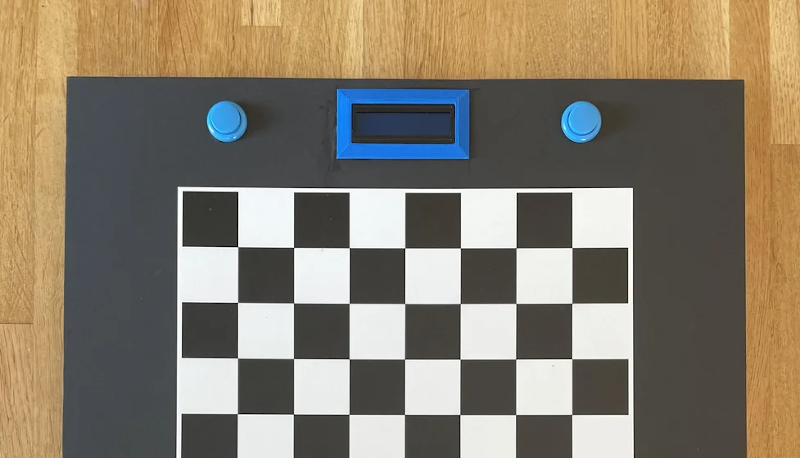
If you’ve ever played chess or even checkers, you’ve probably thought about making a board that lets a computer play you without having to enter your moves and look at the board on a screen. [Greg06] not only thought about it, but he built it.
The board looks great and uses foamboard which makes it easy to reproduce. Each piece has a small magnet within and an electromagnet on an XY motion system can selectively pick up and move pieces. In addition, a reed switch under each square can tell if a square is occupied or not.
This system is pretty simple, but it is effective. After all, you know the position of the pieces at the start. So if a bishop leaves a square and a new square gets a piece, you can assume it is the bishop. There is no need to actually distinguish the pieces.
An LCD and some buttons act as a chess clock, and note if a move is illegal. The Arduino has a pretty basic chess algorithm known as Micro Max that runs on the Arduino, but we wondered if you couldn’t connect to a remote computer to get more sophisticated gameplay or even interface to the Internet to play remote humans, something we’ve seen before. You could even adapt it for other input methods.
Activision Blizzard is dealing with particularly serious fallout from the sexual misconduct allegations surrounding the company. The Washington Post has learned Activision Blizzard is facing a wrongful death lawsuit from the family of Kerri Moynihan, a woman who died by suicide in April 2017 during a company retreat. The family alleges sexual harassment at the game developer played a "significant factor" in her death.
Moynihan's death was referenced in a California Department of Fair Employment and Housing (DFEH) lawsuit over Activision Blizzard's reported "frat boy" culture, albeit without mentioning her name. Male colleagues reportedly shared an explicit photo of Moynihan at the holiday party preceding her death, according to that lawsuit, and referred to a male supervisor who supposedly brought sex toys to the retreat.
The family lawsuit alleges Moynihan's boss, Greg Restituito, lied to Anaheim police and otherwise tried to hide evidence of a sexual relationship with the victim. He made "unusual inquiries" with employees present with Moynihan the night before her demise, according to a police report cited in the suit. Restituito left Activision Blizzard in May 2017, the month after Moynihan's death.
Activision Blizzard was reportedly uncooperative with police at the time. It refused to hand over the company laptops of either Moynihan or Restituito, and also declined access to Restituito's phone.
The family's lawyers shared a copy of the lawsuit with The Post, but otherwise haven't commented on the lawsuit. Anaheim police and Restituito have so far been silent. An Activision Blizzard spokesperson said the company was "deeply saddened" by Moynihan's death and would respond to the complaint through legal channels, but said it had "no further comment" out of respect.
Activision Blizzard has taken numerous actions in response to the misconduct scandal. It removed 37 employees between July 2021 and January 2022, and disciplined another 44. Blizzard leader Mike Ybarra has also vowed to restore trust by reforming company culture. The Moynihan lawsuit underscores the apparent toxicity at Activision Blizzard in previous years, however, and adds to the pressures on the company (and its buyer Microsoft) from the SEC and others to fix its workplace practices.
In the US, the National Suicide Prevention Lifeline is 1-800-273-8255. Crisis Text Line can be reached by texting HOME to 741741 (US), 686868 (Canada), or 85258 (UK). Wikipedia maintains a list of crisis lines for people outside of those countries.