Star Trek's first NFTs lean heavily on incentives

If you've been yearning for an official Star Trek NFT, now's your chance. Paramount and Recur are launching the first batch of Star Trek NFTs through Paramount.xyz in a 24-hour sale starting April 9th at 11AM Eastern. Despite the franchise's futuristic vision, though, the experience will be familiar to blockchain art buyers. Spend $250 on a Season 0 pack and you'll get unique, algorithmically-built starships (see an example above) that you can flaunt and sell to other Trekkies. There will be 20,000 items in this first wave, with 2,000 more "in reserve."

There will be incentives to buy early. Starship owners will receive crew member NFTs ahead of their wider release in Season 1, and Season 2 will let you use that crew for missions in a play-to-earn game.

The Star Trek offering is part of a larger Paramount strategy to offer NFTs across its "key franchises." Don't be surprised if you see a CSI or Indiana Jones drop, then. It's just a question of whether or not they'll be successful. The NFT market is still young, and the industry frequently deals with scams, spam and other headaches. It's not yet clear that there's sustainable demand for (and trust in) digital rarities, even if they're attached to a well-known sci-fi series.

Anker's affordable Eufy RoboVac 11S drops to $160 at Amazon

Spring cleaning has a way of sneaking up on us all, but luckily you can outsource the vacuuming portion of your chores to a semi-autonomous robot. Anker's Eufy brand has a number of solid robot vacuums at various prices, and many of them have been discounted on Amazon. Key among them is the Eufy BoostIQ RoboVac 11S, which is $70 off and down to $160. This model earned a spot in our budget robot vacuum guide thanks to its slim frame and solid cleaning chops.

Buy Eufy RoboVac 11S at Amazon - $160Shop Eufy robot vacuums at Amazon

The most important thing to know about the RoboVac 11S is that it does not have WiFi connectivity. That means you won't be able to control it from your phone, but it does come with a physical remote that lets you do things like set cleaning schedules and up the suction power using BoostIQ or Max modes. It cleans both hard and carpeted floors well and has pretty decent collision avoidance. Most robot vacuums will bump into furniture every now and then, and the 11S is no different, but it's better at avoiding obstacles than many others at this price range. It's also less than three inches high, so it may be able to slip under some of your furniture to clean hard-to-reach spots. It's hard to beat a robot vacuum for $160, so if you can live without WiFi features, the 11S is a solid option.

In addition to the RoboVac 11S, there are a number of other Eufy robot vacuums on sale right now. The RoboVac G30 is essentially an updated version of the 11S with more suction power and WiFi connectivity, and it's $90 cheaper than usual and down to $230. Another one of our favorites, the RoboVac X8 Hybrid, is down to $530 thanks to a clippable $120 coupon on its product page. It held its own against premium Shark and iRobot devices, earning a spot in our best robot vacuums guide. Despite not having a self-cleaning base, the X8 Hybrid impressed us with its easy setup, strong cleaning abilities, accurate home mapping and its 250-milliliter water tank than you can fill to turn the vacuum into a smart mop.

Buy Eufy RoboVac G30 at Amazon - $230Buy Eufy RoboVac X8 Hybrid at Amazon - $530

Follow @EngadgetDeals on Twitter for the latest tech deals and buying advice.

Google Lens can now search images and text at the same time

At I/O 2021, Google announced it was using a new technology called Multitask Unified Model to enhance the capabilities of its search engine. Then, in September of that same year, it showed off how MUM would make it possible to search images and text simultaneously within Google Lens. At the time, the company promised that multisearch would launch “in the coming months.” And while it's not using MUM to enhance searches just yet, it has started beta testing multisearch.  

Google

Provided you live in the US, you can try the feature out in the Google app on Android and iOS. To do so, tap the Lens icon and then swipe up after snapping a new photo or importing an existing image from your camera roll. Then tap the “Add to your search” icon.

You can use this field to either ask questions about the image before you or to refine your search. For instance, you could take a photo of your bike’s rear derailleur (the component that moves the chain from one gear to another) and then search for how to fix or adjust it on your own. By combining text and images, Google suggests it’s making it easier to complete searches where doing so with words alone might be tricky. After all, even most casual cyclists don’t know what a derailleur is or what it does.

Google

As mentioned already, you can also use the feature to refine your searches. So say you see a shirt with a pattern you like but want to see if that same pattern is available on socks and other items of clothing. You could type “white floral Victorian socks” into Google, but again that would depend on you having the fashion vocabulary to know what you want from Google, and even if you accurately describe what you see, the search engine might not produce useful results. At the moment, Google suggests the feature works best when posed shopping-related searches such as the one pictured above.

“All this is made possible by our latest advancements in artificial intelligence, which is making it easier to understand the world around you in more natural and intuitive ways,” Google said. “We’re also exploring ways in which this feature might be enhanced by MUM – our latest AI model in Search – to improve results for all the questions you could imagine asking.”

Nike is opening a 'technology center' in Atlanta next year

Nike has facilities all over the world for product innovations and its aspirations beyond footwear. Today, the company announced that it's opening a new Technology Center in Atlanta, Georgia. Nike says the location will be located in West Midtown and is slated to open in early 2023. Until it's ready, employees based out of the new center will work remotely. 

The Atlanta Technology Center will focus on expanding Nike's digital-first supply chain and logistics operations. The location will also be home to a new east coast cybersecurity command center for the company. Third, the new center will use AI and machine learning to "reimagine consumer experiences." Details are vague at this point, but we expect specifics from Nike as the Technology Center's opening approaches. 

Atlanta may not be a city that screams tech hub, but Nike touted its deep sports roots and skilled workforce for the decision to build there. "We chose Atlanta because of its strong connection to sport, as well as the city’s wealth of skilled and diverse tech talent — both in the private and public sectors — and all the great universities in the region," the company said in a press release. Atlanta is home to Georgia Tech, Georgia State, Emory University, Morehouse College and many other schools. The University of Georgia isn't far away either, located a little over an hour down the road in Athens. The city also has professional sports franchises in the NBA, WNBA, MLB, NFL and MLS. 

Nike has tapped Dr. Mona-Lisa Pinkney to lead the Atlanta Technology Center. Pinkney has worked with the company as its senior director of cybersecurity as well as co-founder of the Black Employees in Technology Network (BEiT) and she assists with the Women in CyberSecurity (WiCyS). As senior site leader, Pinkney will oversee "work on cutting-edge technology and innovation initiatives that move the world forward through sport." 

SpaceX's Texas expansion plans derailed by environmental paperwork

SpaceX can't start expanding its launch facilities in Boca Chica, Texas anytime soon. According to documents obtained by Bloomberg and CNBC, the Army Corps of Engineers has closed its review of the company's application to build a new launch pad, landing pad and other related infrastructure in Boca Chica. SpaceX reportedly failed to provide the Army Corps with the environmental information it requested, and the permit process can't continue without it. 

The company was planning to build new infrastructure on 17 acres of land that includes wetlands and mud flats. As CNBC notes, the Army Corps has stewardship over wetland areas that serve as habitat for fish and wildlife in the country. It oversees any development over wetlands to ensure it doesn't cause significant impact on the endangered species living in them, as well as on drinking water for people in the area. It's also in charge of examining whether it's feasible for companies applying for a permit to move construction elsewhere.

In the letter it sent to the company, the Army Corps listed the information it's seeking from SpaceX, including how its expansion would impact the wetlands exactly. It's also asking for data on threatened or endangered species that may be significantly impacted by the construction, as well as the company's current knowledge on the presence or absence of historic properties on the land. While the Army Corps suspended the company's application, SpaceX can reinitiate the permit process if it can provide all the information being requested. 

The Federal Aviation Administration is also conducting a separate review of the facility to determine whether launching the Starship out of Boca Chica will cause safety issues or have significant environmental impact on the area. SpaceX was supposed to hear from the FAA last year, but the agency has delayed its decision quite a few times since then: Its latest target date of completion is April 29th. Without permission from the FAA, it won't be able to launch its massive spaceship from Boca Chica for its first orbital test flight that's expected to take place in the next few months. Elon Musk previously said that if SpaceX fails to secure the permits company needs in Texas, it will move Starship launches to Cape Canaveral in Florida. 

Facebook may crack down on Russian government accounts to fight disinformation

Facebook says it’s eyeing new ways to limit the influence of official Russian government accounts as it sees a surge in cyber espionage and “covert influence operations” tied to “government-linked actors” from Russia and Belarus.

Facebook’s security researchers shared the update as part of the company’s first quarterly threat report, which detailed its latest efforts to prevent its platform from being exploited amid Russia’s invasion of Ukraine.

During a call with reporters, Meta’s President of Public Policy Nick Clegg said that the company has seen an uptick in state-backed disinformation and other efforts to sow misinformation. “Since Russia's invasion of Ukraine, we've seen attacks on internet freedom and access to information intensified,” Clegg said. “It's manifested itself in two ways: One focus is on pushing state propaganda through state-run media, influence operations and espionage campaigns. And the other aimed at closing down the flow of credible information.”

Clegg added that the company is considering new steps to prevent official government accounts from spreading disinformation, but didn’t elaborate. Though Facebook has been demoting Russian state media outlets since March, the company hasn’t had a clear strategy for addressing misinformation and lies about the war from official government accounts. Up to know, it’s taken one-off actions against specific posts, like when an account belonging to Russia’s UK embassy falsely claimed a photo of a hospital bombing was staged.

Now Facebook is apparently considering how it can better prevent these accounts from spreading misinformation, said Clegg, who has previously been a vocal defender of Facebook’s policy against fact-checking politicians. “We are actively now reviewing additional steps to address misinformation and hoaxes coming from Russian government pages,” Clegg said.

Official pages are just one area of concern for Facebook though. In its report, Facebook security researchers detailed several influence operations and other campaigns to manipulate its platform in favor of pro-Russian interests and disinformation.

“For example, we detected and disrupted recidivist CIB [coordinated inauthentic behavior] activity linked to the Belarusian KGB who suddenly began posting in Polish and English about Ukrainian troops surrendering without a fight and the nation’s leaders fleeing the country on February 24, the day Russia began the war,” they wrote in the report. “On March 14, they pivoted back to Poland and created an event in Warsaw calling for a protest against the Polish government. We disabled the account and event that same day.”

The company also said it saw renewed activity from Ghostwriter, an entity that uses phishing attacks on email accounts to take over its targets’ social media accounts. Facebook previously said Ghostwriter targeted a handful of Ukrainian journalists, military officials and other public figures at the start of the war. This time, Ghostwriter “attempted to hack into the Facebook accounts of dozens of Ukrainian military personnel,” Facebook wrote. “In a handful of cases, they posted videos calling on the Army to surrender as if these posts were coming from the legitimate account owners. We blocked these videos from being shared.”

Facebook also spotted renewed activity from Russia’s Internet Research Agency, the troll farm behind Russia’s 2016 election interference campaign that’s made repeated attempts to get back on Facebook in recent years. Facebook said their attempts to make new accounts on the platform were “unsuccessful” and appeared to be trying to drive traffic to a separate website that “blamed Russia’s attack on NATO and the West and accused Ukrainian forces of targeting civilians.”

Finally, Facebook also said it has removed “tens of thousands' ' of accounts, pages and groups for using spammy and misleading tactics in an attempt to profit off the war in Ukraine. These efforts included meme pages posing as on-the-ground reports from Ukraine as well as spammers trying to sell merch or lure people to outside websites for ad revenue.

Google is clamping down on out-of-date Android apps

Google has unveiled new policies for the Play Store that will effectively bar any existing Android Apps that are significantly out of date. All apps in the Store must target an API level within two years of the latest major Android release, or they won't be available for discovery or installation, it announced on its Android Developer blog. The aim is to "protect users from installing older apps that may not have these protections in place," the company said. The changes will go into effect on November 1st, 2022.

Currently, Google requires new apps and app updates to target an Android API level within just one year of the latest Android OS version release. The new changes, by contrast, target existing apps that may not have been updated in a while. Google notes that if you're running an older device, you'll "continue to be able to discover, re-install, and use the app on any device running any Android OS version that the app supports."

Google said the "vast majority" of apps already follow the incoming standard. While that may be true, the Play Store has around 2.87 million apps in total, so there are a no doubt a huge number that need attention. For those that don't conform, it's notifying developers and giving them any resources needed to update.

Play has seen a lot of new security measures over the last few years. The most significant came in 2017 when Google launched Play Protect designed to scan for rogue apps with help from machine learning. However, some still get through that pose security risks and violate user privacy. The new policy may help stop a good chunk of those, but as we all know by now, it will never catch them all

The Morning After: OpenAI’s DALL·E 2 is imagination meets AI image generation

The OpenAI consortium has unveiled the next iteration of DALL·E, a multimodal AI that could generate rudimental, low-res images from a text-based prompt. This time around, the system is capable of generating images at higher resolution and with lower latency than the original. They’re also eminently more shareable and impressive — check the AI’s Instagram account right here.

OpenAI

DALL·E 2 uses OpenAI's CLIP image recognition system and adds the ability for users to edit the results. They can now select and edit areas of existing images, add or remove elements, mash together two images into a single collage and generate further variations of an existing image. What's more, the output images are 1,024 pixel squares, up from the 256 x 256-pixel canvases generated by the original version. Unlike the first, which anybody could play with on the OpenAI website, this new version is currently limited to vetted partners who are also constrained in their uploads and creations. The consortium is trying to keep it all family-friendly, too.

Anyone interested in collaborating with DALL·E 2 can register for the waitlist here.

— Mat Smith

The biggest stories you might have missed

The Peloton Guide wouldn’t let me skip a single push-up

The connected camera is a simple but persistent workout monitor.

Engadget

Peloton’s Guide, a $295 movement-tracking camera that brings strength training to the company’s fitness offering, is finally available to purchase. Before you do that, check out some early first impressions. For people like me, who loathe cardio, it could be a high-tech way to add some scrutiny and guidance to your bodyweight (and weight-lifting) workouts. Expect the detailed, polished interface of a Peloton product, even if I wish the Guide could share a little more, well, guidance.

Continue reading.

Police reports suggest a larger pattern of AirTag stalking

Fifty women in eight jurisdictions called the cops about unwanted trackers.

A report from Motherboard, based on police data, suggests that bad actors are using Apple’s AirTag to track people without their consent. Motherboard received 150 reports from eight police departments and found that, in 50 cases, women called the cops after receiving notifications suggesting someone was tracking them with an AirTag or they heard the device chiming. Half of those women suspected the tags were planted in their car by a man they knew, such as a current or former romantic partner or their boss.

Continue reading.

ESPN aired last night’s Nets and Knicks game with decade-spanning classic graphics

To mark the NBA’s 75th anniversary.

On November 1st, 1946, the Toronto Huskies and New York Knicks played what is now considered the first game in NBA history. With the league celebrating its 75th birthday this season, ESPN took fans down memory lane, with ESPN2 broadcasting an alternative presentation of the game with in-game graphics from past NBA broadcasts. These spanned 1960s on ABC, the 1970s and 1980s on CBS and the 1990s on NBC, each represented during the game with graphics changing between quarters.

Continue reading.

MLB will fight cheating with an electronic pitch-calling system

PitchCom could prevent opposing teams from stealing signs.

Baseball catchers have long signaled pitches with their fingers, but that could soon become a thing of the past in the big leagues. Major League Baseball has approved a system for catchers to send directions to their pitchers electronically. The PitchCom system centers around a sleeve catchers wear on their forearm. They can press buttons to identify the pitch type and location. The pitcher hears the call through a bone-conduction listening device. The channels are encrypted and teams can program codewords to replace terms like "fastball" or "curveball." It all sounds delightfully espionage heavy. I love it.

PitchCom will be optional, and teams can still use traditional hand signals if they wish. However, according to AP, around half of MLB teams have expressed interest in using the new system.

Continue reading.


Anker says its first 3D printer is built for speed.

It’s a little different to a power bank.

The AnkerMake M5 is the company’s first 3D printer, and Anker claims the M5 should prototype creations faster, while also offering a slower, smoother finish when needed.

The AnkerMake M5 has a basic print speed of 250 mm/s² for more detailed projects that need a smooth finish. However, the printer also has a much speedier mode that hits 2,500 mm/s². The end result is rougher and less detailed, but Anker says it enables the M5 to reduce average print times by up to 70 percent compared to other printers. The company isn’t entirely on board: For now, it’s a Kickstarter project, and you can back it for an early bird price of $429. After that, you'll have to pledge at least $499 to grab the printer.

Continue reading.

Custom Macro Keyboard With RGB Lighting

From the smallest 60% keyboards for those with no desk space to keyboards with number pads for those doing data entry all day, there’s a keyboard size and shape for just about everyone. The only problem, even with the largest keyboards, is that they’re still fairly limited in what they can do. If you find yourself wishing for even more functionality, you might want to build something like this custom macro keyboard with built-in LED backlighting.

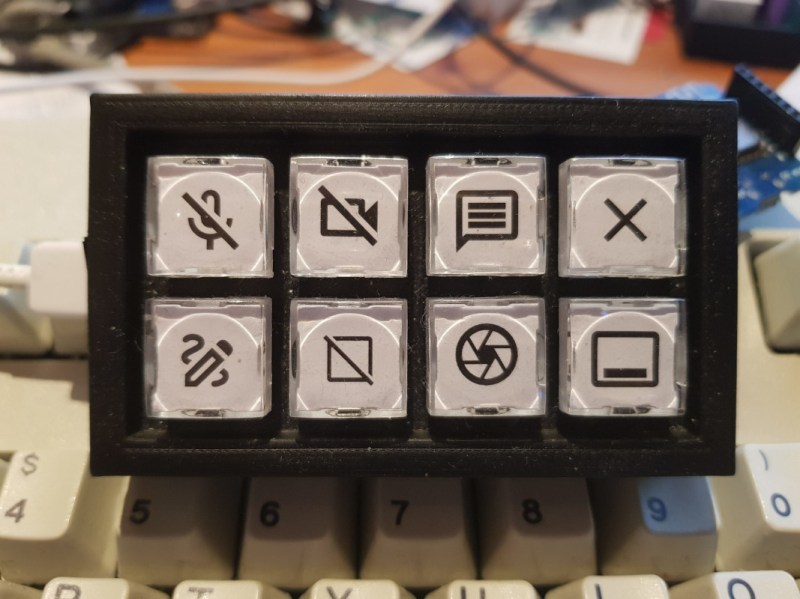
Rather than go with a standard mechanical keyboard switch like a Cherry MX, this build is based around TS26-2 pushbuttons with built-in LED lighting. [atkaper] only really needed one button for managing the mute button on MS Teams, but still built a total of eight switches into this keyboard which can all be individually programmed with different functions. The controller is an Arduino Leonardo and the enclosure was 3D printed.

Paired with the classic IBM Model M keyboard, this new macro keyboard adds plenty of functionality while also having control over LED backlighting. Macro keyboards are incredibly useful, especially with their ability to easily change function with control over the software that runs on them. The key to most builds is the 32U4 chip found in some Atmel microcontrollers which allows it to easily pass keyboard (and mouse) functionality to any computer its plugged in to.

Custom Macro Keyboard With Sweet Backlighting

From the smallest 60% keyboards for those with no desk space to keyboards with number pads for those doing data entry all day, there’s a keyboard size and shape for just about everyone. The only problem, even with the largest keyboards, is that they’re still fairly limited in what they can do. If you find yourself wishing for even more functionality, you might want to build something like this custom macro keyboard with built-in LED backlighting.

Rather than go with a standard mechanical keyboard switch like a Cherry MX, this build is based around TS26-2 pushbuttons with built-in LED lighting. [atkaper] only really needed one button for managing the mute button on MS Teams, but still built a total of eight switches into this keyboard which can all be individually programmed with different functions. The controller is an Arduino Leonardo and the enclosure was 3D printed.

Paired with the classic IBM Model M keyboard, this new macro keyboard adds plenty of functionality while also having control over LED backlighting. Macro keyboards are incredibly useful, especially with their ability to easily change function with control over the software that runs on them. The key to most builds is the 32U4 chip found in some Atmel microcontrollers which allows it to easily pass keyboard (and mouse) functionality to any computer its plugged in to.