Thermophotovoltaic cell converts 40 percent of heat energy to electricity

Researchers have revealed a new thermophotovoltaic (TPV) cell that converts heat to electricity with over 40 percent efficiency, performance nearly on par with traditional steam turbine power plants. The cells have the potential to be used in grid-scale "thermal batteries," generating energy dependably with no moving parts. 

Thermophotovoltaic cells work by heating semiconducting materials enough to significantly boost the energy of photons. At high enough energies, those photos can kick an electron across the material's "bandgap," generating electricity. So far, TPV cells have achieved up to just 32 percent efficiency because they operate at lower temperatures. 

By contrast, the new design from MIT and the National Renewable Energy Laboratory (NREL) takes power from white-hot heat sources between 1,900 to 2,400 degree Celsius (3,452 to 4,352 degrees F). To do that, it uses "high-bandgap" metal alloys sitting over a slightly lower-bandgap alloy.  

The high-bandgap layer captures the highest-energy photons from a heat source and converts them to electricity, while lower-energy photons pass through the first layer and add to the voltage. Any photons that run the two-layer gauntlet are reflected by a mirror back to the heat source to avoid wasting energy.

This is an absolutely critical step on the path to proliferate renewable energy and get to a fully decarbonized grid.

Measuring the efficiency using a heat flux sensor, the team found that power varied with temperature. Between 1,900 to 2,400 degrees Celsius, the new TPV design produced electricity with about 40 percent efficiency.

Steam turbines can deliver the same efficiency, but are far more complicated and restricted to lower temperatures. "One of the advantages of solid-state energy converters are that they can operate at higher temperatures with lower maintenance costs because they have no moving parts," MIT Professor Asegun Henry told MIT News. "They just sit there and reliably generate electricity."

In a grid-scale thermal battery, the system would absorb excess energy from renewable sources like the sun and store it in heavily insulated banks of hot graphite. When needed, the TPV cells could then convert that heat to electricity and send it to the power grid. The experimental cell was just a square centimeter, so the team would have to ramp that up to around 10,000 square feet for grid-level power, but the technology already exists to create cells on that scale, Henry notes. 

"Thermophotovoltaic cells were the last key step toward demonstrating that thermal batteries are a viable concept," he said. "This is an absolutely critical step on the path to proliferate renewable energy and get to a fully decarbonized grid."

Google's 'Switch to Android' app helps iOS users do just that

Google has finally countered Apple's "Move to iOS" app by releasing "Switch to Android" for iOS on the App Store, confirming earlier rumors. As the name indicates, it's designed to help iPhone and iPad users import contacts, photos, calendars and video to an Android device. It also shows users how to turn off iMessage in favor of Android messaging and transfer photos/videos by connecting to iCloud. 

Google dropped the new app without a lot of fanfare, as TechCrunch notes. On its Switch to Android website, the app is still not mentioned and can only be found on the App Store with a direct link — search results still turn up nothing.

Google

The app is a big improvement over the current system, which requires you to back up photos, video, calendar and contacts using the Google Drive iOS app. It was first spotted last summer by 9to5Google in code tucked into Google's Data Transfer Tool, and seen in a more recent release with the ability to import iCloud video and photos into Google Photos. 

Apple's equivalent app arrived way back in September 2015, so Google certainly took its time responding. "Move to iOS" works in much the same way, helping users import photos, video, messages, contacts and more over to an iOS device. One Android device maker, Samsung, has its own device migration app as well called Smart Switch, helping you switch from an iPhone or other Android device to a Galaxy smartphone. However, it's only available on Google Play or its own Galaxy store and doesn't run on iOS. 

Amazon hits US sellers with a 5 percent fuel and inflation surcharge

Amazon will charge US sellers using its fulfillment services a 5 percent fuel and inflation fee for the first time. It will add the fees to what it already collects from third-party sellers using the Fulfillment by Amazon service to store, pack and ship their goods starting on April 28th, the e-commerce giant wrote on its website. Amazon already raised its fulfillment fees back in January by an average of around 5.2 percent, as noted by Bloomberg.

In an email sent to sellers, Amazon said it has experienced "significant cost increases and absorbed them, wherever possible" to reduce the impact on its sellers. When it raised its fulfillment fees earlier this year, the company said it more than doubled its US fulfillment capacity since the start of the pandemic, hired over 628,000 people and increased its starting wage in the US. It raised its fulfillment fees back then to offset its higher operating costs going forward.

Now, Amazon told CNBC in a statement that while it expected a return to normalcy this year after COVID-19 restrictions have started lifting, "fuel and inflation have presented further challenges." Inflation in the US surged to 8.5 percent in March from the same period last year, according to the Labor Department, which is the highest increase the country has seen over the past four decades. Gas prices, as most people know, reached new heights after Russia's invasion of Ukraine.

Amazon explained that it chose to impose a fuel and inflation surcharge instead of raising its fees permanently again, because it's "unclear if these inflationary costs will go up or down, or for how long they will persist." The spokesperson said its surcharge will cost 24 cents per unit, which is lower than the fuel surcharge imposed by UPS and FedEx. All the same, some sellers told Bloomberg that they have to raise prices to remain in business, so buyers can most likely expect to pay more for their purchases in the near future. 

Nikon's Z9 gets 8K 60p RAW video and more via a major firmware update

Nikon has released the firmware 2.0 update for its flagship mirrorless Z9 camera that gives it significant new video powers including 8.3K 60p RAW. It also offers benefits to photographers with autofocus and EVF enhancements along with a new feature that pre-captures photos before you hit the shutter button. 

The 45-megapixel Z9 was already a powerful mirrorless camera for video, but the new enhancements put it ahead of all rivals, including Sony's A1 and Canon's EOS R5, at least on the spec sheet. The biggest update is the addition of 12-bit RAW video at up to 8.3K 60p using Nikon's new RAW video format called N-RAW, along with 12-bit ProRes RAW HQ capture at up to 4.1K 60p.

Nikon

N-RAW "records a vast amount of scene information, yet is a significantly smaller file size, allowing for much more recording time and [a] less intensive workflow," Nikon wrote in a press release. The files take up about half the space of equivalent ProRes RAW HQ files (ProRes RAW HQ 12-bit, 4K 24p video has a data rate of 80-140 MB/s). 

A company called IntoPix previously said that Nikon would be using its TicoRAW technology for RAW video. When the firmware is released, N-RAW will be supported on DaVinci Resolve and Edius, but not Premiere Pro, Final Cut Pro or other editing apps. 

On top of 8.3K 60p, the Z9 can capture N-RAW 4.1K 120p, 60p, 30p and 24p (plus equivalent PAL formats) in full frame FX mode, 5.3K 60p, 30p and 24p with a 1.5X crop and 3.8K 120p with a 2.3X crop. It also creates an MP4 proxy file, allowing for "previews, quick transfers or edits on the fly," according to Nikon. 

If you'd rather shoot ProRes RAW HQ, 8K isn't an option as capture is limited to 4.1K 60p, though crop options are available. Nikon has also introduced an "extended oversampling mode" delivering 2:1 oversampled 4K 60fps footage from an 8K capture. That setting requires a very fast CFexpress card, limited to ProGrade's Cobalt 650GB or 325GB memory cards. Nikon also launched its own CFexpress card today, the 660GB MC-CF660G, arriving in June 2022 with up to 1700 MB/s and 1500 MB/s read/write speeds.

Video operation is also improved with several new features. The most requested is the addition of a waveform display that greatly helps visualize exposure, particularly with in log modes. You can also put a red frame around the display during recording and adjust the magnification. Other features include finer ISO increments for smoother transitions and a "Fast AF On" function that lets you quickly change the AF speed without diving into menus — another much-asked-for setting.

Nikon

On the photography side, the Z9 now has a pre-buffer option for JPEGs only, at 30fps full resolution and 11-megapixel 120 fps modes. It captures buffered images when the shutter button is half press pressed, keeping up to a second of images when you fully press it. It also retains up to 4 seconds afterwards. 

Meanwhile, Nikon boosted the EVF's refresh rate to a smoother 120 fps, bringing it in line with rivals like Sony and Canon — though enabling the setting will reduce battery life. It also added custom Wide AF zones, letting you select which parts of your scene are active and create two user-defined zones. That way, you can keep the AF and subject tracking in a defined area to improve focus reliability. 

The update is one of the most impressive I've seen and significantly improves the $5,500 Z9's functionality and desirability. Features like MP4 proxy recording are usually only seen on pro video cameras. However, Nikon has nothing to lose by making the Z9 a limit-free video powerhouse, because unlike Sony and Canon, it has no professional video lineup to cannibalize. The firmware 2.0 upgrade will be available to download for free starting on April 20, 2022 at Nikon's website.

Judge affirms jury's verdict in Tesla racism lawsuit but reduces $137 million payout

US District Judge William Orrick has rejected Tesla's argument that it isn't liable to Owen Diaz, according to The Wall Street Journal and Reuters. Diaz is a former Black Tesla worker who accused the company of turning a blind eye to the racial abuse he suffered while working at its Fremont, California factory from 2015 to 2016. Last year, a jury ruled in favor of Diaz and awarded him $6.9 million in compensatory damages, as well as $130 million in punitive damages. Orrick has affirmed the jury's verdict but reduced the award to $15 million.

To be exact, he reduced the compensatory damages awarded to Diaz to $1.5 million from $6.9 million, which he called "excessive." He also slashed the "unconstitutionally large" punitive damages award from $130 million to $13.5 million. Punitive damages awarded by courts are meant to punish a defendant and deter them from repeating their actions — or, in Tesla's case, from allegedly ignoring the racial abuse of a Black worker. Tesla has a market value exceeding $1 trillion, however, and $13.5 million is a drop in the bucket for the automaker. Diaz's lawyer said they plan to appeal the lowered damages award.

Nevertheless, Judge Orrick agreed that Tesla showed a "striking" indifference to Diaz's plight. In his original lawsuit, Diaz said he wasn't just subjected to racial slurs, fellow workers (and even one supervisor) also left drawings of swastika and racist graffiti around the plant. He said Tesla's management neglected to halt the abuse. Judge Orrick wrote in his ruling:

"Not only does the evidence support a finding of recklessness or indifference to Diaz’s health and safety, it supports a finding that Tesla intentionally built an employment structure that allowed it to take advantage of Diaz’s (and others’) labor for its benefit while attempting to avoid any of the obligations and responsibilities that employers owe employees."

Tesla has faced several racial discrimination lawsuits over the years other than Diaz's, with workers claiming that they were subjected to constant racial abuse in its factories. In February, the California Department of Fair Employment and Housing filed a lawsuit against the automaker after finding evidence that its "Fremont factory is a racially segregated workplace" where Black workers are discriminated against. Tesla denied the accusation, saying it "opposes all forms of discrimination and harassment" and that it has a "dedicated Employee Relations team that responds to and investigates all complaints."

The New York Public Library makes four banned books free nationwide on its e-reader app

The New York Public Library made four banned books available nationwide on SimplyE, its free-reader app. The titles include Speak by Laurie Halse Anderson, King and the Dragonflies by Kacen Callender, Stamped: Racism, Antiracism, and You by Jason Reynolds and Ibram X. Kendi and Catcher in the Rye by J.D. Salinger. The library worked in coordination with the publishers and authors to make the titles available to the public for free, with no wait times or download limits. Normally publishers allow libraries to only lend out e-books to a single person at a time, often leading to long hold times at public libraries.

While the titles are only available for a month (the titles will disappear by the end of May), interested readers don’t need to hold an NYPL library card or live in the region. The books will be released through NYPL’s “Books For All” program, which makes hundreds of titles in the public domain available to anyone nationwide.

The NYPL has voiced its opposition to a recent spike in book banning across school districts nationwide, largely driven by conservative activists groups. Over the last nine months, more than 1,000 books have been banned or temporarily pulled from school districts, according to a report PEN America released this week.

“These recent instances of censorship and book banning are extremely disturbing and amount to an all-out attack on the very foundation of our democracy,” said New York Public Library President Anthony W. Marx.

The 1999 young adult novel Speak, about a ninth grade girl who has refused to talk since being raped at a party, is included in ALA’s list of 100 most challenged books between 2000 and 2009. Parents often voice opposition to its graphic, sexual content. King and the Dragonflies, about a middle school boy who struggles with the loss of his brother and his sexual identity, is the winner of the 2020 National Book Award for Young People’s Literature, was flagged for removal in Keller, Texas. Stamped was challenged by parents in Round Rock, Texas last year, in part due to a tweet by by its author that criticized then-Supreme Court nominee Amy Coney Barrett.

Angela Montefinise, vice-president of communications and marketing, told Engadget in an email that the SimplyE app had to increase its server capacity three times today to account for the spike in downloads. Currently there are no future plans to release any more banned titles on the app.

“At this point we’re not planning to release more books as part of this project, but we’ll see how things go,” wrote Montefinise in an email.

NASA’s James Webb Space Telescope is ready for calibration after chilling out

The James Webb Space Telescope is one step closer to probing the depths of the universe. On Wednesday, NASA announced that it was ready to start taking test images and aligning the optics of the JWST after the telescope’s instrumentation reached its final operating temperature of minus 448 degrees Fahrenheit (or minus 267 degrees Celsius) partway through last week.

Cool news! Webb’s MIRI instrument recently passed through its critical “pinch point” and cooled to just a few kelvins above absolute zero, which is the coldest you can go: https://t.co/jjE7xTal0O

Wondering why MIRI is extremely chill? Thread ❄️ pic.twitter.com/a9l7lcZ645

— NASA Webb Telescope (@NASAWebb) April 13, 2022

The JWST has been gradually cooling down ever since its successful December 25th launch, but the telescope took a major step forward on that front when it deployed its massive 70-foot sunshield at the start of the year. That component allowed JWST’s systems, including its critical Mid-Infrared Instrument (MIRI), to drop to a temperature of approximately minus 298 degrees Fahrenheit (or about minus 183 degrees Celsius). 

Getting the JWST to its final operating temperature required NASA and the European Space Agency to activate the telescope’s electric “cryocooler.” That in itself involved passing a technical hurdle dubbed the “pinch point,” or the stage at which the James Webb’s instruments went from minus 433 degrees Fahrenheit to minus 448 Fahrenheit.

“The MIRI cooler team has poured a lot of hard work into developing the procedure for the pinch point,” said Analyn Schneider, MIRI project manager for NASA’s Jet Propulsion Laboratory. “The team was both excited and nervous going into the critical activity. In the end, it was a textbook execution of the procedure, and the cooler performance is even better than expected.”

Part of the reason the James Webb needs to be so cold before it can begin its mission is so that its electronics generate the least amount of infrared light possible and are thereby less likely to interfere with its instruments when astronomers turn them toward distant cosmic bodies. The cold temperatures are also required to avoid something called “dark current,” an electrical force that’s generated when the atoms in the telescope’s detectors vibrate. That movement can create false signals that make it more difficult for the telescope to get an accurate picture of a celestial body.

Supercomputer simulations show climate change’s role in early human migration

Humanity's expansion across the globe is inextricably tied to the environmental conditions that our early ancestors faced. On Wednesday, a research team from South Korea's Pusan National University revealed research from supercomputing modeling that suggests just how much of humanity's rise is thanks to changes in prehistoric weather.

The Pusan team, led by climate physicist Axel Timmermann, used an "unprecedented transient Pleistocene-coupled general circulation model simulation in combination with an extensive compilation of fossil and archaeological records to study the spatiotemporal habitat suitability for five hominin species over the past 2 million years," per the study published in Nature.

That 2-million year model, which the team refers to as the 2ma simulation, "reproduces key palaeoclimate records such as tropical sea surface temperatures, Antarctic temperatures, the eastern African hydroclimate and the East Asian summer monsoon in close agreement with paleo-reconstructions," to ensure a realistic representation of how the rain patterns in Southern Africa were likely shifting at the time. 

Basically, the team was looking at how the 41,000-year cyclical patterns of precipitation and temperature change caused by the Earth's axial wobble impacted the availability of resources for early humans and our close cousins. By combining the synthetic data generated by the 2ma simulation with the hard evidence of fossil and archaeological findings, the team puzzled out the places where homo sapiens and our genetic offshoots were most likely to inhabit.

The Pusan team noted a few surprising trends emerging from the data. For example, the researchers found that around 700,000 years ago, Homo heidelbergensis (suspected to be the progenitors of both Neanderthals and modern humans) began expanding from their traditional range. They were able to do so because our planet's elliptical orbit created wetter, more habitable climate conditions at that time to support the expansion. The simulation projected the movement of these wet spots across the Earth and the researchers found evidence within the fossil record that moved along with them. 

“The global collection of skulls and tools is not randomly distributed in time,” Timmermann told Nature. “It follows a pattern.”

Timmermann explained that these results could support the single-evolutionary-path hypothesis, which posits that climate change 700,000 years ago led to hotter, drier conditions in South Africa and h.heidelbergensis' evolutionary response to those changes eventually gave rise to Homo sapiens.

"We acknowledge that our species subdivisions may be controversial and that these do not necessarily require constancy of morphology, habitat and behaviour," the team wrote. "However, even though some species attributions such as H. heidelbergensis could be questioned, we remain confident that the majority of the record presents little challenge considering that 86 percent of the core data belong to the well-defined, widely accepted H. neanderthalensis or H. sapiens record and tool-making traditions."

These findings won't likely end the debate on humanity's beginnings but rather add to our growing patchwork of understanding.  

2022 Sci-Fi Contest: A Hand-Following Robot, Powered by Arduino

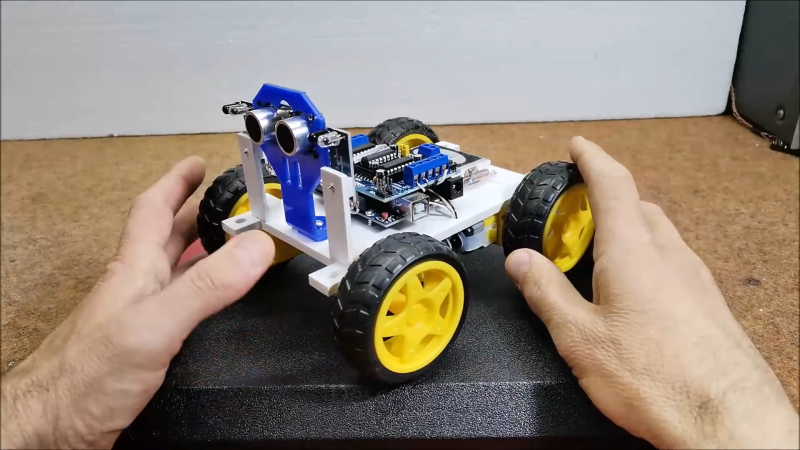
If there’s one thing audiences love in sci-fi, it’s a cute robot companion that follows the heroes around. If you want one of your own, starting with this build from [mircemk] could be just the ticket.

The build relies on the classic Arduino Uno microcontroller, which talks to a HC-SR04 ultrasonic sensor module and two infrared sensors in order to track a human target and follow it around. Drive is thanks to four DC gear motors, driven by a L293D motor driver, with a two-cell lithium battery providing power for everything onboard.

The robot works in a simple manner, following a hand placed in front of the robot’s sensors. First, the robot checks for the presence of an object in front using the ultrasonic sensor. If something is detected, the twin infrared sensors mounted left and right are used to guide the robot, following the hand.

It’s not a sophisticated algorithm, and it won’t really let your robot follow you down a crowded street. However, it’s a great project to learn on for beginners and could serve as a great entry into more advanced projects using face tracking or other techniques. Video after the break.


Hack a Day 13 Apr 21:00

CD Projekt Red delays 'The Witcher 3: Wild Hunt' next-gen update indefinitely

Don't count on playing The Witcher 3: Wild Hunt's next-gen update in the near future. CD Projekt Red has delayed the free upgrade's release "until further notice" after deciding to finish the project with an internal development team instead of Saber Interactive. The company wants to evaluate the necessary "scope of work," according to a statement.

The Wild Hunt update was originally slated to arrive in the second quarter (that is, before the end of June). It would refresh the 2015-era game for PlayStation 5, Xbox Series X/S and PC with ray-traced lighting, faster load times and possibly other features taking advantage of modern hardware. This would be a "Complete Edition" with expansions and other content, including material inspired by Netflix's Witcher series.

It's not certain what prompted the decision to drop the outside studio. This isn't necessarily an attempt to avoid a repeat of Cyberpunk 2077's buggy launch. However, it wouldn't be surprising if CDPR exercises caution. This will be the last Witcher release until the new title based on Unreal Engine 5 — a polished experience will make sure gamers have a favorable opinion of the series by the time the follow-up arrives.

We have decided to have our in-house development team conduct the remaining work on the next-gen version of The Witcher 3: Wild Hunt. We are currently evaluating the scope of work to be done and thus have to postpone Q2 release until further notice. 1/2

— The Witcher (@witchergame) April 13, 2022