Audi will integrate Apple Music into 'nearly all' of its newer models

Audi owners can now play Apple Music through their infotainment systems without having to connect it to their iPhones via Bluetooth or USB. The luxury automaker has rolled out Apple Music integration for almost all of its newer vehicles in Europe, North America and Japan, starting with the 2022 model year. Even cars already on the road will get the feature through an automatic over-the-air update. 

After getting the app on their infotainment systems, Audi owners simply need to fire it up, follow the onscreen instructions and type in the Apple ID login they use for Apple Music. The system will send a verification code to their phones that they have to key in, but that's pretty much it for the setup process. In Europe, owners can enjoy the first 3GB of streaming free of charge and will be billed the subsequent cellular data streaming costs through a data package available from Cubic-Telekom. 

Audi vehicles already come with Apple's CarPlay — it started bundling the software with its European vehicles in 2015 and with its North American vehicles a year later. Through CarPlay, users can connect their phones to their infotainment systems to get directions optimized for traffic, make calls, send and receive messages and play Apple Music onscreen. This standalone Apple Music rollout, however, makes it a lot easier to access their playlists and all the other available tracks on the service.

Apple's AirTag four-pack falls to $89

If you've got a bunch of items you need to protect from theft or loss, you can now pick up a four-pack of Apple's AirTags at Amazon and Best Buy for $89, or $10 (10 percent) off. We've seen them a little bit cheaper recently, but it's still a good time to act if you missed the last deal. 

Buy Apple AirTags 4-pack at Amazon - $89Buy Apple AirTags 4-pack at Best Buy - $89

For Apple users, AirTags deliver significant advantages over Tile and other trackers. The ultra-wideband feature offers precise tracking with iPhone 11 or later devices when you're reasonably close, so you can narrow your search between a bed and night table in the same bedroom. Over wider distances, the Apple device AirTag networks lets you track down an object you might have misplaced in a bar, for instance.

AirTags use a simple coin-sized design and offer a seamless experience via the Find My app. You can also force an AirTag to emit a chime to help you pinpoint an object's location, and that chime is now loader than ever thanks to a recent update.

It does lack a built-in keyring like rival trackers, so you'll need to pay extra for that. And it only works with Apple devices, so Android users will need to look elsewhere. However, if you're in Apple's ecosystem, you can pick up four at a discount — just remember that the deal ends today.

Follow @EngadgetDeals on Twitter for the latest tech deals and buying advice.

The Morning After: New York City's Airbnb listings may outnumber rentable apartments

Airbnb makes news for a mix of good and bad reasons. When it’s not expanding the service to make it easier to stay between multiple properties on the same trip, its safety team (and terrible rentals) are becoming the subject of a documentary series.

Now, according to a report from Curbed, April 2022 apartment rental inventory in Manhattan, Brooklyn and northwest Queens numbered 7,699 units. That compares to somewhere between 10,000 and 20,000 entire-apartment or entire-home Airbnb listings across all of NYC, as calculated by AirDNA and Inside Airbnb.

New York City prohibited short-term rentals (less than 30 days) in multi-unit buildings without the owner present since 2011, making it illegal to even advertise such listings in 2016. The report hasn’t traced whether Airbnb hosts are following these guidelines.

Airbnb hasn’t solely caused the NYC housing shortage – an issue seen in most ‘desirable’ cities across the world. In New York, rents are going up, and permits for new apartments are down by “a double-digit percentage” said Airbnb’s spokesperson.

However, the optics of having more Airbnb listings than rentable apartments are not good.

–Mat Smith

The biggest stories you might have missed

Russia claims it's using new laser weapons against Ukraine

The technology reportedly blinds satellites and destroys drones.

Russia is reportedly testing out new technology on the battlefield as it continues its invasion of Ukraine. According to a Reuters report, the Russian government says it's using a new wave of laser weapons. One weapon, a destructive laser called Zadira, can apparently burn up drones. Deputy prime minister Yury Borisov said that in one test, it incinerated a drone 3.1 miles away within five seconds. A more established system, Peresvet, reportedly blinds satellites up to 932 miles above Earth.

Continue reading.

NASA will soon bid farewell to its Mars InSight lander

The lander is expected to end its science activities by the end of summer.

NASA

NASA's Mars InSight lander will soon no longer be able to send back data and images. It's been gradually losing power for a while now as dust continues to accumulate on its solar panels. The darker skies expected in the next few months — also due to having more dust in the air — won't help either.

The space agency believes the lander will no longer be able to sustain its seismometer by the end of summer.

Continue reading.

Amazon refreshes its Fire 7 tablets with faster CPUs and longer battery life

The new Fire 7 will set you back at least $60.

The new Fire 7 has double the RAM of the previous generation and is powered by a quad-core processor that's 30 percent faster. It also has 40 percent more battery life and can last for up to 10 hours while browsing and watching videos. Unlike previous Fire 7 models, it now comes with a USB-C port instead of a micro-USB. One day I’ll shut up about USB-C, I promise.

The Fire 7 is available in black, denim and rose and will set you back at least $60. It will start shipping on June 29th and is available to preorder now.

Continue reading.

Homeland Security 'pauses' disinformation board three weeks after creating it

The group's leader was the target of harassment and threats.

The Department of Homeland Security (DHS) has "paused" a Disinformation Governance Board just three weeks after its April 27th announcement. Officials reportedly decided to shut down the board on May 16th, but that decision appears to be on hold after a last-minute effort to retain board leader Nina Jankowicz. She resigned from the board and the DHS today (May 18th). Far-right influencers and media outlets portrayed the board as a censorship tool and villainized Jankowicz. The campaigns led to harassment and threats against the board leader.

Continue reading.

Sony’s LinkBuds S are smaller $200 noise-canceling earbuds

Lots of new Sony headphones to pine after.

Sony

Sony’s LinkBuds S are apparently designed for a "never off wearing experience," with transparency mode allowing you to tune into your surroundings as needed. Unlike the open-ear LinkBuds that debuted earlier this year, the LinkBuds S have a more "traditional" closed design, with a shape that’s more similar to Sony's flagship WF-1000XM4 buds. These, however, are much smaller.

The LinkBuds S are up for pre-order now, with general availability starting May 20th.

Continue reading.

Water Your Plants Just Four Times Per Year

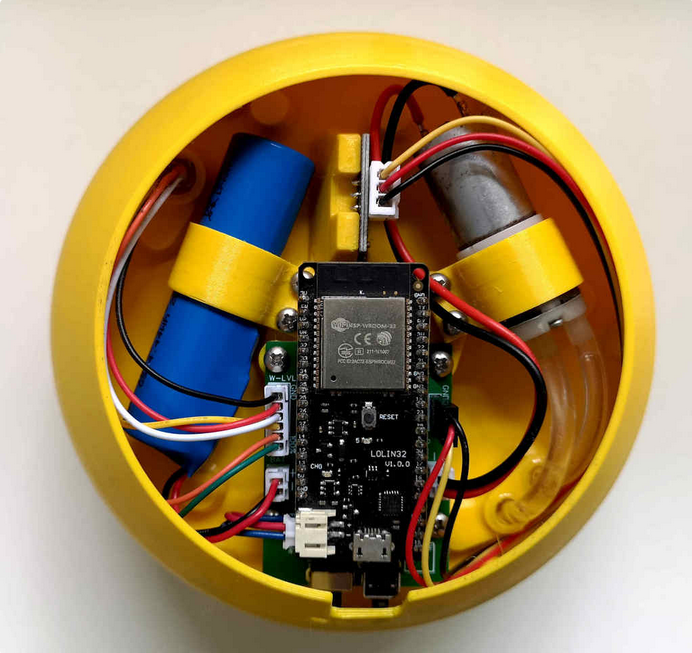
While it’s true that some plants thrive on neglect, many of them do just fine with a few ounces of water once a week, as long as the light level is right. But even that is plenty to remember and actually do in our unprecedented times, so why bother trying? [Martin] has solved this problem for us, having given every aspect of automatic plant care a lot of thought. The result of his efforts is Flaura, a self-watering open-source plant pot, and a YouTube channel to go with it.

The 3D-printed pot can easily be scaled up or down to suit the size of the plant, and contains a water reservoir that holds about 0.7 L of water at the default size. Just pour it in through the little spout, and you’re good for about three months, depending on the plant, the light it’s in, and how much current water it draws. You can track the dryness level in the companion app.

Whenever the capacitive soil moisture sensor hidden in the bottom of the dirt detects drought conditions, it sends a signal through the Wemos LOLIN32 and a MOSFET to a small pump, which sends up water from the reservoir.

The soil is watered uniformly by a small hose riddled with dozens of tiny holes that create little low-pressure water jets. This is definitely our favorite part of the project — not just because it’s cool looking, but also because a lot of these types of builds tend to release the water in the same spot all the time, which is. . . not how we water our plants. Be sure to check out the project overview video after the break.

No printer? No problem — you could always use an old Keurig machine to water a single plant, as long as the pump is still good.

Thanks for the tip, [Keith]!

I tried (and failed) to channel my inner Bezos

We live in an age where the power of narrative is so strong that it has become the defining way to build organizations, products and brands. In recent decades, the tech industry has presented itself as the savior to all of our problems, and now dominates so much of our culture as a consequence. And there is a quasi-religious fervor to this, especially when we look at the lionization of certain individuals, or the fact that paid-for-marketing-types are called “evangelists,” and the in-group mentality that forms afterward.

If the model for this sanctified tech guru was Steve Jobs, then its most recent exponent must be Elon Musk. Musk’s rise coincided with a vacuum left in the wake of Jobs’ demise, and his image - his personal brand - has been tweaked several times in the last two decades. Compare this footage from the turn of the century when he received his first McLaren F1 to a more recent clip from last year. And Musk’s savviest piece of personal branding is to make him an aspirational figure both as an engineer and entrepreneur.

Noted philosopher Andre Agassi once said that “image is everything,” and that was back in the days before social media. It’s something that I’ve been thinking about a lot recently after watching Apple TV’s WeCrashed. There’s a scene where Anne Hathaway’s character enlists the help of a personal branding expert who asks her, deep down, what sort of person she wants to be. It’s a scene designed to emphasize her inner turmoil at the time, but it got me wondering. Were these consultants invented for the purposes of the story, or do they really do exist?

It turns out that there’s a whole industry of people helping the titans of industry massage their personal brand. But branding, in this context, isn’t the same as styling or something similarly superficial. Its boosters would say it’s a combination of psychotherapy and marketing that, when done properly, is about resolving deep-seated internal conflicts in your psyche. And yes, you might need to pick a pair of shoes that test well with adults aged 29-45, but it’s a lot more about crafting a story around you, about you, which you can present to the wider world.

Branding consultant Lucy Freeman says that many of her clients reach their late ‘30s or early ‘40s and feel suddenly unmoored from their own personalities. “They come to this realization that [having reached a point of leadership in a company] they’ve let themselves disappear,” she said. That’s a problem, especially if they’re now expected to take on a more public-facing role and now need to “fight their way out of the company brand.”

Branding expert Am Golhar says that, often, it’s about how people “want to be perceived” that drives them to seek out help. Ed Zitron, owner of PR agency EZPR, agrees, saying that the point of personal branding is to gain “attention with the media,” so a person can “position themselves as good at, or smart, about something.” He added that “third-party validation is huge: You’d rather listen to a reporter that’s ostensibly done research on something than an ad or piece of marketing collateral.”

Emerge founder Emily Austen recruits a behavioral psychologist as part of her process, with a mission to help identify “what [the client’s] POV should, or could, be to have the space to say something others cannot.” She added that being seen as an “entrepreneur has become a status symbol,” a phenomenon supercharged by the ability to broadcast what you’re doing over social media. “It satisfies the [public] fascination with success, and it looks glamorous and exciting,” she said.

I also asked if it would be possible to drag some random from the street, My Fair Lady style, and turn them into a branding superstar. Golhar says that there’s “got to be something there,” citing the example of Gemma Collins, a British reality TV star who leveraged her larger-than-life personality on The Only Way is Essex to become a household name.

All of the people I spoke to described, in one way or another, a process whereby the figure looking to change has to first interrogate themselves. Golhar says that it’s about them going through an “alignment process [to discover] who they are.” Thought Leadership PR founder Helen Croydon added that the questions you ask people include “why they chose this career path” and what are their “talking points.” Before you can brand, or rebrand yourself, you need to understand what it is that you’re selling.

One common anxiety that clients share is the belief that they’re about to become a strutting diva. After all, executives don’t need a brand, which sounds a little too much like caring about what other people think of you, do they? (I mean, we all do care about what other people think about us, but it seems gauche to do anything so drastic as to do anything about that.) Freeman says that the process is more about re-discovering your “non-negotiables and absolute truths.”

Another thing that came up repeatedly was a desire for these figures to demonstrate that they were an expert in the subject matter at hand. “They do care about their image,” said Croydon, “but [they’re] more concerned with portraying professional expertise in their industry.” The hope is, as always, that the greater your esteem, the more you’ll be able to leverage that into future opportunities.

There are shortcuts, if you can afford it, that will help cut some of the time it would normally take to build your new brand. Croydon, for instance, explained that agencies will hire journalists to ghostwrite material on behalf of their clients. She herself employs a number of writers who can produce such content in the service of furthering someone’s brand. Not, she explains, because the individuals can’t do it themselves, but often they’re sufficiently time-poor that they need the help.

Zitron has made his name as a vocal critic of much of what the PR industry does and isn’t a fan of the idea of personal branding at all. “There isn’t an honest [process],” he said, “personal branding is intentionally choosing what you want to share with the world at large.” That, however, “involves hiding specific things, or intentionally obfuscating parts of your life so you look better or are accepted by more people.” “If you are building a narrative for a singular person that is not ‘this is their history and this is where they’ve got to in their lives,’ then you are intentionally misleading people.” Zitron added that while there is “nothing wrong with trying to present your best self,” which, of course, we’re all doing a lot of the time, there’s a problem if “you are doing so with malicious intent.”

But despite Zitron’s warnings, I did want to explore the world of personal branding, hell, it might even help me in my career. Freeman was kind enough to sign me up for a 90-minute session where we would delve into what exactly my personal brand was, and what it could be. She started by asking me questions about what I like, what my values are and what brings me joy. Then we moved on to questions about what I’d like to do more and less of, looking for problems in my day that I’d like to get past.

Then we spent a long time discussing, for instance, how my friends, family and co-workers perceive me – or how I think they do. These were, I’ll admit, hard questions, and there’s a noticeable pause when I’m asked Who do you tell yourself you are? The follow up was harder: Who are you afraid to tell yourself that you are? It was heavy stuff. Now, in any normal story, this is the point where I reveal I’ve got lots of good tips on finding my own personal brand to share with you. But that didn’t happen, mostly because, based on my responses, Freeman told me “you have never, actually thought about [your authentic self] for a second.”

Ah. Maybe it's true, then, that in order to cultivate a personal brand that there has to be some nugget of raw something that can be shaped into something more effective. I wonder, too, if you don't require a fairly hefty dose of self-belief, enough to propel you toward the idea of considering your brand in the first place. Clearly that is something I'll need to work on.

Tesla Autopilot under investigation following crash that killed three people

A recent Model S crash that killed three people has sparked another Federal probe into Tesla's Autopilot system, The Wall Street Journal has reported. The National Highway Traffic Safety Administration (NHTSA) is conducting the investigation and said it's currently looking into more than 30 incidents involving Tesla's Autopilot.

The accident occurred on May 12th in Newport Beach's Mariners Mile strip, according to the Orange County Register. The EV reportedly struck a curb and ran into construction equipment, killing all three occupants. Three construction workers were also sent to hospital with non-life-threatening injuries. Police declined to say whether Tesla's Autopilot was involved. 

Tesla is one of a number of automakers that have released Level 2 driver assistance systems designed to ease driving chores. Those systems are far from full self-driving (Level 4 or 5) though, and Tesla specifically instructs drivers to pay attention to the road and keep their hands on the wheel. 

The NHTSA said last August that it was opening an investigation into Autopilot following 11 crashes with parked first responder vehicles since 2018 that resulted in 17 injuries and one death. 

The NHTSA itself has been criticized by the National Transportation Safety Board (NTSB) for not ensuring automakers include the right safety features in their Level 2 autonomous vehicles. NTSB chair Jennifer Homendy has called Tesla's use of the term "Full Self-Driving" for its latest Autopilot system "misleading and irresponsible," saying "it has clearly misled numerous people to misuse and abuse technology." 

How Does the GP2Y1014AU0F Dust Sensor Work and How to Interface it with Arduino

How Does the GP2Y1014AU0F Dust Sensor Work and How to Interface it with Arduino

When we are talking about air pollution, dust and smoke are one of the many reasons for air pollution. Not only that, in recent years due to climate change, wildfires have become more frequent. A recent report from National Interagency Fire Center (NIFC) reported a total of 58,733 wildfires across the US that had burned more than 7.13 million acres in 2021 alone. That is why in this article we are going to Interface the GP2Y1014AU0F Dust Sensor with Arduino to add basic particle sensing to our project.

Debashis Das Thu, 05/19/2022 - 13:36

Multitopology Dual-Channel Boost Controller with Spread Spectrum Frequency Modulation for LED Drivers

Multitopology Dual-Channel Boost Controller with Spread Spectrum Frequency Modulation for LED Drivers

Infineon Technologies AG has expanded the LITIX Power family with the dual-channel, stand-alone DC-DC controller TLD6098-2ES that can drive a full LED headlamp by itself without an additional microcontroller and can also operate the four standard LED front light functions: High Beam (HB), Low Beam (LB), Daytime Running Lights (DRL) and Turn Signal (TURN).

Lakshita Khanna Thu, 05/19/2022 - 11:52
Circuit Digest 19 May 07:22

Apple Store workers at the World Trade Center accuse the company of union busting

The Communications Workers of America has filed a second Unfair Labor Practice charge against Apple this week. This time, the labor union is accusing the tech giant of violating multiple federal labor laws at its flagship World Trade Center store. The complaint alleges that Apple interrogated workers at the WTC store regarding their "protected concerted activities." Apple also allegedly monitored those activities, or at least made employees believe that they were being monitored. Based on the group's filing, those incidents happened on or about May 3rd. 

By May 15th, the group said Apple "unlawfully implemented" a rule at the store that prohibits employees from posting union flyers in work areas during their breaks. Further, it's accusing the tech giant of conducting "captive-audience" speeches designed to discourage them from unionizing. 

Earlier this year, Apple Store workers across the US started planning to unionize in an effort to get the company to increase their pay, which they claim isn't keeping up with the cost of living. Apple reportedly hired anti-union law firm Littler Mendelson, which counts Starbucks and McDonald's as clients, in response. According to a Motherboard report, the company also recently started arming its Store managers with anti-union talking points. They were apparently instructed to tell employees that they could lose career opportunities, as well as personal time off and work flexibility, if they join a union. 

The Communications Workers of America also filed an Unfair Labor Practice complaint against Apple on behalf of workers at the Cumberland Mall store on May 17th. In it, the group accused the company of holding mandatory captive audience meetings regarding the upcoming union election for the Atlanta location that's scheduled to take place in early June. 

Tim Dubnau, CWA's Deputy Organizing Director, said:

"Apple retail workers across the country are demanding a voice on the job and a seat at the table. Unfortunately, and in contradiction to its stated values, Apple has responded like a typical American corporation with heavy-handed tactics designed to intimidate and coerce workers. The best thing Apple can do is allow workers to choose for themselves whether or not they want a union. When we learn of situations where Apple is violating labor law, we intend to hold the company accountable and help the workers defend their rights under the law."

Facebook issues $397 checks to Illinois residents as part of class-action lawsuit

More than a million Illinois residents will receive a $397 settlement payment from Facebook this week, thanks to a legal battle over the platform’s since-retired photo-tagging system that used facial recognition. It’s been nearly seven years since the 2015 class-action lawsuit was first filed, which accused Facebook of breaking a state privacy law that forbids companies from collecting biometric data without informing users. The platform has since faced broad, global criticism for its use of facial recognition tech, and last year Meta halted the practice completely on Facebook and Instagram. But as Voxnotes, the company has made no promises to avoid facial recognition in future products.

Even though it was first filed in Illinois, the class-action lawsuit eventually wound up on Facebook’s home turf — at the U.S. District Court for Northern California. Nevertheless, the court repeatedly denied the platform’s many motions to dismiss the lawsuit and eventually certified the Illinois class-action. Facebook tried to appeal the case certification with the Ninth Circuit Court of Appeals, but was rejected. After Facebook initially agreed to settle the lawsuit for $550 million — which at the time was the largest payout from an online privacy class-action lawsuit — a federal judge fought back and said the amount was too small. Finally, the company last year agreed to a settlement total of $650 million.

The issue at hand was Facebook’s old photo-tagging system, which relied on facial recognition to recognize users in photos and videos. Attorneys representing Illinois residents argued that the platform’s “Suggested Tags” feature violated the state’s Biometric Information Privacy Act. Any Facebook user in Illinois who posted a photo of themselves or was tagged on the platform during a certain time period was eligible to file a claim. Nearly 1.6 million Illinois residents in total were included in the settlement.

A number of Redditors reported receiving their settlement checks via direct deposit or in the mail this week, though not everyone has received their payment yet. “I did mine and my wife’s at the same time and got one yesterday and the other today. This was through Zelle,” noted one user on Reddit.

Some who opted to receive a check in the mail were a little thrown off by its non-descript appearance. “Honestly I almost threw mine away. It was sent in a brown envelope made of recycled paper. Felt just like a paper bag. I thought for sure it was junk mail,” said a user on Reddit.