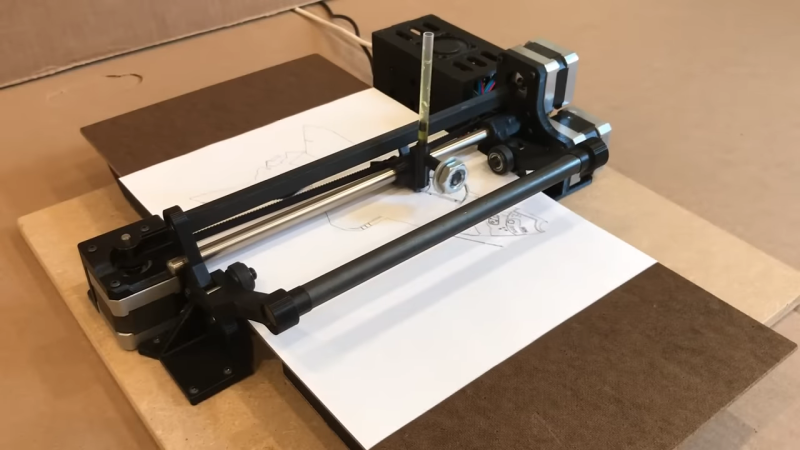
We see a lot of simple pen plotter projects around here, and while we appreciate them one and all, most of them are a little on the slow side. That’s OK — a glacial pace is sometimes all that’s needed, as long as it gets the job done. But there’s nothing wrong with putting the pedal to the metal, so to speak. And that’s exactly what this super-fast Arduino-based plotter is all about.
As the story goes, [IV Projects] felt the need for speed after building an earlier pen plotter project that worked, but failed to excite. With the additional goal of keeping the plotter easy to build with cheap parts, the design centers on a “grit roller drive” for the Y-axis — the one that actually moves the paper back and forth. And move it does, using Dremel tool sanding drums on a lightweight shaft to maximize acceleration. In fact, all the moving parts are kept as lightweight as possible, and the results really show — the three steppers really sing when this plotter is in action.
There are some really clever details in [IV Projects]’ design. We particularly like the way the pen lift mechanism works, and the surprise appearance of a clothespin spring as a belt tensioner was a real treat. Judging by the pile of rejected prototype parts, it took quite a bit of work to get this design right. If you’d like to build your own, STLs are available for the printed parts.
WhatsApp has added a handful of features to make group calls more manageable. As of this week, you can both mute and message specific people in your group calls, the company announced in a tweet spotted by Android Central (via The Verge). The former should be particularly helpful in situations where someone might not be aware that everyone else can hear what’s going on in the background of their home or office. The company has also added a banner that will notify you when someone joins a group call.
Some new features for group calls on @WhatsApp: You can now mute or message specific people on a call (great if someone forgets to mute themselves!), and we've added a helpful indicator so you can more easily see when more people join large calls. pic.twitter.com/fxAUCAzrsy
WhatsApp has introduced a number of new features as of late. Alongside the group calling functionality, this week saw the addition of new privacy toggles that give people more granular controls over their profile photos and Last Seen status. The company also finally made it easier for Android users to migrate their chat histories to a new iPhone.
Nearly four months after integrating Comixology into its other services, Amazon acknowledged the platform has been left worse off. “We understand that the current experience needs improvements, and want you to know that we’re working hard to get those out the door as quickly as possible,” the company said in an 11-part Twitter thread spotted by Gizmodo.
1./ We’ve been combing through your feedback, and continue to be grateful for all the comics lovers out there. We understand that the current experience needs improvements, and want you to know that we’re working hard to get those out the door as quickly as possible.
In the coming weeks, Amazon promised to address some of the more prominent issues that have plagued the digital comics service since its integration with the Kindle app. For instance, an upcoming beta version of Comixology’s web-reading client will bring back support for double-page spreads. Additionally, Amazon said it was working to fix a problem with its store algorithm that causes the software to show results for novels and non-fiction books when customers search for comics, manga and graphic novels.
Amazon noted that some of the enhancements would arrive soon, but others do not yet have a release date. “We’ll let you know when this launches,” the company said of a feature that will allow people to filter for their comics within the Kindle app. “We know there’s a lot more that needs to be done to improve the Comixology experience, and we have many more initiatives we’ll share soon,” the company said.
For fans, Amazon’s handling of Comixology is particularly frustrating given that the previous version of the app was serviceable and included many of the features the company is now working on adding. Unfortunately, they can’t use that software anymore since it was shut down by Amazon shortly after it completed the Kindle integration. To make matters worse, Comixology is the only digital service you can currently use to purchase comics piecemeal from a variety of publishers.
Two weeks after release, Blizzard’s Diablo Immortal has earned approximately $24 million for the troubled studio, according to Appmagic. In an estimate it shared with GameDev Reports, the analytics firm said the free-to-play game was downloaded almost 8.5 million times over the same timeframe, with 26 percent of downloads originating in the US. The bulk of Blizzard’s revenue from Diablo Immortal has also come from America. To date, US players contributed about 43 percent of all the game’s earnings.
To put Immortal’s earlyfinancial success in context, Hearthstone, the only other mobile game Blizzard has out at the moment, earned about $5 million in May. Despite the vocal backlash to Immortal’s monetization systems, it’s probably safe to say no one expected the game to fail out of the gate. Instead, the worry for many fans was a scenario where Immortal was so successful for Blizzard that it went on to inform how the studio monetizes its future games.
For the time being, that fear seems unfounded. Diablo franchise general manager Rod Fergusson recently said Diablo IV would feature a different set of monetization systems than Immortal. “To be clear, D4 is a full-price game built for PC/PS/Xbox audiences,” he tweeted after the game’srecent showing at Microsoft’s recent Summer Game Fest presentation. Separately, Blizzard announced this week Overwatch 2 would do away with loot boxes.
Since the start of the year, Google has tried to publicly pressure Apple into adopting the GSMA’s RCS messaging protocol. The search giant’s campaign has involved everything from not-so-subtle jabs at I/O 2022 to long Twitter threads from the head of Android. Now the feud has expanded to include Drake.
In a tweet spotted by 9to5Google, the Android Twitter account shared an “unofficial lyric explainer video” for “Texts Go Green,” the third song from the rapper’s latest album. The song features Drake singing about a toxic relationship. Both the title and chorus of “Texts Go Green” refer to what happens when an iPhone user blocks someone from contacting them through iMessage. The service defaults to SMS and the blacklisted individual will lose all the benefits of iMessage, including read receipts if the other person had them enabled previously.
Calling the song “a real banger,” Google says the “phenomenon” of green text bubbles is “pretty rough” for both non-iPhone users and anyone who gets blocked. “If only some super talented engineering team at Apple would fix this,” the company says in the video. “Because this is a problem only Apple can fix. They just have to adopt RCS, actually.”
The irony of Google’s video is that doesn’t accurately explain the meaning of “Texts Go Green.” In the context of the song, iMessage’s incompatibility with RCS is a comfort for Drake. “Texts go green, it hits a little different, don't it?” he sings. “Know you miss the days when I was grippin' on it / Know you're in a house tonight just thinkin' on it / I moved on so long ago.”
But, hey, whatever it takes for Apple to adopt RCS, right?
As distressing a prospect it may sound, our world did exist before social media. Those were some interesting times with nary a poorly lit portion of Cheesecake Factory fare to critique, exactly zero epic fails to laugh at and not one adorable paw bean available for ogling. There weren't even daily main characters! We lived as low-bandwidth savages, huddled around the soft glow of CRT monitors and our cackling, crackling signal modulators, blissfully unaware of the societal upheaval this newfangled internet would bring about.
In his new book, The Modem World: A Prehistory of Social Media, author and Assistant Professor in the Department of Media Studies at the University of Virginia, Kevin Driscoll examines the halcyon days of the early internet — before even AOL Online — when BBS was king, WiFi wasn't even yet a notion, and the speed of electronic thought topped out at 300 baud.
Early on, the heartbeat of the modem world pulsed at a steady 300 bits per second. Streams of binary digits flowed through the telephone network in 7- and 8-bit chunks, or “bytes,” and each byte corresponded to a single character of text. The typical home computer, hooked up to a fuzzy CRT monitor, could display only about a thousand characters at once, organized into forty columns and twenty-four rows. At 300 bits per second, or 300 “baud,” filling the entire screen took approximately thirty seconds. The text appeared faster than if someone were typing in real time, but it was hardly instantaneous.
In the late 1970s, the speed at which data moved through dial-up networks followed a specification published by Ma Bell nearly two decades before. Created in the early 1960s, the AT&T Data-Phone system introduced a reliable technique for two-way, machine-to-machine communication over consumer-grade telephone lines. Although Data-Phone was initially sold to large firms to facilitate communication between various offices and a single data-processing center, it soon became a de facto standard for commercial time-sharing services, online databases, and amateur telecom projects. In 1976, Lee Felsenstein of the People’s Computer Company designed a DIY modem kit offering compatibility with the AT&T system for under $100. And as newer tech firms like Hayes Microcomputer Products in Atlanta and US Robotics in Chicago began to sell modems for the home computer market, they assured consumers of their compatibility with the “Bell 103” standard. Rather than compete on speed, these companies sold hobbyist consumers on “smart” features like auto-answer, auto-dial, and programmable “remote control” modes. A 1980 ad for the US Robotics Phone Link Acoustic Modem emphasized its warranty, diagnostic features, and high-end aesthetics: “Sleek... Quiet... Reliable.”
To survive, early PC modem makers had to sell more than modems.
They had to sell the value of getting online at all. Today, networking is central to the experience of personal computing — can you imagine a laptop without WiFi? — but in the late 1970s, computer owners did not yet see their machines as communication devices. Against this conventional view, upstart modem makers pitched their products as gateways to a fundamentally different form of computing. Like the home computer itself, modems were sold as transformative technologies, consumer electronics with the potential to change your life. Novation, the first mover in this rhetorical game, promised that its iconic black modem, the Cat, would “tie you into the world.” Hayes soon adopted similar language, describing the Micromodem II as a boundary-breaking technology that would “open your Apple II to the outside world.” Never mind that these “worlds” did not yet exist in 1979. Modem marketing conjured a desirable vision of the near future, specially crafted for computer enthusiasts. Instead of driving to an office park or riding the train, modem owners would be the first truly autonomous information workers: telecommuting to meetings, dialing into remote databases, and swapping files with other “computer people” around the globe. According to Novation, the potential uses for a modem like the Cat were “endless.”
In practice, 300 bits per second did not seem slow. In fact, the range of online services available to microcomputer owners in 1980 was rather astonishing, given their tiny numbers. A Bell-compatible modem like the Pennywhistle or Novation Cat offered access to searchable databases such as Dialog and Dow Jones, as well as communication services like CompuServe and The Source. Despite the hype, microcomputers alone could sometimes seem underwhelming to a public primed by visions of all-powerful, superhuman “world brains.” Yet, as one Byte contributor recounted, the experience of using an online “information retrieval” service felt like consulting an electronic oracle. The oracle accepted queries on virtually any topic — “from aardvarks to zymurgy” — and the answers seemed instantaneous. “What’s your time worth?” asked another Byte writer, comparing the breadth and speed of an online database to a “well- stocked public library.” Furthermore, exploring electronic databases was fun. A representative for Dialog likened searching its system to going on an “adventure” and joked that it was “much less frustrating” than the computer game of the same name. Indeed, many early modem owners came to believe that online information retrieval would be the killer app propelling computer ownership into the mainstream.
Yet it was not access to other machines but access to other people that ultimately drove the adoption of telephone modems among micro- computer owners. Just as email sustained a feeling of community among ARPANET researchers and time-sharing brought thousands of Minnesota teachers and students into collaboration, dial-up modems helped to catalyze a growing network of microcomputer enthusiasts. Whereas users of time-sharing networks tended to access a central computer through a “dumb” terminal, users of microcomputer networks were of- ten themselves typing on a microcomputer. In other words, there was a symmetry between the users and hosts of microcomputer networks. The same apparatus — a microcomputer and modem — used to dial into a BBS could be repurposed to host one. Microcomputers were more expensive than simple terminals, but they were much cheaper than the minicomputers deployed in contemporary time-sharing environments.
Like many fans and enthusiasts, computer hobbyists were eager to connect with others who shared their passion for hands-on technology. News and information about telephone networking spread through the preexisting network of regional computer clubs, fairs, newsletters, and magazines. At the outset of 1979, a first wave of modem owners was meeting on bulletin board systems like CBBS in Chicago and ABBS in San Diego to talk about their hobby. In a 1981 article for InfoWorld, Craig Vaughan, creator of ABBS, characterized these early years as an awakening: “Suddenly, everyone was talking about modems, what they had read on such and such a bulletin board, or which of the alternatives to Ma Bell... was most reliable for long-distance data communication.” By 1982, hundreds of BBSs were operating throughout North America, and the topics of discussion were growing beyond the computing hobby itself. Comparing the participatory culture of BBSs to amateur radio, Vaughan argued that modems transformed the computer from a business tool to a medium for personal expression. Sluggish connection speeds did not slow the spread of the modem world.
True to the original metaphor of the “computerized bulletin board,” all early BBSs provided two core functions: read old messages or post a new message. At this protean stage, the distinction between “files” and “messages” could be rather fuzzy. In a 1983 how-to book for BBS software developers, Lary Myers described three types of files accessible to users: messages, bulletins, and downloads. While all three were stored and transmitted as sequences of ASCII characters, Myers distinguished “the message file” as the defining feature of the BBS. Available day and night, the message file provided an “electronic corkboard” to the community of callers: a place to post announcements, queries, or comments “for the good of all.” Myers’s example routine, written in BASIC, identified each message by a unique number and stored all of the messages on the system in a single random-access file. A comment in Myers’s code suggested that eighty messages would be a reasonable maximum for systems running on a TRS-80. A caller to such a system requested messages by typing numbers on their keyboard, and the system retrieved the corresponding sequence of characters from the message file. New messages were appended to the end of the message file, and when the maximum number of messages was reached, the system simply wrote over the old ones. Like flyers on a corkboard, messages on a BBS were not expected to stay up forever.
Apple Store employees at the company’s Towson Town Center location in Maryland have voted to unionize. According to the Coalition of Organized Retail Employees (AppleCore), the group that led the unionization effort, workers voted "overwhelming" in favor of joining the International Association of Machinists and Aerospace Workers (IAM). With the historic vote, Towson Town Center should become the first unionized Apple Store in the US.
“I applaud the courage displayed by CORE members at the Apple store in Towson for achieving this historic victory,” said IAM International President Robert Martinez Jr. in a statement following the vote.“They made a huge sacrifice for thousands of Apple employees across the nation who had all eyes on this election. I ask Apple CEO Tim Cook to respect the election results and fast-track a first contract for the dedicated IAM CORE Apple employees in Towson. This victory shows the growing demand for unions at Apple stores and different industries across our nation.”
We did it Towson! We won our union vote! Thanks to all who worked so hard and all who supported! Now we celebrate with @machinistsunion. Tomorrow we keep organizing.
An advocacy group is calling on Meta to allow Facebook users to list more than one romantic partner in their profiles. In a letter the Organization for Polyamory and Ethical Non-monogamy (OPEN) sent to the social media giant on Thursday, it said the current design of Facebook’s relationship status feature is “exclusionary” towards people who practice ethical non-monogamy. The group has asked that Meta allow users to tag all their romantic partners.
“At best, this restriction perpetuates the erasure and marginalization of non-monogamous relationships; at worst, it harms non-monogamous users by perpetuating social stigmas around the validity and authenticity of their relationships,” OPEN said.
A Meta spokesperson told The New York Times the company is reviewing the letter and noted that Facebook already allows users to mention on their profile that they’re in an “open relationship” with one or more people. The timing of the request may seem curious given Facebook’s declining daily userbase, but it’s in line with the growing number of people who find themselves in non-monogamous relationships. According to data cited by OPEN, about four to five percent of American adults practice ethical non-monogamy.
When Microsoft effectively discontinued support for Internet Explorer earlier this week, one person decided to mark the occasion with a bit of humor. Per Reuters, software Jung Ki-young spent 430,000 won (about $330) to design and order a headstone for the web browser ahead of its official end-of-support date. The memorial, located on the roof of his brother’s cafe in the South Korean city of Gyeongju, features IE’s iconic logo followed by an English epitaph that reads, “He was a good tool to download other browsers.”
Jung told Reuters he commissioned the memorial to commemorate a program that had defined his career. Even as apps like Chrome and Firefox went on to replace Internet Explorer in both prominence and popularity, many of Jung’s customers kept asking him to ensure their websites looked good in Microsoft’s aging web browser. "It was a pain in the ass, but I would call it a love-hate relationship because Explorer itself once dominated an era,” he said.
As funny as the tombstone is, it may be premature. Microsoft still plans to support Internet Explorer in some contexts. For instance, Edge’s IE Mode will continue to work through 2029 or later. Moreover, parts of the world, including countries like Japan, continue to use the web browser for business and government administration.
With repairs complete and the rocket in place at its designated launch pad, NASA is ready to once again attempt a critical fueling test of its next-generation Space Launch System. Per Space.com, the Artemis 1 “wet dress rehearsal” will begin at 5PM ET today with a call to stations for ground personnel at Kennedy Space Center.
Over the next 48 hours, technicians will attempt loading the rocket’s first and second stages with cryogenic fuel. Provided there aren’t major setbacks, they will then try to load it with propellant starting Monday morning. If the test is successful, the Artemis 1 mission could get underway as early as July 26th.
For the oft-delayed SLS, this is its second trip to historic Launch Pad 39B. Following an initial attempt at the wet dress rehearsal on April 1st, NASA tried to complete a modified version of the fueling test on April 14th, but that was cut short after the agency discovered a hydrogen leak in the rocket’s mobile launch tower. NASA eventually decided to move the SLS back to the Kennedy Space Center’s Vehicle Assembly Building for repairs and to give a critical nitrogen supplier time to complete capacity upgrades.
Once the wet dress rehearsal is complete, NASA can finally move forward with Artemis 1. The mission will send an unmanned Orion capsule on a flight around the Moon. The next two Artemis missions would feature human astronauts, with an eye toward a lunar landing sometime in 2025 or 2026.