Meta will no longer pay US publishers for news content

After Meta's revenue shrank for the first time in its history, the company has reportedly told publishers it will no longer pay for content to run in Facebook's News Tab, according to Axios. "Most people do not come to Facebook for news, and as a business it doesn't make sense to over-invest in areas that don't align with user preferences," a spokesperson said in a statement.

Facebook spent around $105 million on such deals, paying $20 million to The New York Times, $10 million to The Wall Street Journal and $3 million to CNN, according to Axios. Facebook struck the deals back in 2019 as it boosted its investment in news and even hired journalists to direct traffic to the news tab. 

Facebook also promised to pay partner sites including The Guardian and The Economist for news in the UK when it launched the News Tab there late in 2020. Shortly after that, it signed a deal with Rupert Murdoch's News Corp to pay for content in Australia, after the Australian Parliament passed a law requiring Facebook and Google to do so. 

Along with Google, Facebook has taken criticism for drawing ad dollars away from dedicated news sites. That has contributed to the failure of a quarter of US news sites over the last 15 years, according to Poynter, with the professional journalism vacuum often been filled by false or misleading news on Facebook. 
Twitter raises the price of Blue subscriptions to $5 a month

Twitter's $3 subscription now costs $5 a month. The social network has sent out an email notifying existing subscribers that Twitter Blue has raised its prices for new members, but as early adopters, the monthly amount they're paying will remain the same until October. In the email posted by social media consultant Matt Navarra and first spotted by The Verge, the company said early adopters will also be notified at least 30 days before the new monthly price takes effect for their accounts. 

The company didn't elaborate on the reason behind the price increase and only said in the email that it will help Twitter build new features subscribers have been asking for, improve upon the ones it already has and sustain its mission of supporting journalism. It also said that it's currently creating a "more frictionless reading experience" and launching new experimental features in Twitter Blue Labs for those who choose to stick around even with the higher subscription price.

Here’s the full email about the Twitter Blue price increase: pic.twitter.com/xXLRhSnxQR

— Matt Navarra (@MattNavarra) July 29, 2022

Twitter launched its subscription service in the US back in November, unlocking additional features for the website's most dedicated users. Some of its features can be very useful, including the ability to Undo tweets, which is the closest thing to an "edit" button at the moment. It also allows members to browse news without ads and gives them access to the latest features the website is testing.

In its second quarter earnings report for 2022, Twitter said it has seen a sharp rise in the number of regular users on the website. The bad news was that it didn't translate to more money for the company. It posted a net loss of $270 million, which it blamed on the economic downturn and the uncertainty surrounding Elon Musk's takeover. If you'll recall, Musk offered to buy Twitter for $44 billion back in April and the social network quickly accepted, but they've been at odds since then. In July, Twitter sued Elon Musk for attempting to back out of the acquisition, and now the two parties are going to face off in an expedited, five-day trial beginning in October.

Sony lowers forecast for PS5 gaming sales in 2022

At the end of its fiscal year in May, Sony was fairly bullish on gaming sales, predicting sales of 18 million PlayStation 5s for 2022 after selling 11.5 million in 2021. The company also expected a "significant" revenue increase over 2021 due to a boost across "all categories."

In its latest earnings drop, however, the company has revised its profit forecast down by 16 percent from 305 billion yen ($2.3 billion) in May to 255 billion yen ($1.9 billion), "due to an expected decrease in sales of first party titles," it wrote. The company also chalked up the drop in revenue to higher expenses due to its acquisition of Bungie Studios closing earlier than expected. 

Sony didn't say anything about its PS5 console forecast, but it sold 2.4 million units this quarter compared to 2.3 million in the same quarter last year (21.4 million units to date). That means it must sell over 5 million units on average for the next three quarters to meet its May forecast — something it has never done before. In May, however, Sony said that it will finally be able to ramp up production to meet PS5 demand as supply chain issues ease — though as it stands now, the consoles are still in short supply. 

On the software side, things also went south as Sony sold just 47.1 million titles, including 6.4 million first party games, compared to 63.6 million titles and 10.5 million first-party games in the same quarter of 2021. On top of that, PlayStation Plus users dropped slightly from Q4 (47.3 million instead of 47.4 million), and monthly active users also dropped from 106 to 102 million. Sony introduced the new higher-priced PS Plus Extra and Premium tiers in June, but it has yet to reveal the impact of those — hopefully, we'll learn more next quarter.

Looking ahead, Sony has a few major titles on the horizon that could perk up software sales, including God of War Ragnarokcoming November 9th, and The Last of Us Part I remake arriving on September 2nd. On the hardware side, the PSVR 2 has been revealed but isn't expected to arrive until next year.  

The next quarter will be a lot more interesting for Sony's gaming division, as PS5 sales will show if it's been able to ramp up production. Game sales will also be notable, as the steep drop this quarter bodes ominously for the industry as a whole. 

US federal court system attacked by 'hostile foreign actors' in 2020 security breach

The US federal courts' document filing system was attacked by three hostile foreign actors, House Judiciary Committee Chair Jerrold Nadler has told fellow lawmakers. According to Politico, Nadler made the first public disclosure of the cyberattack at a committee hearing on oversight of the Justice Department’s National Security Division (NSD). The attack happened as part of a bigger security breach that led to a "system security failure" way back in 2020. Nadler has admitted during the hearing, however, that the committee only learned about the "startling breadth and scope" of the breach this March. 

Matthew Olsen, the Assistant Attorney General for National Security, has testified at the hearing and said his division is "working very closely with the judicial conference and judges around the country to address this issue." As you can guess, lawmakers are worried about how many cases were impacted by the breach and how exactly the issue had affected them. "[T]his is a dangerous set of circumstances that has now been publicly announced, and we need to know how many…were dismissed," committee member Rep. Sheila Jackson Lee told Olsen. When asked if the breach had affected any of the cases the NSD had handled, Olsen said he couldn't think of any in particular. 

There's still a lot of information about the breach that's kept under wraps — Senator Ron Wyden even wrote to the Administrative Office of the US Courts to express concerns about the fact that "the federal judiciary has yet to publicly explain what happened and has refused multiple requests to provide unclassified briefings to Congress." As Politico notes, though, the US Courts admitted in January 2021 that its Case Management/Electronic Case Files system was breached and even changed its filing procedures for sensitive documents. The publication also points out that this breach wasn't a part of the massive SolarWinds hacks, which are being blamed on a Russian state-sponsored group known as Nobelium.

Olsen said the Justice Department's investigators will keep the committee updated about any new developments, so we'll likely hear more information about the data breach in the future. 

Apple's Mac and wearables revenue stumbles as tech sector recedes

After a strong quarter earlier this year, Apple is continuing to break records. According to the company's financial results posted today, it's reporting a revenue record of $83 billion, an increase of 2 percent from the same period last year. Apple also said it reached an all-time high for its installed base of active devices "in every geographic segment and product category." However, the company's profits are down by a whole 11 percent, and while it continued to see growth in its iPhone sales, revenue from Macs and wearables dropped.

It's worth noting that Apple's recently announced MacBook Air with M2 chip only started shipping this month, so the numbers for Macs are likely to increase next quarter. Considering the devices the company is expected to launch in the fall, it's also possible consumers are holding out for new products and waiting out the ongoing inflation. 

Apple CEO Tim Cook said in a press release “This quarter’s record results speak to Apple’s constant efforts to innovate, to advance new possibilities, and to enrich the lives of our customers.” The company's CFO Luca Maestri added “Our June quarter results continued to demonstrate our ability to manage our business effectively despite the challenging operating environment."

The company is holding a call at 5pm ET to shed light on its results and answer questions from the investor community, and we'll update this post with any newsworthy findings.

House passes CHIPS Act, preparing semiconductor bill to become law

Legislation aimed at boosting US chip production has cleared its last major hurdle. The House of Representatives has passed the CHIPS and Science Act in a 243-187-1 vote, leaving just the reconciliation process and President Biden's signature before the bill becomes law. The equivalent Senate measure passed 64-33 in a vote one day earlier.

The Act is a dialed-down version of previous bills, but promises significant help for American semiconductor manufacturing. It offers more than $52 billion for US chipmakers as well as tax credits for domestic factories. In a statement, the President claimed the bill would lower product costs, create "high-paying" jobs and reduce the country's dependence on foreign chip sources.

Earlier approaches drew objections from both sides of Congress. Republicans were concerned the reconciliation bill would include unrelated climate, health and tax elements. They also said it risked funding Chinese manufacturing. Independent Senator Bernie Sanders, meanwhile, has expressed concerns the bill might reward chip manufacturers already rolling in cash, and was the only non-Republican in the Senate to vote against it.

The CHIPS and Science Act isn't expected to affect production in the short term. It will take companies years to build new factories and otherwise upgrade facilities to tackle chip shortages and improve manufacturing independence. If things play out as its supporters imagine, however, CHIPS will hopefully decrease the severity of future supply chain crunches.

a Customizable Macropad to Make Anyone’s Tail Wag

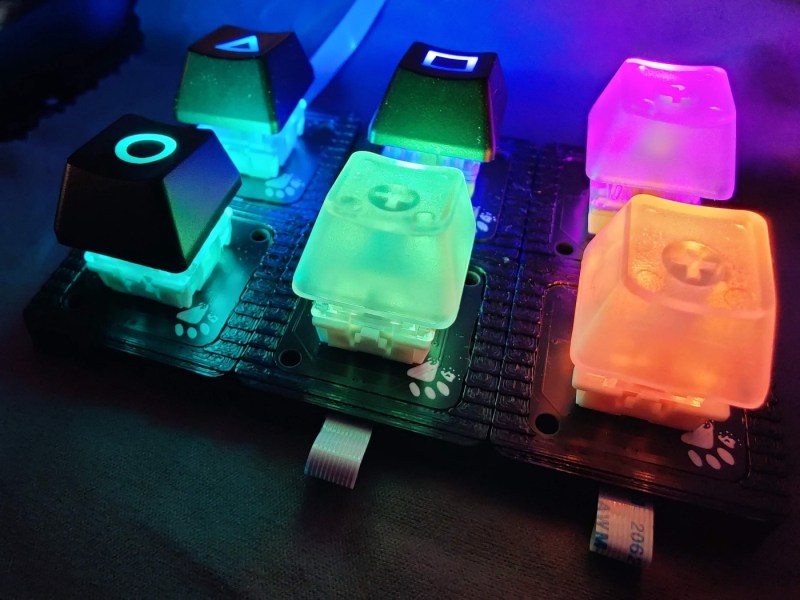
[Gili Yankovitch] has always wanted some kind of macro keypad for all those boss-slaying combos he keeps up the sleeve of his wizard robe while playing WoW. Seventeen years later, he finally threw down the gauntlet and built one. But really, this is an understatement, because Paws is kind of the customizable macropad to end all customizable macropads.

This thing is completely bespoke, and yet cookie cutter at the same time — but we mean that in the best possible way. Paws can be made in any shape or form, and quite easily. How is this even possible, you ask? Well, every single key has its own microcontroller.

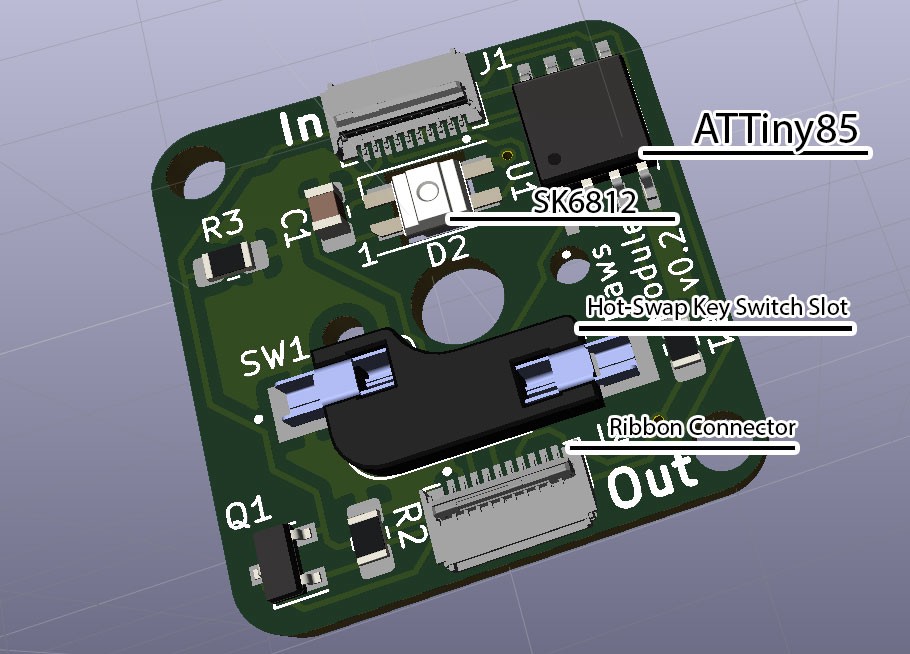
Yep, each key has an ATtiny85 and a cute little ribbon cable, and these form a token ring network that talks to an Arduino, which provides the keyboard interface to the computer. To make things even easier, [Gili] built a simple programming UI that automatically recognizes the configuration and number of keys, and lets the user choose the most important bit of all — the color of the LED.

[Gili] wanted to combine all the skills he’s learned since the worst timeline started in early 2020 — embedded software, CAD, electronics, and PCB design. We’d like to add networking to that list, especially since he figured out a nice workaround for the slowness of I²C and the limitations of communication between the ‘tiny85s and the Arduino. Though [Gili] may have started out with a tall order, he definitely filled it. Want to get your paws on the design files? Just claw your way over to GitHub.

If your customization interests lie more toward what program is in focus, be sure to check out Keybon, which was one of the many awesome winners of our Odd Inputs and Peculiar Peripherals contest.

AMD accidentally reveals its first Ryzen 7000 desktop processors

You don't have to wait until the fall to have an idea of what AMD's Ryzen 7000 desktop CPUs will be like — the company has unintentionally provided clues of its own. Videocardz and Gizmodo note AMD's resource page contained a since-removed list of early Ryzen 7000 processor models. The focus is primarily on higher-end chips, including two Ryzen 9 variants (the 7900X and 7950X), one Ryzen 7 (the 7700X) and a Ryzen 5 model (the 7600X). There's no Ryzen 3 chips, although that last part isn't shocking when AMD has historically focused on enthusiast parts in the early stages of CPU rollouts.

The list didn't include technical details. In its Computex demo, however, AMD showed a 16-core CPU that reached a 5.5GHz clock speed. That might represent the Ryzen 9 7950X. All of the 7000 series will be based on a new Zen 4 architecture that delivers twice the Level 2 cache per core, maximum boost speeds above 5GHz, AI acceleration and support for technologies like DDR5 memory and PCIe 5.0. You'll need an AM5-compatible motherboard to make the leap, but AMD is promising a 15 percent or higher increase in single-threaded performance.

It's still unclear when the Ryzen 7000 desktop line will ship, or how much it will cost. You'll also have to wait longer if you're hoping for high-end laptop CPUs, as AMD won't deliver Dragon Range until 2023. Even so, the teaser gives you an idea of what to expect when Zen 4 finally reaches stores. AMD isn't reinventing its product strategy, so you can plan your PC upgrade accordingly.

'Outer Wilds' will be upgraded for PS5 and Xbox Series X/S September 15th

Outer Wilds is getting a PlayStation 5 and Xbox Series X/S upgrade on September 15th, and it'll be free for anyone who already owns the game on PS4 or Xbox One. Outer Wilds is a brilliant open-world mystery about exploring strange planets and unlocking the secrets of an endless time loop that's consumed the solar system, and it first landed in 2019. It's the first console and PC game out of indie studio Mobius Digital, and it's picked up a handful of prestigious accolades since launch, including Best Game at the 2020 BAFTA Games Awards.

Outer Wilds: Echoes of the Eye, a big and beautiful bit of DLC for the game, landed in September 2021. The native PS5 and Xbox Series upgrade will hit 60fps. It's unclear whether Echoes of the Eye will be included.

The Switch version of Outer Wilds is set to come out after the new upgrade in September, and this is a delay from its original release window of this summer. Mobius Digital made all of these announcements during today's Annapurna Interactive showcase.

Senate committee chair grills Apple, Google over protection against crypto app scams

Crypto scams remain a serious problem, and a key senator wants to make sure app store operators are cracking down. Senate banking committee chair Sen. Sherrod Brown has sent letters to the CEOs of Apple and Google requesting answers on their protections against cryptocurrency app fraud. The politician wanted details of their app approval and reporting processes, user alerts for fraudulent activity, coordination with rival stores and monitoring for apps that transform into phishing scams.

We've asked Apple and Google for comment. Brown gave the executives until August 10th to provide responses to the letters.

Both tech firms provide at least some screening for bogus crypto apps. Apple's App Store review guidelines forbid scam apps, including bait-and-switch tactics. Google is less targeted with its Play Store policies, but bars apps that enable illegal activity or "dishonest behavior." Both companies let you report suspicious apps. They haven't historically sent direct scam alerts, however, and aren't known to actively monitor apps in case they launch phishing scams.

Whatever the stances, Brown saw effective safeguards as important. The FBI recently warned that app-based cryptocurrency fraud has already led to losses of $42.7 million. It was "imperative" that shops protect investors against this damage, the senator said.

There's no certainty that the requests will translate to legislation requiring stricter anti-fraud systems. The committee request could clarify the stances of Apple and Google on the subject, though, and might increase the pressure to take further action. At the least, it's a reminder that an app's presence on the App Store or Google Play isn't a guarantee it will be trustworthy.