The Morning After: Crypto.com refunded someone $7.2 million by mistake

If you ever want a reminder of how hard it is to run a financial institution, check out this unfortunate error made by Crypto.com. It accidentally refunded one of its customers around $7.2 million, rather than the $68 she was expecting. Even worse, the company didn’t discover the expensive snafu until nearly seven months after the transfer. Given the basic tenets of crypto-libertarianism and its philosophical resentment of institutions, you might have expected the site to just write-off the loss. But the platform has instead gone to the courts to get the cash back, forcing the woman to return it, with interest.

– Daniel Cooper

The biggest stories you might have missed

'The Last of Us Part I' is a gorgeous, faithful, expensive remake

It’s the same game, but far better looking.

Naughty Dog

If there’s one sign The Last of Us is already in the pantheon of greatest games ever made, it’s the fact it’s already leapt across two console generations. The title is just nine years old, yet it’s already on its second remaster, this time a ground-up remake for the PlayStation 5. Our resident TLoU fan Nathan Ingraham got to play the new edition before launch, and says it’s the same game, spared from much of the tinkering that has plagued some remakes we could mention. Instead, developers have taken the original and dramatically improved the visuals, including the performance and facial animation to make the story hit harder than it did before.

Continue Reading.

ASUS' Zenbook 17 Fold OLED laptop will start at $3,500

It’s an early adopter price for an early adopter product.

ASUS

ASUS’ Zenbook 17 Fold is an all-screen foldable tablet PC borne out of the company’s Project Precog prototype. It was announced at CES, all the way back in January, but it’s only now the company has announced a price for this groundbreaking machine. $3,500 is the starting price for one of these beasts when they roll out towards the end of the year. It’s early adopter money, but you wouldn’t expect anything less for a 17.3-inch laptop with a foldable OLED display, would you?

Continue Reading.

The best gadgets under $50 for students

Save some cash in the back-to-school rush.

Will Lipman Photography for Engadget

Dr. Richard Carlson once told the world not to “sweat the small stuff,” a command for us to stop worrying about the minutiae of our lives. Sadly, our legion of product geniuses can’t help but obsess over the gadgets you can purchase for less than $50. So why not take advantage of their failings by picking up some sweet bargains during back-to-school season. If they’ve already spent the time sweating, it makes sense for you to take advantage of it, right?

Continue Reading.

Snap confirms it's laying off around 1,300 employees

It’s also canceled almost all of its original series.

Snap has announced a savage round of job losses and project cancellations as part of a major cost-cutting drive. The company behind Snapchat will lay off 20 percent of its workforce, around 1,300 people, and cancel almost all of its original content projects. Standalone apps like Zenly and Voisey close, and development work on its lackluster, if cute, Pixy selfie drone will stop. Snap hopes it can save around $500 million as a result, although losing so many reasons to stick around might cause users to desert the platform as well.

Continue Reading.

Meta is shutting down the standalone Facebook Gaming app

The Twitch competitor was popular, but not popular enough.

Facebook Gaming, the social giant’s attempt to gain a foothold in the live gaming space, is closing down. Two years after launch, the standalone app is being shuttered, but the functionality will remain inside the main app’s gaming tab. It’s thought Facebook snipped the app to cut costs ahead of the looming economic downturn, but the company opted not to share its rationale.

Continue Reading.

What we bought: An NVIDIA RTX 3070, two years late

Was it worth the wait?

Igor Bonifacic / Engadget

Engadget’s Igor Bonifacic has spent the better part of two years trying to snag NVIDIA’s drool-worthy graphics card, the RTX 3070. Cryptocurrency miners have held the graphics card market in their fist for years, and so it’s taken this long to find one available at an affordable price. He said it was worth the wait, especially now they can play games with the settings dialed up to 11 without breaking a sweat.
Continue Reading.

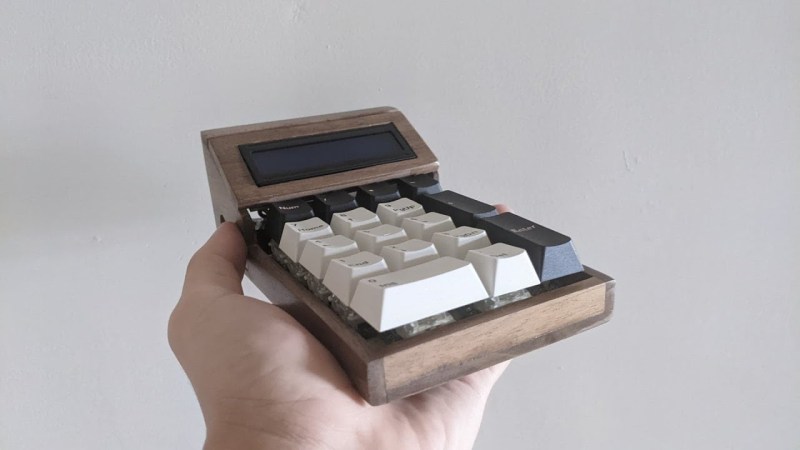
Custom Calculator Brings Us Back To The 70s

There are certain design aesthetics from every era that manage to survive the fads of their time and live throughout history. Ancient Greek architecture is still drawn upon for design inspiration in modern buildings, the mid-century modern style from the 60s still inspires various designs of consumer goods, and the rounded, clean looking cars from the 90s are still highly desirable qualities in automotive design. For electronics, though, we like this 70s-inspired calculator that [Aaron] recently built.

The calculator hearkens back to the days of calculators like the HP-29C with its large buttons and dot-matrix display. [Aaron] built the case out of various woods with a screen angled towards the user, and it uses a LCD display similar to those found in antique calculators. The brain of the calculator is an Arduino which fits easily into the case, and [Aaron] also built the keyboard from scratch with Cherry MX-style mechanical keys soldered together into a custom shape.

The software to run the calculator is fairly straightforward, but we are most impressed with the woodworking, styling, and keyboard design in this build. [Aaron] is also still ironing out some bugs with the power supply as it uses a DC-DC converter to power the device from a single lithium battery. For those who are more fond of early 2000s graphing calculators instead, be sure to take a look at this graphing calculator arcade cabinet.

HMD's Nokia launches a smartphone subscription service with eco-friendly twists

HMD’s Nokia has continued to roll out serviceable but unremarkable smartphones for the last few years. Forgoing attempts to go toe-to-toe with the likes of Samsung and Apple, it’s settled into a groove of releasing solid mid-range and entry-level smartphones, wireless headphones and even tablets. Now it’s announced a new subscription plan that it says will “reward users” for keeping their phone for longer.

Its new Circular subscription, launching in the UK and Germany to begin with, centers around the environment and sustainability. It’ll appear alongside four new devices, including what HMD calls its most eco-friendly smartphone yet. The Nokia X30 is made of 100% recycled aluminum, including both the frame of the device and speaker grills, and uses 65% recycled plastic.

The X30, which for now isn’t coming to the US, has a 6.54-inch screen and a 50-megapixel camera with optical image stabilization (OIS). However, despite those recycled material bona fides, HMD confirmed that there’s still no removable battery, one of (several) issues when it comes to electronics waste.

The Circular service itself is more interesting than the phones. The subscription fee will cover the phone itself, and any accidental damage, loss or theft will be taken care of without a separate monthly cost. The monthly pricing is reasonable, if not groundbreaking. For now, two devices (and they’re not even the new Nokia phones) will join Circular; The Nokia XR20 will cost £20 (roughly $23) per month with a £30 (around $35) setup fee. It’s a ruggedized 6.67-inch 5G smartphone with dual cameras, including a 48-megapixel primary sensor.

There is also the Nokia T10 LTE, an entry-level 8-inch tablet, for £10 (roughly $12) a month with the same £30 (around $35) setup fee.

While the aforementioned X30 won’t be on Circular at launch, those concerns about a reduced footprint when the battery isn’t removable are at least partially addressed. When you return a phone to them, either when you upgrade or leave the service, the company will recycle or refurbish the device. It will also donate devices that can’t be resold to charitable causes, although details were scant on what these would be. There will be longevity incentives for holding onto your Nokia phone for longer too, it’s just not a financial one. Instead, you’ll gain credits for every six months you continue to use your phone, with these increasing the older the handset gets. These can then be put towards ‘buying’ some tree saplings, or carbon offset credits.

Given the structure (and power) of US mobile carriers, this model is unlikely to carry over with similar prices, if at all, but the company said it will roll Circular out globally in the coming months.

LG's MoodUP refrigerator comes with color-changing LED doors and a built-in speaker

IFA 2022 (Europe's answer to CES) starts tomorrow, so you know what that means — some wacky new appliances and home products. LG is kicking off the proceedings with the MoodUP refrigerator that has color-changing LED door panels, offering something completely different for your kitchen than the usual white or brushed metal.

Using LG's ThinkQ app or tapping on the door, you can choose from 22 colors for the upper door panel and 19 colors for the lower one. Or, you can let it choose various color themes like 'Season,' 'Place,' 'Mood' and 'Pop,' that represent things like the colors of nature or "a feeling of wellbeing through the use of soft, soothing colors," LG wrote. 

LG

The panels will blink repeatedly if you leave the door open for too long, or flash a welcome when someone approaches. The freezer door will also glow brighter at night "to help midnight snackers find and open the door" (never stop, LG). With the LED panels switched off, it offers a combination of gray and white for a more traditional look.

It also comes with a built-in Bluetooth speaker that connects to mobile devices or PCs. You can get it to play songs from LG's Music Collection playlist that match the color theme, or have the LED panels change colors in sync with the music. The idea is to add "a sense of liveliness and fun" by apparently transforming your kitchen into a discotheque. 

LG

Details are scarce on the refrigerator itself, but it looks like LG has both a wide, four-door model and a regular single-door version with two freezer compartments. The top image appears to show both models side-by-side. 

It also offers upgraded voice recognition along with WiFi and Bluetooth connectivity. Several PR photos appear to show the company's "InstaView" camera/display tech as well, but LG didn't mention that in the news release. There's no word on pricing, but LG will be showing off the "Dios Object Collection MoodUP" refrigerators at IFA 2022 in Berlin, starting tomorrow. 

Sony's $1,000 Xperia 5 IV offers 4K 120p HDR on all three rear cameras

Sony has unveiled a smartphone with both gaming and photo-taking powers that's (a bit) less expensive than its last few models. The Xperia 5 IV comes with a Snapdragon 8 Gen 1 Mobile Platform and 120Hz 6.1-inch 21:9 OLED display, while offering photo features from the Xperia 1 IV flagship like real-time eye AF and real-time tracking on all three rear cameras. 

Taking advantage of its strong reputation in photography with models like the Alpha A7 IV, Sony is pitching the Xperia 5 IV as a content creation device. To that end, it comes with no less then four 12-megapixel cameras with three on the back (a 16mm 1/2.5-inch f/2.2 ultra-wide, 24mm f/1.7 1/1.7-inch wide and 60mm f/2.4 1/3.5-inch portrait) and one up front for selfies (1/2.9-inch). 

The real-time eye AF promises that your subjects' eyes rather than their nose will stay in focus, and the real-time AI-powered tracking feature keeps fast-moving subjects in focus. It supports shooting speeds of 20 fps with AF and auto exposure for all lenses. The relatively large pixels (1.9 microns) on the main camera should allow for decent low-light shooting, too.

Sony

All three rear sensors have 120fps read-out speeds, letting you record 4K HDR at up to 120fps. Sony is also promising 4K HDR with "outstanding contrast grading" and the ability to take selfies or vlog in high glare or dark environments. As with the Xperia I IV, it comes with the Videography Pro feature that lets you livestream your content to YouTube and other streaming services.

The screen looks to be up to the job for creators as well. It's HDR10 capable (though doesn't support Dolby Vision) and supposedly 50 percent brighter than the last model. It also offers something called "Real Time HDR Drive" that can increase image quality by filling in details on over- and underexposed shots. Users of Bravia Core will also be able to access Sony's latest releases and classic films. 

On the gaming side, the 120Hz display should allow for smooth gaming, and a 240Hz touch scanning rate allowing for rapid inputs. The Plus Game enhancer lets you customize picture and sound, and it offers live streaming on Sony's Social Networking Service (SNS), with high-frame recording up to 120fps. You can use it to check viewer's comments in real time and implement game commentary.

On the audio side, it supports both Dolby Atmos and Sony's 360 Reality audio, either via a wired 3.5mm jack or wireless Bluetooth LE. Other features include a 5,000mAh battery, 8GB of RAM, 128GB of memory and 5G capabilities. The Xperia 5 IV will be available at the end of October 2022 for $1,000 in black or a green color variation. If you pre-order starting today at 11AM ET, you'll be eligible to receive the WF-1000XM4 wireless earbuds, a $280 value. 

Ring's latest device makes voice intercom systems smarter

Ring is today announcing Intercom, its twist on the video and audio entry systems found in many apartment blocks. It’s designed to replace the hardware that’s already wired in to these buildings, and will work with a number of existing audio intercom handsets already in place. But unlike those systems, users will be able to communicate with visitors via their phone, and can offer specific access rights to frequent visitors. Similarly, you can give a pass to your local Amazon driver who will be able to drop a parcel off at your building without you needing to be in.

Ring

I would assume that Intercom would be predominantly targeted at building owners rather than renters, but the company has said it's easy enough for anyone to install. More interesting is that Ring Intercom won't come to the US until 2023, and will instead make its debut in the UK and Germany, with shipping due to start on October 26th. That's mostly common-sense, since there's significantly more apartment blocks in Europe than in the US, and it'll hit Spain, France and Italy in early 2023 as well. The unit will be sold for £120, or as a bundle with some extra battery gear for £150, although you might find an introductory deal knocks that price down by some margin. Americans looking to add one of these to their own apartment, or building, are encouraged to register for updates on Ring’s website.

You'll soon be able to control your Philips Hue sync box from the main app

When you search for "Philips Hue" on your phone's app store, a few options will pop out. Now, Signify has announced that it's making things a bit less confusing by merging the Philips Hue sync app into the main Hue app sometime in the fourth quarter. The Philips Hue sync app controls the ecosystem's sync box, which you can use to connect four devices to your setup via HDMI. That box is what you need if, say, you want to sync your smart lights with what's playing on your TV. 

With the sync app's integration, you can set up the sync box, as well as enable features such as voice control for it, within the main Hue app. Signify said it will phase out the standalone sync app, though it didn't say when exactly it would be pulled out from app stores.

In addition to announcing the applications' merging, Signify has also added a handful of new smart lighting products to its Philips Hue lineup. The new Lightguide bulbs have a distinct inner tube that can diffuse light in any color. They will be available in thee different shapes, namely large globe, ellipsis and triangular, and can be sold with a black or white fabric-wrapped cord and holder. Not including the cords, the bulbs will be available in the fourth quarter of 2022 for prices starting at £75 (US$87). 

Signify has also launched a new vintage-style Philips Hue Filament candle bulb that's capable of diffusing dimmable warm-to-cool white light, as well as a new gradient lightstrip for PC that will be available on September 13th in the UK for prices starting at £130 (US$151). Speaking of PC lighting, the company has teamed up with Corsair to give you a way to sync the lighting on your peripherals with your Hue lights via the Corsair iCUE software. Finally, in the fourth quarter of this year, the company will roll out the capability to sync your smart lights with songs playing out of a Samsung Galaxy smartphone or tablet. The Music Sync feature will be available through a future update for Samsung's SmartThings app.

Signify

NVIDIA reveals new US government rule restricting export of AI chips to China and Russia

The US government has introduced and immediately started imposing a new rule that would restrict the export of computer chips used for supercomputers and artificial intelligence to Russia and China. NVIDIA has revealed in a SEC filing that the government has informed the company of the new license requirement affecting one of its current (A100) and one of its upcoming (H100) GPUs, which were designed to speed up machine learning tasks. 

The government apparently indicated to NVIDIA that the new license requirement will address the risk that the affected products may be used for military purposes by either country. As The New York Times notes, AI and machine learning are used for various applications that include weapons development and surveillance. A US Department of Commerce spokesperson told Reuters:

"While we are not in a position to outline specific policy changes at this time, we are taking a comprehensive approach to implement additional actions necessary related to technologies, end-uses, and end-users to protect US national security and foreign policy interests."

This requirement comes on the heels of another export control rule issued in mid-August that would prevent China from accessing advanced chip design software necessary to produce the next-generation processors.

NVIDIA has admitted in its filing that the restriction might hamper its ability to complete the development of the H100 chip. It doesn't sell its products in Russia, but it's expecting to earn around $400 million from sales to Chinese companies for the third fiscal quarter. That's money it could use for the development of future products. The chipmaker could lose all those potential sales if its Chinese clients refuse to purchase its alternative offerings or if the government refuses to grant licenses to its biggest customers.

As for AMD, a spokesperson told Reuters that while the new license requirement will prevent the company from exporting its MI250 chips to China, it doesn't believe it will have a big impact on its business.

The Kobo Clara2E e-reader is waterproof and made of recycled plastic

If you’re looking for an e-reader that doesn’t fall under the Amazon or Apple umbrella, Kobo is a solid option. The company today unveiled the Clara2E, the successor to the affordable, 6-inch Clara e-reader it released in 2018. The new model is waterproof and features a shell that is made of 85 percent recycled plastic, which the company says makes the e-reader more “eco-conscious” (for comparison, the 2021 Paperwhite is made of 60 percent recycled plastic and 70 percent recycled magnesium.) Kobo says it plans to source the material for the Clara 2E from plastic bottles found in the ocean, along with CDs and DVDs from landfills. At $130, the Clara2E is cheaper than Kobo's other waterproof models and more compact. 

Similar to the older Clara, the Clara2E also has a 6-inch screen and a blue light reduction feature known as ComfortLightPRO. It has an upgraded HD E Ink Carta 1200 glare-free screen and Dark Mode, making it adaptable for both reading outdoors and late at night. It comes with 16 GB of storage (about double that of the original Clara) and is Bluetooth-enabled, allowing for easy listening of audiobooks.

The Clara2E won’t go on sale until September 22nd, but you can pre-order one now on Kobo’s website. The e-reader will will be sold in Canada, the US, the UK, Netherlands, France, Italy, Spain, Portugal, Sweden, Switzerland, Poland, Australia, Singapore and Malaysia.

Lenovo's IdeaPad 5i Chromebook features a 16-inch display and full-sized keyboard

Like many other tech companies this week, Lenovo is at IFA Berlin sharing details about what it has in store for the end of the year. The company’s 2022 holiday lineup includes the first-ever 16-inch Chromebook. You can configure the IdeaPad 5i with a 2.5K 16:10 LCD that features a 120Hz refresh rate and a modest 350 nits of brightness. Thanks to its larger size, the IdeaPad 5i also comes with a full-sized keyboard.

Internally, the base model features an Intel Pentium 8505 processor, 4GB of RAM and 64GB of eMMC storage. That said, you can upgrade the IdeaPad with a 12th-gen Intel Core i3 processor, 8GB of RAM and a proper SSD with up to 512GB of storage. It also sports plenty of ports, including a MicroSD slot, four total USB-C and USB-A ports, an audio jack, Bluetooth 5.0 and WiFi 6E connectivity. Additionally, the Chromebook comes standard with a 1080p web camera. Lenovo claims it’s possible to get up to 12 hours of use on a single charge from the built-in battery. The company said it would share US pricing and availability at a later date. In Europe, the IdeaPad 5i will start at €549 when it arrives on the continent sometime next month.

Lenovo

Alongside the IdeaPad 5i, Lenovo refreshed the Tab P11 and Tab P11 Pro. Now in their second generation, the two Android tablets feature updated internals and displays. The Pro is the more interesting of the two, boasting an 11.2-inch OLED with 600 nits of brightness, a 120Hz refresh rate, a 360Hz touch response rate and support for both HDR10 and Dolby Vision. With 8GB of RAM and a new MediaTek Kompanio 1300T chipset, Lenovo says the Tab P11 Pro offers 120 percent more processing power than its predecessor. You can pair the tablet with the company’s Precision Pen 3. Like the second-generation Apple Pencil, Lenovo’s stylus magnetically attaches to the tablet, allowing it to charge wirelessly when not in use.

As for the Tab P11, it now comes with an 11.5-inch LCD that features a variable 120Hz refresh rate, 400 nits of brightness and a 2,000 by 1,200 resolution. According to Lenovo, the tablet’s new MediaTek Helio G99 processor is 50 percent faster than the chipset found on its predecessor. The P11 Pro will cost $400 when it arrives next month. Meanwhile, Lenovo expects the $250 P11 to hit store shelves at the start of 2023.

In addition to the above mobile devices, Lenovo showed off a new flagship gaming monitor. The Legion Y32p-30 features a 31.5-inch LCD panel with a 4K resolution, 16:9 aspect ratio, 144Hz refresh rate and claimed 0.2ms response rate. Notably, it also comes with two HDMI 2.1 ports so you can connect it to your PlayStation 5 and Xbox Series X/S consoles. The Y32p-30 will cost $750 when it becomes available at the end of the year.

Lenovo

No Lenovo announcement is complete without at least one offbeat gadget thrown into the mix. At IFA 2022, that came in the form of the Glasses T1, a wearable Lenovo is pitching as a private display for on-the-go professionals. You can connect them to your Windows, Android or macOS device over USB-C to create a virtual monitor. Using them with an iPhone or iPad is also possible, provided you get a separate Lightning adapter. Either way, the Glasses T1 will display content from your device on a pair of micro OLED panels. Lenovo suggests you can use its new wearable to prevent prying eyes from seeing what’s on your screen. The Glasses T1 will arrive in China at the end of 2022 before arriving in other markets in 2023.