The first video game studio in the US to unionize is shutting down. On Wednesday, Beast Breaker developer Vodeo Games announced it had failed to secure funding to produce an additional release beyond its debut title. “Despite a year of avid efforts, we’ve been unable to secure funding for our next project from publishers and investors,” Vodeo Games said in a tweet spotted by Polygon. “As such, we’ve run out of funds and aren’t able to keep the team together — and there simply is no Vodeo without our incredible team.”
Vodeo Games was founded in 2021 by Threes! designer Asher Vollmer. The studio released its first game that same year. According to Vodeo’s website, it had been working on a new project before today’s announcement. The studio will complete work on the Steam version of Beast Breaker before closing shop.
At the end of last year, Vodeo’s all-remote team of 13 successfully unionized with Code-CWA, the Communication Workers of America's Campaign to Organize Digital Employees. Despite the management of Vodeo Games recognizing the studio’s union, the two sides never came to a bargaining agreement. According to Vodeo Workers United, negotiations came to an end when it became apparent the studio could not secure additional funding. The group said it would share what it learned with other industry workers to help them organize their workplaces.
Vodeo Games has announced that it has closed its doors. Vodeo Workers United (CODE-CWA) were in the process of collective bargaining but had not yet reached an agreement when it became clear the studio was no longer financially viable. Therefore we decided to halt bargaining.
Since workers at Vodeo unionized, employees at other studios have attempted to follow suit. Most notably, there’s the QA division at Activision's Raven Software, which voted in May to form the Game Workers Alliance. More recently, quality assurance staff at Blizzard Albany, formerly Vicarious Visions, filed for a union election.
Starting sometime this fall, you'll no longer need an Apple Watch to use Apple Fitness+. The service will be available on iPhone in all 21 countries where Apple currently offers it. Apple said at WWDC that a Watch-free iPhone Fitness app was on the way, so the news isn't exactly unexpected.
When Apple debuted Fitness+ in 2020, the experience centered entirely around its smartwatches, which seemed a little egregious for workouts that you could view on Apple TV. Soon, though, iPhone-only users will be able to access the full Fitness+ service, including 3,000 workouts and meditations that are guided by trainers. Your iPhone will estimate the calories that you burn, which will count toward progress on the Move ring (Apple Watch will almost certainly provide more accurate stats, though). While you'll need an iPhone to join Fitness+, you will be able to access it on iPad and Apple TV as well.
Moreover, Apple will release more Time to Walk episodes this fall. Time to Walk is an audio experience designed to prompt people to get out and walk more often. The fourth season will include stories from Regina Hall, Nicky Jam, Constance Wu and Meghan Trainor. Time to Run, meanwhile, will offer Fitness+ subscribers virtual running routes from the likes of Yellowstone National Park in Wyoming; Mexico City; Anchorage, Alaska; Monterey, California; and Seattle. Both Time to Walk and Time to Run will be available in the iPhone Fitness app as well.
Starting September 12th, Fitness+ users will gain access to more Artist Spotlight workouts featuring music from the likes of Mary J. Blige, The Rolling Stones and The Weeknd. There were also be a fresh collection of Pilates workouts designed to strengthen the entire body, along with classes with a new yoga trainer. On Apple Watch, select Fitness+ workouts will have extra onscreen guidance and trainer coaching.
Follow all of the news from Apple’s iPhone event right here.
As usual, Apple's September event was packed with new hardware, most of which we aren't too shocked to see. The rumor mill correctly predicted the all-new Apple Watch Ultra, as well as the more iterative Apple Watch Series 8 and a new Apple Watch SE. And the iPhone 14 and 14 Pro mostly met expectations, as well — including the sad fact that the iPhone mini is no more. The AirPods Pro have also gotten a long-awaited update, though we'd classify this as another iterative change.
The iPhone 14 and 14 Pro
Shocking no one, Apple introduced four new iPhones today across two different lines. The iPhone 14 is joined this year not by a mini model, but by a bigger iPhone 14 Plus with a 6.7-inch screen. Aside from the bigger screen, the design is essentially identical to last year's iPhone 13. As is often the case, the camera got some of the biggest upgrades — Apple says the main back camera as well as the front-facing TrueDepth camera are all new, and they're combined with a new photo processing pipeline called the Photonic Engine for improved low-light performance. The True Tone flash has been improved, as well. And for video shooters, a new "action mode" should reduce shaking and vibration that occurs when you move around while filming.
There are also some notable new safety features on board here. Just like the new Apple Watch models, the iPhone 14 features crash detection, which uses a new accelerometer and gyroscope along with machine learning models to detect severe car crashes; it'll automatically call emergency services if a user is unable to reach or use their phone. The new iPhone also has a satellite connection to contact emergency services in places where there's no cellular signal. As usual, Apple also says that the iPhone 14 will have better battery life than ever before — particular the iPhone 14 Plus, which can have a bigger battery thanks to its larger size.
The iPhone 14 Pro and 14 Pro Max come in the same two screen sizes and include all the features found on the iPhone 14, along with some notable improvements. The iPhone 14 Pro has an "always-on" screen for the first time. The refresh rate drops to 1Hz and the screen dims, similar to what happens on the Apple Watch's own always-on display. This lets you see notifications and widgets from the new Lock Screen in iOS 16 at all times.
Another significant change to the iPhone 14 Pro display is that the notch has been replaced with a circular cut-out that Apple calls the Dynamic Island. Rather than just leave this space as a blank hole to house the front-facing camera and face detection systems, this area will work alongside iOS 16 to provide a quick view at background processes running on your phone like timers, directions, Face ID or music playback. We haven't seen it in action yet, but it seems like a good improvement over the static and fairly large notch that has been part of the iPhone for years now.
Apple's iPhone Pro lineup always has some significant camera advantages, and that's the case again this year. The iPhone 14 Pro has a new 48-megapixel, quad-pixel sensor for the main camera lens. Typically, the iPhone 14 Pro will combine four pixels into one ultra-sized pixel that keeps image size around 12MP but allows for significantly improved low-light performance. You can also use 2x telephoto zoom with no loss of quality, as it just uses the middle 12 megapixels of the sensor for full-sized images. The ultra-wide camera and front-facing camera are also all new, and naturally the iPhone 14 Pro uses the new Photonic Engine for further image improvements.
All iPhone 14 and iPhone 14 Pro models will be available for pre-order on Friday, September 9th. The iPhone 14 starts at $699 and will be widely available on September 16th, while the $799 iPhone 14 Plus arrives on October 7th. The iPhone 14 Pro and 14 Pro Max start at $999 and $1,099, respectively, and will also be in stores on September 16th.
Apple Watch Series 8, Apple Watch Ultra and Apple Watch SE
As expected, Apple Watch Series 8 is just a minor tweak to the existing Apple Watch formula. The main new hardware features are a temperature sensor and two new accelerometers that work in concert with the Watch's existing sensors to detect car crashes. If you use the temperature sensor overnight, women can get estimates about when they're expected to ovulate, as well. The Series 8 is also getting a new software feature called low power mode. Apple says this should extend battery life from the standard 18 hours to 36 hours by turning off features like the always-on display and features like automatic workout detection while keeping key tools like activity tracking on. Fortunately, this feature is coming to all Apple Watches since the Series 4.
The $799 Apple Watch Ultra, however, is an entirely new beast. It resembles the original Apple Watch, but with a much larger 49mm display and a flat front crystal that is built to project the screen from side impacts. The Digital Crown and side button are built into a new protruding area that helps protect the crown, and there's a new "action" button on the left side of the Watch, as well. You can customize that button to launch any feature or app you want — like starting a workout or activating a built-in dive computer.
Speaking of dives, the Ultra has twice the water resistance of the standard Apple Watch, and it also has a bigger battery rated for 36 hours of usage. That can be extended to 60 hours using the new battery saver feature. Given that the Apple Watch Ultra is much larger than its predecessors, it requires new bands, and Apple designed three entirely new options: Trail Loop, Alpine Loop and Ocean Band. Each of those bands is meant for a different activity. You can pre-order the Apple Watch Ultra today, and it'll be available in stores on September 16th.
Finally, Apple updated the entry-level Apple Watch SE. It starts at $249 and has a larger screen, the same crash detection features as the Series 8, a 20 percent faster S8 chip and health features like AFib history and heart rate notifications. Thankfully, this means Apple has finally stopped selling the ancient Apple Watch Series 3; the SE is now the cheapest option available.
AirPods Pro
The new AirPods Pro look essentially identical to the original model, but there are a lot of nice updates on board here. Perhaps most significant are touch-sensitive areas on the headphone stems that you can swipe to adjust volume, a pretty handy addition for when you don't want to ask Siri for help. The new H2 chip, meanwhile, offers up to two times the noise cancellation performance as the original AirPods Pro, along with improvements to overall sound quality and transparency mode. Battery life has been improved, too — you should get about 6 hours per change, or 30 hours total with the charging case.
The charging case has gotten some good improvements, too — it now works with the small Apple Watch charging disc as well as the MagSafe charger and any other Qi-compatible wireless chargers. It also has a built-in speaker so you can find it if you lose it, and there's also a lanyard attachment. The new AirPods Pro cost the same $249 as the last model, and they'll be up for pre-order on September 9th and available on September 23rd.
For the iPhone 14, Apple has decided to "go bigger." So instead of an iPhone 14 mini, this year we're seeing the iPhone 14 Plus take the smaller handset's place. The new 6.1-inch iPhone 14 is accompanied by the 6.7-inch Plus variant, with the company promising to deliver the best battery life on an iPhone. Though I can't verify that claim yet, I was able to spend some time with the new iPhone 14s at the Apple event. Though I miss the cute mini flagship, I can understand why the company opted for a larger phone.
Many reviewers like myself loved the small iPhone for its size, but lamented its short battery life. With a bigger frame, the iPhone 14 Plus should have room for a larger battery to last longer. Both the 6.1-inch and the 6.7-inch models also use the A15 Bionic chip found in the iPhone 13 Pro, and are generally not very different from the last generation.
In spite of its size, I liked that the iPhone 14 Plus felt lighter than the Pros, though. At 203 grams, it's lighter than the iPhone 14 Pro (206 grams) and the Pro Max, which is an absolute brick at 240 grams
The biggest difference here is that the rear camera has a larger 12-megapixel sensor and bigger 1.9-micron pixels. The front camera now offers autofocus for clearer selfies, and these were things that were hard to gauge at the crowded hands-on area. US models of the iPhone 14 will no longer have a physical SIM card slot, though this wasn't something I was very bothered by.
This story is developing, please refresh for updates.
Follow all of the news from Apple’s iPhone event right here.
Elon Musk can use whistleblower claims from Twitter’s former head of security, Pieter Zatko, as he attempts to get out of the $44 billion acquisition, a judge has ruled. The ruling comes one day after lawyers for Musk and twitter faced off in Delaware’s Court of Chancery over Zatko’s allegations.
Twitter had argued that Zatko was a disgruntled employee, and that Musk was looking for reasons to get out of the deal long before he learned about the whistleblower complaint. The decision could complicate Twitter’s ongoing legal battle. The company has so far declined to address Zatko’s allegations in detail, though it’s not clear how long it can continue to do so. Zatko is also scheduled to testify at the Senate Judiciary Committee next week.
Musk’s attempt to delay the October trial that will decide whether he can get out of the Twitter deal, however, was rebuffed. In the same decision, the judge wrote that “even four weeks’ delay would risk further harm to Twitter too great to justify.” The trial is scheduled for October 17th and expected to last 5 days.
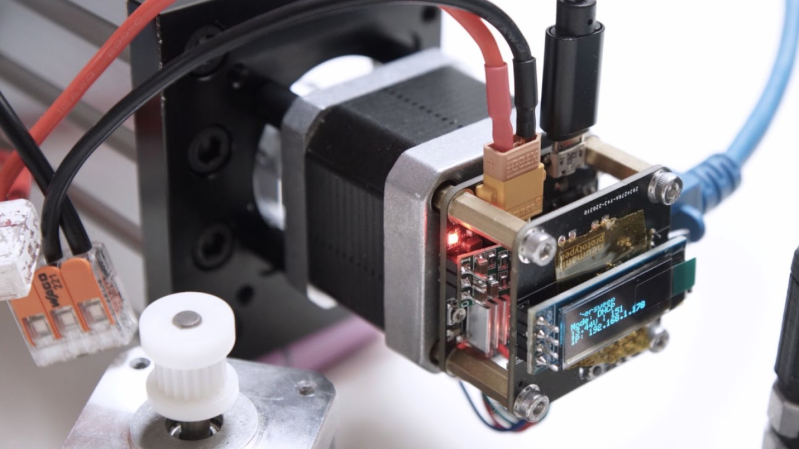
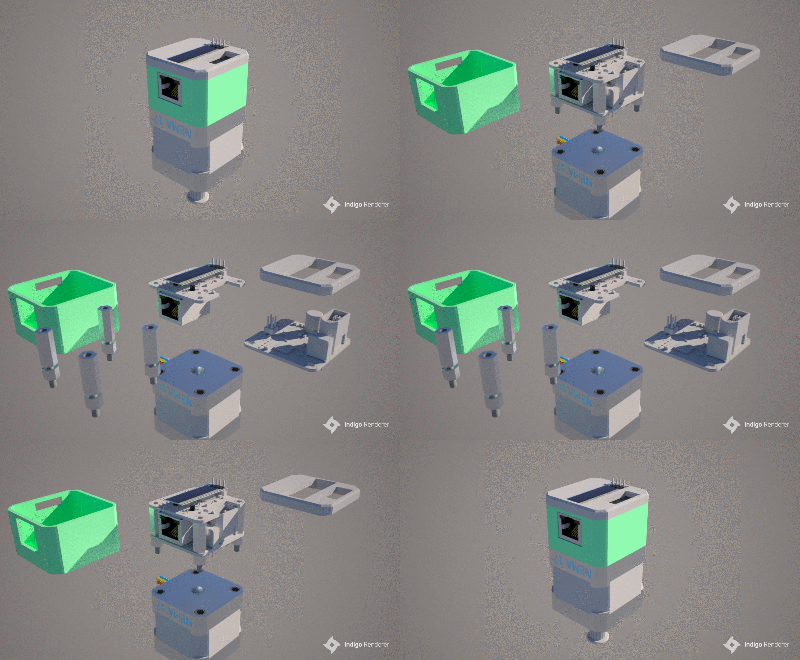
[Neumi] over on Hackaday.IO wanted a simple-to-use way to drive stepper motors, which could be quickly deployed in a wide variety of applications yet to be determined. The solution is named Ethersweep, and is a small PCB stack that sits on the rear of the common NEMA17-format stepper motor. The only physical connectivity, beside the motor, are ethernet and a power supply via the user friendly XT30 connector. The system can be closed loop, with both an end-stop input as well as an on-board AMS AS5600 magnetic rotary encoder (which senses the rotating magnetic field on the rear side of the motor assembly – clever!) giving the necessary feedback. Leveraging the Trinamic TMC2208 stepper motor driver gives Ethersweep silky smooth and quiet motor control, which could be very important for some applications. A rear-facing OLED display shows some useful debug information as well as the all important IP address that was assigned to the unit.
Control is performed with the ubiquitous ATMega328 microcontroller, with the Arduino software stack deployed, making uploading firmware a breeze. To that end, a USB port is also provided, hooked up to the uC with the cheap CP2102 USB bridge chip as per most Arduino-like designs. The thing that makes this build a little unusual is the ethernet port. The hardware side of things is taken care of with the Wiznet WS500 ethernet chip, which implements the MAC and PHY in a single device, needing only a few passives and a magjack to operate. The chip also handles the whole TCP/IP stack internally, so only needs an external SPI interface to talk to the host device.
Talking about firmware for a moment, to ease deployment, the network configuration is handled by DHCP, although some control over MAC address assignment is promised for the future. All control is via UDP over ethernet, and again the basic functionality is there, but some niceties such as motor synchronisation and state querying are again subject to further releases. Hardware design is implemented in KiCAD and FreeCAD, with Arduino covering the firmware and host control side in python. You can read all about it on the Ethersweep project GitHub, what is there not to like?
If you thought you’d seen this stepper-mounted driver setup before, you’d be correct, here’s a Hackaday Prize 2017 Entry for a CANBUS controlled driver. We also saw this on Dummy: the obscenely well made robot arm by [Zhihui Jun], which if you missed it, then do circle back and take a look, you won’t regret it!
Apple added plenty of new features to its latest iPhones, including a nifty display cutout on the iPhone 14 Pro it's calling the Dynamic Island. But as is so often the case with the company, Apple gives and it takes away, and the feature it's removing this time is the physical SIM slot. On US models, the company is going all in on eSIM technology.
In practice, that's a decision that will have a few effects on how you use the iPhone 14 if you decide to upgrade. For one, you won't be able to simply transfer the SIM from your current phone to your new device. Instead, you'll need to either call your carrier or complete an enrolment process online. Many people when they travel tend to buy local SIMs as a way to save on data roaming costs. That's something that won't be an option if you buy an iPhone 14 in the US. Thankfully, there are plenty of eSIM options like Airalo.
Apple has supported eSIM since it introduced the iPhone XS, XS Max and XR in 2018, and has included the technology in most of its recent Apple Watch and iPad devices. Starting with last year's iPhone 13, the company even began allowing users to use multiple eSIMs on the same device at the same time. The good news is the majority of US carriers support the technology. T-Mobile even recently began using eSIM to let iPhone users try its network.
Follow all of the news from Apple’s iPhone event right here.
It was a day of farewells today at Apple's 'Far Out' iPhone launch event. In addition to getting rid of the iPhone mini variant, Apple also ditched the notch on the iPhone 14 Pro in favor of a pill-shaped cutout. The company is calling this the "Dynamic Island" at the top of the screen. The iPhone 14 Pro and Pro Max also feature brighter screens and offer an Always On Display so you can always see your most important information. At the Apple Event in Cupertino, I spent some time with the new devices and have to say that while the dynamic island still feels very obvious, it also seems a lot more useful.
The difference is that the interface now makes better use of the space by displaying different information on it. When I started a countdown on the timer app or played a song on Apple Music, the island would show an orange dot to indicate something was happening. Then, when I left the app, the island displayed a waveform to show that my voice recorder was still running, or that music was playing. When I long-pressed the island with one of these activities going on, the box expanded to show more controls.
Apple Music, for example, expanded to show the playback progress bar and buttons for rewind, pause and skip below it. For Timer and Voice Memo, controls appeared for stopping the countdowns and recordings respectively. The software cleverly camouflages the camera hole here, so it never interrupts the content and is hidden with empty black space in that area. Of course, so far, I've just used Apple's own first-party apps on the iPhone 14, and third-party options might not adapt to the island as well.
Cherlynn Low / Engadget
When nothing was going on, long-pressing the dynamic island resulted in a slight stretching animation and light haptic feedback. If you peer hard at the pill, you can also see the 12-megapixel TrueDepth camera off to the right under it. Again, it's not quite an all-screen display, but the camera cutout feels better hidden than before.
Speaking of, the iPhone 14 Pro also got an upgraded camera system, with a new 48-MP primary rear sensor backed by Apple's new Photonic engine for better low light performance. That's not something I could test here at the brightly lit demo space, nor was I able to check out the new Action mode for video stabilization. But there are plenty of improvements to the iPhone 14 Pros on the video and camera front, like Cinematic Mode support for up to 4K resolution and 30fps framerates that we'd have to check out in a full review.
Another new feature I was able to briefly try is the Always On Display. When left to sit for awhile, the iPhone 14 Pro dims its screen, but remains just bright enough so you can see your lock screen's contents. When I lifted the iPhone 14 Pro slightly, its display quickly reverted to full brightness, just as responsively as older iPhones wake from sleep.
Cherlynn Low / Engadget
Unlike the approach on Samsung or Pixel phones, Apple's version keeps things like your wallpaper and widgets visible in addition to the clock. This might tax the battery a bit more, but the company is still promising all-day endurance for the iPhone 14 Pro series. That might be thanks to the new A16 Bionic Chip, which is built on a 4nm design process that might be more energy efficient. But it's something that again, we'll have to wait till we can test for ourselves to verify.
There was quite a bit more that I couldn't properly check out here at the Apple event, including the company's new Emergency SOS and Crash Detection features. And though the Pro and Pro Max's respective 6.1-inch and 6.7-inch screens were plenty bright, it wasn't easy to determine if the new phones' displays were indeed brighter than their predecessors.
If you're already overdue an upgrade or can't want to make sure you get one next week, you can pre-order the iPhone 14 Pros on September 9th. Those who can should wait till we can perform a full review, and the phones will be available from September 16th starting at $999 for the Pro and $1,099 for the Max.
This story is developing, please refresh for updates.
Follow all of the news from Apple’s iPhone event right here.
Today's iPhone 2022 event was chock full of marquee reveals with the new iPhone 14 and 14 Pro — not to mention the new Watch Ultra line. But tucked away amidst the news torrenting out of Cupertino, Apple announced on Wednesday that iOS 16, which all this new hardware runs, will be available as a free download beginning September 12th. Not everybody will be eligible to upgrade however.
Among the updated operating system's new features is a redesigned lock screen focused on "communication, sharing, and intelligence" with more expansive wallpaper options, enhanced messaging capabilities and photo sharing, and improved Live Text performance. iOS 16 will also be the first to offer Apple's new Emergency SOS service, which will enable folks stranded in the backcountry to contact emergency responders via low bandwidth satellite communications. That service will be free for the first two years, though the company has not yet released pricing for following the introductory period.
If you have an iPhone 7 or older, you will not have access to the new OS, unfortunately. iPhones 8 and newer, up to today's announced iPhone 14 and 14 Pro, will be notified once the update is pushed live.
Just before the new generation of Apple Watches (including the fancy Apple Watch Ultra) arrives later this month, current smartwatch owners will be able to upgrade to watchOS 9. Apple says it will roll out the operating system on September 12th, the same day that iOS 16 will arrive.
You'll need an iPhone 8 or later or second-gen iPhone SE or later running iOS to install watchOS 9. Apple Watch Series 3 owners will miss out on the upgrade, which is compatible with Series 4 and later devices. It's worth noting that not all of the watchOS 9 features will be available on every Apple Watch and in every region.
There are notable upgrades to the fitness features, including heart rate zones for sleep and workouts, multisport workouts and a way to monitor your personal best performances. You'll be able to track atrial fibrillation events and receive alerts when it's time to take medication. Other new features include a new-look Siri, a revamped Calendar app, Quick Actions gestures and more watch screens.


 making uploading firmware a breeze. To that end, a USB port is also provided, hooked up to the uC with the cheap CP2102 USB bridge chip as per most Arduino-like designs. The thing that makes this build a little unusual is the ethernet port. The hardware side of things is taken care of with the