Korg's Drumlogue is an analog drum machine with a powerful digital engine

After first teasing it way back on January 2021, Korg has released the much-anticipated Drumlogue, a hybrid drum machine with a digital multi-engine and expandability via the logue SDK used in its Minilogue XD and other products. It has both analog and digital drum synths and can also play back samples, with the unique ability to add third-party plug-in effects and more — making it one of the more versatile drum machines out there.

As mentioned, the Drumlogue has three sound engines, analog and digital synthesisers as well as sample-based instruments. The analog has a kick, snare hi tom and low tom, with controls to manipulate decay, tune and more. 

On the digital side, it comes with the Nano virtual analog synth plugin or, you can load a multi-engine with VPM synthesis, a noise generator, or other custom algorithms via the logue SDK (multi-engine) found on the NTS-1 and other products. It also supports third-party logue plugins using Korg's SDK. From there, you can use the multi-fx engine to load effects including reverb, delay, equalizer, boost and compressor.

The sequencer offers 64 steps, chain functionality and other features. On the connectivity side, it comes with four assignable 6.3mm audio outputs and an audio input for routing external audio through the effects. Despite the audio input, it doesn't work as a sampler — you can only play back samples. It's now available on preorder for $600 at B&H Photo Video and elsewhere. 

Resolver 4.0 Catalog Offers Inductive Position Sensor Designs for Robotics and Home Automation

Resolver 4.0 Catalog Offers Inductive Position Sensor Designs for Robotics and Home Automation

Renesas Electronics Corporation has released a catalog of reference designs for its innovative inductive position sensors for automotive and industrial electric motors. The new Resolver 4.0 catalog offers market-ready solutions that can be implemented in a wide range of applications such as automotive systems, robotics, servo motors, home automation, and medical. These reference designs include completed schematics, fully wired PCB designs, and Gerber files, allowing engineers to immediately start building working sensing solutions.

Lakshita Khanna Thu, 09/15/2022 - 12:10
Circuit Digest 15 Sep 07:40

Samsung vows to produce net zero carbon emissions by 2050

Samsung has made a commitment to achieve net zero carbon emissions for the whole company by 2050 and will spend KRW 7 trillion (US$5 billion) over the next seven-and-a-half years to make that happen. While its plans are likely not as aggressive as Microsoft's, which previously promised to be carbon negative by the end of the decade, it intends to implement changes soon so that its Device eXperience (DX) Division is producing net zero carbon by 2030. 

Samsung's DX division encompasses its consumer electronics businesses, including its mobile and display manufacturing operations, and was only responsible for 10 percent of its greenhouse gas emissions in 2021. Meanwhile, the company's chip and components business, which is often is biggest moneymaker, was responsible for 90 percent of the 17.4 million tons of greenhouses gases it emitted last year. 

Clearly, there's a lot of work to be done for its chipmaking business to be net zero. One of the things the company plans to do is develop technologies that can significantly reduce the gas byproducts of semiconductor manufacturing. Samsung also plans to install treatment facilities at its chip-making plants. In addition, the company will develop carbon capture and utilization technologies that can harness carbon emissions from its semiconductor facilities, store them and then turn them into a usable source. 

The tech giant has joined RE100, the global initiative for businesses that want to use renewable energy to power their operation, as well. It will start by running the DX division and all operations outside its home country on renewable energy within the next five years before matching 100 percent of all its power needs around the world with renewable energy by 2050. Samsung has also detailed other environmental plans in its announcement, including its commitment to promote water reuse and to expand its electronic waste collection initiative to 180 countries from 50. 

A spokesperson for one of its shareholders told Reuters that Samsung had delayed making a clear commitment towards reducing carbon emissions so much, it became a growing concern among long-term investors. Kim Soo-jin, Samsung's head of ESG strategy group, explained: "We are a company that manufactures directly... so there are various, layered challenges. In the end, we are a technology company... So we will contribute positively to climate change through technology development. Since we are a large company and our products are widely used, we will make an impact through scale."

Lawmakers press TikTok about China and user data in Senate hearing

Top executives from Meta, Twitter, YouTube and TikTok just wrapped up a three-hour hearing in front of the Senate Homeland Security Committee. The hearing, which featured Meta CPO Chris Cox, YouTube CPO Neal Mohan, TikTok COO Vanessa Pappas and Twitter’s GM of consumer product (known as “Bluebird”), was meant to be focused on how their services impact national security issues.

Notably, the hearing is only the second time representatives for TikTok and YouTube had ever appeared at such a hearing — Meta and Twitter execs have been hauled in front of Congress far more often — and the first dedicated to security. The hearing also came one day after Twitter’s former security chief turned whistleblower told a different Senate committee that the company had been previously warned by the FBI it had a Chinese spy on its payroll. Yet not one senator on the Homeland Security Committee asked Sullivan about the allegation.

To be clear, Sullivan was unlikely to have given a substantive answer. When asked about whistleblower Peiter Zatko’s claim that Twitter lied to the FTC, he would only say that “Twitter disputes the allegations." But it was still somewhat shocking that the issue was not raised in a hearing dedicated to social media platforms' impact on national security. 

Lawmakers did, however, spend considerable time questioning Pappas on TikTok’s connections to China, which has long been a source of suspicion among lawmakers on both sides of the aisle."TikTok does not operate in China,” Pappas said more than once.

At one point, Sen. Josh Hawley got into a heated exchange with Pappas over whether the company has China-based employees who are members of the Chinese Communist Party. “We've said many times, Senator, that we do have Chinese engineers based in China,” Pappas said. “I don't think there's any platform up here that would be able to speak to what you're talking about as it relates to the political affiliation of an individual.” She later added that the company’s leadership team is based in the United States and Singapore.

Pappas was also asked about a BuzzFeed News story that TikTok user data had been repeatedly accessed by employees based in China. She said that “those allegations were not found,” and emphasized the company’s “strict access controls” and its work with Oracle.

The TikTok COO was also questioned about the app’s use of biometric data. “We do not use any sort of a facial, voice, audio or body recognition that would identify an individual,” Pappas told Sen. Kristen Sinema. She added that facial recognition is used for augmented reality effects in creators’ videos.

There was a lot less discussion of other security-related issues, including social media companies’ handling of domestic extremism. Committee Chairman Sen. Gary Peters pressed Cox and Mohan and why Meta and YouTube didn’t crack down on QAnon more quickly. Both side-stepped the question by focusing on their current policies. Other lawmakers chose to spend their time questioning the companies about their handling of vaccine misinformation during the pandemic and other content moderation issues. 

And, as with previous hearings, the executives were often reluctant to provide specific answers even to seemingly straightforward questions. Peters repeatedly asked each executive how many engineers each company had on staff — a question he said they were notified would be coming in advance — but none would give a direct answer. “I'll be honest, I’m frustrated that chief product officers — all of you have a prominent seat at the table where these business decisions are made — were not more prepared,” Peters said. “Your companies continue to really avoid you sharing some very important information with us.”

Announcing Arduino IDE 2.0

After a long period of development, we’re really happy to pass on the announcement that version 2.0.0 of the Arduino IDE is now available. Not only is it a more usable and practical development environment, there’s also some new features such as seamless cloud integration (which you are not forced to used) which makes moving between machines easy. From the arduino website:

We’re pleased to announce that as of today Arduino IDE 2.0 has moved to stable and is available for download. Since the launch of the Beta version back in Spring 2021, the feedback received from the active Arduino community has enabled us to focus on what’s meaningful to the widest user-base. It carries a modern editor and provides a better overall user experience thanks to a responsive interface and faster compilation time.

Over and above the core features (we’ll get into those in more details later) the IDE 2.0 benefits from a number of enhancements and additional support. The Serial Monitor and Plotter can be used together, enabling users to have two viewports onto their data output. Before you had to choose between text and graphs, whereas now you can have both.

As well as the refreshed User Interface that provides a more intuitive experience whilst using Arduino IDE 2.0, speed is of the essence. An Arduino-optimized code-completion and code-assist within the language server, help you write code quickly and spot errors as you type. The enormous amount of user feedback allowed us to identify the weakest spots such as code assist and completion, serial output, loading and compilation time.
We made it all better now.

A special mention goes out to Paul Stoffregen who has provided enormous feedback to the IDE development team and been actively developing the initial support for advanced third-party platforms such as Teensy for IDE 2.0 (currently experimental).

If you haven’t already given the new IDE 2.0 a try, here are just a few of the key features… 

Autocomplete during sketch editing

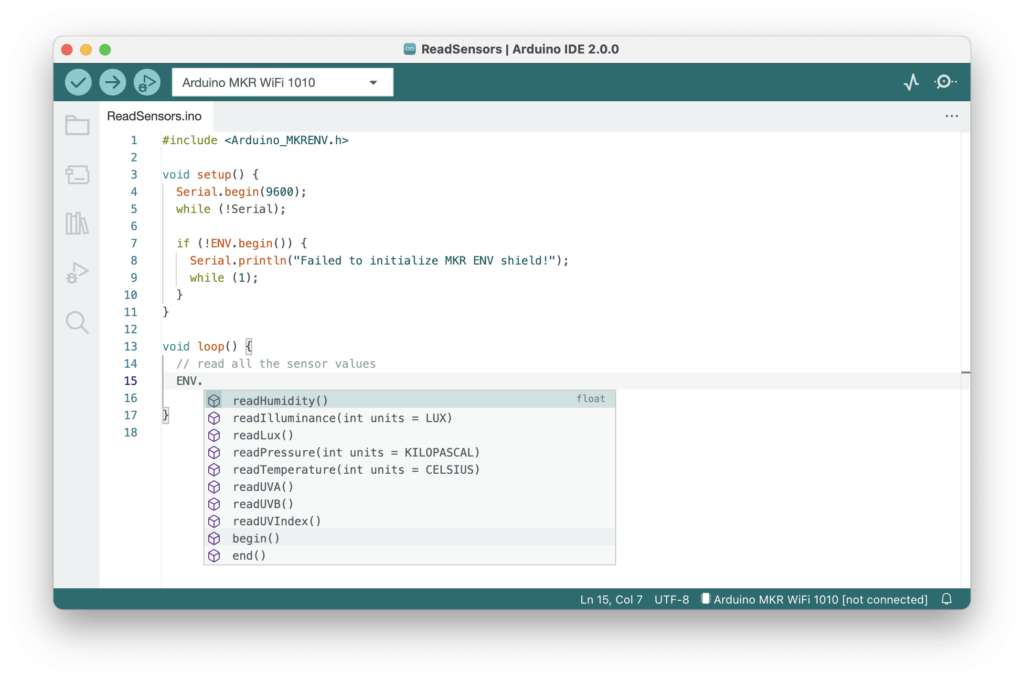
While typing, the editor can suggest the autocompletion of variables and functions according to your code and the libraries you included:

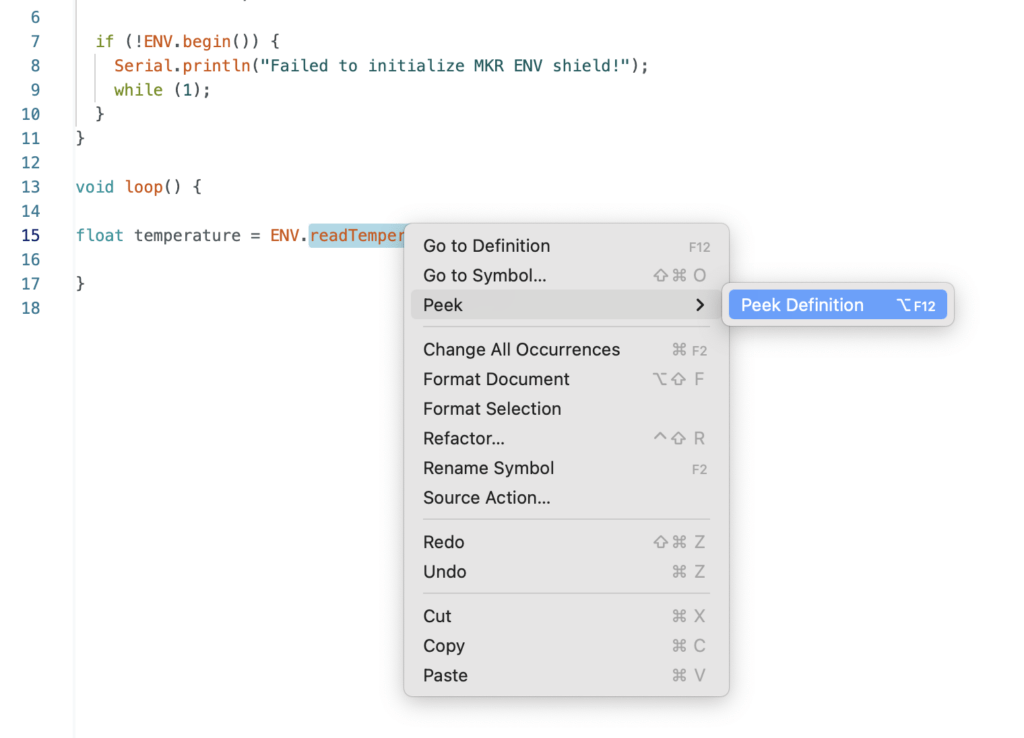
When right-clicking on a variable or a function, a contextual menu will provide navigation shortcuts to jump to the line (and file) where they are declared:

Dark Mode

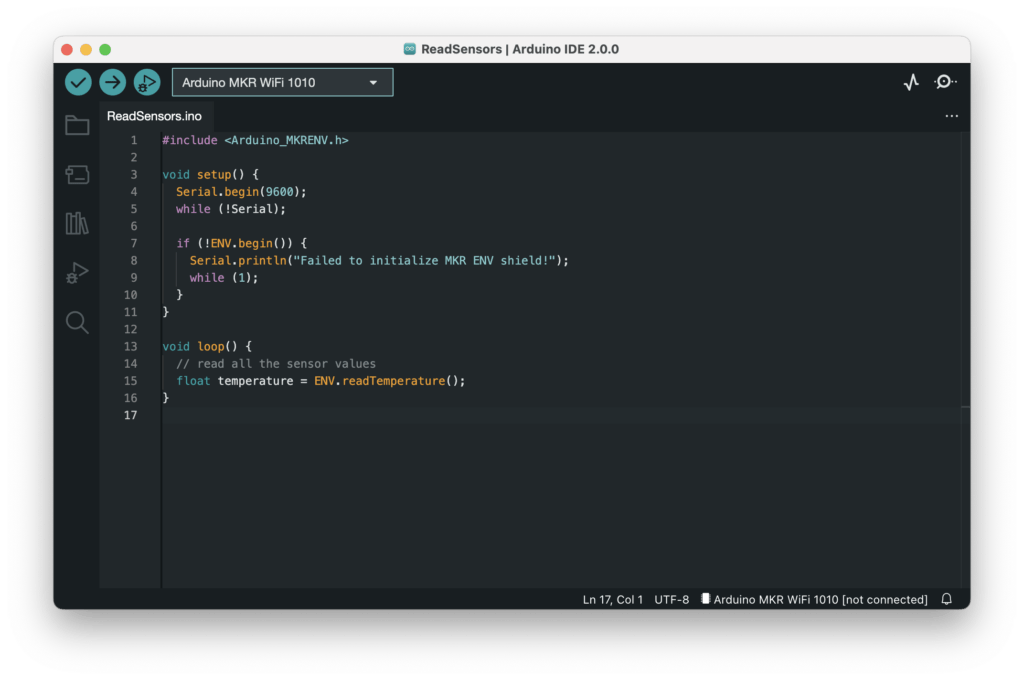
If your eyes are feeling the strain you can quickly change settings and switch to Dark Mode.
Some of you may have used this during the Beta, but our design team has reworked the entire Dark Theme to make it more consistent, beautiful and easy on the eye. 

Never lose a sketch keeping them safely at Arduino Cloud 

For people who work on multiple computers or want to store their Sketches securely in the Cloud, the Remote Sketchbook integration is a really useful feature.

For now, all the sketches you have in Arduino Cloud and Arduino Web Editor can be edited in IDE 2.0 .

Easily switch from one computer to another and keep working. If you don’t have Arduino IDE 2.0 installed on all your machines, just open the Arduino Web Editor and you can code from your browser in the online IDE with access to all your sketches and libraries. There’s no need to worry about losing your sketches either, with Remote Sketchbook you only need one click and they will be pushed securely to the Arduino Cloud. 

Work offline and sync later, simply bring your sketch down from the Cloud, edit offline and when you are back online click on “Push” and all your changes will be uploaded, meaning all your sketches will always be up-to-date and ready to use. 

Serial Plotter

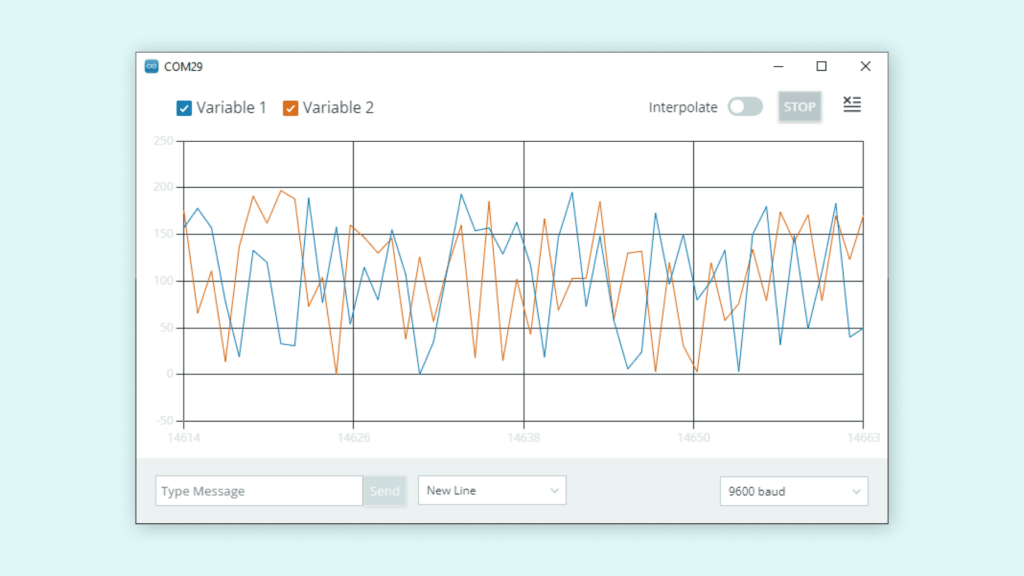
The IDE 2.0 features a richer Serial Plotter that is a versatile tool for tracking different data and variables which are received from your Arduino board. The Serial Plotter is a really useful visual tool that will help you to understand and compare your data points better. It can be used for testing and calibrating sensors, comparing values and other similar scenarios.

In-app updates

Our users have always been accustomed to receiving notifications when new boards’ support or libraries updates were available, and IDE 2.0 is no exception.
As a plus, the IDE can now itself be updated when a new version is available, so no need to head to the downloads page anymore: click the button and get the latest and greatest.

The new IDE is based on the Eclipse Theia framework, which is an open source project based on the same architecture as VS Code (language server protocol, extensions, debugger). The front-end is written in TypeScript, while most of the backend is written in Golang.

Click here to download the new IDE for your system now. Time certainly flies along, it feels like yesterday when we switched from the old Arduino IDE to version 1.0. Kudos to everyone at the Arduino team and all the beta testers for the works and effort.

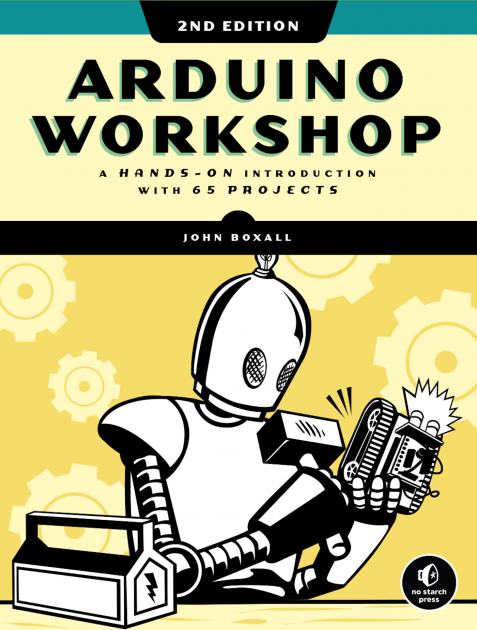
If you’re interested in Arduino and want to get started – please purchase a copy of Arduino Workshop, 2nd Edition – a hands-on introduction to electronics and Arduino with 65 projects. It’s written for the complete beginner – you won’t need any other book or website, and by the end you’ll have the knowledge and skills to turn a wide range of ideas into life.

And as always, have fun and make something.

Tronixstuff 15 Sep 00:28
arduino  

California sues Amazon for preventing third-party sellers offering cheaper prices elsewhere

Amazon still can't avoid lawsuits over third-party prices. The New York Timesreports California has filed an antitrust lawsuit accusing Amazon of violating both the Cartwright Act and state competition law through its pricing rules. The internet giant is stifling competition by preventing sellers from offering lower prices on other sites, according to Attorney General Rob Bonta. If they defy Amazon, they risk losing buy buttons, prominent listings or even basic access to Amazon's marketplace.

If successful, the lawsuit would bar any contracts deemed anti-competitive and notify sellers that they're free to reduce prices elsewhere. Amazon would also have to pay damages, return "ill-gotten gains" and appoint a court-approved overseer.

In a statement, an Amazon spokesperson said California had the situation "exactly backwards." Third-parties still have control over prices, Amazon claimed, and inclusion in the "Buy Box" space supposedly shows that a deal is truly competitive. It further contended that the suit would raise prices. You can read the full statement below.

The case is similar to a District of Columbia lawsuit. The region's Superior Court dismissed that case in March citing a lack of evidence, but Attorney General Karl Racine is appealing the decision.

Amazon is facing increasing government scrutiny of its practices. The Federal Trade Commission has been investigating issues ranging from major acquisitions through to withheld driver tips, while EU pressure prompted Amazon to revise its seller program and improve third parties' chances of competing with direct sales. The tech firm has balked at these moves, and went so far as to both demand the FTC chair's recusal as well as fight agency requests to interview executives. Don't expect either side to back down any time soon, in other words.

"Similar to the D.C. Attorney General—whose complaint was dismissed by the courts—the California Attorney General has it exactly backwards. Sellers set their own prices for the products they offer in our store. Amazon takes pride in the fact that we offer low prices across the broadest selection, and like any store we reserve the right not to highlight offers to customers that are not priced competitively. The relief the AG seeks would force Amazon to feature higher prices to customers, oddly going against core objectives of antitrust law. We hope that the California court will reach the same conclusion as the D.C. court and dismiss this lawsuit promptly."

Yakuza spinoffs ‘Judgment’ and ‘Lost Judgment’ finally arrive on Steam

In a surprising turn of events, Sega has released Yakuza series spinoffs Judgment and Lost Judgment on Steam. The former first arrived on PlayStation 4 in 2018 before making its way to current generation consoles and Stadia last year. Judgment casts players as Takayuki Yagami, a private detective investigating a serial murder case in a fictional part of Tokyo modeled after the city’s famous Kabukicho district. The game’s 2021 sequel, Lost Judgment, takes place three years later and has a darker tone and new gameplay elements.

The likelihood of the Judgment franchise ever making its way to PC seemed bleak before this week. According to a report published last year by Japan’s Nikkan Taishu (via Kotaku), the series was unlikely to continue due to a dispute between Sega and the talent agency representing Takuya Kimura, the actor who lent his likeness and voice to its protagonist. Kimura’s agency was reportedly against a PC release, fearing it would hurt its business model. At one point, the two sides were so far apart it seemed unlikely Sega would make another Judgment game.

But that was before and now you can buy Judgment and Lost Judgment on Steam either separately or as part of a bundle that includes the sequel’s Kaito Files expansion.

HP's construction robot puts blueprints on site floors

Construction workers might soon spend more time building and less time preparing. HP has unveiled a SitePrint robot that autonomously prints layouts on construction site floors. With the help of a remote control tablet and cloud tools, the machine can outline walls, doors and other elements with little intervention — it can avoid unexpected obstacles, including steep drops. The company claims the bot can finish a layout in a "fraction" of the time humans require, although this will vary by the complexity of the project.

The robot includes two batteries that can each handle up to four hours of printing. It can print on surfaces like concrete, plywood and terrazzo, even if they're rough. You can also choose inks that last days or months to suit the timeline for a given job.

HP is making the SitePrint robot available to North American companies this month as part of an early access program. The finished automaton and a full-scale launch are due sometime in 2023. The hardware has already been tested with projects ranging from airports to hospitals.

There's clearly a concern SitePrint might automate people out of jobs. The robot only requires one operator versus the two or three people typically needed for manual layouts. However, its timing might be particularly apt. As in many other fields, the construction industry is grappling with labor shortages. Robots like SitePrint could help builders make the most of limited staff, or take on more ambitious tasks without hiring larger crews.

Discord revolutionizes online conversations with... forums

Discord, the social messaging service that helped to displace old-school internet forums, now wants to bring them back. Today, the company announced Forum Channels, which are exactly what you'd imagine: A dedicated space to have conversations without the worry of a fast-paced chat feed. You'll find them right below your usual Discord channels. When creating a forum, you'll be able to restrict posting permissions and set guidelines for the conversation. Crucially, they'll also be compatible with Discord's AutoMod, which can help to clean up discussions. (Moderation was always the downfall of a poorly-run forum.)

Discord

While it's nice to have the concept returning, it's funny to see Discord explaining the concept of forums to younger users. Yes kids, back in our day, we had to furiously refresh web pages to discover the latest reply to our Halo lore theories. Discord has often been framed as a return to the messaging blitz of IRC, paired together with real-time voice chat. So it only makes sense that it'll be responsible for helping us relive the glory days of forums. 

The Xbox app for PC now has 'HowLongToBeat' built in

Microsoft has released a new version of the Xbox app for PC. The September update adds HowLongToBeat integration. If you’re not familiar with the website, it’s a resource where you can find out how much time you may need to complete a specific game. What makes HowLongToBeat so helpful is that it has separate estimates for players with different playstyles.

Using Red Dead Redemption 2 as an example, HowLongToBeat estimates most people will need about 50 hours to complete the main story, and another 30 or so hours to play through the game’s side content. If you want to see everything RDR2 has to offer, that will take about 174 hours.

Microsoft suggests the integration will make it easier to decide what game you want to play next since you’ll have a better idea of the time commitment it wants from you. The company also notes you can click “View Details” to submit your own play times and help other players decide how to spend their time.

Even if you don’t end up using the HowLongToBeat integration much, the September update will help you save time. According to Microsoft, the Xbox app is now 15 percent faster at launching. Additionally, there should be significantly fewer instances of crashes and games failing to download or install successfully. Lastly, the search functionality should produce results about 20 percent faster.