The Morning After: Netflix with ads launches on November 3rd

Netflix's ad-supported tier finally has a release date. The new Basic with Ads plan will be available November 3rd from 12 PM ET for $7 per month. It launches in 12 countries: the US, UK, Australia, Brazil, Canada, France, Germany, Italy, Japan, Mexico, South Korea and Spain.

The ads will run for an average of four to five minutes per hour, and you'll be limited to 720p/HD resolution. That’s not the only limitation: Licensing will also prevent you from watching certain movies and TV shows on the ad plan.

While we don’t know what kinds of ads you’ll get, we do know they’ll initially be 15- to 30-second spots and will play both before and during shows. There’ll be "broad" targeting for those ads based on criteria like your country and the content genres you watch.

That list of caveats might stop existing Netflix subscribers from downgrading (the Basic plan starts at $10), but it could convince folks with other video subscriptions – or a lapsed Netflix sub – to start paying again.

– Mat Smith

The biggest stories you might have missed

Microsoft Office is dead. Long live Microsoft 365

Because it’s more than just Word and Excel.

Back in 2020, Microsoft announced it would change the name of its Office 365 subscription to Microsoft 365, acknowledging it had become more than just a work app. Now, it's removing most of the remaining Office branding. "In the coming months, Office.com, the Office mobile app and the Office app for Windows will become the Microsoft 365 app, with a new icon, a new look and even more features," an FAQ says.

Continue reading.

Sony and Honda will open pre-orders for their first EV in 2025

Their joint company aims to make the first deliveries in the US by 2026.

Sony and Honda have announced they’ll open pre-orders for their first electric vehicle model in the first half of 2025. Their joint venture, Sony Honda Mobility Inc., hopes to begin deliveries in the US by spring 2026. The companies didn't give us a glimpse of the vehicle they're working on during the event, and they didn't mention anything about its pricing or its battery technology and range. They did say, however, they're planning to focus on online sales, like Tesla.

Continue reading.

Microsoft accuses UK regulator of adopting Sony's complaints in Activision probe

The regulator focused on ‘Call of Duty.’

Activision Blizzard

Microsoft's $68.7 billion purchase of Activision Blizzard will have to gain approval from various regulators around the world before the deal can go through, including the UK's Competition and Markets Authority (CMA). The CMA has recommended a more in-depth inquiry. Shortly after the CMA published its decision, Microsoft accused the regulator of relying "on self-serving statements by Sony." In a response it shared with Ars Technica, the tech giant said the CMA's decision was rooted in the concern that Activision's catalog of games, specifically the Call of Duty franchise, will allow Xbox to "foreclose its competitors." Microsoft called that concern "misplaced."

Continue reading.

Sony's ZV-1F is its most affordable vlogging camera yet

At $500, it's designed as a smartphone step-up cam.

Sony

Sony has unveiled the ZV-1F, its third and most affordable vlogging camera. At just $500, it's slotted below the $700 ZV-1 compact, with a Type-1 Exmor 20.1-megapixel sensor, 4K video and a raft of Sony camera features. Those include the "product showcase" feature, which lets you place a product in front of the camera to quickly get focus and background defocus, for quick-and-easy bokeh backgrounds. And a new Shot Mark feature lets you grab a 15-, 30- or 60-second clip and send it to a smartphone. The camera arrives on October 24th.

Continue reading.

The best smart light bulbs for 2022

Ditch the dumb bulbs for ones you can control from anywhere.

One of the best places to start when building a smart home ecosystem is smart light bulbs. Not only are they relatively affordable compared to other IoT gadgets, often costing between $10 and $50 a bulb, but they can also completely change the feel of your home. And there are now more players in smart lighting than ever before. Here are our top picks.
Continue reading.

Meta's VR legs video wasn't what it seemed

When Meta announced that its Horizon Worlds avatars were getting legs in the near future, we got to see VR Mark Zuckerberg lift his legs one after the after and then jump as if to demonstrate what the company has achieved. Apparently, though, what we saw wasn't a real demonstration of how Meta was able to conquer the difficulties of creating full-body virtual reality avatars. According to UploadVR editor, Ian Hamilton, the event used animations that were created using motion capture:

For those who've been wondering about the legs shown in the Connect keynote (@hrafntho). Meta: "To enable this preview of what’s to come, the segment featured animations created from motion capture."

— Ian Hamilton (@hmltn) October 13, 2022

The process, which is called mocap for short, is widely used in cinema and games and entails recording the movements of a real person or object so they can be turned into computer animated graphics. 

During the event, Meta said that "legs have been one of the most requested features on [its] roadmap, and it’s been a significant area of [the company's] focus." Indeed, the addition of legs to Horizon's legless avatar would be a noteworthy achievement due to the technological constraints of the VR devices we have access to today. VR headsets as we know the weren't made to track legs. As Meta CTO and Reality Labs team leader Andrew Bosworth had explained to CNN Business earlier this year: "Tracking your own legs accurately is super hard and basically not workable just from a physics standpoint with existing headsets." Meta's solution to that problem involves the use of an artificial intelligence model to predict where the user's legs are supposed to be. 

We'll have to wait a bit more to see these AI-powered VR legs in action, though, because Meta's full-body avatars that don't rely on mocaps won't be coming out until 2023.

Legs are coming soon! Are you excited? 🎉 pic.twitter.com/SB6qSepKm4

— Meta Horizon (@MetaHorizon) October 11, 2022

Framework is selling refurbished versions of its modular laptops

Framework, which make modular, easy-to-repair laptops with the idea of reducing e-waste, is now selling refurbished models. They come from "the small number of returns we get from our 30-day return guarantee," and promise a like-new laptop with decent specs, a full guarantee and a discount from all-new models. The company is also selling refurbished version of its expansions packs (USB-C, USB-A, HDMI, etc.)

The returns go through a detailed testing process, and the company replaces any parts that fail to meet its specifications. They're then tested to confirm functionality and cleaned. There are what Framework calls "cosmetic limitations," but the company has set "pretty stringent" limits for the initial set of refurbed laptops.

Framework

The cheapest refurbished model available has an Intel Core i5-1135G7 processor for $600, without memory, storage, WiFi, a power adapter, the OS and expansion cards. In comparison, the same model new costs $680. With 16GB of DDR4-3200 RAM, 1TB of storage, WiFi, a power adapter and a refurbished expansion card pack (2 USB-C, 1 USB-A and 1 HDMI), you're looking at $905 in total — not bad for a decently equipped laptop that's easy to repair and upgrade. The other options are a Core i7-1165G7 model for $800 and a Core i7-1185G7 model for $1,069.

Allowing the sale of previously purchased devices is part of the company's pledge to "remake consumer electronics to respect people and the planet," while letting buyers contribute to the circular economy. The refurbished program is only available in Canada and the US so far — it hasn't received enough returns to launch the program in Europe yet.

Framework has always said that it wants to sell PCs to compete with models like the Surface Laptop or Dell XPS 13, and spec-wise, its latest 12th-generation Intel models are at least competitive. And so far, the company has offered mainboard updates you can install yourself, should you desire more performance down the road. In any case, most buyers will likely be just as interested in playing a part in reducing e-waste, and the refurbished models give Framework another way to do that.

Lo-Fi Orchestra Learns Tubular Bells

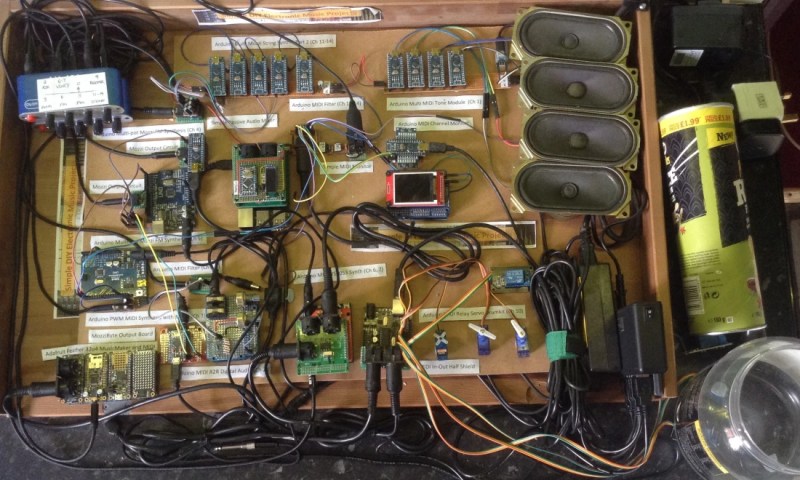
Hardware projects often fall into three categories: Those that flash lights, those that make sounds and those that move. This virtuoso performance by [Kevin]’s “Lo-Fi Orchestra” manages all three, whilst doing an excellent job of reproducing the 1973 musical classic Tubular Bells by Mike Oldfield.

Producing decent polyphonic sounds of different timbres simultaneously is a challenge for simple microcontroller boards like Arduinos, so [Kevin] has embraced the “More is more” philosophy and split up the job of sound generation in much the same way as a traditional orchestra might. Altogether, 11 Arduino Nanos, 6 Arduino Unos, an Arduino Pro Mini, an Adafruit Feather 32u4, and a Raspberry Pi running MT32-Pi make up this electronic ensemble.

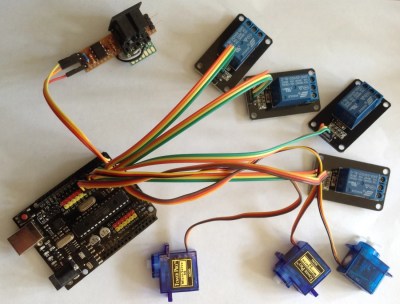
Arduino Servo & Relay Drumkit

The servo & relay drumkit is a particular highlight, providing some physical sounds to go along with the otherwise solid-state generation.

The whole project is “conducted” over MIDI and the flashing sequencer in the middle gives a visual indication of the music that is almost hypnotic. The performance is split into two videos (after the break), and will be familiar to fans of 70’s music and classic horror movies alike. We’re astonished how accurately [Kevin] has captured the mood of the original recording.

If this all looks slightly familiar, it may be because we have covered the Lo-Fi Orchestra before, when it entertained us with a rousing rendition of Gustav Holst’s Planets Suite. If you’re more interested in real Tubular Bells than synthesized ones, then check out this MIDI-controlled set from 2013.

Apple slapped with a $19 million fine in Brazil for not selling iPhones with a charger

Apple keeps on losing court battles in Brazil over its decision to stop shipping iPhones with a charger. The São Paulo state court has ruled against the tech giant and slapped it with a 100 million real ($19 million) fine in a lawsuit filed by the Brazilian Consumers' Association, a group of borrowers, consumers and taxpayers. In addition, the court has ordered Apple to supply all customers in Brazil who purchased the iPhone 12 or 13 over the past couple of years with a charger, as well as to start including them with all new purchases. Apple, as you'd expect, told the news organization that it will appeal the decision. 

According to Barron's, the judge in charge of the case called the non-inclusion of chargers in phone purchases an "abusive practice" that "requires consumers to purchase a second product in order for the first to work." Apple has been at odds with Brazilian authorities over the issue for a while now. In 2021, São Paulo consumer protection agency Procon-SP fined Apple around $2 million for removing the power adapter from the iPhone 12, telling the company that it was in violation of Brazil's Consumer Defense Code.

This September, the country's Ministry of Justice issued an order that bans Apple from selling iPhones that don't come with a charger. It also fined the company another $2.38 million and ordered the cancelation of iPhone 12's registration with Brazil's national telecoms agency. The tech giant is also appealing that decision. 

Apple stopped bundling its iPhones with power adapters back in 2020 with the release of iPhone 12. The company cited environmental concerns for removing chargers with every purchase of the device and claimed that the decision will save 861,000 tons of copper, zinc and tin. The Brazilian Ministry of Justice remained unmoved by that reasoning, telling Apple that it could help the environment in other ways, such as giving its devices USB-C support. In Europe, Apple has a couple of years to do just that after the European Parliament voted to make USB-C the common charging standard in the EU. Mobile devices like the iPhone sold in the region will have to come with USB-C charging posts by the end of 2024.

Google will soon test Project Starline video chat booths in the real world

Google's elaborate video chat booths will soon exist as more than just a clever design exercise. Ars Technicareports the company will start installing Project Starline prototypes in some of its corporate partners' offices for "regular" tests later this year. In other words, Google will see how its "magic windows" work beyond on-campus demos.

Program partners include Salesforce, T-Mobile and WeWork, among others. The in-house demos have included over 100 companies spread across healthcare, media and retailers.

Project Starline is effectively a bid to create a natural-feeling telepresence system. Each participant sits in a booth with an array of cameras and infrared projectors that create a realistic 3D depiction, with spatial audio capture making it seem as if the voice is coming from that digital persona's mouth. Combined with head tracking and a 65-inch, 8K glasses-free display, the system makes it seem as if the other person is sitting in front of you. This theoretically leads to more effortless meetings than you'd get by staring at a computer monitor with a webcam.

The question, of course, is whether or not the early access program will lead to installations at your employer's boardroom or the local store. While Google hasn't outlined the cost of a Project Starline booth, the technology is inherently expensive and consumes a lot of space. Smaller businesses might have trouble justifying this when off-the-shelf computers may be good enough. The timing is also less than ideal. While remote and hybrid work have taken off, Starline is coming right as more people are comfortable returning to in-person interaction. The audience for the tech isn't nearly as large as it might have been a year ago, and we wouldn't count on it getting bigger.

Twitter is testing a way for users to limit their mentions

One of the great things about Twitter is that you can reach out to any public user with a quick @ mention to their username. One of the worst things about Twitter is that it's all too easy to abuse that feature. But it turns out, the bird network may be working on a way to control those mentions. According to privacy researcher and engineer Jane Manchun Wong, the company is testing out the ability to block @ mentions entirely, or limit them to people who already follow you. (Literally, don't @ me, bro.)

Twitter is working on letting you control who can mention you on Twitter pic.twitter.com/UemMCGcy70

— Jane Manchun Wong (@wongmjane) October 13, 2022

Twitter privacy designer Dominic Camozzi initially confirmed the feature was in the works, but as The Verge reports, he later deleted that confirmation. Giving users more granular control of @ mentions falls right in line with Twitter's other recent privacy features, like limiting replies, and being able to unmention yourself from threads. While it might make Twitter seem less open, but mention controls will ultimately make the service a better experience for users who inevitably find themselves targeted by trolls.

Samsung's One UI 5 update is largely about personalization

Samsung has revealed more details about One UI 5, the updated user interface it will begin rolling out to devices later this month. Galaxy S22-series devices will be the first to get the update. The company is placing an even bigger focus on personalization, including on the lock screen. You'll be able to select up to 15 photos and videos for the lock screen, with a different one appearing each time you turn on the display.

Alternatively, you can let Samsung handle the dynamic lock screen with a selection of curated images — you'll see a different one each time. You can choose up to five image categories (such as dogs, cats, animals, landscapes and plants) and Samsung will refresh the collections every two weeks. You'll also be able to tweak the wallpaper, clock style and notification pop-ups on the lock screen. Expect more color palette options to change the device-wide look of the UI and more customizable faces for Galaxy Watches.

Samsung

Samsung says it has redesigned notifications to make them more intuitive and easier to parse with a glance. There's the promise of improved widget stacking on the home screen too. One UI 5 will also have "more defined answer and decline buttons" when you see the pop-up call display.

Speaking of calls, there's a new feature called Bixby Text Call. You'll be able to answer a call by typing a message and Bixby can read this to the caller. The voice assistant can convert what the caller says into text as well. This could come in handy if you're in a noisy environment and wouldn't be able to hear what the other person is saying. Bixby Text Call became available in Korean as part of One UI 4.1.1. An English version will arrive in early 2023.

One UI 5 will place an onus on modes and routines too. With routines, you can trigger several actions on your device based on your activities (such as starting a certain playlist when you leave home). In addition, you can have modes with custom settings for certain situations, such as when you're sleeping, relaxing or working out. In relax mode, you might mute notifications so you can focus on watching a video or playing a game. And when it's time for bed, perhaps turning off all sounds and reducing the screen brightness will do the trick.

Samsung

At the Samsung Developer Conference keynote, Sally Hyesoon Jeong said that your device will ask a series of simple questions to help you set modes up as you see fit. The company plans to launch modes on more devices (namely watches and tablets) in the near future

Elsewhere, Samsung is merging the "biometrics and security" and "privacy" settings from One UI 4 into a single security and privacy menu. You'll be alerted to potential security issues and see possible solutions all on one screen.

You'll see a new warning on the share panel if your phone believes you're about to share an image that includes sensitive information, such as a photo of your credit card, driver’s license, Social Security card or passport. When it comes to IDs, Samsung noted that availability may vary depending on the language. At least for now, this feature will only be available when you set your system language to English (US) or Korean.

On the health front, Samsung worked with Google on a platform called Health Connect, a single set of APIs that should enable Android developers to create "richer health experiences," Jeong said. There will be centralized privacy controls that will still enable you to sync data between various health and fitness apps.

As a result of Samsung's partnership with Microsoft, when you set up a new Windows PC, you can use a QR code to link it to your phone. This will automatically add your mobile hotspot to your PC WiFi options. Jeong suggested that One UI 5 will deliver improved continuity across apps. You can switch from PowerPoint on phones to the desktop app and continue from where you left off, for instance. There are plans to enable similar features for non-Microsoft apps soon. Also on the productivity front, the Z Fold 4's redesigned taskbar is coming to other Z Fold and Tab S8 devices as part of the Android 12L update. Moreover, you'll be able to copy text from images and paste it elsewhere.

A new connected devices menu will include interoperability options for the likes of Quick Share, Smart View and Samsung DeX. Finally, you can expect easier access to a menu that will help you switch your Galaxy Buds from one device to another.

FAA says Apple AirTags are allowed in checked baggage

Don't worry that you might not be allowed to slip an Apple AirTag into your luggage for your next flight. As The Points Guy notes, the Federal Aviation Administration (FAA) has stated that AirTags are allowed on checked baggage. Any item tracker whose battery has under 0.3g of lithium is clear to fly. You can track your suitcase without fear of the airline taking action.

The clarification comes after worries Lufthansa might ban active AirTags in baggage. There were concerns the German carrier would interpret the International Civil Aviation Organization's (ICAO) guidance to forbid any lithium-powered tracker that can't be turned off, including AirTags. There was speculation Lufthansa wanted to forbid the tags to mask problems with lost luggage and other air travel problems. However, ICAO can only issue guidelines — it's up to officials to adopt and enforce rules, and there are none pertaining to these devices in Germany or the US.

Lufthansa issued its own statement clarifying that Apple's devices are allowed on flights. Both the airline and German regulators have determined that item trackers with small batteries and low power "do not pose a safety risk." The company added that it sought exemptions for AirTags and similar tags for checked luggage restrictions.

The FAA and Lufthansa statements theoretically settle the matter. While we wouldn't completely rule out governments or airlines altering their stance, there haven't been any reports of fires or other incidents that would prompt a change of heart. You can safely use AirTags, Tile trackers and similar find-my-stuff products to provide some reassurance during your next vacation.

Netflix with ads will be available November 3rd for $7 per month

Netflix's ad-supported tier finally has a release date, and it's now clear just what sacrifices you'll have to make to get a lower price. The new "Basic with Ads" plan will be available November 3rd at 12PM Eastern for $7 per month. It will initially be available to viewers in 12 countries, including the US, UK, Australia, Brazil, Canada, France, Germany, Italy, Japan, Mexico, South Korea and Spain.

There are compromises beyond the commercials, which will run for an average of four to five minutes per hour. You'll be limited to a "720p/HD" resolution, and licensing will prevent you from watching certain movies and TV shows. Netflix says it's "working on" lifting that content restriction. You also can't download content to watch offline, so you'll need to pay for a Standard or Premium plan if you need viewing material for your next flight.

The ads will initially be 15- to 30-second spots, and will play both before and during shows. There will be "broad" targeting for those ads based on criteria like your country and the genres of content you watch. Nielsen is also tracking the performance of these ads in the US through its digital rating system.

There are still plenty of incentives to use a more expensive plan, then. However, Netflix is hopeful this will make its service accessible to a wider audience than before. To some extent, it's necessary. Netflix has been losing subscribers in recent quarters, and Basic with Ads could help either attract newcomers or keep existing users from jumping ship.