Twitter has announced through its Safety account that it has "identified several policies where permanent suspension was a disproportionate action for breaking Twitter rules." The website has already started reinstating accounts that were suspended for violating those rules, the tweet continued, and it will lift more suspensions every week over the next month. Twitter didn't specify the policies it's talking about and which accounts will be reinstated. But upon checking, the accounts of Mastodon and the journalists recently banned due to the website's new doxxing rules are up and running again.
To understand what happened, we have to go back a few days. The website banned several accounts over the past week, starting with @ElonJet, the account that tracked flights of Elon Musk's private jet using publicly available data. Other accounts that also tracked the planes of government agencies and high-profile individuals were banned, as well.
On his account, Musk announced that any account "doxxing real-time location info of anyone will be suspended." In a follow-up tweet, he said that a car carrying his child was "followed by crazy stalker" and that he was taking legal action against Jack Sweeney, the college student who ran @ElonJet, and "organizations who supported harm to [his] family." As of this writing, the @ElonJet account is still suspended.
We’ve identified several policies where permanent suspension was a disproportionate action for breaking Twitter rules. We recently started reinstating accounts that were suspended for violations of these policies and plan to expand to more accounts weekly over the next 30 days.
Shortly after that, Twitter also suspended the account of its rival social network Mastodon when it tweeted a link to the account tracking Musk's jet on its own service. It's worth noting that Twitter seems to have started flagging posts containing the word "Mastodon" as "sensitive content" days before this happened. Users also found themselves unable to post links to Mastodon servers.
In addition to Mastodon, Twitter suspended the accounts of several journalists who report on Elon Musk and the social network itself. Most of them talked about Sweeney or linked to @ElonJet in some way, and based on Musk's responses to questions about the event, the journalists were suspended due to Twitter's new doxxing rules. One of the banned journalists, The Washington Post's Drew Harwell, posted a screenshot of the tweet that the website had flagged for doxxing: It was a report about Mastodon's suspension for tweeting a link to it service's own @ElonJet account.
Following the journalists' suspensions, Musk posted a poll asking people whether he should reinstate the accounts of users who doxxed his exact location in real time "now" or "in 7 days." The "now" option won, and Musk promised that those accounts will be restored. So far, Twitter has reinstated Harwell's account, along with the accounts of The New York Times'Ryan Mac, Mashable'sMatt Binder, The Intercept'sMicah Lee and CNN'sDonie O'Sullivan. Keith Olbermann's account is still suspended, and it's unclear if Twitter will lift @ElonJet's suspension in the coming days.
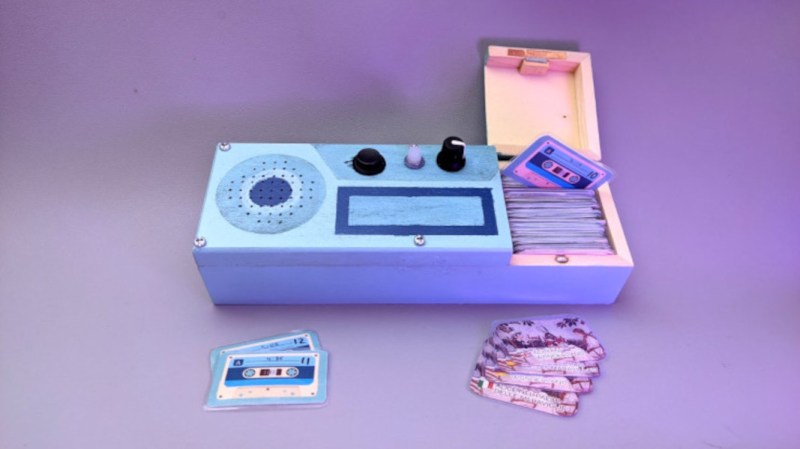
Consumer electronics aimed at young children tend to be quite janky and cheap-looking, and they often have to be to survive the extreme stress-testing normal use in this situation. You could buy a higher quality item intended for normal use, but this carries the risk of burning a hole in the pockets of the parents. To thread the needle on this dilemma for a child’s audiobook player, [Turi] built the Grimmboy for a relative of his.
Taking its name from the Brothers Grimm, the player is able of playing a number of children’s stories and fables in multiple languages, with each physically represented by a small cassette tape likeness with an RFID tag hidden in each one. A tape can be selected and placed in the player, and the Arduino at the center of it will recognize the tag and play the corresponding MP3 file stored locally on an SD card. There are simple controls and all the circuitry to support its lithium battery as well. All of the source code that [Turi] used to build this is available on the project’s GitHub page.
John Carmack, the virtual reality pioneer who joined Meta from Oculus after its $2 billion acquisition, has left the social network. Business Insider first reported his departure, citing people familiar with the company, and published pieces of his internal memo that contained sentiments critical of Meta and its augmented and virtual reality efforts. After Insider's and The New York Times' reports came out, Carmack confirmed on Twitter and Facebook that he is indeed leaving the company and even published his note to staff members in full.
"This is the end of my decade in VR," Carmack said in his memo. He started by praising the Quest 2 headset for being what he "wanted to see from the beginning," with its inside out tracking, optional PC streaming, cost effectiveness and a screen with a resolution that's nearly 4K. However, he argued that it could "have happened a bit faster and been going better if different decisions had been made."
Carmack's main issue with Meta seems to be the company's efficiency — or, based on his memo, its lack thereof. "We have a ridiculous amount of people and resources, but we constantly self-sabotage and squander effort," he wrote. "There is no way to sugar coat this; I think our organization is operating at half the effectiveness that would make me happy."
The executive said that as "a voice at the highest levels," he felt like he should've been able to move things along, but he was "evidently not persuasive enough." While he didn't give detailed examples, Carmack noted that a good fraction of the things he complained about only turned his way a year or two after evidence of the issue had already piled up. "I have never been able to kill stupid things before they cause damage, or set a direction and have a team actually stick to it," he added. Carmack admitted near the end of the memo that he was "wearied of the fight" but that he still believes that "VR can bring value to most of the people in the world, and no company is better positioned to do it than Meta."
As the executive said on Twitter, he makes it no secret that he has "always been pretty frustrated with how things get done at [Meta.]" In a podcast interview with Lex Fridman back in August, he said the $10 billion loss by the company's AR and VR division made him "sick to [his] stomach thinking about that much money being spent." He wrote posts on Meta's internal messaging board criticizing its headsets' features and the need to install software updates before being able to use them. Apparently, he was also pushing Meta to put immediate user experience first when it comes to how it wants build out its vision of the metaverse.
Carmack became Oculus' first chief technology officer in 2013 after he left id Software, where he co-created the Doom and Quake franchises. He joined Meta when, as Facebook, it purchased Oculus for $2 billion back in 2014. In 2019, he took a step back from Oculus and acted as CTO only in a consulting capacity to focus on Artificial General Intelligence (AGI), or the kind of AI that's capable of performing human tasks. His startup, Keen Technologies, is working on developing that type of AI systems.
As anyone who listens to my unscripted Connect talks knows, I have always been pretty frustrated with how things get done at FB/Meta. Everything necessary for spectacular success is right there, but it doesn't get put together effectively.
Google, Apple and Mozilla are collaborating on a better web browser benchmark. Speedometer 3 will be a “cross-industry collaborative effort” from the Chrome, Safari and Firefox makers to create a new model that balances the companies’ visions for measuring responsiveness.
Three companies making a tool that will rate the effectiveness of their competing products sounds like a recipe for disaster. However, Speedometer’s governance policy includes a consent system that differs based on potential ramifications. For example, significant changes will require approval from the other two companies, while “non-trivial changes” will need consent from one of the other two parties. Meanwhile, “trivial changes” can be green-lit by a reviewer from any of the three browser makers. The policy’s aim is that “the working team should be able to move quickly for most changes, with a higher level of process and consensus expected based on the impact of the change.”
Unlike some past benchmarks, Speedometer 3 is being started as a cross-industry collaborative effort. Building this will be hard work, and working together gives us a chance to build the best version to help make the Web faster for years to come. https://t.co/lZyegpIAeW
The project will follow Speedometer 2, the current de facto benchmark developed by Apple’s WebKit team. Chrome, Safari and Firefox are three of the four most-used browsers today. That fourth browser, Microsoft Edge, doesn’t run its own engine, instead relying on Google’s open-sourced Chromium with Blink and V8 engines.
The Speedometer 3 project is still in its infancy, and its GitHub page warns that it is “in active development and is unstable.” The groups recommend using Speedometer 2.1 until development is further along, though we don't yet know when Speedometer 3 will be ready.
The first in-depth testing for Formula E’s Gen3 car took place this week in Valencia, just one month away from the start of Season 9 in Mexico City. Across three full days, one simulated race and an added one-hour jaunt on a planned media day, some teams ran nearly 600 laps and over 2,000 kilometers to get a handle on what the new cars are capable of. The week wasn’t without incidents, of course, but Formula E co-founder and chief championship officer Alberto Longo said the sessions were “very successful.”
“The teams and drivers are obviously still learning and integrating the new system,” Longo explained. “We know that [going] from Gen2 to Gen3 is much harder to navigate than from Gen 1 to Gen 2, so it’s great to see that we are already much quicker than where we were with Gen2.”
After this week’s testing in Spain, here are the biggest things we learned about Formula E’s pending Gen3 debut next month.
The Gen3 cars look great on track
I’ll be the first to admit that when Formula E pulled the wraps off the Gen3 car in Monaco last April, I was a bit skeptical of the new, bold look. Once the teams started revealing their final liveries in the lead up to the Valencia test, I started to see the potential. All of the teams have been posting clips this week and Formula E has compiled footage as well, showing that the new cars do indeed look great on track despite their fighter jet-esque design.
The Gen3 car isn’t that much faster than Gen2 yet
When the Gen3 car was first revealed one of the main points Formula E hyped up was how much faster the new trim would be. That included a top speed of up to 200MPH. Of course, speed is dependent on a number of factors, including the circuit, but on paper the new cars should be much quicker than the Gen2 EVs. In the first practice session of the week, Maserati MSG Racing's Maximilian Günther posted the quickest official time of 1:26.096, slower than the fastest lap of Valencia testing last year in the Gen2 car of 1:25.763. The quickest lap this week came when Günther notched a 1:25.127 on the final day.
“When developing a new car, it’s really important to collect as much data as possible and to get a good feel for the car, and I believe that we have achieved this over the past few days,” Günther said. “Now, we just need to refine some aspects of our performance and continue with our preparations ahead of the first race of the season in Mexico."
Maserati MSG Racing
With the Gen3 cars being lighter and more powerful, an added 100kW to be exact, you’d expect the lap times to fall from the previous generation running. However, with limited testing, specifically in regards to the new tires, teams haven’t dialed-in their setups to take full advantage of the new cars just yet. Hankook told The Racethat some drivers experienced the new compound “for the first time in their life” during the initial session in Valencia.
The new tires are posing a challenge
For the first eight seasons, Formula E ran Michelin tires. Starting with Season 9, however, the series is making the switch to Hankook. More specifically, it moved to a more sustainable compound that aligns with Formula E’s green initiatives. 30 percent of the new tires are made from environmentally-friendlier materials like natural rubber. The challenge for Hankook is not only does the tire have to be better for the Earth, it also has to work well in both wet and dry conditions since Formula E only runs one compound.
Autosport reports that Hankook tested “maybe even 80 different specs” of tire compounds during the development phase, according to the company’s head of motorsport Manfred Sandbichler. The end result is a tire where the inside is softer and the outside is harder – a combination that could have implications for how teams tackle corners at each circuit.
One thing that’s clear throughout the paddock is that the new Hankook tires are more durable than the final spec of Michelins. McLaren Racing’s Jake Hughes told Engadget recently that the new tires “behave very differently” and that they’re “a bit harder, a bit stiffer.” The harder tire should be more durable than what Formula E ran in the past, according to Hughes, as the degradation on the Michlins would lead to the treaded tire being nearly slick by the end of the race.
“We need to try to understand how we can maximize it,” he explained. “At some point we’re talking in miniscule details to try to find an advantage over the competition.”
Teams are dealing with reliability concerns
Formula E
With limited testing ahead of the official preseason sessions in Valencia, teams are finding issues with their cars. The Race reports that some teams were in such a crunch to make it to Spain that they didn’t have time to shakedown their cars beforehand to make sure the basic systems were functioning properly due to parts that arrived late. According to that report, around-the-clock work shifts were required for some to make it to testing.
During a mock race this week, eight of 22 cars retired before the end of the trial event. One car didn’t make the start due to battery issues and two others had to pit on the first lap. A handful of others had to visit pitlane, which doesn’t happen during a Formula E race unless you have an issue (until the series institutes charging stops at least). The two biggest problems seem to be with the Williams Advanced Engineering battery setups and the brakes, both of which The Race reported teams were having issues with in early November. Formula E is said to be working on a secondary braking system after a number crashes in testing prior to Valencia, but The Race understands that it won’t be available during the first two E-Prix in Mexico City and Diriyah.
Teams expect Gen3 cars to improve quickly and drastically
Maserati MSG Racing
This isn’t exactly a new development, but teams up and down the paddock echoed the sentiment after the handful of test runs. McLaren’s team principal Ian James told Engadget that he expects “a development rather than a complete evolution.”
“As much as we’ll prepare the best we can for Mexico and that first race, undoubtedly there’s going to be a very steep learning curve as we get into the new season,” he explained. “And a fast rate of development as well.”
Drivers are also clear there’s “a lot to learn and plenty of work to do” before the first race, as Maserati’s Edoardo Mortara explained. “This week of testing has been intense but overall positive, and although we’re still understanding the finer points of the Gen3, I think we are in a strong position,” he said. “From here, we will fully analyze our data, debrief and continue to gather simulations from HQ.”
The first race in Mexico City could be… interesting
The issues with batteries and brakes aside, there are a number of elements of a proper Formula E E-Prix that could make the first full race quite an adventure. The new tires pose a challenge on a full street circuit, as opposed to the smooth track in Valencia. Getting the rubber in the proper window for qualifying and managing any degradation over the course of the race will be key.
There are also some unknowns with race format as well, as Formula E plans to test a mandatory Attack Charge stop in certain races in Season 9. Attack Charge will give drivers a temporary power boost much like Attack Mode has in previous seasons. Formula E says the 30-second stop can deliver 4kWh of energy to power an “enhanced” Attack Mode where the power of the Gen3 cars increases from 300kW to 350kW. It’s unclear where the Attack Charge trials will take place as specific races weren’t announced when the updated sporting regulations were revealed last month.
The National Highway Transportation Safety Administration announced Thursday that it is opening an investigation into the self-driving technology behind General Motors' robotaxi fleet. This announcement follows three reported accidents allegedly caused by Cruise vehicles braking hard or otherwise becoming immobilized in traffic, creating unannounced obstacles for other vehicles and resulting in rear-end collisions with other motorists.
"With respect to the incidents of hard braking, NHTSA has received three reports of the ADS initiating a hard braking maneuver in response to another road user that was quickly approaching from the rear," the agency reports, noting that human supervisors were aboard for each incident. "In each case, the other road user subsequently struck the rear of the ADS-equipped vehicle."
"With respect to the incidents of vehicle immobilization, NHTSA has been notified of multiple reports involving Cruise ADS equipped vehicles, operating without onboard human supervision, becoming immobilized," the report continues. "When this occurs, the vehicle may strand vehicle passengers in unsafe locations, such as lanes of travel or intersections, and become an unexpected obstacle to other road users."
In response the company touted its technology's history of safe operations. “Cruise’s safety record is publicly reported and includes having driven nearly 700,000 fully autonomous miles in an extremely complex urban environment with zero life-threatening injuries or fatalities," Hannah Lindow, Cruise spokesperson, told Engadget via email. "This is against the backdrop of over 40,000 deaths each year on American roads. There’s always a balance between healthy regulatory scrutiny and the innovation we desperately need to save lives, which is why we’ll continue to fully cooperate with NHTSA or any regulator in achieving that shared goal.”
The company goes on to argue that in the cases of hard braking, the vehicles were reacting to the actions of other drivers, had a human operator onboard (though the ADS was in control at the time), and has already met with the NHTSA regarding each incident. Cruise frames the immobilization events as equivalent to a flat tire, wherein the ADS encounters an unexpected and potentially dangerous situation, turns on the vehicle's hazards and pulls off to the side of the road.
As the NHTSA is sure it's aware of every braking/immobilization incident to date, the agency is opening a preliminary evaluation,"to determine the scope and severity of the potential problem and fully assess the potential safety-related issues posed by these two types of incidents." It has not announced a timeline for publication of the PE's findings.
Ford F-150 Lightning prices are going up again. The US automaker is raising the electric pickup’s starting cost by $4,000, bringing the new entry price to $55,974. That’s a 40 percent increase over the electric vehicle’s initial starting price in May 2021.
Ford toldCNBC today that it is changing pricing “as a normal course of business due to rising material costs, market factors, and ongoing supply chain constraints.” Raw material costs of nickel, cobalt and lithium — crucial to electric car batteries — have soared alongside EV demand.
Through the end of November, Ford has only sold 13,258 F-150 Lightning units, but that number is a reflection of supply constraints rather than low demand (on the contrary, the truck is still a hot commodity). The company plans to boost production to 150,000 units by next fall — and it said earlier this week that it’s still on track to meet that goal. It recently added a third shift of workers to a Michigan production plant to help meet that goal.
Ford is the second-biggest American seller of electric vehicles (behind Tesla), and the F-150 Lightning is the top-selling electric truck. Considering Ford F-series trucks have been the best-selling vehicles in the US for three decades, that customer loyalty appears to be carrying over to EVs. Earlier this year, Engadget's Roberto Baldwin rode along for a test drive and commented on how much it felt like a standard F-150.
The cut-off dates for holiday shopping have mostly passed, but that doesn't mean the deals have disappeared. We're seeing prices that match Black Friday, like the Beats Fit Pro for just $160 and Bose's QuietComfort Earbuds II for $249. Some items have even dipped below their Cyber Week prices, like GoPro's Hero 11 Black Mini, the 13.3-inch MacBook Pro and Eufy's RoboVac X8 Hybrid. While these items may not ship out in time to wrap them up as gifts, this is still a great opportunity to grab devices and tech you've had your eye on, and save a little in the process. Here are the best deals from the week that you can still get today.
Apple MacBook Air M2
Amazon and B&H Photo are both selling the base MacBook Air M2 with 8GB of RAM and 256GB of storage at an all-time low of $999. The 512GB model is discounted at B&H, too with $180 savings. We think Apple's latest ultra-thin portable is the definition of a well-rounded laptop. It's fast for day-to-day productivity or even more intensive work on like media editing. The screen feels more expansive than its 13.6-inch size might suggest and the speakers are surprisingly strong. There's no SD card slot or a 120Hz screen, and the Air probably isn't what you want for intensive gaming or heavy video and audio editing, but it's a well rounded daily drive. For more intense use, you'll likely want to go for the 2021 MacBook Pro models. Right now the 16-inch MacBook Pro is $450 off at B&H, bringing it down to $3,049.
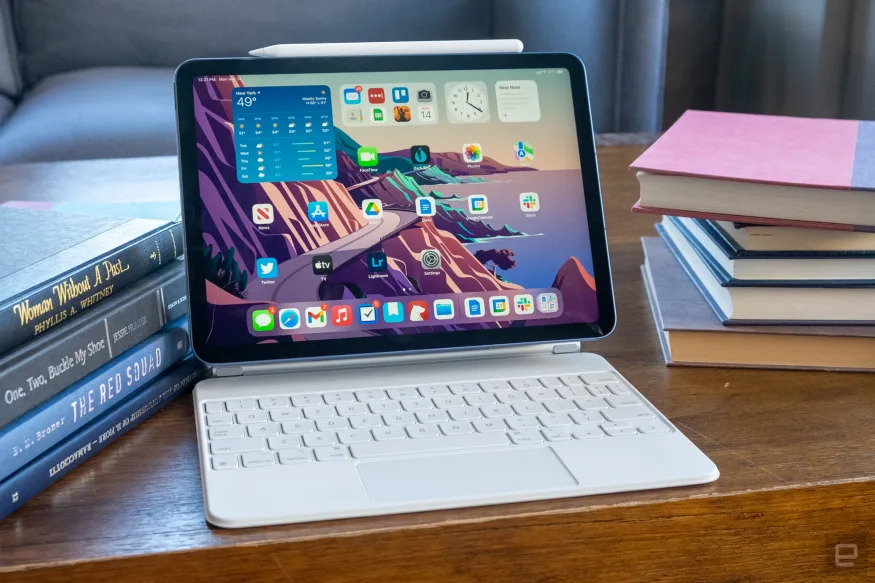
The second generation Apple Pencil is the best stylus you can get for your iPad Pro or Air and one of the our top-recommended accessories. At $130, the Pencil isn't cheap and doesn't often go on sale, but right now it's down to $89 at Amazon. That's a 31 percent discount and matches its all-time low price. It's great for drawing and sketching using a wide range of drawing apps, and with the Scribble setting enabled, you can convert your handwriting into typed text in virtually any text field.
The second-generation improves upon the prior iteration with the addition of on-board tap controls and wireless charging while magnetically snapped to the edge of your iPad Pro or iPad Air. The second-generation stylus is compatible with the latest iPad Pro, Mini and Air models, but not with the 2022 standard iPad. To go with that tablet, you'll want the first-generation Apple Pencil, currently $95 at Amazon.
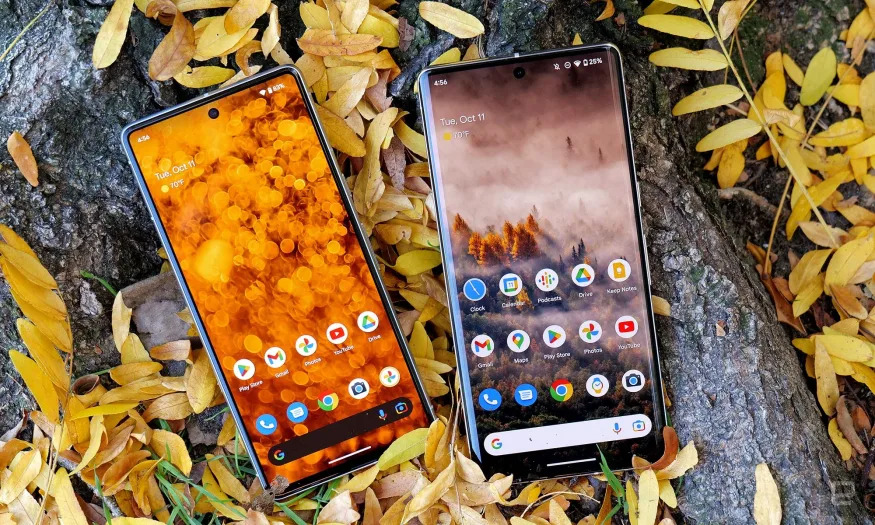
If you missed the Black Friday deals on Google's Pixel devices, here's a second chance at grabbing one at a discount. Right now a Pixel 6a smartphone is up to 33 percent off while Pixel 7 smartphones are up to 17 percent off. That brings an unlocked 5G Pixel 6a down to just $299 and an unlocked 5G Google Pixel 7 down to $499. If you want a Pixel 7 Pro, that's seeing a $150 discount, bringing it to $749. We called the Pixel 7 and Pixel 7 Pro "the best bargain in flagship phones" in our review back in October, praising their smarter software and upgraded cameras.
The sale also extends to the Pixel Watch which is $50 off during the sale. That brings Google's new smartwatch down to $300, which is its lowest price yet. We admired the gorgeous design and the integration of Fitbit health and fitness features in our review.
Google's Pixel Buds A-Series are also on sale, down to just $69 after a 30 percent discount. The A-Series are the more affordable of Google's two earbud offerings, and we were impressed by the sound quality, seamless integration of the Google Assistant and large number of features they offer for the price. Which is even more impressive after this latest discount.
The same sale that's discounting the Pixel products above also extends to devices from Google's smart home brand, Nest. Right now the Nest Thermostat, Nest Security Cam and Nest Doorbell have dropped to some of the lowest prices we've seen. The Nest Thermostat helps you program an energy efficient schedule and lets you control your temp from anywhere via the Google Home app. During the sale, its down just just $90, which is $40 off the usual price.
Also compatible with the Google Home app, Nest Security cameras are 30 percent off, making it a good time to act if you wanted an extra set of "eyes" keeping tabs on your home. The smart cameras can tell the difference between people, pets and vehicles and sends you relevant alerts so you can check in with your phone at any time. The Google Nest Doorbell packs many of the same features as the security cams, but this version keeps an eye on your front door. The wireless, battery-powered version of the doorbell is 33 percent off during the sale, bringing the price down from $180 to just $120.
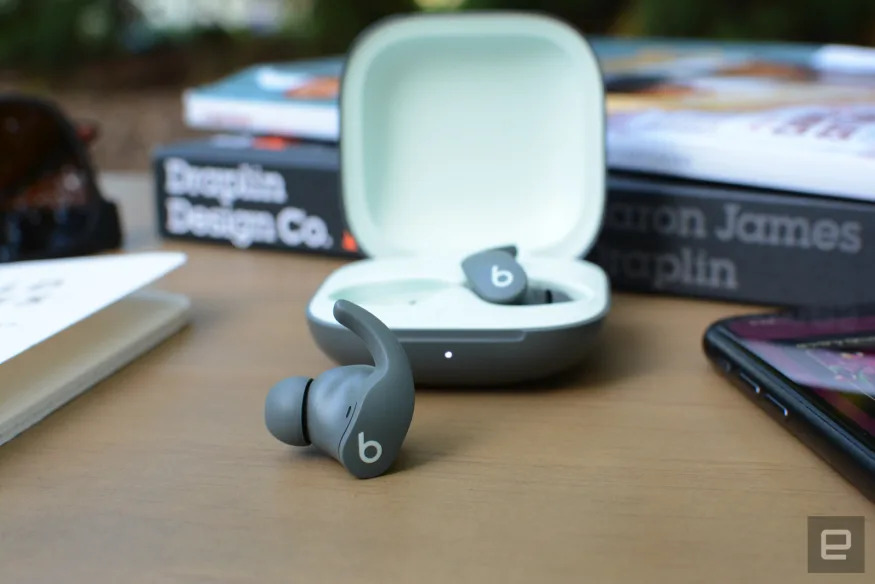
As part of a larger sale on Beats earbuds, Amazon is offering the Beats Fit Pro for just $160, which is $40 off the list price and the same as it was for Black Friday. All four colorways are discounted, including white, black, purple and green. You can also snag the Beats Studio Buds for just $90 in black, red, white, blue or gray — that's a steep 40 percent discount off the usual price.
In our review of the Beats Fit Pro, we admired the balanced sound quality and comfortable fit. We also liked how the buds come with nearly all of the features you'll get with the AirPods Pro, like Siri's assistance and spacial audio support. They're also workout-ready with an IPX4 sweat-resistant rating and have a decent six-hour battery life. There's no wireless charging though, a drawback you may be able to overlook when the buds are $40 cheaper than usual.
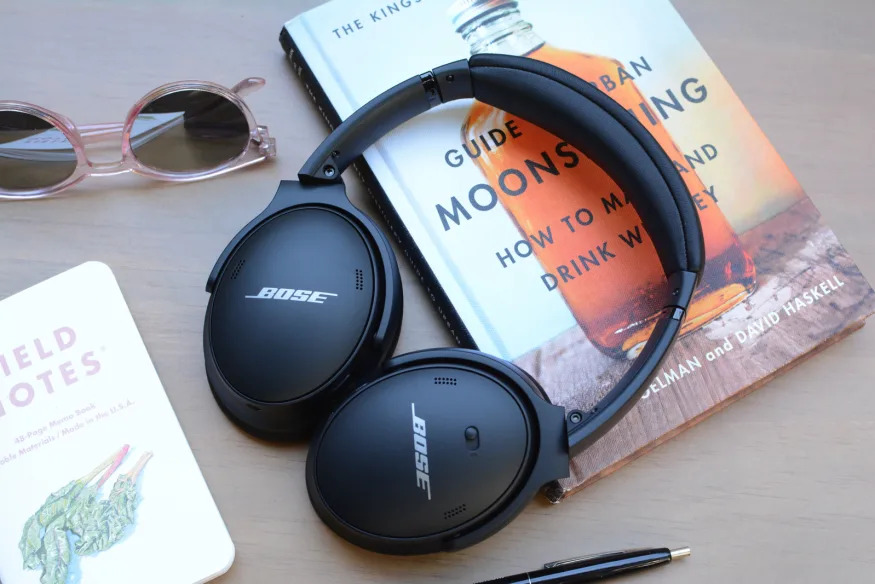
If you want your personal audio delivered in an over-the-ear package, you may be pleased to hear that Bose's QuietComfort 45 is on sale for $229 at Amazon, B&H Photo, and Bose. This is close to the lowest price so far for these headphones which is $100 below Bose's list price, and the same price they went for on Cyber Monday. According to Bose, the deal is only scheduled to run through Monday.
In our guide to the best wireless headphones, we called the headphones a solid option and gave them a score of 86 in our review. The cans are lightweight and extremely comfortable, like the name suggests. The noise cancellation is smooth and capable and the sound quality is balanced and pleasant. To get and even more precise sound, you can use the graphic equalizer settings in Bose's companion app.
The sale is part of a larger Bose sale, many of which are gathered here on Amazon's sale page, so if you're looking for Bose speakers or earbuds too, now's a good time to grab them.
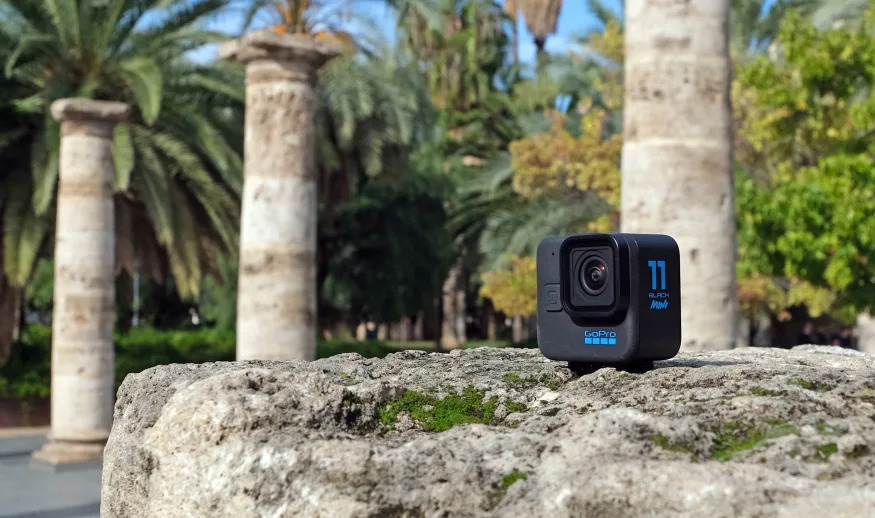
The newest GoPro is the Hero 11 Black Mini, a smaller version of GoPro's top-end action camera. Right now you can get it for 42 percent off at GoPro's website when you bundle it with a GoPro subscription. The camera is usually $400, but when you add a year of the GoPro subscription for $50, GoPro will knock $150 off the price. Then, after you add the camera to your cart, you'll get an additional 15 percent discount as part of GoPro's holiday sale. If that sounds like a lot of numbers, the bottom line is you can get the Mini for just $262.50, and it includes a year of a GoPro subscription. That's a good discount considering the Hero 11 Mini by itself is $400 right now at Amazon.
In our hands-on test of the Mini we noted a few drawbacks like a status-only display instead of a touchscreen and no photo mode. That means you'll need to control the camera with the companion app and pull stills your video. But as a helmet- or body-mounted camera, we think this device excels. It has horizon lock and Hyperview mode like the larger Hero 11, plus it offers a second pair of mounting fingers to get the camera oriented exactly the direction you want.
The 13.3-inch MacBook Pro is on sale at B&H Photo right now for just $1,099. That's the lowest price the laptop has seen since its release back in June and is even below what it went for during Black Friday sales. The 13-inch model is the only one of Apple's Pro laptops that got an update this year, receiving Apple's latest M2 processor chip. When we reviewed the laptop after its debut, we praised it's faster speeds (thanks to that new chip), excellent build and long battery life. While we prefer the older model 14-inch MacBook Pro and called the M2-enabled MacBook Air "near perfect," this is still a good time to buy if you've had your eye on a Pro Apple laptop with their latest processor.
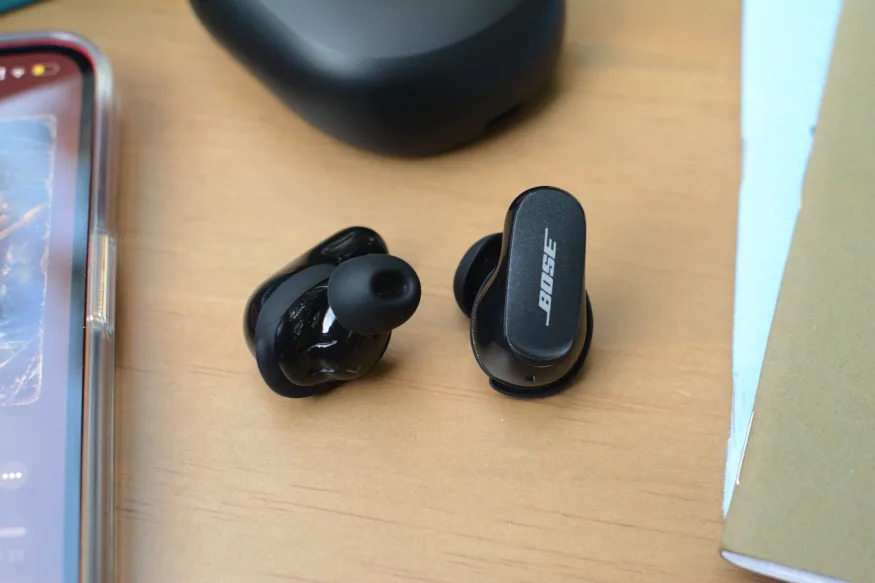
In addition to the sale on Bose's QuietComfort 45 headphones above, you can also save on their QuietComfort Earbuds II. The wireless earbuds are now on sale for $249 at Amazon, Bose and B&H Photo, matching the all-time low we saw for Black Friday. These usually go for $299 and Bose saysthe deal will run through the end of the year.
We gave the earbuds a score of 87 in our review, they're our favorite earbuds for active noise cancellation (ANC) in our wireless earbuds guide as they're impressively good at muting both low- and high-frequency sounds so you can focus on whatever you're listening to. if you do want to keep tabs on what's going on, the Aware Mode is an improved transparency option over the last model (but still doesn't beat the AirPods Pro). The audio quality is smooth with a richer high-end than the previous QC earbud from Bose. Note that these are on the larger size for in-ear buds, which may start to feel heavy after a while. You'll get around six to seven hours of battery life, but keep in mind there's no wireless charging, but the case holds three additional charges.
The new Apple Watch Ultra is quickly becoming a strong option for divers, explorers and athletes, but it's not cheap. The rugged wearable usually goes for $800, but we're seeing a $60 discount right now at Adorama. The deal only applies to the green strap option, but if you plan to swap out the band anyway, that's probably not an issue.
We gave it an 85 in our review, admiring the bright screen and durability of the build, calling it a "monster truck of a watch." The battery is great, giving around three days of usage on a charge, and the hiking capabilities like GPS, Backtrack and waypoint kept our team safely on track on the New Jersey’s South Mountain reservation.
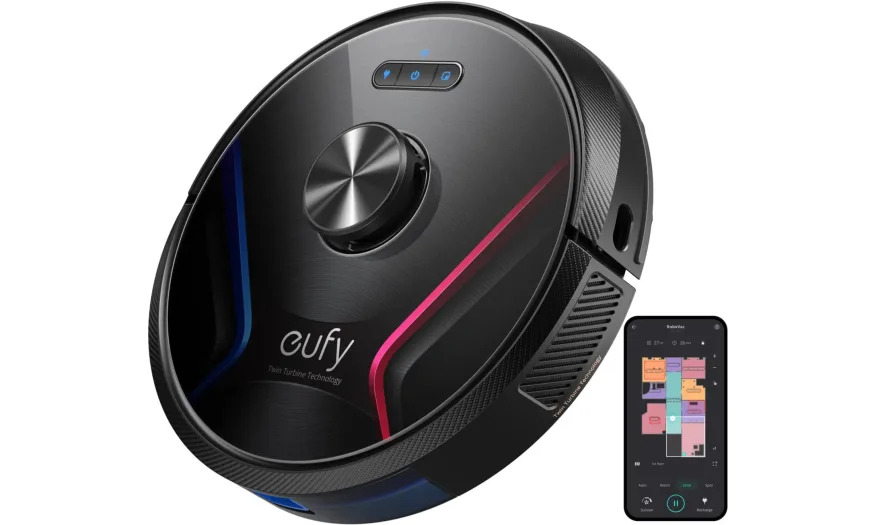
Robot vacuums are a true time saver, but they're not cheap. Right now Amazon is discounting many models of Eufy vacs, with savings of up to 51 percent. That puts many vacs below the discounts we saw for Black Friday. The RoboVac X8 Hybrid made the cut as one of our recommended robot vacuums in our guide. Right now it's going for $280 instead of its usual $550, which is a 49 percent discount and $40 cheaper than it was for Cyber Week. If you don't need the mopping function, you can grab the RoboVac X8 for $260.
We also recommend the Eufy RoboVac 11S for its thin profile and good suction. We named it the best "bang for your buck option" in our budget smart vac guide and right now it's just $200. For a little more suction power, you might go for the RoboVac 11S Max. It's down to $150 for Prime members. If you're not a member, it's $250. The RoboVac G30 Edge and RoboVac G30 Hybrid are also on sale, priced at $160 and $180, respectively. There's a total of six vacs on sale, so you've been thinking about getting a little help with the floors, there's sure to be a model that'll fit your needs.
Microsoft's Xbox Series S is down to $230 at Verizon, which is $70 less than the compact game console's MSRP. While this discount isn't as steep as some of the offers we saw around Black Friday, it's still $10 below the typical sale price that's been available in the time since.
We gave the Series S a review score of 85 when it launched in late 2020: It's not powerful enough to play games in 4K like the brawnier Xbox Series X, but it's a much more affordable entry point into the exact same library. It's a fine choice for a secondary console hooked up to a monitor or bedroom TV. Do note, though, that it's a digital-only affair, with no disc drive and only 512GB of built-in storage.
Starting today, human-averse travelers in Phoenix can book a fully autonomous Waymo ride between the Phoenix Sky Harbor International Airport and downtown. The Alphabet-owned company, which is also doubling its fully automated coverage area in the city, says the new route is the world’s only fully autonomous airport robotaxi service.
Waymo has accelerated its public rollout lately. In March, it received permission to charge for rides with a human safety driver in San Francisco. It also got approval last month to offer fully driverless cars there before rolling out service to the public earlier in December. San Francisco riders can now book a Waymo robotaxi across “a large portion of the city, including every neighborhood along the 17-mile Crosstown Trail.”
However, the company is still waiting for approval to charge for rider-only cars in San Francisco. It currently only offers service to Waymo employees, their guests and select members of the public. Waymo was the second fully autonomous service operating in San Francisco, behind GM-owned rival Cruise (although it only offers fully automated rides at night).
Waymo’s expansion means more Americans can book a driverless car, but it’s still modest compared to what you’ll see in China. Baidu's robotaxi service is available to the public in larger Chinese cities, although with limitations on cars without a safety driver.
If it's ever seemed like people are more crotchety on social media when there's a heatwave or heavy rain, you're probably not alone in having that perspective. Researchers analyzed more than 7.7 billion geotagged tweets from 190 countries that were posted between 2015 and 2021. They used a language analysis tool to measure the sentiment of tweets against daily weather data.
The researchers found that, compared with days of regular weather, "both local extreme heat and extreme precipitation events worsen online emotional states globally by elevating rates of posts with negative expressions and also reducing the rate of posts with positive words." They also determined that people were more likely to tweet negatively during downpours and heatwaves than when daylight savings time kicks in and they forego an hour of sleep.
These outcomes might not seem incredibly surprising. However, the researchers suggested that because the findings were so consistent across tweets from more than 43,000 counties, they indicate that we're finding it hard to adapt to climate change. They carried out the study in the first place to explore the links between climate change and mental health.
“As of right now, we see very little evidence of adaptation in the way that these new extreme events that are emerging globally are impacting human sentiment,” says Kelton Minor, a postdoctoral research scientist at Columbia University and co-author of the study, told The Verge. "Since climate change is shifting the extreme tails of most regional temperature and heavy precipitation distributions rightwards, the impact of more severe extremes on overt emotional states may far exceed those registered in the recent past, pending further adaptation," the abstract of the study reads.
Minor and co-author Nick Obradovich, chief scientist at a nonprofit called Project Regeneration, found the biggest shift in sentiment during a record-breaking heatwave in the Pacific Northwest and southwest Canada in 2021. More than a thousand deaths were linked to that heatwave, while negative sentiment in tweets increased tenfold compared with the typical heatwave in the US, the researchers found. Minor and his colleagues plan to keep monitoring social media sentiment in the face of more extreme weather events, which studies suggest are likely to happen more often amid rising global temperatures.