Five years later, Mercedes is finally ready to show the finished version of its hybrid hypercar. The production Mercedes-AMG One now packs a Formula 1-derived, 1,063HP hybrid powertrain with a turbocharged 1.6-liter V6 engine and four electric motors, including one motor in the turbocharger and another linked to the crankcase. While the car won't rev up to F1 levels (to last longer and use commercial fuel), the result is high responsiveness across the rev range, sustained boost pressure and strong torque even at low engine speeds. The One promises the advantages of both gas and electric powerplants, to put it another way.
That unsurprisingly translates to brisk performance without guzzling too much gas. You'll reach 62MPH in 2.9 seconds (124MPH in seven seconds), but the combined fuel consumption is relatively modest at 27MPG. Mercedes SUVs like the AMG GLE 53 aren't as efficient, for context. You can drive 11.2 miles purely on electric power, and the 800-volt architecture helps you charge quickly (including from the gas engine in race mode) while minimizing weight. The custom seven-speed manual, your only transmission option, is built to keep the One's engine operating at peak performance.
The interior is just as plain as you might remember from the 2017 concept, although that still gives you a digital instrument cluster, an infotainment touchscreen and a camera-linked screen that replaces the usual interior rear mirror. Expect plenty of carbon fiber, nappa leather and microfiber cloth.
The first customers should get their Mercedes-AMG One cars in the second half of 2022. Not that you're going to buy one — all of the production models have been spoken for despite the $2.7 million price tag.
Mercedes-Benz
You're far more likely to drive the equally new GLC (shown at middle), which is built solely around hybrid power (four "mild" hybrids and three plug-in models). The PHEV variants of the updated SUV have up to 74.5 miles of pure electric driving, and will prioritize the EV mode for long urban trips and other "suitable" routes. Mercedes hasn't detailed prices at this stage, but the revamped GLC should reach European dealers in the fall.
Buick is finally joining GM's EV transition, and it's ready to tease what you can expect. The badge has unveiled a Wildcat EV concept car that previews both the design language and technology for production models. The two-plus-two coupe sports a sharper, more aggressive look than Buicks from the past, and includes a few clever tricks you rarely see in other electric cars.
Micro-LEDs and thin-beam projectors not only provide front lighting, but greet you as you enter the vehicle. You can see a state of charge indicator through the hatchback glass. The cabin unsurprisingly includes plenty of displays (including an ultra-wide main screen and a secondary panel), but there's also a "Zen Mode" that dims the lights, massages you through the seat and even sprays aromatherapy scents through the interior.
GM didn't provide performance specs for the Wildcat, and stressed the concept would "influence" production Buick EVs rather than serve as a prototype. The coupe design is a notable break from Buick's usual SUVs, though. While executives in a Q&A session wouldn't confirm a shift in body styles, they hinted the Ultium platform enabled a variety of EV designs.
GM
It's also clear that GM intends to use Buick as a vanguard for its electrification plans. The first production Buick EV (expected to be the Electra SUV) doesn't arrive until 2024, but the lineup will be fully electrified by 2030 — five years ahead of GM's deadline for ditching combustion engines. Buick won't be alone when Cadillac and Hummer are on similar paths, but it's evident you'll have plenty of choice in American luxury EVs over the next few years.
DeLorean Motor Company has revealed the first images name of its upcoming EV called the Alpha5. The main things that stand are the wedge-like supercar styling, pair of massive gullwing doors and four seats — letting it hit 88 MPH with two extra passengers or carry considerably more than 55 pounds of cocaine. DeLorean first teased its upcoming EV last month, promising a full reveal later this summer on August 18th. To be clear, it won't be built by the original DeLorean, but rather a Texas company that purchased the rights to the DeLorean name and spare parts.
DeLorean
The Alpha5 was designed by Giorgetto Giugiaro's ItalDesign studio (which also designed the original DeLorean) but there's no word if it uses stainless steel panels like the OG. It's based on the "Medusa" concept that the original DeLorean company had been working on before it went bankrupt back in 1982.
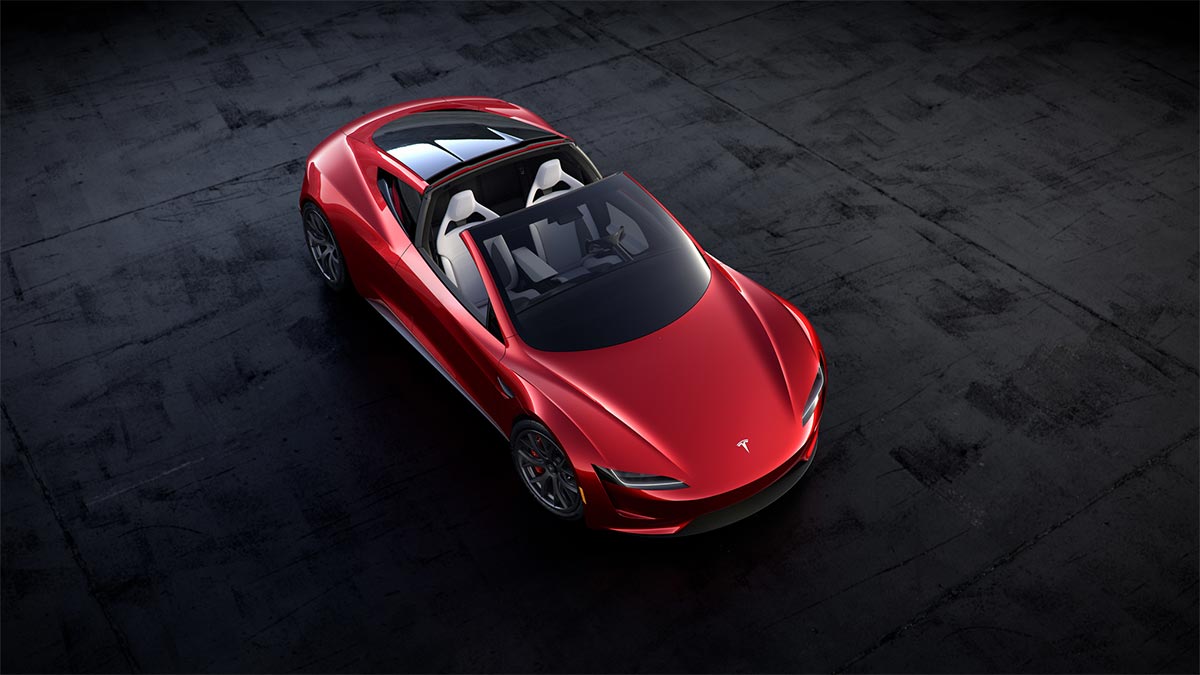
That vehicle was supposed to have four independent gullwing doors, but the DeLorean appears to have decided (probably wisely, given the complexity of such doors) to stick with two. From a top-front angle, the Alpha5 bears a passing resemblance to Tesla's new Roadster with similar lines on the hood/frunk.
DeLorean
DeLorean is targeting a 100kWh battery pack that should provide excellent range, along with a dual-motor, all-wheel-drive setup. It's projected to hit a top speed of 155 MPH and go from 0 to 60 MPH in 2.99 seconds or (yes) 0-88 MPH in 4.35 seconds.
The DeLorean was made famous, of course, by the Back to the Future series of films. Its creator John DeLorean also had a colorful history, having managed the development of American muscle cars like the Pontiac GTO in the '60s and '70s. He was arrested in 1982 and charged with cocaine trafficking, but the trial ended in a not guilty charge. The new DeLorean company will reveal the Alpha5 to the general public tomorrow morning on its website.
The world’s fifth-largest automaker will reportedly soon plead guilty to end a multi-year investigation into its efforts to conceal the amount of pollution created by its diesel engines. According to Reuters, the US Justice Department and Dodge parent company Stellantis could announce as early as next week that the automaker has agreed to pay $300 million to settle allegations of crminal fraud. Stellantis declined to comment on the report.
The Justice Department began investigating Stellantis around 2019 when the automaker recalled nearly 1 million vehicles in the US and Canada for not meeting federal tailpipe emission standards. As of last year, the agency has announced criminal charges for just three Stellantis employees. The probe involved approximately 100,000 Ram pickup trucks and Jeep SUVs sold in the US.
The deal comes five years after Volkswagen famously pleaded guilty to its own emissions scandal. “Dieselgate” saw the German automaker eventually pay more than $20 billion in fines and legal settlements for installing illegal software designed to cheat government emissions tests. Since then, sales of diesel vehicles have plummeted in Europe and other parts of the world.
Despite already struggling to meet production targets, luxury EV maker Lucid has now issued a recall for the Air due to potential issues stemming from the car's wiring harness.
In a recent notice posted on the NHTSA website spotted by Lucid Insiders, a summary for the recall says unsecured wires on 2022 Air vehicles could cause the car's displays to turn off. And because the Air's displays contain critical information including speed, range and warning indicators, this would present a hazard in violation of the Federal Motor Vehicle Safety Standards.
The notice states that the potential number of affected vehicles is 1,117. That means with Lucid having delivered less than 1,000 cars to date, the recall appears to cover all 2022 Air Dream Edition and Grand Touring models. For any potentially affected owners, you can get more info by calling Lucid's customer service at 1-888-995-8243 and mentioning recall number NCR-22-01-0.
Official notification letters are slated to be sent out on June 20th Meanwhile, for cars that are subject to the recall, the NHTSA says Lucid dealers will be responsible for inspecting vehicles and addressing the issue as needed, free of charge.
Going forward, Lucid Insiders claims the company has already started making adjustments to the glass canopy on new vehicles to prevent any issues with unsecured wires. However, perhaps the bigger concern is that this recall comes just a few months after Lucid recalled 200 cars for having front strut dampers that may have been improperly installed by a supplier. And with reservations for the Air now exceeding 25,000 cars, ironing out any issues will be hugely important if Lucid hopes to deliver those vehicles in a timely manner.
Automaker Stellantis and Samsung SDI are teaming up to build a $2.5 billion EV battery plant in Indiana, reported CNBC. It’ll be the first US-based battery plant for Stellantis, which has an umbrella of 16 brands that include Jeep, Maserati, Dodge, Fiat and Chrysler. Construction on the lithium-ion battery manufacturing facility is set to begin later this year, with a projected launch date for the first quarter of 2025. This timing fits in nicely with Stellantis’ goal of selling 5 million EVs globally by 2030. The plant will be located in Kokomo, where the Chrysler parent company already has a supplier base.
Stellantis said the Kokomo facility will provide lithium-ion battery modules for a wide range of vehicles, including plug-in hybrids and full battery-electric vehicles. The timing makes sense, given the automaker’s ambitious electrification plans in both Europe and North America. As TechCrunchnotes, Stellantis has been a pretty late arrival to the electric future. Currently the company only sells three plug-in hybrids — the Chrysler Pacifica Hybrid Minivan, the Jeep Wrangler 4xe and the Jeep Grand Cherokee 4xe. Stellantis has thrown a lot of time and money into changing that, with plans to offer more than 75 battery vehicle models by 2030.
We’re due for a number of new EV concepts from Stellantis in the next couple of years, including an electric Dodge muscle car, an all-electric Ram pick-up, a fully electric 4xe model in every Jeep SUV category and Chrysler’s 400-mile range electric SUV. All together, Stellantis has planned to invest $35.5 billion in electric vehicles by 2025. The automaker recently also teamed up with LG to build a $4.1 billion EV plant in Windsor, Ontario, which is projected to launch in 2024.
London has the oldest underground railway in the world, and on May 24th, it will welcome its newest addition to the family. Crossrail is the realization of a dream first mooted in 1941, but one that would only start being built in 2009. It is one of the biggest infrastructure projects in the western world, arriving several years late and several more billion pounds over budget. But it’s hoped that this gigantic system will spur growth, relieve congestion on its Victorian-era network and remind the world of what Britain can do when it puts its mind to something. No pressure, then.
The London Underground as it exists today was borne out of a historical railway boom, with competing companies building routes to serve the city’s major economic hubs. Its many quirks are a consequence of nearly 200 years of politics, commerce, geography and geology shaping how things work. It comprises eleven lines, 272 stations and 250 miles of track, which is now under the aegis of a dedicated body, Transport for London.
Despite the wealth of transport links, many of the lines were built to serve a city far smaller than its present population. Not to mention that London is the center of gravity for far more than just the people living within its metropolitan area – it dominates much of the southeast of the country. It’s for this reason that Crossrail was given the green light, as both a way to relieve congestion on its tiny, Victorian-era tunnels, and to recognize just how broad London’s influence had become.
Crossrail Ltd.
Crossrail runs from Shenfield, a commuter suburb 35 miles northeast of London in the neighboring county of Essex, via the Great Eastern Main Line. It then runs through the city, connecting to the Great Western Main Line and then on to Reading, a large town 40 miles west of London. When fully running, it is expected to serve 200 million passengers a year, increasing London and the south east’s total rail capacity by around 10 percent in total. Crossrail is primarily an above-ground line, aside from the Central Operating Section (COS); the tunnels that run through London itself.
“It’s hard to fathom how there is space in this city to put in new stations, new infrastructure,” says Olga Konopka, Principal Delivery Engineer at Crossrail. She cited an example of how when the new Crossrail tunnels pass existing Jubilee line tunnels, the gap between them is just two meters (6.5 feet). A fleet of eight 1,000-ton Tunnel Boring Machines (TBMs) were tasked with weaving a new route through some of the most congested soil anywhere in the world. It’s one of the reasons that Crossrail’s birth hasn’t been an easy one – since you’ve got hundreds of years worth of infrastructure that you can’t touch during the construction process.
The TBMs pulled around seven million tonnes of material out of the ground, but Crossrail’s leaders said that almost all of it was re-used. For instance, around three million tonnes of soil was donated to the Royal Society for the Protection of Birds. This was used to construct a new wetland nature reserve at Wallasea Island in neighboring Essex. The rest of the clay soil was used to restore landfill, raise land and, in one instance, help build a golf course.
Luca Marino / Crossrail Ltd.
Some 26 miles of tunnels have been dug below the city, which took between May 2012 and May 2015 to complete. Konopka explained that as well as being “the biggest civil engineering project in Europe,” it also produced the largest tunnels dug for the London underground. The Central Line, for instance, has a diameter of roughly 3.5 meters (around 11.5 feet), while Crossrail tunnels are 6.2 meters (around 20 feet) wide. “Crossrail tunnels have an emergency walkway in them, which is a massive improvement to health and safety from the current infrastructure,” she said.
Konopka explained that there was some art and artistry baked into the system to help things run smoother and smarter. For instance, the gradient of the railway line gently inclines in the tunnel sections approaching a station. That way, a train slows down more efficiently since some of its forward motion is being sapped by the hill it has to climb. The situation is reversed when you pull out of a station, the track sloping almost imperceptibly downward in order to give the train a speedy departure.
It should be clear by now that Crossrail, despite the fact that it is an electric railway running under a city, is not a regular subway. It may feature on the Underground Map, and even has a line name – The Elizabeth line – but it’s not an official part of the underground itself. (Pedants beware: Crossrail denotes the project, the Elizabeth line is the thing you’ll actually be riding.) Because it connects to mainline stations at either end, and uses full-size mainline trains, it is a railway unlike anything else in the UK. In fact, the closest comparator is Paris’ Réseau Express Régional (RER), a series of lines that connect commuter suburbs to the city itself, and then moves people between stops in the city – a railway that acts like a subway when it’s in the middle of a city.
Crossrail Ltd.
One thing that was often repeated was the fact that Crossrail was a project designed to marry the very old and the very new into one seamless whole. “Farringdon was the first part of the Underground,” said Konopka, “we need[ed] to somehow marry up the old and the new, and that’s been the biggest struggle.” And making a 21st century railway run in perfect harmony with a pair of railways built in the Victorian era is one of the reasons that Crossrail’s deadline slipped from 2018 to 2022. (COVID-19, of course, was the other.)
“Conceptually, the project is brilliant,” says Colin Brown, Technical Director of the Crossrail project, but “it joins up to railways that were built in Victorian times, and that’s where your problem starts,” he said. “The Great Western was built by [Legendary engineering pioneer Isembard Kingdom] Brunel,” he explained, “and the Great Eastern wasn’t far behind it.” “The technology on those two railways has evolved over many years,” he said “but hasn’t been changed since the ‘60s or ‘70s.”
Britain’s railways, including the two main lines that Crossrail connects, use an antiquated, analog signaling system to communicate hazard warnings to drivers. This system, after a series of fatal train disasters in the ‘90s, was updated slightly to improve safety, but remains a 20th century tool. The digital replacement is ETCS (European Train Control System), which brings digital technology into the railways and promises a much safer network overall. While Crossrail was built with ETCS as standard, it also had to play nice with its analog predecessors.
Subway systems, however, use an entirely different signaling system called Communications Based Train Control (CTBC). Given the density of trains using tunnels under cities, and the need for accurate location data, CBTC is key to run services with small gaps between each train. Crossrail may not be a subway, but it will run 24 trains per hour inside the tunnels, and so needs to behave like one while it’s underground. Not to mention that CBTC is the only system that can also run the more subway-esque functions, like platform screen doors and tunnel vent interfaces.
Brown explained his dismay at the patchwork of systems and why it wouldn’t have been simpler just to pay to standardize the technology. For a variety of reasons, it wasn’t deemed feasible, and so engineers have spent years finding ways to make the old and new, analog and digital, above-ground and below-ground systems work as one cohesive whole. “You’ve [never had] a mainline train morphing into a metro train and then morphing back out again,” said Brown – at least not in the UK.
CBTC is also predominantly automatic, with drivers acting in a more supervisory role while the trains are underground.This automatic system will even operate the train when it needs to reorient itself ready for its next leg of the journey. “When it gets to Paddington,” said Pradeep Vasudev, Head of System Integration, “the driver pushes a button and then he walks from one cab to the other [at the other end of the train] while the train drives itself.” This system is also sufficiently smart that it can help find ways for the timetable to recover when a train breaks down or an incident causes a delay elsewhere on the line.
And because the system is now so much more complex, and broad, means that the timetabling systems are paramount. “For the first time, a train in Bristol [120 miles west of London] breaking down could affect a train on the Great Eastern [Main Line] in Shenfield [Crossrail’s Eastern Terminus, 35 miles northeast of London],” said Vasudev. And, of course, on the software engineering side, all of this information, and calculation, needs to be boiled down to a series of simple commands that a staffer can use to recover the service when things go awry.
One problem that Crossrail was also forced to address was the privatization of Britain’s railways in the early ‘90s. Rather than a centrally-planned and operated railway, the then Government decided to franchise each region’s railway operator. Consequently the Crossrail project had to engage with a variety of operators running different lines and find some happy harmony. “We have MTR driving, we have RFLI who owns the central section of the railway, we have London Underground, who operates a lot of the stations, we have Network Rail on either side, when we go into Heathrow, we’ve got Heathrow Express which is a different operator,” said Vasudev.
“Some of that, you’ll never get away from the fact that an operator is key, regardless of how much information the system can give you,” said Vasudev. Lee Price is one such operator, a former personal trainer and badminton coach who joined the company in 2016. Price’s story is common among new Crossrail drivers, coming from outside the train driving fraternity rather than within. This was because the project opted not to poach drivers from other underground or mainline services to avoid denting staffing levels elsewhere. (Not to mention that it helps bring the economic benefits of the system to more people, creating training and job opportunities.)
Andrew Parish / Crossrail Ltd.
Price is now a veteran of the service, and trains other drivers, although he too isn’t yet rated for the entire route. Since it’s being used as three separate railways, it will only be after the central section is opened that drivers will be running back and forth on a regular basis.
Unlike a mainline train, or a subway, the role shifts depending on where along the route the train is. “On the East and the West, you’ll be physically driving [the train],” he said, while in the COS, “in theory, the train is automatic, but we’re there for more of a safety [role].” “Although you’re doing less, you still have to remain alert,” he added, especially in the dark tunnels that require drivers to “keep their awareness up.”
Crossrail opens to the public on May 24th, with services running between Paddington and Abbey Wood. On the day, the various arms of the service will be rebranded from TFL Rail – a placeholder name – to the Elizabeth line. 12 trains per hour will run along the line, starting at 6:30am and ending at 11:00pm each weekday, with a fuller service ramping up over time. One of the new mainline stations, Bond Street, has yet to open thanks to service delays.
Work on the project is not likely to be complete for a long while yet, but if the railway does help boost London’s fortunes, it won’t be long before eyes look forward to the next project. Crossrail 2 is a proposed line running from Broxbourne and Cheshunt in London’s northeast down to Chessington, southwest of the city. It is designed to join up routes north and south of the city, and relieve congestion on those journeys as much as Crossrail is expected to do from east to west.
Unfortunately, COVID-19 and government funding cuts have put the project on ice for the foreseeable future. But one thing that is clear, is that the expertise, the lessons learned from Crossrail’s slower-than-expected birth, are currently embedded in the team that’s just finishing their work. To let all of that experience wither on the vine would seem like a criminal waste of resources. Then again, there will be voices asking why London deserves yet another expansion of its public transport network when other major cities have nothing. As always, politics, economics, geography and geology will determine the future of the most famous tube in the world.
Hyundai is betting big on American electric vehicle sales. The automaker has struck a deal with Georgia to build its first dedicated EV factory in the US. The 2,923-acre plant near Savannah will make cars and batteries when production is projected to start in the first half of 2025. Construction starts in early 2023. The company expects to manufacture 300,000 EVs per year at the facility, covering a "wide range" of models.
Multiple factors led to the location choice. Hyundai pointed to "favorable business conditions" that included speedy market access, a large talent pool and an existing network that includes Kia's main manufacturing hub as well as suppliers. Unnamed incentives play a part, according to Savannah Morning News. However, it's also a prime spot for transportation. The factory is less than 31 miles from Savannah's port, which is the largest container stopover in the US and has two railway facilities at its disposal. Add the proximity of two major highways (the I-95 and I-16) and it will be easy for Hyundai to receive supplies and ship finished EVs.
Not surprisingly, both Georgia and Hyundai are touting economic benefits. They estimate the investment to be worth $5.54 billion, with Governor Brian Kemp claiming it will be the "largest project" in state history. Hyundai further claimed the plant would create 8,100 jobs, although it's not clear how many of those are full-time, permanent roles.
The annual production level won't be quite as strong as Hyundai's conventional manufacturing output. The company's Montgomery, Alabama plant can make up to 399,500 vehicles per year. This represents a major commitment to EVs, however, and suggests Hyundai is racing to compete with Tesla, Rivian, Volkswagen and other brands expanding their electric car production in the country.
Mercedes-Benz offered a glimpse today into what its all-electric future will look like. The Germany automaker released a concept for the Vision AMG, a sports EV that will be launched under its high-performance brand AMG. The low-lying, four-door coupe has a long wheelbase, silver paint and teal accents, bearing an intentional resemblance to the Formula 1 cars driven by the Mercedes-AMG Petronas F1 Team. Most strikingly, the side windows and rear glass of the Vision AMG are painted the same silver as the body of the car. Due to the hexagonal pattern of the design, drivers will still be able to see the road.
The Vision will be AMG’s first sports EV, joining the subsidiary’s other all-electric efforts, the EQE and the EQS. Other than that, there’s still very little we know about what the Vision AMG will offer — the automaker didn’t reveal any performance details for the car in the press release. It did say the Vision AMG would be equipped with an Axial Flux Motor by YASA, which has partnered with Mercedes to develop electric motors for their EV lineup that are more compact and lightweight than traditional electric motors.
The automaker also didn’t reveal any details on pricing, but the goal is for the production version to be out in 2025. Last December, Mercedes-Benz upped its initial EV investment to a staggering $63.6 billion, which it's planning to spend between 2022 and 2026. Just this week, the automaker announced it was partnering with battery materials company Sila Nanotechnologies to create a more energy-dense, silicon-anode battery for EVS. The company estimates that silicon-anode batteries offer 20 to 40 percent more capacity than the traditional lithium-ion found in most of today's electric cars.
The Vision AMG will be one of the three dedicated EV platforms that Mercedes plans on launching in 2025, in addition to the MB.EA platform for medium and large vehicles and the Van.EA for light commercial vehicles. The automaker has stated its goal is to switch to an all-electric lineup by 2030. Mercedes-AMG also released a promotional video (also with virtually no technical details) for the Vision AMG, which you can watch below.
A recent Model S crash that killed three people has sparked another Federal probe into Tesla's Autopilot system, The Wall Street Journal has reported. The National Highway Traffic Safety Administration (NHTSA) is conducting the investigation and said it's currently looking into more than 30 incidents involving Tesla's Autopilot.
The accident occurred on May 12th in Newport Beach's Mariners Mile strip, according to the Orange County Register. The EV reportedly struck a curb and ran into construction equipment, killing all three occupants. Three construction workers were also sent to hospital with non-life-threatening injuries. Police declined to say whether Tesla's Autopilot was involved.
Tesla is one of a number of automakers that have released Level 2 driver assistance systems designed to ease driving chores. Those systems are far from full self-driving (Level 4 or 5) though, and Tesla specifically instructs drivers to pay attention to the road and keep their hands on the wheel.
The NHTSA said last August that it was opening an investigation into Autopilot following 11 crashes with parked first responder vehicles since 2018 that resulted in 17 injuries and one death.
The NHTSA itself has been criticized by the National Transportation Safety Board (NTSB) for not ensuring automakers include the right safety features in their Level 2 autonomous vehicles. NTSB chair Jennifer Homendy has called Tesla's use of the term "Full Self-Driving" for its latest Autopilot system "misleading and irresponsible," saying "it has clearly misled numerous people to misuse and abuse technology."