A robot vacuum can help you stick to that New Year's resolution you made to keep your home a bit more tidy — and it helps that you don't have to spend a fortune to get one of these gadgets anymore. There are many more budget-friendly robot vacuums available today than there were even just a couple of years ago, and iRobot's Roomba 694 is one of the better ones we've tried. Normally priced at $274, the affordable robo-vac is even cheaper right now on Amazon where it's $95 off and down to $179. That's the same price we saw during the Black Friday shopping season last year, so if you missed the gadget when it was previously on sale, you have another chance to grab it now.
This is one of iRobot's entry-level vacuums with a three-button design, mobile app connectivity and the ability to clean both hard and carpeted surfaces well. It earned a spot in our budget robot vacuum guide for those reasons — not only does it do a good job puttering around your home, sucking up dirt and debris along the way, but we also like that you can control it using the on-device buttons or the companion mobile app. iRobot's app is pretty straightforward, so even if you're a newbie to the world of autonomous cleaning robots, it shouldn't be difficult to figure out. The app also lets you set cleaning schedules, which tell the Roomba to automatically clean on certain days of the week and at specific times. The Roomba 694 is also compatible with Alexa and the Google Assistant, so you can control it with voice commands, too.
The Roomba 694 is a great option if you want to introduce a robo-vac into your home without dropping too much money. iRobot also has a number of more advanced machines if you're looking to invest in a vacuum with more power and smarts. The new Roomba j7+ is on sale for $599 right now, which is $250 off and the best price we've seen. It has 10x the suction power of the 694 plus Precision View Navigation with obstacle avoidance, the latter of which is the reason why iRobot dubbed the machine its "poop-detecting" robot. It also comes with a clean base, so the robo-vac will automatically empty its bin into that base after every job so you don't have to.
Similarly, the Roomba s9+ is also $250 off and down to $849. It has 40x the suction of a standard Roomba, a design that can more easily clean in room corners and an included clean base. While it's probably overkill for most people, it's the model to get if you want one of the highest-end robot vacuums around.
You won't have to wait as long for Netflix's Cuphead show as you did for the video game. Netflix has revealedThe Cuphead Show premieres February 18th, and has offered a trailer to show just what you can expect. At first glance, fans of the difficult-but-loveable side-scroller don't have much to worry about — Studio MDHR's signature 1930s art style and characters have successfully made the leap, even if this is still a modern cartoon in many respects.
The trailer shows Cuphead and his easily-persuaded brother Mugman getting into plenty of trouble by visiting the "Carnevil," among other hijinks. They'll have to contend with the Devil and King Dice as well as friends that include Ms. Chalice (from the game's upcoming Delicious Last Course DLC), Elder Kettle and the pig shopkeeper. You can also see several of the game's lesser bosses make cameo appearances in the clip.
The series stars voice acting veterans Tru Valentino and Frank Todaro as Cuphead and Mugman respectively, with Wayne Brady as King Dice. It's too early to say if The Cuphead Show will be as popular as some of Netflix's other video game endeavors, but the influence of Studio MDHR creators Chad and Jared Moldenhauer (who helped executive-produce the show) is clear. This appears to be a sincere nod to what made the game special, not just an attempt to milk its success and widen its audience.
OlliOlli and its sequel, OlliOlli 2: Welcome to Olliwood, are notoriously difficult to master. These side-scrolling skateboarding games start out easily enough, but if you want to complete every challenge, get ready to play and replay some levels dozens of times over. It can be infuriating, but also extremely satisfying to pull off just the right combo of tricks and grinds needed for a big score.
I was worried that OlliOlli World, a new direction for the series that arrives on February 8th, was going to dispense with that level of challenge. After playing an extended preview of the game over the last week, I’m no longer concerned. Developer Roll7 has made a game that’s significantly more approachable than the original titles — but one that keeps the twitch-response gameplay and score-chasing highs intact for those who crave them.
For the uninitiated, OlliOlli World is a, 2.5D skateboarding platformer where your character simply has to make it from one end of the course to the other while pulling off as many tricks and combos as possible. That’s the same basic formula as the original games, but the scope of OlliOlli World is much greater. The game is split into five different areas, three of which were playable in my demo. The first one, Sunshine Valley, had close to 20 distinct levels, a handful of which were merely training levels meant to introduce the basics of skating, grinding and pulling off different tricks. But even if you don’t count those levels, there’s far more to explore in OlliOlli World than the two earlier games, each of which had 50 levels total.
There’s a host of ways to challenge yourself as you skate through these levels. For starters, you need to navigate grind rails, gaps, ramps and other obstacles to get to the end before you can progress. In a concession to the game’s history of bruising difficulty, though, levels now have checkpoints — so if you blow it 90 percent of the way through the level, you can try that last segment again. Of course, if you had a huge combo going that got interrupted, you’ll lose out on that opportunity for big points. But this at least makes it easier to learn levels and work on problem spots without having to tackle the entire course again.
But the levels are both extremely well designed and visually interesting, so I was eager to play and replay them until I mastered all the challenges and found as many secrets as I possibly could. The world is populated with colorful and fantastical creatures like walking bananas, smiling trees, giant bees holding signs for you to wall ride on, huge frogs (sometimes riding those giant bees) and, of course, the Skate Godz that you meet at the end of each world.
Roll7
See, your character is on a quest to become the new Skate Wizard, with the help of a goofy and delightful animated crew, including Chiffon, the one-eyed, pipe-smoking current Skate Wizard who’s ready to retire. To take their place, you’ll need to meet all of the Skate Godz that inhabit the five different zones you can play through. Each level has some banter with your crew as well as people you meet on your journeys, full of ridiculous puns and occasional advice on how to improve your scores or pull off new moves. You can skip it if you want, but it helped me get in the headspace of the gorgeous world of Radlandia.
It’s hard to sum up in words what makes the individual levels in OlliOlli World so compelling, but they mix serious challenge in with moments that let you really get into that elusive flow state, where you’re just pulling off tricks, riding rails and generally tearing through a course without thinking too much about what you’re doing. The music, sound effects, art style, level design and variety of moves you can pull off all contribute to this vibe — and even though the game looks entirely different from its predecessors, the end result is the same: skateboarding bliss.
My skills from the original OlliOlli games translated here, but there are plenty of new things to challenge long-time players. The game isn’t straight 2D anymore, which means there are multiple paths you can discover through many levels, something that seriously adds to replayability and challenge of these levels. Each level has multiple goals you’re presented with at the beginning, and meeting them all will almost certainly require multiple plays, especially as the game goes on and the tracks get more complex.
Indeed, by the time I got about halfway through the third world in the game, I was seriously struggling to check off all of a level's goals. The good news is you can keep progressing without beating all three challenges, nor are you penalized for using checkpoints, but the game is so well designed that I wanted to keep going back and trying to best my earlier scores and nail those goals.
Roll7
There are plenty of new moves like grabs to pull off, and quarter-pipes let you change the direction your skater is going in. It sounds simple, but having your skater go right-to-left instead of the opposite really threw me for a loop, but I also audibly cheered the first time I skated into one of those quarter-pipes. They add a whole new dimension to the game that I wasn’t expecting.
It’s also worth mentioning some of the other ways Roll7 made this game more approachable than the earlier ones. Besides the aforementioned checkpoints, it’s a lot harder to wipe out now. Earlier games required you to press a button when landing, or else you’d lose all your momentum as well as the points you accumulated from a trick. Now, you can land without having to worry about that step — but pulling off so-called “perfect” landings increases your speed and score.
The main game is a deep experience, but Roll7 added new features for those who love to chase high scores. Every time you finish a level, you’ll see a rival player’s score that you’re then challenged to best. It’s subtle, just showing your rival’s high score beneath your best score — but these challenges taunted me into playing a few extra rounds to try and beat that challenge. OlliOlli World is smart enough to match you with players of your own skill level, so if your high score tops out at 100,000, you won’t be challenged to beat someone who got 1 million on a level; the rival scores are usually around 20 percent higher than your own best. It’s good encouragement to push yourself even harder through a level.
OlliOlli World also offers daily challenges through the Gnarvana League, which you unlock once you finish the game’s first area. Here, you join a league where you’re pitted against nine competitors who again skate at a similar skill level to you. The levels change every day, and you’re simply trying to put up the best score in your group. As you play, you can get promoted to other leagues, where the courses presumably will get trickier. I’ll readily admit that after putting up a score that put me on top of my group, I kept my eyes on the league throughout the day to see if I’d have to replay it and improve my score to keep that top spot.
Roll7
Finally, there’s a random level generator that you can use to challenge your friends or strangers to put up their best score. The Gnarvana Portal is extremely simple, letting you pick a level’s “style,” which is based on the five main worlds in the game. You can then choose one of four difficulty levels and set the course’s length. Once it’s generated, you can share that course via an eight-digit postcode. That code lets anyone else try your level, regardless of what platform they’re playing on, and you again compete to see who can put up the highest score. The fun thing is that anyone can try this, so you can give the postcode to a few close friends, or post it online and challenge anyone you want.
For the first time in an OlliOlli game, you can also customize your character to your heart's content. There are a ton of clothing options, hairstyles, skateboard designs, skin color options and much more here, and you'll unlock much more as you check off the different challenges each level offers. Unlike the first two games' single, generic male skater design, you can make a character here that truly fits your personality.
There’s a ton of game here for $30, and the Roll7 team has at least two DLC expansions planned for later this year (both of which are included if you order the $45 Rad Edition). If you have even a passing interest in skateboarding or platformer games, OlliOlli World is absolutely worth your time. It’s deeper, brighter, bigger and more fun than the original games, and I expect it’ll be a hit with hardcore OlliOllli fanatics as well as a much bigger new audience experiencing the thrill of this meditative skating series for the first time.
OlliOlli World will be available on the Switch, PS4, PS5, Xbox Series X/S, Xbox One and PC on February 8th.
The latest Awesome Games Done Quick speedrunning marathon is in the books. After another week of players showing off their skills and romping through games as quickly as possible, AGDQ 2022 raised $3,416,729 for the Prevent Cancer Foundation. That's a record total for any Games Done Quick event in the organization's 12-year history.
🏁TIME 🏁 #AGDQ2022 has raised a total amount of $3,416,729 for @preventcancer! This is officially the most we've ever raised in the history of @GamesDoneQuick - ANOTHER WR🏆 Thank you to everyone who made this marathon possible, and thank you all for your generosity & support❤️
According to GDQ's tracker, the highest donation was $236,656 and the median pledge was $25. AGDQ 2022 speedran to $1 million in donations, hitting that threshold faster than any previous GDQ event.
AGDQ once again took place as an online-only event amid COVID-19 concerns. Even though there wasn't an in-person audience to hype up the players, there were still some remarkable runs. For instance, a runner named Mitchriz used audio cues and a deep knowledge of the notoriously difficult Sekiro: Shadows Die Twiceto beat the game in two hours while blindfolded.
Runners broke some world records during the event too, including in Kena: Bridge of Spirits, Pumpkin Jack and Webbed. You can catch up on those runs, and everything else from AGDQ, on the Games Done Quick YouTube channel.
GDQ will next host an all-women speedrunning event called Frost Fatales, which takes place between February 27th and March 5th. As usual, you'll be able to watch it live on Twitch. Summer Games Done Quick will return later this year.
Samsung's long-rumored 14-inch Galaxy Tab S8 Ultra might be close to launch — and could have more to offer than its screen size. WinFuture has obtained what it says are leaked official images and specs for the Ultra (pictured above) and its more modestly-sized counterparts. The Ultra would unsurprisingly revolve around its 14.6-inch, 2,960 x 1,848 AMOLED screen with a 120Hz refresh rate and S-Pen support, but it would come with as much as 16GB of RAM and 512GB of expandable storage. If you don't mind the display notch built to hold dual 12MP front cameras, this might be the ultimate Android tablet.
All Galaxy Tab S8 models would reportedly have Qualcomm's new Snapdragon 8 Gen 1 chip, dual rear cameras (13MP main, 6MP ultra wide), Dolby Atmos-capable quad speakers and optional 5G. The differences would mostly come down to screens, memory and storage. The 12.7-inch Tab S8+ would carry a 120Hz, 2,800 x 1,752 AMOLED panel, one 12MP front camera, 8GB of RAM and up to 256GB of expandable storage. The 11-inch regular Tab S8 would 'just' include a 120Hz 2,560 x 1,600 LCD but otherwise offer features similar to the mid-tier model.
The release date and pricing weren't mentioned in the Galaxy Tab S8 leak. However, WinFuture expects Samsung to introduce the range at its rumored February 8th Unpacked event. If so, the presentation could be one of Samsung's most important to date when the Galaxy S22 is also expected to make an appearance.
If you made the resolution to tidy up more regularly in 2022, a robot vacuum can help with that. And for those that hate cleaning, investing in a robot vacuum with self-emptying functionality can make it so you rarely have to interact with the machine. Two of iRobot's higher-end models with clean bases are on sale at Wellbots right now when you use the code ENGADGET250 at checkout — both the Roomba s9+ and the Roomba j7+ will be $250 off, bringing them down to $850 and $600, respectively. Those are great deals, especially considering the prices are better than we saw during Cyber Monday at the end of last year.
The Roomba j7+ is the latest robo-vac from iRobot and it has new AI-driven computer vision technology the helps it detect objects and move around them as it cleans. It's thanks to this feature that the company calls the j7 a series of "poop-detecting" devices because they should be able to successfully avoid a robot vacuum's arch nemesis — your pet's accidents. iRobot's Pet Owner Official Promise (or P.O.O.P. for short) ensures that you'll get a new vacuum if the robot fails to avoid a run in with poop during your first year of ownership.
Otherwise, the j7 series sits right under the s9 series in iRobot's lineup, meaning it has a number of advanced features like 10x the suction power of a standard Roomba, dual multi-surface rubber brushes and Imprint Smart Mapping, the latter of which lets you direct the vacuum to clean only certain rooms. The "plus" part of the j7+ refers to the clean base, or an extended part of the dock into which the vacuum will empty its debris after every job. So instead of emptying the dustbin yourself after every cleaning, you'll only have to empty the base about once every two months. Combine that with the smart controls in the iRobot mobile app and you may only have to interact with the Roomba every so often — the app lets you do things like remote start the device, set cleaning schedules and more.
The s9+ is the most advanced device that iRobot makes and it has a few differences from the j7 series. It has 40x the suction power of iRobot's standard series of vacuums and a design that helps it clean corners better. It also has a 3D sensor that helps it detect and clean around objects, although the technology is slightly different than that in the j7 series. Both are compatible with Amazon's Alexa and the Google Assistant, too, so you can control the robo-vacs with voice commands if you wish.
Follow @EngadgetDeals on Twitter for the latest tech deals and buying advice.
This week brought deals on Apple devices, gaming gear and more. The Mac Mini M1 remains on sale for $600 while the 3rd-generation AirPods are back down to a record low of $140. Nintendo's Ring Fit Adventure is back in stock and $25 off, while you can still get a one-year Switch Online family membership plus a microSD card for 50 percent off. Here are the best tech deals from this week that you can still get today.
Nintendo Ring Fit Adventure
Devindra Hardawar / Engadget
The Ring Fit Adventure is back on sale for $55, or $25 off its normal price. It's a good option for Switch owners who want to work out more in the new year but don't want to go outside to do it. Joy-Cons strap to the included ring and leg strap so the game can record your movements as it has you doing things like squats and crunches to progress through a fantasy world, defeat enemies and more.
Apple's latest AirPods are on sale for $140 right now, or 22 percent off their normal price. These are the company's newest earbuds and we gave them a score of 88 for their improved design, better audio quality and long battery life.
The 2020 MacBook Pro M1 remains $150 off, bringing the model with 8GB of RAM and 256GB of storage down to $1,150. It's not the latest MacBook Pro with the higher-end CPUs that Apple recently came out with, but it's still a viable option. We gave it a score of 84 for its speedy performance, lovely display and its long, 16.5-hour battery life.
The base Mac Mini M1 is $100 off thanks to a sale and an additional coupon, bringing it down to $600. This model runs on the M1 chipset along with 8GB of RAM and 256GB of storage. This is Apple's most affordable M1 machine, making it a good option if you're in need of an upgraded desktop.
Amazon still has a bundle that includes a one-year Switch Online family membership and a 128GB SanDisk microSD card for $35. You're essentially getting the microSD card for free here, and the family-plan subscription gives up to eight people access to online play, cloud data storage and a library of NES and SNES games to play whenever you want.
The Galaxy Buds 2 are down to $100 right now, or $50 off their normal price. We gave them a score of 84 for their improve sound quality, adjustable ambient sound mode, comfortable design and support for wireless charging.
Samsung's latest smartphone, the Galaxy S21 FE, is officially available and starting to ship and Amazon throws in a $100 gift card if you order the handset through the online retailer. We briefly tested the FE at CES 2022 and called it "last year's flagship without the frills," and it includes a 5-nanometer processor, a 120HZ display, a 32-megapixel front-facing camera, a larger battery and more.
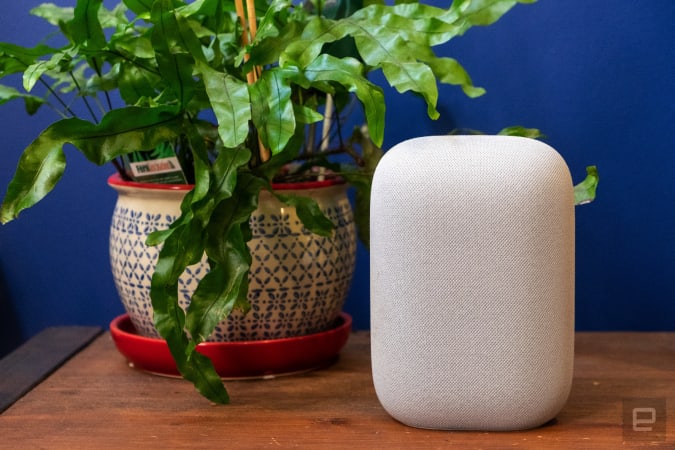
The Nest Audio smart speaker is down to $75, which is $25 off its regular price. While not as good as its Black Friday price, it's still a good discount on one of our favorite smart speakers. It earned a score of 87 from us for its excellent audio quality, stereo mode and minimalist design. You can also pick up the Nest Mini for only $25.
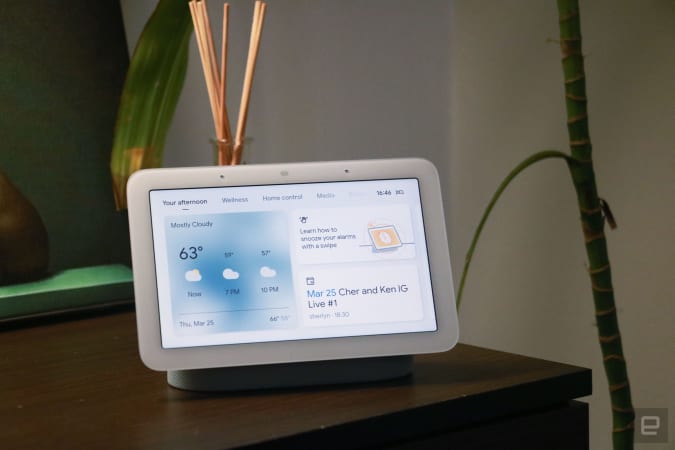
The second-generation Nest Hub has been discounted to $60, or $40 off its normal price. That's also only $10 more than it was during the holiday shopping season. We gave it a score of 89 for its nice 7-inch display, improved performance and audio quality plus its new sleep tracking feature.
Withings' Body+ smart scale is 41 percent off for today only as part of a daily deal on Amazon that includes a number of other similar scales. Withings' gadget connects to WiFi and tracks things like your weight change, body fat and water percentage, muscle and bone mass and more.
Engadget readers can get a total of two free audiobooks when signing up for Libro.fm, the audiobook subscription service that supports local bookstores. Similarly to Audible, a Libro.fm membership costs $15 per month and gives you one audiobook credit per month, plus 30 percent off any audiobooks you buy á la carte.
The second-generation Echo Show 5 is on sale for $45, or 47 percent off its normal price. Not much has changed from the first to the second generation, but that's ok. We gave the latest model a score of 85 for its good sound quality, tap-to-snooze feature and quaint design.
The Wyze Cam v3 with spotlight kit is 32 percent off, knocking it down to $36. This is one of the easiest smart home security cameras to use, and one of the most affordable, and the spotlight kit will make it more useful as an outside cam at night.
HBO Max is having a sale through January 25th that knocks 20 percent off its monthly plans. That means you can get the service with ads for $8 per month or the ad-free tier for $12 per month, with both discounted rates lasting for one year. Current HBO Max subscribers cannot take advantage of the deal, but if you recently cancelled and wanted to come back, you should be able to get the discount.
Ubisoft's The Settlers revival is finally here... almost. The company has revealed that its reboot of the classic build-up real-time strategy game will be available March 17th for Windows PCs through the Epic Games Store and Ubisoft Connect. The developers are also whetting appetites with a five-day, registration-only closed beta starting January 20th that will include two of the game's three factions as well as two multiplayer Skirmish modes (one- and two-player teams).
The rebuilt game is "mostly" derived from The Settlers III and The Settlers IV, and looks decidedly nicer than many RTS titles thanks to the use of the same Snowdrop Engine you find in games like The Division series and the upcoming Avatar release. While it won't compete with the latest first-person shooter in looks, it might be more visually appealing than its competitors. There is a story-driven single-player campaign, but Ubisoft is clearly banking on the eight-way multiplayer to help with longevity.
However well the game plays, Ubisoft's main challenge is simply revitalizing the franchise. There hasn't been a brand-new game in the series since The Settlers Online in 2010, and the decade since has only led to a cancelled game (Kingdoms of Anteria) and four years of development for the imminent reboot. While there will certainly still be fans, it's not clear how many of them were willing to wait a decade for a follow-up.
As if the market for battle royale games wasn’t crowded enough already, you’ll soon have another option in the form of My Hero Academia: Ultra Rumble. Based on the popular manga and anime, Bandai Namco teased the title in a Weekly Shōnen Jump article spotted by Gematsu.
The latest issue of Weekly Jump reveals. Bandai Namco has announced free-to-play battle royale My Hero Academia: Ultra Rumble for PS4, Xbox One, Switch, and PC (Steam)
Ultra Rumble doesn’t have a release date yet, but it will come to Nintendo Switch, PlayStation 4, Xbox One, and PC via Steam. Compared to battle royales like Call of Duty: Warzone and PUBG, Ultra Rumble looks like it will be a more intimate affair with support for up to 24 players in a single match. Bandai Namco plans to hold a closed beta for the game in the future.
It’s hard to judge the potential quality of Ultra Rumble based on a few magazine scans, but as Eurogamer notes, past My Hero Academia haven’t been great despite the popularity of the source material. 2018’s My Hero One’s Justice, for instance, was greeted mostly with middling reviews. Here’s hoping Ultra Rumble breaks that trend.
Nearly four years after Sony released its highly successful A7 III hybrid full-frame mirrorless camera, it finally launched a follow up. The A7 IV brings a raft of new features and improvements like a higher-resolution 33-megapixel sensor, improved video specs and updated AI-powered autofocus. However, at $2,500 it’s also $500 more than the A7 III was at launch.
A lot has changed over the years between the two models. Sony now has to contend with formidable rivals like Canon’s EOS R6 and the Nikon Z6 II. It itself has also released new high-end models like the A7S III, A7R IV and A1 loaded with the latest technology.
With all that, I was of course curious to see how the A7 IV would stack up in a category it dominated for quite a few years. How does it measure up against rivals, particularly when it comes to video? How much new tech from the high-end models has made it to the mainstream A7 IV? And is it suitable for professional use? Let’s dive in and find out.
Design and handling
Sony’s A1, A7S III and A7R IV all had substantial body changes compared to their predecessors, and the A7 IV follows the same script. It has the same nice big grip, so you never feel you’re going to drop it, even with a big lens. However, it has picked up some heft and size, weighing in at 699 grams compared to 650 with the AIII. It’s 7mm thicker, too.
It has similar controls to the A7 III, with the biggest difference being that the record button has moved from the back to an easier-to-access position on top. The buttons and dials also generally feel better and more precise, and the joystick is grippier and easier to use. It lacks certain dials compared to the far more expensive A1, like the shooting mode and autofocus dials. The lockable exposure compensation dial is the same, but lacks the graphics because it’s designed to be programmable.
In one way, however, the A7 IV’s body is a step up from the A1. The rear touch display can fully articulate and not just tilt out, so it’s much more practical for low-angle shooting in portrait orientation. That also makes it far more useful as a vlogging camera.
It has the same well-organized menu system as the A1 and A7S III, though some controls can be a bit tricky to find. As with any other modern camera then, it’s time well spent to set up the function menu, custom menus and manual controls to your liking. Overall, though, Sony’s menus are now among the best, and better organized than on Canon’s EOS R6, for example.
Steve Dent/Engadget
The 3.69-million dot EVF is much clearer than the 2.68-million dot one one on the A7 and on par with similarly priced rivals. However, the rear display is smaller and has lower resolution than the one on the R6. That can make manual focus tricky, though the A7 IV has a new feature that can help there – more on that shortly.
The A7 IV has a dual-slot card system that supports both SD UHS II and much faster CFexpress Type A cards. However, unlike the slots on the A1 and A7S III, it only has a single dual-slot, with the other being SD UHS II only. Type A CFexpress cards aren’t quite as fast as regular CFexpress cards, topping out at 800 MB/s compared to 1,700 MB/s. They're also only used in Sony cameras, so they’re relatively hard to find and quite expensive.
Other features include a USB-C port that can power the camera during operation, along with a full-sized HDMI port, thank God. It uses Sony’s new NP-FZ100 battery that delivers up to 580 shots on a charge, or about 2 hours of 4K video shooting. Finally, the A7 IV can close its mechanical shutter when the camera is turned off, protecting it from dust when you change lenses. That’s a feature that first appeared on the EOS R, so thanks for starting that trend, Canon.
Performance
Steve Dent/Engadget
Sony’s mirrorless cameras are renowned for their autofocus speeds and AI smarts and the A7 IV is no exception. However, Sony made some compromises that affect performance.
The new 33-megapixel sensor is back-side illuminated but not stacked like the sensor on the A1, so readout speeds are relatively slow. As a result, shooting speeds are 10 fps like the A7 III in either mechanical or electronic shutter modes for compressed RAW photos, and drop to 6 fps if you use lossless or uncompressed RAW, as many photographers prefer to do.
That’s still impressive considering the resolution is up nearly 50 percent. By comparison though, the Sony A1 can shoot 50-megapixel photos in electronic mode at up to 30 fps, showing the speed benefits of a stacked sensor.
While burst speeds aren’t improved, you can capture more photos at a time, up to 1,000 in the uncompressed RAW format. If you use CFexpress Type A cards from Sony or ProGrade, you can effectively shoot forever without filling the buffer.
Steve Dent/Engadget
Another drawback with the A7 IV’s slow sensor readout speeds is rolling shutter. If you want to shoot silently in electronic mode, you’ll need to keep the camera steady and your subject can’t move quickly either. Otherwise, you’ll see slanted lines and other artifacts that can be bad enough to ruin shots. Using the crop mode helps a lot, but then you lose the benefits of a full-frame sensor.
The A7 IV is Sony’s most advanced camera yet when it comes to autofocus. All of Sony’s new AI tricks add up to make it the easiest to use and most reliable camera I’ve ever tested in that regard.
Unlike the A7 III, face, eye and body tracking works in all focus modes for animals, birds and people. Unless you turn it off, it’ll automatically pick up your subject’s eyes, face or body and track them even if they turn or disappear from frame.
Whether you’re tracking sports, birds or cars, the tracking spot will stay tenaciously locked to your subject in most situations. All you have to do is touch the subject you want to track and the camera will take it from there.
Steve Dent/Engadget
The A7 IV’s autofocus can easily keep up with the camera’s burst speeds for sports or bird shooting. But more importantly, the A7 IV consistently nails focus in other tricky situations, particularly with people. In some chaotic situations with lots of subjects and complex lighting, I ended up with very few unusable shots. Keep in mind that optimum focus performance requires Sony’s latest lenses, but it worked well with recent Sigma models as well.
Focus is just one part of the equation. It consistently nailed auto-exposure and auto white balance in tricky situations with a mix of lighting. That worked well in a bar with a mix of studio and practical lights, or in front of the famous Paris department store animated windows with all kinds of colors of lights.
In-body stabilization improves a half stop over the A7 III to 5.5 stops with compatible lenses, but neither comes close to Canon’s claimed 8 stops on the EOS R6. That’s somewhat balanced out by Sony’s superior high ISO performance, however. I was still able to get reasonably sharp shots down to a half second with some care.
Photo Quality
A big improvement with the A7 IV is with image quality. You’d expect more sharpness with the extra resolution, and it certainly delivers that. However, you might also think that the smaller pixels would make A7 IV worse in low light, but nope. In fact, through much of its ISO range, the A7 IV performs better even than Sony’s low-light champ, the A7S III.
Images are clean and usable in most low-light situations right up to ISO 12,800, with plenty of detail even in underexposed shots. In fact, the A7 IV has the least noise I’ve ever seen in that ISO range. Correctly exposed photos are usable up to ISO 25,600, but noise becomes a serious issue after that.
Sony has improved its color science with every new camera lately, and the A7 IV has perhaps its best setup yet. The green cast we’ve seen on earlier models is gone and colors are accurate right out of the camera and easier to balance in post than ever before.
JPEGs look great straight out of the camera with a nice balance between detail and noise reduction. The 14-bit RAW images deliver up to 13 stops of dynamic range, giving you plenty of room to lift shadows and claw back highlights. Overall, Sony’s A7 IV delivers perhaps the best images of any of its cameras, with a great balance between detail, high ISO performance and color accuracy.
As a semi-pro hybrid camera, the A7 IV is aimed at enthusiasts but could easily serve as a second body for professional shooters who use Sony gear. To that end, I’ve enlisted the services of Samuel Dejours and Nathanael Charpentiers from Studio Nathsam in Gien, France, who do weddings, births, events and studio work.
How is the handling on the a7 III from a pro standpoint?
Samuel: First of all the handling is a lot better than the A7 III. What I liked a lot, which is a big change for Sony, is the fully articulating display. It’s especially useful in portrait mode when you’re shooting from ground level below the subject.
What are the strong and weak points for events and studio use?
Nat: In terms of the color accuracy, it’s really improved a lot, it’s great now.
Samuel: A big issue for us is that the rolling shutter is pretty pronounced, which is a shame because it limits the use of the camera in silent mode for weddings and events.
Nathanael: And if you use this camera it’s really required for certain things because the mechanical shutter is particularly loud.
Could this serve as a professional camera for you?
Yes, it could serve as a professional camera because it’s really versatile in terms of doing both photos and video. It lacks features available on the A1 and A9, but that’s normal because those cameras are in a completely different price category.
Video
Samuel Dejours
Finally we’re onto video, the one area where rival cameras have moved well beyond the A7 III. Fortunately the A7 IV has big improvements in that area too, along with one drawback.
As before, it can shoot downsampled 4K video at up to 30p using the full width of the sensor, meaning video is extremely sharp. But now, it can capture that video at 4:2:2 10-bit with Sony’s S-Log, so it’s much easier to stretch and pull in post-production.
And now you can shoot 4K at up to 60 fps, also with 10 bits of color depth. While it’s cropped, video is still downsampled from a 4.6K size, so it remains sharp. The A7 IV can’t handle 120 fps 4K like Canon’s EOS R6, but then again it doesn’t have the R6’s serious overheating issues either. If you need that frame rate, it’s only available up to 1080p. HDMI output is limited to 4K 25p at just 8 bits of color depth, unfortunately.
With 13 stops of dynamic range in Sony’s S-Log3 mode, along with 10-bit 4:2:2 color and reasonably high bit rates up to 500 Mbps, image quality is superb and easy to control in post. The lack of noise at high ISO ranges is a huge plus, making the camera usable in a lot of low and tricky lighting situations.
Eye AF and tracking now work in video mode, making it far more dependable for shooting interviews or action. As with photos, it’s extremely intuitive to use. You can tap a subject to track it, and it will automatically switch to eye or face tracking as needed.
There’s a new and cool video feature called lens breathing compensation. Normally, pulling focus from one subject to another causes a slight but distracting zoom – an issue that’s particularly problematic on Sony’s pricey GM lenses, as good as they are. The breathing compensation function introduces a slight digital zoom that counteracts any change in focal length when focusing on a new subject.
Using the feature does cause a slight crop, and it only works with select, mostly expensive, Sony lenses. It’s a really nice feature though, and currently only found on the A7 IV.
Sony has made manual focusing for video easier as well with Manual Focus Assist. It places blue and red colors over objects behind and in front of the focus plane, while objects in focus are clear. Once I got used to it, it was relatively easy to pull focus quickly and in the right direction. The color display is a bit blocky, though, so super precise adjustments can be a challenge.
Image stabilization is very effective for video, particularly with active mode engaged. It works with 4K in both cropped 60p and uncropped 30p modes. However, rolling shutter can be pretty brutal in 30p mode with the full width of the sensor, and stabilization can sometimes make that worse (and unfixable). If you have a wide lens and can stick to the cropped mode with active stabilization, wobble is well controlled and not much worse than with the excellent A1.
Wrap-up
Steve Dent/Engadget
The A7 IV offers big improvements in resolution, AF tracking, video features and more, but forget about the spec sheet for a second. Sony’s largest achievement is that it created a mainstream camera that makes photography and video easier, thanks to AI smarts that can aid any photographer, no matter their skill.
The biggest drawback is rolling shutter that might give you pause if you require a silent mode or want to shoot uncropped 4K video. Another issue is the $2,500 price that’s $500 more than the A7 III was at launch.
Other hybrid cameras in that price range can’t quite measure up, though. Canon’s $2,500 20-megapixel EOS R6 is your best alternative, but the resolution is a big step down. Panasonic’s 24-megapixel S5 and Nikon’s Z6 II are other decent options, but lack the reliability and ease of use of the A7 IV. So once again, Sony rules the mainstream hybrid camera market and will probably do so for a while to come.