The much-delayed remaster of the classic Blade Runner adventure game is finally here. As Polygonreports, Nightdive Studios has released Blade Runner: Enhanced Edition for Windows PCs (via Steam) as well as PlayStation, Switch and Xbox consoles. The modernized version runs at 60 frames per second instead of the original's 15FPS, complete with updated animations and models. Improved in-game tools help you work with clues as you track down hostile replicants, and gamepad support is available on all platforms.
Westwood's 1997 game pushed the boundaries of both gameplay and graphics at the time. Instead of the usual fixed plot, Blade Runner changed the replicant with each playthrough while offering branching storylines, different outcomes and characters that operate on their own timetables. You couldn't just cut to the chase and 'retire' the android at the start. And instead of relying on either 2D art or crude 3D, the title used voxels (pixels with 3D attributes) that allowed far more visual detail for the era, including volumetric lighting that mimicked the Ridley Scott movie's gritty atmosphere.
You'll still notice the limitations from 25 years ago. This won't control as elegantly as present-day games, and Westwood's budget limited it to only some voices from the movie cast (including Sean Young and James Hong) and recreated music from Vangelis' score. Even so, this remains the closest you'll get to filling Deckard's shoes in a game while preserving the 1982 film's atmosphere.
Toyota's US launch of the unpronounceable bZ4X EV is off to a rough start with the automaker announcing on Thursday a broad recall of the vehicle barely two months after its debut, due to a potentially deadly situation that could lead to the vehicle's wheels separating while driving at speed.
Some 2,700 of the electric crossovers are subject to the recall — 2,000 destined for the European market, 260 to the US, 110 to Japan and 20 to Canada. The company implores owners to park their vehicles immediately and not resume driving them until a more "permanent" solution can be devised.
"No one should drive these vehicles until the remedy is performed," Toyota said in the Thursday notice. "After low-mileage use, all of the hub bolts on the wheel can loosen to the point where the wheel can detach from the vehicle. If a wheel detaches from the vehicle while driving, it could result in a loss of vehicle control, increasing the risk of a crash. The cause of the issue and the driving patterns under which this issue could occur are still under investigation."
Subaru has issued a similar recall for about 2,600 Solterra EVs. These EVs are functionally identical to the bZ4X and are produced on the same lines at Toyota's Motomachi facility. There's no word yet on when Toyota engineers might have a solution for the issue.
If you visited arcades in the late ‘80s or early ‘90s, you surely remember the golden age of beat-em-up games. Cabinets like Teenage Mutant Ninja Turtles, The Simpsons, X-Men and more followed a fairly simple formula: take a popular franchise and have its characters cut through swaths of bad guys, throw in some environmental challenges to keep the levels from getting too repetitive, and top it off with a big boss battle at the end. But the real draw was multiplayer — these games let four or even six friends (or strangers) play simultaneously, a totally chaotic but thrilling shared experience.
Given the popularity of the TMNT franchise, it’s no surprise that both the original arcade game and its sequel Teenage Mutant Ninja Turtles: Turtles in Time were both ported to the NES and SNES, respectively. As a pre-teen, my best friend and I spent untold hours playing these ports, as well as the arcade games on the too-rare occasions that we could get to the mall.
I clearly have a lot of nostalgia for these games, and I’m not alone. Last year, developer Tribute Games announced Teenage Mutant Ninja Turtles: Shredder’s Revenge, a brand-new beat-em-up title inspired by the arcade games of yesteryear. The game features retro pixel-art, two different game modes, online and local multiplayer (up to six players online), and seven playable characters, including the four turtles, Master Splinter, April O’Neil and Casey Jones. On the surface, it seems to have everything you could ask for in a modern version of an arcade classic, and Tribute’s comments prior to the game’s release showed a deep love for the source material.
After a week playing Shredder’s Revenge on the Xbox Series S, PlayStation 5 and Nintendo Switch, I can confirm that Tribute absolutely nailed its mission of bringing the classic TMNT experience into the modern era. It all starts with the art style and music, both of which are spot-on for this franchise; it feels like a natural evolution of the original two arcade games, both of which were largely based on the 1987 cartoon (rather than the comic books, live-action films, or more recent animated shows). The music immediately sets the tone – the score by Tee Lopes immediately brings to mind classic 16-bit tunes, Mike Patton performs the opening theme, and Raekwon and Ghostface Killah contribute as well. While the music isn’t quite as compelling as the soundtrack from Turtles in Time (which is an absolute banger), it evokes the essential mood of playing in an arcade with your friends in the early ‘90s.
The gameplay essentials from earlier games are all intact here — each playable character has different strengths and weaknesses like range and speed, but they’re not so different that you’ll feel thrown by switching players. The core gameplay is still mostly accomplished with two buttons: attack and jump.
Tribute
But, there are a lot more moves than in earlier games, including a variety of throws, slides, aerial attacks and dodges. Dashing lets you pull off different slide and charge attacks, you can grab enemies and throw them right towards the TV screen (just like you do in Turtles in Time), there’s a dodge button that lets you dance out of trouble and there are a host of different aerial moves. And unlike older games, Shredder’s Revenge has unique animations for every move each character in the game can pull off. Even though gameplay between each character isn’t radically different, the distinct visuals for all four turtles and their friends keeps things looking fresh.
As with any good beat-‘em-up, each character has their own special move, too. Unlike in old arcade games, where using a special would usually take a chunk out of your health, these moves are tied to a power bar that fills up as you string together longer and longer hit combos. When it’s full, you can unleash a special move or save it for later use. It’s a good way to make it so players can’t just use special attacks constantly and adds a bit of strategy to the otherwise chaotic melee.
Another way Tribute makes Shredder’s Revenge feel more modern is the game’s story mode. You’ll be able to level up your character over time, which unlocks more health, extra lives and new special attacks. You’ll also eventually get the ability to stack multiple special moves — when you fill up your bar and bank one move, you can keep filling it up and hold two and eventually three in reserve — or you can blow all three at once in a frenzied super-attack. Story mode also lets you re-enter levels to find hidden items or meet the achievement goals for each stage (things like take out 10 enemies with a special attack, or make it through without taking damage). And you can switch your character between levels, rather than stay locked to one turtle for the entire game.
Arcade mode, on the other hand, is for old-school fans who want a tougher challenge. The game is simple: pick a character, and fight through all of the game’s dozen-plus levels before you run out of lives and continues. You get the advantage of having your health bar extended to its max capacity and all your special moves are unlocked — but given the number of stages in this game, it won’t be easy, especially on the intense “gnarly” difficulty level.
Tribute
This all makes for a fun single-player experience, but — just like the arcade games from the ‘90s — Shredder’s Revenge really shines in multiplayer mode. You can have up to four player on local co-op, or an insane six-players online. It’s a glorious amount of chaos, but it’s managed surprisingly well. The game scales up in difficulty depending on how many people you’re playing with; that usually just amounts to more enemies and bosses that can take more damage.
Unfortunately, cross-play isn’t supported for now — Xbox and PC players can team up, but PlayStation and Switch players will need to play the same version as their friends if they want to work together. The good news is that it’s also not hard to get a game going with strangers. It’s not quite as much fun as playing with people you know, but the game definitely feels more alive when you have at least a pair taking on Shredder and the Foot clan.
This all adds up to a game that’s a lot more fun to play than even I expected. Nostalgia goes a long way, but Shredder’s Revenge manages to work as a love letter to games of the past while still feeling fresh. There’s just something incredibly satisfying about teaming up with a few friends and mowing down a never-ending swarm of enemies; that was true in the ‘90s, and it’s still true today.
Of course, it helps if you have some affection for the TMNT franchise, but even if you don’t, the tight gameplay, addictive soundtrack and great co-op features should be enough to enjoy Shredder’s Revenge. And if you grew up playing the arcade games or their home console counterparts, this new adventure is a must-play. That’s especially true if you have friends to play it with, either IRL or online.
Microsoft is hoping to make Edge the browser of choice for gamers. The company is rolling out a host of gaming-related updates to most users, including perks for game streaming. A new (if long in development) Clarity Boost feature improves the visual quality of console titles when you're using Xbox Cloud Gaming on a Windows 10 or 11 PC. The spatial upscaling technology won't make you forget that it's a stream, but the sample Microsoft offered suggests it will reduce the muddy look that sometimes plagues remote games.
You won't need an Xbox Game Pass Ultimate subscription for the other improvements. Windows 10 and 11 users will also see a toggle in Efficiency mode that automatically reduces Edge's resource use when you start a PC game. You might not have to close your browser to wring every last drop of performance out of your system.
Regardless of platform, there's an optional gaming-oriented homepage that points you to news, livestreams, new releases and quick access to the Xbox Cloud Gaming catalog. You can also visit a dedicated games menu that offers free-to-play arcade and casual titles to keep you entertained during uneventful meetings.
This isn't the first browser built for gamers. Opera GX launched three years ago with similar features, such as lower resource usage and quick access to livestreams. Microsoft features like Clarity Boost might be more appealing in some cases, though, and Edge's ubiquity on Windows systems gives it better odds of widespread adoption.
The Food and Drug Administration has banned e-cigarette maker Juul from selling and distributing its products in the US. It ordered the company to remove its wares from the market or face enforcement actions.
Reports earlier this week suggested that an FDA ban on Juul products was imminent. After a two-year review, the FDA rejected Juul's application to keep selling tobacco- and menthol-flavored pods as well as its vape pen.
The decision doesn't apply to Juul pens and pods that are already in the possession of the company's customers. However, it'll be difficult, if not impossible, to find those products in the near future.
In 2020, the FDA began a comprehensive review of all e-cigarette products sold in the US. It weighed up the potential benefits of vaping vs. cigarettes for adult smokers against the popularity of e-cigarettes among underage users. The agency has permitted other manufacturers to continue selling vape products, including NJOY and Vuse parent Reynolds American. To date, the agency has authorized 23 "electronic nicotine delivery systems" (to give vape pens their formal name).
In Juul's case, though, the FDA said the company's application "lacked sufficient evidence regarding the toxicological profile of the products to demonstrate that marketing of the products would be appropriate for the protection of the public health. In particular, some of the company’s study findings raised concerns due to insufficient and conflicting data – including regarding genotoxicity and potentially harmful chemicals leaching from the company’s proprietary e-liquid pods – that have not been adequately addressed and precluded the FDA from completing a full toxicological risk assessment of the products named in the company’s applications."
The agency went on to say that it doesn't have clinical information that suggests there is "an immediate hazard" linked to Juul's pen or pods. "However, the [marketing denial orders] issued today reflect FDA’s determination that there is insufficient evidence to assess the potential toxicological risks of using the Juul products," the FDA said. It noted that it's not possible to grasp the possible harms of using other pods in a Juul vape pen or the company's pods in third-party devices.
“The FDA is tasked with ensuring that tobacco products sold in this country meet the standard set by the law, but the responsibility to demonstrate that a product meets those standards ultimately falls on the shoulders of the company,” said Michele Mital, acting director of the FDA’s Center for Tobacco Products. “As with all manufacturers, Juul had the opportunity to provide evidence demonstrating that the marketing of their products meets these standards. However, the company did not provide that evidence and instead left us with significant questions. Without the data needed to determine relevant health risks, the FDA is issuing these marketing denial orders.”
Juul can appeal the decision or challenge it in court. Engadget has contacted the company for comment.
The company became the leader in the US e-cigarette market in 2018. However, sales have dropped following a string of controversies. Juul slipped to second place behind Vuse in terms of US market share. The vast majority of the company's revenue comes from the US, The Wall Street Journal noted this week.
Juul had been accused by federal agencies, state attorneys general and other officials of marketing its products to teens. The company agreed to pay eight-figure settlements related to lawsuits in North Carolina and Washington state, and faced suits in several other states.
The company halted sales of mint- and fruit-flavored vape pods in 2019 before the FDA banned most flavored variants in early 2020. According to the Centers for Disease Control and Prevention, nearly 85 percent of young people who had used e-cigarettes said they used flavored varieties. However, vaping has become less popular among teens overall. In 2019, Juul revealed a new, connected version of its vape pen that can verify a user's identity in an attempt to prevent underage use.
No Man's Sky will make its long-awaited arrival on Nintendo Switch on October 7th. The Switch version was previously announced for this summer, so that marks a delay of at least a couple of weeks.
The sandbox survival title landed on PC and PlayStation 4 in 2016 and Xbox One two years later, so its Switch debut has been a long time coming. From the jump, Switch players will have access to all of the features and upgrades Hello Games has brought to No Man's Sky since its rocky launch. The game's in a much healthier place than it was at the outset.
Some players might have reservations about how well No Man's Sky will run on the Switch's aging hardware. Hello Games tried to placate concerns with a video that shows the game running fairly well on the console, though it remains to be seen what Switch performance will actually be like.
There will be physical and digital editions of No Man's Sky available for Switch on October 7th. On the same day, fans will be able to purchase a physical version for PS5 for the first time. No Man's Sky is also slated to arrive on Mac and iPad later this year.
TikTok users now have another way to catch up on their For You page. The app is available on Vizio smart TVs starting today and you'll be able to watch TikTok TV content directly from the home screen.
The app, which landed on smart TVs from the likes of Samsung and LG last November, reworks the TikTok experience for big-screen viewing. TikTok TV features popular videos from categories including gaming, comedy, food and animals. If you have a TikTok account, you can log in to view videos from your Following and For You feeds. The app has an autoplay feature as well, so you'll be able to watch an endless string of TikToks without interruption if you wish.
The Food and Drug Administration could be set to bring the hammer down on vape pen maker Juul. The agency is preparing to order it to stop selling e-cigarettes in the US and the decision could come as soon as today, according to The Wall Street Journal.
Along with other e-cigarette makers, Juul was required to submit its products to the FDA for review in 2020. The agency has been looking into the possible benefits of vaping as an alternative to cigarettes, but the popularity of the products among young people has caused concern. The FDA has already cleared products from Juul's rivals, Reynolds American (which is behind the Vuse brand) and NJOY.
The FDA has been scrutinizing Juul for several years. It seized marketing materials from the company for review in 2018 over concerns about underage vaping. In 2019, the FDA criticized the company for telling students its products were "totally safe" after it accused Juul of undermining efforts to clamp down on teen vaping.
The agency limited sales of flavored e-cigarettes in 2018 and banned several variants outright in early 2020 in an attempt to reduce the appeal of vaping among teens. Juul pre-empted that ban (perhaps in an attempt to get in the good graces of regulators and the public) when it stopped sales of mint- and fruit-flavored vape pods in 2019.
Several states have sued Juul, alleging that it targeted minors with marketing. It paid $40 million to settle a North Carolina suit in 2021, and a $22.5 million settlement in Washington state earlier this year. The Federal Trade Commission has also reportedly looked into Juul's marketing tactics.
Juul will have the option of appealing a federal ban on sales of its products, if the FDA does take that step, or challenging it in court. Some observers have suggested that the company may ask for a stay while the agency reviews a version of the vape pen that has age verification tech. Engadget has contacted Juul for comment.
A blanket ban would likely prove devastating for Juul's business. The WSJnotes that the vast majority of the company's revenue comes from the US. Juul became the top e-cigarette brand in the country a few years ago, but sales have dropped and it's now said to be in second place in the US market behind Vuse.
Meanwhile, the FDA is aiming to remove nearly all nicotine from cigarettes to make them less addictive. That could lead to millions of smokers switching to vaping or giving up smoking entirely.
A group of companies, including some of the biggest names in tech and the internet, have banded together to develop interoperability standards needed to achieve an open metaverse. The organization is called Metaverse Standards Forum, and its founding members include Meta, Microsoft, Huawei, NVIDIA, Qualcomm, Sony Interactive Entertainment, Epic Games, Unity and Adobe. As Reuters notes, one company that's conspicuously missing from the list is Apple. Multiple reports have come come out these past few years that Apple is releasing its own virtual or augmented reality headset, and it's expected to become a major player in the metaverse when the device becomes available.
Yet another big name that's missing from the list is Google, which is also reportedly working on an AR headset codenamed Project Iris. Niantic, the developer of Pokémon Go, and Roblox aren't in the list of members, as well. That said, membership is free and open to any organization, so more companies could join later on. As with any standard, one for the metaverse would only be considered a success if companies, especially the biggest players in the industry, adopt them. "Multiple industry leaders have stated that the potential of the metaverse will be best realized if it is built on a foundation of open standards," the forum wrote in its press release.
The group also said that it will focus on "pragmatic, action-based projects." Those include conducting hackathons and working on open-source tools designed to accelerate the testing and adoption of metaverse standards. And while companies can join anytime, members are expected to start forum meetings this July.
Smart displays have evolved quite a bit since the initial debut of Amazon’s first Echo Show back in 2017. In fact, the category didn’t really come into its own until Google joined the fray with its own line of hardware about a year later. Now, both of these companies are essentially dominating the smart display landscape, with each offering their own take on a smart assistant with a screen.
It’s that screen that makes smart displays so much more useful than smart speakers. Rather than just having a voice recite the current weather report, for example, you can see a five-day forecast as well. The same goes for when you ask about your shopping list or calendar; it's simply easier to see the whole list or your day's appointments at a glance.
Plus, displays offer other benefits that speakers can't, like watching videos or checking your webcam to see who's at your front door. They're especially handy in the kitchen, where you can use them for step-by-step cooking instructions. And, thanks to touchscreens, you can often navigate through functions and settings a lot faster than using your voice.
Amazon vs. Google
The first question you should ask is whether you'd rather be in Amazon's ecosystem or Google's. If you have a lot of Google products in your home, like Nest thermostats or Nest cams, then a Google-powered model makes more sense. If you have Amazon products, like a Fire TV Stick or a Ring cam, Amazon would obviously be a better choice. Of course, it's perfectly acceptable to have products from competing companies in the same home, but just realize they might not work seamlessly with each other.
Aside from that, the two systems also offer some unique features. Google, for example, works best if you have an existing Google account and use services like Calendar and Photos. In fact, we especially love Google smart displays because they work well as digital photo frames. You can set it up to automatically pull in pictures of friends and family from your Google Photos library, and the algorithm is smart enough to use what it thinks are the best shots — so less chance of blurry photos or images of your eyes half-closed showing up, for example.
It might seem like a minor point, but seeing as the display is on standby 90 percent of the time, its secondary function as a digital photo frame is very welcome. All Google smart displays also support YouTube and YouTube TV, step-by-step cooking instructions and all of the usual benefits of Google Assistant, like weather reports. As with Assistant on the phone, it also has voice recognition, so only you can see your calendar appointments and not others.
Amazon's smart displays, on the other hand, are slightly different. Instead of YouTube, they offer some alternative video streaming options, including Amazon Prime, NBC and Hulu. They also come with two browsers (Silk and Firefox), which you can use to search the web or watch YouTube videos – a handy enough workaround given the lack of a dedicated app.
Amazon devices offer step-by-step cooking instructions as well, thanks to collaborations with sources like SideChef and AllRecipes. In fact, the cooking instructions sometimes include short video clips. But although you can use Amazon's displays as digital photo frames, the process is not quite as intuitive as Google’s, and Amazon doesn’t have anything comparable to Google’s photo-sorting algorithm.
The best smart displays
Smart displays come in all sorts of shapes and sizes, and some are better suited to certain rooms in the home than others. So while we do have some favorite all-around picks, we've also compiled a list of smart displays that would suit specific use cases as well.
The best Google smart display: Google Nest Hub
We at Engadget tend to prefer Google smart displays because most people are likely already entrenched in the Google ecosystem due to the ubiquity of Google services like Gmail, Calendar and so forth. We also tend to find Google Assistant to be a little smarter than Alexa, especially when bringing up answers from the web. As mentioned earlier, we also really like the tie-in with Google Photos and the smart photo-sorting algorithm.
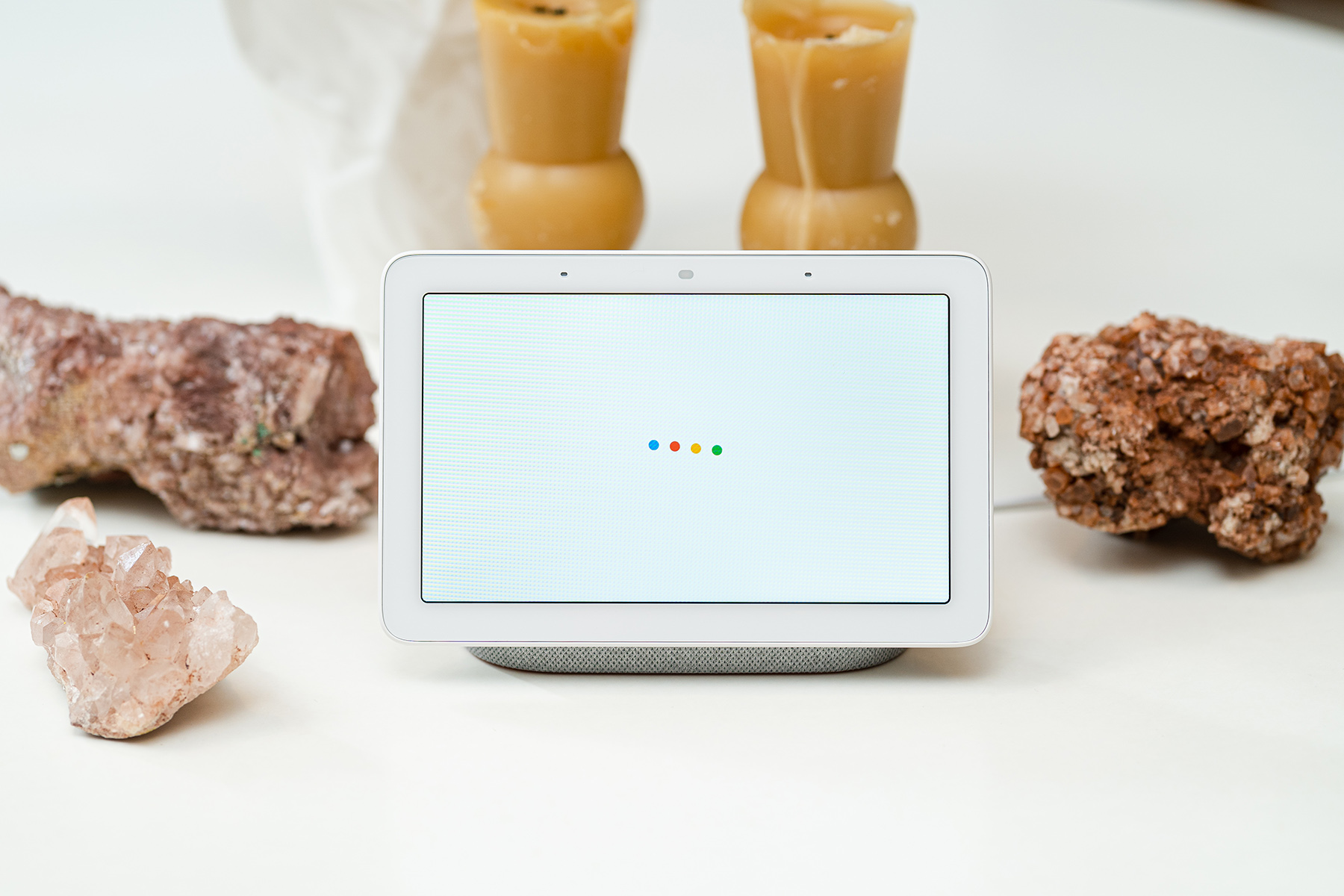
Our favorite smart display overall is Google's latest Nest Hub. Its 7-inch size is a better fit in more rooms, and its unobtrusive design combined with its soft fabric exterior blends nicely into your existing home decor. It does everything we think most people would want in a smart display, like YouTube videos, step-by-step cooking instructions, smart home controls and the ability to check in on your Nest cams if you have any.
In fact, the Nest Hub is especially useful if you have a Nest video doorbell, as the camera view of who’s at the front door will show up on the screen. An ambient light sensor helps to detect the light and color temperature of the environment and adjusts the screen to match. Plus, if you choose, it can help track your sleep patterns if placed next to your bed.
Another feature of the Nest Hub is actually a lack of one: It doesn't have a camera. That gives it that additional layer of privacy that many people covet, and it's also a lot more suitable for personal spaces like the bedroom. Sure, you could also cover up a camera with a shutter, but with the Nest Hub you don't have to remember to do that.
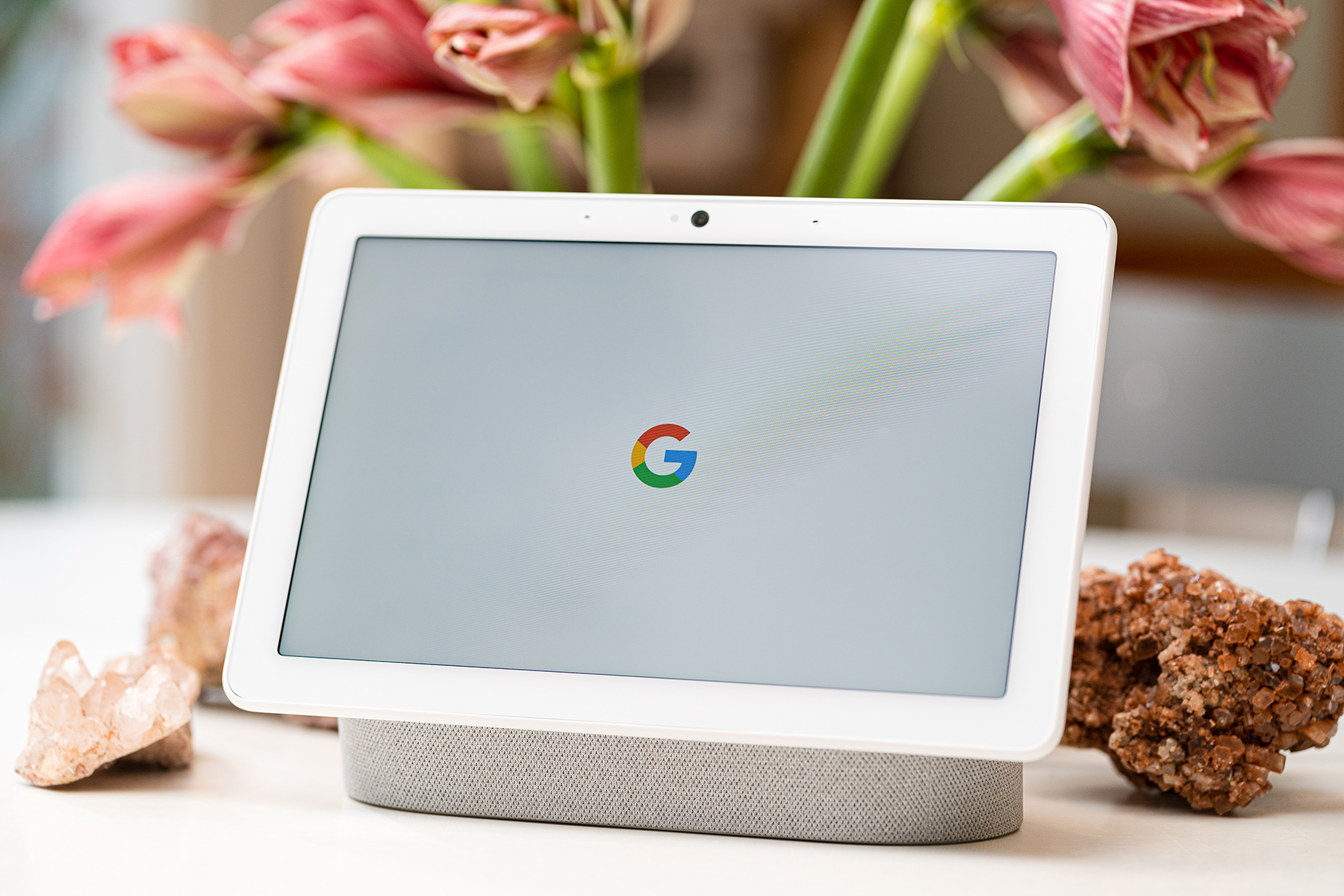
If you like Google but you miss having a camera for video calls, or you just prefer a bigger screen, consider the Google Nest Hub Max. At 10 inches instead of seven, it works a lot better for watching videos from YouTube and YouTube TV. It's especially useful in the kitchen, where it functions as a kind of portable television, and you can see more of those step-by-step cooking instructions at a glance. The bigger display also means a larger photo frame, which you may prefer.
As mentioned, the Nest Hub Max adds a camera to the mix. It doesn't have a physical shutter, which is a concern, but you can shut it off with an electronic switch. You can use the camera for video calls with Google's Duo service as well as Zoom, and it can also function as a Nest Cam to help you keep an eye on your house when you're away. Another benefit of the camera is the addition of Face Match facial recognition for authentication purposes, which we found to be a little more accurate than just using Voice Match.
Last but not least, the Nest Hub Max's camera adds a unique gestures feature that lets you play and pause media simply by holding up your hand to the screen. It's not entirely necessary, but it's potentially useful if you're in a noisy environment and just want the music to stop without having to shout over everyone. Or perhaps you have messy hands while cooking and don’t want to dirty up the display.
Our favorite Amazon smart display is the second-gen Echo Show 8. Its 8-inch screen is just right; it doesn’t take up as much space as the Echo Show 10, but it’s also more suitable for watching videos than the tiny Echo Show 5. Like other Amazon smart displays, it has a built-in camera, but there is a physical camera cover to help alleviate privacy concerns.
As such, the Echo Show 8 is a compelling choice if you want the option of using your smart display for video calls. Not only is the camera quality fantastic, but the Show 8 has a feature that automatically frames your face and follows your movements during video calls. It’s useful if you want to move around as you’re chatting, or if you have rambunctious children and pets running around the house and you want to involve them in the conversation. You can use the Echo Show 8 to make calls between other Echo Show displays, or through Skype or Zoom.
As with the other smart displays, the Echo Show 8 also works as a digital photo frame and can be used to keep up with the news, check the weather and control smart home devices. If you want to use your smart display to play music, we also really like the Echo Show 8’s audio quality on account of its deep bass and rich tone.
At only 5.5 inches wide, the Echo Show 5 is one of the smallest smart displays on the market, and as a result, will work nicely on a desk or a nightstand. In fact, one of the reasons we like the Echo Show 5 so much is that it doubles as a stellar smart alarm clock. It has an ambient light sensor that adjusts the screen's brightness automatically; a tap-to-snooze function so you can whack the top of it for a few extra minutes of shut-eye; plus a sunrise alarm that slowly brightens the screen to wake you up gently.
The Echo Show 5 does have a camera, which might make you a touch queasy if you are privacy conscious – especially if this is supposed to sit by your bedside. Still, it does have a physical camera cover, which can help ease any fears.
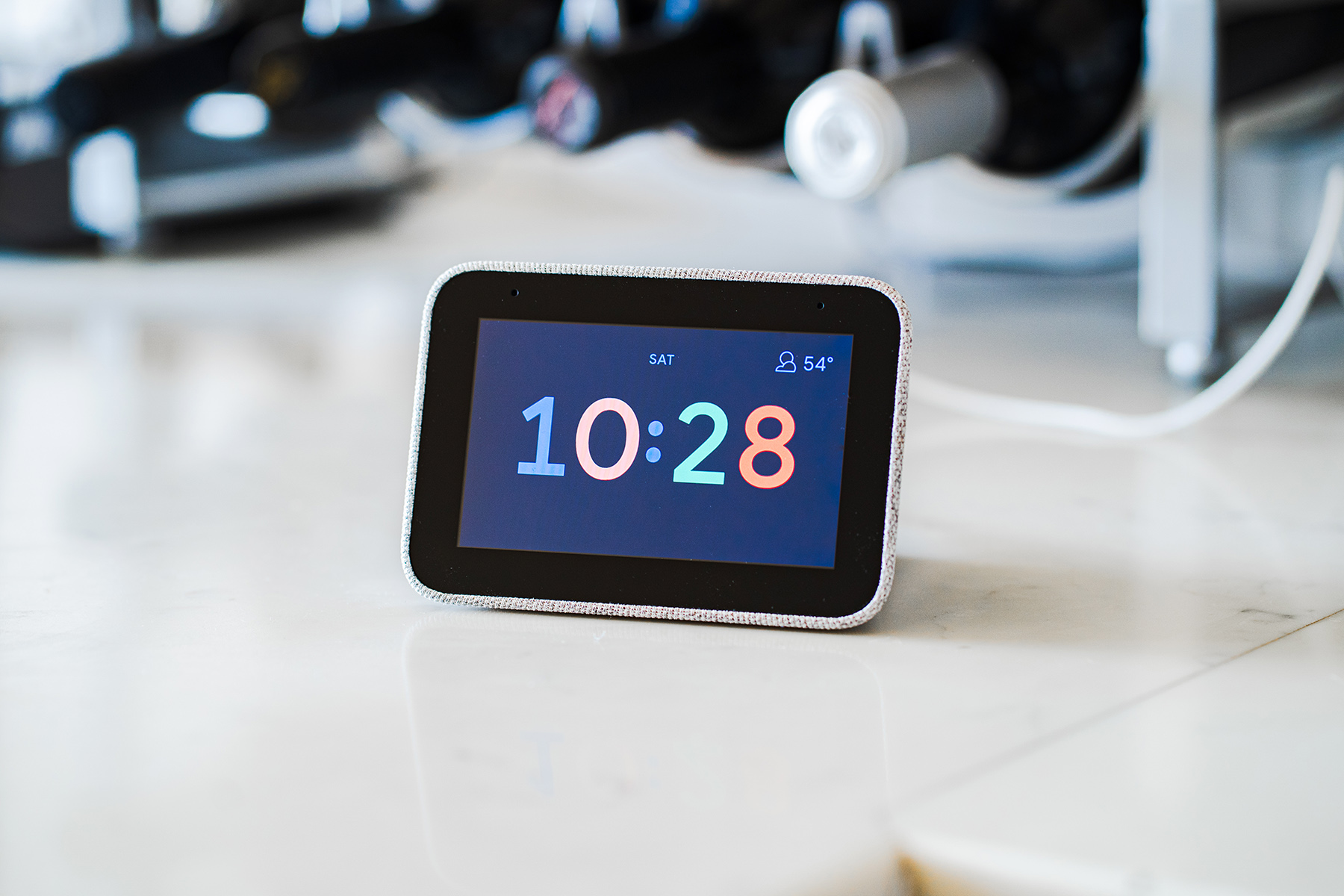
Perhaps a smart display doesn't appeal to you because you don't care about watching videos on it. But maybe the idea of a smarter alarm clock like the Echo Show 5 intrigues you. In that case, I’d recommend the 4-inch Lenovo Smart Clock 2, which isn't a full-fledged smart display because you can't play any videos on it, but it does use Google's smart display tech, so you can use it for controlling your smart home as well as checking out your Nest Cams.
We also like it because it lacks a camera, which makes it perfect for your nightstand. It has all of the features we want in a smart alarm clock, like an ambient light sensor, that tap-to-snooze function and a sunrise alarm. Plus, the latest version can double as a night light – you can swipe down the display to enable it – and you can get an optional wireless charging base to go with it.
If the Smart Clock 2 is too advanced for you, Lenovo does offer an even simpler version called the Smart Clock Essential. It really isn’t a smart display at all – it’s really more of a smart speaker with a clock – but it does perform many of the same functions as the Smart Clock 2.
Lenovo sells the Smart Clock Essential in two different versions: One has Google Assistant, while the other is powered by Alexa. The one with Google Assistant has a built-in night light, an extra USB port for charging devices and a mic-mute button. The one with Alexa, on the other hand, is compatible with an optional docking station that can be used with accessories such as a wireless charging pad or an ambient light dock (it comes in either a sea lion or a squid shape) that can act as a night light.