Don't panic that you might miss out on tonight's potentially legendary match-up between the Yankees and Red Sox just because it's on Apple TV+ — there's a good chance you can tune in for free. Apple is streaming the game at no charge as part of its weekly Friday Night Baseball feature, with coverage starting at 6:25PM Eastern and the action starting in earnest at 7PM. It'll require a little bit of work and a compatible device, but you too can see if Aaron Judge will break Roger Maris' American League home run record. Here's how to watch.
You'll need to either sign into or create a free Apple ID account at the Apple TV+ website or a supporting app. You may be prompted to add a credit card, but Apple won't charge you for this or any Friday Night Baseball game. The service is available on the web for Android- and computer-based viewers. iPhone, iPad and Mac users can also try the native app.
You also have many choices for watching in the living room. On top of Apple TV boxes, you can also tune into the Yankees-Red Sox game using the app for recent smart TVs from Samsung, LG, Sony, HiSense, Panasonic and Vizio. PS4, PS5, Xbox One and Xbox Series X/S owners can also watch, as can people with Fire TV, Google TV and Roku media players. Receivers for Comcast's Xfinity and T-Mobile's Magenta TV similarly offer Apple TV+ apps.
Millions of New Yorkers paid their cable bills expecting to see live sports programming. Denying them the chance to watch Aaron Judge step up to the plate to make history tonight is wrong and unfair.
The free viewing might just head off some controversy. New York State Attorney General Letitia James has been worried enough about the TV+ exclusive to issue a statement asking Apple and the MLB to make the game available on the Yankees-oriented YES Network, calling the deal "wrong and unfair." However, James incorrectly claimed people need to "pay extra" to watch — if you're reading her press release or tweet (i.e. you have internet access), you can stream the potentially history-making showdown at no charge. The exclusive is only really a problem if all your devices are too old to use either the app or the web client.
DJI has launched the Osmo Mobile 6 gimbal, and it comes with a larger clamp than its predecessors to accommodate bigger phones or smaller ones with bulky cases. It has a new handle handle designed to be more comfortable to hold, but it kept the Osmo Mobile 5's built-in extension rod that lets you use it as a selfie stick. The Osmo 6 also features an improved version of DJI's ActiveTrack, which allows stable tracking for longer distances and enables the phone's front camera to track subjects that spin or turn to the side.
Another new feature is Quick Launch for the iPhone. So long as it's an iPhone that's attached to the stabilizer, the Mimo app instantly enters camera view when the gimbal is unfolded. DJI says it could dramatically reduce prep times and can get the phone ready to take photos three times faster than previous Osmo Mobile models can.
DJI
The new gimbal has a built-in status panel that lets you quickly check battery levels, as well as a Mode button that gives you a way to cycle between modes with every tap. When in Follow mode, the camera view stays locked in during rolls but follows the gimbal's pan and tilt movements. Tilt Lock enables the camera view to follow the gimbal's pan movements but stays stable during tit and rolls. The camera view follows all the gimbal's movements in FPV mode for a more dynamic footage, while SpinShot lets you control the camera view by moving the joystick left or right.
Just like its predecessor, the Osmo Mobile 6 also has a number of intelligent features, namely timelapse, gesture control, automatic dynamic zoom, panorama and story mode. Finally, the gimbal comes with a Side Wheel that lets you control and adjust the focal length and zoom in or out. The DJI Osmo Mobile 6 will be available starting today from the company's online store for €169/£145 (US$166) and will make its way to more retailers in the future. It will ship with a magnetic clamp, tripod, power cable, wrist strap and storage pouch.
NVIDIA's GeForce RTX 40 series GPUs won't just rely on brute force to deliver high-performance visuals. The company has unveiled Deep Learning Super Sampling 3 (aka DLSS 3), a new version of its AI-based rendering accelerator. Rather than generating 'only' pixels, the third-gen technology can create entire new frames independently. It's a bit like the frame interpolation you see (and sometimes despise) with TVs, although this is clearly more sophisticated — NVIDIA is improving performance, not just smoothing out video.
The technique relies on both fourth-gen Tensor Cores and an "Optical Flow Accelerator" that predicts movement in a scene by comparing two high-resolution frames and generating intermediate frames. As it doesn't involve a computer's main processor, the approach is particularly helpful for Microsoft Flight Simulator and other games that are typically CPU-limited. A new detail setting in Cyberpunk 2077 runs at 62FPS in 4K resolution using DLSS2 in NVIDIA's tests, but jumps beyond 100FPS with DLSS 3.
Roughly 35 apps and games will offer DLSS 3 support early on. This includes Portal RTX, older titles like The Witcher 3: Wild Hunt and releases based on Unreal Engine 4 and 5.
It's too soon to say how well DLSS 3 works in practice. NVIDIA is choosing games that make the most of DLSS, and the technology might not help as much with less constrained titles. Nonetheless, this might be useful for ensuring that more of your games are consistently smooth. Provided, of course, that you're willing to spend the $899-plus GPU makers are currently asking for RTX 40-based video cards.
One good thing that came out of the pandemic is that more people picked up cycling. In the first three months of 2021, American consumer spending on bikes and cycling accessories increased by 34 percent year on year to $8.2 billion. However, the pandemic also saw more die and suffer injuries while biking. According to the National Safety Council, 1,260 cyclists were killed in 2020, a 16 percent increase from 2019.
It’s a problem that Ford thinks technology can address. On Monday, the automaker announced it’s working with Commsignia, PSS, Ohio State University, T-Mobile and Tome Software to explore how a smartphone app could warn drivers of pedestrians and cyclists they may not see. As someone sharing the road with a car, you would install the company's software on your phone. With the help of Bluetooth Low Energy, vehicles with Ford’s Sync infotainment system would see you as “beacons.” If the car then determines there’s the potential for a crash, it will warn the driver using audiovisual cues.
According to Ford, its approach has a few advantages. One is that Bluetooth LE is nearly ubiquitous. The technology has been part of the Bluetooth protocol since 2009, meaning every modern smartphone has access to it. If you own a Ford vehicle, you won’t need to bring your car to a dealership for a hardware upgrade since the Sync system features Bluetooth compatibility. The other advantage of using Bluetooth LE is that your car won’t need to see pedestrians and cyclists before it can warn you. Ford and T-Mobile are also working on a version of the app that uses 5G instead of Bluetooth LE.
In practice, the company’s approach is reminiscent of the COVID exposure notification apps some countries and states deployed at the beginning of the pandemic. As you may recall, those also used Bluetooth LE. However, despite backing from Apple and Google, they were never effective due to low usage. In Canada, for instance, the federal COVID Alert app was only downloaded 6.9 million times and logged 63,117 positive tests. Put another way, nowhere near enough Canadians downloaded the software to make it an effective contact tracing tool. Ford's app is likely to experience some of the same issues.
As an avid cyclist, I can’t tell you how many people I’ve seen riding their bikes at night without an LED light to make themselves visible to traffic. On the other hand, statistics suggest motorists have been driving more aggressively in recent years, leading to the aforementioned increase in cyclist deaths as well as vehicle crashes. Any kind of intervention would be welcome, but Ford's app isn't likely to be a meaningful solution if it ever comes to market. While the Bluetooth LE solution to COVID had only one uphill climb, apps like Ford's have two: adoption by cyclists and adoption by automakers.
Kiwi Farms, a forum that's long been accused of fostering targeted online and real-world harassment campaigns, says that someone hacked its proxy service and website. As noted by cybersecurity researcher Kevin Beaumont, it told users in a Telegram message that all avatars had been changed to the logo of another website (said to be another purported "free speech" forum) and that "each node on the forum index was deleted one at a time."
While Kiwi Farms apparently has backups and none of the forum data has been permanently deleted, users' personal information may have been compromised. Founder Joshua Moon told users to assume that their email and password information has been obtained, as well as the IP address of any device they've used to access Kiwi Farms in the last month.
Kiwi Farms’ proxy service and Kiwi Farms itself has been hacked.
My guess would be users might want to change their passwords and consider DMs etc may be compromised. pic.twitter.com/NU6EJPKFou
"I do not know for sure if any user information was leaked. In my access logs, they attempted to download all user records at once," Moon wrote in a statement on the Kiwi Farms website. "This caused an error and no output was returned. I shut everything off soon after. If they scraped information through some other mechanism, I cannot say with any confidence either way."
The hacker is said to have used an injected script to gather data from users' systems. Moon said they accessed his admin account as a result of this method. Moon added that he would restore the site from a backup, but noted that the process (as well as reviewing Kiwi Farms' security procedures) would take some time. However, he noted on Telegram today that he had to leave for a week to deal with a family emergency.
Earlier this month, Kiwi Farms was effectively forced off of the open web following an effort to take down the forum. Streamer and political commentator Clara “Keffals” Sorrenti, a prominent target of a harassment campaign that allegedly stemmed from the website, started the movement to bring down Kiwi Farms. While Moon was later able to bring the forum back online through other means.
Cloudflare, a DDoS protection company, kicked Kiwi Farms off its service due to a significant increase in targeted threats originating on the site. That seems to have played a role in this weekend's hack. "Cloudflare not only provided DDoS protection, they also accounted for many popular exploits like this," Moon wrote.
After the launch of the ROG Phone 6 Pro gaming phone, some hardcore fans were left wondering what happened to the "Ultimate" variant. As it turns out, ASUS waited for over two months before unveiling its "one more thing": the ROG Phone 6D Ultimate. It's identical to the 6 Pro in almost every way, except for four things: the new "space gray" color, the interesting choice of the MediaTek Dimensity 9000+ processor (which is what the "D" in "6D" stands for), the switch to the faster LPDDR5X RAM, and the new "AeroActive Portal" design for blowing cool air into its internal heat-dissipation fins — I'll abbreviate this as heatsink from here onwards.
The AeroActive Portal itself is essentially a door flap that opens when the bundled AeroActive Cooler 6 is attached, so that a portion of the cool wind produced by the fan — at nearly 1,000cc per second — is guided through a wind tunnel and into the heatsink, with hot air coming out from the top slot. The heatsink is, of course, linked to the generously sized thermal layers covering the logic board and battery cells, in order to transfer heat from the components to the airflow. This is to help sustain a high frame rate over a longer period while gaming, as well as to ensure the phone is still comfortable to hold.
Richard Lai/Engadget
ASUS claimed that after 60 minutes of Perfdog benchmarking on Genshin Impact at 60Hz in air cooling mode, the ROG Phone 6D reached 36.9°C (98.42°F), which was 3.4°C lower than the ROG Phone 6 in the same mode. It appears that the AeroActive Portal does make a notable difference. Likewise in "Frosty" and "Frozen" modes (with the Peltier thermoelectric cooling chip enabled), and it's worth noting that the AeroActive Cooler 6 is the only Peltier-enabled cooler in the market that doesn't require additional power externally — it only needs that for the more powerful "Frozen" mode.
While the AeroActive Portal only kicks in when an AeroActive Cooler 6 is attached, you can open it temporarily in settings for cleaning purposes. The flap is otherwise shut tight to safeguard the phone's IPX4 splash resistance. It also has fall detection for automatically retracting the flap, and the stepping motor along with the zirconium alloy hinge are apparently good for over 40,000 flips — both of which are based on the learnings from the now-retired Flip Camera feature from the Zenfone series.
ASUS
The 6D Ultimate packs the same set of key features as the 6 Pro: 165Hz 6.78-inch AMOLED display, 720Hz touch sampling rate, up to 512GB of storage, 6,000mAh battery, 65W fast charging (42 minutes), Dirac-tuned front-facing stereo speakers, ultrasonic "AirTiggers" and a customizable "ROG Vision" color display on the back. It's also the same set of cameras: a 50-megapixel main camera with Sony's IMX766 sensor, a 13-megapixel ultra-wide camera plus a 5-megapixel macro camera; and on the front, there's a 12-megapixel selfie camera with a Sony IMX663 sensor.
For the processor, ASUS made the surprise switch to MediaTek for its Dimensity 9000+ processor, which apparently scores a tad higher than the ROG Phone 6's Qualcomm Snapdragon 8+ Gen 1. The company added that while the Snapdragon flagship chipset packs a better GPU, the Dimensity's CPU is allegedly 10 percent more powerful (albeit with the same 3.2GHz maximum clock speed), and this is more crucial to most mobile games. The CPU is complemented by the faster LPDDR5X RAM as well, though this is the same reason as to why this is capped at 16GB instead of 18GB here.
ASUS
The ROG Phone 6D Ultimate will be available across Europe very soon, with the sole model (16GB RAM with 512GB storage) priced at €1,399 (around $1,400) or £1,199. Again, this premium model comes bundled with an AeroActive Cooler 6. There's also the ROG Phone 6D launching alongside, which is basically the ROG Phone 6 but packing MediaTek's chipset and LPDDR5X RAM instead (also, it's just an RGB logo instead of an ROG Vision screen on the back; and no AeroActive Portal, of course). This starts from €949 (around $950) or £799 with the 12GB RAM plus 256GB storage base model.
With PS VR2 set to arrive early next year, Sony is starting to accelerate the hype train for its next-gen virtual reality headset. The hardware made its public debut at the Tokyo Game Show this week (early impressions are largelypositive) and the company revealed some more titles that are coming to the platform during Tuesday’s State of Play. Some other important information just emerged, albeit on the negative side: PS VR games will not work on PS VR2.
“PS VR games are not compatible with PS VR2 because PS VR2 is designed to deliver a truly next-generation VR experience," PlayStation senior vice-president of platform experience Hideaki Nishino said on the latest episode of the Official PlayStation Podcast (as spotted by Nibellion). “PS VR2 has much more advanced features, like [an] all-new controller with haptic feedback and adaptive triggers, inside-out tracking, eye tracking… Video and audio are coming together and 4K HDR, of course. This means developing games for PS VR2 requires a whole different approach than the original PS VR.”
Confirmed on Sony's Official PlayStation Podcast: PSVR games are not compatible with PSVR2
Some games that do work on PS VR have been confirmed for PS VR2 (such as No Man's Sky), but this is still disappointing news. It means players will not be able to access PS VR games from the new headset, so if they want to be able to dip back into older games from time to time, they'll need to keep the old hardware around.
It seems that newcomers to PlayStation VR will also not be able to check out games they might have heard good things about, such as Astro Bot Rescue Mission or Moss, unless the developers port their games to PS VR2. A more limited library of games may make the new headset a less appealing purchase.
The decision could have something to do with the fact that the PS VR2 uses different tracking methods. The controllers are completely different. PS VR uses the PlayStation Camera and light-based tracking, while Sony tracks the position of the new Sense controllers using infrared LED. Still, those hoping to bring (almost) their entire PS4-era collection of PlayStation games over to the current generation when PS VR2 arrives may feel discouraged.
Genshin Impactis one of the biggest gaming success stories of the last few years. Fans will have another way to enjoy the world of Teyvat at some point, as developer miHoYo has teamed up with animation studio Ufotable to create an anime based on the free-to-play action RPG.
Ufotable has worked on several other game-related projects. God Eater and Tales of Zestiria the X are both based on Bandai Namco properties, for instance. A concept trailer (which was spotted by IGN) offers a peek at the art style Ufotable will employ this time around. As you might expect, the studio doesn't seem to veer too far away from the look of the game.
If anything, it's a little surprising that it took this long for an official Genshin Impact anime announcement. The developers took inspiration from anime in the first place and the game has long seemed primed for an adaptation.
Several other notable games have been turned into animated series in recent years. Cyberpunk 2077spinoff Cyberpunk: Edgerunners hit Netflix just this week, while Arcane (which is based on League of Legends), became the first animated streaming series to win an Emmy earlier this month.
It's not clear when or where fans will be able to watch the Genshin Impact anime. However, given that the trailer is only showing off the concept and it refers to the Ufotable collaboration as a long-term project, it might be quite a while before the first season debuts.
The Genshin Impact anime reveal came as miHoYo offered a look at version 3.1 of the game, which will arrive on September 28th. The update will expand the new region of Sumeru and help to continue the game's core story. It will introduce King Deshret’s Mausoleum, dungeons, new Archon Quests, more weapons, three playable characters, two fresh bosses and more. Meanwhile, miHoYo will add a permanent card game mode in version 3.3.
Once upon a time, desktop computer speakers actually mattered. That was more than a decade ago, long before gaming headsets filled the land and wireless Bluetooth headphones were any good. In the early 2000's, more people also had actual desktops computers chained to desks, so it was worth investing a bit in decent audio. SteelSeries' new Arena 9 surround sound PC speakers reminds me of that era, a time when I eagerly strung cables throughout my dorm room to connect Logitech's legendary Z-680 surround sound speakers. (Apologies for anyone who lived near me. I tried to keep things civil, I swear!)
Luckily, it's not as tough to go surround sound today – though it will still cost you a ton. The $550 Arena 9 connect over USB, so you don't have to worry about a specialized sound card, and they feature wireless rear satellites, which only need to be connected to power and each other. There's no need to string anything to the front speakers. That solves a huge pain point, and it makes the Arena 9 a far more viable option for the cable-averse. But is setting up a surround sound system worth it when gaming headphones are cheaper, more immersive and kinder to your neighbors? You'll have to decide that for yourself.
Assuming you do want to fill your room with speakers, the Arena 9 are notable for existing at all. There aren't many PC alternatives today, and they're mostly several years old, like Logitech's Z906 (released in 2011). You could, of course, set up an amplifier and connect whatever speakers you'd like, but anyone doing that probably isn't in the market for a self-contained kit. SteelSeries is striking a delicate balance between complexity and convenience – for the most part, I think the Arena 9 is a success.
Devindra Hardawar/Engadget
In the box, you'll find two front speakers (both equipped with RGB lighting along their base and rears), two wireless rear satellites, a center channel, a control module, and a 6.5-inch downward-firing subwoofer. The two-way speakers don't exactly feel high-end, but their matte plastic casing should blend in with your keyboards and other PC components. They're also far lighter than I expected, which is rarely a good sign with audio gear. My biggest gripe, though, comes down to the cabling. The front and center speakers are hard-wired to the rear of the subwoofer. From what I can tell, there's no easy way to replace those cables, so you're stuck chucking the entire speaker if something goes wrong (or getting very familiar with soldering). I'd much rather have removable cables instead of superfluous RGB lighting.
SteelSeries
I can understand why SteelSeries chose to include all of its audio inputs behind the subwoofer. It gets more cables away from your desk, and it's a smart place to house the amplifier and power components. But that's also the only place with an aux connection, so you'll need to string a long 3.5mm cable if you want to plug in any other devices. Thankfully, there's also Bluetooth support, which gives you an easy way to wirelessly stream tunes when your computer is off. For devices with digital audio, like the PlayStation 5, you can connect them via an optical cable (there's also optical output port to pass sound to other gear).
Unfortunately, the PS5 can only output 2.1 sound (two front speakers and the subwoofer) over optical or USB. You could upmix that audio across all of your speakers via the control pod, but that would still just be simulated surround. That's a shame for anyone who wants a system that can seamlessly work across their gaming systems and computers. It's also doubly disappointing since the Logitech Z-680 handled Dolby Digital and DTS surround processing from consoles and other devices all the way back in 2003 for just $400. For the price, I'm surprised the Arena 9 can't handle their own decoding.
Devindra Hardawar/Engadget
At least SteelSeries isn't trying to push the Arena 9 as an ideal surround sound system for your home theater. What's notable is that it's the first 5.1 gaming speakers that work over a single USB connection. Typically, PC speakers either rely on three 3.5mm jacks or a digital connection like optical or coaxial. Since it's relying on USB, setup is simple – even for laptop users, who would typically have to get some sort of external sound card to use a 5.1 system.
It only took a few minutes to get the Arena 9's front and center speakers hooked up to the subwoofer, while the rears found homes on bookshelves behind my desk chair. Those took a bit more effort, since I had to find a nearby outlet to power the right rear speaker, as well as string a cable across the floor to the left one. (If you've got a large space, you can also use an extra long RCA cable to connect those speakers.) On my desk, the Arena 9 looks cleaner than the huge KEF Q150 bookshelves I typically use.
Devindra Hardawar/Engadget
I'll be honest, though, I care far more about sound quality than aesthetics when it comes to speakers. Despite their relatively small size and average build quality, the Arena 9 sounds fantastic across games and movies. The opening monster attack in Netflix's The Sea Beast rocked my office with explosions, the sounds of giant waves and the rumble of a pissed off monster. While playing Halo Infinite, I felt fully immersed in every firefight, so much so that I could clearly hear enemies creeping up behind me on the rear speakers. One Halo Infinite match, which equipped everyone with rocket launchers and skewers, sounded like I was front row in a 15-minute long fireworks show.
The Arena 9s are best when you can crank the volume as much as possible – making them ill-suited for apartments and smaller homes. (Do as I say, not as I did.) They’re peppy and energetic enough for games and films with large soundscapes. I would have liked to see a larger subwoofer, though. A 6.5-inch ported unit for a system this expensive just feels limiting. I had to push the subwoofer's volume dial almost to its maximum to get a satisfying amount of low-end punch. A larger sub wouldn't need to work so hard.
Unfortunately, the Arena 9s aren't as well-suited to music, something that seems to be the case for most gaming speakers. They handled some of my typical speaker and headphone testing tracks just fine, like Clint Mansell's "Death is the Road to Awe" from The Fountain, as well as George Benson's “White Rabbit.” But the sound felt trapped by the small front boxes, and the sub was far too boomy for my tastes. Maybe my ears have been spoiled by my KEF speakers, but I would have liked a larger sense of presence from the Arena 9. Flipping on the simulated surround sound, which plays music across all of the speakers, just made the limitations of the entire system all the more clear.
I’ll admit, the Arena 9 have a bit more depth than the Logitech Z-680s, but they can’t touch Klipsch’s classic ProMedia 2.1 speakers when it comes to music. That system is legendary at this point – it was originally released in 2000 (which is when I bought it for college), but the same exact hardware is still being sold today. These complaints won’t matter much if you're focused on gaming, but discerning audiophiles would be better off with a bigger set that's better suited to tunes.
As much as I love great gaming headsets, like SteelSeries’ own Arctis Pro and Nova Pro, there’s something more visceral about having speakers moving the air around you. If you’re a gamer looking for something a bit different, and you have the money and space to spare, the Arena 9 could help you appreciate your favorite titles in entirely new ways. But if you don’t have the freedom to blast your nightly Halo Infinite runs at full volume, it doesn’t make sense to spend $550 on PC surround sound speakers. Get a decent 2.1 system for music, and stick with your headphones for gaming.
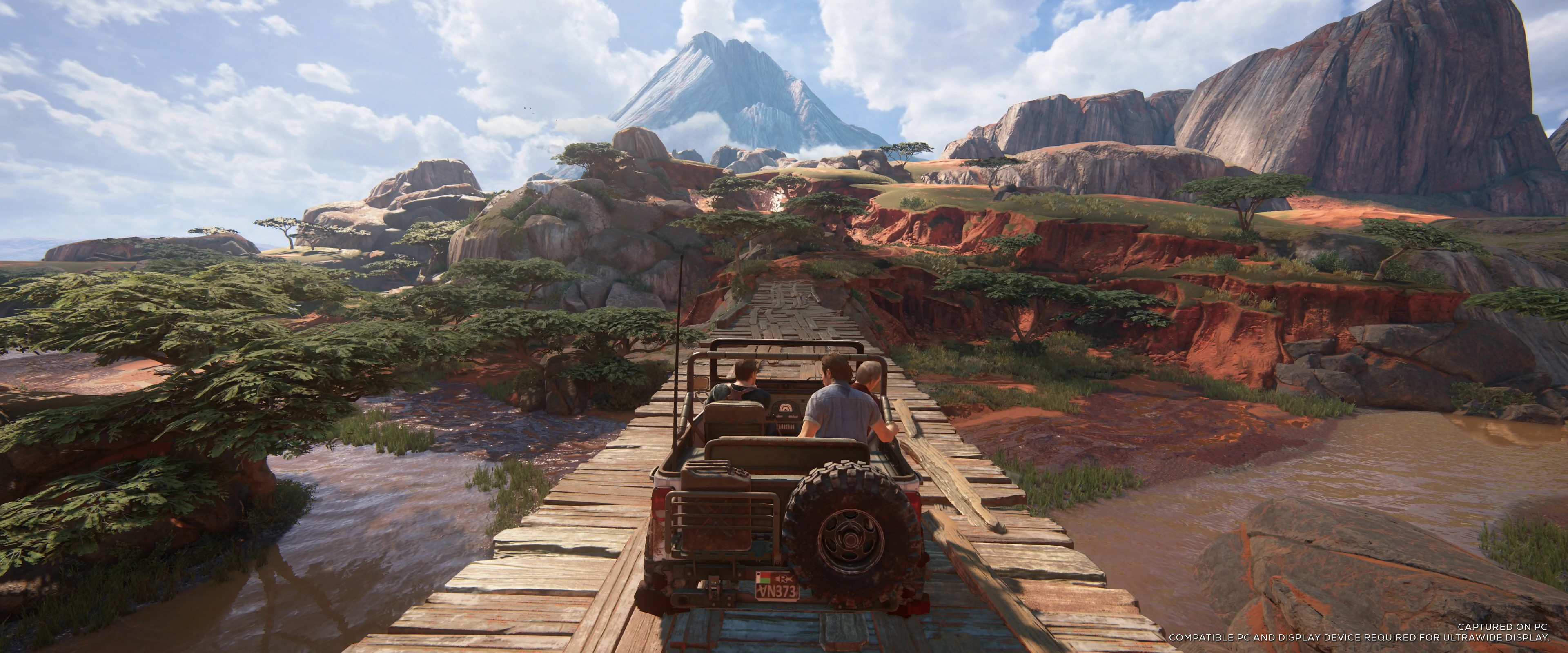
This news lines up with a leak last week that showed a listing for the game on the Epic Games Store with an October 19th release date. This confirmation comes after Sony had delayed the game's release from its original "early 2022" timeline. As you'd expect, there are a host of features relevant to PC players, including ultra widescreen monitor support and a host of graphics adjustment options including texture and model quality, anisotropic filtering, shadows, reflections and ambient occlusion. The UI has also been tweaked to better fit on PC and you can remap all controls as you see fit.
Speaking of controls, you can also play this game wirelessly with the PS4's DualShock 4 controller; if you plug in a PS5 DualSense controller, you'll get more advanced haptic feedback.
If you're interested, Uncharted: Legacy of Thieves is up for pre-order on Steam and the Epic Games Store for $49.99. It's the first Naughty Dog title to hit the PC, but a number of other high-profile Sony exclusives (including Horizon Zero Dawn and God of War) have come to the PC in recent years. And Naughty Dog's latest release, the remade The Last of Us Part I will also be released for the PC, though there's no timeframe just yet.