Robotics engineer Ken Pillonel, known for creating a makeshift USB-C iPhone and AirPods, has revealed his next project. The modding wunderkind has deconstructed Apple’s AirPods Pro case and built a custom repairable version. Pillonel is sharing the design for free, allowing enterprising self-repair enthusiasts with a knack for engineering to make their own.
Pillonel has already tackled the AirPods Pro with a custom replaceable printed circuit board (PCB). However, his new project attempts to dissect the earbuds’ entire case, offering a complete blueprint for others to do the same — with 3D-printed sections and a few (cheap) afterparty parts. “Most gadgets are designed without repairability in mind, unlike the durable technology of the past that seemed built to last,” Pillonel wrote, noting that iFixit gave the second-gen AirPods Pro a dismal zero repairability score. “It is troubling to see design choices like non-replaceable batteries, glued-in components, and a lack of transparency in public information leading to the rise of ‘fast electronics.’”
In response, the engineer took on this latest project “to demonstrate how one of the most popular gadgets today — Apple’s AirPods Pro — could have been easily made repairable with minimal effort.” His stated goal is to inspire consumers and multi-billion-dollar corporations (ahem, Apple) to treat technology less like a locked-down disposable commodity and more like something one can tinker with, learn from and — with the right skills — repair themselves. Of course, a central component is using screws and nuts instead of adhesives to create a makeshift case you can crack open and fix down the road.
Ken Pillonel / Exploring the Simulation
Pillonel says this was one of his most challenging custom projects yet, as he had to create precise scans of the case’s every component. As he explains in the video below from his YouTube channel, some of the case’s parts proved especially difficult with complex curves that a simple caliper and basic 2D scans couldn’t quite nail down. He even detailed his quest for finding the right spring-loaded contact pins to charge the buds and an affordable 3D scanner to capture some of the more oddly shaped parts. I recommend a quick watch to anyone curious about sustainability and the nuts and bolts behind iconic consumer tech gadgets. (Remember that such tinkering will void your warranty, and you should probably only give it a shot if you’re experienced with electronics repairs.)
“I am thrilled to make these repairable designs available to the public at no cost, encouraging individuals and manufacturers alike to prioritize repairability in their product development,” Pillonel wrote today. “Together, we can work towards a circular economy that not only minimizes electronic waste but also fosters a culture of conscious consumption and responsible tech innovation.” You can peruse Pillonel’s designs and storefront for replacement parts on his website.
This article originally appeared on Engadget at https://www.engadget.com/the-man-behind-the-usb-c-iphone-rebuilt-the-airpods-pro-case-to-make-it-repairable-130008565.html?src=rss
Amazon has the company’s Kindle Kids e-reader on sale for 33 percent off right now. Its $80 price (usually $120) is nearly as low as it was on Prime Day, making it an ideal time to surprise your little one(s) with the gift of distraction-free reading. The device is an Engadget recommendation in our Best Educational Toys guide.
The discounted Kindle Kids model is the latest (2022) version. It includes a cover, bundled with your purchase, available in three designs resembling children’s book art: space whale, ocean explorer and unicorn valley.
The e-reader’s internal tech is identical to the standard 2022 Kindle, one of our picks for the best e-reader. Its specs include a high-res (300 ppi) display, 16GB storage, six weeks of battery life, USB-C charging and an adjustable front light. Each purchase comes with a year’s subscription to Amazon Kids+, including a library of thousands of kid-appropriate books and hundreds of audiobooks. (The membership will renew at $5 a month after that, so be sure to cancel before then if you only want the free year.)
Although the standard Kindle Kids is our top recommendation, you can also save on the Kindle Paperwhite Kids if you don’t mind spending more on an upgraded model. Compared to the cheaper Kindle Kids model, the child-focused Paperwhite has a larger screen (6.8 inches vs. 6 inches), more LEDs for better front-lit reading and an adjustable warm light that’s easier on the eyes. Amazon’s sale has the Kindle Paperwhite Kids for $114 (typically $170), only $10 higher than its Prime Day discount.
Last month, theoretical physicist Avi Loeb made headlines with the sensational claim that tiny spherules recovered from the bottom of the ocean were probably of alien origin. “It’s most likely a technological gadget with artificial intelligence,” he said to The New York Times, which published a story today about the Harvard professor’s contentious claims. Although the biggest scientific breakthroughs often start with a bold hypothesis, Loeb’s peers believe the decorated astrophysicist’s assertions can be called many things — but “good science” isn’t one of them.
Loeb’s proclamations stem from an object that US government sensors logged on January 8th, 2014: a fireball from space that blazed into the western Pacific Ocean off the northeastern coast of Papua New Guinea. Highlighting its logged speed and direction as an anomaly, Loeb and undergraduate assistant Amir Siraj targeted the otherwise inconsequential planetary entry as an object worthy of further investigation.
Fast-forward to last month, when Loeb led a voyage — funded by a crypto entrepreneur — to recover evidence from the fireball’s calculated crash path. Dragging a magnetic sled attached to the expedition boat across the ocean floor, the team recovered a series of tiny spherical objects which Loeb says “appear under a microscope as beautiful metallic marbles.” Preliminary analysis indicated that the sub-millimeter orbs were 84 percent iron, with silicon, magnesium and trace elements comprising the rest. Loeb believes that “as a result of being exposed to the fireball’s heat, the surface of the object likely disintegrated into tiny spherules, similar in number per unit area to those recovered by the expedition.”
Avi Loeb / Medium
Not one to exercise much caution with public pronouncements, Loeb wrote in a Medium post, “Their discovery opens a new frontier in astronomy, where what lay outside the solar system is studied through a microscope rather than a telescope.” He summarized, in an equally dramatic manner, “The discovery of spherules felt like a miracle.” Soon after, CBS News picked up on his excitement and published an attention-grabbing article titled, “Harvard professor Avi Loeb believes he’s found fragments of alien technology.” Loeb has sent the mysterious spheres to Harvard University, the University of California, Berkeley and the Bruker Corporation in Germany for more in-depth analysis.
“It has material strength that is tougher than all space rock that were seen before, and catalogued by NASA,” CBS Newsreported Loeb as saying earlier this month. “We calculated its speed outside the solar system. It was 60 km per second, faster than 95% of all stars in the vicinity of the sun. The fact that it was made of materials tougher than even iron meteorites, and moving faster than 95% of all stars in the vicinity of the sun, suggested potentially it could be a spacecraft from another civilization or some technological gadget.”
It all sounds fascinating, especially with the resurgent interest in UFOs and the quest to discover signs of alien life. But there’s one problem: The scientific community, by and large, believes Loeb is, if not entirely full of it, practicing something far outside what they’d call science.
Peter Brown, a meteor physicist at Western University in Ontario, said that “several percent” of detected events appear interstellar at first but almost always end up chalked up to a measurement error. Steve Desch, an astrophysicist at Arizona State University, argued at a recent conference that if the object were traveling as fast as the data suggests — one of the points Loeb uses to indicate its origin was from outside our solar system — it would have been wholly incinerated entering the Earth’s atmosphere. Brown and other scientists also highlight Loeb’s lack of engagement with peers who study similar unidentified fireballs.
Brown recently presented data (accepted for publication in The Astrophysical Journal) demonstrating that NASA’s recordings in cases like these often end up being proven untrustworthy. He believes the fireball likely impacted at a slower speed than the recorded data suggested. “If the speed was overestimated, then the object becomes, more or less, within the realm of what we see in terms of other bound solar system objects,” he said. (Loeb retorted by citing an unbendable trust in government data: “They are responsible for national security. I think they know what they are doing.”) The New York Times adds that the government is unlikely to declassify the data that would allow the scientific community to learn how precise (or not) it is.
Avi Loeb / Medium
Regardless of the spherules’ origins, researchers are alarmed by Loeb’s penchant for venturing outside science to make bold (and highly publicized) claims — with his scientific background boosting their perceived legitimacy. The gist of their alarm is that becoming a Harvard-employed astrophysicist doesn’t grant you the wizard-like ability to know the answers to questions the scientific method hasn’t yet confirmed. On the contrary, it’s supposed to mean your peers respect you for exercising restraint and doing quite the opposite. “[Loeb’s claims are] a real breakdown of the peer review process and the scientific method,” Desch said to The New York Times. “And it’s so demoralizing and tiring.”
Loeb’s views about his peers’ harsh response can be summarized in his cited quote from philosopher Arthur Schopenhauer from a recent blog post. “All truth passes through three stages: First, it is ridiculed; second, it is violently opposed; and third, it is accepted as self-evident.” Notably, Loeb seemingly refers to his team’s preliminary findings — with plenty of question marks still intact — as “truth.”
The Oxford English Dictionary defines confirmation bias as “the tendency to interpret new evidence as confirmation of one's existing beliefs or theories.” Loeb’s words and excited tone suggest he knows the answer and that his peers’ criticism stems from their resistance to the new frontier he’s discovered. However, their criticism seems only partially about his specific conclusions; it’s paired with a larger concern about an esteemed cohort jumping to conclusions that fall far outside of the scientific method. “What the public is seeing in Loeb is not how science works,” remarked Desch. “And they shouldn’t go away thinking that.”
This article originally appeared on Engadget at https://www.engadget.com/astrophysicist-who-claimed-to-find-alien-tech-may-have-done-the-science-wrong-214008434.html?src=rss
Amazon has Apple’s iPhone Leather Wallet with MagSafe on sale for close to its all-time lowest price — and its cheapest price (so far) in 2023. The magnetic wallet, usually $59, is currently available for $48. It’s handy for bringing a few identification and credit cards out into the world without having to lug along a standalone wallet. Although the sale only applies to the Midnight (black) colorway, the neutral hue shouldn’t clash with any phone model or case.
If you have a MagSafe-friendly Apple handset (iPhone 12 or later), you can snap the leather wallet onto the back of your phone (or a MagSafe-compatible case) for safekeeping. The magnets are plenty strong, so you can avoid worrying about losing your IDs or credit cards on the go. And, although it only has room for three cards, it can serve as minimalist card storage for trips out where you don’t need a thick stack of payment or store discount cards.
The iPhone Leather Wallet with MagSafe now supports Find My. This feature allows you to link the accessory with your Apple ID and view its last known location on a map if you ever lose it. To set it up, your iPhone will ask you if you want to connect it to Find My when you first attach it to your phone. Or, you can add it later in the Find My app by selecting the plus symbol and then “Add MagSafe Accessory.”
In addition to a deal on the latest AirPods Pro, Amazon’s Apple accessories sale also includes the Apple MagSafe Battery Pack: Instead of its usual $99, you can get the charging add-on for $84. Also designed for the iPhone 12 and later, it snaps onto your handset to supply extra battery power to help your device make it through longer days. It also has some advantages over third-party magnetic battery packs: higher voltage (making it more potent than its mere 1,460 mAh capacity may suggest) and greater charging efficiency. Finally, it integrates tightly with iOS, letting the software manage charging for you and allowing you to view its remaining level in a battery widget on your home screen.
This article originally appeared on Engadget at https://www.engadget.com/apples-magsafe-leather-wallet-drops-to-its-cheapest-price-this-year-163007993.html?src=rss
Some Amazon employees will be forced to relocate to fulfill a company policy requiring three days per week of in-office work, according to sources speaking withBloomberg. Those affected will include workers hired for remote positions and those who moved during peak pandemic days.
Remote Amazon workers will have to report to “main hub” offices, including company headquarters in Seattle, New York and San Francisco (and possibly other locations), as The Wall Street Journalreported. However, decisions on who has to relocate, and where, will be decided on a departmental basis. The company reportedly hasn’t yet established how many employees will have to uproot themselves.
An Amazon representative told Bloomberg today that it observes “more energy, collaboration, and connections happening” since implementing the in-office mandate, which CEO Andy Jassy announced in February. Some of the company’s workforce viewed the policy as adding insult to injury, as it arrived around the same time as widespread layoffs starting in late 2022 that affected around 27,000 employees. Hundreds of workers staged a walkout in May, protesting the return-to-office policy and the company’s climate shortcomings.
“We continue to look at the best ways to bring more teams together in the same locations, and we’ll communicate directly with employees as we make decisions that affect them,” an Amazon spokesperson told Bloomberg.
This article originally appeared on Engadget at https://www.engadget.com/amazon-is-reportedly-making-employees-relocate-for-return-to-office-200435517.html?src=rss
Amazon’s Starlink rival, Project Kuiper, is moving closer to liftoff. The company announced today that a new $120 million satellite-processing facility for the initiative is under construction at Kennedy Space Center in Florida. Amazon plans to launch its first satellites “in the coming months,” followed by the first customer pilots next year.
Like Elon Musk’s Starlink, Project Kuiper aims to provide fast and affordable satellite broadband to areas “unserved or underserved by traditional internet and communications options.” (It’s an Amazon initiative but should enjoy a cozy relationship with Blue Origin, owned by Amazon founder Jeff Bezos.) Project Kuiper kickstarted in 2018, receiving FCC satellite licensing two years later. The company plans to create a constellation of 3,236 satellites to provide seamless broadband coverage for rural users. Amazon hasn’t yet announced consumer pricing, but it hints at budget-friendly plans, saying, “affordability is a key principle of Project Kuiper.” The company also intends to offer multiple speed / pricing tiers.
Kuiper’s satellites will be assembled at a new “state-of-the-art manufacturing facility” in Kirkland, Washington, by the end of 2023. The new Florida installation will receive the satellite shipments, perform final preparations ahead of their commercial deployment. Amazon says it’s secured launches from Blue Origin, Arianespace and United Launch Alliance (ULA). Most units will deploy from Florida’s Cape Canaveral Space Force Station, near the new processing facility.
Amazon touted Project Kuiper’s anticipated job creation. It says over 1,400 people are already working on it, and the company expects the initiative to eventually support thousands of suppliers and highly skilled jobs — especially in Alabama, Florida and Colorado.
This article originally appeared on Engadget at https://www.engadget.com/amazon-builds-new-florida-satellite-facility-for-its-starlink-rival-173537256.html?src=rss
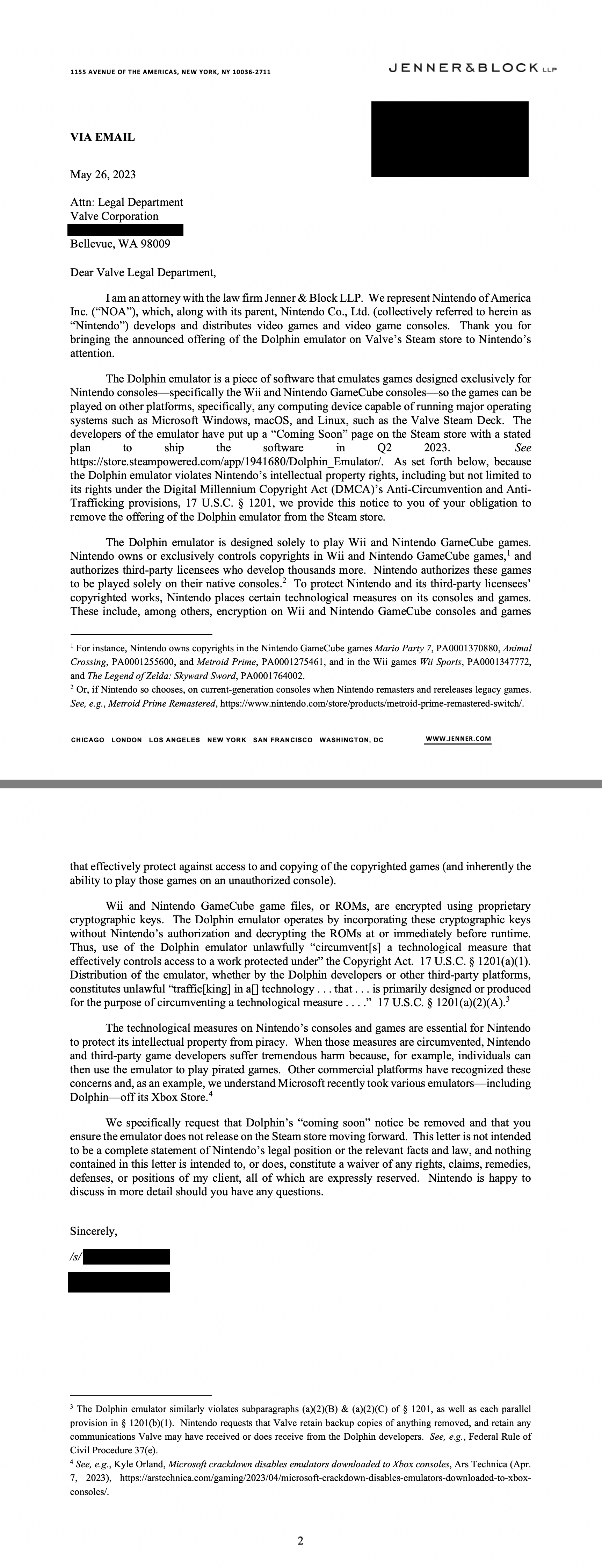
The Dolphin Emulator, the software that lets you play old Wii and GameCube games, isn’t coming to Steam after all. The developers published a blog post today explaining how the fumbled launch went down — and why they still believe they were in the right legally. In short, Nintendo’s lawyers didn’t want it on Steam, and Valve wasn’t about to take a stand in a potential showdown with a fellow gaming behemoth.
The emulator’s creators explained that, contrary to online perceptions, Nintendo didn’t send the team a DMCA takedown notice (or any other legal action). However, Valve’s legal department contacted Nintendo, asking about the planned release of the app that could run old games like Super Mario Galaxy, Wii Sports and The Legend of Zelda: Majora’s Mask through the ubiquitous PC storefront. Valve then forwarded a statement from Nintendo’s lawyers to the Dolphin team and told them they could only launch the emulator if Nintendo approved. “We specifically request that Dolphin’s ‘coming soon’ notice be removed and that you ensure the emulator does not release on the Steam store moving forward,” Nintendo’s letter to Valve read.
Dolphin
It sounds like Valve didn’t want to get involved and instead put the onus on Dolphin’s developers to get permission which everyone involved must have known wouldn’t have been granted. Considering how quick a trigger Nintendo’s lawyers have had in the past — coupled with the wording of the letter they sent about the matter — the development team saw the writing on the wall and pulled the plug on the Steam release. Of course, the Dolphin Emulator is still available as a discrete download for Windows, macOS and Linux from the project’s website. However, having it on Steam could have boosted its perceived legitimacy and opened it up to a much wider audience.
“Valve ultimately runs the store and can set any condition they wish for software to appear on it,” the Dolphin team wrote today. “But given Nintendo’s long-held stance on emulation, we find Valve’s requirement for us to get approval from Nintendo for a Steam release to be impossible. Unfortunately, that’s that.”
This article originally appeared on Engadget at https://www.engadget.com/dolphins-wii-and-gamecube-emulator-isnt-coming-to-steam-after-all-170029820.html?src=rss
Robosen announced a new auto-converting Transformer today. After launching its self-transforming Optimus Prime in 2021, the company set its sights on Grimlock, the Autobot-allied leader of the Dinobots who changes from a robot into a mechanical T-Rex. However, its $1,699 sticker price (a mere $1,499 for pre-orders) also allows it to transform your finances for the worse.
The Grimlock collectible stands 15 inches tall in robot mode and 15.4 inches in dinosaur mode. Robosen describes its auto-transforming as “the epitome of auto-conversion” while calling the product “the world’s first dual-form, bipedal walking robot.” (The Optimus Prime version walks as a robot but drives in truck form.) The manufacturer says Grimlock includes 85 microchips, 34 high-precision intelligent servos while running on “advanced SOC chip technology” and “a comprehensive robot operating system.” In addition, it has six-axis IMU sensors for balance monitoring.
This Grimlock is based on the Transformers G1 version, which debuted in 1985. The collectible includes the original toy’s Energon sword, galaxial rocket launcher, and crown accessories. Robosen and Hasbro even brought back the original voice actor from the G1 animated series, the now 72-year-old Gregg Berger, to record “150+ original Generation 1 Transformers audio lines” for the expensive toy. For the uninitiated, the character is known for a simplistic speaking style, including the well-trodden phrase, “Me Grimlock!”
Robosen / Hasbro
In addition to hearing Grimlock’s classic voice (synchronized with “robotic actions”), you can also control it by speaking to it. The product recognizes 42 voice commands, letting you tell it to transform, walk and perform various “stunning stunts.” You can also create new poses and actions for the Dinobot using four programming modes (block-based, manual, voice and computer-based). And if money truly is no object, you can pair it with the $699 Optimus Prime robot to watch them reenact your favorite classic Transformers battle scenes. This would be wonderful for children, but its pricing mostly limits it to nostalgia-stricken adults with more money than meets the eye.
The Grimlock auto-converting robot is available for pre-order now from Robosen and Hasbro. It’s expected to ship in late fall. Although its pricing may be a tough sell, at least they’re throwing in a limited edition collector’s coin so you can demonstrate that you spent the equivalent of a month’s rent on a robotic T-Rex that speaks about itself in the third person.
This article originally appeared on Engadget at https://www.engadget.com/robosens-auto-transforming-grimlock-will-set-you-back-about-a-mortgage-payment-182443528.html?src=rss
Cricut, a company that makes popular cutting machines for crafting projects, announced a new model today. Although its devices are relatively affordable, the new Cricut Venture is a higher-end $1,000 machine aimed at “incredibly enthusiastic makers and those who sell their crafts.” In other words, this variant is less for occasional hobbyists and more for hardcore makers or small businesses selling their creations somewhere like Etsy.
Cricut Venture is a “large-format” cutting machine that can handle bigger projects — whether physical size or higher volume. The device, the company’s biggest yet, can cut up to 75 feet of repeated images and 12 ft of single images. Cricut says it’s also its fastest machine, cutting up to 25 inches per second. “Cricut Venture is optimized for size and speed,” said Michelle Fishberg, Cricut’s VP of Global Product Management. “You will find the beautiful design and quality Cricut is known for, with increased precision and attention to detail, all of which make cutting on this large-format machine an easy and productive experience.”
Like the company’s other models, the Cricut Venture can handle materials like vinyl, iron-on, cardstock, bonded fabric, leather and poster boards. Engadget’s Terrence O’Brien reviewed the printer-sized Explore 3 in 2021 and found it worked well for projects like vinyl decals and cardstock animals (that he may or may not have ever fully assembled). However, these machines are more limited by the user’s experience with crafts than technology: The company lists banners, engraved metal, debased leather, custom cards, t-shirts and color stickers among the various tasks it can handle.
The Cricut Venture will be available from the company website and retail partners starting on July 25th. Its $1,000 sticker price is for the machine only; Cricut also offers bundles with a stand or materials to help you get started.
This article originally appeared on Engadget at https://www.engadget.com/the-cricut-venture-is-a-1000-cutting-machine-for-the-most-ambitious-diyers-201519614.html?src=rss
Framework’s modular Laptop 16 is available for preorder in the US, Canada, Germany, France, UK, Netherlands, Austria, Ireland and Australia. The company’s first gaming notebook starts at $1,399 for a DIY system (sans operating system). Pre-built variants start at $1,799.
The machine ships with an AMD Ryzen 7 7840HS or AMD Ryzen 9 7940HS processor; the DIY versions start at $1,399 and $1,699, respectively. You can use it with the processor’s integrated graphics or pay $1,799 or $2,099 for a ready-to-go model with Radeon RX 7700S discrete graphics.
Of course, the company’s modular focus is what differentiates the Laptop 16 from the multitude of same-y notebooks at your local electronics store. The plan is for its expansion bay system to let you upgrade its graphics (and other hardware) over time without buying an entirely new machine. Its top deck, including the keyboard and numpad, is also user reconfigurable. It adds up to an ambitious plan for a gaming laptop, but the company has so far followed through on supporting its less powerful (but also modular) Laptop 13, the first version of which launched in 2021.
Framework
The Framework Laptop 16 machine has a 16-inch 2560 x 1600 display with a 165Hz refresh rate (with FreeSync). The screen can reach 500 nits brightness, and it’s rated for 1500:1 contrast and 100 percent of the DCI-P3 color gamut. The laptop has an 85Wh battery, which Framework says will retain 80 percent capacity after 1,000 charging cycles. (The company says it’s “easy to replace” if needed.) It supports WiFi 6E and Bluetooth 5.2 and has a 1080p webcam with dual mics and hardware privacy switches. It also includes a fingerprint reader, compatible with Windows and Linux.
The company will follow a batch ordering system, and it expects the first round to ship in Q4 2023. Framework says a limited supply of pre-orders that include an eligible AMD Radeon GPU will receive a free download code for the highly anticipatedStarfield: Premium Edition. (CEO Nirav Patel says game codes will arrive before its early access launch.) You can preorder the Laptop 16 now from the company website.
This article originally appeared on Engadget at https://www.engadget.com/you-can-pre-order-frameworks-modular-gaming-laptop-16-today-183702718.html?src=rss