After all the rumors and teasers, Peloton’s $3,195 rowing machine is finally official. It packs a 24-inch HD display and electronically-controlled resistance. That kind of resistance, which typically feels different to Concept2 rowers in your local gym, doesn’t mean it’s particularly small, however – you might want to check you have the space in your home. Peloton claims the Row can offer on-screen feedback on your form as you work out.
That will have to be some incredible coaching, given that its price tag is far higher than its rivals. The aforementioned (and benchmark) Concept2 rowing machine doesn’t have a screen, Bluetooth or any digital tricks, but it’s also under $1,000. Hydrow’s cheapest rower, the Wave, is priced at $1,495, while the premium model is still hundreds of dollars less than the Peloton Row. It’s an expensive gambit for a company still getting its house in order, adjusting its prices and reconsidering its approach.
Preorders for the Row start today in the US. The company expects to ship the machines in December – just in time for those 2023 fitness resolutions.
NVIDIA's 40 series GPUs are finally here. The company unveiled the GeForce RTX 4090 and GeForce RTX 4080 today at its GTC 2022 keynote. Taking full advantage of its new "Ada Lovelace" architecture, NVIDIA says the two GPUs offer significantly better ray tracing performance – and generally a lot of power for a lot of money. The first of the new GPUs will arrive next month when the GeForce RTX 4090 goes on for sale for $1,599 on October 12th. There will be two different variants of the RTX 4080. The base model will start at $899 and features 12GB of GDDR6X memory and 7,680 cores, while a 16GB version with 9,728 cores will set you back a cool $1,199. Both configurations will arrive sometime in November.
With iOS 16, Apple has focused on modernizing the iPhone lock screen, making it a more useful part of how you interact with your phone. These changes also make it easier to use the iPhone’s Focus modes, which remain a little complicated to set up. Overall, the company has made lots of minor changes that add up to a better iPhone experience. Apple’s Messages app continues to improve, and the increasingly useful Visual Lookup feature is something an Android device can’t quite replicate — yet. These iOS updates are usually followed by a few extra tweaks – and Apple has already fixed its weird battery percentage indicator. Was it my review? (It wasn’t.)
Spotify has officially added audiobooks as yet another listening option in its app – for when you run out of podcasts, right? Starting today, US users will see a dedicated section for the format that allows standalone purchases via a web link. The company says its library will contain over 300,000 titles at launch. As well as their own section alongside music and podcasts, audiobooks will show up in your recommendations on the main page.
That’s according to a new study on recommendations.
If you’ve ever felt like it’s difficult to “un-train” YouTube’s algorithm, you’re not alone. One major issue, according to new research conducted by Mozilla, is that YouTube’s in-app controls such as the “dislike” button, “prevent less than half of unwanted algorithmic recommendations.” Of the controls available on YouTube, the most effective was “don’t recommend from channel,” which prevented 43 percent of unwanted recommendations, while “not interested” was the least effective and only prevented about 11 percent of unwanted suggestions.
It’s already been a year since Windows 11 launched. Somehow. It’s a good time for an update, then. Much like the improved Windows Update experience, the vast majority of new features in this 2022 update are under the hood. Those include a slew of accessibility upgrades including system-wide live captions and a preview of improved voice commands for using your PC and transcription.
As recently as last year, TikTok used a two-tier moderation system that gave preferential treatment to its most popular users, according to Forbes. The publication obtained an audio recording of a September 2021 meeting where the company detailed an internal feature called “creator labels” that was reserved for accounts with more than 5 million followers.
The Morning After isn’t just a newsletter – it’s also a daily podcast. Get our daily audio briefings, Monday through Friday, by subscribing right here.
Just in time for the arrival of the iPhone 14 line, iOS 16 is officially here, after spending several months in beta. I’ve spent the last week or so testing out the final version of the software, and there are plenty of new things to try, including customizable lock screens, improvements to the Messages app and some smarter AI tricks. Just as importantly, it’s not buggy. The latest edition of Apple’s mobile OS works with the iPhone 8 and newer models, although some features, demand the relatively recent A12 chip. (More on that later.)
This year’s version of iOS is an update you’ll notice – something that was hard to say about iOS 15, whose most notable features related to media sharing, Focus modes and SharePlay. iOS 14, now two years old, added widgets to the grid of icons and shook up your homepage experience for the first time since the iPhone launched. With iOS 16, Apple finally tackled the lock screen.
A personalized lock screen
The lock screen used to feature a clock and not much else. Things are a little different now, but let’s start with the clock. The font is thicker and you can even choose the color of the text and there’s now space for widgets. You might not like how the new default font looks (I don’t), but the good news is that it’s customizable, with several font styles and colors. You can of course choose photos for the lock screen, which isn’t anything new, and you can apply filter styles and even choose a shuffled selection of photos to cycle through. If the images were taken in Portrait mode, you can also enable a multilayered photo effect, with the photo's subject popping out in front of the time. If you do have an iPhone 14 Pro, check out our full review for our thoughts on the Always On Display and, naturally, Apple's new Dynamic Island.
There are two different widget areas you can customize. First up is a slim box above the clock that’s best suited to one-line text (think: the date, chances of rain, or your next calendar event.) Below that, there’s a box that can house up to four different widgets — a mix of 2x1 and 1x1 icons. From the lock screen, you can tap on these to launch into the appropriate itself, but don’t expect to glean any extra information by long-pressing on the icons, which seems like a very Apple way to expand the information offered by these widgets. Maybe in iOS 16.1, or iOS 17?
Mat Smith / Engadget
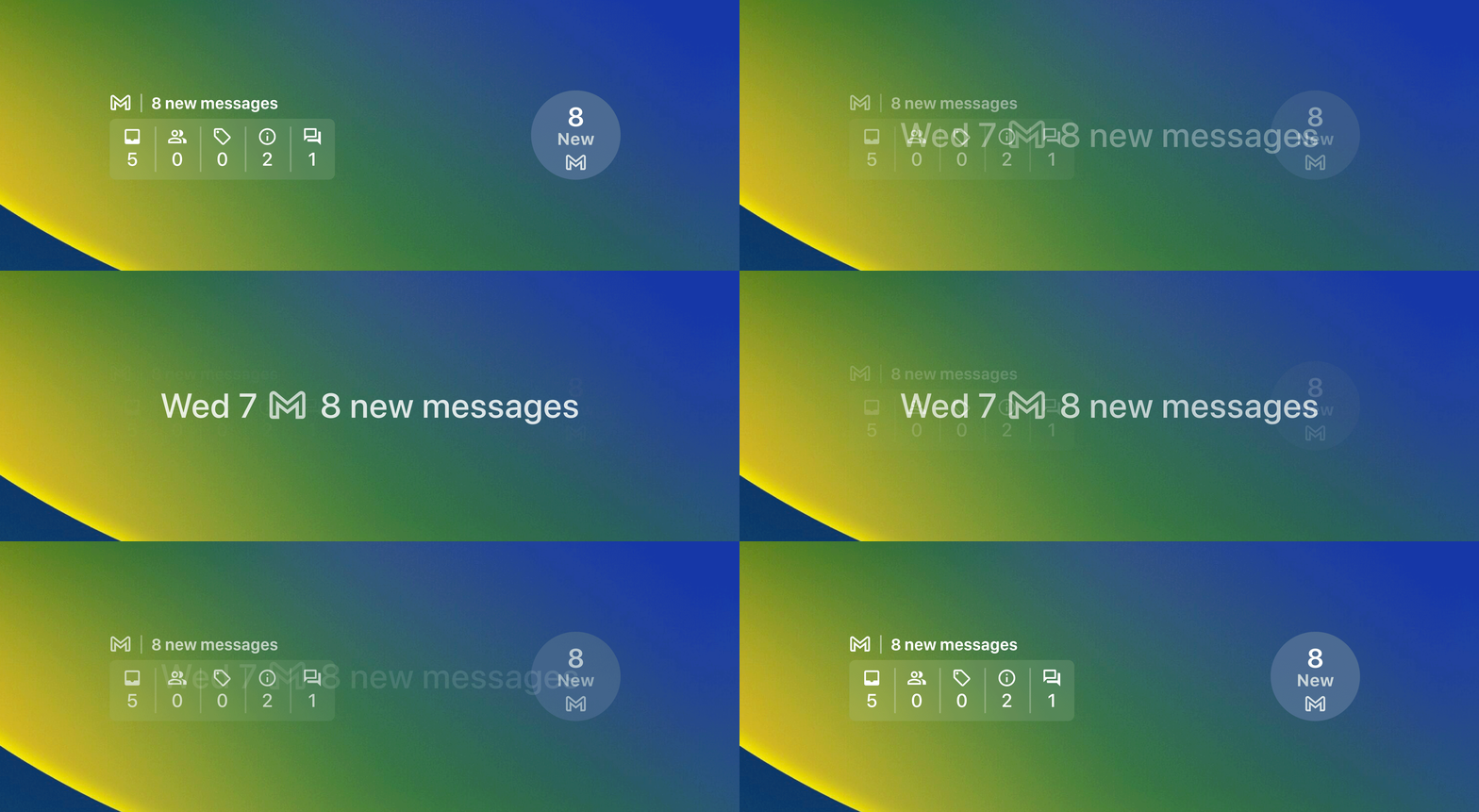
Similar to the debut of home screen widgets on iOS 14, it’ll take time for third-party app developers to get widgets into their updates and onto your phone, but I’m sure productivity, fitness tracking services and others will jump at the chance. Google in particular seems ready to get on board: Its forthcoming Gmail widget will absolutely be getting a place on my lock screen when it becomes available.
The new lock screen keeps some classic features, too. You’ll still see signal strength and battery icons (now with a percentage readout), and both the flashlight and camera shortcuts are still available to tap away at. Oddly, the battery indicator only visually replicates how charged it is when the battery is under 20 percent, which is counterintuitive when you’re at 50 percent, for example.
The lock screen refresh also functions as a renewed way of showcasing an iOS 15 feature that can be pretty laborious to set up: Focus modes. You can now assign a Focus mode to individual lock screens (one for personal, one for work, one for sleep), each with their own custom widget layouts and photos. If you rarely change your wallpaper during weekdays, you could set up, say, a fun weekend image of your family, and assign it to your personal focus mode.
Conversely, I have a pretentious motivational quote on a black background for when I’m crunching away on deadlines and have my phone set to Do Not Disturb. The ability to swipe between Focus modes makes them easier to use in everyday life. Sure, I could have done so in the past from the top-right drop-down menu, but I didn’t. With iOS 16, I’m already using Focus modes more often.
A better messaging experience
Mat Smith / Engadget
Apple’s native messaging app gets some unique tricks, including new Visual Lookup features. It now handles image copy-and-pasting, pulling subjects from photos, screenshots and more, turning them into easy-to-share stickers. Long-press on the object / animal / person and your iPhone (if it’s an XS or newer) will endeavor to clip it away from the background, ready to paste elsewhere.
It’s uncannily accurate for such a, well, lazy method. I love it. The Visual Lookup skills in iOS 16 are even more expansive, with the new ability to lift text from video. In addition to videos you take yourself, it should work with full-screen videos in web browsers.
Messages has also expanded its sharing capabilities beyond SharePlay and stickers. You can now send documents, spreadsheets and more, as long as they’re saved in one of Apple’s office software file types. Hopefully, third-party support for Microsoft and the Google Suite will soon follow.
Apple is making up for lost time elsewhere as well. Finally, you can edit and unsend messages on the Messages app – if you’re quick enough. You’ll have up to 15 minutes to edit after you first send the message, with the chance to change your message up to five times. You can see any edited messages from other folks also using iOS 16, which will be grayed (blued?) out underneath the corrected message. Unsend features are only for iPhone-to-iPhone messages.
Similarly, you can now undo send and schedule emails from the native Mail app. (Finally.) There are also further modern features you are probably already used to on Gmail, like suggestions when you might have forgotten an attachment or recipient. .
Apple has upgraded its voice dictation, too. Now when you’re talking into your iPhone, the keyboard will stay on screen, meaning you can type and correct while the dictation takes place – ideal for specific names and places. You can also tap on a word and dictate over them to correct any mistakes. Apple has also added more rigorous auto punctuation to dictation, which generally helped insert commas, periods and the rest without you having to say “question mark” at the end of your text-based requests to friends. It also gleans emoji as you say them, inserting them into your typing. (This feature requires the A12 Bionic chip found in the iPhone XR and newer devices.)
Health and Fitness
Apple’s Health and Fitness apps are relative newcomers to the native app family, and they continue to evolve. The Health app has a new Medications feature that helps log what you take and when. You can set up multiple meds for different time-of-day reminders and frequencies and your iPhone will ping you when it’s time. Another addition to the Health app is the ability to enable notifications if your logged menstrual cycles show a pattern of infrequent periods and other signs of possible abnormalities.
On a more light-hearted note, depending on how serious an athlete you are, Apple has also added a My Sports tab to its News app, dedicating a section to your favorite sports teams. This encompasses news, results, related stories and upcoming game reminders. A word of warning: Some of the stories may be locked behind Apple’s News+ paywall.
One of the best updates is one you might miss. I did too, until I perused Apple’s iOS 16 lengthy release notes: Haptic typing is here, on an iPhone, several years late. Until now, if you wanted typing vibrations on an iOS device you’d have to install Gboard – yes, Google’s third-party keyboard – to get this functionality. Now, mere days later it’s hard to imagine going back to typing on glass without it. Android users have had it good.
Everything else
iOS 16 introduces some potentially life-saving personal safety updates as well. Emergency SOS, which sounds an alarm on the phone before automatically calling emergency services, can now be activated by rapidly pressing the side button five times. Crash Detection, enabled in settings, will take data from the motion sensor, gyroscope, accelerometer, GPS, barometer and microphone, and combine it with algorithms to estimate if you’ve been in a car crash. When detected, a warning will flag up on both your iPhone and your Apple Watch. If you're still responsive, you can swipe the screen to call emergency services or close the alert, if it was a false alarm. Like the SOS call, the iPhone will automatically dial emergency services after 10 seconds have passed.
Mat Smith / Engadget
It wouldn’t be an Apple update with at least a few security updates. Perhaps the most noticeable addition is Safety Check, which can decouple your iPhone from specific contacts, gadgets and services. From here, you can uncheck permissions and even nix the connection completely with “Emergency Reset” or “Select All and Stop Sharing.” You will need to use your passcode or FaceID for these more extreme measures.
Apple is also touting what it calls Passkeys: digital keys that use your iPhone’s security features to securely log in to websites and devices like your smart TV. These aren’t an Apple invention, but with Passkeys on iOS devices this should lead to wider uptake and, well, a chance to use them. That said, I haven’t yet found any opportunities yet to test them out.
And there are even more notable features:
Apple Maps includes support for multi-stop routing, which can also be synced with your Mac. Travel fares are also displayed when you’re riding public transport.
Camera-wise, you can add foreground blur on Portrait mode photos, and Apple has improved cinematic mode video capture – at least on select devices. You’ll get cinematic mode on the iPhone 13 series and newer.
The Home app has been streamlined, with categories for lighting, speakers, TV and more. The tiles have been redesigned to make it easier to discriminate between all your connected gadgets. And, of course, there are now Home app lock screen widgets.
Apple has expanded the Fitness app to everyone; you no longer need an Apple Watch to use the activity tracking parts. Your iPhone’s motion sensors will estimate your steps, distance and workouts to offer up a rough calorie burn figure, too.
New accessibility features include Door Detection in the iPhone’s Magnifier mode – if you have a device with LIDAR, anyway. (That’s ‘Pro’ iPhone models starting with the iPhone 12 Pro.) A new detection mode offers more detailed descriptions in Magnifier, as well as people detection and image descriptions.
Apple finally lets you hang up on calls with Siri, hands-free. It sounds incredibly abrupt, sure, but hang-ups required a physical tap until now. You can also adjust Siri's wait time before it responds to your voice commands.
Wrap-up
iOS 16 marks another notable evolution for Apple’s often slow-to-change mobile OS, this time enriching your iPhone lock screen in several ways. I focused on the lock screen in this review because it’s an inescapable part of the iPhone experience. Changes elsewhere are small, but there are an awful lot of them, and they add up. (Apple has added seven more nose options for Memoji, FYI.)
There are some features that I haven’t been able to test, including accessibility upgrades for LIDAR-capable phones and Passkey support. As with many iOS updates, you might not notice all of the improvements. Many will find the medication reminder features useful and simple; others won’t even know it’s there. Sports fans might love the dedicated News app tab, but on the other hand, you also might not care about sportsball? You can test out the lock screen widgets, set up some Focus modes. Or not. But please turn on Haptic typing, and never let your iPhone make those typing sound effects ever again.
Voyager and Lockheed Martin plan to have their private space station, Starlab, up and running by 2027. The latest development is a partnership with Hilton, which will help design astronaut facilities, including the sleeping quarters and other parts of the station. NASA has contracted four private companies to build private space stations ahead of the agency's planned decommissioning of the International Space Station at the end of the decade.
Under the partnership, Hilton and Voyager will investigate marketing opportunities related to Starlab and trips to what could be one of the first space hotels.
ASUS’ latest hardcore gamer phone, carrying its gaming PC ROG branding, includes a flap that exposes the phone when you attach the bundled AeroActive Cooler 6 – yes a giant cooling peripheral. This blasts 1,000cc of air through the phone per second. The ROG Phone 6D Ultimate will be available across Europe soon, priced at €1,399 (around $1,400) or £1,199 in the UK. No word on US availability yet.
That purported Grand Theft Auto VI leak appears to be real. Rockstar Games has confirmed the leak's authenticity in a tweet, noting that a hacker stole confidential data including "early development footage" of the next Grand Theft Auto title. The firm didn't foresee any long-term damage to development or live services like GTA Online, but was "extremely disappointed" that details of the future game were revealed. It was a big leak, including 90 videos of a very early build of GTA VI. The clips appear to confirm rumors from July that a return to Vice City was on the cards, as well as a Bonnie and Clyde-like pair of male and female protagonists.
Manufacturers say supersonic travel is 'tangential' and are focusing on efficiency instead.
Boom recently lost its jet engine partner for the Overture supersonic jet, and other major engine manufacturers reportedly aren't interested in the project either, according to a report from Insider. After Boom signed an "engagement agreement" with Rolls-Royce for supersonic jet engines back in 2020, the latter announced last week that it had left the project. Another jet engine supplier, Pratt & Whitney, cited efficiency as an issue for supersonic jets, while other manufacturers say they're concentrating on reducing fuel-burn – the primary focus for the industry, given criticism of air travel's contribution to global warming.
iFixit has finished a teardown of this year's iPhone 14, and it's clear that the device was reworked from the ground up, with do-it-yourself fixes in mind. The back glass is easier and cheaper to fix, but the metal midframe keeps the front just as accessible. Apple still demands that customers and technicians activate parts after installation, so you can't just use an unofficial back instead of Self Service Repair components. Still, iFixit claims this is the most repairable Apple handset since 2016's iPhone 7. In Fact, the design is more repairable than many Android phones that are only easy to open from the back.
With nearly 80,000 concurrent Steam players at the moment, Cyberpunk 2077 is enjoying a resurgence in popularity. While it’s a far cry from the more than one million people that played the game on PC following its troubled launch, it’s still more interest than the game has seen in over a year. That’s likely thanks to the game’s anime spinoff, Cyberpunk: Edgerunners, which premiered on Netflix to critical acclaim.
The next generation of iPhones only just went on sale, but enough about them; what about the iPhone 15? According to display analyst Ross Young, the new Dynamic Island, found on iPhone 14 Pro models, will be standard on all 2023 iPhones, mimicking the rollout of Apple’s display notch which first appeared on the 2018 iPhone X.
Making the Dynamic Island standard on every new iPhone would cajole developers into utilizing the new display layout. Once iOS 16.1 arrives later this year, Dynamic Island will also work with Apple’s Live Activities API, adding interactive notifications. ProMotion 120Hz displays will likely stay exclusive to Pro variants, ensuring the cheaper iPhones remain more affordable.
Apple’s new Dynamic Island interface is also being used in… different ways. Take Reddit client Apollo, which has added “Pixel Pals.” The feature adds a Tamagotchi-like critter that does cute things on top of your phone’s Dynamic Island while you have Apollo open. You can even choose between a few animals, including a cat, dog, hedgehog, fox or axolotl. Game-changing? No. Cute? Very.
Sony’s PlayStation VR2 headset will arrive early next year, and some folks have tested it out at the Tokyo Game Show. It’s been well-received so far, but enthusiasm was tempered by news that existing PS VR games will not work on the next-gen hardware. The company’s senior vice-president of platform experience Hideaki Nishino said: “PS VR2 has much more advanced features, like [an] all-new controller with haptic feedback and adaptive triggers, inside-out tracking, eye tracking, 3D audio is coming together and 4K HDR." He added: "This means developing games for PS VR2 requires a whole different approach than the original PS VR.”
If you were thinking of grabbing Apple’s second-generation AirPods Pro, you should consider buying them from Amazon – because they’re already discounted. Ahead of their September 23rd release date, the retailer has priced the earbuds at $240, or $10 less than MSRP. We haven’t reviewed the 2022 AirPods Pro yet, but expect improved active noise cancellation thanks to Apple’s new H2 chip and the addition of volume touch controls, something the first-gen AirPods Pro lacked.
Genshin Impact is one of the biggest gaming success stories of the last few years. Finally, fans will have another way to enjoy the world of Teyvat at some point, as developer miHoYo has teamed up with animation studio Ufotable to create an anime based on the free-to-play action RPG. There’s already a concept trailer to watch, but given the lush anime aesthetics of the game, it’s a little surprising this spin-off took this long.
Maybe you like to run, or perhaps you’re many years into a regular gym habit. You’ve dabbled with fitness wearables and thought about treating yourself to a massage gun, but never got around to buying one. Perhaps your foam roller is starting to crumble, and that free tee you got with protein powder has seen better days. You might be fitter, but your fitness equipment and tech are due for an upgrade.
The Engadget team has picked some of their favorite exercise tech purchases that have made our fitness journeys less of a struggle. From the best wearable tech to our favorite smart scale, some selections command premium prices, while a few are surprisingly affordable.
Oura Ring
Mat Smith / Engadget
As we said in our review, the Oura ring is a wearable for people who hate wearables. It also offers more robust sleep tracking than many watch-like devices. Despite the size and weight remaining unchanged from the second-gen Oura ring, it’s incredible how much technology is crammed into this thing. The third generation has sensors that can track your heart rate continuously; temperature monitoring; blood oxygenation; and period prediction.
The Oura ring is very serious about tracking everything it can. Given the lack of a display, you’ll need your smartphone to check on your recovery scores and how well you slept. These scores are synthesized from biometrics, including your heart rate variability, body temperature, resting heart rate and breathing rate. With a subscription – yes, something you may have to pay beyond the $299 asking price – you’ll get weekly summaries to show how your activity levels and sleeping hours are trending. I like Oura’s ability to tell when you’ve been training a little too hard and that the app suggests taking a day off to recover.
The ring isn’t perfect. The company has let some features drag for months – especially frustrating when some users pay a monthly sub. For example, blood oxygenation (SpO2) level tracking was promised when the third-gen Oura Ring was first announced and has only just arrived on most rings – almost half a year late.
A warning: If you’re planning to track weight lifting workouts with the Oura ring, the black edition is likely to show some conspicuous scratches if you’re gripping metallic bars and plates. I also struggled with pull-ups, as I’m not quite used to wearing a ring while gripping for my life. – Mat Smith, UK Bureau Chief
The most popular smartwatch series continues to lead on the feature front – if you ignore sleep tracking. The Series 7 has the biggest screen yet of any Apple Watch. It’s over 50 percent bigger than the Series 3 and 20 percent larger than the Series 6 that came before it. With more screen space and bigger buttons, it’s easier to stop and start workouts and check your heart rate and time elapsed during exercise. In addition, since watchOS 5, Apple’s wearables have been able to auto-detect specific workouts, which is great for when you forget to start logging a run or a spin session.
The Series 7 can track your VO2 Max levels, measuring your cardiorespiratory fitness level. What’s cool here is how the wearable notifies you when your levels tangibly change. So if you start a new intensive workout regime, you’ll see these figures creep up. Your iPhone will notify you when you make tangible improvements, say moving from below to above average cardio fitness levels, possibly even to its high fitness level. I’ve been hovering around 50 VO2 Max, but I’ll get to 52 eventually.
The Apple Watch also has its own connected workout platform in the form of Fitness+, offering HIIT, dance, pilates, yoga classes and more, streaming classes to your iPhone, iPad, Mac or Apple TV. Your heart rate will show on screen during many classes, indicating how you’re faring compared to other Fitness+ members and hopefully inspiring you to push a little harder.
Of course, Apple Watch Series 8 (as well as a new 'pro' Ultra model) are both launching very soon. The Watch Ultra, in particular, packs longer battery life and a brighter screen — perfect for outdoor sports. – M.S.
Theragun’s unique triangle design helps its devices stand out from a legion of other massage therapy guns. Multiple ways to grip the Theragun make it easier to target trickier body parts. As one of the more premium massage devices, it offers 16mm amplitude (typically only bested by devices several hundred dollars more) and speeds of up to 2,400 percussions per minute. Some health claims (like improved performance) are backed up by limited studies, but others (including sped-up muscle recovery) are not. I love using mine to target specifically tight areas; it even feels good ahead of a workout.
The Theragun Prime is better than most of the massage gun competition. It’s more flexible, too. Compared to Therabody’s own more basic options, the Prime comes with three extra attachments in addition to the standard ball: a cone, a dampener with a flattened head, and a thumb attachment, which can help dig deeper. The battery is thankfully long-lasting, too. – M.S.
It’s time to throw away that chunky analog scale with the wobbly dial. Instead, for a more aesthetically pleasing design and deeper insight into your body weight and composition, it’s time to go digital. Several smart scale options are available, but I’ve used the sensibly priced Eufy Smart Scale P1. This smart scale connects with your smartphone to sync your data, and you just need to remember to open the app. Otherwise, it won’t track your progress.
It can monitor your weight in imperial or metric measurements and even make a rough guess at your body fat and water percentages. However, it’s worth noting that domestic smart scales are often not hugely accurate at gauging these measurements.
There are even more advanced smart scales too. Still, they are usually over double the price of the Smart Scale P1, often adding unnecessary features like multiple user profiles, Alexa voice activation, athletic modes for pro athletes and more. At some point, it’s diminishing returns, but the ability to digitally track (as well as set up weigh-in reminders) helped me form better habits to monitor my weight. – M.S.
Many true wireless earbuds, let alone conventional headphones, weren’t made for working out. Some have non-removable parts that can get gunked up, while others lack water and dust resistance or have wires liable to tangle up or tug at you during workouts. For many of these reasons, I swear by true wireless earbuds and the Beats Fit Pro deliver on everything I want from workout buds. That includes active noise cancellation (less weight slamming and awful gym music), an understated profile, and a comfortable fit with a convenient fin design to lock it into your ear without making your ears ache.
Thankfully, they don’t stick out your ears like many earbud options. The company recently launched a series of even more subtle skin-colored buds in collaboration with Kim Kardashian. With Apple’s H1 chip, the Beats Fit Pro can offer hands-free Siri functionality and enhanced Find My item tracking. – M.S.
One of the best things I've done for my fitness routine as of late is introducing some variety. Since I work out in the morning right after waking up, it's pretty easy for me to fall into a routine of doing the same thing over and over again. However, I've found it much easier to switch things up by relying on an on-demand fitness subscription.
I've tried a handful of the many services out there now, but the ones I've stuck with are Peloton and Alo Moves. I don't own a single piece of Peloton hardware; I instead spend $13 each month for app access only, and that's where I take most of my strength-training classes. I like that they're constantly putting out new offerings every day, but the backlog of on-demand classes is bursting at the seams, too. The sessions are challenging and engaging, and there are plenty of options if you don't have any equipment at all.
Alo Moves is more focused on yoga, pilates and barre, and it’s a bit more expensive at $20 per month. I'm more interested in toning than bulking up, so I try to incorporate some of these classes into my strength training routine. I particularly like that Alo Moves has a "series" of sessions that fall under the same umbrella that you can take over the course of many days. When I really don't want to think about what I'm doing on a given morning for a workout, it's easy just to turn to the next class in the barre series I was already working on. – Valentina Palladino, Senior Commerce Editor
For a lot of us, space is at a premium. We might have enough space to roll out a yoga mat, but not much more beyond that. Consolidating (and shrinking) your home workout gear is a nice way to keep your exercise habits going without tripping over weights or resistance band. Bowflex is a well-established fitness company that’s made adjustable dumbbells for several years now. The weight range will depend on the model, but the Bowflex SelectTech 552i can be dialed (literally) down to 2kg (4.4 pounds) and up to 24kg (53 pounds) each, making them suitable for all kinds of full-body and dedicated muscle group moves. A dial on each side of the weight adjusts how many plates the bar latches onto, with the remaining weight staying behind in the included storage tray.
There are several adjustable dumbbells out there, but I prefer this classic ‘dumbbell’ look compared to some of the more squarish-looking rivals. One minor issue is that you’ll have to tinker with both sides to adjust the weight. Also, if you’re looking for an on-demand workout service, Bowflex includes a free one-year subscription to its JRNY streaming service. – M.S.
Apple is rolling out no fewer than three new smartwatches – and we’ve already spent a week with two of ‘em. While we’re still waiting to put the priciest Watch Ultra through its paces, the $399 Watch Series 8 is now Apple’s best wearable. Crash detection and a new skin temperature sensor for ovulation tracking are the key updates. But dollar for dollar, the new $250 Watch SE seems like a steal. The main features you might miss if you get an SE instead of a Series 8 are the Always On Display (AOD), ECG reader, blood oxygen app and the new skin temperature sensor.
If aesthetics are a priority, you may also find the SE’s thicker borders a little off-putting, but it has a larger screen than the last SE model. Both models are available now.
It now uses 'proof of stake' to approve new transactions.
Ethereum tokens will no longer be minted by "proof-of-work" that uses powerful computers to solve cryptographic tasks. Instead, a new "proof-of-stake" method requires users, called validators, to stake tokens for the chance to approve transactions and earn a small reward. Before now, mining Ethereum (and most cryptocurrencies) demanded vast amounts of energy, and made Ethereum challenging to scale and costly for small transactions.
New tricks deliver improved noise cancellation and other upgrades.
As I wait on upgraded AirPods Pro, there might be another option: Bose has massively improvedhow much sound it can cancel on the QuietComfort Earbuds II, cutting out more everyday noise, including voices. According to Engadget’s Billy Steele, the sound quality is also markedly improved and smaller buds offer a more comfy fit (and less awkward look). At $299, however, they’re still pretty pricey.
The long-teased Blade Runner sequel series is real. Variety confirms that Amazon has ordered production of a Blade Runner 2099 showfor Prime Video, with original movie director Ridley Scott serving as an executive producer. The project could be another ambitious show for Amazon. The first season of The Lord of the Rings: The Rings of Power reportedly cost $465 million to make, but it set a Prime viewing record on its debut.
Zoom is recovering from a major outage that prevented users from starting or joining meetings Thursday morning. The company didn't yet have an explanation for the problem but said it had "identified" the cause and will continue to investigate the fault. However, Zoom managed to fix the issue before 12PM ET.
Call of Duty is doubling down on portable play with Warzone Mobile, a battle royale game heading to smartphones in 2023. The game will support a shared Battle Pass, social features and cross-progression with Modern Warfare II and Warzone 2.0, both of which are due out at the end of 2022. While the game is free, expect microtransactions. In-game purchases were part of Call of Duty: Mobile since its debut in 2019. The studio reportedly made more than $1.5 billion off Android and iOS players in less than three years.
It was a big day for tech reviews. Alongside the iPhone 14 and 14 Pro, there are also new action cams from both GoPro and DJI – and we’ve got detailed reviews on all of them.
But let’s kick things off with the 6.1-inch iPhone 14 Pro and 6.7-inch iPhone 14 Pro Max. With Apple embracing higher resolution cameras, always-on displays and smaller screen cutouts – now called a Dynamic Island – there are new features, new tech and plenty to assess. The new 48-megapixel camera doesn’t translate to dramatic photography improvements (images and video are still great!), but the new implementation of the screen cut-out is a smart distraction for what was once a divisive notch. Sure, we’re still on Lightning chargers, and, yes, iPhones aren’t for everyone, but there are more tangible changes to this year’s Pro phones. Check out Cherlynn Low’s full review right here.
While the GoPro Hero 11 looks exactly the same as the 10, there are some extra shooting modes, with SuperView available right up to 5K 60 fps and 4K at 120 fps. There’s also a new 360-degree horizon-locked Linear mode and the ability to record in Full Frame. The latter is more of a tool for shooting absolutely everything and then “punching out” the aspect ratio you want. The Hero 11 Black costs the same as last year’s flagship: $399.98 with a subscription or $500 without. Check our full review from Engadget’s James Trew, who put the camera through its paces.
DJI wisely returned to an action cam form-factor for its third Osmo action camera, addressing the overheating and other complaints of users who purchased the Action 2. It also introduced features that trump the Hero 10, like the magnetic clip mount and long-lasting, fast-charging battery. However, it still doesn’t beat GoPro where it really counts: the footage. But it’s a good option for many, particularly at the $329 base price.
Contrary to this year’s Pro model, not much has changed for Apple’s base iPhone. Pour one out for the iPhone mini, which sadly didn't survive longer than two years. The iPhone 14 is pretty similar to the iPhone 13, which was very similar to the iPhone 12. That doesn’t mean it’s a bad phone – it’s just less of an upgrade for anyone using an iPhone that’s only two years old. For US readers, the move from SIM cards to eSIMs is probably the biggest change. Apple may have been early in getting rid of the SIM card tray, but it could give US carriers the push they need to adopt the format. Compare it to the disappearance of the headphone socket.
The culprit reportedly had a grudge against Mark Zuckerberg.
Northeastern University has found itself the victim of an unusual technology-related bomb attack. CNN reported that someone sent a bomb-like package to the Boston university's virtual reality lab in Holmes Hall, causing hand injuries to the man who opened the container. The unidentified attacker appears to have a grudge against VR, and Meta in particular. CNN sources claimed a "rambling" note in the package slammed Meta chief Mark Zuckerberg as well as the links between academia and VR developers.
The base game won't cost you a penny after October 18th.
Almost exactly eight years after first arriving on PC, The Sims 4 is going free to play. Starting on October 18th, publisher EA won't charge you anything to download the base game on Mac, PC, PlayStation 4, PS5, Xbox One and Xbox Series X. If you already paid for the original release or decide to buy it before October 17th, the company will offer some free DLC, too. However, for all the content in the existing 12 (!) DLC packs, you will have to pay.
But it expects its device experience division to get there by 2030.
Samsung has committed to achieving net zero carbon emissions for the whole company by 2050 and will spend KRW 7 trillion ($5 billion) over the next seven-and-a-half years to make that happen. While its plans are likely not as aggressive as Microsoft's, which previously promised to be carbon negative by the end of the decade, it plans to get its devices arm to net zero by 2030.
The sequel to The Legend of Zelda: Breath of the Wild finally has a name: Tears of the Kingdom. And it’s finally got a release date, too: May 12th, 2023. This was arguably the big reveal of Nintendo’s Direct live stream, alongside a Pikmin sequel.
We got an all-too-brief teaser showcasing the verticality of the BoTW sequel, and what appears to be a Link that runs faster. Hopefully. We’re excited. We’ve got a lot more gaming news today, from both Nintendo and PlayStation.
Sonos already offers a wireless subwoofer as part of its home theater. It’s big, and it’s expensive, at $749. Now, for anyone with a smaller room or a smaller budget, it was a bit of a stretch. Sonos is giving bass-lovers a new option today: the rumored Sub Mini is real — and at $429, it costs a lot less than its bigger sibling.
Longer battery life and a higher resolution display.
The 2022 edition of Amazon’s entry-level Kindle has enough new stuff that existing Kindle owners might even consider upgrading. First up, there’s a new 300 ppi display, up from the 167 ppi on its predecessors, giving it the same resolution as the last few Paperwhites. However, unlike those premium e-readers, the price is a more palatable $99.99.
During today's Nintendo Direct, it emerged that GoldenEye 007 is coming to the Nintendo Switch Online + Expansion Pack service. What's more, you'll be able to hop into the iconic multiplayer mode with your friends through online play. Nintendo didn't say when the first-person shooter will arrive on Switch, other than to say it's "coming soon." And GoldenEye 007 will be available on Xbox Game Pass. Rare says the game has been "faithfully recreated for Xbox consoles."
An October trial will determine if Musk is able to terminate the deal.
A majority of Twitter’s shareholders have voted to approve Elon Musk’s $44 billion takeover. During a special meeting of shareholders that lasted about seven minutes, stockholders approved two proposals: one to adopt the merger agreement with Musk, and one related to how the company’s executives will be compensated as a result of the deal. However, the October trial in Delaware’s Court of Chancery will determine whether Musk is able to terminate the agreement. Musk initially cited concerns about bots and spam as reasons for ending the merger agreement, though Twitter’s lawyers argued he was actually concerned about “World War 3.”
Meta's Quest Pro headset is due to arrive next month, but there are always leaks to spoil the party. In a video from Ramiro Cardenas, you can see a black headset with three cameras on the front that resembles the minimal glimpses we've seen of the Project Cambria headset. Cardenas said multiple devices (labeled "engineering samples") were left in a hotel room. Whoops.
We also got a closer look at a pair of new controllers, with a new design that replaces the previous looped ones. The packaging says "Meta Quest Pro" – so that’s probably the name. The hype may have died down, but the tech has continued to advance. Expect better movement tracking, higher-quality displays and more.
Virtual reality should get another boost over the next 12 months. Alongside Meta’s new headset, Sony’s PS VR 2 headset is due to appear next year. Actually, expect to hear more on PlayStation VR titles later today.
Samsung's Galaxy Z Fold 4 is the pinnacle of its foldable smartphone lineup, but it's also the company's most expensive phone at $1,800. If you've been eyeing one but find the price hard to stomach, there's good news. You can already grab one for $1,600 ($200 off) at Amazon, just a few short weeks after it went on sale. (And my favorite foldable phone, the Z Flip 4 is also on sale for $900 – a $1,000 discount.)
Apple has released iOS 16 to all of us, and the theme is personalization. Apple redesigned the iPhone's lock screen. You can now tweak the typeface and accent color of the on-screen clock and date to more closely match your wallpaper. You can even create multiple lock screens and tie them to specific focus modes. Oh, and you can make stickers from photos. The software is available on iPhone 8 and later devices.
Canon’s EOS R10 offers some nice features for a sub-$1,000 camera: reliable autofocus 4K 60p, super slow-mo, a flip-out display, a built-in flash and very fast shooting. However, the sensor can produce some rolling shutter, and for a few reasons, it’s not the best camera in low light. Check out our full verdict.
The company also previewed more discovery features.
Roku’s new subwoofer, the Wireless Bass, costs $130. That’s $50 less than the Roku Wireless Bass Pro, and there are some compromises. It has one 5.25-inch subwoofer, compared with the Pro's 10-inch subwoofer, and is front-firing instead of downward-firing. The Wireless Bass has less oomph as well, with 120W of peak power against the Wireless Bass Pro's 250W. Roku also revealed a new version of its entry-level streaming media player, Roku Express. The latest model comes with dual-band WiFi, which will likely improve streaming performance. The $30 device streams video in 1080p quality, so you'll need to consider other models if you want to watch TV and movies in 4K.
A new Pixelbook was reportedly "far along in development."
According to an internal memo reported by The Verge, Google is killing its Pixelbook laptop development. It has apparently “shut down” the team working on the next generation of the device. The move means Google is officially done making laptops after nearly a decade of experimenting with notebooks. Will this mean more resources devoted to the company’s big-screened version of Android?
I wasn’t sure Marvel could shoehorn its characters and stories anywhere else, beyond all the movies, TV shows, games and toys, but now it wants you thinking about those heroes wherever you go. It’s teamed up with Pokémon Godeveloper Niantic to create an augmented reality mobile game launching next year. In Marvel World of Heroes, you can create your own superhero in a Marvel game for the first time, according to Niantic.
You patrol your neighborhood to thwart crimes, take on missions and fend off interdimensional threats and supervillains. You'll be able to team up with friends, as well as the likes of Spider-Man, Captain America and Wolverine. It seems you can also visit multiple alternate realities — in a virtual sense, anyway.
Niantic hopes to replicate the magic of Pokemon Go, something it’s struggled with so far, across properties like Harry Potter and Pikmin. You can register your interest on the game’s site now.
Assassin’s Creed Mirage, the next entry in Ubisoft’s long-running series, will arrive in 2023. Set two decades before the events of Assassin’s Creed Valhalla, the game returns to the series’ stealth roots. Ubisoft Bordeaux said protagonist Basim would be one of the fastest free runners in franchise history – all the better to collect collectibles, right? Assassin’s Creed Mirage will be available on PS4, PS5, Xbox One, Xbox Series X/S, Amazon Luna and PC. Oh, and we might finally get a ninja Assassin’s Creed game, too.
Steam Deck owners have a new option for repairs if their device breaks. Valve has opened its own Steam Deck repair centers, which should streamline the process for fixes. Valve also points to iFixit’s guides to support people who prefer to go the DIY route. The repair centers will cover in-warranty fixes free of charge as well as repairs for damage beyond the warranty.
A judge recently ruled that Elon Musk can use the allegations made by Twitter whistleblower Peiter Zatko as part of the arguments in his countersuit against the company. As it turns out, Musk intends to use not just Zatko's claims to win his case but also that the former Twitter executive received a settlement to get out of the $44 billion acquisition deal he made with the social network. Twitter and Musk will face off in a five-day trial scheduled to start on October 17th.
NASA has completed a critical repair of its next-generation Space Launch System (SLS) rocket. On Friday, engineers replaced the leaky seal that forced the agency to scrub its most recent attempt to launch Artemis 1. With the new gaskets in place, NASA plans to conduct a fueling test to verify they’re working as intended. In the dry run, engineers will attempt to load the SLS with all 736,000 gallons of liquid hydrogen and oxygen it would need during a regular flight. NASA now hopes to complete the test as early as September 17th.