Posts with «8 bit» label

Three Arduinos Team Up To Make 80s-Style Computer
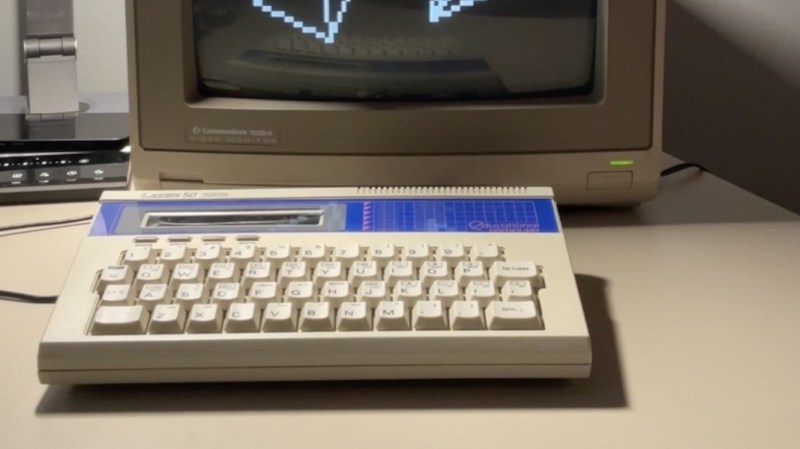
Back in the 80s, buying a home computer could easily mean an inflation-adjusted cost of thousands of dollars (or your equivalent currency unit of choice), and all for an 8-bit machine that might not have a hard drive and almost certainly didn’t connect to a network. Here in the future it’s easy to get spoiled by all the computing power and inexpensive devices practically falling into our laps, but using some modern low-cost microcontrollers can connect us to our early computing roots like [Joe]’s latest Arduino-based computer.

Taking design an engineering cues from computers like the Timex Sinclair 1000, Commodore PET, and TRS-80 MC-10, this computer uses a trio of Arduinos to accomplish what the best computer manufacturers once did with tons of integrated circuits. An Arduino Due handles all of the processing and traditional computing tasks, including a somewhat customized BASIC implementation, while an Uno performs audio processing duties. Taking care of the video processing is the much more capable Arduino Mega, outputting 40×25 monochrome NTSC composite video at 8×8 character resolution. There’s even WiFi courtesy of an ESP32 — certainly an upgrade compared to the source material.

After booting it up, the user gets a Commodore-like experience that replicates the 80s computing era quite well, and is even built inside its own keyboard case just like that era of computers usually were. [Joe] plans to release all three firmware images and the Python script used to get files onto the faux-retro machine, so keep an eye out for that.

In the event that you used rubles instead of dollars to pay for your expensive 8-bit machines back in the 80s, this computer might be more up your alley instead.

Hack a Day 27 May 16:30

An Arduino From The Distant Past

Arduinos are a handy tool to have around. They’re versatile, cheap, easy to program, and have a ton of software libraries to build on. They’ve only been around for about a decade and a half though, so if you were living in 1989 and wanted to program a microcontroller you’d probably be stuck with an 8-bit microprocessor with no built-in peripherals to help, reading from a physical book about registers and timing, and probably trying to get a broken ribbon cable to behave so it would actually power up. If you want a less frustrating alternate history to live in, though, check out the latest project from [Marek].

He discovered some 6502 chips (Polish language, Google Translate link) that a Chinese manufacturer was selling, but didn’t really trust that they were legitimate. On a lark he ordered some and upon testing them he found out that they were real 6502s. Building an 8-bit computer is something he’d like to do, but in the meantime he decided to do a project using one of these chips as a general-purpose microcontroller similar to a modern Arduino. The project has similar specs as an Arduino too, including 8kB of RAM memory, 8kB of I/O address space, and various EPROM capabilities. [Marek] went on to build a shield board for it as well, for easy access to some switches and LEDs. It’s a great build that anyone interested in microcontrollers should check out.

Keep in mind that an ATtiny45 has 8 bits like the 6502 but only costs around $1 USD, whereas a 6502 would have cost around $200 in today’s dollars. It’s really only in modern times that we can appreciate the 6502 as a cheap 8-bit microcontroller for that reason alone, but we can also appreciate how it ushered in a computer revolution since competing Intel and Motorola chips cost around six times more before it showed up. They became so popular in fact that people still regularly use them to build retrocomputers of all kinds.