Posts with «arduino ventuno q» label

Smart Mirror: local visual AI turns a mirror into a style consultant

The Smart Mirror turns a mirror into a style consultant. With a tap on Scan your look, a USB camera frames the garment being worn and the system recognises its colour and type, then suggests how to complete the outfit. The example runs on the Arduino VENTUNO Q board and shows how local visual AI can become part of a context-aware retail experience. Here the inference happens on the board, not on a remote server: images never leave the device, so privacy and latency stay under control.

The flow is linear and reads well from start to finish. A USB camera provides a live video stream, and the most recent frame is saved into a shared buffer. When Scan your look is tapped, the last frame is analysed locally on the VENTUNO Q board by the Qwen3-VL model, accessible through the Arduino VLM Brick. The model identifies the main garment and its colour and returns two short sentences: a description of the outfit and a style suggestion.

Two App Lab Bricks and an MJPEG stream to the browser

The result is sent to the browser and shown over the live camera view. The browser displays the live feed through an MJPEG stream exposed by the backend. The application therefore uses two App Lab Bricks: the Vision Language Model Brick and the Web Interface Brick. The first handles frame analysis, the second the page and the stream. The prompt behaviour can also be customised through a single configuration file, prompt.py.

Arduino VENTUNO Q as the compute board

  • USB camera for the live video stream
  • Arduino VLM Brick to access the model
  • Vision Language Model Brick for frame analysis
  • Web Interface Brick for the page and MJPEG stream
  • prompt.py to customise the prompt

Anyone who wants to rebuild the project will find the parts list here is fairly short overall. The VENTUNO Q board is the heart of the system, while the USB camera is the only sensor required. The Qwen3-VL model does not need training: it is used as it is, through the Arduino VLM Brick.

The physical assembly is not described in the example: the system relies on a USB camera connected to the VENTUNO Q board and on a backend that exposes the MJPEG stream. The rest, from the framing to the physical mirror, depends on how you want to build the mount. The software side, on the other hand, is all inside the two Bricks and the prompt.py file.

What changes with visual AI inference running locally

The interesting point is not the individual style suggestion, but where it is computed. The Qwen3-VL model runs on the VENTUNO Q board, so no image of the garment being worn is sent to a cloud service. As a result, latency stays low and privacy is simpler to guarantee: what the camera sees does not leave the mirror. The system also works without an internet connection, because inference is local.

The complete flow can be summed up like this: the camera produces the frames, the shared buffer holds the most recent one, the model analyses it on request and the browser shows the result over the live video. Every step stays on the board or on the local network, and the tap on Scan your look is the only trigger for the analysis. If you want to see how the project is built and which files it uses, the post on the Arduino blog is the place to start.

For those working in retail or in the maker world, this Smart Mirror is a concrete example of how local visual AI can power a complete, real-time user experience. No cloud is needed, no fast connection is needed, no images travelling outside the home are needed. A USB camera, a VENTUNO Q board and two well-chosen Bricks are enough.

Source: https://blog.arduino.cc/2026/09/23/making-retail-smarter-build-context-aware-experiences-with-the-arduino-ventuno-q-board/

The post Smart Mirror: local visual AI turns a mirror into a style consultant appeared first on Open Electronics.
A letter to our community: VENTUNO Q reaches its official price

Dear Builders, Engineers, and Innovators,

At Arduino, we have always believed that the most powerful technology should be in the hands of the many, not the few. That belief is the very reason VENTUNO Q exists, to put real AI into the hands of more creators. This includes access to the product itself, and when we introduced VENTUNO Q back in March we made the promise of an introductory price of under $300. A promise we honored when we made the product available for order in August for $299.

The cost of the many key components that make a board like this possible, in particular memory modules, has risen sharply across our entire industry, and continues to climb. We absorbed those increases for as long as we possibly could, because a commitment is a commitment, and your response made every bit of that effort worthwhile. VENTUNO Q sold out (twice!) in no time at all, and the orders have not stopped since. To everyone who pre-ordered, built, and believed in this board from day one, thank you! You proved what we hoped: that there is a real, deep hunger for open, powerful, physical AI.

But, what moves me most is not the numbers, but what you are already doing with it. In these first weeks we have begun to see projects arrive from our online community, and in person at events: Agentic AI reasoning assistant, depth camera multitool, industrial production line vision inspection, humanoid service robot, JetArm face-tracking, voice control, etc. You even have Half Life 2 & Skyrim running on it. From personal robotics experiments to serious edge AI industrial applications, this range of ideas is exactly why the VENTUNO Q exists. Take a look at what the community is already making, it’s truly impressive!

So here is where we stand. From October 19, VENTUNO Q graduates from its special introductory price to its official retail price, at $399. This is not a number we chose lightly, it is the honest price of delivering this AI computer, and this much ambition, in today’s market. If you have already pre-ordered VENTUNO Q, nothing changes for you, the introductory price will be honored in full.

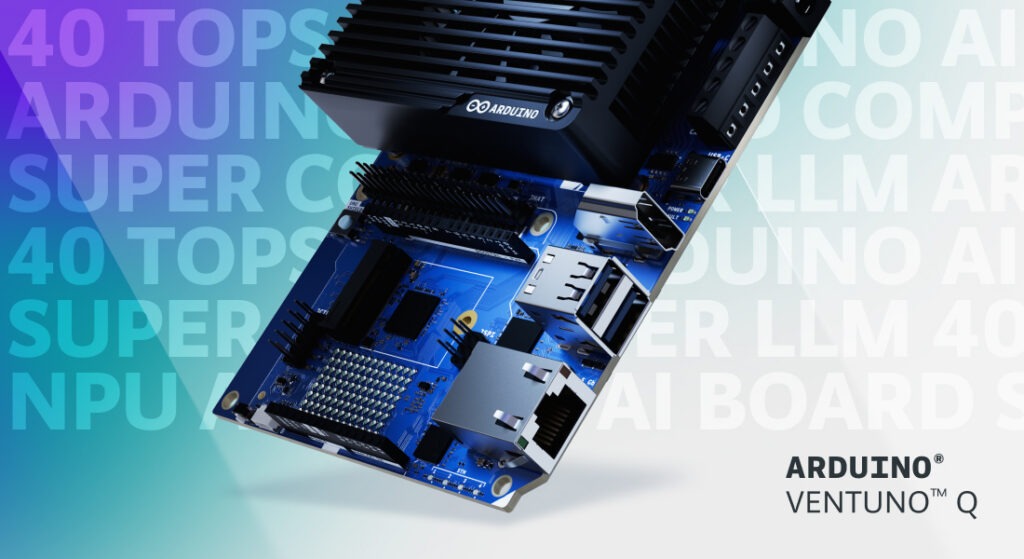
What I want you to know is this: at $399, VENTUNO Q still delivers unprecedented value. In a single open platform, it brings together an Qualcomm® Hexagon NPU rated at 40 dense TOPS for local LLMs and vision AI running on-device, a dedicated STM32H5 sub-millisecond brain to act on the physical world, 16 GB of RAM, and a genuine path from prototype to production through the Works with Arduino program powered by Qualcomm Dragonwing processors.

And we are only getting started. The board you hold is one half of the story; the software keeps evolving continuously and at no extra cost. Our next Arduino® App Lab release will bring new AI models, support for 3rd-party accessories like the Raspberry Pi HATs and MIPI CSI cameras, and many more new features. Qualcomm® Linux® software stack support for VENTUNO Q is already live in beta on GitHub for you to experiment with today. There is a lot more on the way in the coming weeks. So stay tuned.

Thank you, as always, for the trust you place in Arduino. I cannot wait to see what you build next.

Marcello Majonchi
Chief Product Officer, Arduino

Get VENTUNO Q from the Arduino Store. Also available from our official distribution partners: Conrad, DigiKey, Mouser, Farnell, RS, Robu.in, and many others worldwide.

Qualcomm branded products are products of Qualcomm Technologies, Inc. and/or its subsidiaries. Arduino, VENTUNO, and Works with Arduino are trademarks or registered trademarks of Arduino S.r.l. Linux® is the registered trademark of Linus Torvalds in the U.S. and other countries.

The post A letter to our community: VENTUNO Q reaches its official price appeared first on Arduino Blog.

SO-101 Robot Arm Meets Arduino VENTUNO Q: Local-AI Pick-and-Place

An SO-101 robot arm, originally a desktop toy, now picks and places rubber ducks by reasoning with a vision-language-action model. Dmitry Maslov’s project swaps the original brain for an Arduino VENTUNO Q board, which runs Hugging Face’s SmolVLA model locally. The result shows that robotics tasks combining vision and language, once confined to costly labs, now fit on a 299-dollar board.

Hardware: two processors on one board

The Arduino VENTUNO Q board has a dual nature. On one side sits an SBC system with a Qualcomm Dragonwing IQ8 processor, equipped with an Adreno 623 GPU and a Hexagon Tensor NPU, built for AI processing. On the other side is an STM32H5F5 microcontroller with an Arm Cortex-M33 core running at 250 MHz, which handles real-time servo control. The board offers 16 GB of LPDDR5 RAM and 64 GB of integrated eMMC storage.

The original SO-101 arm carries gearmotors on every joint and two cameras: one fixed overhead and one on the gripper. The images and joint position data go to the Dragonwing IQ8 processor, where the SmolVLA model interprets them. The model was trained with 50 demonstrations of the task of grabbing and moving the rubber ducks.

The SmolVLA model and the system’s numbers

SmolVLA is an open source vision-language-action model from Hugging Face. It processes the camera images and joint data, then produces the commands for the servo motors. All the processing happens locally on the VENTUNO Q board, with no connection to external services. The board costs 299 dollars, against 399 dollars for the Jetson Orin Nano Super Developer Kit, cited as a competitor.

Dmitry Maslov’s system points the way to accessible robotics. What’s more, the fact that the model runs on a commercial board costing less than 300 dollars opens up new scenarios for makers. For anyone who wants to see the project in action, Dmitry Maslov’s video shows the arm grabbing and moving the rubber ducks.

  • Arduino VENTUNO Q board with Qualcomm Dragonwing IQ8 processor and STM32H5F5
  • Hugging Face SmolVLA model running locally
  • 50 demonstrations to train the pick-and-place task
  • Two cameras: one overhead and one on the gripper
  • 16 GB of LPDDR5 RAM and 64 GB of eMMC storage

For anyone wanting to rebuild the project, the trickiest part is the integration between the SBC side and the microcontroller side of the board. The Dragonwing IQ8 processor runs the model, while the STM32H5F5 controls the servos. Communication between the two sides is essential to synchronise vision with movement.

Source: https://youtu.be/T0frBNASr3M?si=Wf1VPI8SoJ6tr18p

The post SO-101 Robot Arm Meets Arduino VENTUNO Q: Local-AI Pick-and-Place appeared first on Open Electronics.