Doubling down on solar power density with the Arduino® GIGA R1™ WiFi board
As global adoption of solar energy continues to accelerate, researchers and engineers face a fundamental spatial challenge: how do you generate more electricity without consuming more land?
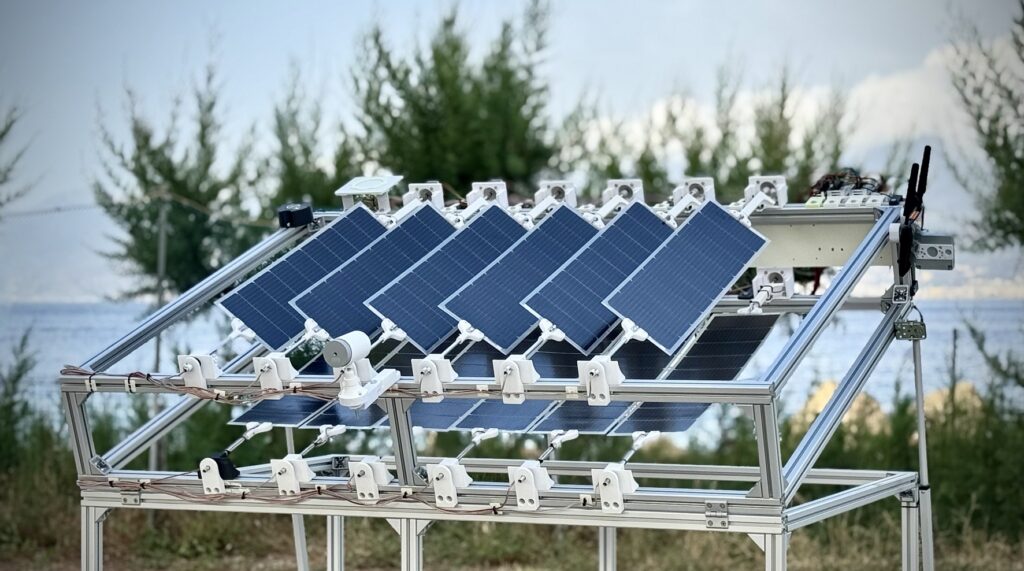
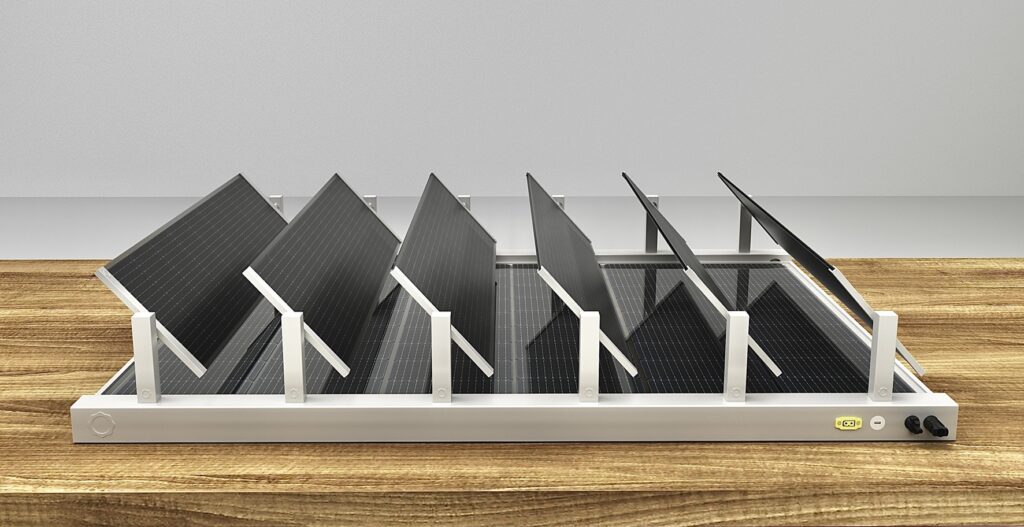
Cosimo Borrello and Ferdinando Gioia – co-founders of the Italian photovoltaic technology startup A.M.P.S. – together with a team of researchers from the “Mediterranea” University of Reggio Calabria developed and field-tested a dynamic double-layer photovoltaic prototype designed to maximize solar power output per square meter of ground area.
The challenge: overcoming land constraints
Conventional single-layer solar farms require significant spacing between rows to avoid mutual shading during solar tracking. While tracking raises energy yields per module, the extra space reduces overall energy production per unit of land.
To solve this, the innovators at A.M.P.S. and the university stacked two vertically aligned layers of bifacial solar mini-modules within the exact same ground footprint as a single-layer setup. Rather than accepting the inevitable shadows cast by the top layer onto the bottom layer, the team implemented independent solar tracking for the stacked panels. By dynamically controlling panel rotation, the system is built to actively manages mutual shading while harvesting direct, diffuse, and reflected sunlight across both active surfaces.
The brain behind the setup: GIGA R1 WiFi
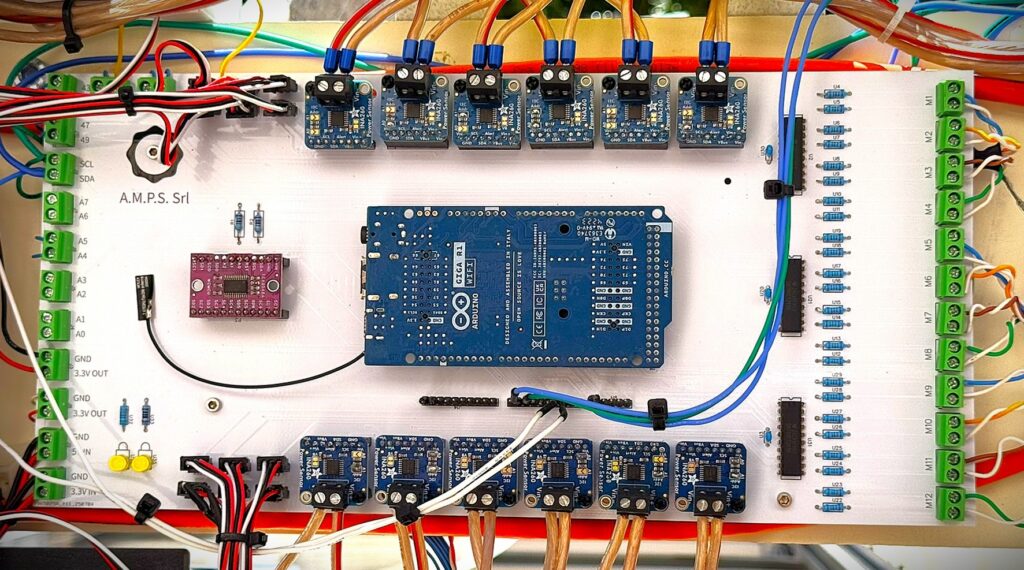
At the core of the experimental testbed in Reggio Calabria, Italy, is a GIGA R1 WiFi. Installed on a custom-designed control PCB, it acts as the central embedded manager for the entire installation:
- Automated motion control: It is structured to coordinate twelve Nema23 stepper motors via dedicated DM542T drivers to independently adjust the rotation angles of twelve bifacial mini-modules across both layers.
- Independent current sensing: It is engineered to acquire real-time current measurements from twelve INA260 sensors attached to each module to track energy performance.
- Remote data logging: It is constructed to process the synchronized current sweeps and uploads the experimental data directly to a remote server for analysis.
“We chose the GIGA R1 WiFi because it brings together everything a prototype like ours needs, with lots of I/O, a fast dual-core microcontroller and built-in Wi-Fi on a single board,” Cosimo told us. “We had to drive twelve stepper motors independently, read twelve limit switches and twelve current sensors, and send the data to a remote server, and very few boards can handle all of that on their own. Having used an Arduino Mega board in many past projects, GIGA R1 was the natural next step, with the same familiar format and far more power and connectivity. It gave us a reliable control platform quickly, so we could focus on the photovoltaic research rather than on the electronics.”
Real-world results and future applications
In field testing under clear-sky conditions, with the top layer tracking the sun and the bottom layer fixed, the researchers reported the following increases in short-circuit current, a test measurement that is not the same as total energy production, compared with a fixed single-layer installation occupying the same ground area:
- About +42% relative to a monofacial single-layer installation.
- About +27% relative to a bifacial single-layer installation.
- About +39% and +25% respectively with a simplified open-loop tracking model based on a five-parameter sigmoid function, which the researchers reported were close to the results obtained using closed-loop control.
The researchers identify potential applications ranging from compact rooftop modules for space-constrained urban environments to utility-scale plants and agrivoltaics. In agricultural settings, the dynamic rotation of both layers may also allow operators to adjust the amount of natural sunlight reaching crops, although these applications were not evaluated in the reported field test.
By serving as a reliable control platform, GIGA R1 WiFi helped enable the team to move rapidly from concept to field validation – demonstrating how accessible open-source hardware can support advanced research in clean energy and land-use efficiency.
Want to explore the mathematical models, control algorithms, and complete test data? Read the coverage on PV Magazine or dive into the full published paper in Renewable Energy.
Arduino, Arduino Mega, GIGA R1 are trademarks or registered trademarks of Arduino S.r.l.
The post Doubling down on solar power density with the Arduino® GIGA R1™ WiFi board appeared first on Arduino Blog.