MLB The Show 22will arrive on April 5th and, for the first time in the series, you'll be able to play on Nintendo Switch. There will be full cross-platform support between Switch, PlayStation and Xbox. You'll be able to transfer Road to the Show or Franchise save files between platforms and have access to items across various consoles (though Xbox Series X/S and PS5-exclusive content will remain locked to those systems).
As with last year's edition, which was the first to land on Xbox, MLB The Show 22 is coming to Xbox Game Pass on its release day. That continues an unusual arrangement where a Sony-published title is available to Game Pass members at no extra cost. Subscribers can play via the cloud as well as on consoles.
This year's cover athlete is Los Angeles Angels megastar Shohei Ohtani. The pitcher and designated hitter had an incredible 2021 season, racking up 46 home runs and 156 strikeouts. It's pretty hard to imagine anyone else gracing MLB The Show 22'scover.
Hazelight Studios and Sonic the Hedgehog production company dj2 Entertainment are aiming to turn It Takes Twointo a movie or TV show. Pat Casey and Josh Miller, who wrote both Sonic movies, are onboard to adapt the co-op game for the big or small screen. Although no studio or network has snapped up the project just yet, Varietyreports that a bidding war is underway.
“Creating the world and story in It Takes Two was so much fun for me and the team,” Hazelight founder and creative director Josef Fares said in a statement. “Since it has a strong narrative with many crazy characters and just as crazy co-op action moments, the potential is huge for a great adaption to film or television.”
Although It Takes Two received widespread plaudits for its platforming and asynchronous split-screen gameplay, several critics took issue with the "stay together for the kids" story and an "awful" character called The Book of Love. With some finding the plot to be the weakest aspect of the game, it'll be interesting to see how that translates to a movie or TV show.
If you've noticed that Apple's two-factor authentication texts include much more extra text than you're used to, don't fret — there's a good reason for it. As Macworldexplains, Apple has implemented a previously proposed system that uses domain-bound codes for sign-ins. The extra tags (such as "@apple.com #123456 %apple.com") are meant to improve the trustworthiness of autofilling text codes in platforms starting with iOS 14, iPadOS 14 and macOS Big Sur.
The technique theoretically discourages more sophisticated phishing attacks that try to intercept and redirect two-factor verification messages. If you're using one of those more recent operating systems, you'll only get a code autofill suggestion if the domain of the site requesting a code matches the one in the text. A phishing site can't simply prompt Apple for a code and expect an autofill prompt, then. If you don't get an autofill prompt, there's a good chance the site is bogus.
Apple quietly started delivering codes in the new format around November 2021. The concept isn't necessarily limited to Apple's ecosystem, but it has yet to be widely adopted elsewhere. Still, don't be surprised if these lengthy 2FA texts become more commonplace and potentially thwart some phishing campaigns.
If the company formerly known as Facebook is going to help establish the metaverse, it's going to need virtual personas that are consistent across its apps — and it now has just that. As of today, Meta is rolling out updated 3D avatars to Facebook, Messenger and Instagram (via DMs and Stories). The new design lets you bring the same avatar across Meta's platforms, including VR — you can maintain your look as you switch to your Quest 2 and back.
The avatars themselves promise to be truer to your style with more faces, skin tones and expressions. You can also add Cochlear implants, over-the-air hearing aids and wheelchairs. Meta is also being more adventurous with clothing. You can now pick up official NFL apparel (shown above) to flaunt your love of football ahead of the Super Bowl.
You can still create different avatars for Facebook, Instagram and VR, so you can have a more realistic persona for VR meetings and a more fantastical one for your social media profiles. Meta has also promised to "eventually" simplify moving avatars across places, and already lets you sync avatar changes between Facebook and Instagram.
Meta acknowledged the unified avatars were an "early step" in creating the metaverse. This doesn't suddenly create a truly cohesive and immersive digital space. It's a start, though. If nothing else, it provides consistency that might encourage you to try an avatar instead of sticking to a favorite photo.
A single-player version of the card game Gwentis in the works. CD Projekt Red said the standalone title, which is currently codenamed Project Golden Nekker, will be released this year. Although the developer has already released a single-player component of Gwent called Thronebreaker: The Witcher Tales, it says the upcoming game will be a distinct experience.
“It’s not another Witcher Tales but something different,” Gwent communication lead Paweł Burza told IGN. “We’re aiming to provide a captivating single-player for players who prefer it over competitive multiplayer Gwent.”
CDPR has been teasing Project Golden Nekker over the last several months, including in a Gwent roadmap presentation in December. It hasn't revealed many more concrete details beyond the release window and some concept art.
As for Gwent, itself a spin-off from The Witcher 3: Wild Hunt, CDPR plans to add new cards throughout the year. The studio is also aiming to release the delayed current-gen console versions of The Witcher 3 and Cyberpunk 2077 in 2022.
Respawn is continuing to expand Apex Legendsbeyond its battle royale roots. The studio is launching its first big team mode, Control, as a limited-time feature available starting February 8th. The mode will sound familiar if you've played Destiny's Control or other hold-the-points gameplay formats. Two teams of nine players each vie to capture and keep up to three zones, with infinite respawns for every player. Those zones will confer benefits like they do in other games, but the nature of those benefits is different — there's a strong incentive to focus on territory rather than wiping out the enemy team.
Every zone your team owns will add points each second, up to a score limit of 1,250. You'll randomly encounter "Capture Bonuses" that deliver a wealth of points if your team holds a given zone when the bonus timer runs out. Own both the center point and your team's home point and you can spawn in that middle ground. And if you manage to capture all three points, you'll start a "Lockout" that guarantees a win if those points are yours when a timer expires. A lopsided match shouldn't drag on longer than necessary, to put it another way.
Control also introduces a ratings system where players can progress through tiers the more they accomplish for the team in a given life. You'll earn use of your ultimate ability every time you move up a tier, so there's plenty of motivation to stay in one piece. Respawn is promising Control-specific badges and challenges for those interested in longer-term goals.
And yes, there's a new Apex character. The game is introducing Mad Maggie, a seemingly Mad Max-inspired, Australian-sounding warlord who has been sentenced to fight in the Apex games. Much like Caustic, her abilities reflect her willingness to leave morality at the door — Riot Drill forces enemies out of cover by burning them, and Wrecking Ball produces boost pads while also exploding near foes. She can also highlight enemies she shoots, and moves more quickly while using shotguns.
It's too soon to know if Control will become permanent like Arenas. Respawn's strategy is clear, however. Modes like this potentially keep Apex fresh for veteran players, and might expand the audience to newcomers who aren't fans of the original game's last-one-standing experience.
Game day is right around the corner, which means it’s one of the best times of the year to upgrade your TV. Aside from the holiday shopping season, the few weeks leading up to the Super Bowl have some of the best TV deals you’ll find throughout the year. Sets from Samsung, LG, Hisense and others can be hundreds of dollars off and you can even find devices like soundbars and streamers for less, too.
Just keep in mind that often the best discounts will be on more expensive TVs. That’s great if you’re looking for a high-end or very large television for your living room, but not ideal if you’re on a strict budget. But retailers like Amazon and Best Buy still have a bunch of TVs under $500 that are worth considering if you don’t want to spend too much — and it's possible to save money on those, too.
If you’re going to upgrade this year and plan to order online, we recommend doing so soon so you can have the new tube delivered and set up before game day arrives. Here are the best Super Bowl TV deals we could find, plus a few other home entertainment sales that are worth considering.
50-inch Samsung Class 7 4K smart TV
This highly-rated 50-inch Samsung 4K TV is $80 off and down to $400. This Tizen set has a crystal display plus support for HDR, Motion Rate 120 and Game Enhancer.
Hisense's 55-inch Quantum Dot 4K TV is 30 percent off and down to just under $600. It packs a lot of value into a relatively affordable TV — the set supports a 120Hz native refresh rate, Dolby Vision and Atmos, 1,000 nits of peak brightness and Game Mode Pro, the latter of which makes use of HDMI 2.1, low latency mode, variable refresh rates and more.
Samsung's 2021 55-inch Neo QLED smart TV is $300 off and down to $1,300. It uses Quantum Mini LED technology to improve details in both dark and bright scenes, and it supports things like 4K AI upscaling, Quantum HDR, 120Hz refresh rates, FreeSync Premium Pro and more.
Samsung's 65-inch Frame set is down to a record low fo $1,500, which is $500 off its normal price. In addition to 4K support and Quantum Dot technology, the Frame TVs have Art Mode, which lets you show pieces of art on the screen when you're not using it.
LG's 65-inch C1 OLED set is on sale for $1,800, or $300 off its normal price. In addition to excellent contrast, intense colors and webOS 6.0, it supports HDMI 2.1, NVIDIA G-Sync and FreeSync Premium for a better gaming experience along with Google Assistant and Amazon Alexa voice commands.
This 75-inch Hisense set is down to $2,000, or $1,000 off its normal price. It uses a luminance control panel behind the 4K screen to manage color more accurately, plus it has high contrast and up to 1,000 nits of peak brightness. The set also supports HDR, Dolby Vision, 120Hz refresh rates, low latency mode, VRR and more.
This large Sony OLED smart TV has been discounted by $600, bringing it down to $2,900. It uses Sony's Cognitive Processor XR for strong performance and Acoustic Surface Audio+ for immersive sound, plus it supports 4K AI upscaling, XR Motion Clarity, HDMI 2.1 and more.
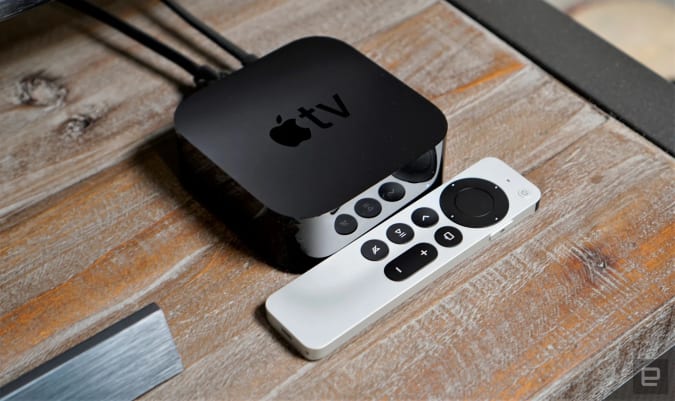
The latest Apple TV 4K is on sale for $160, or $20 off its normal price. While the 2021 version isn't drastically different from the previous model, its new Siri remote is a big selling point. We gave it a score of 90 for its speedy performance, HomeKit integration and the easy of use that comes with the improved Siri remote.
The Streambar Pro is $30 off and down to an all-time low of $150. It has all of the features that the standard Streambar does along with four 2.5-inch full range drivers, private listening and a lost remote finder in the Roku mobile app.
Amazon's Fire TV Stick 4K has been discounted to $30, which is 40 percent off its normal price. This gives you 4K streaming with Dolby Vision in an ultra-compact package, and the stick also supports Dolby Atmos audio and Alexa voice commands.
The Fire TV Cube is down to $85, or only $10 more than its record-low price. Despite being a few years old, it's still a strong set-top box and the most powerful in Amazon's lineup. It supports 4K HDR streaming, Dolby Vision and Atmos, HDR10+ and Alexa controls for both your TV and compatible smart home gadgets.
Optoma's CinemaX P2 projector is $800 off, bringing it down to $2,499. This earned a spot in our best projectors guide thanks to its 3,000 lumen brightness, improved color accuracy and 80 percent DCI-P3 coverage.
Starting today, owners of non-Tesla electric vehicles can juice up their batteries at select Superchargers in France and Norway. Drivers can find eligible locations in the Tesla app. Based on screenshots Tesla shared, there are 20 such sites in France and 15 in Norway.
Tesla started opening up broader access to its Supercharger network in November. It initially allowed drivers of non-Tesla EVs to charge their car at 10 stations in the Netherlands. The pilot is open to EV drivers who live in the Netherlands, France, Norway, Germany and Belgium.
Only CCS-enabled vehicles are supported for now. Tesla owners will still be able to charge at Supercharger stations as normal, though drivers of other EVs will need to pay some additional fees to "support charging a broad range of vehicles and adjustments to our sites to accommodate these vehicles."
The company said it will keep an eye on possible congestion at each site. Future expansion of the pilot will depend on capacity, though Tesla said that "more customers using the Supercharger network enables faster expansion." It aims to eventually open all of its sites to all EV owners. Tesla said it has long been its ambition to open Supercharger locations to non-Tesla EVs to boost the overall availability of charging locations and encourage more drivers to opt for an electric vehicle (while earning some more scratch, of course).
Pinterest is expanding its augmented reality “try on” feature to home furniture. With the update, users will be able to preview how furniture and other home decor will look in their space.
The company has teamed up with major retailers, including Wayfair, Crate & Barrel, Macy’s and Target, which have made more than 20,000 products to the service. And, like Pinterest’s earlier AR try-on features for beauty products, the new furniture pins are shoppable, so users can buy the items they are trying out.
Pinterest isn’t the first to use augmented reality for furniture shopping — Ikea introduced an AR-powered app in 2017 — the app is also able to recommend specific items based on your previous searches and pins you’ve saved. “Home decor and redesigning and planning for the future is one of the main things people come to Pinterest for,” says Jeremy King, Pinterest’s head of engineering.
While the new pins have an obvious benefit to retailers, King says the platform’s creators are also interested in the feature. Pinterest has been leaning into creator-centric features over the last year, and while AR shopping isn’t explicitly a creator tool, it gives the app’s lifestyle influencers another avenue to create (potentially monetizable) content.
And while the company has had shoppable AR for beauty products for years, the addition of furniture will vastly expand the number of shoppable pins with “try on” enabled, from 14,000 beauty pins to 80,000 home decor pins.
In addition to boosting Pinterest’s commerce features, having a catalog of shoppable AR objects would seem to make the service well-positioned for an eventual metaverse play, should one ever materialize. “We're definitely watching it,” King says of the metaverse. “The good news is all this technology translates exactly into the metaverse. I think it's on its way, but there's not a lot of people shopping for physical objects yet in the metaverse.”