Posts with «rover» label

An MSE-6 rover with Arduino UNO: autonomy, lights and rave mode

A robotic rover shaped like the iconic MSE-6 droid from Star Wars. It walks, avoids obstacles on its own and, when it feels like it, spins in place with flashing lights and music at full blast. It is Cass’s project, and under the shell there is an Arduino UNO Rev3.

The mechanical part is a 3D-printed shell that follows the lines of the screen droid. Inside fit the board, the motor driver, the audio module and the battery. So the rover is not just a styling exercise: it is a complete autonomous robot, with onboard power and sensors to move around without bumping into things.

Motors, ultrasonic sensor and L298N driver

Arduino drives a pair of motors through an L298N driver. The driver acts as a bridge between the board’s 5V logic and the current the motors need, so the UNO does not have to handle the load directly. To find its way, the rover relies on an ultrasonic sensor: it measures the distance to whatever is in front of it and, when the obstacle is too close, it changes direction.

The behaviour is simple but effective. Forward until the road is clear, then a turn to get around the obstacle and forward again. No map is needed, no GPS: the sensor mounted on the front is enough. For anyone who wants to rebuild the project, the ultrasonic module for measuring distance is the part to start from.

  • Arduino UNO Rev3 as the rover’s brain
  • L298N driver to control the pair of motors
  • Ultrasonic sensor to detect obstacles
  • DFPlayer Mini MP3 for the audio side
  • 5mm red LEDs for the visual effect
  • 7.4V lithium battery pack and 5V buck converter

7.4V power and a 5V buck converter

Power comes from a 7.4V lithium battery pack. The motors can run at that voltage, but the control electronics cannot: so a buck converter brings the voltage down to 5V for Arduino and the modules. This way the rover has a single energy source and two voltage levels, handled by one extra component but with clean wiring.

The logical heart is still the control board. In fact the Arduino Uno Rev3 board with Atmega328 is the one the project actually uses, and it is also the most convenient starting point for anyone who wants to change the firmware and add behaviours.

Rave mode: 5mm red LEDs and DFPlayer Mini

Besides normal driving, the droid has a rave mode. In that mode it spins in place, flashes the lights and plays music. The visual side is handled by arrays of 5mm red LEDs, while the audio goes through a DFPlayer Mini MP3 module; an equivalent is the UART-TTL MP3 module, which can be driven by Arduino over serial. So the rover does not just move around: it also becomes a bit of a showpiece.

To get the effect, the firmware alternates between two distinct behaviours: autonomous navigation with the ultrasonic sensor and spinning in place with lights and music. Switching between the two needs no extra hardware, just different handling of the motors and outputs. As a result the project stays simple to wire and to modify.

Anyone who wants to build it will find Cass’s step-by-step guide on Instructables a good reference to start from. There you will find the instructions to get to a working rover, from the shell to the electronics.

The nice thing about this project is that it comes from a prop. The MSE-6 droid was a small background robot in the Star Wars films, and here it becomes a custom maker rover, with autonomy, lights and a rave mode. An idea you can copy as it is or bend to your own taste, changing the shell, the colours or the light sequences.

Source: https://www.instructables.com/Autonomous-Mouse-Droid-With-Party-Mode

Related products

The post An MSE-6 rover with Arduino UNO: autonomy, lights and rave mode appeared first on Open Electronics.

3D Printed Arduino Bot is Limbo Master

As if we didn’t have enough to worry about in regards to the coming robot uprising, [Ali Aslam] of Potent Printables has recently wrapped up work on a 3D printed robot that can flatten itself down to the point it can fit under doors and other tight spaces. Based on research done at UC Berkeley, this robot is built entirely from printed parts and off the shelf hardware, so anyone can have their own little slice of Skynet.

On display at East Coast RepRap Festival

The key to the design are the folding “wings” which allow the robot to raise and lower itself on command. This not only helps it navigate tight spaces, but also gives it considerable all-terrain capability when it’s riding high. Rather than wheels or tracks, the design uses six rotors which look more like propellers than something you’d expect to find on a ground vehicle. These rotors work at the extreme angles necessary when the robot has lowered itself, and allow it to “step” over obstructions when they’re vertical.

For the electronics, things are about what you’d expect. An Arduino Pro Mini combined with tiny Pololu motor controllers is enough to get the bot rolling, and a Flysky FS-X6B receiver is onboard so the whole thing can be operated with a standard RC transmitter. The design could easily be adapted for WiFi or Bluetooth control if you’d rather not use RC gear for whatever reason.

Want to build your own? All of the STL files, as well as a complete Bill of Materials, are available on the Thingiverse page. [Ali] even has a series of videos on YouTube videos walking through the design and construction of the bot to help you along. Outside of the electronics, you’ll need a handful of screws and rods to complement the 50+ printed parts. Better start warming up the printer now.

As an interesting aside, we got a chance to see this little critter first hand at the recent East Coast RepRap Festival in Maryland, along with a number of other engineering marvels.

An Affordable Phone Controlled Rover

A while back Jason made a phone controlled rover using the MotorAir. He wanted to revisit the basic idea but using cheaper, more widely available parts. Also since this is Arduino based, it is a great springboard for more than just a rover that drives around. You could add sensors, servos, etc. to really drive this project in any direction you want.

https://youtu.be/Qx0tvpr2DNw

read more

Let's Make Robots 19 Feb 22:38

Would you like to invite my robot to visit your location on it's tour around the globe?

Primary image

What does it do?

Remote controlled through web interface

The idea in short:
I will send a robot around planet earth. The robot will be sent to you free of charge. Let it run in your area for 24h and show all earthlings your projects or a piece of your country. Send the rover to the next destination after your mission is over (postal charges will be refunded).
The robot can be controlled through a web interface while transmitting a live video stream. All young scientist and of course all discoverers that are young at heart get free access to the robots, there is even no registration needed.

Cost to build

$200, 00

Embedded video

Finished project

Number

Time to build

20 hours

Type

wheels

URL to more information

Weight

3300 grams

read more

Nerf-firing Rover

Primary image

What does it do?

Navigate via RC control, fires Nerf gun, supports autonomous control via Raspberry Pi

This rover makes use of the following:

CPPM RC radio input from openTx RC radio

Arduino Nano to handle communcations from RC, Raspberry Pi via USB (not attached  yet), I/O to servos via i2c, I/O to/from Roboclaw motor controller via serial (gets velocity from encoders on motors), and output to various DC-driven devices (headlight, gripper).

5.8ghz video transmitter for FPV roving

Cost to build

$600, 00

Embedded video

Finished project

Number

Time to build

50 hours

Type

wheels

URL to more information

Weight

read more

RobotShop Rover Development

Primary image

What does it do?

Tracked mobile platform using an Arduino USB microcontroller

The RobotShop Rover was largely created as an exercise in integration and when it was first released in 2009 there were not many commercial Arduino-based mobile rovers on the market. We wanted to make a mobile platform which incorporated both drive and servo motors, sensors, and was programmable using an Arduino. We also set out to keep the retail price between about $200 to $300.

Cost to build

$229, 00

Embedded video

Finished project

Complete

Number

Time to build

Type

URL to more information

Weight

read more

New Project: How to Build a Self-Balancing Autonomous Arduino Bot

Ready to level-up your robot skills? ArduRoller is a self-balancing, inverted pendulum robot that’s also capable of autonomous navigation indoors or out. I created it as an entry for the annual SparkFun Autonomous Vehicle Competition: The goal was to create a nontraditional vehicle capable of quickly navigating an obstacle course […]

Read more on MAKE

The post How to Build a Self-Balancing Autonomous Arduino Bot appeared first on Make:.

Four guys met at Arduino Day and now they are finalists at NASA Challenge

Last March, during Arduino Day in Zaragoza, four guys met for the first time and  then decided to participate to the Nasa Challenge collaborating to the project made by Carlos Sicilia Til in the previews months:

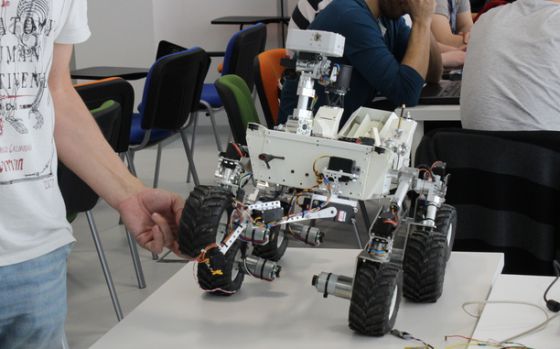
OpenCuriosity is an open source, exomars rover (1:5 scale) with Arduino as main controller, based on the NASA Curiosity Rover. It contains a set of Arduino boards and sensors. The general public will be allowed to use these Arduinos and sensors for their own creative purposes while they are in space. All the people will be allowed to integrate their project in the robot, and the data gathered will be available on the internet in order to share this information with the general public for educational, science or other purposes. We want to provide affordable space exploration for everyone!

The robot designed by the Aragonese team is now among the finalists of the NASA contest!

Read the details of the story on El Pais.

Arduino Blog 26 May 17:06
arduino  nasa  opensource  robot  rover  zaragoza  

MARS ROVER Autonomous Desert Roving Robot (Help Needed)

Autonomous Navigation Requirements Guy's I'm completely new to this and just ordered my first prototype kit with the following components as a starting point. 1. Arduino UNO Rev3 2. Dagu Rover 5 4wd 3. Parallax PING 4. Motor sheild kit In sum, here are my project requirements.  I've been searching the web and LMR to find snippets of code that I might be able to use and am now reaching out to the forum to see if anyone has any interest in sharing some more specific code for my prototype.

read more

Let's Make Robots 06 Mar 19:39
arduino  autonomous  avr  gps  rover