Congress is once again hoping to limit Section 230 safeguards under certain circumstances. Rep. Frank Pallone and other House Democrats are introducing a bill, the Justice Against Malicious Algorithms Act (JAMA), that would make internet platforms liable when they "knowingly or recklessly" use algorithms to recommend content that leads to physical or "severe emotional" harm. They're concerned online giants like Facebook are knowingly amplifying harmful material, and that companies should be held responsible for this damage.
The key sponsors, including Reps. Mike Doyle, Jan Schakowsky and Anna Eshoo, pointed to whistleblower Frances Haugen's Senate testimony as supposed evidence of Facebook's algorithm abuse. Her statements were proof Facebook was abusing the Communications Decency Act's Section 230 "well beyond congressional intent," according to Eshoo. Haugen alleged that Facebook knew its social networks were harmful to children and spread "divisive and extreme" content.
The bill only applies to services with over 5 million monthly users, and won't cover basic online infrastructure (such as web hosting) or user-specified searches. JAMA will go before the House on October 15th.
As with past proposed reforms, there are no guarantees JAMA will become law. Provided it passes the House, an equivalent measure still has to clear a Senate that has been hostile to some Democrat bills. The parties have historically disagreed on how to change Section 230 — Democrats believe it doesn't require enough moderation for hate and misinformation, while Republicans have claimed it enables censorship of conservative viewpoints. The bill's vaguer concepts, such as 'reckless' algorithm use and emotional damage, might raise fears of over-broad interpretations.
The bill could still send a message even if it dies, though. Pallone and the other JAMA backers argue the "time for self-regulation is over" — they're no longer convinced social media heavyweights like Facebook can apologize, implement a few changes and carry on. This won't necessarily lead to a more strictly regulated social media space, but it could put more pressure on social networks to implement far-reaching policy changes.
LinkedIn will shut down the Chinese version of its service later this year. The company cited "a significantly more challenging operating environment and greater compliance requirements in China" as the reasons for closing the local edition of its social network for professionals.
"While we’ve found success in helping Chinese members find jobs and economic opportunity, we have not found that same level of success in the more social aspects of sharing and staying informed," LinkedIn said in a statement. As such, the company isn't abandoning China completely. It's working on a standalone job board app called InJobs, which won't have a social feed or any way to share posts or articles.
LinkedIn agreed to adhere to state restrictions and block certain content when it launched in China in February 2014. However, some signs of trouble bubbled up this year. In March, the company prevented new Chinese users from signing up for a spell while it made sure it was abiding by the countries' laws. A couple of months later, China said 105 apps were violating data collection laws, including LinkedIn.
The Microsoft-owned service was the last major US social network that was still officially operating in China. The country banned Signal and Clubhouse earlier this year. Facebook and Twitter have been blocked there since 2009, and China barred Instagram in 2014.
Spotify is expanding US availability of its Car Thing, an $80 music and podcast player for vehicles. The company debuted the gizmo back in the spring on an invite-only basis and only charged users for shipping during a test phase.
Those who signed up for the Car Thing waitlist before now will get first dibs on the company's first hardware device. In addition, both free and Premium Spotify members in the country can now sign up for the waitlist, though the Car Thing requires a Premium subscription and a smartphone for connectivity. Everyone who signs up for the waitlist will eventually be offered a Car Thing.
Spotify worked on Car Thing for several years before it started shipping the device a few months ago. The idea is to bring infotainment features to almost any car, particularly older ones without newfangled touchscreens. Once you hook up Car Thing to your vehicle with the help of one of the included mounts, you can use it to play music and podcasts with either physical controls or "Hey Spotify" voice commands.
The fitness tracker isn’t dead, and if you’re reading this, you’re probably one of the people keeping these little devices alive. Smartwatches have all but taken over the mainstream wearable space, but the humble fitness tracker remains an option for those who want a gadget to do one thing right all the time. Despite the headwinds, there are still a bunch of fitness bands out there to choose from. Engadget has tested many of them and picked out the best for most people.
What do fitness trackers do best?
The answer seems simple: Fitness trackers are best at monitoring exercise, be it a 10-minute walk around the block or that half marathon you’ve been diligently training for. Obviously, smartwatches can do that too, but there are some areas where fitness bands have the upper hand: focus, design, battery life and price.
When I say “focus,” I’m alluding to the fact that fitness trackers are made to track activity well; anything else is extra. They often don’t have the bells and whistles that smartwatches do, which could distract from their activity-tracking abilities. They also tend to have fewer sensors and internal components, which keeps them smaller and lighter. Fitness trackers are also a better option for those who just want a less conspicuous device on their wrists all day.
Battery life tends to be better on fitness trackers, too. While most smartwatches last one to two days on a single charge, fitness bands will last five days to one week — and that’s with all-day and all-night use.
When it comes to price, there’s no competition. Most worthwhile smartwatches start at $175 to $200, but you can get a solid fitness tracker starting at $70. Yes, more expensive bands exist (and we recommend a few here), but you’ll find more options under $150 in the fitness tracker space than in the smartwatch space.
When to get a smartwatch instead
If you need a bit more from your wearable, you’ll likely want a smartwatch instead. There are things like on-watch apps, alerts and even more robust fitness features that smartwatches have and fitness trackers don’t. You can use one to control smart home appliances, set timers and reminders, check weather reports and more. Some smartwatches let you choose which apps you want to receive alerts from, and the options go beyond just call and text notifications.
But the extra fitness features are arguably the most important thing to think about when deciding between a fitness tracker and a smartwatch. The latter devices tend to be larger, giving them more space for things like GPS, barometers, onboard music storage and more. While you can find built-in GPS on select fitness trackers, it’s not common.
Engadget picks
Best overall: Fitbit Charge 5
Valentina Palladino / Engadget
Fitbit's Charge 5 has everything most people would want in a fitness tracker. First and foremost, it's not a smartwatch. That means it has a slightly lower profile on the wrist and lasts days on a single charge while tracking activity and sleep. It also has a full-color AMOLED display — a big improvement from the smaller, grayscale screen on last year's Charge 4. That display, along with a thinner design, make Charge 5 feel more premium than its predecessor.
But it also costs $180 — $30 more than the Charge 4 — and that's due in part to the design upgrades but also some additional features. The Charge 5 has EDA sensors for stress tracking and it will eventually support ECG measurements and Daily Readiness Scores (the latter is for only for Premium subscribers). Those are on top of existing features that were carried over from the Charge 4 — most notably, Fitbit Pay support and built-in GPS. The former lets you pay for coffee or groceries with a swipe of your wrist, while the latter helps map outdoor runs, bike rides and other activities. Built-in GPS remains the star of the show here — it's fast and accurate, making the Charge 5 the best option if you want a do-it-all wearable that’s focused on fitness.
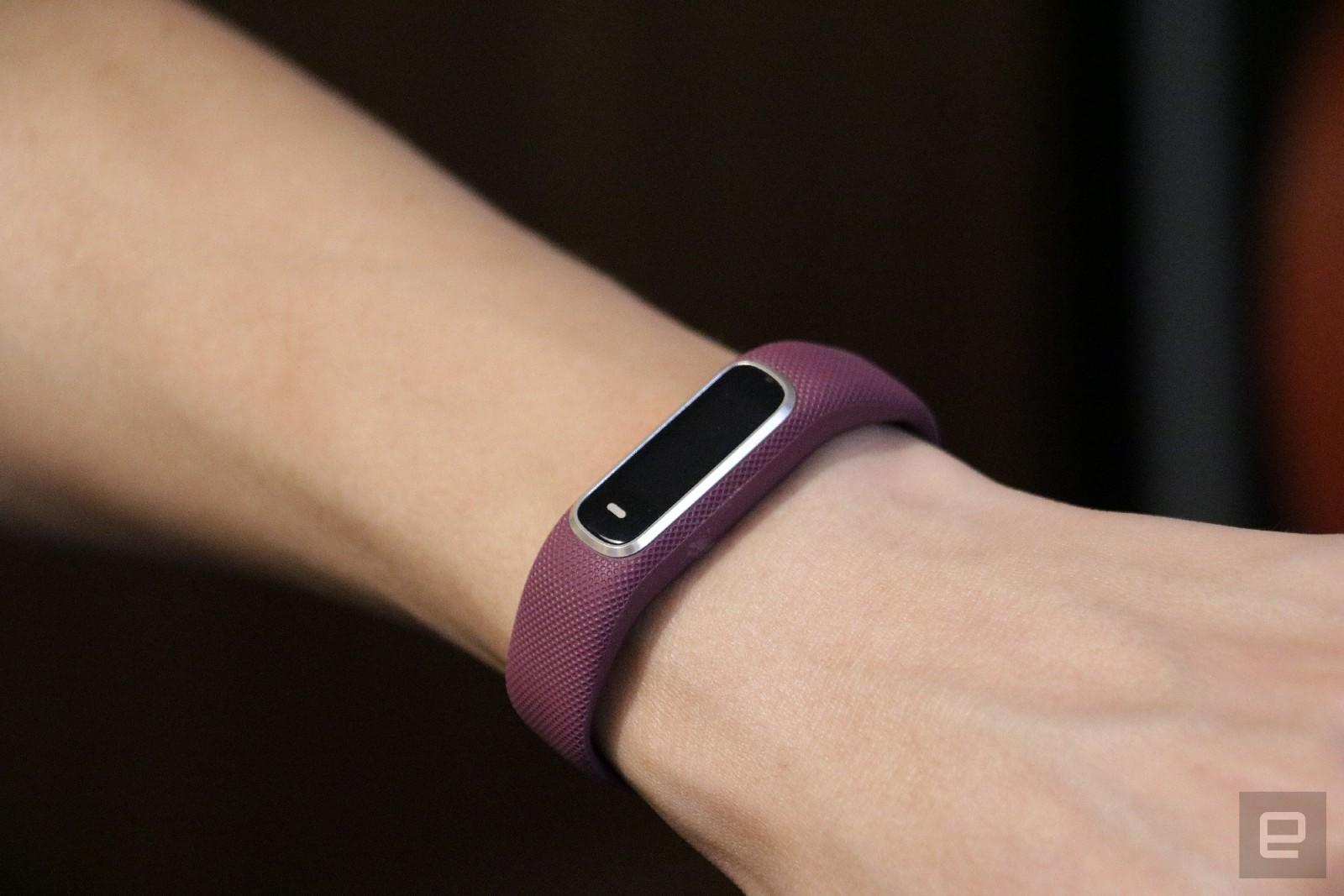
A more subtle-looking alternative is the $100 Garmin Vivosmart 4. It’s thinner than the Charge 5 and fits in a bit better with bracelets and other jewelry you might wear regularly. But its attractive design is only part of its appeal — Garmin knows how to track fitness, and the Vivosmart 4 is proof that you don’t need to drop hundreds on one of the company’s fitness watches to get a capable device.
Like the Charge 5, the Vivosmart 4 tracks all-day activity and sleep and has a pulse ox sensor for blood oxygen saturation measurements. It has only connected GPS capabilities, and it has universal music controls that can control the playback of most anything. The band is also waterproof and can track basic swim workouts, plus it also has a battery life of up to seven days. While it’s similar to the Charge 5 in that the Vivosmart 4 works with both Android and iOS devices, it’s a bit more flexible as it syncs with Apple Health (the Charge 5 and other Fitbit devices do not).
If you only have $100 to spare, the Fitbit Inspire 2 is the best option. It strips out all the luxury features from the Charge 5 and keeps only the essentials. You won’t get built-in GPS, Fitbit Pay or Spotify control but you do get excellent activity tracking, automatic workout detection, smartphone alerts and plenty more. As the updated version of the Inspire HR, the Inspire 2 includes a heart rate monitor, which the device uses to keep track of all-day heart rate, active zone minutes, sleep stages and more.
The Inspire HR is thinner than the Charge 5 but it also has interchangeable bands, so you can switch up its style whenever you feel like it. Its design is also swimproof, and it should last up to 10 days on a single charge. Fitbit also recently added Tile-tracking to the Inspire 2, allowing you to find your misplaced band using the Bluetooth locator feature and the Tile mobile app. All of these features make it the best value fitness tracker you can get.
The $60 Samsung Galaxy Fit 2 band is almost like a more affordable Garmin Vivosmart 4. The two trackers share the same skeletal design but the Galaxy Fit looks a bit more utilitarian — you can swap out its bands, though — something you can’t do on Garmin’s device.
We haven’t given the Fit 2 the full review treatment, but Engadget’s Cherlynn Low was impressed with the original Galaxy Fit: the Tizen-based interface is colorful and easy to use, and plenty of people will appreciate its durable, no-nonsense design. It tracks a bunch of workouts as well and even has auto-exercise recognition. That’s on top of its daily activity tracking and sleep monitor, all of which uses the built-in heart rate monitor to collect pulse data throughout the day.
The kicker for the Galaxy Fit 2 is battery life — the tiny tracker can last for up to 15 days on a single charge, and you can even extend it to 21 days if you change some settings. That’s much longer than most competing bands, so even if Samsung isn’t as comprehensive as Garmin or Fitbit is when it comes to fitness data collection and analysis, the Galaxy Fit 2 is a good option for those who want a basic tracker that they can safely forget to charge each night.
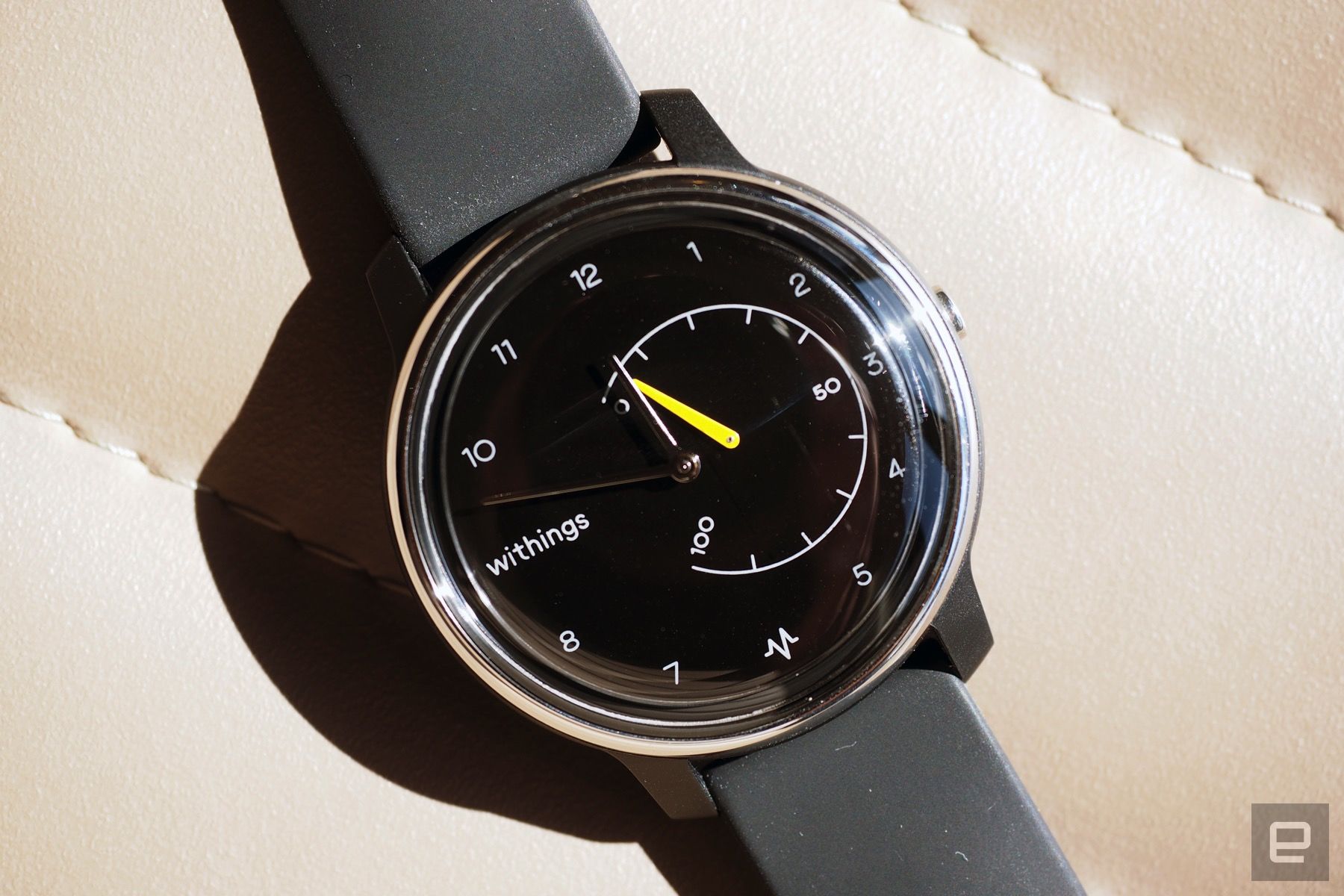
All of the previously mentioned fitness trackers are attractive in their own way (bonus points to those that have interchangeable bands), but they share a similar look. There aren’t many alternative designs for these devices anymore. The $70 Withings Move watch is an exception, and one of the most traditionally fashionable fitness trackers you can get. It’s an analog watch with a couple of health monitoring features including step, calorie, distance and sleep tracking, connected GPS, auto-recognition for more than 30 workouts and a water-resistant design. But we really love it for its button-cell battery, which can last up to 18 months before needing a replacement.
HTC is today launching a lightweight headset designed to split the difference between a standalone VR headset and a personal cinema. The HTC Vive Flow is a pair of glasses weighing just 189 grams (6.6 pounces) which pair with a smartphone to let you play some VR content or simply watch TV. It’s marketed as both a piece of tech to keep you entertained and a device to help you improve your mental wellbeing.
Naturally, the company doesn’t want to talk too much about the technology inside Flow, preferring to focus on what it can do. What we do know, however, is that it has two “1.6K” displays running at a 75Hz refresh rate and offering a 100-degree field of vision. There’s no battery per-se, except for a tiny cell designed to make sure that it’ll shut down safely if Flow is severed from whatever power source you've connected its USB-C cable to.
HTC
It’s in this regard that it’s set up more like a personal cinema than it is your standard VR headset, especially with the fairly narrow body. HTC spent a lot of time and effort shrinking the distance between the display and your eyes, and Flow uses a pair of diopter lenses up front. It means that short-sighted folks won’t need to wear their glasses when using Flow, since they can set the lenses up to suit their comfort level.
To ensure that Flow really is portable, HTC set a power budget of 7.5 watts, the upper limit for USB 3’s charging spec. It means you can run this thing off any compatible battery pack (or your phone, in a pinch) as well as a standard socket over a USB-C cable. Some of that juice goes to powering a small active fan in front of the nose, which pulls cold air over your face and pushes warm air out of the Flow’s top vents.
HTC
HTC also spent plenty of time talking about how the dual-hinge system will ensure that the Flow’s glasses-like frame will sit comfortably on anyone’s head. A pair of speakers embedded into the arms offer what we’re told is surprisingly high quality spatial audio, and beefy given their relative size. And since they sit on your head like regular glasses, you can wear them laying down should the need arise.
You can pair Flow with your smartphone over Bluetooth or Miracast (for watching protected content) and use the phone as a pointer inside VR content. That limits the number of experiences you’ll be able to enjoy with the gear, but you were hardly going to be able to play Half Life: Alyx on this thing anyway. A pair of camera lenses facing forward will, when the feature is ready, enable the Flow to track your hands for more immersive VR, too.
It's worth saying that this is not, and as I understand it, can never become an AR headset in its current form. Those lenses don't apparently offer much passthrough (beyond what's necessary for motion tracking) and this isn't designed for it anyway.
HTC says that the focus of Flow’s content on “wellbeing, brain training, productivity” and “light gaming,” with apps like Color Connect VR, Space Slurpies and VR meditation app Tripp. The headset will be able to access a special version of Viveport Infinity, offering a wide library of Flow-compatible content for a monthly fee of $5.99. The company added that if users wanted to meditate within the Flow towards the end of the day, a blue light filter will kick in to help ensure that you can get more restful sleep.
HTC
If you’re looking to get hold of an HTC Vive Flow, then pre-orders are opening from today, with shipping expected to begin in November. The price is $499, and for that you get the glasses and a soft carrying case thrown-in, but I’d strongly advise you to pre-order if you want one. Doing so entitles you to receive the flask-like hard carrying case, as well as seven pieces of additional VR content thrown in gratis.
Naturally, Flow has become something of a worst-kept secret in technology after many of these details were leaked ahead of time. One of the obvious sticking points is the higher price compared to the Quest 2, although HTC was clear to dispel the notion that the products were equals. Flow, after all, is a not a standalone headset, and HTC believes that the lighter, more elegant hardware will win it fans in the health and fitness market.
On October 18th, Apple will hold its second event of the fall and likely last event of the year. The invite the company sent out this time doesn’t provide any hints on what announcements we should expect, but thanks to a variety of leaks and reports, we have some good ideas about what it will show off.
MacBook Pro
Devindra Hardawar/Engadget
All signs point to new 14- and 16-inch MacBook Pro models headlining the event. Apple will reportedly turn back the clock on its flagship laptop, undoing many of the design features that have defined the line since late 2016. MagSafe may be back on the table, as well as an HDMI port and SD card slot. Oh, and the Touch Bar will apparently get the axe, with a standard set of function keys set to replace the OLED strip.
Beyond those changes, the new MacBook Pro is expected to feature thinner bezels. According to display analyst Ross Young, it could even come with a mini-LED panel capable of refreshing its screen at 120Hz. Ross suggests that’s a feature both models could include, but knowing Apple, it may be something that’s only available on the top-tier 16-inch model or an add-on that costs extra. Additionally, there have been reports of the 14- and 16-inch models supporting maximum resolutions of 3,024 x 1,964 and 3,456 x 2,224, which would be a major upgrade over the current 13- and 16-inch MacBook Pros.
Yes, new 14" and 16" MacBook Pro's will have miniLEDs and we believe they will also be 120Hz refresh.
Internally, the MacBook Pro will reportedly include Apple’s latest system-on-a-chip, possibly called the M1X. According to a recent report from Bloomberg’s Mark Gurman, there will be two variants of the M1X, with the main difference between the two coming down to the number of graphics cores they have at their disposal. In addition to delivering faster performance than the M1, the new chip could come with support for up to 32GB of RAM, making it a much better fit for work like coding and video editing.
Speaking of the M1X, it could tie into the other announcements Apple has planned for October 18th. In August, Gurman said Apple was working on a redesigned Mac mini that will include the new processor and add additional ports. At the time, he noted the desktop would launch sometime within the “next several months.” Recent reports suggest that a new Mac mini isn’t a guarantee for next week, but Apple could still surprise us. We know from Gurman and analyst Ming-Chi Kuo that Apple is also working on a redesigned MacBook Air, but the company reportedly won’t announce that device until sometime next year.
macOS Monterey
Apple
Given the timing of the event and the likely focus on Mac hardware, Apple will almost certainly announce a release date for macOS Monterey. The company previewed the next version of its desktop operating system at WWDC 2021, showing how features like SharePlay and Universal Control will build on the enhancements it introduced with Big Sur in 2020. We got a chance to preview the update this past summer and found it was a mostly subtle upgrade to Apple’s desktop OS. Still, we wager Mac fans will be excited to find out when they can download the software.
Everything else
We could also see the company announce a new set of AirPods to replace the current second-generation model. Apple hasn’t updated its original wireless earbuds since 2019 when it released a minor update that added support for inductive charging. Taking a page from the AirPods Pro, the new model is expected to feature an updated design with shorter stems, but they won’t include more premium features like ANC. In the lead-up to next week’s event, we’ve seen leaked images of the third-generation AirPods with both silicone ear tips and without. So it’s not clear just how heavily Apple plans to lean into the AirPods Pro design.
We’ll note here AirPods haven’t been a frequent feature of Apple’s hardware events. Outside of when it unveiled the earbuds back in 2016, Apple has announced all subsequent models, including the AirPods Pro and AirPods Max, through press releases. We can see the company doing the same here with the new “basic” model. One last thing the company could mention at the event is that Apple Music is coming to the PlayStation 4 and PS5. Given that you can already access Apple TV from Sony’s consoles, it’s not a jump for the streaming service to become available there as well.
So there you have it, that’s everything we see Apple potentially sharing on October 18th. As always, the company could surprise us, so you’ll want to visit Engadget on the day of the event. We’ll have comprehensive coverage of the company’s latest announcements.
Four years after Monument Valley 2 hit iOS and Android, Ustwo Games has added a new chapter. The developer released “The Lost Forest” as its contribution to Playing for the Planet’s Green Game Jam, which promotes tree conservation.
The chapter includes “four intimate scenes” and Ustwo hopes that by playing through them, people will be inspired to sign a Play4Forests petition to show their interest in protecting forests. Play4Forests is an initiative run by the United Nations’ climate and forest partnership and the Playing for the Planet Alliance. The goal is to work with major names in gaming to highlight the “importance of conserving and restoring forests.”
“Our forests, one of our best allies in fighting the climate emergency, are facing mounting threats,” the Play4Forests website reads. “Your voice can help secure a better future for forests and humans.”
It might initially seem unusual to bring extra content to a game like Monument Valley 2 four years later, but there’s an admirable reason in this particular case. Tiny Wings, a popular iOS title from a decade ago, was updated with more levels in 2016, so such a long gap between a mobile game’s release and more content isn’t exactly unheard of.
Don't be surprised if your Twitter feed is cluttered with more advertising than usual. The Vergereports that Twitter is testing a format that displays ads in the replies to a given tweet. As Revenue Product Lead Bruce Falk explains, those involved in the test will see ads under the first, third or eighth reply to a tweet. The experiment is worldwide and applies to both Android and iOS users.
Falck said the ad format produces value and "aligns incentives for creators and advertisers." However, he also acknowledged that it wasn't a surefire concept. Twitter would spend the "coming months" testing the frequency, layouts and other aspects of the ads to see how well they perform and affect the community. This could be helpful for advertisers, of course, but it might also lead to more compensation for Twitter users.
This probably isn't the sort of Twitter test you'd want to see, but it's not surprising. Twitter has been eager to find new sources of revenue for both itself and its most prolific users, ranging from Blue subscriptions to Tip Jar donations. Ads in replies could not only improve Twitter's bottom line, but attract creators used to making money from sponsored Instagram and TikTok posts.
Starting today, we’re trying something different and testing a new ad format in Tweet conversations. If you’re a part of this test (which is global; on iOS & Android only), you’ll see ads after the first, third or eighth reply under a Tweet. 🗣️ pic.twitter.com/kvIGeYt2vp
It's smart to try to get some of your holiday shopping done early this year and Amazon's making it a bit easier to do so for those looking for solid headphones and earbuds to gift. The online retailer has a big Bose sale going on right now that knocks up to 29 percent off a bunch of the company's audio devices. Key among them are the Bose QuietComfort earbuds, which are down to a record low of $199.
The QuietComfort earbuds give our favorite Sony pairs a run for their money, and we consider them to be the best option if you want to truly block out all surrounding noises. These buds shine in the ANC department with 11 levels of noise cancellation that you can choose from in its companion app, three of which you can assign to onboard controls for easy access. They block out the world better than all other true wireless earbuds we've tested — only Sony's WF-1000XM3 (and the newer XM4) even come close. Sound quality is also great and battery life is good at roughly seven hours. Our biggest complaints about the QuietComfort earbuds are that they are quite large (but not too heavy) and they have limited customizations and touch control options.
A couple of other Bose buds are on sale, too, including the Sport Open earbuds for $179. In many ways, these are the opposite of the QuietComfort earbuds. They have an open, over-ear design that's supposed to let in outside noise so you can be more aware of what's going on around you. They're also comfortable since they don't stick directly inside your ear canal. Since they're quite niche, you probably know already if you, or someone you love, is the type of person who would love these earbuds.
Unfortunately the new Bose QuietComfort 45 headphones are not included in this sale, but the QC 35 II and their gaming-headset equivalent are. The QC 35 II are down to $250, which isn't a record low but still a decent $50 discount. They're Bose's hallmark headphones for noise cancellation that came out in 2017 and they have excellent ANC and sound quality along with a comfortable design. Last year, the company turned the QC 35 II into a gaming headset by essentially giving you a detachable boom mic and PC controller to use with the cans. That one is down to a record low of $279 in this sale.
Follow @EngadgetDeals on Twitter for the latest tech deals and buying advice.
Last week I posited that seasons one and two of Lower Decks together would make up one story arc of the show. Given this week’s finale, it looks like we’ll be dealing with the consequences of the Pakled threat for just a bit longer. But when an episode is this good, I’m perfectly fine with being wrong.
Especially when this installment just encompasses so many of my favorite things about Star Trek. It’s not just the delightful appearance by Captain Sonya Gomez — you might remember her as the ensign who spilled hot chocolate on Captain Picard way back in season two of The Next Generation. And it’s not because of the first on-screen appearance of cetacean ops, a concept hinted at in various blueprints but never actually mentioned with any real seriousness.
CBS
It’s the general plot of the episode, where the entire crew must work together to save the day. I’m a real sucker for teamwork scenes, like the final battle in The Undiscovered Country or, more recently, when the crew of the USS Discovery had to disguise themselves as their mirror universe counterpart. Star Trek has been described as “competence porn” by many online, in how it depicts people who are insanely good at their jobs and work together well.
The first two seasons haven’t always showcased the crew at their finest. We’ve seen Boimler and Mariner lose the Klingon diplomat they were supposed to be escorting, Freeman get into a pissing match with the captain of another Starfleet vessel, and the crew fail its (rigged) assessment test spectacularly. At times the show is very much like The Office, more interested in the personal lives and antics of its employees than the actual business at hand.
CBS
However, even The Office would occasionally remind you that the staff of Dunder Mifflin were good at their jobs, particularly Michael Scott. Michael was a terrible manager, but one hell of a salesman. And this episode of Lower Decks put the spotlight on Carol Freeman, whose fine work over the past two years is being rewarded with a promotion to a better ship. The USS Cerritos is a California-class ship, a real workhorse of a vessel that doesn’t get a lot of respect. That the Cerritos even became important at all is completely due to circumstance in encountering and surviving the newly empowered Pakleds. But it’s given Freeman a lot of time in the spotlight, with her tasked a few episodes ago with negotiating a cease-fire with the Pakled government. (It was a ruse, but that’s not her fault.)
Last week I thought this episode would wrap up that storyline, given that we now know the Pakleds were getting help from a Klingon captain, one who is no longer alive thanks to the actions of a lower-decker. Instead, this episode focuses on Freeman’s possible promotion, her senior staff’s reaction to it, and the futures of our lower decks ensigns.
CBS
This is all happening against the backdrop of a first contact mission. The USS Cerritos mostly specializes in second contact missions — we’re told this in the very first episode. That means they come in and handle all the annoying administrative stuff after flagships like the Enterprise come in and establish initial relations. Now, the Cerritos gets to take part in the more important first impression, but only as backup to the USS Archimedes.
Sitting on the bench ends up serving the Cerritos well when a solar flare plus an unstable planetoid ends up disabling the Archimedes and putting it on a crash course with the planet below. Freeman is ready to sacrifice herself in order to save the other ship, but Rutherford and company have a better plan, one that can prevent fatalities on both vessels. But they’ve only got 20 hours, so the whole crew has to chip in. That means Ransom piloting, Billups supervising the hull removal, and Tendi giving Mariner a much-needed pep talk. The latter might not be necessary to the functioning of the ship, but it is important to the show because it pushes the two women toward the emotional resolution they need.
CBS
We also get to meet the crew of cetacean ops, two beluga whale lieutenants named Kimolu and Matt. But it’s Boimler who has to save the day, because the clamp they need to release isn’t made to be turned by flippers. (I really appreciate the accessibility joke here, because Starfleet has often been cited over the decades as an OSHA nightmare.) Needless to say, the crew succeeds (this isn’t a movie, after all, so we’re not losing the ship). After the bravery shown by the entire crew of the Cerritos, particularly Boimler and Rutherford, it’s hard to imagine that season three won’t start off with a few promotions.
But first, there’s the matter of Freeman’s transfer, which she has decided to decline in favor of staying with a crew that has proven itself capable of being truly excellent. Unfortunately, that Pakled storyline comes to bite us all one more time, leading us into the show’s very first cliffhanger, and the very first season-ending cliffhanger in the new Kurtzman-era of Trek programs.
CBS
Star Trek: Lower Decks had a lot to prove when it debuted last year: It was the first animated show since the ‘70s, and the franchise’s first attempt at a primarily comedic series. It also had to overcome the initial impressions of it as being akin to Rick and Morty or Family Guy. The quality of the first season started a bit rough but improved as time went on, ending on the fantastic action-packed episode, “No Small Parts.” Season two’s “First First Contact” ups the game in several ways, not just in its element of danger but also in how the show is willing to use big storylines to push the characters forward as the seasons progress.