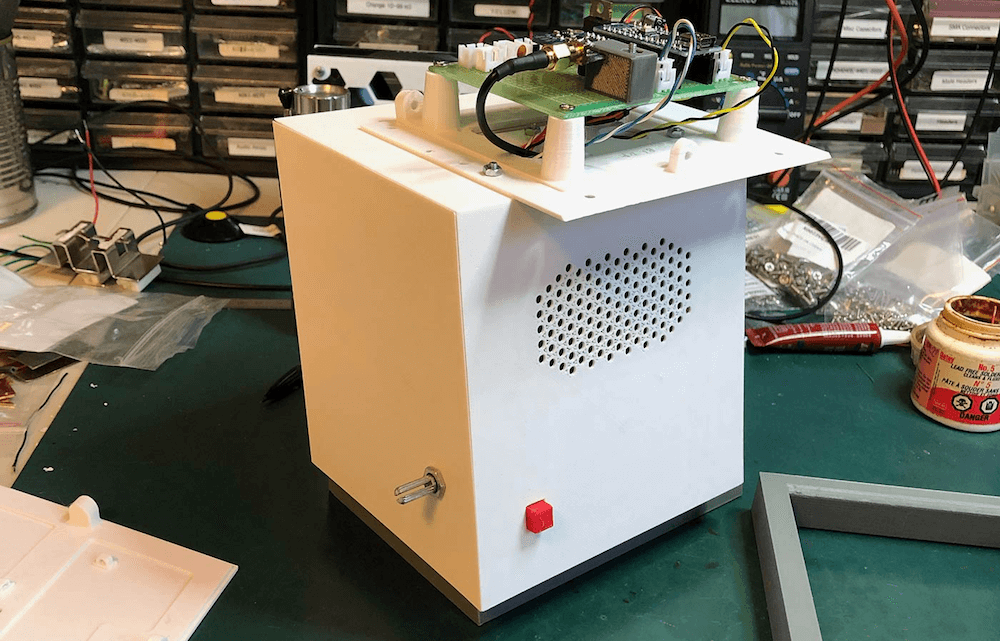
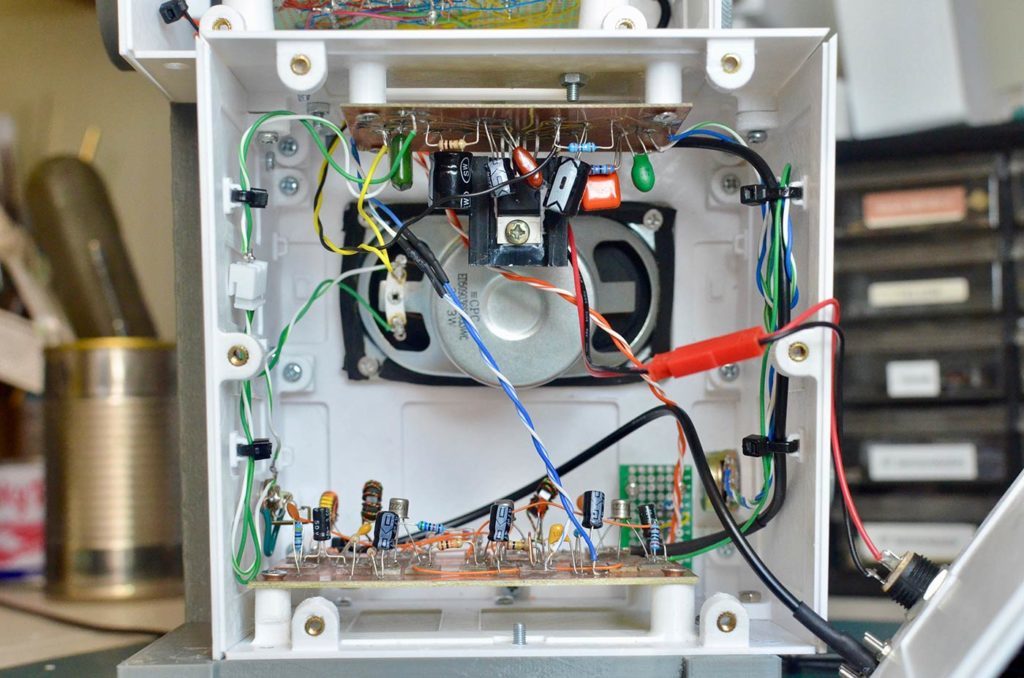
After constructing a regen (regenerative) radio receiver several years ago, Michael LeBlanc decided to upgrade to a direct conversion receiver in order to gain some performance improvements and support both AM and SSB signals. His build is based on a generic design available here, along with a couple modifications by Ryan Flowers, and of course his own experimentation to get things working properly.
The device is controlled by an Arduino, which changes the frequency via an Si6351 oscillator depending on encoder input. Visual frequency feedback is provided by a small OLED display, and the assembly is encased in a very cool 3D-printed enclosure—or rather ‘enclosures’ as two boxes separate the digital and radio/audio circuits.
It’s a simple configuration and the result, as shown in the video below, is a very clean sound!
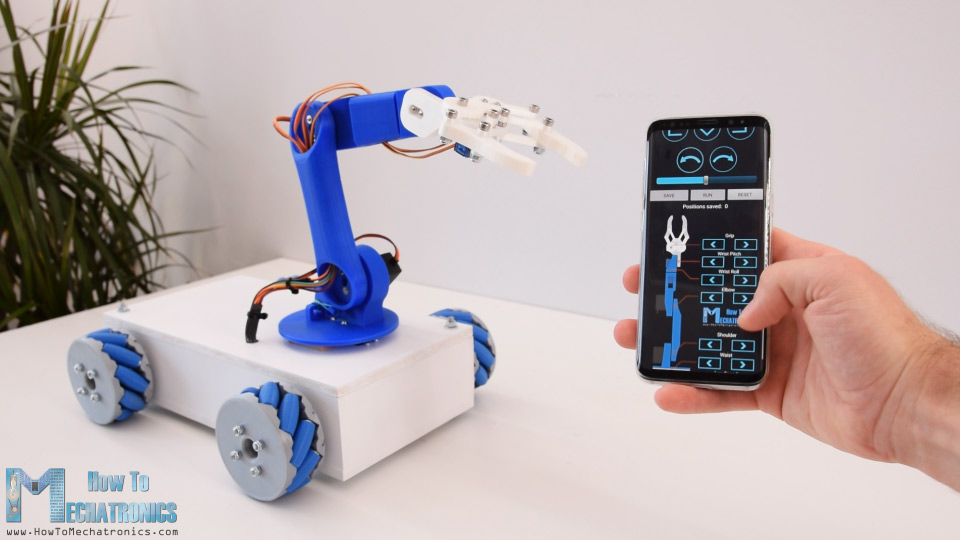
Robotic arms can be interesting, as are robots that roll around—especially on a semi-exotic Mecanum wheel setup. Dejan Nedelkovski’s latest How To Mechatronics build, however, combines both into one package.
This project actually starts out in a previous post, where he constructs the moving base with Mecanum wheels, enabling it to slide and rotate in any direction.
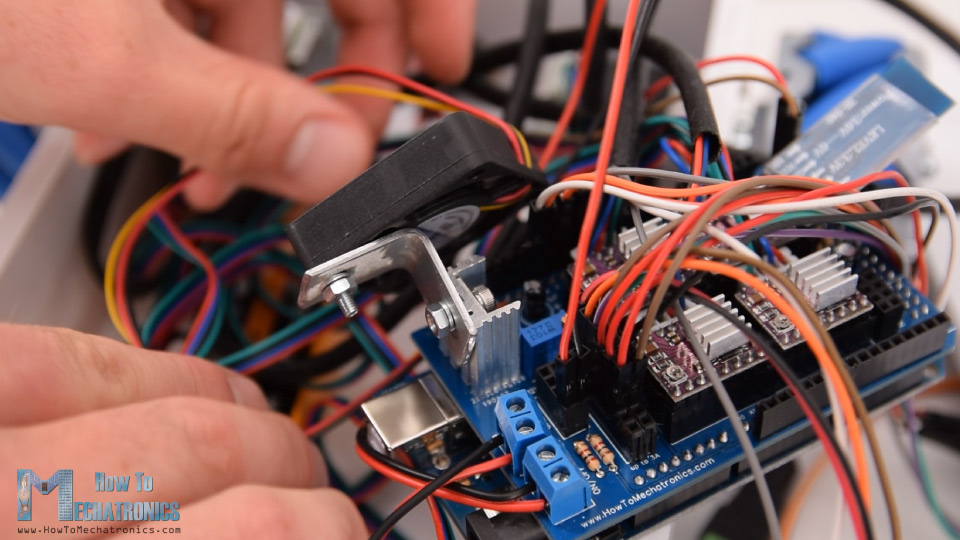
In this final(?) stage, he adds a five-axis robot arm mounted on top of its boxy frame, or six-axis if you count the gripper. Either way, the arm uses a total of six servos for actuation, and the base of the bot travels around under the power of four stepper motors. Each motor is controlled by an Arduino Mega, using a custom shield, allowing repeatable movements in any direction. These can be stored and replayed via the robot’s custom Android app as desired.
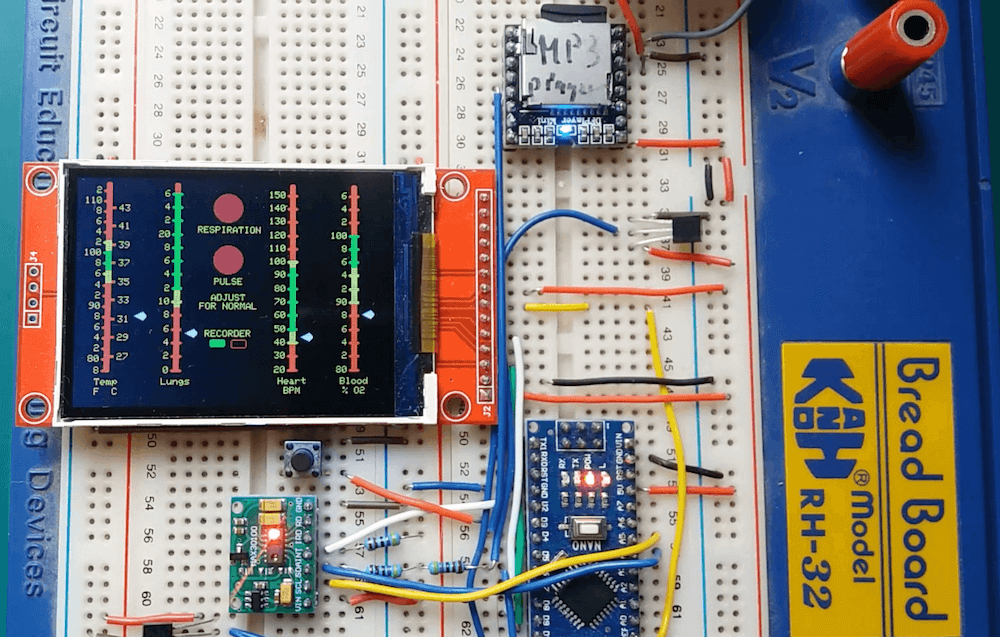
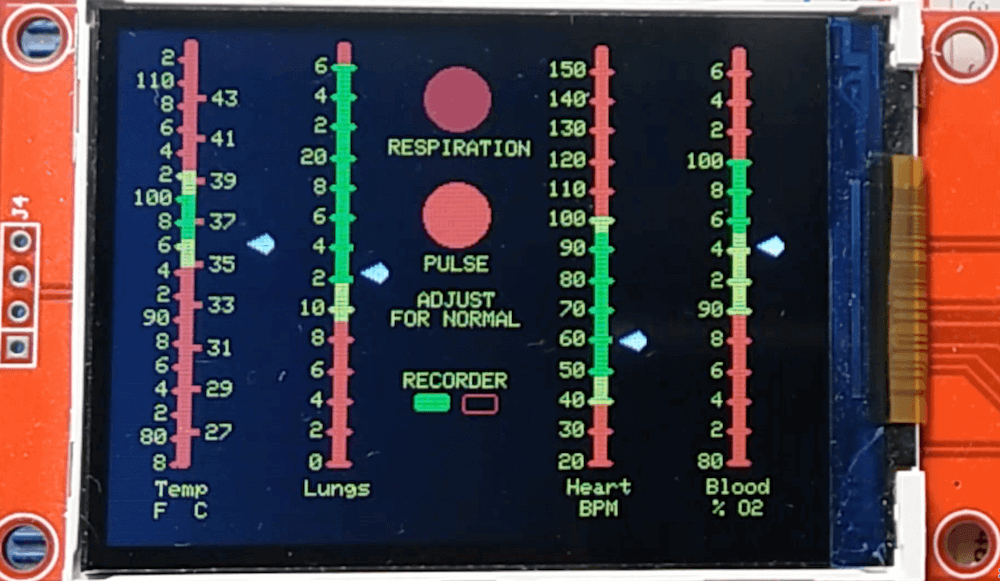
The future envisioned in the original Star Trek included, among other things, a shipboard sickbay with electronic monitors strangely reminiscent of the machines that medical personnel use today. To recreate a functional mini-replica of these displays, YouTuber Xtronical turned to a 2.8” TFT screen, a breadboard, and an Arduino Nano—noting that an Uno would also work.
The LCD display nails the look of Dr. McCoy’s device, and heartbeat sound can be played along with an onscreen flashing “PULSE” circle. A MAX30100 pulse/oximeter sensor and a temperature sensor take body readings, while a second DS18B20 is implemented to read ambient conditions for increased accuracy.
It’s a fun Trekkie project, and Xtronical plans to elaborate on how it was made in future videos.
A build of a working original Star Trek display with real sampled heart beat sound. Uses various sensors to get the readings from your body (via just your fingers) and displays them in the style of the 60’s sick bay screen. This bare “Bones” system could be built into a model unit or even a replica Tricorder.
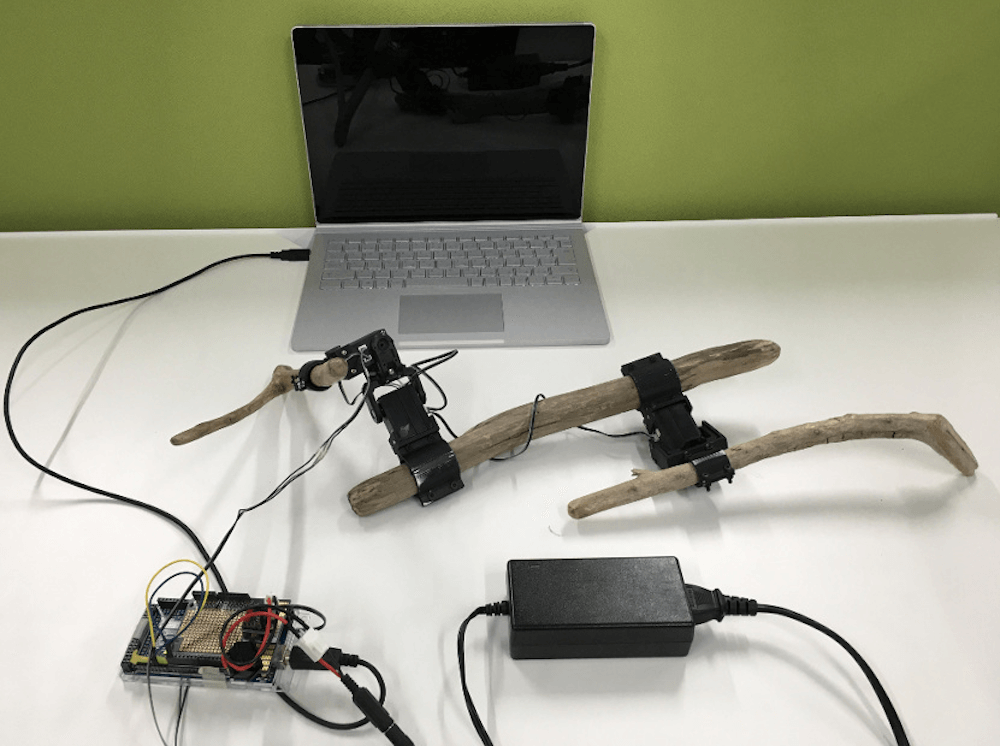
What if you were to neglect a robot’s mechanical design entirely and instead construct it out of unusual materials like random sticks? Researchers from the University of Tokyo and Preferred Networks have done just that. To accomplish this feat, the engineers first scanned and weighed the branches, then used deep reinforcement learning to teach the new contraption to walk.
The branch-bots were then constructed in the real world using generic servos, and controlled via an Arduino Mega tether setup with a motor driver and a separate power supply.
You can see one of these bots moving around in the video below, though this configuration ironically seems to have more trouble when dropped off at its native forest habitat. Be sure to read more about this research in IEEE Spectrum‘s article here.
This project aims at creating bricolages of robots out of tree branches found at hand. Through the process in which natural objects learn how to walk by themselves, the artwork portrays the perspectives of objects. Unlike the top-down process where functions of mechanical systems are explicitly defined by designers, this project puts an emphasis on the emergence of functions, which is a bottom-up process where found objects seek for the function as a whole.
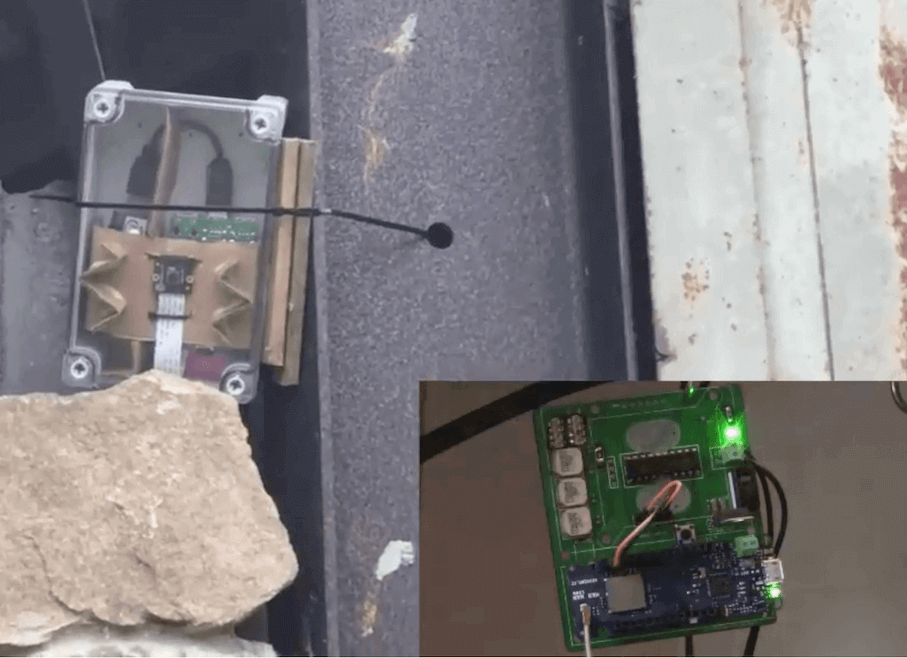
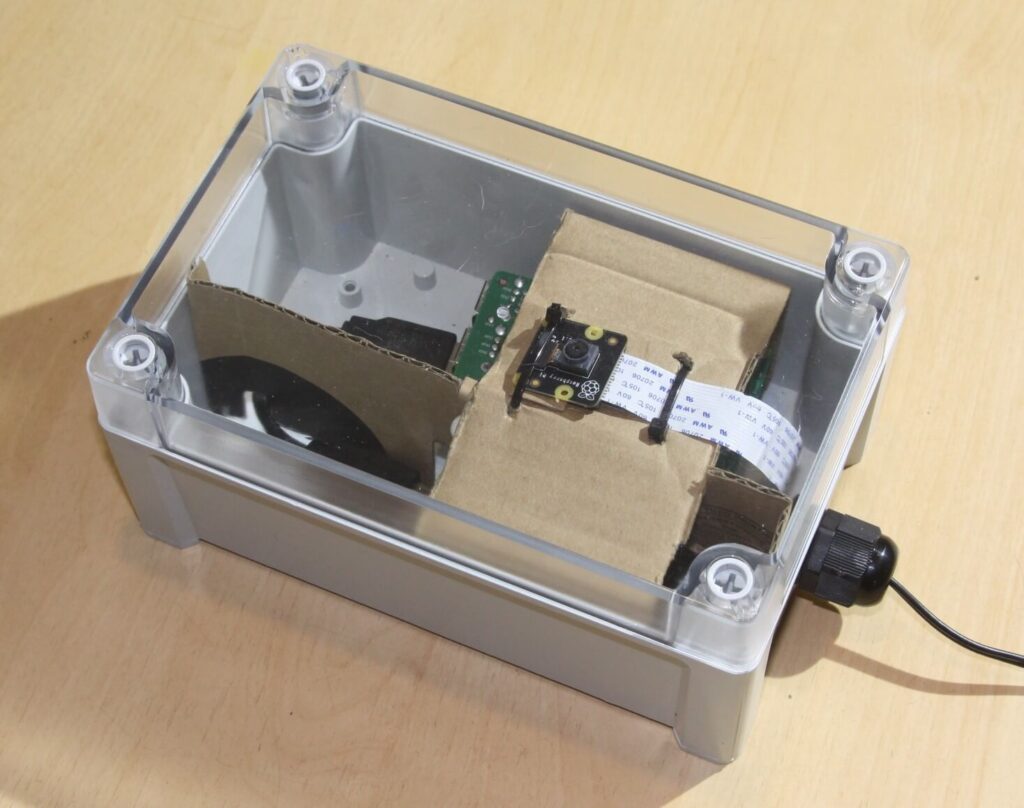
Security cameras are a great way to deter theft and vandalism, but what if the camera is out of WiFi range, or otherwise would need long cables to transmit pictures? As explained here, Tegwyn Twmffat has an interesting solution–taking advantage of neural network processing to recognize moving objects, along with a LoRa connection to sound the alarm when there is a potential problem.
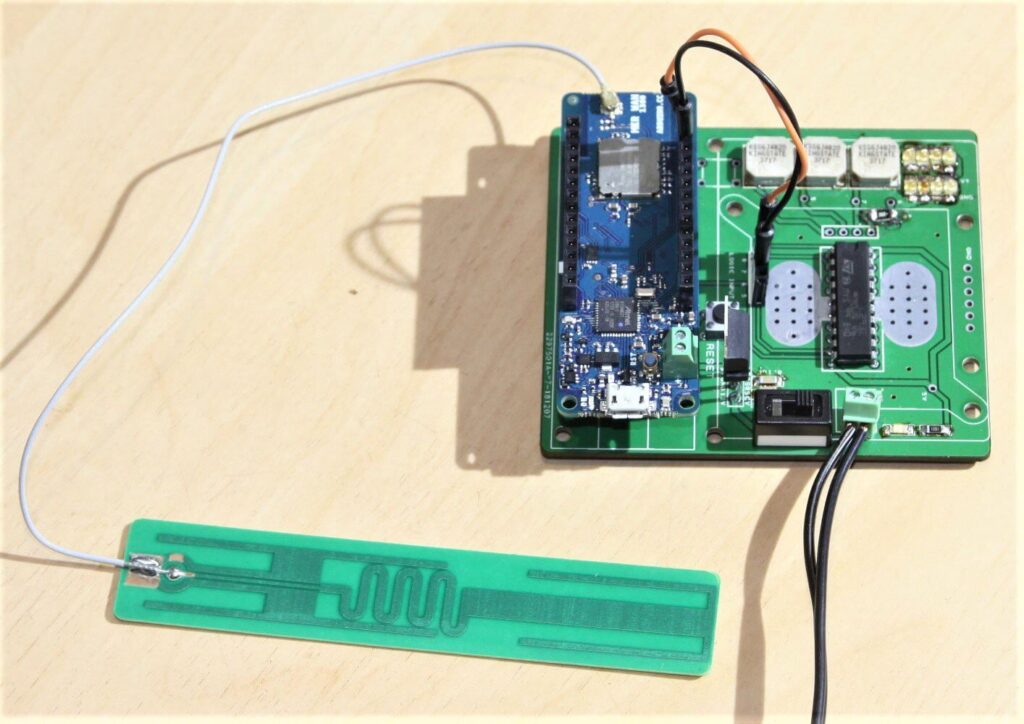
Images are captured by a Raspberry Pi and camera, then processed with the help of an Intel Movidius Neural Compute Stick for identification. If it’s something of interest—a human, for example—a relatively small amount of data is transmitted to a MKR WAN 1300 base station, beeping faster and faster as the person approaches.
As seen in the video below, it’s able to properly ignore the ‘test dog,’ while it beeps away when a person approaches!
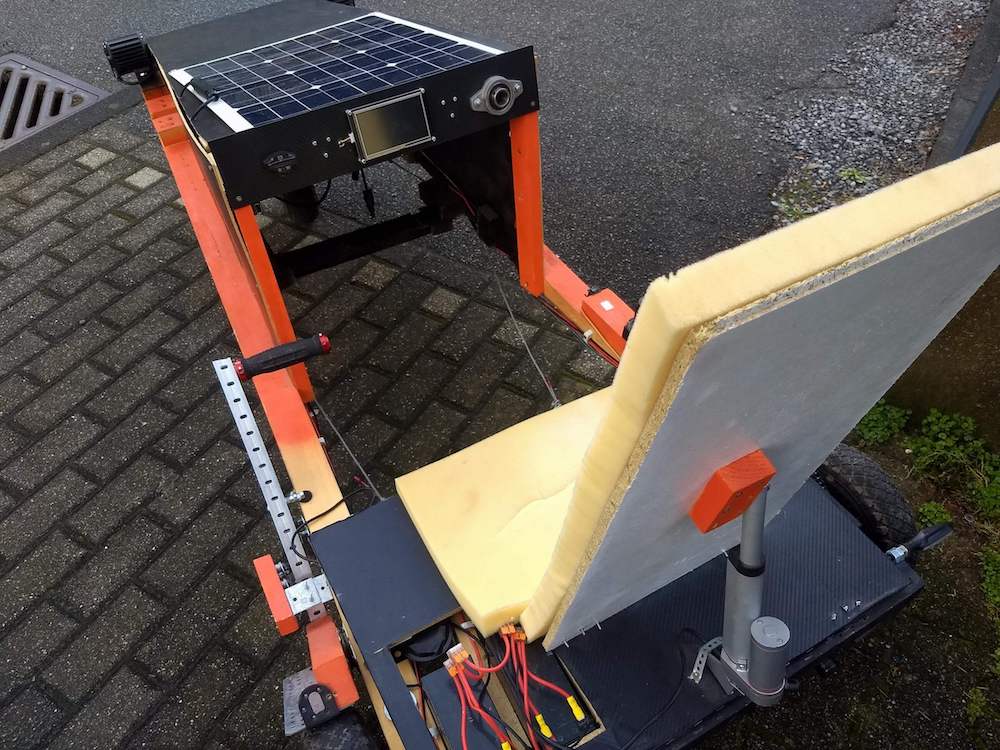
If Elon Musk was to design a soapbox car, the prototype might look something like this by David Traum.
Traum’s project is powered by a 500W motor which is fed by a pair of 12V batteries and a 40 W solar cell, allowing it to attain a top speed of 35 km/h and a range of 10 to 15km. Although that might not sound like a huge number, it looks pretty fast at the end of the video below!
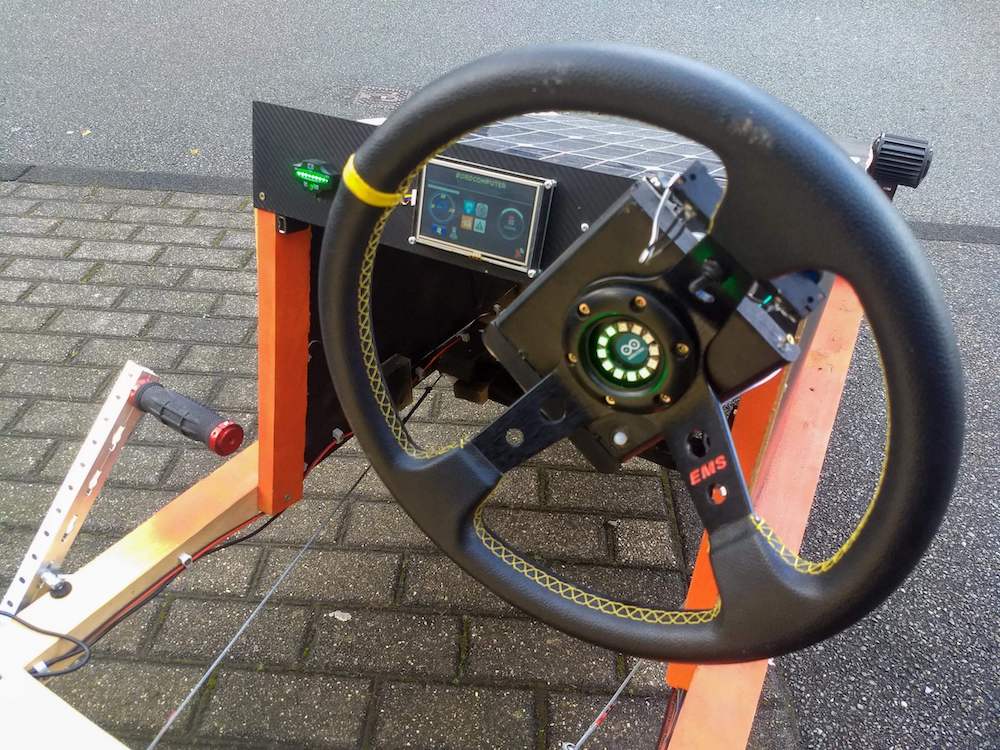
But that’s not all. The vehicle features a rather unique control system, with front wheel steering actuated by a stepper and cable assembly. An Arduino Mega is the brains of the operation, while user input is via a small touchscreen, a joystick, and even a steering wheel (equipped with an Uno, a 9V battery, radio module, and gyro sensor) that can work wirelessly as needed—perhaps to park remotely, or simply as a gigantic RC car
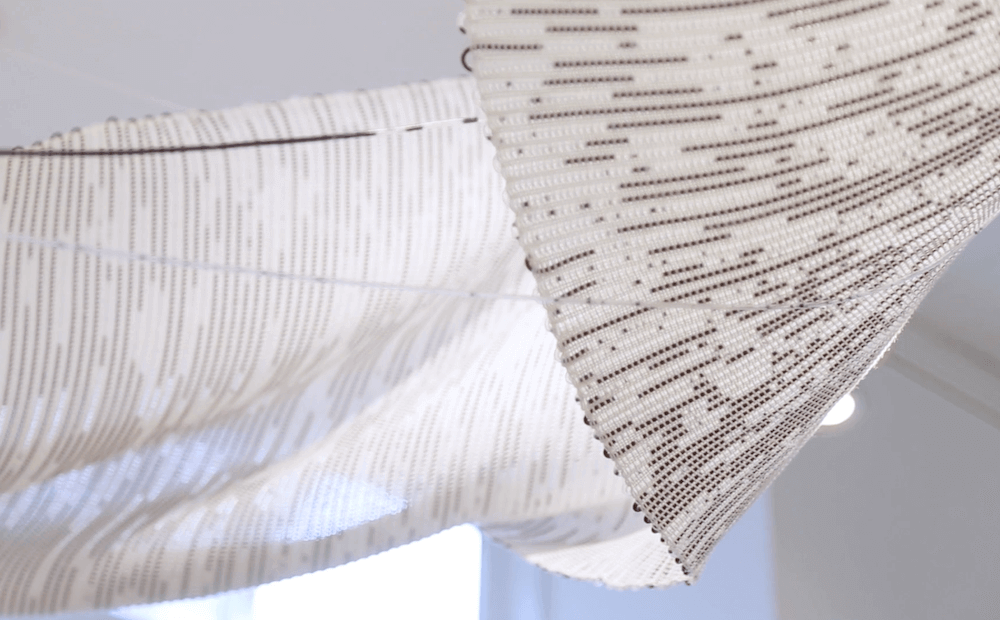
While you might have never considered the idea, looms—especially the punchcard-driven Jacquard loom, which helped inform both Ada Lovelace and Charles Babbage’s pioneering work—are an important part of computing history. As reported here, Victoria Manganiello and Julian Goldman have created an awe-inspiring ode to this computing heritage in the form of a handwoven tapestry that constantly changes the way it looks, aptly named “Computer 1.0.”
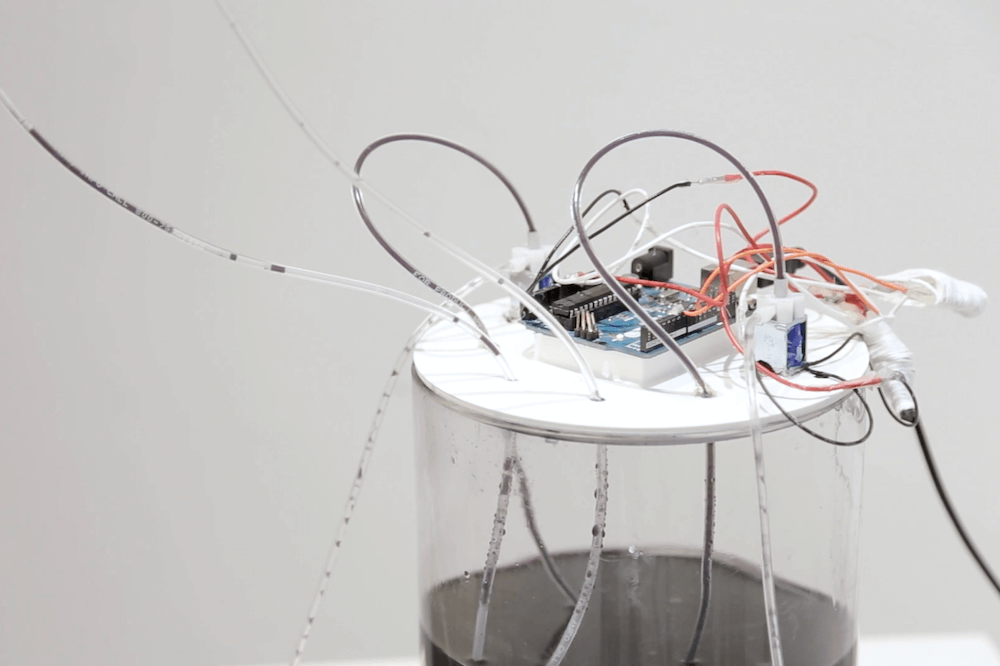
The tapestry, which was recently on display at the Museum of Arts and Design in New York City, stretches nine meters in length and features tubing woven throughout. An Arduino actuates pumps and valves to produce familiar patterns in this tubing with blue-dyed water and air.
These patterns soon become abstract and perhaps more open to interpretation, though with more development it’s noted that images and even smartphone-readable designs could be possible.
Be sure to see the short demo of this incredible installation in the video below!
A handwoven textile activated by computer code, Computer 1.0 explores connections between weaving and technology. For the project, Victoria Manganiello invited designer Julian Goldman to collaborate on designing and programming a pump controlled by Arduino microcomputers to move precise sequences of air and liquid through the approximately 2,000 feet of tubing woven through the cloth. The movement of the air and liquid evokes traditional weaving patterns such as bird’s eye, monk’s cloth, and twill. And the operating system—the computer and the pump—is not kept out of sight in the service of the woven screen and the pixelated patterns that run across it, but rather are an integral part of the work; nothing is hidden.
Manganiello’s textile reflects and expands on the obscured history of weaving and coding, calling attention to the “under-over, under-over” movement of thread becoming cloth that originally inspired the “zero-one-zero-one” of binary code. The jacquard loom of 1801, which used punch cards to program the movement of thread into increasingly complex woven patterns, is a direct, though frequently forgotten, ancestor of modern computers.
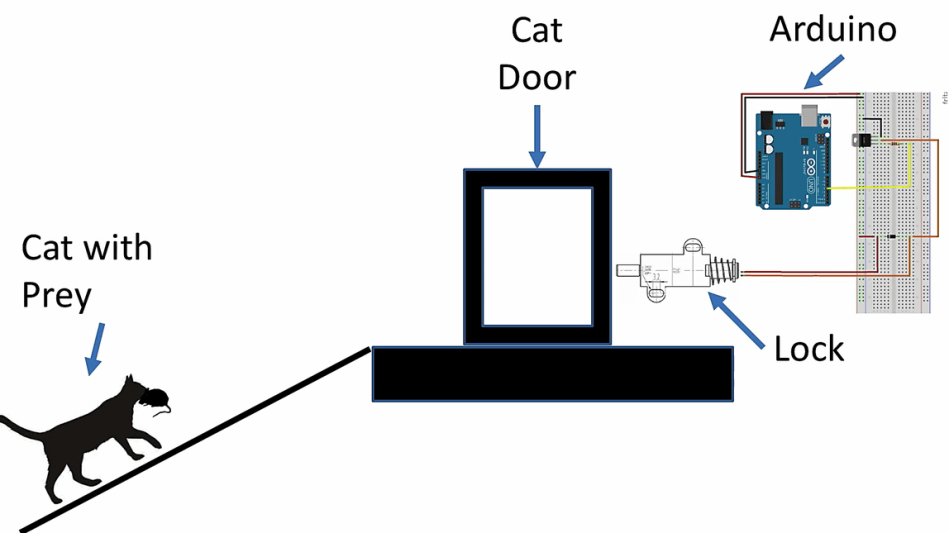
Amazon senior product manager Ben Hamm has a cat named Metric. While this adorable feline friend helped with a rat infestation problem in his apartment, he also likes to take his hunting skills out into nature, bringing… whatever home around one out of 10 nights.
To combat this situation, Hamm used an Amazon DeepLens camera to detect the cat, then examine whether or not it’s carrying something extra, based on a machine learning algorithm trained with over 23,000 images.
If the cat is carrying prey, an Arduino locks the cat out for 15 minutes, while the system texts Hamm pictures. It also gives a donation to the National Audubon Society, described by Hamm in his presentation below, as “blood money.” Currently it only works with Metric, but could be generalized with more cat data if you’re having the same problem.
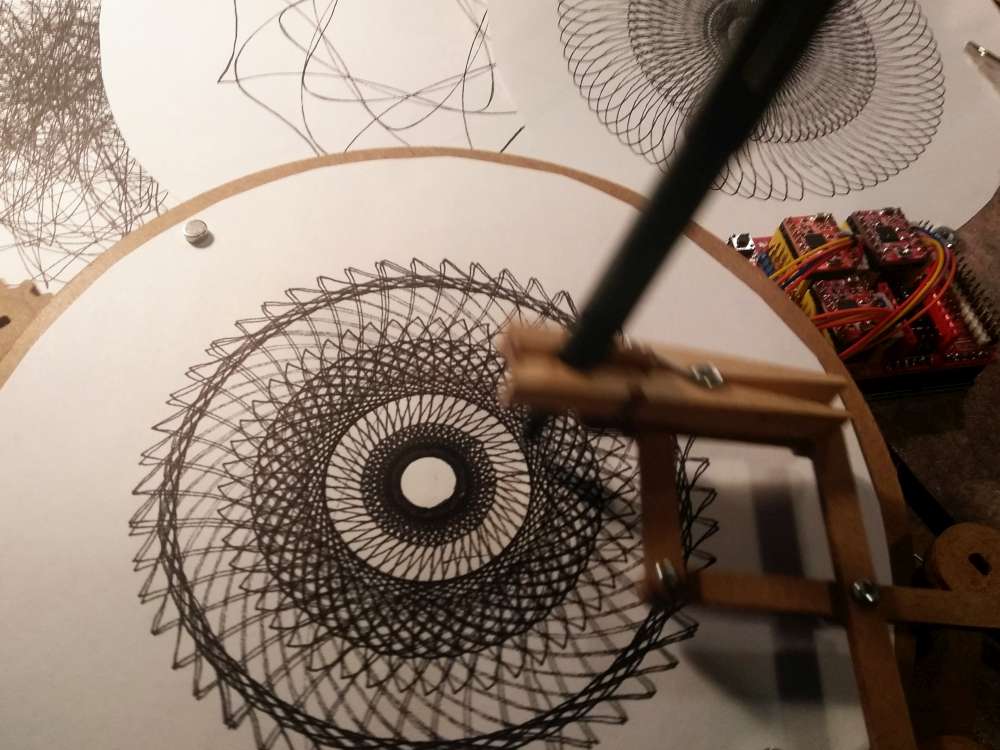
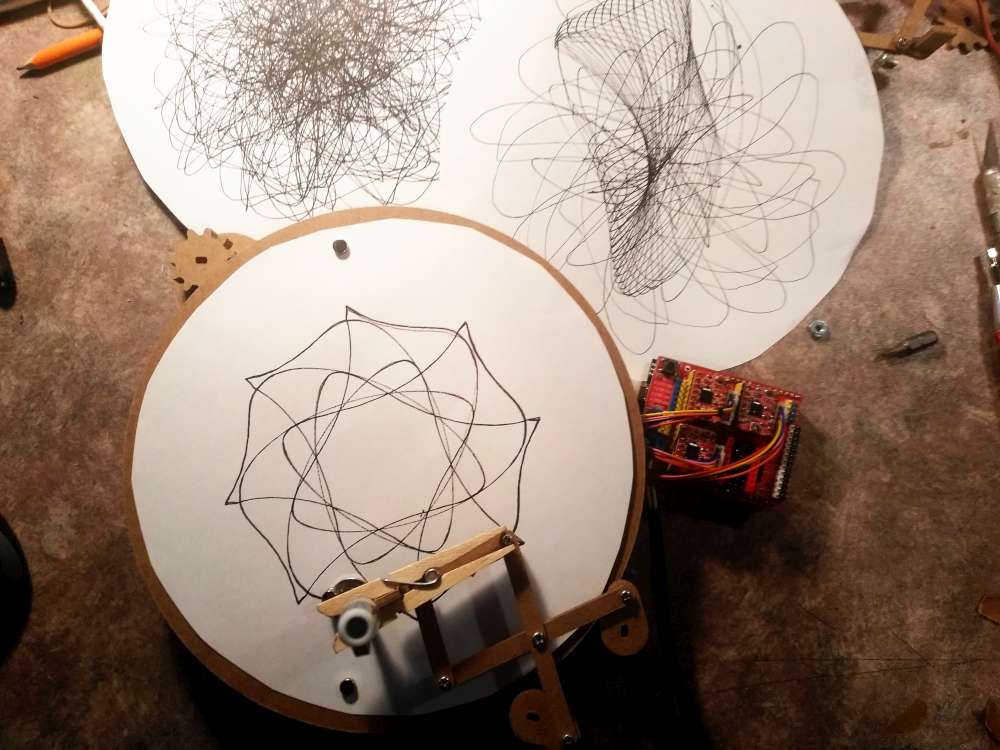
If you’ve been waiting for a new way to generate geometric art, then be sure to check out the Cycloid-O-Matic from InventorArtist Darcy Whyte.
This three-axis cycloid drawing machine is something of an update on the classic spirograph toy, but instead of (only) using an arrangement of gears, it incorporates stepper motors to create smooth curving patterns.
Control is accomplished via an Arduino Uno and GRBL shield, while a single motor rotates the paper in a circle on top of a lazy Susan. A pen is held above in a linkage system, actuated by two steppers that spin to move the linkages and draw in the X/Y plane.
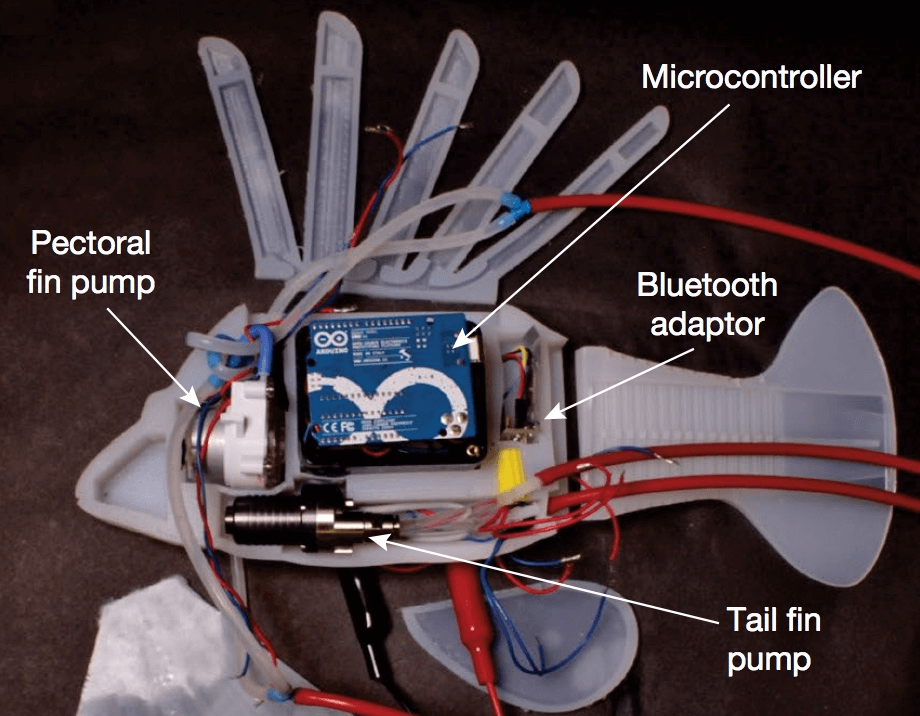
Hydraulically-actuated robots are nothing new, but normally they come with a battery or external supply of some sort. This lifelike robotic lionfish developed by Cornell and the University of Pennsylvania researchers, however, has its own artificial circulatory that pumps synthetic ‘blood’ to help flap its fins and as the device’s power source itself.
The trick is that the liquid is actually the cathode of a battery built into the fish, which powers its two hydraulic actuators, as well as the Arduino Uno control system. This integral battery—which would be analogous to blood in a real fish—gives it enough energy to operate untethered for 36 hours, though as it swims at 1.56 body lengths per minute, so it can use all the time it can get!
As James Pikul, a co-author on the study and researcher at Penn, told Gizmodo:
In our synthetic vascular system, the fluid stores chemical energy which we can use to power the fish robot. As the fluid is pumped through the fish robot, the moving fluid also causes the robot to move. The vascular system, therefore, is multifunctional. It is these multiple functions that allow the robot to maintain its dexterity while also having a long operational time.