Posts with «education» label

Creative Technologies in the Classroom goes to Ecuador

We are happy to announce that Creative Technologies in the Classroom has been successfully implemented in Ecuador since the fall of 2014 in 40 different places along the country, to more than 600 participants and thanks to the Telefonica Foundation Ecuador.

Creative Technologies in the Classroom (CTC) is a collection of experiments aimed at transforming the way technology is taught in schools around the world for participants going from 10 to 18 years old. These experiments introduce basic concepts in programming, electronics, and mechanics and consists of four phases:

  • Teacher Training (1 week)
  • Themed Modules (4 modules)
  • Student Projects (9 weeks)
  • Technology Fair

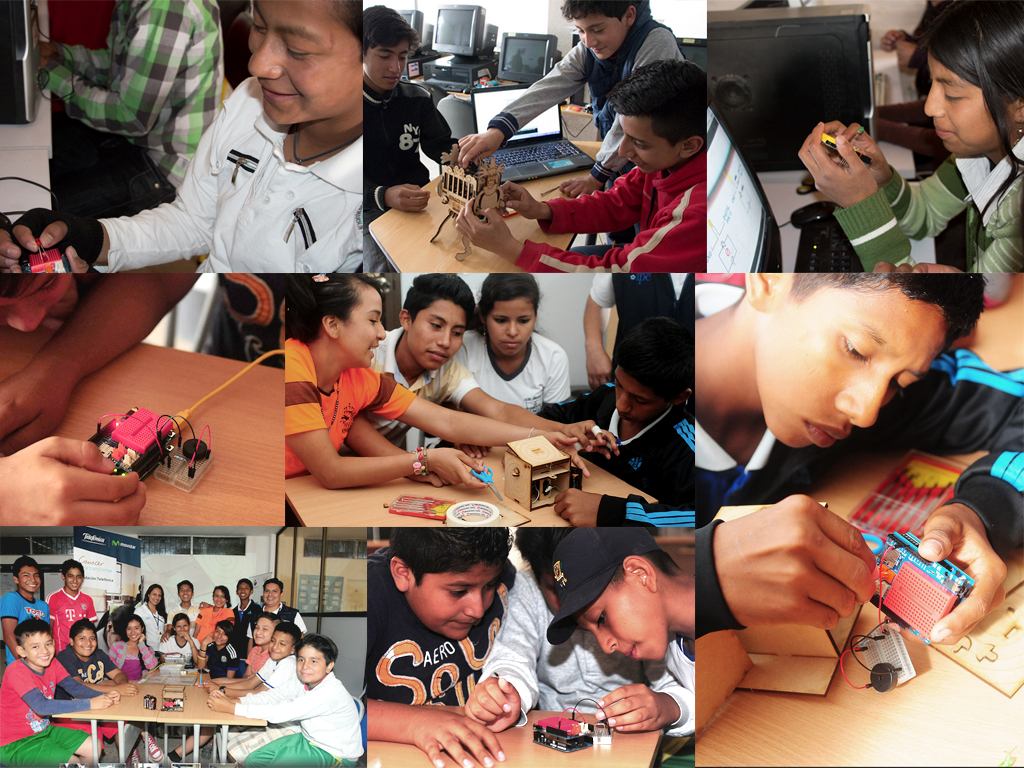
CTC Ecuador has also been implemented within the Pro Niño Project that helps employed children to attend to educational activities and learn about technology. This aims to open an opportunity for them to study at the technical universities in the area (many of them also support the project). The teachers for CTC/Pro Niño are social workers instead of regular school teachers. Here are some pictures of the program in El Oro and the South of Quito.

Some CTC Ecuador projects were also presented at an exhibition in Cuenca about society, art and technology hosted by Telefonica Movistar Ecuador.

(The news was originally posted on Arduino Verkstad blog)

Arduino Blog 07 Apr 20:38

Making Space Accessible to Students with U of M Satellite

The U of M Satellite project started in 2010 as a student group at the University of Manitoba with the goal of building a nano satellite (10 x 10 x 34 cm) and make space accessible to the public. We got in touch with Ahmed Byagowi, co-founder of the project, who teaches robotics in the same university. Ahmed told us that U of M Satellite became soon very popular, in fact  more than 300 students joined the group. In the first iteration the satellite’s goal was studying a micro animal (about 1 mm) called tardigrades and see its behaviour in space. The second iteration started in 2012, the same year of the launch of the Arduino Due and that’s why they designed everything based on it.

We had a nice talk with Ahmed and asked a bit more about the project.

Why is space so important for research, and why it would be cool if more people could have access to it?

Space research is important because it challenges us to solve problems and find solutions which can translate to everyday life here on Earth. The products of space research and space technology are all around us today. From the ballpoint pen, all the way to GPS, special composite materials, special surgical equipment and satellite communication.

For a while, only government and military had access to space. However, over the past decade there has been a rapid increase in commercial and public access to space. Private companies can take risks that the government and military can not, which leads to even bolder and newer technologies being developed.

For the general public, there are many creative and dynamic thinkers in the world who may not be able to share their ideas through a government agency or company. Public access to space allows more people to innovate on their own terms, and with 7 billion people on this planet, surely there are a great deal of innovation to be found.

With more people involved in researching space technologies, even more ideas can reach fruition, which can hopefully lead to technologies that will benefit life here on Earth even more.

There are other open source projects going to space (i.e. Ardusat), how’s U of M Student Satellite different or similar to others?

Ardusat is using Arduino as its payload (in fact, 16 of them) to run certain experiments in space and its main controller system is based on other processors and software. On the other hand, UMSATS’ satellite is going to be based on the Arduino Due architecture (the main controller) aided by the Arduino Zero and Arduino Uno’s design for payload and other controllers such as attitude determination and control system (ADCS) and power management as well as onboard image processing.

In which way open source is making exploration of space possible?

Open source makes things more accessible and helps a community work together to solve problems. If more open source platforms become available that can aid in space exploration, people can focus their efforts more on the next big problem using tools already developed, instead of resolving the same problems over and over again (reinventing the wheel). Plus, learning from watching other people’s work is a great way to learn things and apparently for some people like me or Massimo, this is best way to learn programming (based on Massimo’s TED talk).

Could you give us a bit more details on how you are using Arduino DUE ?

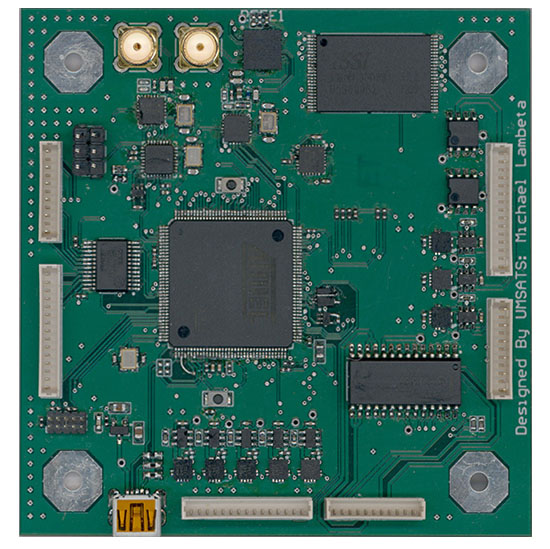
Our main Command and Data Handling (CDH) controller is based on the SAM3X8E and we are using Arduino Due’s bootloader and IDE for the software development. We added some more software layers as well as a scheduler and we aim to open source the entire software and hardware as soon as possible. In the picture of our motherboard below, you can clearly see the SAM3X8E and on the top right, there is a SMD version of the ATMEGA328P running and Arduino Uno core and acts as the beacon transmitter. This board encompasses the CDH, ADCS, Power and Communication of 2 meter and 70 cm bands (144.390MHz and 435MHz ham radio bands).
A famous quote of Massimo’s Banzi says: “You don’t need anyone’s permission to make something great” and in your TED talk you start saying “You can make big things using small tools”, what’s the relations between the two?

There is no formula for greatness. We live in a time where anything is truly possible, and the way to achieve your goals is numerous. Nobody said we couldn’t do something big with our small satellite, and we didn’t ask if we could either. Instead, we try to do big things with small tools that are accessible to us.

Arduino Blog 03 Apr 18:22

Having fun with music in a science class

A science teacher at Bundang management high school 20 kilometers southeast of downtown Seoul, South Korea, involved his students in an Arduino Music project running Arduino Uno, Sparkfun Music Instrument Shield and Makey Makey.

Students started studying the principles of sensors and then built their own music instruments using recycled materials. Finally they played them as you can see from the video he shared with us:

See more pictures and videos at this link.

Arduino Blog 24 Mar 20:16
arduino  diy  education  featured  kids  music  science  

Getting Started with Intel Edison Mini Breakout Board

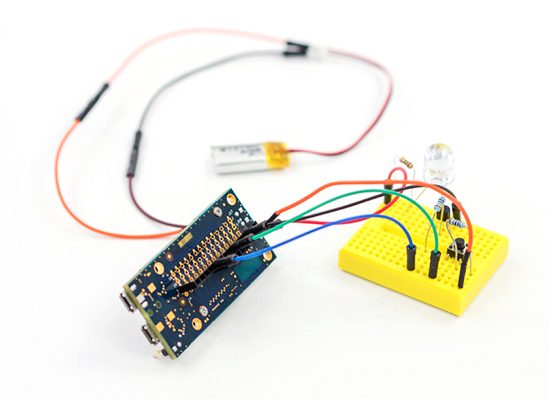
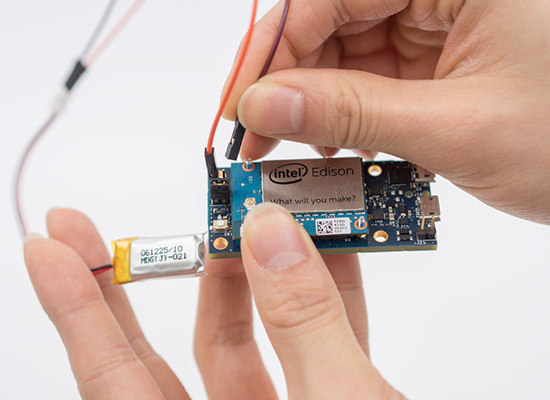
Let’s start exploring a bit more about Intel Edison. As you may already know, Intel provides 2 different hardware platforms to work with Edison development board: the core module is called Intel Edison Compute Module, while the 2 extension boards are called Intel Edison Arduino Board and Intel Edison Breakout Board respectively. We refer to them as the Arduino module and mini-breakout board, respectively. The tutorial of this week is called Getting Started with Intel Edison Mini Breakout Board:

It is probably more common to use the Arduino module, since it’s easy to use and has many useful features, most notably the pin headers. However, the mini-breakout’s main advantage comes from its size and possible use as a wearable.

In this tutorial, you’ll get more familiar the mini-breakout board, learn how to use it for basic tasks, and then build a small “blink” example based on this knowledge.

Follow the link and explore

MIT's light-up robot garden teaches you how to code

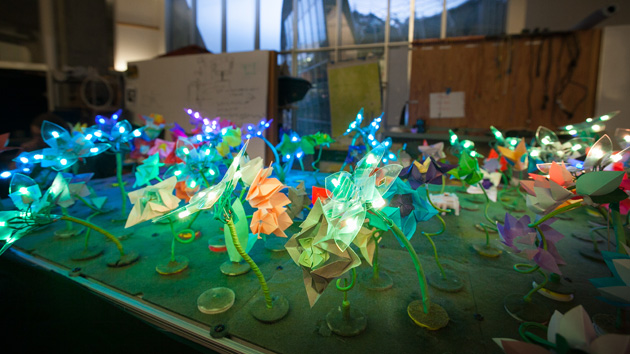
If you're teaching kids how to code, what do you do to show that software makes an impact in the real world? MIT has a clever idea: a robot garden. The project lets you control a grid of Arduino-linked "plants" through programming that makes them blossom and light up in pretty (and occasionally mesmerizing) ways. It'll even teach the virtues of distributed computing -- you can tell these leafy robots to bloom or change color in algorithm-driven sequences. The garden is just a demo for now, but it'll eventually turn into an easy-to-replicate curriculum for students who'd otherwise have to settle for seeing their results on-screen.

[Image credit: Jason Dorfman, CSAIL]

Filed under: Science, Software

Comments

Source: MIT News

Control This Robot Arm – With Your Brain

"We are aiming to make a change, show the world that BCI is not something in the future, it is something that is already happening."

Read more on MAKE

Losing to My High School Class a Big Win

Recently I switched careers from designing industrial food and dairy equipment to teaching industrial technology in a high school. While planning this move and taking night classes, I read quite a bit about authentic instruction where the students engage in real projects that end with something tangible and with real […]

Read more on MAKE

“Fireball” Shooting Piranha Plant

If you’re familiar with Super Mario Brothers, you’re certainly familiar with this character, the fire-breathing Piranha Plant. If you would like to have a replica of one in real life, you can build your own following instructions found here. The plant, which could probably double as a prop for Little […]

Read more on MAKE

MOMA Adds Arduino, Makey Makey, And More

I've always said that one day I'd wake up and the Arduino would be in a museum. However, I'd sort of expected it to take a bit longer.

Read more on MAKE

MAKE » Arduino 09 Nov 15:01

Yes, The Drink Up Fountain is talking to you!

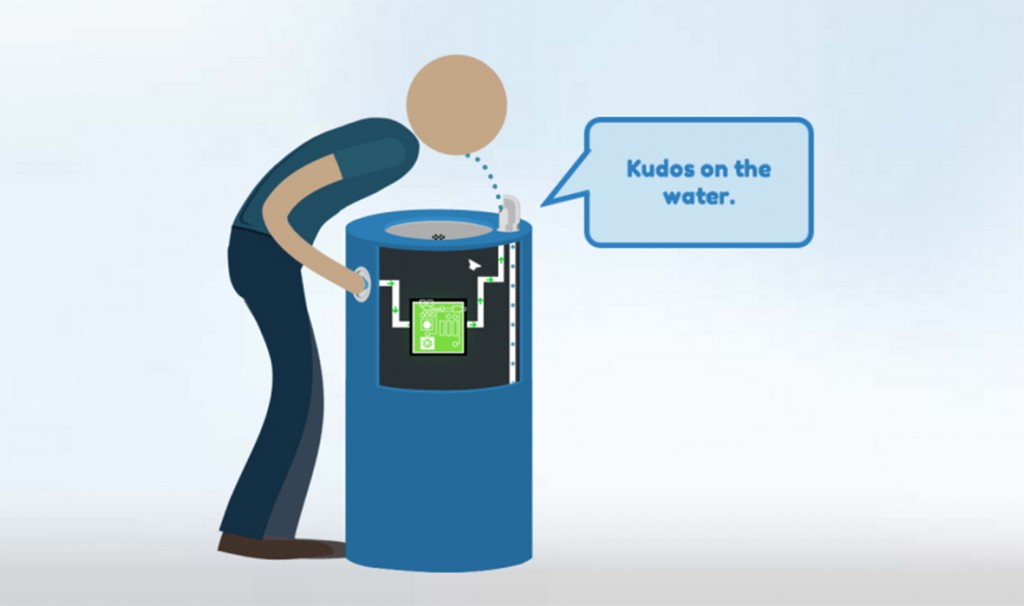
The Drink Up Fountain is project created in September 2013 by YesYesNo Interactive studio in collaboration with PHA Honorary Chair First Lady Michelle Obama and dedicated to encouraging people to drink more water more often: “You are what you drink, and when you drink water you drink up!”

The Fountain runs on Arduino Mega  and

dispenses entertaining greetings and compliments intended to entice the drinker to continue sipping. When a drinker’s lips touch the water, the fountain “talks,” completing a circuit and activating speakers. When the drinker pulls his or her head away and stops drinking, the circuit breaks and the fountain stops talking. With hidden cameras set up, Drink Up caught unsuspecting individuals using the fountain in New York City’s Brooklyn Bridge Park


Take a look at the video to see how the fountain interacts the people: