Posts with «community» label

Introducing Maker – Michael Shiloh
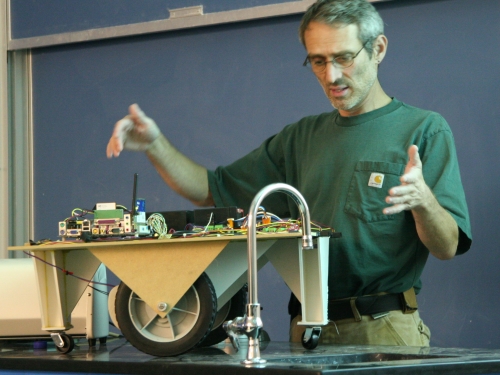

photo by Scott Beale / Laughing Squid

“Teach me to make” as simple as it sounds is a simple yet powerful effort on wordpress by a maker from USA. Apart from being a true maker, Michael Shiloh is an absolutely delightful and an approachable person to talk to. His sense of purpose in his work was very much apparent in my short, yet interesting conversation with him. Here are some widely and less known things about the teacher, student and entrepreneur.

Priya: What brought your interest in electronics? What is the very first project that you fondly remember completing till date?
Michael: Ever since I remember, I have been taking things apart and putting them back. The important thing is to pay attention to details while doing that. Like, where the screw fits, what part goes where, what are the names of the parts etc. even if one is not able to know the full functioning one should be able to call the parts by the name and know where they fit and what they do. Growing up at a time with limited resources, left only one option of harvesting old electronic parts. I suggest every aspiring-maker to do that!

(Gives a pause) As for the finishing part, I never finished a lot of projects, and I had a LOT of unfinished projects sitting around me in my room. But the important part was, that I caught hold of a lot of basics while making them. Not stopping, is important.

P: What drives your passion for Arduino and open source hardware?
M: 10 years back, I started a project called Teleo based on PIC which was on similar lines as an Arduino, just not with an IDE. Hence, a simple prototype for students to interact has always been my passion.

P: You talk about 3 methods of your teaching – contraption building, physical computing, and open source advocacy. What is Contraption building as defined by you?
M: Interesting question! Contraption, is an idea of a prototype in its raw un-polished form. It is the fastest way to check if what you assume in theory is in fact practical or not. I always encourage contraption as it makes understanding and explaining easier of the internal working mechanisms of an idea.

P: How is it different from Physical computing?
M: Contraption building, may or may not include electronics. It can be purely mechanical, say, just a few wheels, pulleys and a rubber band? Physical computing on the other hand needs an inclusion of electronics.

P: What do you think is the right approach to Advocate Open source hardware?
M: The right approach is to teach the concept of sharing knowledge, Eg: Pythagoras Theorem. Its a shared piece of knowledge which is applied everywhere, new theorems are proven using the age old theorem. The strength of Open source hardware is not only the product, but what people do using the product.

P: In all your teaching classes, What do you think is the biggest attraction for any individual towards Arduino?
M: (Laughs) I am yet to find a concept or topic where Arduino has not been used. Type on google, ‘The concept + Arduino’ and voila! You have an application. BE it gardening, space, music or photography, name your interest and there is a way to tinker with it using an Arduino.

P: We hear a lot about media art, as a concept these days. What is special about adding electronics to art?
M: Any Art installation with electronics is based on sensors and actuators. Arduino helps the artist to manipulate the idea in his head and give a more personal and interactive approach to a previously ‘look-but-don’t-touch’ art. Let me call it a more knowledgeable way of interacting?

P: Since you have taken so many workshops and visited so many hackerspaces, what are the few useful tips you might want to give to the maker at home?
M: The most important thing is, to have a space. Space defines purpose. The next is organizing the tools that you have. In my times, I used old shoe boxes with egg-cartons inside to separate the resistors, LEDs and potentiometers. Harvest old electronic items and know what they are used for, they might come of use later. A multimeter is a must have. So are tiny components like LEDs etc. To add intelligence a programing board would be useful, and arduino has a great community support for a maker even at the middle of the night!

Never get intimidated by others polished presentations. The more raw your circuit is, the better it is appreciated among the maker community. Do share the knowledge, including the success and including the failures.

P: What is your role as a part of Arduino?
M: Let me see… We can call it Community Liason. Ill take care of all the minor bugs, wishlist and major issues, bridging the gap between developers and the community.
P: Wow! That sounds exciting! On a separate note, what would be your Ideal birthday gift?
M: Since there is SO much to build and manage, that would be – time.

A full bios of Michael alongwith his latest work can be read here.
Arduino Camp 2012

Gli hackers credono di poter apprendere lezioni essenziali sui sistemi (sul mondo) smontando le cose, vedendo come funzionano, ed utilizzare questa conoscenza per creare cose nuove e più interessanti.

Steven Levy

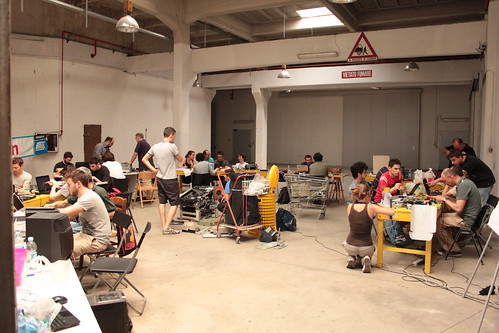
Domenica 17 Giugno alle Officine Arduino una quarantina di persone hanno dimostrato la veridicita’ dell’affermazione di S. Levy.

Dall’anno scorso Arduino organizza in Italia l’Arduino Camp , un evento di due giorni che vede il primo giorno dedicato a presentazioni e talk su Arduino, seguito da un secondo giorno di Hack Day su un tema. per vedere video e foto dell’evento consulta il set su Flickr.

Il tema dell’HackDay di quest’anno era costruire un’ orologio/sveglia utilizzando Arduino, un circuito integrato RTC PCF8563 (con quarzo da 32.768 kHz) ed una montagnetta di rifiuti da cui attingere.

Divisi in gruppi di 4 o cinque persone, in poche ore i partecipanti hanno realizzato il proprio progetto. Potete leggere il resoconto della giornata qui.

La giuria (composta da Aurelio Balestra, Massimo Poti’, Fabio Varesano, Uwe Federer e Federico) alle 17 :30 ha iniziato ad esaminare i risultati dei vari gruppi ed ha decretato come vincitori il gruppo Clock Cloud, che ha creato un manufatto riciclando un vecchio giradischi e sostituendo gran parte della meccanica e dell’elettronica interne con una scheda Arduino Uno, uno shield Ethernet , un buzzer, uno stepper motor e varie parti meccaniche per  realizzare un riduttore.


Il gruppo, composto da Stella, Giulio, Bissaorboea e Diego cosi’  descrive il funzionamento dell’ oggetto:

Il sistema sfrutta le API di Google per leggere la presenza di un allarme sul Google Calendar e l’ora corrente. Arduino pilota lo stepper all’ora corretta e se c’è un allarme attivo provvede a far suonare il buzzer. L’intera modifica ha preservato l’aspetto fisico e conservato il design utilizzando i caratteri e i colori del tempo.

Un lavoro ben fatto, che prevedeva addirittura dei gadget per la campagna di lancio sul mercato!

Congratulazioni ai vincitori, un grosso ringraziamento ai partecipanti ed ai volontari che hanno prestato aiuto ed a Toolbox per il supporto.

Arrivederci al prossimo Arduino Camp.


Massimo’s Talk at TEDGlobal

We are really thrilled to blog Massimo’s delightful talk of yesterday about Arduino and the open hardware movement: TED team chose it to be the first video to be traslated and released for everybody to see.

Enjoy!


Arduino Barcamp Zaragoza 2012


Arduteka en colaboración con Cooking Hacks y Milla Digital del ayuntamiento de Zaragoza han preparado un evento con capacidad para más de 400 personas en uno de los edificios más emblemáticos de la ciudad, el Antiguo Seminario Metropolitano de Zaragoza transformando en una moderna Ciudad Administrativa Municipal y que amablemente han cedido para organizar el evento.


Desde charlas sobre arte interactivo con Arduino como interface, pasando por talleres sobre impresión 3D hasta demostración de integración de Arduino con Asterisk será solo una parte de lo que vamos a poder disfrutar, ya que estarán habilitados diferentes Stands como el de Parrot, en que podremos probar el nuevo Ar-Drone 2.0, el de Cooking Hacks que nos amenizarán con micro talleres Arduino e incluso el de nuestros amigos de Ultra-Lab que seguro hará las delicias de los asistentes.


Por si esto fuera poco.. Contaremos con la presencia y colaboración de David Cuartielles, el cual nos ofrecerá una charla sobre los últimos productos Arduino que se está aconteciendo…


Accede ahora a toda la información en la nueva web de Arduteka AQUÍ e inscríbete!!

Te lo vas a perder??


Via | Arduteka


Reminder: Open Hardware Summit submissions due next week.

The submission deadline for the Open Hardware Summit is next Thursday, May 31st. If you’re doing something cool with open-source hardware and would like to present it as a talk, demo, or poster, check out the call for submissions and send in your proposal! The submissions are fairly informal and short (only a page or two), so there’s still time to put something together. The summit itself will be held on September 27th at Eyebeam in New York City.

Here’s some more information from the call:

The Open Hardware Summit (OHS) invites submissions for the third annual summit, to be held on September 27, 2012 at Eyebeam Art + Technology Center in New York City. The Open Hardware Summit is a venue to present, discuss, and learn about open hardware of all kinds. The summit examines open hardware and its relation to other issues, such as software, design, business, law, and education. We are seeking submissions for talks, posters, and demos from individuals and groups working with open hardware and related areas. Submissions are due by May 31, 2012 BY 11:59pm (EST). Notification of accepted proposals will happen by July 8th, 2012.

Full details here.

Arduino Blog 25 May 19:45

Open Source Hardware Convention 2012 Madrid: Call for papers

The Open Source Hardware, Electronics and Robotics Convention is a 3-day event organized by the Synusia collective. The aim of the Convention is to extend the Open Source Software and to promote electronics and the philosophy of “do it yourself”. The event will take place in Madrid at the Centro de Formación Padre Piquer,  from the 21 to 23 September 2012. During the Convention, visitors will be able to attend and participate in lectures, workshops, round table discussions, and exhibitions of personal projects. The Convention is currently seeking submissions for papers and talks. Deadline for papers: 23 of July.

For more information: http://oshwcon.org/en

[Save The Date] Arduino Camp 2012 a Torino

Il 16-17 Giugno prossimi si tiene a Torino, presso le Officine Arduino, l’ArduinoCamp 2012 (leggi post di Massimo sul Forum di Arduino)

La partecipazione è gratuita ma i posti saranno limitati dalla capienza del luogo dell’incontro.

  • Vuoi partecipare all’ArduinoCamp e/o HackDay? Inserisci i tuoi dati qui   http://bit.ly/JFqWxP
  • Hai  fatto un progetto con Arduino o stai usando Arduino nella tua azienda, faccelo sapere inserendolo qui:  http://bit.ly/Lwm6BW
    Saremmo contenti di vedervi raccontarlo nel nostro tradizionale pecha-kucha
  • Vuoi essere volontario? ne stiamo cercando 6  http://bit.ly/K82OkU

Due giorni di Arduino, il primo dedicato a presentazioni sui vari utilizzi di Arduino (con il tradizionale pecha-kucha), il secondo con l’HackDay a premi. Per trovare indirizzo e programma consulta la pagina creata sul playground di Arduino.


Arduino Blog 18 May 16:18

iOS and arduino – A talk

Alasdair Allan, author of Learning iPhone Programming, Programming iPhone Sensors, and iOS Sensor Apps with Arduino, sat down with MAKE’s Dale Dougherty to talk about getting iOS devices and Arduino talking to each other.

The words of an Astrophysicist turned maker!

Hear-hear!

Via:[Makezine]

Arduino Blog 02 May 20:48

Open hardware – Creating an open world

A nice, detailed, well linked article on Open source hardware, its impact and future scope along with real life citations about the key players.

Click here to read the full text.

Via:[ISGTW]

Arduino is one of the 10 highly desired skills

Lifehacker, usually known for its nice varied content which is relevant to everyday life, recently featured an article on “Top 10 Highly-Desired Skills You Can Teach Yourself“. A set of useful skills to keep you happy, creative and employed in today’s world.

We love technology, and we love it more when we can make it do pretty much whatever we want. There is almost no end to what you can hack, but getting started does require teaching yourself a few skills. Learning to build a computer is a good place to start. Soldering is especially helpful, and understanding the basics of arduino can help you build some really neat stuff. One of the best ways to get started is to pick a project and learn by doing. If you’re not sure where to start, our DIY tag page can offer a few ideas.

Via:[Lifehacker]

Arduino Blog 30 Apr 15:40
arduino  community  press