


Thea: exploring a wearable experience for people with allergies
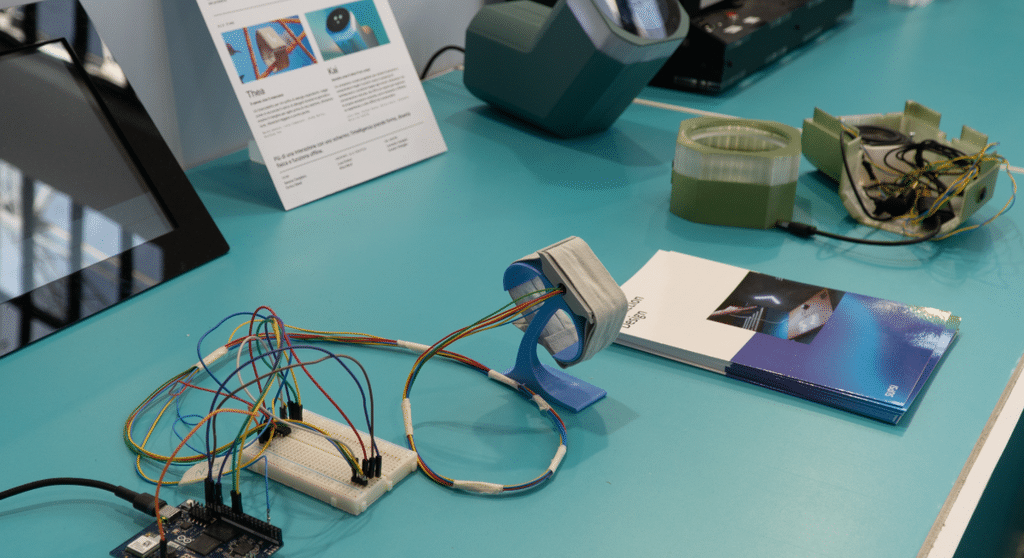
For people living with chronic respiratory allergies, a reaction often seems to come out of nowhere. Potential triggers may accumulate before symptoms appear. Pollen, dust, pet dander, pollution, a bad night’s sleep: the student team designed Thea to explore how information about environmental exposures and user-reported factors could be presented before symptoms arise. It is a wearable built on the Arduino by students of the Master of Arts in Interaction Design (MAInD) at SUPSI, the University of Applied Sciences and Arts of Southern Switzerland.
At Maker Faire Rome 2026, visitors to the Arduino booth got to try it for themselves.
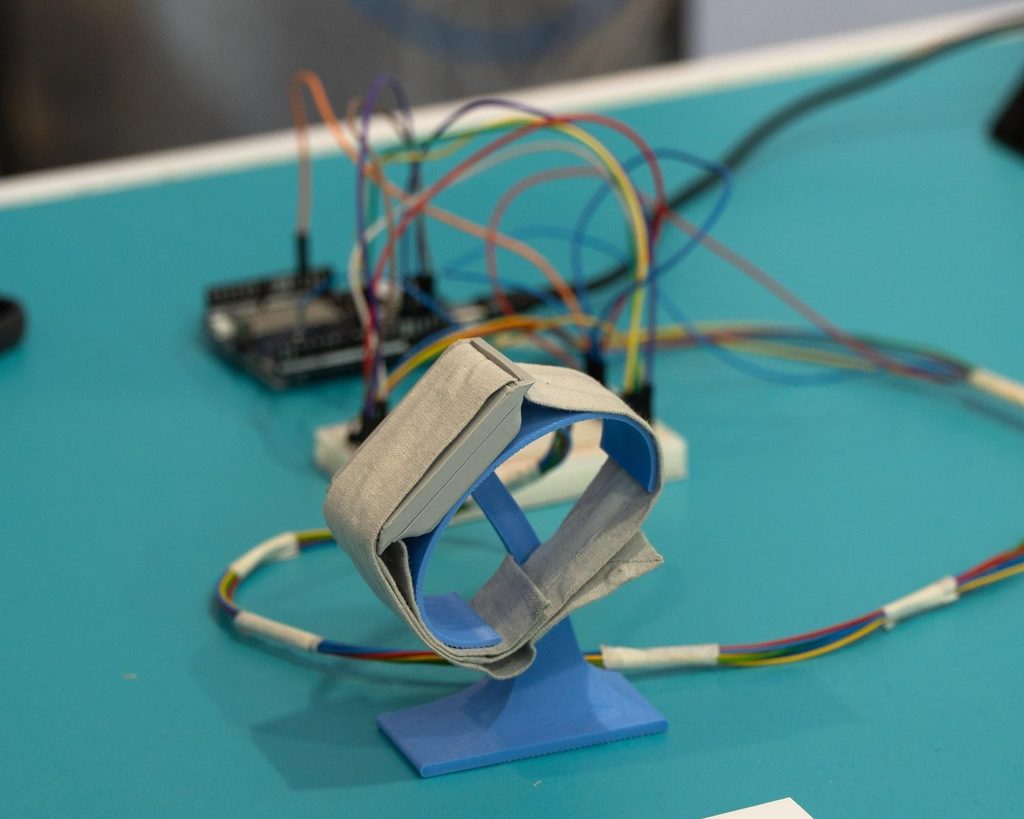
The Thea wristband prototype: a 3D-printed case wrapped in a fabric strap, wired to an UNO Q.
Not a tracker, a new sense
Most allergy apps follow one trigger at a time. Thea looks at cumulative load: how everything you have been exposed to adds up, and how close that brings you to your personal threshold. The space between the two is what the team calls the “action window”: an estimate generated by the prototype’s model to indicate when the user may wish to consider taking action.
Rather than sounding alarms, Thea follows the principles of calm technology. It stays at the edge of your attention and communicates through the senses:
• Light. A gauge fills clockwise to show how much headroom is left.
• Vibration. Pulses tell you how fast the window is narrowing or opening again, always paired with the light.
• Voice. Used rarely, and never on its own. You open the conversation yourself and tell Thea what it cannot measure (“I was just near a dog”); it answers in a calm voice. When the window is about to close, the light and the vibration ask you to acknowledge the situation first. Only then does a voice provide information based on the prototype’s simulated exposure model.
A single tap gives you a status check at any moment, without opening an app. Thea never speaks unless you asked, or acknowledged a signal first. The prototype may then provide a status message based on its model.
Two brains, one board
The team selected UNO Q, because Thea is two systems in one. A predictable, real-time layer senses and signals. A conversational layer listens and talks. UNO Q combines a Qualcomm Dragonwing QRB2210 processor running Linux with a real-time STM32U585 microcontroller, so both can live on the same board.
• On the microcontroller: the button, the light gauge, and the haptic motor, together with the cumulative load model that calculates the action window. This layer is designed to operate deterministically and in real time in the demonstrated prototype.
• On the Linux side: the voice agent, connected to a microphone and speaker, which handles the moments when light and vibration are not enough.
The split also reflects a key design principle. The language model never decides how much room you have: the load model does, on the microcontroller. The voice only puts that state into words, which is intended to keep responses tied to the state generated by the load model.
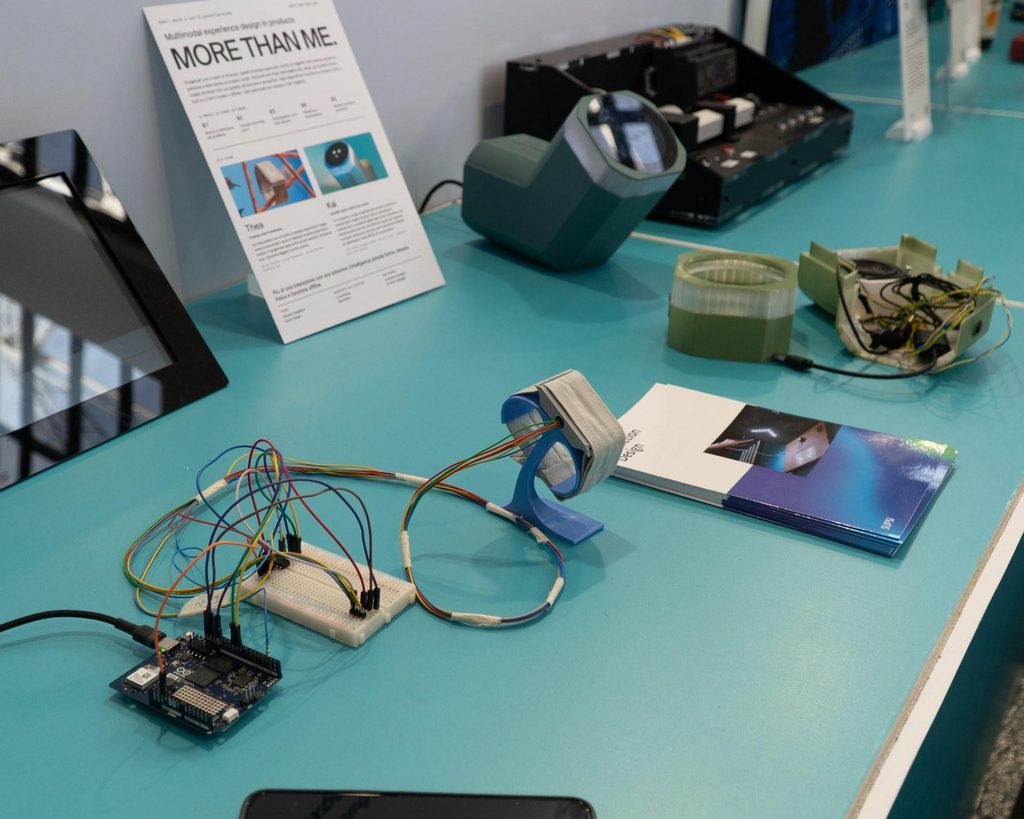
Thea’s setup on the table: the wristband prototype wired to UNO Q through a breadboard.
Local by design
Allergy data is health data, and the team believes it should stay with the person it belongs to. That is why Thea is designed to run locally: the risk model and the voice live on the device, and the team’s intended on-device implementation would process health-related data locally.
UNO Q supports this intended architecture. Its Linux side can run small open-source language models, speech recognition, and text-to-speech directly at the edge.
In Rome, the voice agent still ran on a cloud model, so the team could iterate quickly on the conversation design. The architecture is built so that this model can be swapped for one running on the board itself, without changing the experience. Bringing the voice fully on-device is the next step.
Local processing brings more than a privacy feature. If the voice functionality is implemented fully on-device, the architecture is intended to support operation without a server connection and local processing of sensitive data.
From the classroom to the Arduino booth
Thea was born in “More Than Me”, a five-week MAInD module on multimodal experience design in products, led by Serena Cangiano and Enrico Bassi. Every team designed and built its prototype on UNO Q.
From October 23 to 25, Thea was one of two MAInD projects shown at the Arduino booth. Over three days, the team talked with makers, families, students, and curious visitors.
The prototype on the table was the one that came out of the course: a 3D-printed case with the light gauge and the vibrating button, connected to UNO Q, a speaker, and a microphone, running on simulated exposure data. A companion app on a phone completed the experience, walking visitors through onboarding.

Visitors gathering around the Thea demo at the Arduino booth.
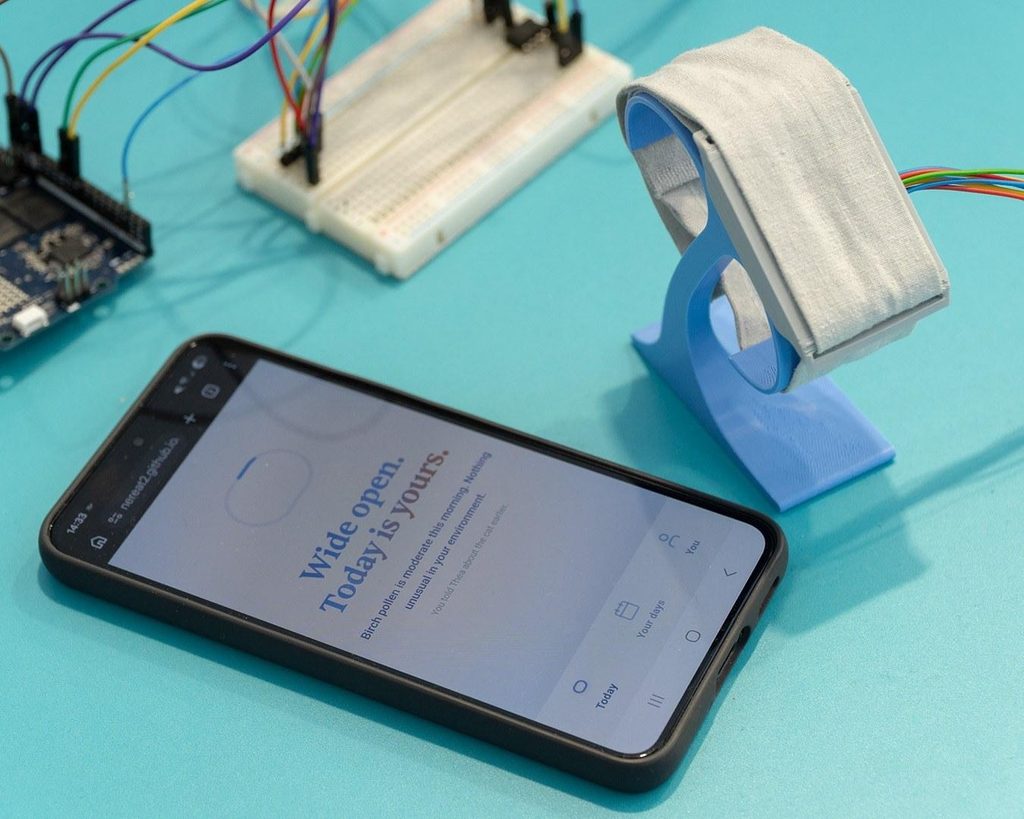
The companion app on a phone next to the prototype: on an open day, Thea simply says “Wide open. Today is yours.”
What’s next for Thea
After Rome, the team is taking Thea beyond the classroom. The team plans to seek input from people who live with allergies, medical experts, and technical specialists as it develops the next version. If that is you, get in touch at info.thea.ch@gmail.com
Behind all of it is the question the team kept asking in Rome: what could technology feel like if it lived on the body instead of on a screen?
Thea was designed and built by Nerea Asensio, Nicholas Vos, Lucia Ciapessoni, and Jérémy Martin at MAInD SUPSI.
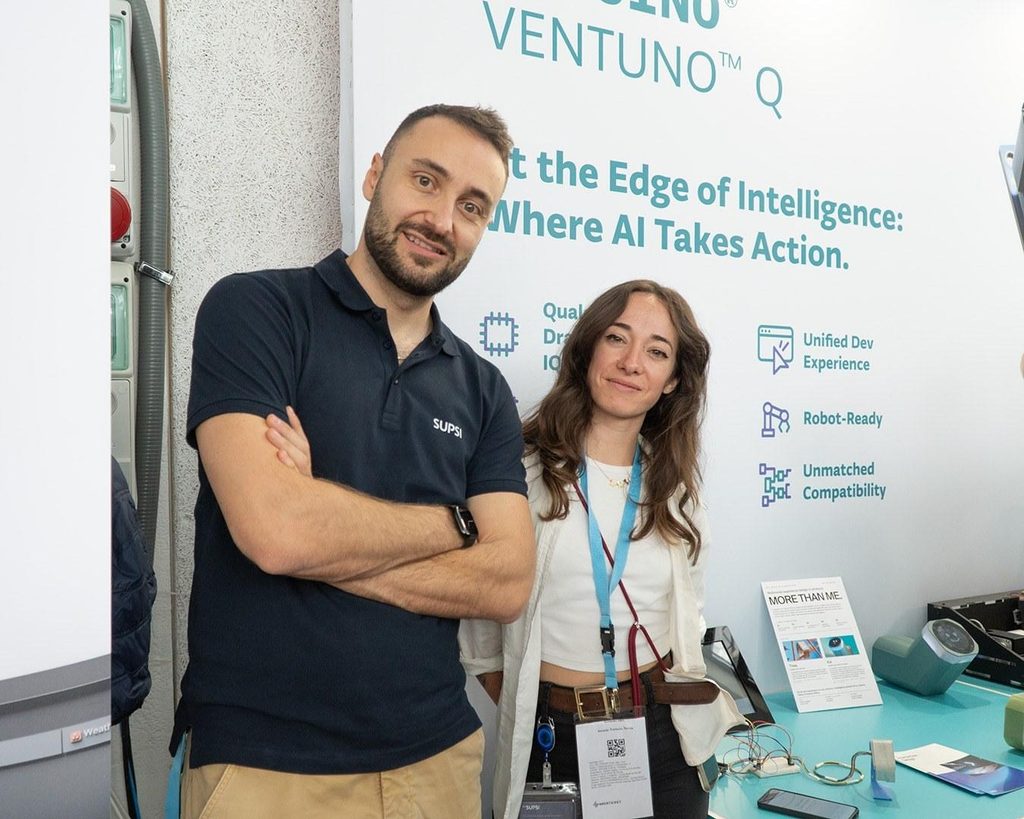
Nicholas and Nerea, two of the team members, at the Arduino booth, Maker Faire Rome 2026.
Qualcomm branded products are products of Qualcomm Technologies, Inc. and/or its subsidiaries. Arduino, UNO, and the Arduino logo are trademarks or registered trademarks of Arduino S.r.l.
The post Thea: exploring a wearable experience for people with allergies appeared first on Arduino Blog.
[original story: Arduino Blog]