Segway is moving into the robot mower market with the Navimow. What sets this model apart from many others is that you don't need to install a boundary wire. Instead, Navimow uses GPS and other sensors to stay within the perimeter of your lawn.
A so-called Exact Fusion Locating System can maintain Navimow's position accurate to within two centimeters, according to Segway. If the GPS signal ever dips, the company says the device's array of sensors and data ensure it will still work. You can tell Navimow where to mow, define the boundaries and instruct it to avoid certain parts of your garden via an app. Segway claims Navimow uses an algorithm to figure out a mowing path so it doesn't have to criss-cross.
Segway says Navimow operates relatively quietly at 54 dB. There are offset blades to trim edges and corners, while the mower gradually cuts grass from above to reach the height you want (between three and six centimeters). The mower can handle 45-degree inclines and it has an IPX6 water resistance rating, according to Segway.
There are safety features too. Segway says Navimow can detect and bypass obstacles, and its blades will stop spinning if pets or kids get too close. If the device detects rain, it'll return to the charging station, but you can turn off the rain sensor and put Navimow to work even when it's wet outside. When the battery gets too low, Navimow will continue cutting from where it left off after it recharges.
Segway
Installing a perimeter wire can take some time and as SlashGear notes, it can damage a garden, since it's usually buried under grass. So Navimow might be a healthier solution for your lawn than other robot mowers. iRobot planned to make a mower with wireless boundary beacons, but it put the device on hold last year amid the onset of the COVID-19 pandemic.
Segway is releasing four versions of its mower. The Navimow H500E is for lawns with an area of up to 5,400 square feet. It costs €1,199 (around $1,425). The other three models have larger batteries to support bigger lawns, along with 4G support and a GPS anti-theft system. The prices top out at €2,499 (around $2,970). However, Segway hasn't announced US launch details yet.
Once you get offworld, count water among your most valuable resources: drink it, wash in it, use it to power your spacecraft. This humble molecule is critical to space exploration and exoplanetary colonization which is why, ahead of an international effort to establish a permanent human presence on the Moon (aka the Artemis Program), NASA scientists plan to land the world’s first autonomous lunar rover there in search of dihydrogen-monoxide deposits worth their weight in gold.
“Every mission, no matter what type, whether roving or not, will be standing on the shoulders of what was learned by other missions before,” Dan Andrews, VIPER project manager, told Engadget. “Otherwise you're just throwing away really good learning.”
However, we don’t necessarily have a great understanding of how those frozen molecules are actually distributed or how to best extract them from the lunar soil — and that’s where the upcoming Volatiles Investigating Polar Exploration Rover (VIPER) mission comes in.
This golf cart-sized machine will be delivered to the Moon’s South Pole in late 2023 and spend its scheduled 100-day mission scouring the area for four “ice stability regions” — surface regions where we might find ice just laying about, shallow regions where the ice is covered by 50 centimeters of regolith, deep regions where the ice is buried up to 100 centimeters, and dry regions where there is no ice present below 100 centimeters. Andrews notes that “those regions exist all over the place in both the North and the South Pole. There's thousands of them.”
As the VIPER trundles about, it will employ its Neutron Spectrometer System (NSS) to indirectly survey the soil around itself in search of water at depths up to three feet (.9m) by looking for the energy losses in cosmic rays (mostly in the form of neutrons) that occur when they strike hydrogen molecules. And where there’s hydrogen, there could well be water.
NASA
Once the NSS finds a suitable concentration, the VIPER will deploy its meter-long TRIDENT (The Regolith and Ice Drill for Exploring New Terrains) to drill down and pull up soil samples for examination by the onboard Near-Infrared Volatiles Spectrometer System (NIRVSS pronounced “nervous”), which can identify the hydrogen’s form, whether that’s free hydrogen atoms or slightly more complex hydroxyls. And even before the rover sets a wheel off its orbital delivery vehicle, the Mass Spectrometer Observing Lunar Operations (MSolo) will be sampling gases kicked up during landing in search of stray hydrogen atoms.
When the LCROSS mission slammed a probe into the moon’s surface, it measured and analyzed the resulting ejecta for water ice using variations of nine commercially available instruments that could be traced back to “everything from NASCAR car instrumentation to manufacturing.” The VIPER mission is taking a similar tack. While not directly a part of the mission itself, other units of the instruments that will land aboard VIPER will also be delivered to the Moon in both 2021 and 2022 as part of NASA’s Commercial Lunar Payload Services program for use in various experiments. This will serve as a sort of shake-down cruise for the instruments, allowing the VIPER team to see how the gear they’re sending will operate under real-world conditions. “If the instruments work beautifully, well great,” Andrews said. “If the instruments have a peculiar behavior that was unexpected, we can plan that in. And if they outright fail... we at least have the chance to try to diagnose why it did go wrong.”
While it won’t be the first wheeled vehicle to roll across the Moon, it will be the first autonomous vehicle to do so with a mission far more important than ferrying astronauts around. But the Moon is a harsh and unforgiving mistress, presenting an entirely unique set of challenges not faced by the larger rovers currently crawling over Mars. For one thing, Mars has an (albeit thin) atmosphere, the Moon has none, “which means it gets really, really hot, and it gets really, really cold,” Andrews said. “There's no moderating atmosphere so that becomes a really strong design point for the rover.”
What’s more, at the South Pole where the VIPER will be prowling the sun will rarely get more than 10 degrees above the horizon, which causes “unbelievably long shadows,” he continued. “And since there's no atmosphere, the lighting conditions are such that it looks to be very, very bright and right next to it can be unbelievably dark and black,” which can create havoc for visual navigation systems.
And then there’s the regolith — the moon’s razor-sharp, electrostatically-charged, insidiously-invasive soil. Created from eons of micrometeorite impacts, the stuff has built into berms and hills, lined craters and valleys across the lunar surface. Regolith can pile high and deep enough to bury the likes of a VIPER. So to ensure that the rover remains mobile, Andrew’s team taught it to “swim.”
NASA
Under typical conditions, the VIPER’s wheels roll conventionally at the ends of a rocker-bogie suspension system at speeds approaching a blistering half-mile-per-hour (that’s 20cm/s). Since the rover is powered exclusively through solar energy with a 450W battery, rather than a handy radioactive core, “we need to be able to move in any direction at any time, independent of how [VIPER is] pointed,” Andrews explained. “That means we need to be able to crab walk. So, each of our four wheels has the ability to independently be steered.”
And when the rover finds itself mired in regolith, it can turn these wheels sideways acting as scoops to drag itself forward. What’s more, the suspension setup enables the rover to lift each wheel independently, like a foot. Combining the vertical movements with dragging action somehow resulted in the Shaq-esque shimmy.
“We know we're going in and out of craters — and in fact we want to, because some of the areas where the water that can be found are going to be in very dark permanently shadowed craters — and because no robot or human has been down there, we don't exactly know what it's going to be like,” Andrews said. “So we needed to improve the capabilities of the rover to handle a lot of the unknown.”
The VIPER will not be driving blind, mind you. NASA is already hard at work producing a lunar road map to help guide the rover on its journey. The 3D, meter-scale maps were created using NASA’s open source Stereo Pipeline software tool alongside its Pleiades supercomputer to assemble satellite images captured by the Lunar Reconnaissance Orbiter using a technique known as photoclinometry. With them, the VIPER will be less likely to fall into craters or tip head over wheels trying to climb a too-steep incline.
Unlike its Mars-based cousins, VIPER won’t have to rely nearly as heavily on automation thanks to its drastically shorter signal lag time — 6-10 seconds compared to the 15-20 minutes needed to talk to Mars. That’s still too long a delay to take control of the VIPER directly from Earth, but it will allow Mission Control to plot a series of incremental 15-foot-long navigational waypoints. “Once we pick the landing site... which will be in October,” Andrews said. “We're going to pick the optimal traverse plan for the rover to get as much science as we can out of it.”
After VIPER completes its mission, NASA researchers should have a much broader and more detailed view of where water deposits are located in the region. But what will happen to VIPER itself once its duties are done?
While the decision on that subject is still being debated by the VIPER team, Andrews points to two possible outcomes. We could drive the rover into the deepest, darkest crater it can find, consequences be damned, to see just what the heck is down there (maybe ghosts!). The other option would be to park it on the highest and best-lit mound of regolith we can find and hope that the rover can be revived after the region sinks into 6 to 9 months of complete darkness.
“NASA would then have to decide if it is worth them keeping the team going for that amount of time,” Andrews conceded, “so when the South Pole comes back into the sun, to try to somehow bring Viper back to life... Is it worth it to NASA, is it worth the money, to do that? Those are the trades that the agency is going to have to make.”
Since April, we’ve known EA has been working on a standalone mobile version of its popular Battlefield games it plans to release sometime in 2022. This week, the publisher shared new details on the upcoming title.
To start, EA plans to begin beta testing Battlefield Mobile this fall with “a series of smaller playtests" involving players in Indonesia and the Philippines who own Android devices. “As we continue with testing, we’ll expand the size of these tests, [and] add new regions,” the company said over on its community website.
The initial beta test will only feature a single map called Grand Bazaar and the franchise’s signature Conquest game mode. EA promised to share more details about other maps and modes closer to Battlefield Mobile’s 2022 release date. In the meantime, the company confirmed the game would be a free-to-play title that will “only” include cosmetic items. You’ll earn some of those through optional seasonal battle passes. Battlefield Mobile won’t support crossplay between any console or PC versions of the Battlefield franchise since it is “being built specially for mobile.”
If you live in Indonesia or the Philippines, you can pre-register on the Google Play Store to get more information about the upcoming beta tests.
WhatsApp has started rolling out its long-awaited cross-platform chat history transfer feature. First announced at Samsung’s recent Unpacked event, the tool allows you to move your chat history, including any voice memos, photos and videos you may have sent to family and friends, between Android and iOS. The feature is currently only available on Samsung phones running Android 10 and above, though WhatsApp notes it will come to more Android devices “soon.”
You can see the full rundown of how to use the tool on WhatsApp’s website. However, one of the more notable requirements is that you’ll need a Lightning to USB-C cable to connect your two phones together. What’s more, both devices must have the same phone number. Oh, and your Samsung phone must be either brand new or recently factory reset. In short, the process isn’t quite as streamlined as we had hoped, but WhatsApp promises it’s secure and reliable.
The current Fortniteseason will wrap up in a little over a week, and once again, Epic Games plans to go out with a bang. Chapter 2 Season 7 is centered around an alien invasion of the island, and it seems you'll have the chance to help send the infiltrating forces packing.
In the Operation: Sky Fire event, which takes place on September 12th at 4PM ET, you'll be able to team up with 15 of your friends and undertake a secret mission. You and your squad will “join a strike team and sneak aboard the Mothership to deliver IO’s final message to the invading aliens.”
As with other Fortniteseasonblowouts, you'll only have one chance to experience this for yourself. You can queue up and reserve your spot 30 minutes before it all goes down.
With the season ending soon, it's worth taking care of some other Fortnite business. You should definitely spend all your bars before the stash resets. Helpfully, residents and vending machines on the island are offering major discounts during Bargain Bin Wild Week, which starts on September 9th. Any battle stars or alien artifacts you don't exchange by the end of the season "will be automatically redeemed for rewards and styles starting with the earliest available unlocks," Epic said.
Until Operation: Sky Fire begins, you can still unlock characters and cosmetics through the current battle pass. Superman's Quests will also no longer be available when the event starts, but you still have some time to unlock the Superman glider, pickaxe and shadow style. Other quests that aren't part of the battle pass, such as the LeBron James and Vox Hunter ones, will still be available in the next season, which should start soon after Operation: Sky Fire.
According to the National Park Service, washing machines are bad for our planet, so bad in fact that they can use up to 41 gallons of water per load. That’s not ideal given the prevalence of droughts as climate change intensifies its work to wipe humanity from the face of the planet. That’s why Bosch, the German multinational which makes, uh, pretty much everything, has created FreshUp. It’s a tool designed to “refresh” your clothes without the need to dump them into your washing machine.
The idea is to remove odors from clothes that are otherwise clean, in the sense that they’re not visibly stained. You know, an evening gown or tuxedo that looks a million dollars but smells like the bottom of a well-visited ashtray, or that t-shirt that goes perfectly with your outfit, but smells a little bit sweaty. In those situations, you’d grab this doodad, rub it over the required garment and step out smelling fresh as a daisy.
FreshUp is a lozenge-shaped device measuring 6.5-inches long, with a 2-inch treatment area on its underside. Once charged and turned on, you press this against your dry clothes so that the process of breaking down the smell can begin. It works as an ionizer, creating a plasma which Bosch says dissolves the connections between odor molecules.
There’s a beautiful design on the top that’s designed to resemble an interlacing series of magnetic field lines. This is backlit in white, and turns purple when it’s actually treating your clothes with its ionization. Despite the overall vibe that this is a product that fell out of a Sharper Image catalog twenty years ago, it’s impeccably designed. Thankfully, there are no “but wait, there’s more” innovations to add to the list of jobs this thing can do.
The battery takes around four hours to charge and will give you an hour of processing before it needs to go back on the wire. Bosch also chose a micro USB port for charging rather than USB-C, which is, you know, a choice you can make in 2021. But it’s not ideal if you’re trying to minimize cable clutter and are looking to ditch the older standard as soon as possible.
As soon as you’ve treated a garment with FreshUp, you’ll be acutely aware of the ionization in the air. It offers a similar smell to the taste you get in your mouth when you’ve bitten your tongue. That iron-in-the-blood scent that clings to your hand when you’ve held onto some loose change while waiting for a vending machine. And it doesn’t just sit on your clothes, but hangs in the air, where on very dry summer days you’ll want to make sure you leave your windows open to encourage airflow.
In its sales pitch, Bosch says that FreshUp was designed to eliminate what it describes as a “chair-drobe.” You know, that pile of clothes in your bedroom that maybe you drape over the back of a chair, or stuff on the bottom of your wardrobe, because they’re too clean to wash. I’m not a regular chair-drobe-ist, but the fan housing of my rowing machine is sturdy enough to drape clothes over on the rare occasions they wind up in this state. Bosch adds that, after treatment, “even tough odors such as cigarette smoke and body odor are removed, leaving clothes as if they have been hung outside to dry.”
Daniel Cooper
And here’s where I’ve really earned my wages over the last month or so, because I’ve spent a chunk of this summer sniffing awful things. Not to mention, of course, wearing already-worn clothes and spending way too long with my nose in my own armpit. I’ve been testing a high-intensity exercise bike and trying to be as active as possible, all the while getting my clothes covered in cigarette smoke and frying oil. Consider this a content warning for what is about to follow, as well as a polite request for danger pay.
There were plenty of smells that the FreshUp was able to dispel without breaking much of a sweat, including the cigarette smoke and fried food. It’s in this regard that makes me think that FreshUp is perfect for traveling, when you want to make sure that you’re looking and smelling your best. If your top smells like the inside of an ashtray, just waft this thing over it, hang it up for an hour or two, and boom, you’re away.
But no matter how much I rubbed this thing over the armpits of my well-worn t-shirts (after, I should make clear, the fabric had dried out) I could never banish the smell of my sweat. I tried everything, including leaving a t-shirt hanging up for a day or two and then treating it again, then leaving it to hang for another couple of hours, and nothing. The scent wasn’t eliminated, although I will say that it was moderated somewhat, but not enough to make you not deeply self-conscious about how you smell. But I did wonder if this was a “me” problem rather than Bosch’s, and so grabbed clothes from other family members. One of my relatives who went for a run handed me a pair of their socks which stank so bad that they probably violated chemical weapons laws.
And again, I’d like to reiterate that the time I spent dry-retching was all in the service of good journalism.
Once dried out, I treated those socks and found that, again, FreshUp hadn’t destroyed the smell, but it had reduced the urge to heave. That, broadly speaking, means that this is not going to be your savior if you’re schlepping around in a warm country.
But if you aren’t cursed with the blight of free-flowing underarms (or, in Richard Nixon’s case, upper lip) then I think FreshUp may have a place for you. I can think of some times where, after a long evening on assignment, I’d love to give my clothes an emergency refresh. If you’re doing two or three smart events back-to-back and can’t visit a dry cleaners, then FreshUp is probably a good shout, but the use cases are limited.
But don’t expect the results to be as good as washing, because fundamentally, nothing is going to be able to replace your washing machine just yet. And then there’s the price, which at £250 ($342) is a little high for a device that can’t revolutionize how you do laundry. At least, not yet.
Apple says it's delaying the rollout of Child Sexual Abuse Material (CSAM) detection tools "to make improvements," following pushback from critics. The features include one that analyzes iCloud Photos for known CSAM, which has caused concern among privacy advocates.
“Last month we announced plans for features intended to help protect children from predators who use communication tools to recruit and exploit them, and limit the spread of Child Sexual Abuse Material," Apple told 9to5Mac in a statement. "Based on feedback from customers, advocacy groups, researchers and others, we have decided to take additional time over the coming months to collect input and make improvements before releasing these critically important child safety features.”
China's second largest e-commerce platform JD.com will stop selling up to 86 games following a crackdown on gaming that limits children to three hours per week, the South China Morning Post (SCMP) has reported. Popular titles being removed from its platform include FIFA 21, The Last of Us 2 and Super Mario Maker 2.
Earlier this week, China's National Press and Publication Administration (NPAA) regulator issued an edict limiting gaming for kids under 18 to three hours of gaming per week. They're only allowed to play now for an hour every Friday, Saturday, Sunday and on statutory holidays, marking some of the governments strictest measures since a blockade on new approvals back in 2018.
The new rule has a few gaping holes, notably that officials won't be able to monitor unlicensed games not officially in the system. It's difficult to see how officials would monitor offline gameplay, as well.
However, it's still a big shift in JD.com's strategy, as SCMP has noted. The company announced that it would ban any game that violates China's constitution or national security laws. That also includes games that might promote vulgarity, pornography, gambling and violence. (It's hard to see how some of those games like FIFA 21 and Super Mario Maker 2 violate those rules.)
Previously, JD.com allowed sales of certain games that straddled or crossed those lines, banning them only when they stirred up controversy. Other firms have sold banned games using code titles, changing the name of Resident Evil 2: Remake to First Day on the Job at the Police Station: Remake, for example.
The new strategy may be due in to stepped up government enforcement, with Guangdong regional officials arresting 54 parallel importers in April and confiscating $11.9 million worth of smuggled consoles, according to the report.
We're back after a week off, and we've got a lot of news to catch up on! This week, Devindra chats with Senior Editor Daniel Cooper about the iPhone potentially getting satellite phone connectivity, as well as the upcoming launch of Windows 11. Plus, they answer some questions from our YouTube livestream audience. And of course, they can't help but dive into the messy Ted Lasso season 2 discourse.
Listen below, or subscribe on your podcast app of choice. If you've got suggestions or topics you'd like covered on the show, be sure to email us or drop a note in the comments! And be sure to check out our other podcasts, the Morning After and Engadget News!
01:56: News talk: Will the next iPhone have satellite calling?
07:12: BTW, we're now Yahoo again!
07:50: Apple will let some media apps link to outside payment providers
09:55: Apple announces the first states to bring driver's license to Apple Wallet
14:15: Microsoft announces a Surface event on Sept 22, Windows 11 launching Oct. 5
22:15: Twitch streamers organized #DayOffTwitch to protest hate raids
26:15: RIP Locast
37:28: Audience Q&A
49:30: Dev working on: Razer Blade 14, Twelve Minutes
55:30: Dan working on: HP Pavilion Aero, Saints Row
1:06:00: Pop culture picks: Ted Lasso, Candyman, Lower Decks
1:23:10: Neill Blomkamp on Demonic
Video livestream
Credits Hosts: Daniel Cooper and Devindra Hardawar Producer: Ben Ellman Livestream producers: Julio Barrientos, Owen Davidoff, Luke Brooks Graphics artists: Luke Brooks, Kyle Maack Music: Dale North and Terrence O'Brien
This week brought more and more gadget deals as Labor Day weekend inched closer. Many of this week's deals are still available right now, including Amazon's discount on the first- and second-generation Echo Show 5 smart displays and a $20 discount on Google's Nest Audio speaker. Plus, a bunch of new sales are running now through the holiday, including those on Dyson vacuums, OLED smart TVs, wireless earbuds and more. Here are the best Labor Day tech sales we could find.
MacBook Air M1
Devindra Hardawar/Engadget
Apple's MacBook Air M1 is back down to an all-time low of $850 thanks to an automatically applied coupon. It earned a score of 94 from us for its stellar performance, attractive, fanless design and its comfortable keyboard and trackpad.
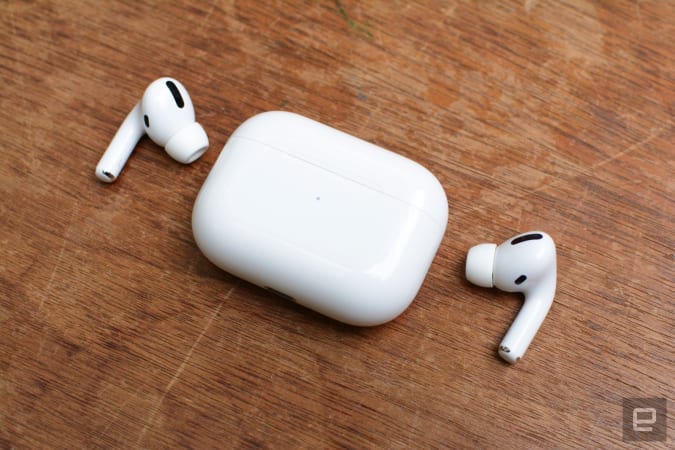
Apple's AirPods Pro are down to $190 right now, or $60 off their normal price. These are the best sounding earbuds you can get from Apple, and we gave them a score of 87 for their better, more secure fit, IPX4 water resistance and solid audio quality.
Apple's Mac Mini M1 returned to its all-time-low price of $600 this week thanks to a sale and an automatically applied coupon. You're getting all of the performance boosts provided by the M1 chipset in a compact desktop package. This is a good machine to get if you have an older desktop that needs replacing, but you don't want to spend a ton of money.
Both the first- and second-generation Echo Show 5s are on sale right now — the original is down to $45 while the updated version is only $10 more. These stand out as excellent smart alarm clocks thanks to their compact size, sunrise alarm feature and tap-to-snooze function. The main difference between the two is the improved, 2MP camera on the second-gen version, which will make for slightly better video calls.
Google's Nest Audio smart speaker remains on sale for $80, or $20 off its normal price. This is one of the best mid-range smart speakers you can get right now and it's especially useful for those already relying on the Google Assistant. We gave it a score of 87 for its solid audio quality, stereo mode with two paired together and attractive design.
Amazon's updated Echo Buds are on sale for $90, or $30 off their normal price. You could pick up the model with a wireless charging case instead and you'd only spend $105. Amazon improved these true wireless earbuds in nearly every way — we gave them a score of 80 for their better sound quality, ANC and small, comfortable design.
Samsung's Premiere Projector is $1,000 cheaper both at Amazon and Samsung's own site. The 4.2.2 sound channel model is down to $5,498, which is still quite expensive, but much better than its normal $6,500 price. We included this in our best projectors guide for its separate red, green and blue lasers that cover the full Rec.2020 color range, maximum 2,800 lumens of brightness and 4K resolution.
Google's Pixel 4 smartphone is down to a new low of $379 at B&H Photo. We believe the launch of the Pixel 6 to be right around the corner, so you may want to wait if you want the latest phone from Google. However, the Pixel 4 remains a solid handset — we liked its speedy performance, lovely display and stellar camera experience.
Samsung's T7 Touch portable SSD in 1TB is down to $170, or $10 off its normal price. It has dropped to $160 in the past, but this is the best price we've seen in a number of months. In addition to read speeds up to 1,050 MB/s and write speeds up to 1,000 MB/s, this tiny SSD has a shock-resistant body and a built-in fingerprint reader for an extra layer of security.
One of Sony's premium OLED TVs, the 55-inch Bravia XR A80J set, is down to $1,700 at Amazon and Best Buy, or $600 off its normal price. It packs most of Sony's best TV technology into one set, including the Cognitive Processor XR, HDMI 2.1 support, 4K upscaling, XR Motion Clarity and improved sound with Acoustic Surface Audio+ and built-in subwoofers. It also runs the Google TV operating system, so you can call upon the Assistant for all your entertainment needs.
Google's Nest WiFi pack with one router and one access point is down to $200 right now at Best Buy. That's $70 off its normal price and a great deal on one of our favorite mesh systems. We gave it a score of 84 for its minimalist design, simple installation and built-in smart speaker.
Through September 18, Omaze is giving away another $20,000 to build your ultimate gaming PC. This sweepstakes is free to enter, but funds donated with purchased entries will benefit Schools on Wheels, an organization that provides free tutoring and mentoring services to children experiencing homelessness across Southern California.
Through December 8, you can enter to win four-day passes to San Diego Comic-Con 2022. Along with the passes, you'll get access to a special preview night, reserved seating in Hall H, a personal concierge, a private tour of the Comic-Con Museum, dinner in Balboa Park and tickets to the "Night at the Comic-Con Museum" event. It's free to enter, but funds from this sweepstakes will go to the San Diego Comic Convention.
Pricing and availability is subject to change. No donation or payment necessary to enter or win this sweepstakes.See official rules on Omaze.
New Labor Day tech sales
Dyson Labor Day sale
Dyson knocked up to $150 off a number of its vacuums and air purifiers for Labor Day. Of note are the Dyson V7 Absolute for $250 and the Dyson V8 Animal for $350. Although both models are a few years old at this point, they remains solid cordless vacuums made even better by these sale prices.
Weber knocked hundreds off its high-end SmokeFire grills — both the EX6 and EX4 are $200 off, bringing them down to $999 and $799, respectively. These WiFi-connected grills are some of our favorites because they're relatively easy for even grilling novices to use and their companion mobile app gives you a number of convenient features like remote temperature adjustment and SmokeBoost activation.
Optoma's CinemaX P2 ultra-short throw projector is $300 off this weekend, bringing it down to a record low of $3,000. This made it onto our list of best projectors because it improves on the P1 while costing less. It can reach up to 3,000 lumens of brightness and it has an improved contrast ration and 80 percent DCI-P3 coverage. You'll get close to a 4K image with this machine, and it looks pretty nice too, so you can leave it out in your living room without drawing too much attention.
Roborock's S6 robot vacuum is down to a record low of $380 thanks to a $102 discount along with a clippable coupon for an extra $168 off. In addition to 2000Pa of suction, this vacuum supports multi-floor mapping, integrated mopping and app and voice control.
You can get up to 35 percent off AeroGarden gadgets when using the code LABORDAY at checkout through September 7. We've long been fans of the Harvest series, which lets you grow multiple herbs and plants indoors without any hassle.
Nanoleaf's Labor Day sale knocks $20 off its triangle LED light kit, bringing it down to $180. It's a cool way to spice up your home office or living room with funky lights and shapes, especially since you can arrange the pieces in any way and control the lights via a mobile app.
BioLite's Labor Day sale has begun and it knocks 20 percent off everything on the company's website. BioLite's gadgets, like the Headlamp 200, has made it into many of our guides in the past, and it's a good place to go when you need new gear for your backyard or for your next camping trip.
One of our recommended VPNs is running a decent sale on a two-year subscription. You can sign up for NordVPN for $99 for the first two years, which comes out to $49.50 per year, and get three additional months of access for free. We like NordVPN for its speed, its no-logs policy, the thousands of servers it has to choose from and that one account supports up to six connected devices.
You can get 15 percent off site-wide at Satechi using the code LDW15 this weekend. We like the company's Bluetooth keyboards and mice, and it also has a wide array of other accessories including USB-C dongles, charging stations, phone and tablet stands and more.
Vantrue's 3-channel dash cam is down to $210 when you clip the on-page coupon and use the code DVVZGJWE at checkout. This is a high-end dash cam that includes a dual camera that records the road ahead as well as the interior of the car, and a separate rear camera for recording what's happening behind you. While that much coverage might be overkill for most, it ensures you'll capture footage at all angles if you're ever in an accident.