The wait is over. It’s now possible to encrypt your WhatsApp chat history on both Android and iOS, Facebook CEO Mark Zuckerberg announced on Thursday. The company plans to roll out the feature slowly to ensure it can deliver a consistent and reliable experience to all users.
However, once you can access the feature, it will allow you to secure your backups before they hit iCloud or Google Drive. At that point, neither WhatsApp nor your cloud service provider will be able to access the files. It’s also worth mentioning you won’t be able to recover your backups if you ever lose the 64-digit encryption key that secures your chat logs. That said, it’s also possible to secure your backups behind a password, in which case you can recover that if you ever lose it.
While WhatsApp has allowed users to securely message each other since 2016, it only started testing encrypted backups earlier this year. With today’s announcement, the company said it has taken the final step toward providing a full end-to-end encrypted messaging experience.
It’s worth pointing out that end-to-end encryption doesn’t guarantee your privacy will be fully protected. According to a report The Informationpublished in August, Facebook was looking into an AI that could analyze encrypted data without having to decrypt it so that it could serve ads based on that information. The head of WhatsApp denied the report, but it’s a reminder that there’s more to privacy than merely the existence of end-to-end encryption.
Boston Dynamics, the company most commonly associated with robot dogs, prohibits the weaponization of its Spot devices. That's not the case for all robot dog manufacturers, however. One of them, Ghost Robotics, showed off a version of its Q-UGV device that many will have been dreading. It's a robot dog with a gun attached to it.
Ghost Robotics has made robot dogs for the military, and it displayed this deadly model at the Association of the United States Army’s 2021 annual conference in Washington DC this week. A company called Sword International built the "special purpose unmanned rifle" (or SPUR) module. According to The Verge, it has a thermal camera for nighttime operation, an effective range of 1.2km (just under three quarters of a mile) and a 30x optical zoom.
"Due to its highly capable sensors the SPUR can operate in a magnitude of conditions, both day and night," a blurb on Sword's website reads. "The Sword Defense Systems SPUR is the future of unmanned weapon systems, and that future is now."
It's unclear how autonomous a SPUR-equipped Q-UGV will be in the field, as Popular Science notes. It remains to be seen whether a human operator will guide the robot to an otherwise hard-to-reach position and manually aim and take shots (which seems more likely), or if the robot will handle entirely things by itself. Either way, it's an unsettling prospect, and that's before we get to the possibility of enemy hackers taking control of these machines.
As if a robot dog with a gun attached wasn't dystopian enough, Ghost Robotics tweeted about a Q-UGV with a different kind of payload: a Lockheed Martin drone and a Digital Force Technologies recon sensor. Sniper robot dogs. Flying robot spy dogs. The future's looking just peachy, isn't it?
You’ll soon have an easier time scrolling through search results on your phone. In the US, Google is rolling out a tweak that does away with the “See more” prompt you’ve had to tap on previously to load additional search results on mobile devices. Now, when you get to the bottom of a set of results, the company’s search engine will instead automatically load the next page for you, allowing you to continuously scroll until you find a website you want to visit.
You should see the change on both your mobile web browser and the Google app for iOS and Android. Per TechCrunch, the company is staggering out the rollout of the feature, so you won’t be able to scroll through every set of results, at least not initially. The change follows a redesign of mobile search Google released at the start of 2021.
While most usually find what they’re looking for quickly, Google notes some people view as many as four pages of search results before they click through to a website. The company suggests the move to continuous scrolling should be particularly helpful to those who tend to ask more open-ended questions of its search engine. It’s also a tweak that brings the platform more in line with modern feed-style apps like Instagram and TikTok.
Ahead of its November 5th release date, we’ve seen sneak peeks of Call of Duty’s Vanguard’s single and multiplayer components. On Thursday, publisher Activision shared a new trailer and blog posts that offer a first look at the game's upcoming Zombies mode.
Developed by Treyarch, Vanguard’s Zombies mode ties into the Dark Aether storyline established in Black Ops Cold War. One year after suffering a decisive defeat at the Battle of Stalingrad, a Nazi officer named Oberführer Wolfram Von List finds a mysterious artifact that binds him to an entity called Kortifex, allowing him to summon an army of the undead. It’s up to you and as many as three other players to battle through the ruins of Stalingrad and stop him.
As you play through a match and complete objectives, you’ll find items called Sacrificial Hearts. You can offer these at an Altar of Covenants to access randomized upgrades that will tweak your playstyle. One of those upgrades will reload your weapons while they’re holstered, while another will allow you to turn zombies into temporary allies.
Any experience you earn while playing Zombies will count toward Vanguard’s Batte Pass, which also shares progression between multiplayer and Warzone. The mode will also support cross-platform play between different consoles. As mentioned above, Vanguard launches on November 5th. It will be available on PlayStation 4, PS5, PC, Xbox One and Xbox Series X/S.
Nanoleaf knows that its users sometimes crave something a bit more minimal than LED light panels that stretch across their wall. That’s why the company is launching Lines, a series of backlight LED light bars which offer the same features as previous products, albeit in a more elegant body. Each “Line” is 10.96-inches (27.85cm) long, and can join to its siblings at either end, or at a 60-degree angle. The company says that you can “paint your space with lines,” creating “grand geometric shapes” and “sleek linear layouts.”
But beyond the new style of design, this is still the same Nanoleaf setup that you already know and love, letting you paint with light. Each Line has two color zones, and you can plug in dynamic lighting scenes, sync with your music and mirror the colors on your computer’s display. In addition, the hardware will act as a Thread Border Router to help connect smart gear nearby that can also harness the same protocol. It’s also future-proof, and will work with Matter, a new protocol due to roll out next year.
Nanoleaf
Nanoleaf Lines are available to pre-order today, with the 9-line starter kit setting you back $200, while add-on packs with 3-lines a piece will cost $80. It’s expected that the products will start shipping to homes in the US at some point before the end of November.
Congress is once again hoping to limit Section 230 safeguards under certain circumstances. Rep. Frank Pallone and other House Democrats are introducing a bill, the Justice Against Malicious Algorithms Act (JAMA), that would make internet platforms liable when they "knowingly or recklessly" use algorithms to recommend content that leads to physical or "severe emotional" harm. They're concerned online giants like Facebook are knowingly amplifying harmful material, and that companies should be held responsible for this damage.
The key sponsors, including Reps. Mike Doyle, Jan Schakowsky and Anna Eshoo, pointed to whistleblower Frances Haugen's Senate testimony as supposed evidence of Facebook's algorithm abuse. Her statements were proof Facebook was abusing the Communications Decency Act's Section 230 "well beyond congressional intent," according to Eshoo. Haugen alleged that Facebook knew its social networks were harmful to children and spread "divisive and extreme" content.
The bill only applies to services with over 5 million monthly users, and won't cover basic online infrastructure (such as web hosting) or user-specified searches. JAMA will go before the House on October 15th.
As with past proposed reforms, there are no guarantees JAMA will become law. Provided it passes the House, an equivalent measure still has to clear a Senate that has been hostile to some Democrat bills. The parties have historically disagreed on how to change Section 230 — Democrats believe it doesn't require enough moderation for hate and misinformation, while Republicans have claimed it enables censorship of conservative viewpoints. The bill's vaguer concepts, such as 'reckless' algorithm use and emotional damage, might raise fears of over-broad interpretations.
The bill could still send a message even if it dies, though. Pallone and the other JAMA backers argue the "time for self-regulation is over" — they're no longer convinced social media heavyweights like Facebook can apologize, implement a few changes and carry on. This won't necessarily lead to a more strictly regulated social media space, but it could put more pressure on social networks to implement far-reaching policy changes.
LinkedIn will shut down the Chinese version of its service later this year. The company cited "a significantly more challenging operating environment and greater compliance requirements in China" as the reasons for closing the local edition of its social network for professionals.
"While we’ve found success in helping Chinese members find jobs and economic opportunity, we have not found that same level of success in the more social aspects of sharing and staying informed," LinkedIn said in a statement. As such, the company isn't abandoning China completely. It's working on a standalone job board app called InJobs, which won't have a social feed or any way to share posts or articles.
LinkedIn agreed to adhere to state restrictions and block certain content when it launched in China in February 2014. However, some signs of trouble bubbled up this year. In March, the company prevented new Chinese users from signing up for a spell while it made sure it was abiding by the countries' laws. A couple of months later, China said 105 apps were violating data collection laws, including LinkedIn.
The Microsoft-owned service was the last major US social network that was still officially operating in China. The country banned Signal and Clubhouse earlier this year. Facebook and Twitter have been blocked there since 2009, and China barred Instagram in 2014.
Spotify is expanding US availability of its Car Thing, an $80 music and podcast player for vehicles. The company debuted the gizmo back in the spring on an invite-only basis and only charged users for shipping during a test phase.
Those who signed up for the Car Thing waitlist before now will get first dibs on the company's first hardware device. In addition, both free and Premium Spotify members in the country can now sign up for the waitlist, though the Car Thing requires a Premium subscription and a smartphone for connectivity. Everyone who signs up for the waitlist will eventually be offered a Car Thing.
Spotify worked on Car Thing for several years before it started shipping the device a few months ago. The idea is to bring infotainment features to almost any car, particularly older ones without newfangled touchscreens. Once you hook up Car Thing to your vehicle with the help of one of the included mounts, you can use it to play music and podcasts with either physical controls or "Hey Spotify" voice commands.
The fitness tracker isn’t dead, and if you’re reading this, you’re probably one of the people keeping these little devices alive. Smartwatches have all but taken over the mainstream wearable space, but the humble fitness tracker remains an option for those who want a gadget to do one thing right all the time. Despite the headwinds, there are still a bunch of fitness bands out there to choose from. Engadget has tested many of them and picked out the best for most people.
What do fitness trackers do best?
The answer seems simple: Fitness trackers are best at monitoring exercise, be it a 10-minute walk around the block or that half marathon you’ve been diligently training for. Obviously, smartwatches can do that too, but there are some areas where fitness bands have the upper hand: focus, design, battery life and price.
When I say “focus,” I’m alluding to the fact that fitness trackers are made to track activity well; anything else is extra. They often don’t have the bells and whistles that smartwatches do, which could distract from their activity-tracking abilities. They also tend to have fewer sensors and internal components, which keeps them smaller and lighter. Fitness trackers are also a better option for those who just want a less conspicuous device on their wrists all day.
Battery life tends to be better on fitness trackers, too. While most smartwatches last one to two days on a single charge, fitness bands will last five days to one week — and that’s with all-day and all-night use.
When it comes to price, there’s no competition. Most worthwhile smartwatches start at $175 to $200, but you can get a solid fitness tracker starting at $70. Yes, more expensive bands exist (and we recommend a few here), but you’ll find more options under $150 in the fitness tracker space than in the smartwatch space.
When to get a smartwatch instead
If you need a bit more from your wearable, you’ll likely want a smartwatch instead. There are things like on-watch apps, alerts and even more robust fitness features that smartwatches have and fitness trackers don’t. You can use one to control smart home appliances, set timers and reminders, check weather reports and more. Some smartwatches let you choose which apps you want to receive alerts from, and the options go beyond just call and text notifications.
But the extra fitness features are arguably the most important thing to think about when deciding between a fitness tracker and a smartwatch. The latter devices tend to be larger, giving them more space for things like GPS, barometers, onboard music storage and more. While you can find built-in GPS on select fitness trackers, it’s not common.
Engadget picks
Best overall: Fitbit Charge 5
Valentina Palladino / Engadget
Fitbit's Charge 5 has everything most people would want in a fitness tracker. First and foremost, it's not a smartwatch. That means it has a slightly lower profile on the wrist and lasts days on a single charge while tracking activity and sleep. It also has a full-color AMOLED display — a big improvement from the smaller, grayscale screen on last year's Charge 4. That display, along with a thinner design, make Charge 5 feel more premium than its predecessor.
But it also costs $180 — $30 more than the Charge 4 — and that's due in part to the design upgrades but also some additional features. The Charge 5 has EDA sensors for stress tracking and it will eventually support ECG measurements and Daily Readiness Scores (the latter is for only for Premium subscribers). Those are on top of existing features that were carried over from the Charge 4 — most notably, Fitbit Pay support and built-in GPS. The former lets you pay for coffee or groceries with a swipe of your wrist, while the latter helps map outdoor runs, bike rides and other activities. Built-in GPS remains the star of the show here — it's fast and accurate, making the Charge 5 the best option if you want a do-it-all wearable that’s focused on fitness.
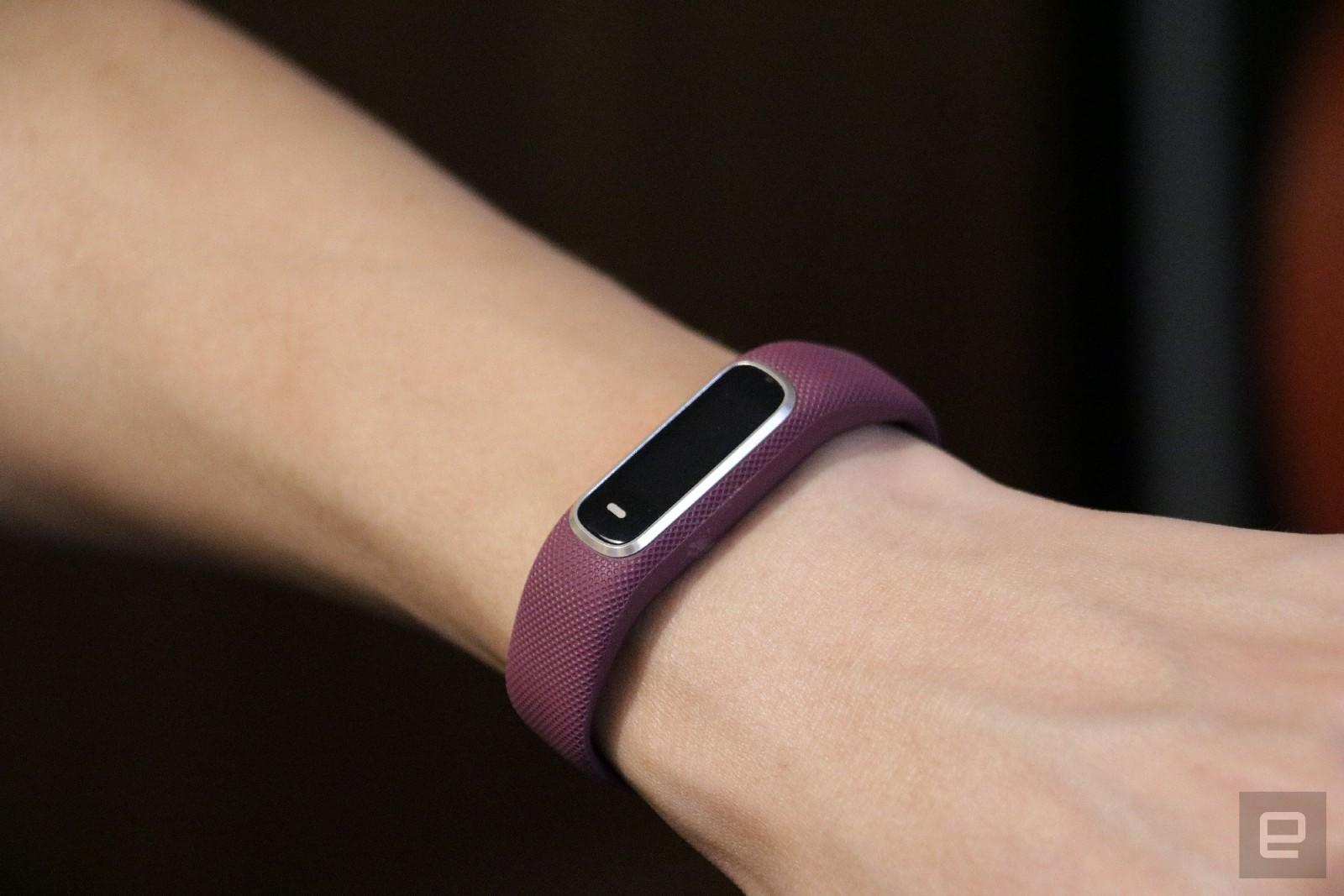
A more subtle-looking alternative is the $100 Garmin Vivosmart 4. It’s thinner than the Charge 5 and fits in a bit better with bracelets and other jewelry you might wear regularly. But its attractive design is only part of its appeal — Garmin knows how to track fitness, and the Vivosmart 4 is proof that you don’t need to drop hundreds on one of the company’s fitness watches to get a capable device.
Like the Charge 5, the Vivosmart 4 tracks all-day activity and sleep and has a pulse ox sensor for blood oxygen saturation measurements. It has only connected GPS capabilities, and it has universal music controls that can control the playback of most anything. The band is also waterproof and can track basic swim workouts, plus it also has a battery life of up to seven days. While it’s similar to the Charge 5 in that the Vivosmart 4 works with both Android and iOS devices, it’s a bit more flexible as it syncs with Apple Health (the Charge 5 and other Fitbit devices do not).
If you only have $100 to spare, the Fitbit Inspire 2 is the best option. It strips out all the luxury features from the Charge 5 and keeps only the essentials. You won’t get built-in GPS, Fitbit Pay or Spotify control but you do get excellent activity tracking, automatic workout detection, smartphone alerts and plenty more. As the updated version of the Inspire HR, the Inspire 2 includes a heart rate monitor, which the device uses to keep track of all-day heart rate, active zone minutes, sleep stages and more.
The Inspire HR is thinner than the Charge 5 but it also has interchangeable bands, so you can switch up its style whenever you feel like it. Its design is also swimproof, and it should last up to 10 days on a single charge. Fitbit also recently added Tile-tracking to the Inspire 2, allowing you to find your misplaced band using the Bluetooth locator feature and the Tile mobile app. All of these features make it the best value fitness tracker you can get.
The $60 Samsung Galaxy Fit 2 band is almost like a more affordable Garmin Vivosmart 4. The two trackers share the same skeletal design but the Galaxy Fit looks a bit more utilitarian — you can swap out its bands, though — something you can’t do on Garmin’s device.
We haven’t given the Fit 2 the full review treatment, but Engadget’s Cherlynn Low was impressed with the original Galaxy Fit: the Tizen-based interface is colorful and easy to use, and plenty of people will appreciate its durable, no-nonsense design. It tracks a bunch of workouts as well and even has auto-exercise recognition. That’s on top of its daily activity tracking and sleep monitor, all of which uses the built-in heart rate monitor to collect pulse data throughout the day.
The kicker for the Galaxy Fit 2 is battery life — the tiny tracker can last for up to 15 days on a single charge, and you can even extend it to 21 days if you change some settings. That’s much longer than most competing bands, so even if Samsung isn’t as comprehensive as Garmin or Fitbit is when it comes to fitness data collection and analysis, the Galaxy Fit 2 is a good option for those who want a basic tracker that they can safely forget to charge each night.
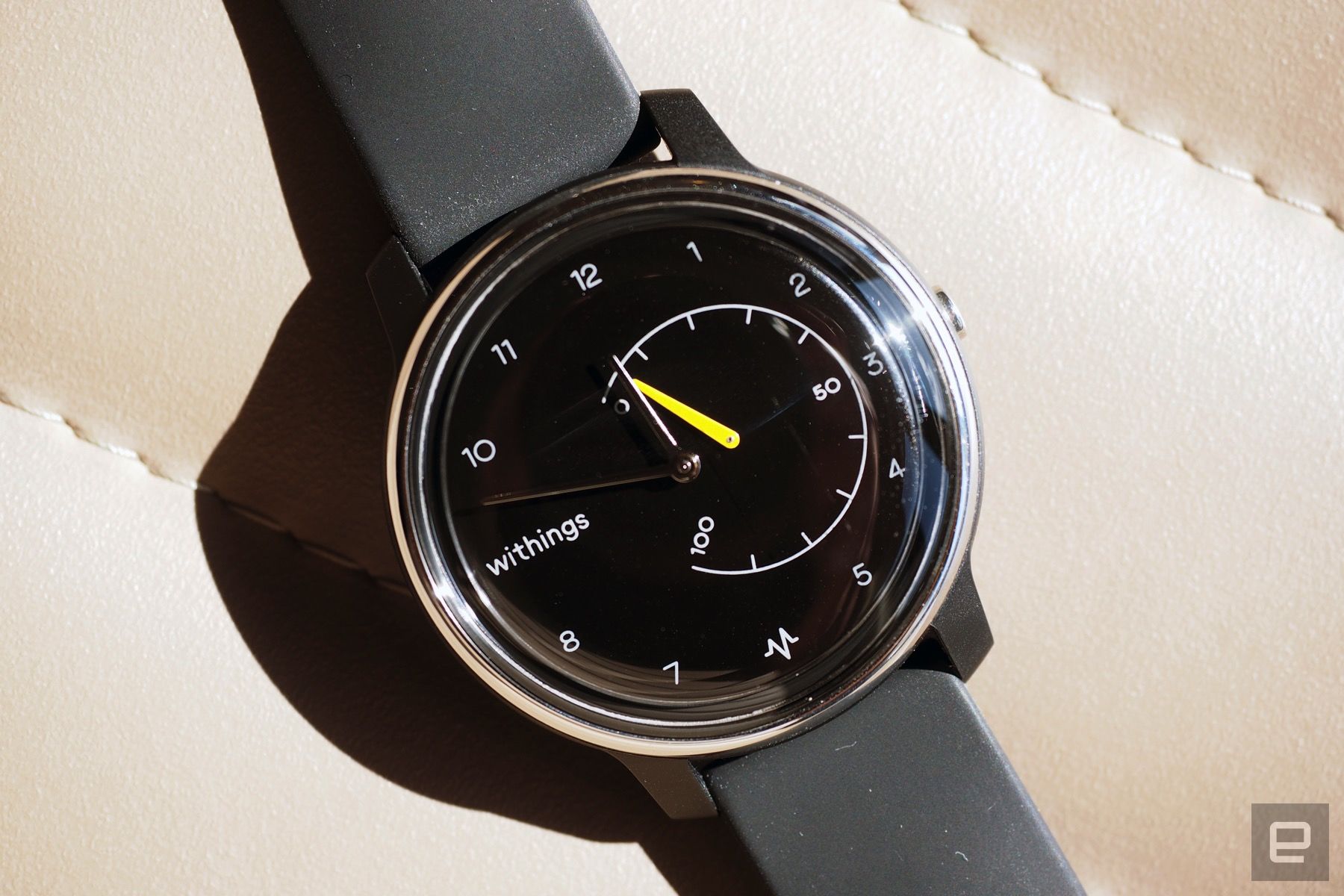
All of the previously mentioned fitness trackers are attractive in their own way (bonus points to those that have interchangeable bands), but they share a similar look. There aren’t many alternative designs for these devices anymore. The $70 Withings Move watch is an exception, and one of the most traditionally fashionable fitness trackers you can get. It’s an analog watch with a couple of health monitoring features including step, calorie, distance and sleep tracking, connected GPS, auto-recognition for more than 30 workouts and a water-resistant design. But we really love it for its button-cell battery, which can last up to 18 months before needing a replacement.
HTC is today launching a lightweight headset designed to split the difference between a standalone VR headset and a personal cinema. The HTC Vive Flow is a pair of glasses weighing just 189 grams (6.6 pounces) which pair with a smartphone to let you play some VR content or simply watch TV. It’s marketed as both a piece of tech to keep you entertained and a device to help you improve your mental wellbeing.
Naturally, the company doesn’t want to talk too much about the technology inside Flow, preferring to focus on what it can do. What we do know, however, is that it has two “1.6K” displays running at a 75Hz refresh rate and offering a 100-degree field of vision. There’s no battery per-se, except for a tiny cell designed to make sure that it’ll shut down safely if Flow is severed from whatever power source you've connected its USB-C cable to.
HTC
It’s in this regard that it’s set up more like a personal cinema than it is your standard VR headset, especially with the fairly narrow body. HTC spent a lot of time and effort shrinking the distance between the display and your eyes, and Flow uses a pair of diopter lenses up front. It means that short-sighted folks won’t need to wear their glasses when using Flow, since they can set the lenses up to suit their comfort level.
To ensure that Flow really is portable, HTC set a power budget of 7.5 watts, the upper limit for USB 3’s charging spec. It means you can run this thing off any compatible battery pack (or your phone, in a pinch) as well as a standard socket over a USB-C cable. Some of that juice goes to powering a small active fan in front of the nose, which pulls cold air over your face and pushes warm air out of the Flow’s top vents.
HTC
HTC also spent plenty of time talking about how the dual-hinge system will ensure that the Flow’s glasses-like frame will sit comfortably on anyone’s head. A pair of speakers embedded into the arms offer what we’re told is surprisingly high quality spatial audio, and beefy given their relative size. And since they sit on your head like regular glasses, you can wear them laying down should the need arise.
You can pair Flow with your smartphone over Bluetooth or Miracast (for watching protected content) and use the phone as a pointer inside VR content. That limits the number of experiences you’ll be able to enjoy with the gear, but you were hardly going to be able to play Half Life: Alyx on this thing anyway. A pair of camera lenses facing forward will, when the feature is ready, enable the Flow to track your hands for more immersive VR, too.
It's worth saying that this is not, and as I understand it, can never become an AR headset in its current form. Those lenses don't apparently offer much passthrough (beyond what's necessary for motion tracking) and this isn't designed for it anyway.
HTC says that the focus of Flow’s content on “wellbeing, brain training, productivity” and “light gaming,” with apps like Color Connect VR, Space Slurpies and VR meditation app Tripp. The headset will be able to access a special version of Viveport Infinity, offering a wide library of Flow-compatible content for a monthly fee of $5.99. The company added that if users wanted to meditate within the Flow towards the end of the day, a blue light filter will kick in to help ensure that you can get more restful sleep.
HTC
If you’re looking to get hold of an HTC Vive Flow, then pre-orders are opening from today, with shipping expected to begin in November. The price is $499, and for that you get the glasses and a soft carrying case thrown-in, but I’d strongly advise you to pre-order if you want one. Doing so entitles you to receive the flask-like hard carrying case, as well as seven pieces of additional VR content thrown in gratis.
Naturally, Flow has become something of a worst-kept secret in technology after many of these details were leaked ahead of time. One of the obvious sticking points is the higher price compared to the Quest 2, although HTC was clear to dispel the notion that the products were equals. Flow, after all, is a not a standalone headset, and HTC believes that the lighter, more elegant hardware will win it fans in the health and fitness market.