Meta has agreed to settle 2019 charges that it enabled housing discrimination through ad targeting. The deal with the Justice Department will have the company end use of a "Special Ad Audiences" tool that allegedly used a discrimination-prone algorithm to widen the reach of housing ads on Facebook. Meta is instead developing a new method, the "variance reduction system," to ensure home ads match their eligible targeted viewers.
The decision to retire Special Ad Audiences also applies to credit and employment ads, Meta added. The company said all three categories were part of a "deep-rooted problem" with discrimination in the US.
This is the first time the DOJ has used a case to tackle algorithmic biases under the Fair Housing Act, according to officials. Meta said it collaborated with the Department of Housing and Urban Development for over a year to more accurately target ads and avoid discrimination. The new system will also be subject to DOJ approval and monitoring.
The firm had already limited ad targeting in 2019 after settling another lawsuit accusing it of violating housing discrimination law. Advertisers haven't been allowed to target campaigns based on age, gender or ZIP code. Special Ad Audiences was launched at the same time to help address issues with a previous system, but Meta said its algorithms needed to adapt to ensure fairness.
A settlement isn't shocking. Meta has faced other accusations of allowing problematic ad targeting in fields like politics. Other tech heavyweights have also faced penalties. The Federal Trade Commission slapped Twitter with a $150 million fine for reportedly "deceptive" ad targeting that relied on sensitive contact information. The agreement could help Meta avoid similar punishments, and suggests it's willing to cooperate when ad systems come under scrutiny.
NASA and the Department of Energy have awarded contracts to three companies that are designing concepts to bring nuclear power to the Moon. The agencies will award Lockheed Martin, Westinghouse and IX around $5 million each to fund the design of a fission surface power system, an idea that NASA has been working on for at least 14 years.
The three companies are being tasked with developing a 40-kilowatt class fission power system that can run for at least 10 years on the lunar surface. NASA hopes to test the system on the Moon as soon as the end of this decade. If the demonstration proves successful, it could lead to nuclear energy powering long-term missions on the Moon and Mars as part of the Artemis program. "Developing these early designs will help us lay the groundwork for powering our long-term human presence on other worlds," Jim Reuter, associate administrator for NASA's Space Technology Mission Directorate, said in a statement.
Under the 12-month contracts, Lockheed Martin will partner with BWXT and Creare. Westinghouse will team up with Aerojet Rocketdyne, while IX (a joint venture of Intuitive Machines and X-Energy) will work with Maxar and Boeing on a proposal.
Lockheed Martin was one of three companies chosen by the Pentagon's Defense Advanced Research Projects Agency last year to develop nuclear-powered spacecraft. The Defense Department has also sought nuclear propulsion systems for spacecraft.
Early in the pandemic, scientists tried training dogs to detect COVID-19 infections in humans. The results were predictable. Man’s best friend proved adept at sniffing out the disease, but the question researchers kept asking themselves was how they would scale that approach. After all, training a dog is expensive, and taking care of one can be a handful.
Still, the idea of using animals to spot sick humans is a good one and one that a team of researchers from Michigan State University approached in a novel way. In a recent study published in the journal bioRXiv, they detailed a locust-based cancer screening system. Per MIT Technology Review, the tech involves surgically-altered locusts with electrodes implanted into the lobes of their brains by Professor Debajit Saha and his colleagues. Those electrodes were there to capture signals from each insect’s antennae, which they use to sense smells.
Additionally, the team grew three different types of cancerous human mouth cells – in addition to a separate set of healthy ones – and built a device for capturing the gases emitted by those tissues. They then used that device to give the insects a whiff of the gases. They found that the locusts' brains responded to each type of tissue differently and that they could correctly identify sick cells with only the recording of the gasses.
It’s hard to say if you’ll ever see your local clinic uses insects for cancer screenings. The study hasn’t been peer-reviewed yet, and it’s difficult to know if regulators like the Food and Drug Administration would ever approve such a procedure. People could also find the treatment of the locusts questionable. “The insect is dead in terms of its body function,” Saha told MIT Technology Review. “We are just keeping its brain alive.”
Saha and his team plan to continue work on the project. Their current system requires between six and 10 locust brains to function. He hopes new electrodes will allow his team to record more neurons, thereby making a single locust brain sufficient for an individual screening. He also wants to make the device holding the brain and antennae portable, which would allow the team to use the system outside of a lab.
Microsoft is keenly aware of the mounting backlash toward facial recognition, and it's shuttering a significant project in response. The company has revealed it will "retire" facial recognition technology that it said could infer emotions as well as characteristics like age, gender and hair. The AI raised privacy questions, Microsoft said, and offering a framework created the potential for discrimination and other abuses. There was also no clear consensus on the definition of emotions, and no way to create a generalized link between expressions and emotions.
New users of Microsoft's Face programming framework no longer have access to these attribute detection features. Current customers can use them until June 30th, 2023. Microsoft will still fold the tech into "controlled" accessibility tools, such as its Seeing AI for people with vision issues.
The exit comes as Microsoft has shared its Responsible AI Standard framework with the public for the first time. The guidelines illustrate the tech firm's decision-making process, including a focus on principles like inclusion, privacy and transparency. This also represents the first big update to the standard since it was introduced in late 2019, and promises more fairness in speech-to-text tech, stricter controls for neural voice and "fit for purpose" requirements that rule out the emotion-detecting system.
Microsoft isn't the first company to have second thoughts about facial recognition. IBM stopped work in that field over worries its projects could be used for human rights abuses. With that said, this is still a major change of heart. One of the world's largest cloud and computing companies is backing away from AI that could have a substantial impact.
Creators on Instagram and Facebook will have another year to make money from the apps without Meta taking a cut from their earnings. Mark Zuckerberg announced Tuesday that Meta will "hold off on any revenue sharing" until 2024, a one-year extension of his prior pledge to not charge a commission until 2023.
The move will cover monetization features where creators directly charge their fans: paid online events, subscriptions, newsletters and badges sold during livestreams. It doesn’t apply to Meta’s advertising-related revenue sharing features for Reels or other video products.
Zuckerberg also announced several other monetization updates for creators on the platform. The company is expanding Stars, the company’s in-app tipping feature, to more creators, and will open up its bonus program for Reels to more users as well. Meta is also expanding its support for NFTs on Instagram, which it began testing on Instagram profiles last month. Now, the feature will be available to more people, though Meta declined to specify exactly how many will now have access. The company also plans to integrate NFTs into Facebook and Instagram Stories “soon.”
The updates build on Meta’s massive investment into creator-centric features. Meta has made competing with TikTok one of its top priorities, and getting more creators on its platform is central to that effort. Creators could also help the company make big bucks on the metaverse, where Meta will get as much as 48 percent of creators’ earnings.
One of the big advantages of cryptocurrency over other financial systems, according to many of its proponents, is that no particular company, central bank or government has control. That's not necessarily the case, though. Researchers who worked on a report commissioned by the Defense Advanced Research Projects Agency (DARPA) found that there can be "unintended centralities" in these supposed decentralized systems.
"It's been taken for granted that the blockchain is immutable and decentralized, because the community says so," said Dan Guido, CEO of Trail of Bits, the software security research company that worked on the report. He told NPRthat cryptocurrency power is concentrated among people or organizations that have a large chunk of the pie. Almost like any other capitalist system, some might argue.
Trail of Bits defined "unintended centralities" as circumstances under which an entity has sway over a so-called decentralized system, which could afford them the opportunity to tamper with records of ownership. The report also notes that three ISPs handle 60 percent of all bitcoin traffic. A blockchain network could be disrupted if a communications regulator, a hacker or someone else with oversight of one of those ISPs slowed down or halted bitcoin traffic.
There are also weaknesses in the bitcoin network itself. The report found that 21 percent of nodes are running an old, vulnerable version of the core bitcoin client. Those systems could be targeted in an attempt by an attacker who's looking to take over the majority of a blockchain network, though that seems relatively unlikely given the size of the bitcoin network.
Some of these situations are theoretical, but the report highlights some of the deficiencies of blockchain tech. There have been some clear instances of centralization impacting parts of the ecosystem, however.
It was reported this week that lending platform Solend (which is based on the Solana blockchain) tried to take control of its single largest account, because it said the operator could have significant sway over market movements. Solend planned to temporarily take over the "whale" investor's account in order to liquidate their position "gracefully" and avoid possible disruption.
A proposal allowing the platform to carry out the controversial move (Solend calls itself a "decentralized protocol," after all) passed on Sunday. However, Solend's users voted on another proposal to overturn the first one, with 99.8 percent of votes in favor. As it turns out, the holder of the account in question had more than 1 million of the 1.48 million total votes. Solend is trying another method of liquidating the whale's position, but for now, the platform's power seems to be centralized in that account holder's favor.
Several major companies are working on quantum computing projects, including IBM and Google. Amazon is also in the mix. The company opened the AWS Center for Quantum Computing last year and has offered quantum computing via Amazon Web Services since 2019. It's expanding that work to what it says is an essential aspect of helping quantum tech reach its full potential: quantum networking. As such, the company has announced the AWS Center for Quantum Networking (CQN).
As with quantum computing, it's early days for quantum networking. It will likely take several more years before researchers start getting the most out of quantum tech. However, Amazon has more resources than most to invest in the field.
Amazon notes that quantum networks will be able to connect quantum devices using single photons rather than laser beams (which are utilized in modern optical communications). However, along with enabling certain capabilities of quantum networks, there are some hurdles to overcome when it comes to using a single photon. Quantum mechanics limits the amplification of a single photon, which restricts the range of a network. "Also, the weakness of single photons complicates interfacing them with today’s quantum computing devices," CQN research scientists Denis Sukachev and Mihir Bhaskar wrote in a blog post.
Researchers at the center will work on new technologies, such as quantum repeaters and transducers, to allow for the creation of global quantum networks. They'll develop hardware, software and apps for quantum networks.
Among the potential applications of quantum networking is "enabling global communications protected by quantum key distribution with privacy and security levels not achievable using conventional encryption techniques," Sukachev and Bhaskar wrote. "Quantum networks will also provide powerful and secure cloud quantum servers by connecting together and amplifying the capabilities of individual quantum processors."
South Korea just took an important step toward becoming a spacefaring nation. The New York Timesreports the country successfully launched a satellite payload into orbit using a domestically-made rocket for the first time. The Korea Aerospace Research Institute's 200-ton Nuri vehicle (aka Korea Space Launch Vehicle-II) ferried both a working satellite (for performance verification) and a dummy into orbit at an altitude of 435 miles.
The accomplishment was a long time in coming. South Korea first launched a satellite into orbit in 2013, but it co-developed the mission's Naro rocket with Russia. Nuri also didn't have the smoothest path. An initial test launch in October 2021 lifted a dummy satellite into space, but an oxidizer tank failure led to a premature burnout that prevented the satellite from staying in orbit.
The successful flight is just the first step in a major expansion of South Korea's spaceflight efforts. Officials plan four more Nuri test launches between 2023 and 2027, and the verification payload will help test components for more satellite missions, including surveillance satellites to monitor North Korea. Long-term plans include a more powerful rocket as well as an uncrewed Moon lander that would arrive by the early 2030s.
The flight helps South Korea join just a handful of countries with similar spaceflight capabilities, including the US, Russia, China, France, India and Japan. There's also large degree of national pride involved. This helps South Korea reduce its dependence on American satellites and rockets, including SpaceX's Falcon 9 — it won't have to worry as much about differing priorities and launch schedules.
Facebook has long taken action against fake reviews, but now it's formalizing that stance. As The Verge notes, Facebook parent company Meta has updated its Community Feedback Policy in the US to explicitly ban fake and paid reviews on its platforms. Users can't post a bogus review for a restaurant in hopes of getting a free meal, or take kickbacks to leave glowing opinions about a product.
The revised policy also forbids "irrelevant" and spam reviews, not to mention those that include graphic or otherwise offensive content. Meta will pull reviews that violate policies, and reserves the right to suspend access to some or all of its products. Habitual violators could face suspensions or permanent bans for their Facebook accounts, and businesses could lose access to product listings and tags.
You might not see a dramatic increase in crackdowns when the new policy mainly continues an existing strategy. It's also uncertain how well this commitment will hold. Facebook removed 16,000 fake review groups last year in response to a UK watchdog's concerns, but there's no guarantee it will catch every offender. An official policy indicates commitment to tackling the problem, though, and could help Meta justify bans when perpetrators complain.
Smart displays have evolved quite a bit since the initial debut of Amazon’s first Echo Show back in 2017. In fact, the category didn’t really come into its own until Google joined the fray with its own line of hardware about a year later. Now, both of these companies are essentially dominating the smart display landscape, with each offering their own take on a smart assistant with a screen.
It’s that screen that makes smart displays so much more useful than smart speakers. Rather than just having a voice recite the current weather report, for example, you can see a five-day forecast as well. The same goes for when you ask about your shopping list or calendar; it's simply easier to see the whole list or your day's appointments at a glance.
Plus, displays offer other benefits that speakers can't, like watching videos or checking your webcam to see who's at your front door. They're especially handy in the kitchen, where you can use them for step-by-step cooking instructions. And, thanks to touchscreens, you can often navigate through functions and settings a lot faster than using your voice.
Amazon vs. Google
The first question you should ask is whether you'd rather be in Amazon's ecosystem or Google's. If you have a lot of Google products in your home, like Nest thermostats or Nest cams, then a Google-powered model makes more sense. If you have Amazon products, like a Fire TV Stick or a Ring cam, Amazon would obviously be a better choice. Of course, it's perfectly acceptable to have products from competing companies in the same home, but just realize they might not work seamlessly with each other.
Aside from that, the two systems also offer some unique features. Google, for example, works best if you have an existing Google account and use services like Calendar and Photos. In fact, we especially love Google smart displays because they work well as digital photo frames. You can set it up to automatically pull in pictures of friends and family from your Google Photos library, and the algorithm is smart enough to use what it thinks are the best shots — so less chance of blurry photos or images of your eyes half-closed showing up, for example.
It might seem like a minor point, but seeing as the display is on standby 90 percent of the time, its secondary function as a digital photo frame is very welcome. All Google smart displays also support YouTube and YouTube TV, step-by-step cooking instructions and all of the usual benefits of Google Assistant, like weather reports. As with Assistant on the phone, it also has voice recognition, so only you can see your calendar appointments and not others.
Amazon's smart displays, on the other hand, are slightly different. Instead of YouTube, they offer some alternative video streaming options, including Amazon Prime, NBC and Hulu. They also come with two browsers (Silk and Firefox), which you can use to search the web or watch YouTube videos – a handy enough workaround given the lack of a dedicated app.
Amazon devices offer step-by-step cooking instructions as well, thanks to collaborations with sources like SideChef and AllRecipes. In fact, the cooking instructions sometimes include short video clips. But although you can use Amazon's displays as digital photo frames, the process is not quite as intuitive as Google’s, and Amazon doesn’t have anything comparable to Google’s photo-sorting algorithm.
The best smart displays
Smart displays come in all sorts of shapes and sizes, and some are better suited to certain rooms in the home than others. So while we do have some favorite all-around picks, we've also compiled a list of smart displays that would suit specific use cases as well.
The best Google smart display: Google Nest Hub
We at Engadget tend to prefer Google smart displays because most people are likely already entrenched in the Google ecosystem due to the ubiquity of Google services like Gmail, Calendar and so forth. We also tend to find Google Assistant to be a little smarter than Alexa, especially when bringing up answers from the web. As mentioned earlier, we also really like the tie-in with Google Photos and the smart photo-sorting algorithm.
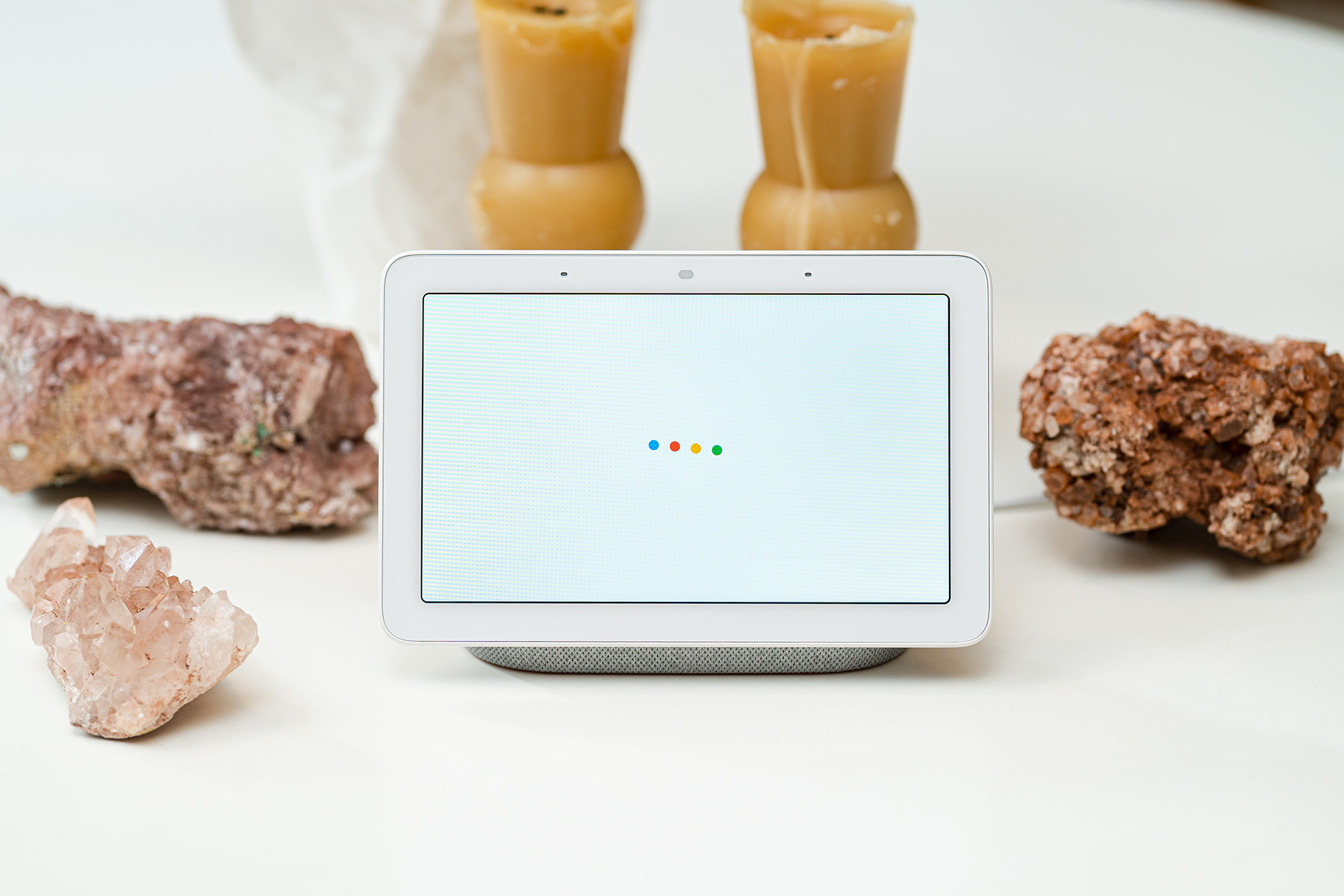
Our favorite smart display overall is Google's latest Nest Hub. Its 7-inch size is a better fit in more rooms, and its unobtrusive design combined with its soft fabric exterior blends nicely into your existing home decor. It does everything we think most people would want in a smart display, like YouTube videos, step-by-step cooking instructions, smart home controls and the ability to check in on your Nest cams if you have any.
In fact, the Nest Hub is especially useful if you have a Nest video doorbell, as the camera view of who’s at the front door will show up on the screen. An ambient light sensor helps to detect the light and color temperature of the environment and adjusts the screen to match. Plus, if you choose, it can help track your sleep patterns if placed next to your bed.
Another feature of the Nest Hub is actually a lack of one: It doesn't have a camera. That gives it that additional layer of privacy that many people covet, and it's also a lot more suitable for personal spaces like the bedroom. Sure, you could also cover up a camera with a shutter, but with the Nest Hub you don't have to remember to do that.
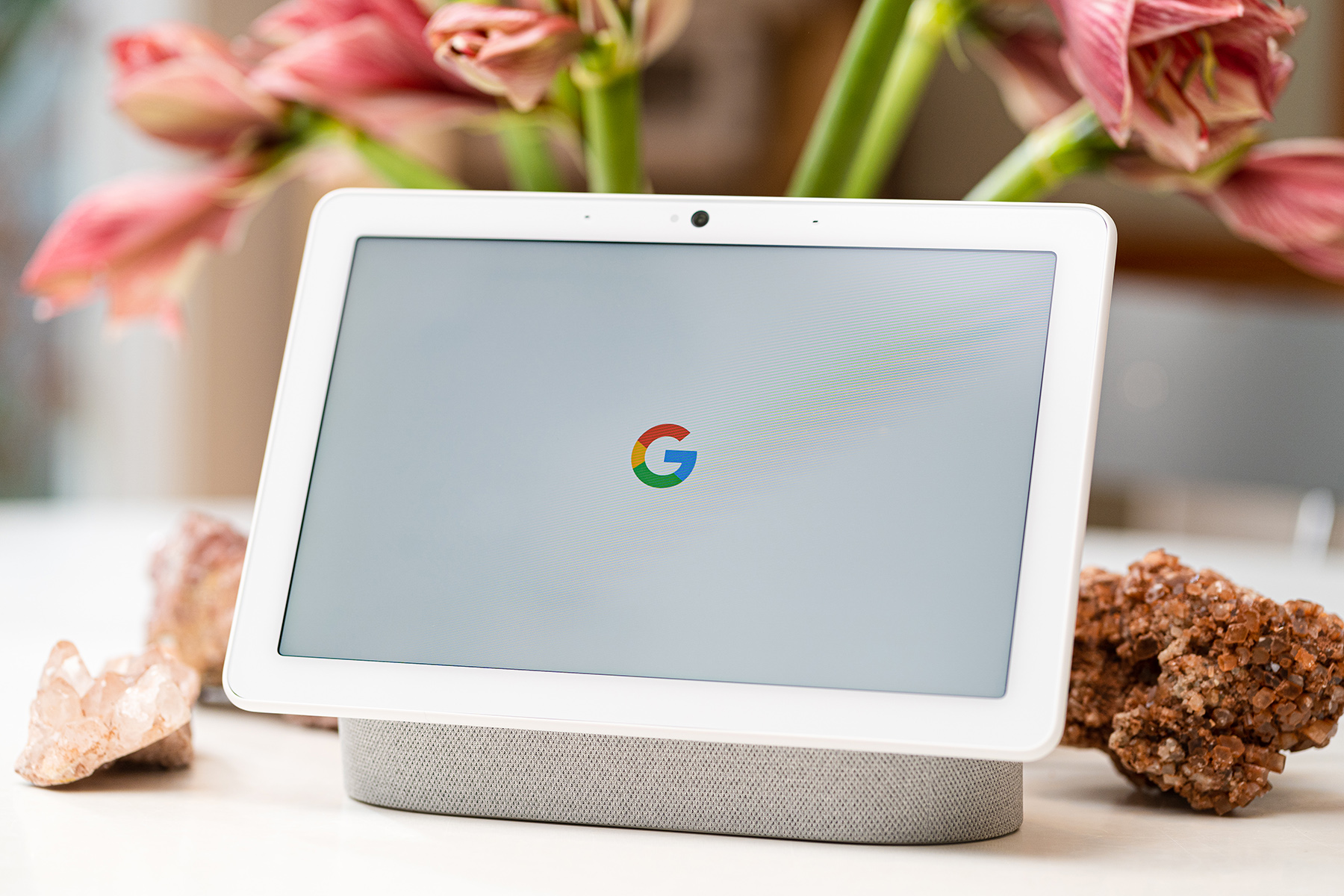
If you like Google but you miss having a camera for video calls, or you just prefer a bigger screen, consider the Google Nest Hub Max. At 10 inches instead of seven, it works a lot better for watching videos from YouTube and YouTube TV. It's especially useful in the kitchen, where it functions as a kind of portable television, and you can see more of those step-by-step cooking instructions at a glance. The bigger display also means a larger photo frame, which you may prefer.
As mentioned, the Nest Hub Max adds a camera to the mix. It doesn't have a physical shutter, which is a concern, but you can shut it off with an electronic switch. You can use the camera for video calls with Google's Duo service as well as Zoom, and it can also function as a Nest Cam to help you keep an eye on your house when you're away. Another benefit of the camera is the addition of Face Match facial recognition for authentication purposes, which we found to be a little more accurate than just using Voice Match.
Last but not least, the Nest Hub Max's camera adds a unique gestures feature that lets you play and pause media simply by holding up your hand to the screen. It's not entirely necessary, but it's potentially useful if you're in a noisy environment and just want the music to stop without having to shout over everyone. Or perhaps you have messy hands while cooking and don’t want to dirty up the display.
Our favorite Amazon smart display is the second-gen Echo Show 8. Its 8-inch screen is just right; it doesn’t take up as much space as the Echo Show 10, but it’s also more suitable for watching videos than the tiny Echo Show 5. Like other Amazon smart displays, it has a built-in camera, but there is a physical camera cover to help alleviate privacy concerns.
As such, the Echo Show 8 is a compelling choice if you want the option of using your smart display for video calls. Not only is the camera quality fantastic, but the Show 8 has a feature that automatically frames your face and follows your movements during video calls. It’s useful if you want to move around as you’re chatting, or if you have rambunctious children and pets running around the house and you want to involve them in the conversation. You can use the Echo Show 8 to make calls between other Echo Show displays, or through Skype or Zoom.
As with the other smart displays, the Echo Show 8 also works as a digital photo frame and can be used to keep up with the news, check the weather and control smart home devices. If you want to use your smart display to play music, we also really like the Echo Show 8’s audio quality on account of its deep bass and rich tone.
At only 5.5 inches wide, the Echo Show 5 is one of the smallest smart displays on the market, and as a result, will work nicely on a desk or a nightstand. In fact, one of the reasons we like the Echo Show 5 so much is that it doubles as a stellar smart alarm clock. It has an ambient light sensor that adjusts the screen's brightness automatically; a tap-to-snooze function so you can whack the top of it for a few extra minutes of shut-eye; plus a sunrise alarm that slowly brightens the screen to wake you up gently.
The Echo Show 5 does have a camera, which might make you a touch queasy if you are privacy conscious – especially if this is supposed to sit by your bedside. Still, it does have a physical camera cover, which can help ease any fears.
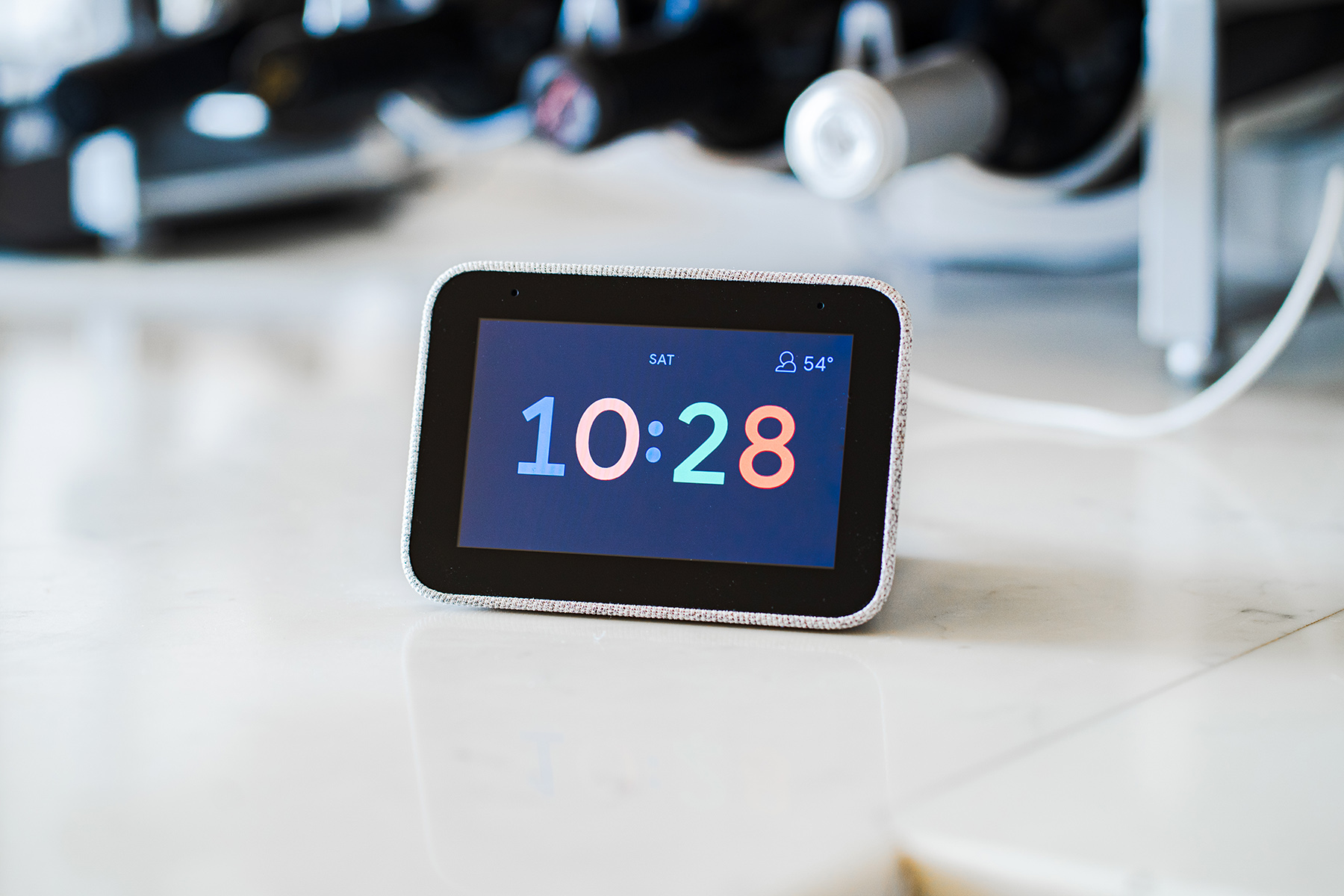
Perhaps a smart display doesn't appeal to you because you don't care about watching videos on it. But maybe the idea of a smarter alarm clock like the Echo Show 5 intrigues you. In that case, I’d recommend the 4-inch Lenovo Smart Clock 2, which isn't a full-fledged smart display because you can't play any videos on it, but it does use Google's smart display tech, so you can use it for controlling your smart home as well as checking out your Nest Cams.
We also like it because it lacks a camera, which makes it perfect for your nightstand. It has all of the features we want in a smart alarm clock, like an ambient light sensor, that tap-to-snooze function and a sunrise alarm. Plus, the latest version can double as a night light – you can swipe down the display to enable it – and you can get an optional wireless charging base to go with it.
If the Smart Clock 2 is too advanced for you, Lenovo does offer an even simpler version called the Smart Clock Essential. It really isn’t a smart display at all – it’s really more of a smart speaker with a clock – but it does perform many of the same functions as the Smart Clock 2.
Lenovo sells the Smart Clock Essential in two different versions: One has Google Assistant, while the other is powered by Alexa. The one with Google Assistant has a built-in night light, an extra USB port for charging devices and a mic-mute button. The one with Alexa, on the other hand, is compatible with an optional docking station that can be used with accessories such as a wireless charging pad or an ambient light dock (it comes in either a sea lion or a squid shape) that can act as a night light.