Posts with «robotics» label

This funny robot pets your dog’s head and feeds them a treat
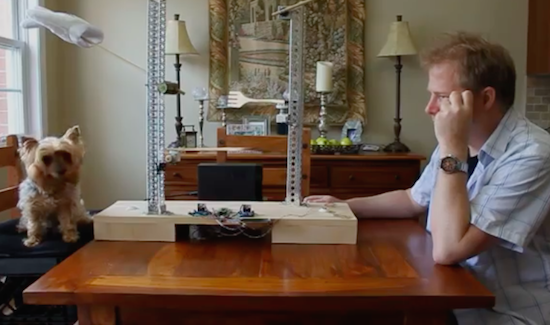
While this recent project may look like something straight out of Simone Giertz’s notebook, it’s actually the brainchild of James Cochrane. The engineer, who admittedly loves building all sorts of crazy machines, has developed an apparatus he calls the IoT Robot People/Pet Affectionator.

As its name would suggest, the Affectionator is an Arduino Nano-driven device that automatically gives his dog T-Bone a pat on the head along with a spoon-fed treat at the touch of an arcade button. That’s not all, though. It even allows the pup to reciprocate by pressing his own button and sending over a token of his appreciation on a fork–which in Cochrane’s case is a gummy worm.

Aside from the Arduino, the Affectionator is equipped with two H-Bridge motor drivers, two geared Pittman motors, and two geared hobby motors.

These days people are more connected with each other, however we are experiencing fewer physical interactions. This device will allow you to provide affection either locally or remotely to your pet without any physical contact. If your pet decides you are also worthy of their affection they can also reciprocate with a pat on the head and a tasty treat.

One day while giving my dog T-Bone a scratch behind the ears I came up with this silly idea. A robot which gives you a pet on the head and feeds you a treat. With the IoT, you can also build two of these and network them across the Internet.

Intrigued? Watch the hilarious idea in action below!
Maker adds gesture control to a surgical robotic

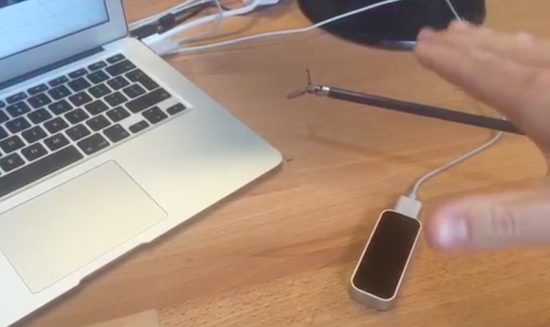
The Da Vinci system is one of the most popular surgical robots around, which allows surgeons to perform operations through only a few small incisions. The device works by translating a doctor’s hand movements into smaller, precise movements of tiny instruments inside the patient’s body. As ubiquitous as they may be in hospitals, chances are it’s never been operated quite like this before.

That’s because Julien Schuermans has managed to connect the robotic surgical tool’s hardware up to a LeapMotion controller, making its small forceps gesture-controlled. You can see how it all works in the video below.

As The Verge explains, four Arduino Uno-controlled servos are fitted to the pulleys and cables that handle the rotation, angle and gripping mechanism. Gesture input is captured by the Leap Motion’s infrared cameras, which is then converted into instructions for these servos, enabling the user to command the endoscopic device with just a wave of the hand.

Scubo is an omnidirectional robot for underwater exploration

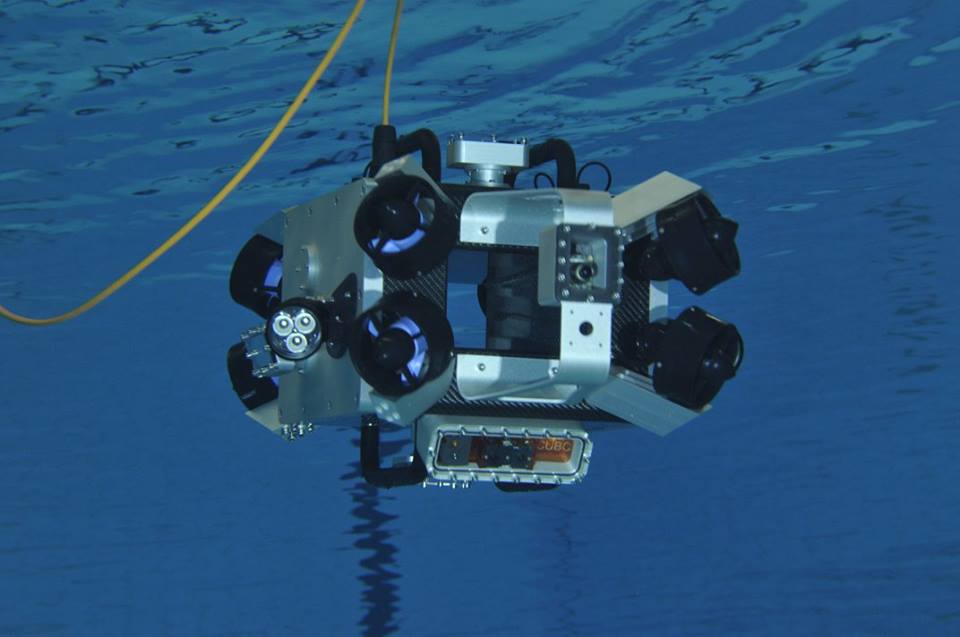
A team from ETH Zurich has created an incredible submersible robot called Scubo as a way to scan entire coral reefs. Equipped with six onboard webcams, the omnidirectional device is capable of exploring the deep sea from every angle. What’s more, users can take a virtual dive by throwing on a pair of VR glasses to make it feel as if they’re swimming with marine life.

Scubo consists of an Arduino Due for hard real-time tasks, an Intel NUC for high-performance calculation, an IMU, and a pressure sensor — all housed inside a carbon cuboid. Eight thrusters are symmetrically mounted to the outside, one at each corner, while a tube goes through the box to ensure proper water flow and to keep the electronics cool. The system is neutrally buoyed and weight in the form of screws can be added to the thruster arms to adjust buoyancy and the center of gravity.

One of its creators Johann Diep tell us, “We chose to work with Arduino because it offers the required interface (I2C, SPI, etc.), it is easy to program (none of us ever worked with Arduino at the beginning), and there is a large community on the web that is very supportive with our questions.”

A tether connects Scubo to a computer outside the water and the power source, which allows the camera pictures to be viewed live and the batteries to be recharged with a steady current. According to the team, this highly extends the operation time, though the batteries would last approximately 120 minutes under standard conditions without recharging.

Scubo is based on ROS, and with the rosserial_arduino package, they are able to send or receive commands on a laptop from the Arduino. This enables them to steer the bot with a SpaceMouse joystick while monitoring all the sensor messages (pressure, leakage, temperature, voltage, etc.) at the same time.

It should be noted that Scubo isn’t only restricted to coral research either. In fact, the underwater machine was built with modularity and entertainment in mind as well. Users can easily attach their own sensors, lights and HD cameras via one of five universal ports.

We are confident that Scubo has great potential for the future. Since every necessary sensor is already implemented, Scubo can be programmed to scan a coral reef or any other place fully autonomous. Telepresence could be used in many aquariums or in the sea for entertainment. Because of the module ports different kinds of sensors and devices can be connected and used, for example to generate a geographical map of the sea floor or to inspect boats.

Whether corals in the Caribbean, the shore of Lake Zurich or even a virtual dive in an aquarium — Scubo not only convinces with its captivating technology but also with its modern design. Innovation starts when science meets entertainment.

Intrigued? You can read more about the project on its website, and check out its trailer video below.

Turn Your Electronics Project into a Sellable Product

Do you dream of developing a hot, new hardware gadget and bringing it to market? Maybe your goal is to make the world better with your product, or perhaps you just want to get filthy rich selling your product. Developing a project prototype using an Arduino, Raspberry Pi, or other […]

Read more on MAKE

The post Turn Your Electronics Project into a Sellable Product appeared first on Make: DIY Projects and Ideas for Makers.

Dtto is a self-reconfigurable modular robot

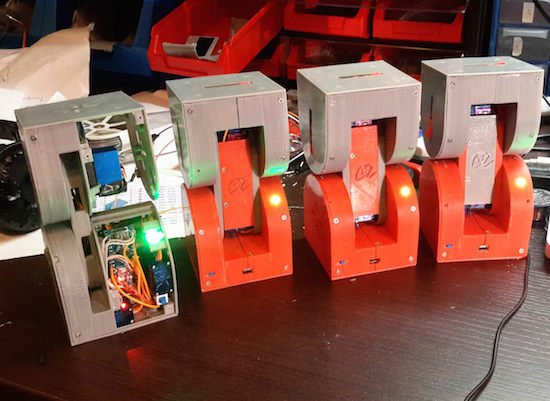
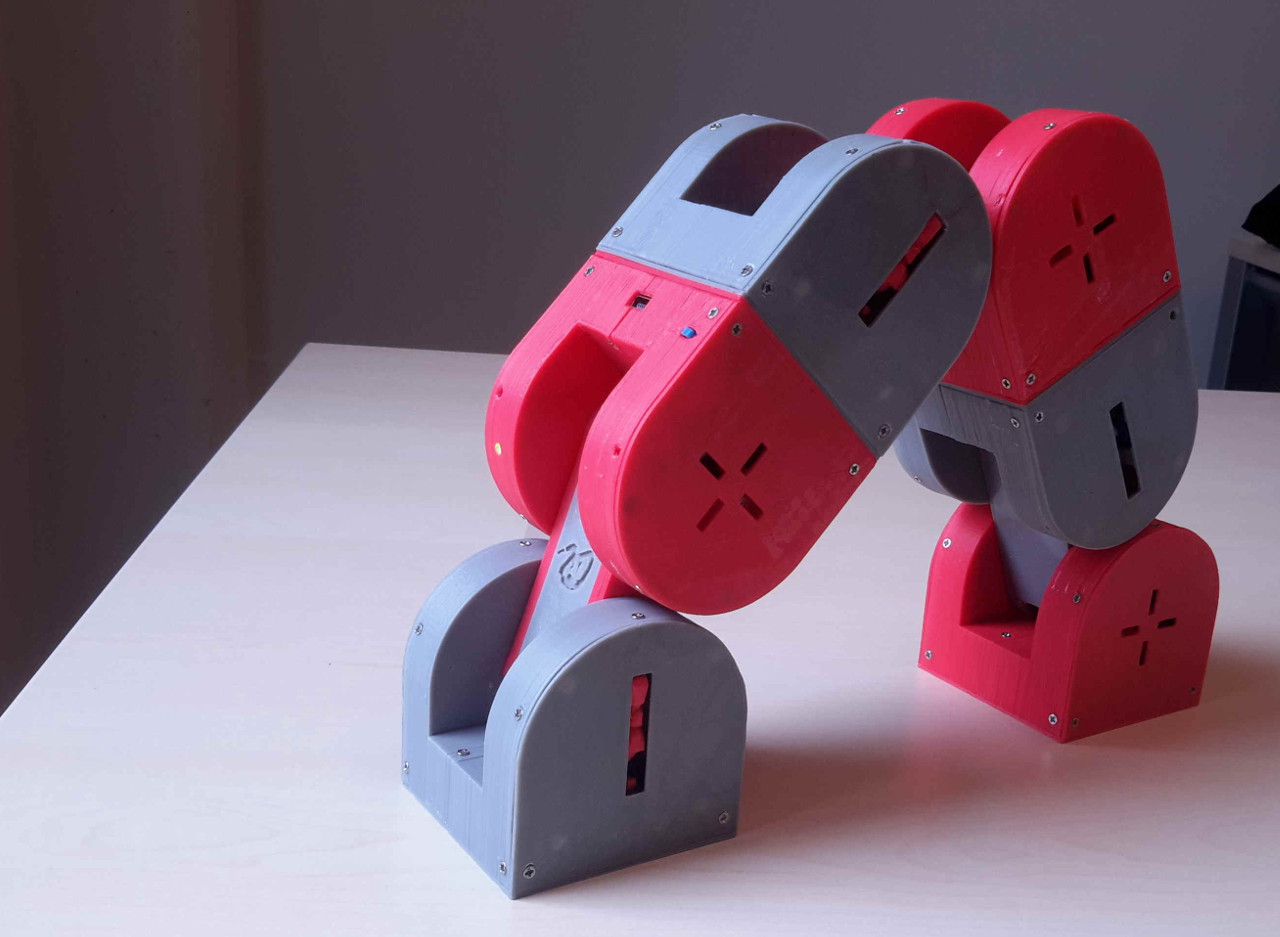
An entry in this year’s Hackaday Prize, Dtto is a snake-like robot designed to be modular and self-reconfigurable.

Inspired by Bruce Lee’s famous water quote, Dtto can transform into various shapes by changing the position and connection of its 3D-printed modules. As Hackaday points out, each section of Dtto is a double-hinged joint. When two come together, magnets help them align. A servo-controlled latch solidly docks the sections, which then work in unison. Impressively, it can connect and separate segments autonomously – without any human intervention. Creator Alberto believes the versatility of the bot will enable it to perform rescue missions, explore unknown environments, and operate in space.

The open-source robot consists of an Arduino Nano, a Bluetooth HC-06 module, an NRF2401+ radio transceiver, two SG92R Tower Pro servos for main movement, three Tower Pro SG90 micro servos for coupling, and a WS2812 RGB LED. For its latest iteration, the Maker has made a few design improvements to allot for 25% more internal space, a data bus connecting the two blocks and Tower Pro MG92B motors. Future modules will even include a built-in camera, an ultrasonic sensor, a gyroscope, an accelerometer, and a magnetometer, to name just a few. Until then, you can follow along on its project page and check out a few of its videos below.

Build your own life-size, multipurpose robot with Arduino

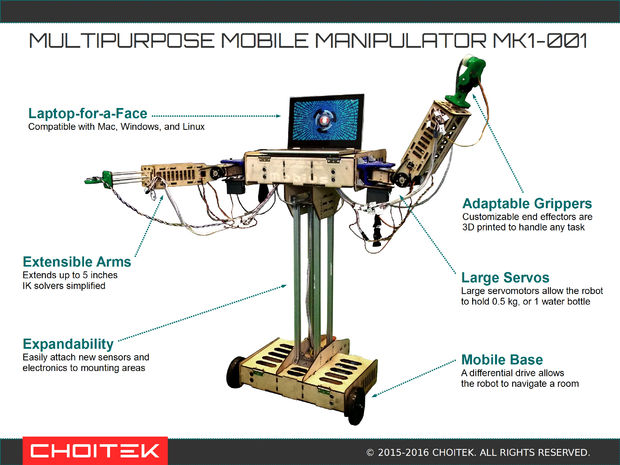
If you’ve always wanted a bot for a friend, personal assistant or butler, you’re in luck. John Choi, a Carnegie Mellon University computer science and arts student, has managed to build his own life-size robotics platform for about $2,000. Sure, a price tag like that may not seem “cheap” but in comparison to other research-grade platforms out there, it’s a bargain.

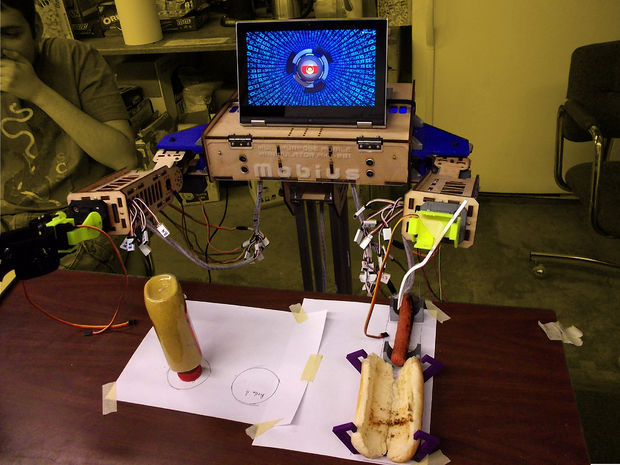
Ideal for Makers, students, educators, artists and researchers alike, the Multipurpose Mobile Manipulator Mk 1 is capable of playing the piano, drawing pictures, preparing meals, watering plants, and engaging in toy sword duels, among many other things.

The Multipurpose Mobile Manipulator is divided into three major parts: the base, the arms, and the chest. The base contains motors for mobility and batteries to power the robot, enabling it to navigate around. The arms contain adaptable grippers, shoulder and elbow joints, and an extensible limb for grabbing and moving things with its environment. Meanwhile, the chest connects all of these together with control electronics and serves as a platform for an intelligent laptop-for-a-face. An Arduino Mega at its heart makes interfacing with sensors and actuators super easy, while the robot’s functionality can also be expanded by simply attaching new electronics and sensors to its mounting areas.

The open-source platform is compatible with Windows, Mac and Linux, and supports Python 2.7 and Arduino libraries. According to Choi, libraries for Unity, Processing, ROS, MATLAB, C++, and Scratch are also in the works.

Those interested in building their own should check out Choi’s incredibly-detailed 80-step tutorial, and watch the robot take on some tasks below. Prepare to be amazed!


Quadrupede bluetooth Spider


After printing pieces to Prusa I3 is the new 4-legged spider with bluetooth comm :)


read more

Let's Make Robots 07 Jun 20:27
32 servo controler  6v  arduino  balance  battery  biped  bluetooth  fast  greek  grrobot  hands  head  hexapod  humanoid  led  legs  mg995  mini servo  move  one leg  program  relay  robot  robotics  servos  slow  ssc32  step  vb.net  walk  warior  

Build an IoT Rover with Arduino Mega and FONA

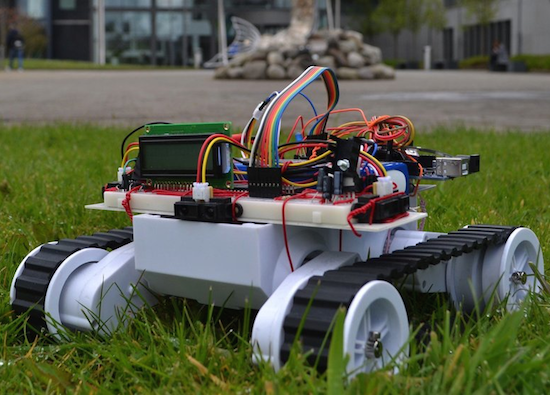
For his end of the year project at the University of Valencia, Maker Jorge Crespo built an Internet-connected, GPS-enabled rover using an Arduino Mega, an Adafruit FONA 808 module, and a PIC18F45K20 microcontroller.

Other hardware includes IR sensors for obstacle avoidance, a dual H-bridge motor controller, an LCD screen, DC/DC converters, and an 11.1V, 5Ah LiPo battery. The bot is managed through a web-based interface, allowing its user to select between auto or manual commands, as well as track its location on a map.

The project can be found on GitHub.

Two college students build a hilarious animatronic face

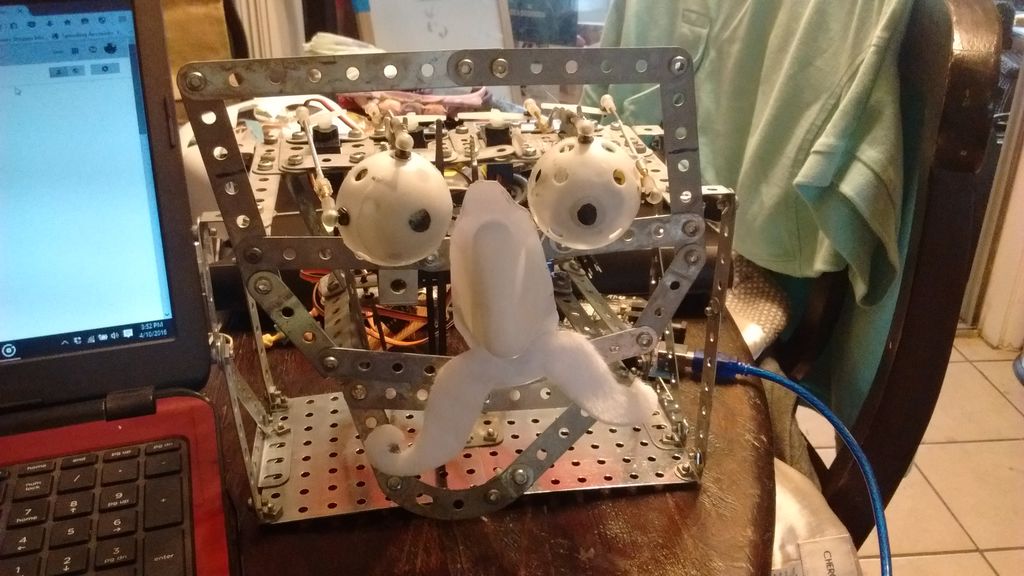
Let’s start off by saying that, if you’re a senior engineering student just weeks away from graduation, it takes some serious guts to create an animatronic face of your school’s president. We should also add that it’s pretty hilarious.

Geoffrey Toombs and James Schopfer are the two University of Texas at San Antonio undergrads behind the Disney Audio-Animatronics-inspired project, which uses a plastic mask, an Erector set, an Arduino Mega with an MP3 shield, and some computer speakers. The face — consisting of eyes, a nose, a mouth and a formidable mustache — is driven by a set of servos. An even cooler feature of the robot is that the mouth is synchronized to an audio clip.

The audio was a sample taken from a YouTube video using various softwares to turn the video file into an audio file and then cutting to the proper length. The original YouTube address of the video I wanted was copied and pasted on the Zamzar.com website so the video could be downloaded and manipulated. The program, Audacity, was used to turn the video file into an audio file and it allowed the audio to be clipped and saved an an MP3. This MP3 audio file was then saved to a microSD card. The card was then placed into the MP3 shield, and the shield is then carefully attached to the Arduino Mega, being careful to not bend the pins.

Code was written for the eye movements. It was decided that he would roll his eyes and wiggle his nose after the mouth movement. This wasn’t really necessary but it let me use the eyes that I spent so much time making and gave a little humor to the project.

While this particular project mimicked the university’s president, the Makers note that any face or picture could be used. A friend? A colleague? A principal? The possibilities are endless. Future upgrades may include a smaller speaker hidden inside the head, a web camera built into an eye, steppers for more precise and fluid movement, IR sensors and more motors for tracking, blinking eyelids, and potentially Skype integration.

Simone Giertz built a hair washing robot

From getting out of bed to applying lipstick to eating breakfast, Simone Giertz has seemingly found every possible way to automate her morning routine. Next on that list? A hair-washing robot made up of a rubber hand, a bottle of shampoo and some basic electronics that allows her to lather, rinse and repeat, while leaving her hands free for other tasks like brushing her teeth.

Giertz’s latest project features a pair of Hitec servo motors, Actobotics from Servocity, an Arduino Uno and a 6V battery pack. Although you’d probably never use this thing in an actual real shower, a shampoo robot is still pretty darn hilarious. See it in action below!

I built a hair washing robot. pic.twitter.com/TSEAugnlfJ

— Simone Giertz (@SimoneGiertz) May 6, 2016