Sony has announced the launch of Inzone, a new brand of PC gaming displays and headsets. They'll be coming out of the company's Electronics division (not to be confused with its Interactive Entertainment unit) and its flagship product will be the Inzone M9, a 27-inch 4K monitor. The M9 boasts an IPS panel with full-array local dimming, a 144Hz refresh rate and a claimed 1-millisecond gray to gray response time.
Sony says the panel is also DisplayHDR 600-certified and covers 95 percent of the DCI-P3 color gamut. Additionally, the monitor is G-Sync compatible and features support for variable refresh rate (VRR) gaming thanks to the inclusion of an HDMI 2.1 port. If you connect the M9 to a PS5 through that port, you’ll get access to a feature that will automatically switch the monitor between its included low-latency and picture processing modes when it detects you’re about to play a game or watch a movie. Sony has also optimized the PS5’s HDR output for the M9, and you’ll see the benefits of that tuning automatically as well. Sony's M9 will hit shelves this summer and retail for $899.
Alongside a 4K display, Sony will also offer a 240Hz Full HD monitor. Like the company’s new flagship, the M3 will boast a 1-millisecond gray to gray response time, PlayStation 5-specific features and compatibility for both G-Sync and VRR. As you might expect, high dynamic range performance won’t be as good as the 4K variant, with the monitor only earning VESA’s DisplayHDR 400 certification. Sony plans to begin selling the M3 sometime this winter for $529.
If you’re looking for a new gaming headset, Sony has you covered there too. For those who want it all, there’s the $299 H9. It features active noise cancellation, Bluetooth and 2.4GHz wireless connectivity, support for spatial audio and the same synthetic leather found on Sony’s recently announced WH-1000XM5 headphones. For a more affordable option, there’s the H7. It omits the H9’s ANC and “soft fit” leather features for a $229 price tag. The H7 will also come with better battery life. Sony claims you can get 40 hours of use from its new mid-tier headphones compared to 32 hours from the H9. Lastly, there’s the $99 H3, which you can connect to your PC or PS5 through a 3.5mm headphone jack or wired USB adapter. Sony will release all three models this summer.
I've always wondered why aside from a handful of peripherals like the Pulse 3D headset and that weird 3D display, Sony never really tried to expand the PlayStation brand outside of consoles. And while you won’t find any PS logos on its new line of headsets and monitors, with Inzone it really feels like Sony is finally bringing its wider tech expertise to gaming.
Now the reason we haven’t seen a ton of PlayStation-branded peripherals before is because the Sony most people think about is actually a conglomerate of several companies that make everything from medical diagnostic tools to camera sensors. And in the case of Inzone, its new gaming gear isn’t being made by the same Sony that produces its iconic consoles (Sony Interactive Entertainment) but instead by the Sony that makes everyday consumer gadgets (Sony Corp/Sony Electronics) like TVs and headphones including the excellent WH-1000XM5.
Sam Rutherford/Engadget
That’s important because, while these devices have design cues borrowed from the PS5, including their black and white color scheme and sleek sci-fi lines, much of the tech inside has trickled down from a range of Sony Electronics' devices. And after using a handful of Inzone’s new peripherals for about a week, it really feels like you’re getting a great mix of tech from two different branches of Sony.
Let’s start with Inzone’s headphones which consist of three different models: the entry-level $99 H3, the mid-range $229 H7 and the high-end $299 H9. As the cheapest of the three, the H3 are incredibly simple and straightforward. Unlike their more expensive siblings, they don’t support wireless audio and instead rely on either a 3.5mm cord or a USB cable for connecting to your console or PC. On the bright side, the thick padded headband and cloth earcups make the H3 a joy to wear, even during marathon gaming sessions.
Sam Rutherford/Engadget
Another bonus is that due to cooperation between two arms of Sony, all Inzone headsets, including the H3, support the PS5’s Tempest 3D audio engine just like you get on the official Pulse 3D headphones. That means you get spatial audio and customizable sound profiles that make it easier to hear things like the footsteps of someone trying to sneak up behind you. That said, with the Pulse 3D also costing just $99 for wireless headphones that are just as comfortable as the H3, I think they’re probably the better buy for anyone on a budget.
Where things get really interesting though is when you move up to the H7 and H9, which feature dual-mode wireless connectivity (Bluetooth and a dedicated 2.4GHz wireless dongle), a slightly more streamlined design and strong battery life. On top of that, the H9 also feature digital noise canceling using the same tech as Sony’s 1000X line, and it shows.
Unlike the cloth earcups you get on the H3 and H7 headsets, the flagship H9 features soft fit leather earcups just like you get on Sony's WH-1000XM5 headphones.
Sam Rutherford/Engadget
Now I should mention Sony was only able to send out the H3 and H9 for testing, so I’ve been using those for my comparisons. But the H7 and H9 are fairly close in terms of specs, with the main difference being the H7’s lack of exterior RGB lighting, no support for digital noise canceling and the use of cloth earcups instead of the soft fit leather padding you get on the H9 (which is the same material Sony uses on the WH-100XM5). In return, because they don’t have built-in noise canceling, the H7 offer slightly longer battery life (around 40 hours) compared to the H9 (around 32 hours).
Regardless, my time with the H9 so far has been great, and in a lot of ways, they feel like a pair of WH-1000XM5 that have been tuned for gaming. The noise cancellation works wonders for drowning out background sounds, and the super supple leather makes wearing them feel like putting a cloud around your head.
Sam Rutherford/Engadget
I also really appreciate some of the small details Sony added to the H9. On a lot of headphones that offer two modes of wireless connectivity, you can typically only use one type at a time. But with the H7 and H9s, you can connect to two different devices simultaneously. This means you can use the wireless dongle to connect to your PlayStation or PC, and then use Bluetooth to get audio from your phone. And because the PS5 doesn’t have native support for chat apps like Discord, this makes it much easier to talk to your friends regardless of what platform you’re on at the moment.
Additionally, the H7 and H9 are the only other headphones besides the Pulse 3Ds that can use the PS5’s on-screen status notifications, which means you can see stuff like volume levels, battery status, mic mute, and game/chat balance all at glance. So while they aren’t the PS5’s official headphones, they behave like they are, while also offering even more features and better audio quality. And just like the WH-1000XM5, you can even use your phone to take a picture of your ear, to tune their sound even further.
Sam Rutherford/Engadget
As for Inzone’s new monitors, there’s the $529 M3 and the $899 M9. However, since the M3 won’t be available until sometime this winter, I’m going to focus on my time with the M9. Featuring a 27-inch 4K IPS panel with a 144Hz refresh rate, the M9 isn’t the biggest or fastest gaming monitor around. But for the money, it packs a ton of features compared to similarly-priced rivals. Not only does it support VRR and NVIDIA G-Sync, it also sports a strong one millisecond gray-to-gray time, DisplayHDR 600 certification and a gamut that covers more than 95 percent of the DCI-P3 spectrum. In short, colors are bright, rich and vivid while also being largely immune from the ghosting you often see on less sophisticated displays.
However, the M9’s biggest advantage is its full-array local dimming (FALD) which is made up of 96 different lighting zones compared to just eight or 16 on competitors like the LG 27GP950 or the Samsung S28AG700. And after seeing the results side-by-side, I was kind of shocked at how much of a difference the M9’s FALD makes. A lot of gamers can spot bloom in games when something bright moves quickly across a dark background, which often produces ring of light around the object. But not only does the M9 almost completely eliminate halos, the ability to adjust lighting zones with greater precision also gives the monitor improved dynamic range. So in games like Elden Ring, I saw backgrounds that were much darker and atmospheric compared to the washed-out gray tones I saw on other monitors. This allows you to get much better contrast and black levels without needing to upgrade to more expensive QD-OLED displays like Alienware’s $1,300 AW3423DW.
Sam Rutherford/Engadget
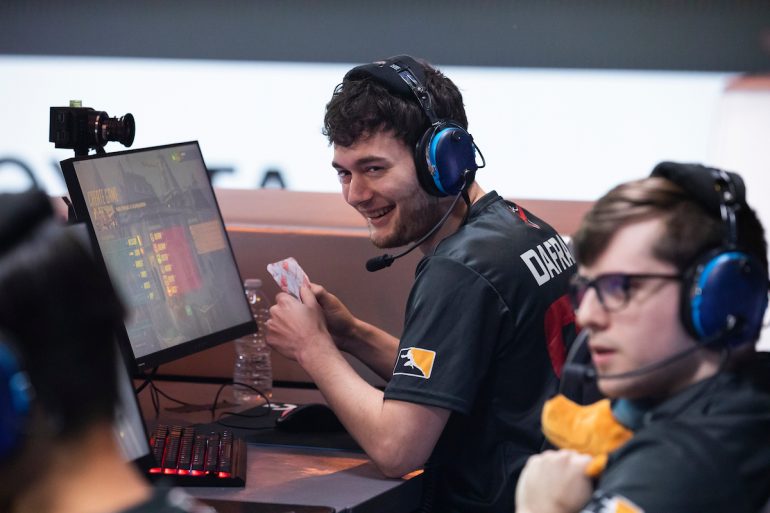
And just like its headphones, Inzone’s first monitor has a lot of really thoughtful smaller features. It has a built-in KVM switch, which is extremely useful if you have multiple PCs connected to the same display. It also has a native FPS counter so you can easily keep tabs on performance, while the monitor’s Auto Genre Picture Mode can switch between settings like Cinema Mode and Gaming Mode depending on the content coming from your PS5. And in addition to being height and tilt adjustable, Sony even designed the M9’s stand so that its feet stick out towards the back, which means PC gamers who need to place their keyboard as close as possible to their monitor like Dafran totally can.
But perhaps my favorite little touch, is the software that allows you to navigate the monitor’s on-screen display with your mouse, instead of having to fumble around with the joystick on the back of the panel. The M9 even comes with built-in stereo speakers, so you can plug in your PS5 and get straight to gaming without worrying about audio. And thanks to two HDMI 2.1 ports, one DisplayPort 1.4 jack, support for video over USB-C (DP Alt mode) and a built-in USB Hub, there’s a wealth of connectivity.
All of Inzone's new headsets and monitors will be available this summer except the M3 display, which will go on sale sometime this winter.
Sam Rutherford/Engadget
So aside from the H3 which is somewhat basic, I’ve come away quite impressed with Inzone’s first batch of PC and console gaming peripherals. That said, looking at the pedigree of these two faces of Sony, that probably shouldn’t be a surprise. It might not say so on the box, but in a lot of ways, this feels like the marriage between PlayStation and the tech from some of Sony’s best gadgets. But what might be the most promising part is that while Inzone hasn’t shared any future plans just yet, after talking to some of its reps, it’s clear Sony has big plans for its new gaming brand going into 2023 and beyond.
Taking a page from on-track rival Mercedes, Red Bull plans to produce its own hypercar. On Tuesday, the company took to Twitter to announce the RB17, which is slated to be a two-seater with a hybrid V8 engine and 1,100 horsepower. Production will start in 2025, with Red Bull planning to only make 50 cars at a price of £5 million ($6.1 million) per vehicle.
If just so happen to be a millionaire, buying the F1-inspired RB17 will net you access to Red Bull’s team simulators and on-track training. The company will also service and maintain the car for you at the Milton Keynes factory in England where it plans to produce the RB17.
— Oracle Red Bull Racing (@redbullracing) June 28, 2022
“The RB17 marks the first time that a car wearing the Red Bull brand has been available to collectors,” Red Bull Racing CEO Christian Horner said. “The RB17 distills everything we know about creating championship-winning Formula 1 cars into a package that delivers extreme levels of performance in a two-seat track car.”
Red Bull chief technical officer Adrian Newey is designing the vehicle. His resume includes the Aston Martin Valkyrie and all four of Red Bull’s F1 championship-winning cars. Red Bull said the RB17 would be built around a carbon-composite tub and a body designed to take advantage of ground effect like modern F1 cars.
Square Enix is moving into the farming sim world with Harvestella, which is coming to Nintendo Switch and PC on November 4th. While this is a 3D game with a distinct art style, you'll surely recognize some elements if you're one of the tens of millions of Stardew Valley players out there. You'll till land, sow seeds, water crops, collect items for cooking and crafting, go fishing, take care of pets, explore dungeons, slay monsters and so on.
You'll be able to visit other towns and get to know their residents. In Nemea Town, cherry blossoms bloom all year, while Seaside Town Shatolla has a vibrant bar scene. There are multiple jobs to choose from as well, including mage, fighter and shadow walker. Each of those will offer different abilities in battle. You'll also be able to explore some of the ocean in a submarine.
The overworld will change based on the season, but there's a catch. Four crystals called Seaslight usually ensure there's a stable transition between seasons. However, the game starts amid some abnormalities. Between each season is a period called the Quietus, when crops die and people are unable to go outside due to deadly dust. Even worse, these Quietus spells are lasting longer every year. You might have to do something about that.
Facebook is experimenting with a new audio feature for Groups. The company is testing audio channels, which will bring Discord-like voice chats to Groups, Facebook shared in a blog post.
Facebook has already had audio features for Groups with rooms. But unlike that feature, which is meant for one-time audio chats, audio channels are dedicated spaces where group members can speak with each other at any time, much like Discord.
The change is one of several updates the social network is testing. The company is also experimenting with other types of “channels,” essentially sub-groups within each Facebook Group, where members can discuss specific topics. There are community chat channels, which organize group message threads around topics relevant to a given group; as well as community feed channels, which are topic-based spaces within the group.
Facebook is also testing a new sidebar that will make all users’ Groups more prominent in its app (and have dedicated shortcuts for creating new channels). For now, all of these features are tests that will only be available to a small subset of users, but the company intends to roll out the changes more broadly over time.
The updates come as Facebook is eyeing bigger changes for its main app. The company is working on a broader redesign that would reorient users’ feeds around AI-driven recommendations more than their existing social graphs. At the same time, the new sidebar is meant to ensure that Groups remain prominent and easily accessible once the app’s main feed changes.
When Return to Monkey Islandarrives later this year, players will finally discover the secret of Monkey Island. That’s the pitch series creator Ron Gilbert made in the game’s newest trailer, which premiered today during Nintendo’s latest Direct showcase. “My name is Guybrush Threepwood, and this is a story about the time I finally found the secret of Monkey Island,” voice actor Dominic Armato declares at the start of the clip.
As you might imagine, the trailer is full of allusions to past Monkey Island games, including some of the series’ best gags. At one point, Guybrush drifts to the floor of the Caribbean, a sign pointing to Monkey Island and noting it’s only a six-minute walk away. Good thing our hero can hold his breath for 10 minutes.
Many fan-favorite characters also make an appearance in the clip. Among others, I spotted used ship salesman and garish dresser Stan S. Stanman locked in the brig of LeChuck’s ship. Coincidently, you can chat to Stan on Return to Monkey Island’s updated website where he explains he’s in jail for “marketing-related crimes” that may have involved selling non-fungible items.
If you missed the news in April, Return to Monkey Island marks the, well, return of Ron Gilbert to the series he created back in the late ‘80s. Gilbert wrote and directed The Secret of Monkey Island, and went to work on the second game before leaving LucasArts in 1992. Fellow Monkey Island veteran Dave Grossman is also working on the new game, which will take place after the first two games. On consoles, Return to Monkey Island will arrive first on Nintendo Switch.
Pokémon Godeveloper Niantic is creating a new augmented reality mobile game with more big-name partners: the NBA and its players' association. NBA All-World will task you with exploring your neighborhood to find some of the league's stars such as Chris Paul, Steph Curry and James Harden. You can challenge and compete against virtual players in mini-games like three-point contests before recruiting them to your team.
NBA All-World players will be able to deck out their NBA stars in custom apparel. Polygonnotes that you can also improve your squad with items you find out in the wild at places such as sporting goods stores and convenience stores. You'll have the chance to battle others in one-on-one matches with swipe-based commands too. These encounters will be available at various locations, including real-life basketball courts.
It's not yet clear exactly when Niantic will release NBA All-World, but the game will soon enter a soft launch period. You can sign up for updates if you're interested.
ARM’s newest flagship GPU will offer hardware-based ray tracing, a first for the company. Announced today, the Immortalis-G715 promises a 15 percent performance boost compared to the firm’s previous generation of premium Mali GPUs. The performance improvement is courtesy of architectural improvements and a design that can accommodate up to 16 cores.
ARM already offered support for software-based ray tracing with last year’s Mali-G710. However, the company claims the Immortalis-G715 will deliver a 300 percent improvement in ray tracing performance thanks to its dedicated hardware.
Whether you’ll see a mobile title with ray tracing anytime soon is hard to say. Since creating games is so expensive, most developers try to make their projects playable on as many devices as possible. In the immediate future, you’re more likely to see a benefit out of the Immortalis-G715’s support for Variable Rate Shading. VRS is a technology that sees a GPU focus its efforts on rendering the parts of a scene that require the most detail. You likely won’t perceive a drop in visual quality, but the GPU will operate more efficiently. ARM says it saw frame rate improvements of up 40 percent in some games thanks to the tech.
ARM announced two other GPUs today: the Mali-G715 and Mali-G615. Both components incorporate the VRS technology found on their more expensive sibling but don’t offer ray tracing and boast fewer cores for lower overall performance.
Android phones with Immortalis-G715 GPUs will begin arriving in 2023. At least when it comes to timing, ARM is playing catch-up. Samsung’s Exynos 2200, with ray tracing graphics from AMD, is already available on Galaxy S22 phones in Europe and other parts of the world.
Last year, hurricanes hammered the Southern and Eastern US coasts at the cost of more than 160 lives and $70 billion in damages. Thanks to climate change, it's only going to get worse. In order to quickly and accurately predict these increasingly severe weather patterns, the National Oceanic and Atmospheric Administration (NOAA) announced Tuesday that it has effectively tripled its supercomputing (and therefore weather modelling) capacity with the addition of two high-performance computing (HPC) systems built by General Dynamics.
“This is a big day for NOAA and the state of weather forecasting,” Ken Graham, director of NOAA’s National Weather Service, said in a press statement. “Researchers are developing new ensemble-based forecast models at record speed, and now we have the computing power needed to implement many of these substantial advancements to improve weather and climate prediction.”
General Dynamics was awarded the $505 million contract back in 2020 and delivered the two computers, dubbed Dogwood and Cactus, to their respective locations in Manassas, Virginia, and Phoenix, Arizona. They'll replace a pair of older Cray and IBM systems in Reston, Virginia, and Orlando, Florida.
Each HPC operates at 12.1 petaflops or, "a quadrillion calculations per second with 26 petabytes of storage," Dave Michaud, Director, National Weather Service Office of Central Processing, said during a press call Tuesday morning. That's "three times the computing capacity and double the storage capacity compared to our previous systems... These systems are amongst the fastest in the world today, currently ranked at number 49 and 50." Combined with its other supercomputers in West Virginia, Tennessee, Mississippi and Colorado, the NOAA wields a full 42 petaflops of capacity.
With this extra computational horsepower, the NOAA will be able to create higher-resolution models with more realistic physics — and generate more of them with a higher degree of model certainty, Brian Gross, Director, NOAA’s Environmental Modeling Center, explained during the call. This should result in more accurate forecasts and longer lead times for storm warnings.
"The new supercomputers will also allow significant upgrades to specific modeling systems in the coming years," Gross said. "This includes a new hurricane forecast model named the Hurricane Analysis and Forecast System, which is slated to be in operation at the start of the 2023 hurricane season," and will replace the existing H4 hurricane weather research and forecasting model.
While the NOAA hasn't yet confirmed in absolute terms how much of an improvement the new supercomputers will grant to the agency's weather modelling efforts, Ken Graham, the Director of National Weather Service, is convinced of their value.
"To translate what these new supercomputers will mean for for the average American," he said during the press call, "we are currently developing models that will be able to provide additional lead time in the outbreak of severe weather events and more accurately track the intensity forecasts for hurricanes, both in the ocean and that are expected to hit landfall, and we want to have longer lead times [before they do]."
Sayonara Wild Heartsdeveloper Simogo has revealed its next game and the eclectic studio is again moving in a different direction. Lorelei and the Laser Eyes is a non-linear adventure title that will land on Nintendo Switch and Steam in 2023.
Simogo and publisher Annapurna Interactive announced the game during today's Nintendo Direct Mini: Partner Showcase. The first trailer depicts a dark, atmospheric world in which you'll need to solve puzzles to get to the bottom of a murder mystery. While the clip is light on story, there are a few peeks at the titular laser eyes.
The trailer description notes that you'll play as a woman who's looking for answers in a central European manor (or possibly a hotel or museum). Players will need to pay attention to what's going on, and think about numbers, patterns and puzzles that they find. Annapurna suggests these could be part of a "macabre game" or just a "simple treasure hunt."
Simogo shook up the gameplay of Sayonara Wild Hearts from level to level and it looks like it's adopting a similar approach here. The trailer suggests there will be a first-person shooter element, for instance. The visuals will vary too, from lo-fi PS1-era environments and character models to wireframe figures. It looks delightfully strange.
Sayonara Wild Hearts is nearly perfect and one of my favorite games of all time. So, I'm really looking forward to checking out Lorelei and the Laser Eyes next year. Here's hoping for more details during the Annapurna Interactive Showcase, which takes place on July 28th.