Posts with «education» label

Macchina poetica converts sounds into onomatopoeic words
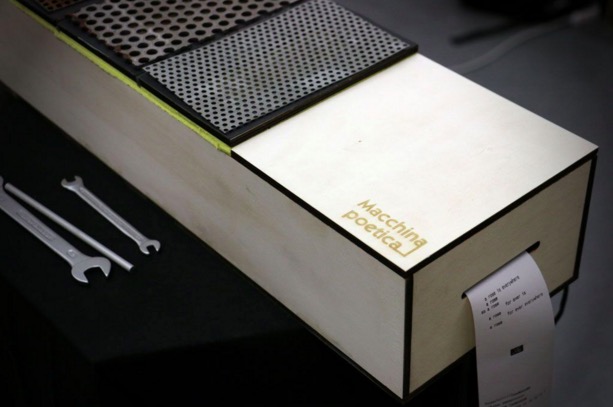

Macchina Poetica is a digital prototype converting sounds into onomatopoeic words and images and it’s inspired by the art of the Futurism movement.

Futurism is a modernist, avant-garde artistic movement originated in Italy in the early 20th century. Thanks to sound representation, Futurism artists aimed to emphasize speed, technology, youth and violence, all concepts arising from industrial innovations and war.

In order to keep continuity with this particular artistic movement, the authors, Alessandra Angelucci, Aris Dotti, Rebecca Guzzo, students at Master of Advanced Studies in Interaction Design SUPSI, decided to design an object that looks like the musical instrument of Futurism movement (precisely a Celesta). The object plays a metallic sounds and the user is facilitated in understanding how to use the object due to a instrument-like interface.

The machine is built using 4 piezo sensors, a thermal printer, a board, electrical cables, 4 resistors (1K), a 6 volt power supply and a Genuino Uno board.

The instrument’s interface is designed with plywood, metal plates and sponge that serves as a shock absorber. Between the metal plates and the sponge there are the piezo sensors along with resistors communicating with the Genuino Uno board every time the user interacts with the metallic plates. Once the Genuino receives the signal, it sends a command to the thermal printer that will print a word or a Futurism poem.

The interaction takes place when the user with the help of a metal tool (for example a screwdriver or a wrench) strikes the metal plates with different pressures. At the end of the performance the user and the viewers can have a clear overview of the produced sounds reviewing the printed paper outputs.
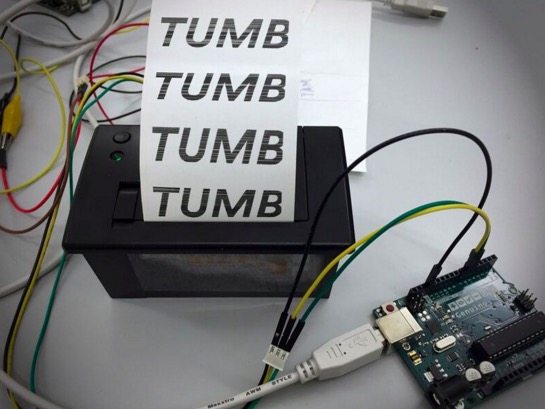
The prototype is the result of two weeks physical computing class Creating Tangible Interfaces held by Ubi De Feo at Maind program SUPSI  in Lugano, the goal of the course is how to make tangible interfaces via learning fundamentals of electronics prototyping and interaction design.  (Applications are open for the next edition 2016/2017 starting in September 2016)
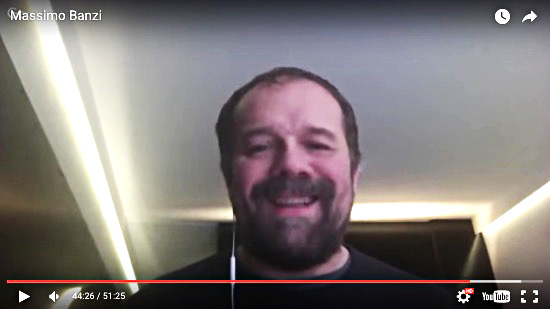
Massimo Banzi hangout at Fabacademy

Fab Academy is a distributed educational model directed by Neil Gershenfeld from MIT’s Center for Bits and Atoms. Students view and participate in global lectures broadcasted every week and on February 1st Massimo Banzi was invited to give a lecture to an audience of  students from all over the world. You can watch the 50-minute recorded lesson in the video below:

Learning Photosynthesis with an Interactive installation

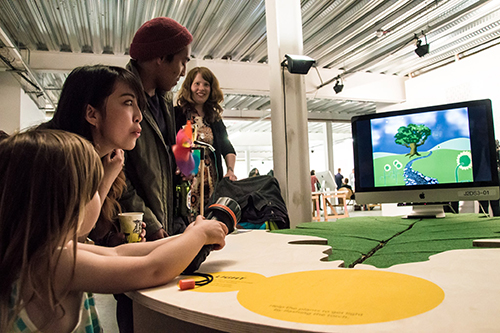
Photosynthesis is an interactive installation for primary school children created, designed and developed by Moritz von Burkersroda and exhibited at P3 Ambika, University of Westminster.

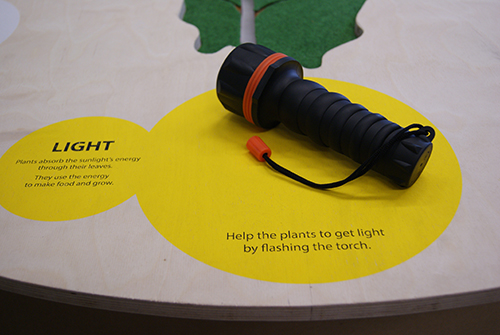
It’s a  learning  experience to understand the abstract process of photosynthesis in a hands-on way.  Thanks to a physical interaction  kids can easily understand what  plants convert light into chemical energy to fuel their activities.

The installation uses an Arduino to measure data from a photoresistor and a hacked Wii-remote to connect the objects with the video feedback on the screen triggered by a Processing sketch. On the page of the project you can download a Design Research Document about Contextual study theory to understand the relationship between interactivity, learning and educational institutions, like museums.

A rec&play loop station for little musicians

The Interaction Awards  published the shortlisted projects for 2016 and up to five finalists in each category will be announced during the event on Friday evening, March 4, 2016. In the Expressing category, showcasing projects enabling self expression and/or creativity there is a project called Step representing an innovative and engaging way of approaching music production for children between 6 and 100 years old.

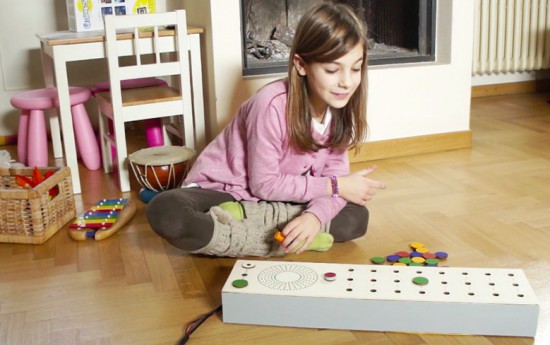
Step runs on an Arduino and has been created by Federico Lameri, Sandro Pianetti at the Master of Advanced Studies in Interaction Design in Lugano under the supervision of Massimo Banzi and Giorgio Olivero of Todo.

To prototype the user experience we’ve used an Arduino Leonardo connected to a processing sketch that handle the recording and playback features. Using a Mux Shield 2 we managed connecting 25 IR sensors, 16 LEDs, 1 knob and a button to a single Arduino board. We needed a quick and effective way to test the experience and by using Arduino we managed to design and build the whole product in three weeks.

Most of the music toys on the market are trying to fake the sounds and the experience of real instruments. Step has a different approach as it’s designed to give children the opportunity to create real loops and beats using whatever sounds they like from objects of everyday life.

Players can record any sounds and match them with  coloured tags, and then  create melodies, loops and and beats by placing tags on the track and by adjusting the tempo!

Check the video below to see it in action:

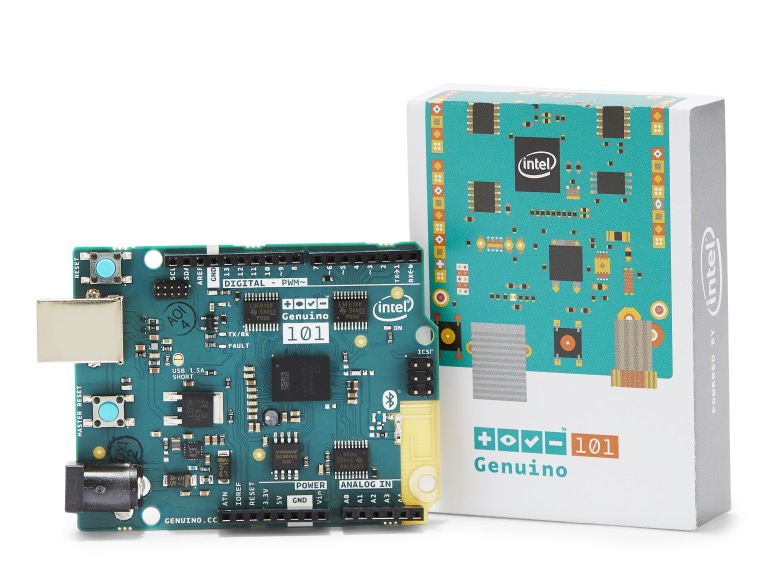
Arduino and Genuino 101 Available in the Arduino Stores

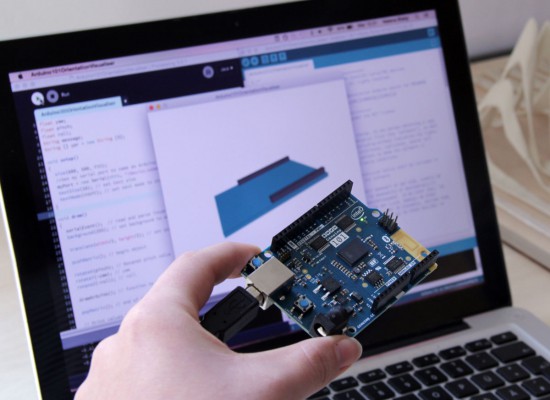
We’re very excited to announce that starting today Arduino 101* (USA only) and Genuino 101 (Outside USA) made in collaboration with Intel, are available for purchase exclusively on the Arduino Stores at the price of $30/€28,65 (+ tax).

Arduino 101 and Genuino 101 are the ideal successor of the Uno featuring a 32-bit Intel® Quark™ microcontroller for minimal power consumption, 384 kB of flash memory, 80 kB of SRAM (24 kB available for sketches), an integrated DSP sensor hub, Bluetooth Low Energy radio, and 6-axis combo sensor with accelerometer and gyroscope. You’ll be able to create projects with great features like recognising gestures and controlling your phone over Bluetooth connectivity — all without needing additional hardware.

We presented it and gave a preview during Maker Faire Rome 2015: watch Massimo Banzi and Josh Walden Senior Vice President of Intel Corporation introducing the board at the Faire in the video below.

We prepared some documentation so you can learn all the details about the new board:

And  3 tutorials focused on the new features of Arduino and Genuino 101:

Like all our boards, Arduino 101 & Genuino 101 are supported by Arduino IDE starting with version 1.6.7, that we have just released. Check out the download page. IDE version 1.6.7 contains a revamped, faster and more compliant version of Arduino-builder (all the fixes are reported here), a lot of fixes to Board Manager and the serial plotter is now able to plot multiple signals at once.

*Please note: Arduino 101 boards sold in USA are in pre-selling, we will be able to ship them  from December 28th onword.

From Aerospace to Weaving, Houston Mini Maker Faire Is an Inventors’ Paradise

Houston Mini Maker Faire attendees had a chance to create scientific creatures, assemble a clock, take a peek through augmented reality, and much more.

Read more on MAKE

The post From Aerospace to Weaving, Houston Mini Maker Faire Is an Inventors’ Paradise appeared first on Make: DIY Projects, How-Tos, Electronics, Crafts and Ideas for Makers.

Discover the role of colors in nature

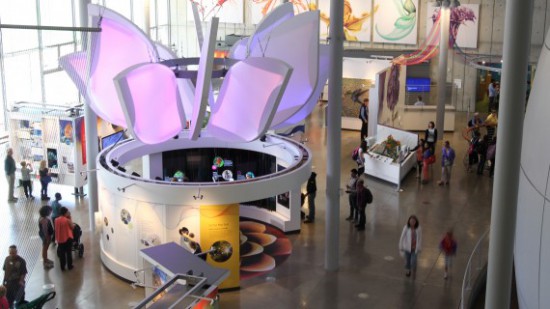
“The color Visualizer” is an immersive installation to understand how color is used in nature to communicate between living organisms and to explore biodiversity through the lens of color:

By plucking an array of multi-colored strings, which are layered over the large array of high resolution screens, visitors can explore over 100 unique color stories as vibrant images and short videos appear before them. Strum a red cord, for example, and learn how a male cardinal bird colors his vibrant red feathers with pigments from food; strum a yellow cord and see how a yellow leopard’s spotted coat allows this predator to blend in with shadow and light while moving through tall grass.

The eye-catching cylindrical installation is part of the permanent exhibition “The color of Life” that opened in June 2015 and was created by Tellart in collaboration with the California Academy of Sciences. It was prototyped using Arduino Uno and it’s currently shortlisted for the Interaction Awards, representing excellence in interaction design.

In the video below the team working at the project explain the main features of the educational installation and show a bit of the making of:

Makeblock: A Construction Set for the 21st Century

Makeblock founder, Jasen Wang, talks about the growing role of the Maker Movement in China.

Read more on MAKE

The post Makeblock: A Construction Set for the 21st Century appeared first on Make: DIY Projects, How-Tos, Electronics, Crafts and Ideas for Makers.

OpenBCI Launches New, Hackable Brain Computer Interface

For Connor Russomanno and Joel Murphy, designing a brain-computer interface is not the stuff of science fiction, it is their day job.

Read more on MAKE

The post OpenBCI Launches New, Hackable Brain Computer Interface appeared first on Make: DIY Projects, How-Tos, Electronics, Crafts and Ideas for Makers.

Petduino Is the DIY Tamagotchi You Can Hack

The Tamagotchi is a thing of the past. Bring your virtual pet into the 21st century with LEDs and an Arduino-compatible processor.

Read more on MAKE

The post Petduino Is the DIY Tamagotchi You Can Hack appeared first on Make: DIY Projects, How-Tos, Electronics, Crafts and Ideas for Makers.