We're back after a week off, and we've got a lot of news to catch up on! This week, Devindra chats with Senior Editor Daniel Cooper about the iPhone potentially getting satellite phone connectivity, as well as the upcoming launch of Windows 11. Plus, they answer some questions from our YouTube livestream audience. And of course, they can't help but dive into the messy Ted Lasso season 2 discourse.
Listen below, or subscribe on your podcast app of choice. If you've got suggestions or topics you'd like covered on the show, be sure to email us or drop a note in the comments! And be sure to check out our other podcasts, the Morning After and Engadget News!
01:56: News talk: Will the next iPhone have satellite calling?
07:12: BTW, we're now Yahoo again!
07:50: Apple will let some media apps link to outside payment providers
09:55: Apple announces the first states to bring driver's license to Apple Wallet
14:15: Microsoft announces a Surface event on Sept 22, Windows 11 launching Oct. 5
22:15: Twitch streamers organized #DayOffTwitch to protest hate raids
26:15: RIP Locast
37:28: Audience Q&A
49:30: Dev working on: Razer Blade 14, Twelve Minutes
55:30: Dan working on: HP Pavilion Aero, Saints Row
1:06:00: Pop culture picks: Ted Lasso, Candyman, Lower Decks
1:23:10: Neill Blomkamp on Demonic
Video livestream
Credits Hosts: Daniel Cooper and Devindra Hardawar Producer: Ben Ellman Livestream producers: Julio Barrientos, Owen Davidoff, Luke Brooks Graphics artists: Luke Brooks, Kyle Maack Music: Dale North and Terrence O'Brien
This week brought more and more gadget deals as Labor Day weekend inched closer. Many of this week's deals are still available right now, including Amazon's discount on the first- and second-generation Echo Show 5 smart displays and a $20 discount on Google's Nest Audio speaker. Plus, a bunch of new sales are running now through the holiday, including those on Dyson vacuums, OLED smart TVs, wireless earbuds and more. Here are the best Labor Day tech sales we could find.
MacBook Air M1
Devindra Hardawar/Engadget
Apple's MacBook Air M1 is back down to an all-time low of $850 thanks to an automatically applied coupon. It earned a score of 94 from us for its stellar performance, attractive, fanless design and its comfortable keyboard and trackpad.
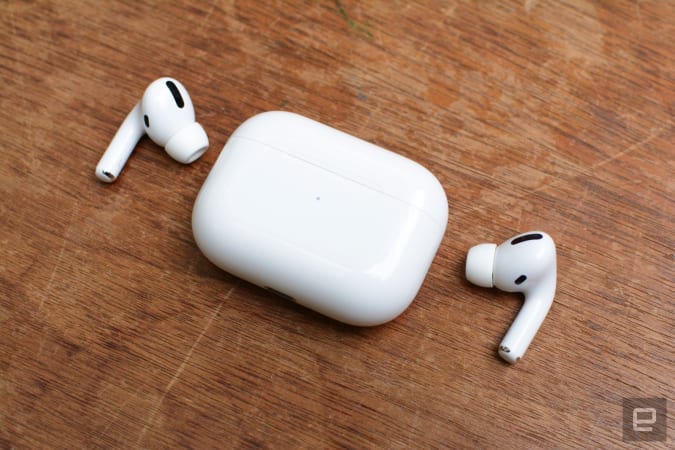
Apple's AirPods Pro are down to $190 right now, or $60 off their normal price. These are the best sounding earbuds you can get from Apple, and we gave them a score of 87 for their better, more secure fit, IPX4 water resistance and solid audio quality.
Apple's Mac Mini M1 returned to its all-time-low price of $600 this week thanks to a sale and an automatically applied coupon. You're getting all of the performance boosts provided by the M1 chipset in a compact desktop package. This is a good machine to get if you have an older desktop that needs replacing, but you don't want to spend a ton of money.
Both the first- and second-generation Echo Show 5s are on sale right now — the original is down to $45 while the updated version is only $10 more. These stand out as excellent smart alarm clocks thanks to their compact size, sunrise alarm feature and tap-to-snooze function. The main difference between the two is the improved, 2MP camera on the second-gen version, which will make for slightly better video calls.
Google's Nest Audio smart speaker remains on sale for $80, or $20 off its normal price. This is one of the best mid-range smart speakers you can get right now and it's especially useful for those already relying on the Google Assistant. We gave it a score of 87 for its solid audio quality, stereo mode with two paired together and attractive design.
Amazon's updated Echo Buds are on sale for $90, or $30 off their normal price. You could pick up the model with a wireless charging case instead and you'd only spend $105. Amazon improved these true wireless earbuds in nearly every way — we gave them a score of 80 for their better sound quality, ANC and small, comfortable design.
Samsung's Premiere Projector is $1,000 cheaper both at Amazon and Samsung's own site. The 4.2.2 sound channel model is down to $5,498, which is still quite expensive, but much better than its normal $6,500 price. We included this in our best projectors guide for its separate red, green and blue lasers that cover the full Rec.2020 color range, maximum 2,800 lumens of brightness and 4K resolution.
Google's Pixel 4 smartphone is down to a new low of $379 at B&H Photo. We believe the launch of the Pixel 6 to be right around the corner, so you may want to wait if you want the latest phone from Google. However, the Pixel 4 remains a solid handset — we liked its speedy performance, lovely display and stellar camera experience.
Samsung's T7 Touch portable SSD in 1TB is down to $170, or $10 off its normal price. It has dropped to $160 in the past, but this is the best price we've seen in a number of months. In addition to read speeds up to 1,050 MB/s and write speeds up to 1,000 MB/s, this tiny SSD has a shock-resistant body and a built-in fingerprint reader for an extra layer of security.
One of Sony's premium OLED TVs, the 55-inch Bravia XR A80J set, is down to $1,700 at Amazon and Best Buy, or $600 off its normal price. It packs most of Sony's best TV technology into one set, including the Cognitive Processor XR, HDMI 2.1 support, 4K upscaling, XR Motion Clarity and improved sound with Acoustic Surface Audio+ and built-in subwoofers. It also runs the Google TV operating system, so you can call upon the Assistant for all your entertainment needs.
Google's Nest WiFi pack with one router and one access point is down to $200 right now at Best Buy. That's $70 off its normal price and a great deal on one of our favorite mesh systems. We gave it a score of 84 for its minimalist design, simple installation and built-in smart speaker.
Through September 18, Omaze is giving away another $20,000 to build your ultimate gaming PC. This sweepstakes is free to enter, but funds donated with purchased entries will benefit Schools on Wheels, an organization that provides free tutoring and mentoring services to children experiencing homelessness across Southern California.
Through December 8, you can enter to win four-day passes to San Diego Comic-Con 2022. Along with the passes, you'll get access to a special preview night, reserved seating in Hall H, a personal concierge, a private tour of the Comic-Con Museum, dinner in Balboa Park and tickets to the "Night at the Comic-Con Museum" event. It's free to enter, but funds from this sweepstakes will go to the San Diego Comic Convention.
Pricing and availability is subject to change. No donation or payment necessary to enter or win this sweepstakes.See official rules on Omaze.
New Labor Day tech sales
Dyson Labor Day sale
Dyson knocked up to $150 off a number of its vacuums and air purifiers for Labor Day. Of note are the Dyson V7 Absolute for $250 and the Dyson V8 Animal for $350. Although both models are a few years old at this point, they remains solid cordless vacuums made even better by these sale prices.
Weber knocked hundreds off its high-end SmokeFire grills — both the EX6 and EX4 are $200 off, bringing them down to $999 and $799, respectively. These WiFi-connected grills are some of our favorites because they're relatively easy for even grilling novices to use and their companion mobile app gives you a number of convenient features like remote temperature adjustment and SmokeBoost activation.
Optoma's CinemaX P2 ultra-short throw projector is $300 off this weekend, bringing it down to a record low of $3,000. This made it onto our list of best projectors because it improves on the P1 while costing less. It can reach up to 3,000 lumens of brightness and it has an improved contrast ration and 80 percent DCI-P3 coverage. You'll get close to a 4K image with this machine, and it looks pretty nice too, so you can leave it out in your living room without drawing too much attention.
Roborock's S6 robot vacuum is down to a record low of $380 thanks to a $102 discount along with a clippable coupon for an extra $168 off. In addition to 2000Pa of suction, this vacuum supports multi-floor mapping, integrated mopping and app and voice control.
You can get up to 35 percent off AeroGarden gadgets when using the code LABORDAY at checkout through September 7. We've long been fans of the Harvest series, which lets you grow multiple herbs and plants indoors without any hassle.
Nanoleaf's Labor Day sale knocks $20 off its triangle LED light kit, bringing it down to $180. It's a cool way to spice up your home office or living room with funky lights and shapes, especially since you can arrange the pieces in any way and control the lights via a mobile app.
BioLite's Labor Day sale has begun and it knocks 20 percent off everything on the company's website. BioLite's gadgets, like the Headlamp 200, has made it into many of our guides in the past, and it's a good place to go when you need new gear for your backyard or for your next camping trip.
One of our recommended VPNs is running a decent sale on a two-year subscription. You can sign up for NordVPN for $99 for the first two years, which comes out to $49.50 per year, and get three additional months of access for free. We like NordVPN for its speed, its no-logs policy, the thousands of servers it has to choose from and that one account supports up to six connected devices.
You can get 15 percent off site-wide at Satechi using the code LDW15 this weekend. We like the company's Bluetooth keyboards and mice, and it also has a wide array of other accessories including USB-C dongles, charging stations, phone and tablet stands and more.
Vantrue's 3-channel dash cam is down to $210 when you clip the on-page coupon and use the code DVVZGJWE at checkout. This is a high-end dash cam that includes a dual camera that records the road ahead as well as the interior of the car, and a separate rear camera for recording what's happening behind you. While that much coverage might be overkill for most, it ensures you'll capture footage at all angles if you're ever in an accident.
Among all the themed restaurants and dining experiences in the world, Park Row, a new dining venture in London, tries to keep things a little classier than the rest. No costumed heroes for a selfie with, no lurid colors (beside the Joker-esque neon signs in the restrooms) and even a big-name executive chef from a Michelin-starred restaurant.
While I didn’t get to experience the high-tech (and high-price) Monarch Theater 11-course spectacle, with projectors, floating plates and more, I hunted down myriad easter eggs and subtle nods to the DC Comics Universe lovingly sewn into the building. With a secret entrance dressed as Wayne Manor, a Batcave staircase and a frosty Penguin statue overseeing the restaurant, it looks the part. There are a lot of playful touches, several of which I mention in my review here, but there are some I didn’t get to squeeze in, like a secret wine list — “supplied by Bruce Wayne’s own private cellar” — aimed at big-spending drinkers.
I’m fascinated by the Park Row pitch, a premium restaurant given DC Comics’ blessing that didn’t make me cringe. Alongside the new premium (thousands-of-dollars) Star Wars experience at Walt Disney World, entertainment franchises are courting its spendiest fans.
Like most 14-inch gaming laptops, the Blade 14's biggest selling point is that it's — unsurprisingly — lighter than most 15-inch notebooks. Razer's own innovations start to work against it, though. The Blade 15 currently weighs around 4.4 pounds, whereas the 14 clocks in at 3.9 pounds. The Blade 14 would have seemed more impressive when the 15-inch model was upwards of 4.6 pounds, but it's actually a bit hefty compared to competitors like the 3.5-pound ASUS Zephyrus G14. With powerful AMD CPU and NVIDIA GPU options and tons of ports, Razer has made another strong laptop, but according to Senior Editor Devindra Hardawar, the Blade 15 might be a more suitable machine for most of us.
If you’re not looking for a powerful gaming laptop like the Razer Blade 14, we’ve updated our ultraportable laptop guide. Dell’s XPS 13 still rules the roost, but we also highlight the best thin-and-light MacBook as well as the best convertible machine, if that’s what you’re shopping for.
And Rosamund Pike steals the show as the magical Moiraine.
Amazon has shared the first trailer for its long-awaited adaptation of Robert Jordan’s Wheel of Time. If you’re a newcomer to the fantasy series, the clip sketches out the basics of the world the author created before his death in 2007. Amazon first announced it was working on a live-action adaptation of Robert Jordan’s 14-volume fantasy back in 2018.
The tool is only in the concept stage at this point.
A few years ago, Disney fired Guardians of the Galaxy director James Gunn over tweets he wrote between 2008 and 2012. While the company later rehired Gunn, he’s just one of many who had an old social media post come back to haunt him. In recent years, some Twitter users have turned to third-party tools to sweep away old tweets of the past.
Reported by Bloomberg, the company has plans to test its own feature for people to automatically archive tweets after a predetermined amount of time. The tool is currently in the concept phase and doesn’t have a release date, but Twitter is apparently considering a number of time options, from 30 through to 90 days.
Apple's fabled AR and VR headset may have to depend heavily on another device. The Informationsources claim the headset will need to wirelessly communicate with a host device like an iPhone, iPad or computer that can handle most of the computing. The chip inside the wearable apparently won't be as powerful as Apple's in-house chips. In fact, Apple supposedly just completed "tape-out" (completed the physical design) for the main chip, display driver and image sensor, so things are still a while away.
It promises images with astonishing detail and low light performance.
Samsung just announced the ISOCELL HP1, a new camera sensor it says is the first 200-megapixel image sensor (with 0.64μm pixels) made for mobile devices. It added that the silicon is already small enough to fit in mobile hardware and the promise of all of those extra pixels is to retain fidelity when pictures are cropped or resized.
The biggest innovation might not be the magical megapixel number, but ChameleonCell, which Samsung explains is variable pixel binning, depending on the environment. In very low light, the camera bins down (by a factor of 16) to a 12.5-megapixel sensor, which should result in brighter, less noisy images than other camera sensors. We’ll have to wait and see.
If you shop for electronics on Cyber Monday this year, your options might include Amazon-branded TVs. According to Insider, the e-commerce giant is planning to launch its own TVs in the US as soon as October, just in time for the holiday shopping season. The project has reportedly been in development for almost two years by teams from Amazon Devices and Lab126, the R&D division responsible for designing the company's products that include the Kindle and the Echo speakers.
Insider says, however, that the models expected to be launched in October were designed and manufactured by third parties like TCL. Amazon's in-house team is apparently working on a separate TV, though it's unclear if that will also be released in the US in the coming months. As for the third-party-made TVs, Insider says they're going to be powered by Alexa, as you'd expect from Amazon-branded hardware. The publication didn't say, however, if they will also run the company's Fire TV software.
Amazon already sells TVs running Fire TV, but they still carry their manufacturers' brands. These upcoming TVs will have Amazon branding even if they're made by third-party companies, similar to the AmazonBasics TVs the e-commerce giant sells in India. If you'll recall, the company released a 55-inch and a 50-inch model under the AmazonBasics brand in the country last year. The models planned for a US release will reportedly be in the range of 55 to 75 inches, though we'll have to wait for more information to find out whether they're also lower-cost models like the TVs released in India.
Fujifilm has announced the latest addition to its GFX family of cameras. Body-only, the new GFX 50S II will debut at $3,999, making it the company’s most affordable medium format camera to date. That’s still a lot of cash to put down to get the tonality and micro-contrasts you can only find on a medium format camera, but it’s significantly less than the $5,999 and $5,499 Fujifilm sells the GFX 100S and GFX 50S for at the moment.
Fujifilm
Headline features of the GFX 50S II include a 51.4-megapixel sensor that’s 1.7 times larger than what you’ll find on a full-frame camera like the Sony A7 III, five-axis in-body stabilization Fujifilm claims provides up to 6.5-stops of shake reduction and a body that weighs just under two pounds. According to Fujifilm, the GFX 50S II also features faster and more accurate autofocus than its predecessor thanks to the inclusion of its latest X-Processor 4. In practice, we’ll have to see how quickly the GFX 50S II can acquire a subject since it uses a contrast-detection system, instead of the more modern phase-detect approach, for autofocus.
The GFX 50S II comes with 19 of Fujifilm’s signature film simulations. It also includes the pixel shift multi-shot feature the company introduced at the end of last year in an update to the GFX 100. In the case of the GFX 50S II, it allows you to combine 16 RAW captures into a 200-megapixel DNG file. One other notable feature is the 1.8-inch monochrome display on the top of the camera you can glance at to see your current capture settings. In addition to selling the camera on its own, Fujifilm will bundle the GFX 50S II with a new 35-70mm kit lens for $4,499. Fujifilm says the GFX 50S II should arrive in the US sometime in late October.
Fujifilm
Fujifilm has also refreshed its much-loved X-T30. The new II model features the same 26.4-megapixel X-Trans sensor as its predecessor but comes with more memory for faster performance and an LCD with 1.68 million dots of resolution. It will also include the company’s latest film simulations and firmware. Body-only, Fujifilm will sell the X-T30 II for $899. Lastly, the company added two new f/1.4 primes to its XF lineup. Both the XF23mm R LM WR and XF33mm R LM WR feature weather sealing and will come under $1,000 when they go on sale this fall.
More rumors suggest Apple's fabled AR and VR headset will depend on another device. The Informationsources claim the headset will need to wirelessly communicate with a host device like an iPhone, iPad or computer that can handle most of the computing. The chip inside the wearable won't be as powerful as Apple's in-house chips and will lack the Neural Engine used to accelerate AI tasks. It'll be made on a 5-nanometer process that will seem old by the time the headset is available, according to one contact.
The chip will reportedly have a CPU and GPU, leaving open the possibility for a weaker stand-alone mode like you see with the Oculus Quest 2. However, the hardware is supposedly optimized for processing and transmitting the headset's camera imagery over a wireless link, with a focus on battery life. Apple is rumored to be using "ultrahigh-resolution" (possibly 8K per eye) displays, with cameras to match.
The headset may still be a long way off. Apple supposedly just completed "tape-out" (that is, completed the physical design) for the main chip, display driver and image sensor. Trial production will take a while, let alone the mass production needed for a shipping product.
Information had heard the device might not be ready until 2022 at best, and might launch later. It's believed to be aimed at developers and creators with a potential price around $3,000. Any truly consumer-oriented hardware might have to wait until a possible set of AR glasses launching in 2023 or later.
Apple declined to comment. With that said, there are signs the company is edging closer to releasing the headset. The company recently shuffled executives, with senior VP Dan Riccio tipped to lead a new project that might center on the headgear. In other words, years of development and acquisitions are finally bearing fruit.
Razer has finally found the perfect balance between power and portability with the Blade 14. It features AMD's latest processor, NVIDIA's RTX 30-series GPUs, and a responsive 14-inch display, but it wraps all of that together in a sub-four-pound package. What's not to love? While Razer's 13-inch Blade Stealth is even lighter, I've always found it to be woefully underpowered and dramatically overpriced. But the Blade 14 represents what Razer does best: delivering powerful hardware that feels more polished than the competition.
Imagine a shrunken-down version of the Blade 15, and you've pretty much got the 14-inch. It has the same sleek black aluminum case, and a minimalist aesthetic that resembles Apple's MacBook Pro more than a typical gaming laptop. That, of course, has been Razer's major accomplishment over the last few years: Its computers are still the closest Windows users can get to Apple's polished hardware. The only major feature that screams "gaming laptop" is the Blade 14's RGB LED keyboard, which allows every key to display its own color (something you can also turn off easily, too).
Like most 14-inch gaming laptops these days, the Blade 14's biggest selling point is that it's lighter than most 15-inch notebooks. Here's where Razer's own innovations start to work against it, though. The Blade 15 currently weighs around 4.4 pounds, whereas the 14 clocks in at 3.9 pounds. That's only a half-pound difference, something that could be noticeable if you were comparing these laptops in each hand, but less so in normal usage. The Blade 14 would have seemed more impressive when the 15-inch model was upwards of 4.6 pounds, but now it's actually a bit hefty compared to competitors like the 3.5-pound ASUS Zephyrus G14.
This isn't the first time that Razer has had a 14-inch laptop either, which takes some of the luster away from the Blade 14. The last model dropped around three years ago, toting a 7th-gen Intel CPU and weak NVIDIA GTX 1650 graphics. What makes this new version stand out is under the hood. It's the first time Razer has used an AMD processor — every Blade 15 comes with the powerful Ryzen 9 5900HX — and it also has NVIDIA's fastest RTX 30 graphics.
Devindra Hardawar/Engadget
Still, it's worth noting even those graphics cards are constrained by the Blade 14's size. NVIDIA lets every PC maker tweak the wattage of their GPUs, which is helpful for dealing with thermal constraints, but that also means performance can vary wildly. Basically, not every RTX 3080 is created equal, especially when it comes to gaming laptops. Keep that caveat in mind, because it'll explain some of the performance benchmarks I ended up seeing.
Our review unit was the most expensive configuration, a $2,800 build with the Ryzen 9 5900HX, RTX 3080, 16GB of fixed RAM, 1TB SSD, and a quad HD 165Hz display Given that caliber hardware, the Blade 14 had no troubling handling demanding games and torturous benchmarks. In Destiny 2, reached up to 120fps while playing in 1,440p with maxed-out settings. It also looked smooth on the laptop's 14-inch screen, with excellent color reproduction and solid brightness. Ray tracing performance was also solid; I was able to see between 60 and 70fps in Control while playing in 1,440p with maxed graphics, DLSS and medium ray tracing.
Still, I definitely noticed the compromises Razer had to make to squeeze the RTX 3080 into such a small case. It was slower than the larger Lenovo Legion 5 Pro, equipped with an RTX 3070 GPU, in all of our 3DMark tests and Geekbench 5's compute benchmark. Clearly, Lenovo was able to squeeze out more performance from what's supposed to be a slower GPU. Compared to the ASUS Zephyrus G15, which has a Ryzen 9 5900HS and an RTX 3080, the Blade 15 lags behind slightly in all of our 3D benchmarks.
I also noticed that the Blade 14 could get toasty, with its CPU reaching up to 94 degrees Celsius when I really stressed it out. It's rare for me to see processors going beyond 85 Celsius in gaming notebooks today, so that was particularly surprising. There were times when the bottom of the Blade 14 felt too hot to touch. I was glad that the GPU generally stayed below 84 Celsius under load, which is more in line with competitors. Despite running so hot, it lasted 10 hours and 50 minutes in our battery benchmark. That’s mainly for productivity tasks, though. Expect it to last a lot less if you’re gaming unplugged.
The Blade 14's case size also has implications for its keyboard. While it looks and feels just like Razer's existing laptop designs, with a satisfying amount of key travel and responsiveness, the layout is far more cramped than the Blade 15. That led to a bit of finger pain after extended Destiny 2 and Overwatch sessions. Maybe I'm just becoming less dexterous in my older age, but I think that alone could be a dealbreaker for some gamers. You're going to be hitting those WASD keys quite a bit in shooters, after all.
Port-wise, the Blade 14 crams in most of what you'd want: two USB-C 3.2 connections with charging; two USB 3.2 Type A sockets; a full-sized HDMI port; a headphone jack; and a custom power cable. It's definitely nice to be able to charge up using a normal USB-C cable, but those won't be powerful enough to juice up while gaming. Thankfully, the Blade 14's bundled power adapter is relatively small, unlike the bricks that gaming laptops used to come with.
Devindra Hardawar/Engadget
As usual, I would have liked to see an SD card reader, but that's just another reason to consider the larger Razer notebooks. Similarly, the Blade 14 doesn't have upgradable RAM, which means you're stuck with the 16GB of memory it comes with. You can upgrade the NVMe SSD, but you'll be limited to 2TB. The Blade 15 and 17, meanwhile, let you add more RAM and up to two NVMe SSDs.
The Blade 14 starts at $1,800 with an RTX 3060 and a 1080p 144Hz screen. Given that price point, I'd recommend the Blade 15 for most shoppers. You'd get a larger screen, more customizable and faster hardware, as well as fewer thermal restrictions. And when it comes to 14-inch competition, the ASUS Zephyrus G14 is another solid choice (though I'd give Razer the upper hand when it comes to long-term reliability).
Still, there’s a lot to love about the Blade 14. More so than the overpriced Blade Stealth 13, this new model is a light laptop that'll satisfy most of your hardware demands. So if you're in love with the idea of a sub-four-pound Blade, and don't mind the compromises involved, then go with the gaming gods.
ASUS has just four letters to sell you on its latest creator-focused notebooks: OLED. The company is bringing OLED screens to all of its new models, a move meant to differentiate them in the increasingly crowded PC market. Compared to traditional LCD screens, OLED offers deeper blacks levels, vastly better contrast, and more responsiveness. Even today, as LCDs have evolved to be brighter and faster, OLED offers a more pronounced visual "pop."
We've been seeing notebooks with OLED for years, like on the XPS 15 and ZenBook, but they've typically been positioned as a premium feature for select models. Now ASUS is trying to make its name synonymous with OLED, so much so that it's bringing it to new mid-range notebooks like the VivoBook Pro 14X and 16X. It's also touting the first 16-inch 4K OLED HDR screens on notebooks across several models: the ProArt Studiobook Pro, ProArt Studiobook and the Vivobook Pro.
Befitting its name, you can expect to see the fastest hardware on the market in the StudioBook Pro 16 OLED (starting at $2,500). It'll be powered by H-series Ryzen 5000 processors, 3rd-gen Intel Xeon chips and NVIDIA's professional-grade RTX A2000 and A5000 GPUs. And if you don't need all of that power, there's also the Studiobook 16 OLED ($2,000), which has the same Ryzen chips, Intel Core i7 CPUs and either RTX 3070 or 3060 graphics. Both notebooks will be equipped with 4K OLED HDR screens that reach up to 550 nits and cover 100 percent of DCI-P3 color gamut. They'll also sport ASUS Dial, a new rotary accessory located at the top of their trackpads, offering similar functionality to Microsoft's forgotten Surface Dial.
ASUS
Stepping down another level, there's the the latest ZenBook Pro Duo 15 OLED, the company's 15-inch dual-screen notebook. That can be equipped with up to RTX 3070 graphics and a core i9 CPU. While they seemed gimmicky at first, ASUS has proven it can make dual-display notebooks genuinely useful, as we saw in our review of the Zenbook Pro Duo. The single-screen ZenBook Pro 15 OLED ($1,470), meanwhile, tops out with RTX 3050 Ti graphics and Ryzen 5000 processors.
The Vivobook Pro 14X and 16X OLED ($1,400) are entirely new territory for ASUS, sitting above the mainstream Vivobook line, but below the more premium Zenbook. I suppose at this point, with consumers eager to snap up more PCs, having additional models won't hurt. The 16X will come with up to a 4K 16-inch OLED screen, while the 14X has a 2.8K OLED 90Hz option. You'll be able to choose from Intel Core i7 or Ryzen 5000 H-series chips and up to RTX 3050 Ti graphics. And, not to be forgotten, the Vivobook Pro 14 and 15 OLED offer similar power in cases that weigh 3.09 pounds and 3.64 pounds, respectively.
ASUS
ASUS's new notebooks are expected to be available in North America in Q4. The one possible exception is the Vivobook Pro 14X OLED, which hits Canada at the same time (but it's unclear about the rest of North America).
The Federal Trade Commission has banned spyware maker SpyFone and its CEO Scott Zuckerman from operating in the surveillance industry. The company has also been ordered to delete the data it allegedly illegally obtained and to inform targets of the stalkerware apps that the software had been covertly installed on their Android devices.
The FTC claims SpyFone "secretly harvested and shared data on people’s physical movements, phone use, and online activities through a hidden device hack." It says SpyFone sold real-time access to that information, which could have enabled domestic abusers and stalkers to track their targets. Some of those who bought the spyware were allegedly able to see live locations of devices and view targets' emails, photos, web browsing history, text messages and video calls.
The agency says SpyFone gave its customers instructions on how to install the app secretly and ensure the device user was unaware their activity was being monitored. The spyware had to gain root access to devices for some functions, which the FTC said "could expose the device to security risks."
What's more, SpyFone allegedly didn't secure the data it harvested. The FTC contends that the company didn't have basic security measures in place. "The stalkerware apps’ security deficiencies include not encrypting personal information it stored, including photos and text messages; failing to ensure that only authorized users could access personal information; and transmitting purchasers’ passwords in plain text," the agency said. That enabled a hacked to obtain personal data of around 2,200 people in 2018, according to the FTC.
Commissioners voted unanimously to ban SpyFone and Zuckerman from the surveillance industry. Specifically, the company and its CEO are prohibited from "offering, promoting, selling or advertising any surveillance app, service or business."
In 2019, the FTC banned Retina-X Studios from promoting and selling spyware apps unless it was able to prove the services were only being used for legitimate purchases. This time around, the agency is letting the public comment on the SpyFone and Zuckerman decision.
Commissioner Rohit Chopra said in a statement that the FTC action doesn't absolve SpyFone and Zuckerman from any criminal liability. "While this action was worthwhile, I am concerned that the FTC will be unable to meaningfully crack down on the underworld of stalking apps using our civil enforcement authorities," Chopra wrote. "I hope that federal and state enforcers examine the applicability of criminal laws, including the Computer Fraud and Abuse Act, the Wiretap Act and other criminal laws, to combat illegal surveillance, including the use of stalkerware."
A decade ago, you’d be hard-pressed to find a laptop weighing less than three pounds with a profile slimmer than a paperback book. Now every manufacturer has at least one, making even some of the most jaded tech reviewers exclaim “how did they do this?”
But, even with the ubiquity of ultraportable laptops, some continue to stand out for their ability to balance sleek designs with powerful performance. As with any else, though, the best ultraportable laptops still demand some sacrifices. We’re here to help you decide which ones are worth making.
What to expect
The first thing to remember is that the term “ultraportable” is subjective. There aren’t any hard-and-fast rules governing the weight and thickness. We at Engadget define an ultraportable laptop as one that weighs less than three pounds and measures less than 0.75 inch thick at its widest point. Usually that means you’re talking about 13-inch and 14-inch laptops, though occasionally a 15-inch device hits the mark too.
Most ultraportables have high-end design touches like ultra-slim bezels, gem-cut edges, and premium materials because they tend to sit at the top of the line. Companies spend a lot of time and money engineering them to be as thin and light as possible without sacrificing too much on power and battery life. They tend to be made from metal, carbon fiber or a mix of the two, and their enclosures are usually just thick enough to include the latest Intel or Ryzen processors, large batteries and enough RAM and storage for most people’s needs.
Devindra Hardawar / Engadget
What you won’t find in most ultraportables are high-powered GPUs or loads of ports. Most have integrated graphics chips (think: Intel UHD) because anything more powerful would take up space and pose heat-management problems. When it comes to ports, the edges of these laptops simply don’t have a lot of free space. You’re almost guaranteed to get a couple Thunderbolt 3 or USB-C ports on the newest notebooks, but some have already abandoned the USB-A standard, which is a shame.
Also, due to the flagship caliber of most ultraportables, you can expect to pay top dollar for these. Most start at $1,000, gradually increasing in price as you bump up the specs. However, there are a few we’d recommend that often come in below the $1,000 mark, either thanks to slightly lower starting prices or frequent sales. We’ve included a “budget” pick in this guide, but just know that “budget” in this case doesn’t mean cheap; it means relatively affordable.
One other thing that’s important to consider is battery life. Manufacturers have gotten better at eking out more juice from their devices. We recommend buying one rated for at least eight to 10 hours.
You can take all of that advice and wade through the plethora of product pages on the Internet to find the best ultraportable laptop for you. But if you don’t have that kind of time or patience, we’ve compiled a list of the devices that we consider to be the best options available right now.
Engadget picks
Best overall: Dell XPS 13
Devindra Hardawar / Engadget
Dell didn’t overhaul the XPS 13 for 2021, because why fix what isn’t broken? Instead, the company brought in more optional add-ons so customers could make its flagship laptop as personalized as possible — as long as they have the cash to do so.
The XPS 13 has been one of our favorite laptops for years thanks to its slim, attractive design, powerful performance and solid battery life. In 2020, we saw Dell remove the excessive chin bezel below the screen, letting the 13.4-inch display extend from corner to corner. It now has a 16:10 aspect ratio, which is better than before but not quite as good as a 3:2 ratio. We prefer taller screens because they reduce the amount of scrolling necessary to browse web pages and review documents comfortably. The XPS 13’s display continues to support HDR and Dolby Vision, so you’ll get top-notch video quality whenever you stream. New for 2021 is the optional 3,456 x 2,160 OLED display, which you can add to the XPS 13 for about $300 extra.
The XPS 13 remains just as thin and light as it has been for the past couple of years. It weighs only 2.64 pounds and measures just over a half-inch thick at its widest point. We also like its spacious trackpad and comfortable, scissor-switch keyboard. It may not be the flashiest ultraportable on our list, but honestly we kinda dig the XPS’ subtle design. It looks and feels like a flagship device, but it never feels ostentatious.
Those set on the XPS 13 in 2021 will find Tiger Lake processors powering the laptop, and the option to trick it out with up to 32GB of RAM and 2TB of storage. Notably, the base model includes 8GB of RAM much better than the 4GB minimum on past models. Four gigs is rarely enough for a daily driver (unless you’re looking at a Chromebook), and it’s reassuring to see Dell finally came around on that. If you’re going to upgrade anything when ordering directly from Dell, we recommend springing for the Core i5 processor instead of sticking with the base Core i3.
Apple continues to make the MacBook Air a compelling option for most people thanks to the M1 chipset in the latest model. And that’s really the star of the show here — the MacBook Air M1 is blazing fast, running native apps like Safari and GarageBand without breaking a sweat. The laptop wakes almost instantly when you open its lid, sites load swiftly and scrolling is seamless. And because M1 is ARM-based, you’ll be able to run iOS apps on the Air, too.
While the MacBook Air M1 looks familiar on the outside, a big difference under the hood is that there’s no fan. Although you sacrifice a bit in the way of heat management, it means the laptop runs more quietly than before. And just because its appearance hasn’t changed, doesn’t mean it looks dated. It still has an attractive 2.8-pound unibody enclosure, a gorgeous 13.3-inch Retina Display, a TouchID fingerprint sensor and a comfortable keyboard with springy buttons (no problematic butterfly keys to be found here).
Along with the M1 processor, the latest MacBook Air comes most readily with 8GB of RAM and either 256GB or 512GB of storage. If you order directly from Apple, you can increase the RAM to 16GB and get as much as 2TB of internal storage. A fully specced-out model will set you back $1,800, but most people will find that their needs are met by the 256GB base model.
The Spectre x360 13 is the culmination of years of improvements on HP’s part. It combines most of the things we’d want in a laptop, including a versatile convertible design. Old-school 2-in-1s had a tendency to be wobbly and unstable, but this is anything but. Its metallic hinges provide a sturdy structure for the machine when in laptop mode and spin smoothly whenever you need to work in tent or tablet mode.
The model we reviewed in 2019 had a 1080p touchscreen, but HP gives you the option to outfit the Spectre x360 13 with a 4K AMOLED panel — a good choice for creatives and streaming aficionados (just be prepared for shorter battery life). By no means is a 4K display necessary on a 13-inch machine, but companies have been adding them as options on flagships to satisfy all the display nerds out there. Regardless of the screen you choose, the laptop’s 90-percent screen-to-body ratio will provide an immersive experience when you’re watching movies on Netflix. The keyboard is also quite comfortable and we particularly like that HP made the buttons as large as possible, stretching them all the way to the edges of the chassis.
In addition, HP included an IR camera for Windows Hello, a Precision touchpad and a few more ports than you’d expect to see on an ultraportable of this size. Its edges hold two USB-C ports for charging and data, a USB-A port and a microSD slot. The machine’s 14.5-hour battery life makes it even more versatile, as it lasts an entire work or school day with juice left to spare.
The worst thing we can say about the Spectre x360 13 is that its webcam produces grainy video and HP includes a bit more bloatware than other OEMs. Also, the machine's jewelry-like design may not be to some shoppers’ tastes, but it’s not garish enough for us to knock it either. It also helps that the base model now includes an 11th-gen Core i5 processor, 8GB of RAM, a 256GB SSD and an FHD touchscreen for just over $1,000. What’s more, HP is one of the few companies to include a stylus with its flagship convertible at no extra cost, meaning you can use it as a digital notebook straight out of the box.
In order to appeal to Gen-Z users, HP made its Pavilion Aero 13 laptop as thin and light as possible while keeping it at a relatively affordable price. Starting at $749, the laptop weighs only 2.2 pounds and takes some design notes from the company's Spectre and Elitebook lines. That makes it a pretty attractive machine, and that's not something we take for granted at this price range.
While its keyboard is not backlit by default, it is comfortable to type on even if the layout is slightly more cramped than usual thanks to the page up/down key column on the right side. You also get a big trackpad and a 13.3-inch 1,920 x 1,200 display on the base model, plus the option to upgrade to a 2,560 x 1,600 display if you like. We also appreciate the port variety on this machine: two USB-A ports, one HDMI connector, one USB-C port and a 3.5mm audio jack. HP has generally done a good job keeping as many connectors as possible on even its flagship laptops, and it's nice to see that its budget notebooks received the same treatment.
We reviewed the top-tier model that costs $999, but the base model isn't anything to scoff at. It includes a Ryzen 5 5600U processor, 8GB of RAM and 256GB of storage, which is impressive when you consider other flagship laptops with similar RAM and storage amounts cost $250 more to start. While it does force some sacrifices, the Pavilion Aero 13 is not one to overlook if you want a good value laptop.