Clubhouse has proven to be a big hit with musicians, helping them try out material on an audience and even create viral hits. Now, the site is becoming more useful to bands and singers with a new feature called music mode, the company announced in a blog post.
The new mode appears in the three-dot menu under "audio quality," with a new selection called "music." Clubhouse didn't reveal any of the audio specs, but said it lets users broadcast with high quality in stereo. "You’ll also be able to use professional audio equipment for your performance, like external USB microphones or mixing boards," it wrote. Users will also be able to add the mode to pre-recorded Clips, "so any snippets you share from performers using music mode will also sound great," according to Clubhouse.
The new feature is the second boost to sound quality over the last couple of months. Late in August, Clubhouse added spatial audio to create more immersive audio chats, making speakers' voices come from different parts of the room.
Along with the music mode, Clubhouse rolled out a couple of new tweaks, moving the search bar to the top of the feed and allowing users to wave at each other through the search bar, on iOS to start with. The new features will roll out to iOS first, "with Android as a fast follow," the company wrote.
Boston Dynamics, the company most commonly associated with robot dogs, prohibits the weaponization of its Spot devices. That's not the case for all robot dog manufacturers, however. One of them, Ghost Robotics, showed off a version of its Q-UGV device that many will have been dreading. It's a robot dog with a gun attached to it.
Ghost Robotics has made robot dogs for the military, and it displayed this deadly model at the Association of the United States Army’s 2021 annual conference in Washington DC this week. A company called Sword International built the "special purpose unmanned rifle" (or SPUR) module. According to The Verge, it has a thermal camera for nighttime operation, an effective range of 1.2km (just under three quarters of a mile) and a 30x optical zoom.
"Due to its highly capable sensors the SPUR can operate in a magnitude of conditions, both day and night," a blurb on Sword's website reads. "The Sword Defense Systems SPUR is the future of unmanned weapon systems, and that future is now."
It's unclear how autonomous a SPUR-equipped Q-UGV will be in the field, as Popular Science notes. It remains to be seen whether a human operator will guide the robot to an otherwise hard-to-reach position and manually aim and take shots (which seems more likely), or if the robot will handle entirely things by itself. Either way, it's an unsettling prospect, and that's before we get to the possibility of enemy hackers taking control of these machines.
As if a robot dog with a gun attached wasn't dystopian enough, Ghost Robotics tweeted about a Q-UGV with a different kind of payload: a Lockheed Martin drone and a Digital Force Technologies recon sensor. Sniper robot dogs. Flying robot spy dogs. The future's looking just peachy, isn't it?
You’ll soon have an easier time scrolling through search results on your phone. In the US, Google is rolling out a tweak that does away with the “See more” prompt you’ve had to tap on previously to load additional search results on mobile devices. Now, when you get to the bottom of a set of results, the company’s search engine will instead automatically load the next page for you, allowing you to continuously scroll until you find a website you want to visit.
You should see the change on both your mobile web browser and the Google app for iOS and Android. Per TechCrunch, the company is staggering out the rollout of the feature, so you won’t be able to scroll through every set of results, at least not initially. The change follows a redesign of mobile search Google released at the start of 2021.
While most usually find what they’re looking for quickly, Google notes some people view as many as four pages of search results before they click through to a website. The company suggests the move to continuous scrolling should be particularly helpful to those who tend to ask more open-ended questions of its search engine. It’s also a tweak that brings the platform more in line with modern feed-style apps like Instagram and TikTok.
The fitness tracker isn’t dead, and if you’re reading this, you’re probably one of the people keeping these little devices alive. Smartwatches have all but taken over the mainstream wearable space, but the humble fitness tracker remains an option for those who want a gadget to do one thing right all the time. Despite the headwinds, there are still a bunch of fitness bands out there to choose from. Engadget has tested many of them and picked out the best for most people.
What do fitness trackers do best?
The answer seems simple: Fitness trackers are best at monitoring exercise, be it a 10-minute walk around the block or that half marathon you’ve been diligently training for. Obviously, smartwatches can do that too, but there are some areas where fitness bands have the upper hand: focus, design, battery life and price.
When I say “focus,” I’m alluding to the fact that fitness trackers are made to track activity well; anything else is extra. They often don’t have the bells and whistles that smartwatches do, which could distract from their activity-tracking abilities. They also tend to have fewer sensors and internal components, which keeps them smaller and lighter. Fitness trackers are also a better option for those who just want a less conspicuous device on their wrists all day.
Battery life tends to be better on fitness trackers, too. While most smartwatches last one to two days on a single charge, fitness bands will last five days to one week — and that’s with all-day and all-night use.
When it comes to price, there’s no competition. Most worthwhile smartwatches start at $175 to $200, but you can get a solid fitness tracker starting at $70. Yes, more expensive bands exist (and we recommend a few here), but you’ll find more options under $150 in the fitness tracker space than in the smartwatch space.
When to get a smartwatch instead
If you need a bit more from your wearable, you’ll likely want a smartwatch instead. There are things like on-watch apps, alerts and even more robust fitness features that smartwatches have and fitness trackers don’t. You can use one to control smart home appliances, set timers and reminders, check weather reports and more. Some smartwatches let you choose which apps you want to receive alerts from, and the options go beyond just call and text notifications.
But the extra fitness features are arguably the most important thing to think about when deciding between a fitness tracker and a smartwatch. The latter devices tend to be larger, giving them more space for things like GPS, barometers, onboard music storage and more. While you can find built-in GPS on select fitness trackers, it’s not common.
Engadget picks
Best overall: Fitbit Charge 5
Valentina Palladino / Engadget
Fitbit's Charge 5 has everything most people would want in a fitness tracker. First and foremost, it's not a smartwatch. That means it has a slightly lower profile on the wrist and lasts days on a single charge while tracking activity and sleep. It also has a full-color AMOLED display — a big improvement from the smaller, grayscale screen on last year's Charge 4. That display, along with a thinner design, make Charge 5 feel more premium than its predecessor.
But it also costs $180 — $30 more than the Charge 4 — and that's due in part to the design upgrades but also some additional features. The Charge 5 has EDA sensors for stress tracking and it will eventually support ECG measurements and Daily Readiness Scores (the latter is for only for Premium subscribers). Those are on top of existing features that were carried over from the Charge 4 — most notably, Fitbit Pay support and built-in GPS. The former lets you pay for coffee or groceries with a swipe of your wrist, while the latter helps map outdoor runs, bike rides and other activities. Built-in GPS remains the star of the show here — it's fast and accurate, making the Charge 5 the best option if you want a do-it-all wearable that’s focused on fitness.
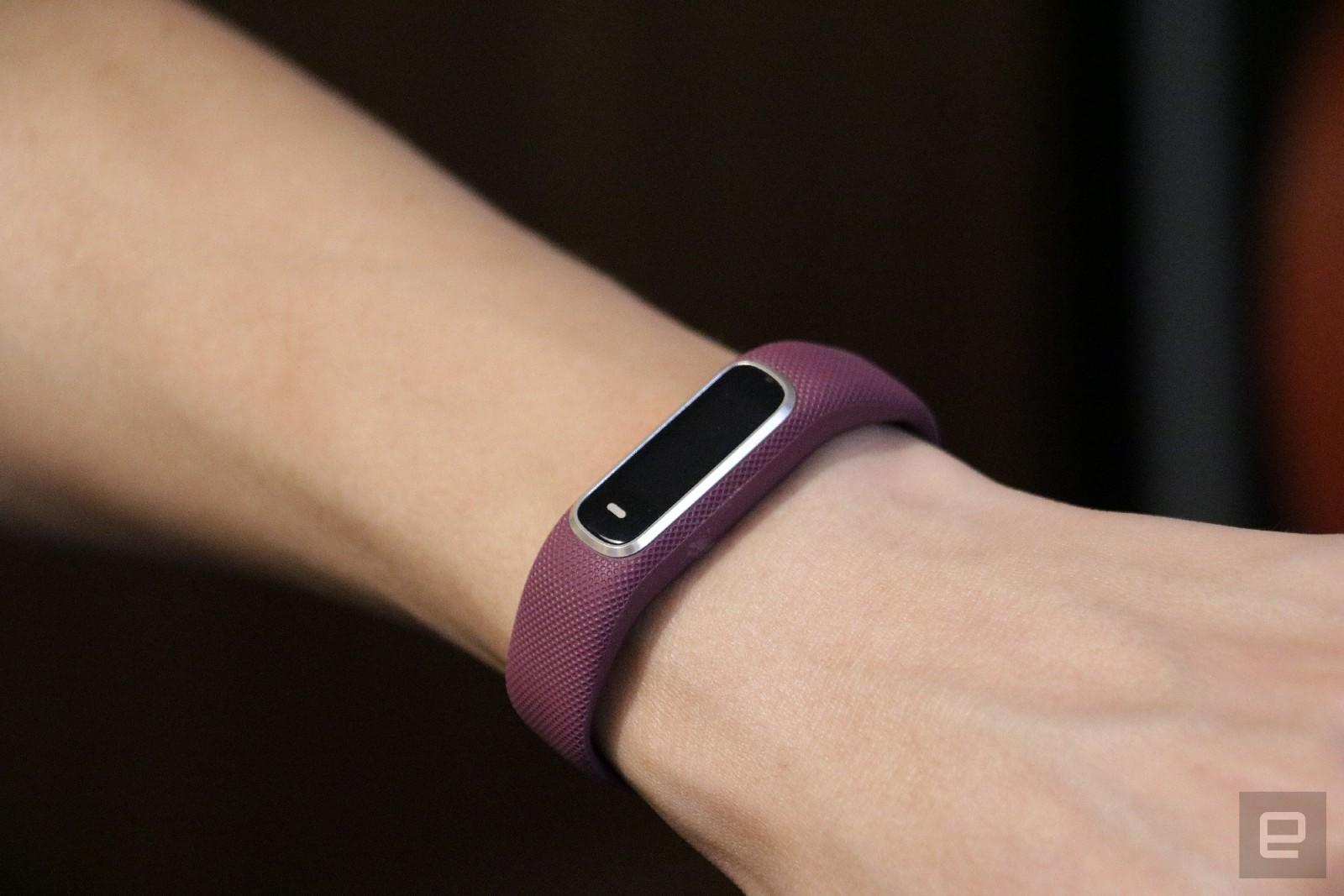
A more subtle-looking alternative is the $100 Garmin Vivosmart 4. It’s thinner than the Charge 5 and fits in a bit better with bracelets and other jewelry you might wear regularly. But its attractive design is only part of its appeal — Garmin knows how to track fitness, and the Vivosmart 4 is proof that you don’t need to drop hundreds on one of the company’s fitness watches to get a capable device.
Like the Charge 5, the Vivosmart 4 tracks all-day activity and sleep and has a pulse ox sensor for blood oxygen saturation measurements. It has only connected GPS capabilities, and it has universal music controls that can control the playback of most anything. The band is also waterproof and can track basic swim workouts, plus it also has a battery life of up to seven days. While it’s similar to the Charge 5 in that the Vivosmart 4 works with both Android and iOS devices, it’s a bit more flexible as it syncs with Apple Health (the Charge 5 and other Fitbit devices do not).
If you only have $100 to spare, the Fitbit Inspire 2 is the best option. It strips out all the luxury features from the Charge 5 and keeps only the essentials. You won’t get built-in GPS, Fitbit Pay or Spotify control but you do get excellent activity tracking, automatic workout detection, smartphone alerts and plenty more. As the updated version of the Inspire HR, the Inspire 2 includes a heart rate monitor, which the device uses to keep track of all-day heart rate, active zone minutes, sleep stages and more.
The Inspire HR is thinner than the Charge 5 but it also has interchangeable bands, so you can switch up its style whenever you feel like it. Its design is also swimproof, and it should last up to 10 days on a single charge. Fitbit also recently added Tile-tracking to the Inspire 2, allowing you to find your misplaced band using the Bluetooth locator feature and the Tile mobile app. All of these features make it the best value fitness tracker you can get.
The $60 Samsung Galaxy Fit 2 band is almost like a more affordable Garmin Vivosmart 4. The two trackers share the same skeletal design but the Galaxy Fit looks a bit more utilitarian — you can swap out its bands, though — something you can’t do on Garmin’s device.
We haven’t given the Fit 2 the full review treatment, but Engadget’s Cherlynn Low was impressed with the original Galaxy Fit: the Tizen-based interface is colorful and easy to use, and plenty of people will appreciate its durable, no-nonsense design. It tracks a bunch of workouts as well and even has auto-exercise recognition. That’s on top of its daily activity tracking and sleep monitor, all of which uses the built-in heart rate monitor to collect pulse data throughout the day.
The kicker for the Galaxy Fit 2 is battery life — the tiny tracker can last for up to 15 days on a single charge, and you can even extend it to 21 days if you change some settings. That’s much longer than most competing bands, so even if Samsung isn’t as comprehensive as Garmin or Fitbit is when it comes to fitness data collection and analysis, the Galaxy Fit 2 is a good option for those who want a basic tracker that they can safely forget to charge each night.
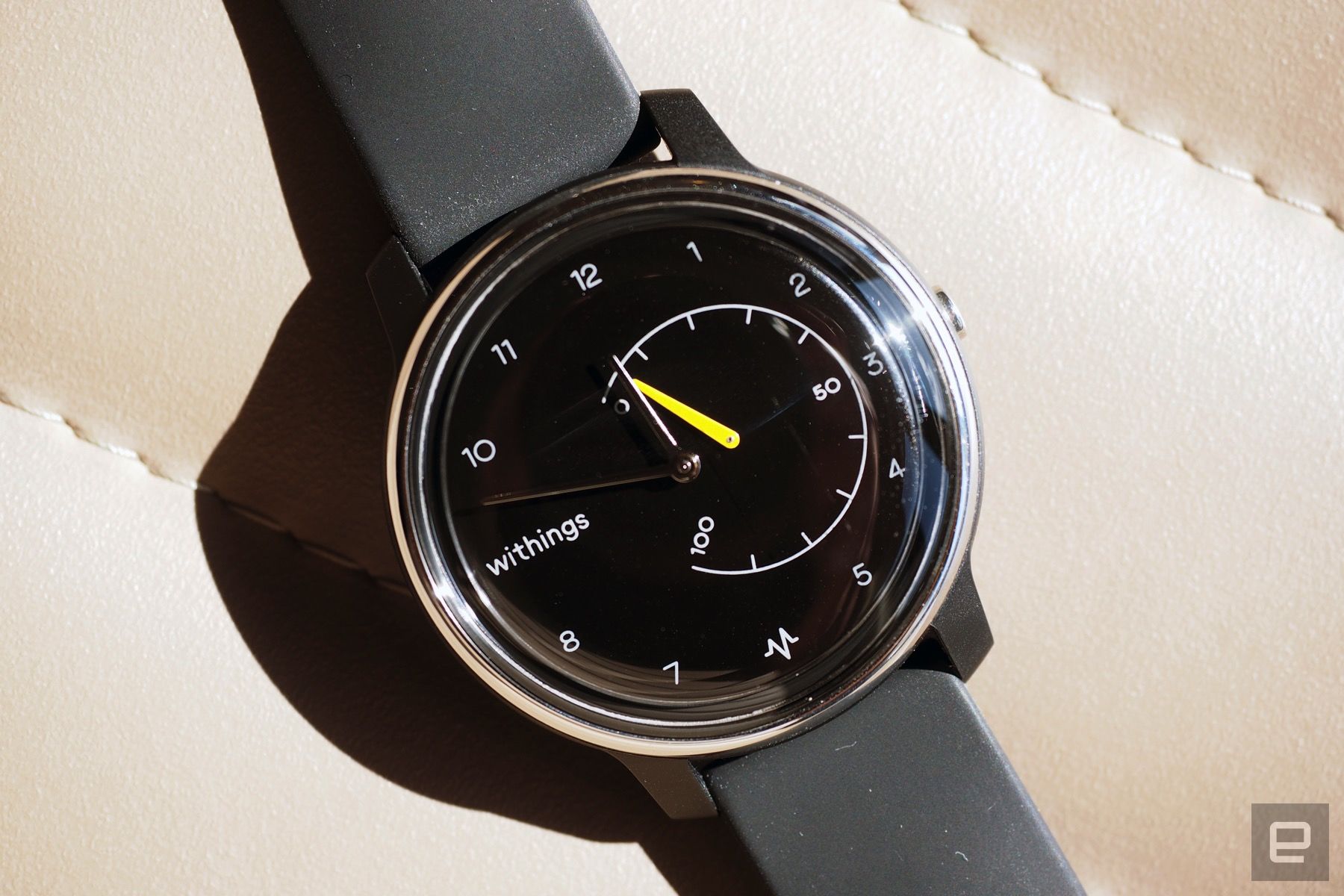
All of the previously mentioned fitness trackers are attractive in their own way (bonus points to those that have interchangeable bands), but they share a similar look. There aren’t many alternative designs for these devices anymore. The $70 Withings Move watch is an exception, and one of the most traditionally fashionable fitness trackers you can get. It’s an analog watch with a couple of health monitoring features including step, calorie, distance and sleep tracking, connected GPS, auto-recognition for more than 30 workouts and a water-resistant design. But we really love it for its button-cell battery, which can last up to 18 months before needing a replacement.
HTC is today launching a lightweight headset designed to split the difference between a standalone VR headset and a personal cinema. The HTC Vive Flow is a pair of glasses weighing just 189 grams (6.6 pounces) which pair with a smartphone to let you play some VR content or simply watch TV. It’s marketed as both a piece of tech to keep you entertained and a device to help you improve your mental wellbeing.
Naturally, the company doesn’t want to talk too much about the technology inside Flow, preferring to focus on what it can do. What we do know, however, is that it has two “1.6K” displays running at a 75Hz refresh rate and offering a 100-degree field of vision. There’s no battery per-se, except for a tiny cell designed to make sure that it’ll shut down safely if Flow is severed from whatever power source you've connected its USB-C cable to.
HTC
It’s in this regard that it’s set up more like a personal cinema than it is your standard VR headset, especially with the fairly narrow body. HTC spent a lot of time and effort shrinking the distance between the display and your eyes, and Flow uses a pair of diopter lenses up front. It means that short-sighted folks won’t need to wear their glasses when using Flow, since they can set the lenses up to suit their comfort level.
To ensure that Flow really is portable, HTC set a power budget of 7.5 watts, the upper limit for USB 3’s charging spec. It means you can run this thing off any compatible battery pack (or your phone, in a pinch) as well as a standard socket over a USB-C cable. Some of that juice goes to powering a small active fan in front of the nose, which pulls cold air over your face and pushes warm air out of the Flow’s top vents.
HTC
HTC also spent plenty of time talking about how the dual-hinge system will ensure that the Flow’s glasses-like frame will sit comfortably on anyone’s head. A pair of speakers embedded into the arms offer what we’re told is surprisingly high quality spatial audio, and beefy given their relative size. And since they sit on your head like regular glasses, you can wear them laying down should the need arise.
You can pair Flow with your smartphone over Bluetooth or Miracast (for watching protected content) and use the phone as a pointer inside VR content. That limits the number of experiences you’ll be able to enjoy with the gear, but you were hardly going to be able to play Half Life: Alyx on this thing anyway. A pair of camera lenses facing forward will, when the feature is ready, enable the Flow to track your hands for more immersive VR, too.
It's worth saying that this is not, and as I understand it, can never become an AR headset in its current form. Those lenses don't apparently offer much passthrough (beyond what's necessary for motion tracking) and this isn't designed for it anyway.
HTC says that the focus of Flow’s content on “wellbeing, brain training, productivity” and “light gaming,” with apps like Color Connect VR, Space Slurpies and VR meditation app Tripp. The headset will be able to access a special version of Viveport Infinity, offering a wide library of Flow-compatible content for a monthly fee of $5.99. The company added that if users wanted to meditate within the Flow towards the end of the day, a blue light filter will kick in to help ensure that you can get more restful sleep.
HTC
If you’re looking to get hold of an HTC Vive Flow, then pre-orders are opening from today, with shipping expected to begin in November. The price is $499, and for that you get the glasses and a soft carrying case thrown-in, but I’d strongly advise you to pre-order if you want one. Doing so entitles you to receive the flask-like hard carrying case, as well as seven pieces of additional VR content thrown in gratis.
Naturally, Flow has become something of a worst-kept secret in technology after many of these details were leaked ahead of time. One of the obvious sticking points is the higher price compared to the Quest 2, although HTC was clear to dispel the notion that the products were equals. Flow, after all, is a not a standalone headset, and HTC believes that the lighter, more elegant hardware will win it fans in the health and fitness market.
On October 18th, Apple will hold its second event of the fall and likely last event of the year. The invite the company sent out this time doesn’t provide any hints on what announcements we should expect, but thanks to a variety of leaks and reports, we have some good ideas about what it will show off.
MacBook Pro
Devindra Hardawar/Engadget
All signs point to new 14- and 16-inch MacBook Pro models headlining the event. Apple will reportedly turn back the clock on its flagship laptop, undoing many of the design features that have defined the line since late 2016. MagSafe may be back on the table, as well as an HDMI port and SD card slot. Oh, and the Touch Bar will apparently get the axe, with a standard set of function keys set to replace the OLED strip.
Beyond those changes, the new MacBook Pro is expected to feature thinner bezels. According to display analyst Ross Young, it could even come with a mini-LED panel capable of refreshing its screen at 120Hz. Ross suggests that’s a feature both models could include, but knowing Apple, it may be something that’s only available on the top-tier 16-inch model or an add-on that costs extra. Additionally, there have been reports of the 14- and 16-inch models supporting maximum resolutions of 3,024 x 1,964 and 3,456 x 2,224, which would be a major upgrade over the current 13- and 16-inch MacBook Pros.
Yes, new 14" and 16" MacBook Pro's will have miniLEDs and we believe they will also be 120Hz refresh.
Internally, the MacBook Pro will reportedly include Apple’s latest system-on-a-chip, possibly called the M1X. According to a recent report from Bloomberg’s Mark Gurman, there will be two variants of the M1X, with the main difference between the two coming down to the number of graphics cores they have at their disposal. In addition to delivering faster performance than the M1, the new chip could come with support for up to 32GB of RAM, making it a much better fit for work like coding and video editing.
Speaking of the M1X, it could tie into the other announcements Apple has planned for October 18th. In August, Gurman said Apple was working on a redesigned Mac mini that will include the new processor and add additional ports. At the time, he noted the desktop would launch sometime within the “next several months.” Recent reports suggest that a new Mac mini isn’t a guarantee for next week, but Apple could still surprise us. We know from Gurman and analyst Ming-Chi Kuo that Apple is also working on a redesigned MacBook Air, but the company reportedly won’t announce that device until sometime next year.
macOS Monterey
Apple
Given the timing of the event and the likely focus on Mac hardware, Apple will almost certainly announce a release date for macOS Monterey. The company previewed the next version of its desktop operating system at WWDC 2021, showing how features like SharePlay and Universal Control will build on the enhancements it introduced with Big Sur in 2020. We got a chance to preview the update this past summer and found it was a mostly subtle upgrade to Apple’s desktop OS. Still, we wager Mac fans will be excited to find out when they can download the software.
Everything else
We could also see the company announce a new set of AirPods to replace the current second-generation model. Apple hasn’t updated its original wireless earbuds since 2019 when it released a minor update that added support for inductive charging. Taking a page from the AirPods Pro, the new model is expected to feature an updated design with shorter stems, but they won’t include more premium features like ANC. In the lead-up to next week’s event, we’ve seen leaked images of the third-generation AirPods with both silicone ear tips and without. So it’s not clear just how heavily Apple plans to lean into the AirPods Pro design.
We’ll note here AirPods haven’t been a frequent feature of Apple’s hardware events. Outside of when it unveiled the earbuds back in 2016, Apple has announced all subsequent models, including the AirPods Pro and AirPods Max, through press releases. We can see the company doing the same here with the new “basic” model. One last thing the company could mention at the event is that Apple Music is coming to the PlayStation 4 and PS5. Given that you can already access Apple TV from Sony’s consoles, it’s not a jump for the streaming service to become available there as well.
So there you have it, that’s everything we see Apple potentially sharing on October 18th. As always, the company could surprise us, so you’ll want to visit Engadget on the day of the event. We’ll have comprehensive coverage of the company’s latest announcements.
If you missed the chance to grab the new Echo Show 8 during Amazon's Prime Day event in July, you may want to check the smart display's listing on Amazon. It's currently on sale for $100, $30 less than its original retail price of $130. That's only $5 more than what it was listed for during Prime Day, and it's certainly not a bad deal for a relatively new device that was only released in June.
We gave the Echo Show 8 a score of 87 in our review. Between this device and its smaller 5-inch sibling, it received more upgrades from the previous generation, including a faster octa-core processor. It also has a 13-megapixel wide-angle camera that's a huge improvement over the previous version's one-megapixel sensor. The smart display uses digital panning and zooming to follow you around during calls, and it worked well enough when we tested it out. It even works with every video calling platform the device supports, including Skype and Zoom.
Aside from its faster processor and better camera, we praised the Echo Show 8 for its minimalist design and its 1,280 x 800-pixel resolution display. It lacks the 3.5 mm jack of its predecessor that will let you connect it to a speaker, but it already has a powerful bass and impressive volume. The device's overall sound quality is also better than its smaller sibling's, since it has two speakers instead of one.
We found the Echo Show 8 a great digital photo frame that's capable of displaying current time and weather conditions during our tests. In addition, we found it helpful in the kitchen, thanks to its large library of recipes with step-by-step instructions from sources that include the Food Network and Allrecipes. And in case you want to use the smart display to watch videos, you can do so, as well, since it supports video streaming from Amazon Prime, Netflix and Hulu.
Follow @EngadgetDeals on Twitter for the latest tech deals and buying advice.
Apple still dominates the world of wearables. Over the last year, research company Canalys noted that smartwatch sales have actually overtaken basic bands and now account for 62 percent of all wearable shipments. And Apple’s versions lays claim to just under a third of all smartwatches sold.
That’s interesting because you need an iOS device to setup and use an Apple Watch, so the company has discounted all the Android phone users that might be interested in an Apple smartwatch. I’ve played with Fitbits, Samsung Galaxy Watches and the occasional Garmin, even, but nothing quite offers the capabilities and premium build-quality of an Apple Watch. (And this comes from someone who was averse to — and still bought — the first Apple smartwatch.)
So here we are for round 7. Apple’s Watch Series 7 goes on sale this Friday, and there seems to be a lot of interest in the bigger-screened watch, with pre-order screens soon showing early November delivery dates when Apple opened up orders. If you’ve already pre-ordered, well you probably don’t care about reviews! For the rest of us, Reviews Editor Cherlynn Low has put the wearable through its paces for the last week. We’ll take a closer look at her review below.
The Star Trek legend's Blue Origin flight went smoothly.
William Shatner has become the oldest person to fly to space. The 90-year-old Star Trek icon was one of four crew members aboard Blue Origin's NS-18 mission as it flew to an altitude of 66 miles. The sci-fi actor and random Engadget nemesis (there was a whole Twitter beef) edged out 82-year-old aviation pioneer Wally Funk, who set the previous age record just a few months ago.
It's also some good publicity for Blue Origin. Jeff Bezos' private spaceflight outfit is currently grappling with accusations of a toxic work environment, not to mention the fallout of its legal tussle with SpaceX over NASA's Moon mission contract.
According to Cherlynn Low, just a little bit more screen makes a huge difference on a device this small. Though it’s otherwise not a huge upgrade over its predecessor, the Apple Watch Series 7’s bigger screen makes it more user-friendly than ever. It’s a solid choice for anyone new to smartwatches or who's upgrading from a much older device. If you’re a Series 6 owner, however, you could probably wait until the next update. And if you’re looking for substantial sleep tracking, the Apple Watch still won’t be the right wearable for you.
They could potentially take your temperature and even check your posture.
Oh, the other wearable. Wall Street Journal sources claim Apple is exploring multiple ways it can use AirPods as health devices. It might use the buds as hearing aids, but it could also use the motion sensors to correct your posture. A prototype would even include a thermometer to check your core body temperature.
HTC is expected to launch a new VR headset within the week, but some leaked images have spoiled the party. A collection of Vive Flow images made its way online, courtesy of Evleaksover on Twitter, before the launch event. Looking like a lightweight steampunk VR fantasy, the goggles appear to be more for media viewing and light gaming than more substantial (or business-centric) capabilities. The images suggest the Vive Flow will be available for pre-order starting on October 15th, with shipments going out in early November.
The social network is trying to lock down access to sensitive info.
Facebook is ramping up its fight against leakers following the disclosures of whistleblower Frances Haugen. According to a report from The New York Times, Facebook is limiting access to some internal groups that deal with “sensitive” issues like safety and elections. The change, which was made to prevent further leaks, immediately leaked. Which is hilarious.
Bowers & Wilkins has launched a new version of its iconic Zeppelin speaker, and the company says it was reimagined for the streaming age. It describes the new Zeppelin as "smarter and more flexible" than its predecessors, with built-in support for Amazon's Alexa.
B&W plans to give it multi-room capability in early 2022 through a software update. Once that arrives, users will be able to link several Zeppelins together or link a Zeppelin with other B&W speakers in a multi-room environment. A chain of Zeppelin speakers isn’t a cheap endeavor, however. Each new speaker will cost $799.
Fujifilm has revealed a new Instax printer that supports its wider, more Polaroid-like film. The Instax Link Wide Smartphone printer connects to your smartphone and prints out camera roll photos twice as wide as the credit-card-sized images from the original Instax mini Link printer. You can also directly transfer and print images from Fujifilm's X-S10 mirrorless camera.
It turns out there’s much more to Nintendo’s recently released OLED Switch than a new display panel from Samsung. Conducting a teardown of the console, the DIY heroes at iFixit found the company made a variety of internal tweaks that make for a device that’s significantly different from its predecessor.
Like Sony’s latest PlayStation 5 revision, the OLED Switch features a smaller cooling assembly than previous models. iFixit suspects Nintendo this tweak to either save on space or dial back the launch model’s “cooling overcompensation.” All we can say is we hope the change doesn’t lead to claims the new model is “worse” than its predecessor. In another space-saving measure, Nintendo has consolidated some components onto a single board. The console’s SD card reader, headphone jack and cartridge reader are now all found on a single PCB.
iFixit
Notably, the only controller-related change the OLED variant features is a set of new console-side rails that hold their respective Joy-Cons more securely. Another change sees the console’s interconnect cables taped to the top of a metal shield. While that's something that will make fixing the OLED Switch on your own more difficult, iFixit suspects it could help with WiFi and Bluetooth connectivity issues.
Speaking of repairability, iFixit gave the OLED model a score of seven out of 10. That’s one less than the company awarded the original model. The OLED Switch features a non-modular storage module that’s soldered to its motherboard, making easy repairs and upgrades on that front something you can’t do.
Just in time for the holiday season, Bose has released a new portable Bluetooth speaker designed for both strong audio performance and durability. The SoundLink Flex has an IP67 rating, meaning it's water, dust and dirt resistant, and the company even claims that the speaker will float to the surface if you drop it in water (but you should probably fish it out quickly if it drops into a bathtub or the ocean).
The silicone rear and powder-coated steel grille should protect the speaker from drops and bumps, according to Bose. The company also claims the device is resistant to UV light and corrosion and it won't peel or flake.
But it's not just the speaker's apparent toughness that makes it interesting. Bose says it packed the SoundLink Flex with features "to deliver astonishing audio performance." It claims that the custom transducer provides maximum audio clarity and "bass that you can feel in your chest.” The SoundLink Flex also has dual-opposing passive radiators, as well as Bose's digital signal processing tech, which should minimize distortion.
Bose
The speaker can detect its orientation and adjust the audio output accordingly. So, whether it's horizontal, vertical or hanging from the utility loop, the sound will be optimized. It's the company's first Bluetooth speaker that uses this Bose PositionIQ tech.
SoundLink Flex can remember up to eight Bluetooth connections to make it easy to switch from one device to another. You can adjust the settings using the Bose Connect app and control your phone's voice assistant and take calls using the speaker's microphone.
You can pair a second Bose Bluetooth speaker for stereo or simultaneous playback. The SoundLink Flex can connect to other Bose speakers and soundbars as part of a home audio system. Bose says you'll get up to 12 hours of playback on a single charge and you can recharge the lithium-ion battery with a USB-C cable.
The SoundLink Flex is just under eight inches wide, 2.1 inches deep and 3.6 inches tall. It weighs just over a pound and is available in black, white smoke or stone blue. The speaker costs $149 and you can pick it up from Bose's website starting today.