If you made the resolution to tidy up more regularly in 2022, a robot vacuum can help with that. And for those that hate cleaning, investing in a robot vacuum with self-emptying functionality can make it so you rarely have to interact with the machine. Two of iRobot's higher-end models with clean bases are on sale at Wellbots right now when you use the code ENGADGET250 at checkout — both the Roomba s9+ and the Roomba j7+ will be $250 off, bringing them down to $850 and $600, respectively. Those are great deals, especially considering the prices are better than we saw during Cyber Monday at the end of last year.
The Roomba j7+ is the latest robo-vac from iRobot and it has new AI-driven computer vision technology the helps it detect objects and move around them as it cleans. It's thanks to this feature that the company calls the j7 a series of "poop-detecting" devices because they should be able to successfully avoid a robot vacuum's arch nemesis — your pet's accidents. iRobot's Pet Owner Official Promise (or P.O.O.P. for short) ensures that you'll get a new vacuum if the robot fails to avoid a run in with poop during your first year of ownership.
Otherwise, the j7 series sits right under the s9 series in iRobot's lineup, meaning it has a number of advanced features like 10x the suction power of a standard Roomba, dual multi-surface rubber brushes and Imprint Smart Mapping, the latter of which lets you direct the vacuum to clean only certain rooms. The "plus" part of the j7+ refers to the clean base, or an extended part of the dock into which the vacuum will empty its debris after every job. So instead of emptying the dustbin yourself after every cleaning, you'll only have to empty the base about once every two months. Combine that with the smart controls in the iRobot mobile app and you may only have to interact with the Roomba every so often — the app lets you do things like remote start the device, set cleaning schedules and more.
The s9+ is the most advanced device that iRobot makes and it has a few differences from the j7 series. It has 40x the suction power of iRobot's standard series of vacuums and a design that helps it clean corners better. It also has a 3D sensor that helps it detect and clean around objects, although the technology is slightly different than that in the j7 series. Both are compatible with Amazon's Alexa and the Google Assistant, too, so you can control the robo-vacs with voice commands if you wish.
Follow @EngadgetDeals on Twitter for the latest tech deals and buying advice.
Apple is once again honoring regulations requiring it to allow alternative payment options in the App Store, although this one is highly specific. As Reutersreports, Apple confirmed it would comply with orders from the Netherlands' Authority for Consumers and Markets forcing it to allow third-party payment systems in Tinder and other locally-offered dating apps. The regulator determined on December 24th that Apple had abused its market power by requiring its in-app purchasing platform, and gave Apple until January 15th to make the change if it wanted to avoid fines.
Like with past decisions, Apple wasn't happy. It contended that allowing third-party options would "compromise the user experience" while posing new privacy and security threats, and reminded developers they (or their payment partners) would be responsible for handling refunds and similar issues. Apple is appealing the ACM's decision.
The order doesn't affect other apps available in the Netherlands. However, it reflects growing regulatory opposition to Apple's App Store business model in multiple countries, including South Korea and the US. Officials are increasingly convinced Apple is using its in-app purchasing requirement to stifle competition, and it won't be surprising if other countries follow suit before long.
Google has begun rolling out the Pixel 6 and 6 Pro’s latest update following a delay in December. As may you recall, the company “paused” the release of the OTA after there were reports of the software causing calls to drop and disconnect. The issue was such that Google took the nearly unprecedented move of removing the associated factory images for that update from its developer website.
In December, the company said the software would arrive sometime in “late January.” Last week, it pushed up that timeline to today, January 14th. “The update will be available for all devices over the following week, but exact timing may vary depending on your carrier and country,” the company said. To that point, some carriers have said they’ll begin pushing out the software starting early next week. For instance, Canadian carrier Fido notes on its website it’s targeting January 17th for the start of its rollout.
Now that the update is available, it includes all the fixes Google had planned to release in December in addition to more than a dozen new ones. Among other tweaks, you’ll find a fix for an issue that had caused the Pixel 6 and 6 Pro to drop a connection to a WiFi network in certain situations. Additionally, the update addresses a bug that had caused the phones to drain their batteries faster than expected.
Companion Mode is a second screen experience designed to support the shift towards hybrid working environments by providing easier access to various Google Meet controls and features for people calling in from a shared office.
Previously, workers who called in from a meeting room often had to jockey for control if they wanted to do simple things like raise their hand (virtually) or drop a comment in chat. The result was that employees who worked remotely and called into meetings using a phone or PC were often more active and visible in meetings than their colleagues at the office who participated using a traditional conference room set up.
However, thanks to the addition of Companion Mode, office workers will soon get access to most of Google Meet’s features via Nest Hub Max or other certified hardware like a Lenovo Tap while still being part of the shared meeting. And while the Nest Hub Max might not be a common sight in conference rooms today, this new mode could help Google push more devices to businesses of all sizes as they adapt to post-pandemic working arrangements. To join a meeting using Companion Mode, you can either activate the setting in Google Meet’s “green room” or by using a dedicated URL: g.co/companion.
Google Meet features available in Companion Mode include chatting, starting and voting on polls, raising your hand (which includes displaying a person’s name and title), using host controls and turning on captions or translations.
Google says the goal is to ensure that regardless of where you’re working from, everyone in a video call will have access to a similar set of tools and features. Companion Mode will be enabled by default, though, for people using the free version of Meet, it’s important to note that anyone using it will count as an additional participant towards the 100-person limit, instead of a room full of people counting as a single attendee.
Companion Mode in Google Meet is rolling out this week, though depending on your domain or user type, it may take another few weeks for it to be available on your device.
This week brought deals on Apple devices, gaming gear and more. The Mac Mini M1 remains on sale for $600 while the 3rd-generation AirPods are back down to a record low of $140. Nintendo's Ring Fit Adventure is back in stock and $25 off, while you can still get a one-year Switch Online family membership plus a microSD card for 50 percent off. Here are the best tech deals from this week that you can still get today.
Nintendo Ring Fit Adventure
Devindra Hardawar / Engadget
The Ring Fit Adventure is back on sale for $55, or $25 off its normal price. It's a good option for Switch owners who want to work out more in the new year but don't want to go outside to do it. Joy-Cons strap to the included ring and leg strap so the game can record your movements as it has you doing things like squats and crunches to progress through a fantasy world, defeat enemies and more.
Apple's latest AirPods are on sale for $140 right now, or 22 percent off their normal price. These are the company's newest earbuds and we gave them a score of 88 for their improved design, better audio quality and long battery life.
The 2020 MacBook Pro M1 remains $150 off, bringing the model with 8GB of RAM and 256GB of storage down to $1,150. It's not the latest MacBook Pro with the higher-end CPUs that Apple recently came out with, but it's still a viable option. We gave it a score of 84 for its speedy performance, lovely display and its long, 16.5-hour battery life.
The base Mac Mini M1 is $100 off thanks to a sale and an additional coupon, bringing it down to $600. This model runs on the M1 chipset along with 8GB of RAM and 256GB of storage. This is Apple's most affordable M1 machine, making it a good option if you're in need of an upgraded desktop.
Amazon still has a bundle that includes a one-year Switch Online family membership and a 128GB SanDisk microSD card for $35. You're essentially getting the microSD card for free here, and the family-plan subscription gives up to eight people access to online play, cloud data storage and a library of NES and SNES games to play whenever you want.
The Galaxy Buds 2 are down to $100 right now, or $50 off their normal price. We gave them a score of 84 for their improve sound quality, adjustable ambient sound mode, comfortable design and support for wireless charging.
Samsung's latest smartphone, the Galaxy S21 FE, is officially available and starting to ship and Amazon throws in a $100 gift card if you order the handset through the online retailer. We briefly tested the FE at CES 2022 and called it "last year's flagship without the frills," and it includes a 5-nanometer processor, a 120HZ display, a 32-megapixel front-facing camera, a larger battery and more.
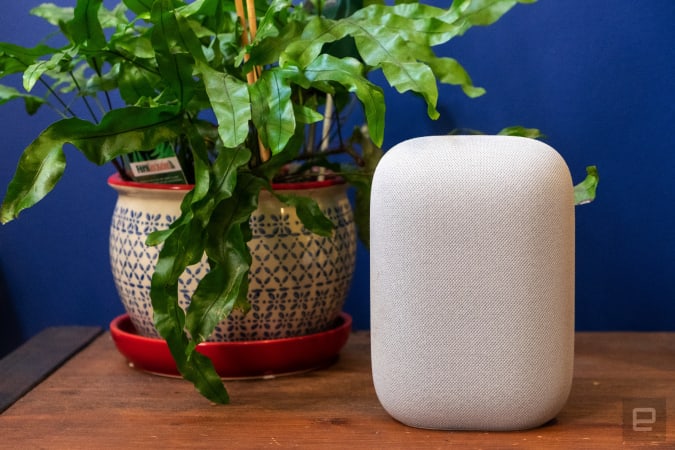
The Nest Audio smart speaker is down to $75, which is $25 off its regular price. While not as good as its Black Friday price, it's still a good discount on one of our favorite smart speakers. It earned a score of 87 from us for its excellent audio quality, stereo mode and minimalist design. You can also pick up the Nest Mini for only $25.
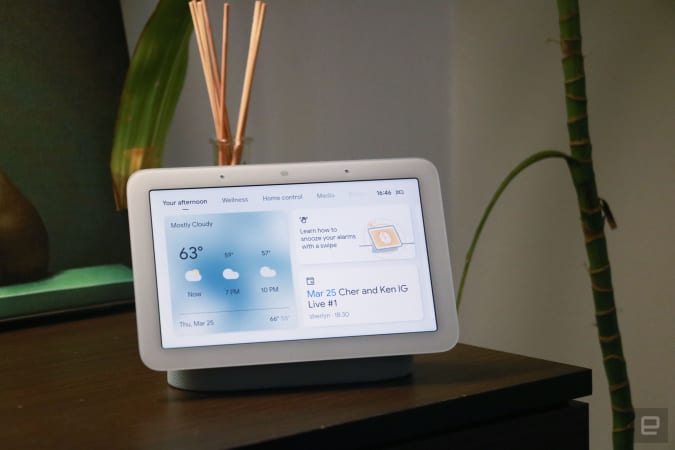
The second-generation Nest Hub has been discounted to $60, or $40 off its normal price. That's also only $10 more than it was during the holiday shopping season. We gave it a score of 89 for its nice 7-inch display, improved performance and audio quality plus its new sleep tracking feature.
Withings' Body+ smart scale is 41 percent off for today only as part of a daily deal on Amazon that includes a number of other similar scales. Withings' gadget connects to WiFi and tracks things like your weight change, body fat and water percentage, muscle and bone mass and more.
Engadget readers can get a total of two free audiobooks when signing up for Libro.fm, the audiobook subscription service that supports local bookstores. Similarly to Audible, a Libro.fm membership costs $15 per month and gives you one audiobook credit per month, plus 30 percent off any audiobooks you buy á la carte.
The second-generation Echo Show 5 is on sale for $45, or 47 percent off its normal price. Not much has changed from the first to the second generation, but that's ok. We gave the latest model a score of 85 for its good sound quality, tap-to-snooze feature and quaint design.
The Wyze Cam v3 with spotlight kit is 32 percent off, knocking it down to $36. This is one of the easiest smart home security cameras to use, and one of the most affordable, and the spotlight kit will make it more useful as an outside cam at night.
HBO Max is having a sale through January 25th that knocks 20 percent off its monthly plans. That means you can get the service with ads for $8 per month or the ad-free tier for $12 per month, with both discounted rates lasting for one year. Current HBO Max subscribers cannot take advantage of the deal, but if you recently cancelled and wanted to come back, you should be able to get the discount.
Meta’s New Product Experimentation (NPE) team is often quick to abandon apps that don’t find traction, and a video speed-dating service it has tested over the last nine months is next for the chopping block. The company told Sparked users the experiment will shut down on January 20th.
“We started building Sparked in late 2020 to help people find love through an experience rooted in kindness. Since then, thanks to regular input and feedback from you, we improved where we could, learned a ton, and made connections between people,” Meta wrote in the email, which TechCrunch obtained. “Like many good ideas, some take off and others, like Sparked, must come to an end.”
Users will be able to download their data before January 20th. After that date, Meta will wipe their Sparked accounts.
Sparked was a blend of Chatroulette, the video chats other dating apps have introduced over the last few years and a speed dating event. At a predetermined time, users from a certain area or demographic would take part in dating events (there were a few global events too). They'd have four minutes to chat with a potential match, and if they both wanted to spend more time with each other, they could set up a second, 10-minute date and/or exchange contact details.
Although users needed a Facebook account to use Sparked, the service was distinct from both Facebook and Facebook Dating. It had no public profiles, messaging or matching features, like swiping on Tinder.
Meta initially described Sparked as a small beta test to learn about video dating, so it might not truly have intended for the service to blow up in popularity. Both Sparked and Facebook Dating added audio chat features last year.
Sparked is joining a long list of NPE projects that Meta has shut down, including Pinterest-style app for hobbyists Hobbi, TikTok clone Lasso and selfie app MSQRD. A few NPE apps remain on the App Store in the US: TikTok-esque app for rappers called BARS, an app for couples called Tuned and collaborative music video app Collab. Meta said this week that Collab is also closing down on March 12th.
As more music streaming services introduce lossless or high-definition audio to their offerings, interest in DACs (digital-to-analog converters, or “headphone amplifiers”) has picked up pace — so much so we created this guide. What was once the reserve of audiophiles is slowly becoming a go-to gadget for those who want more than what their phone and AirPods can deliver. But they’re not without caveats. For one, they’re often expensive, and sometimes they aren’t much smaller than the phone you’re attaching them to. Enter the Tea DAC by Khadas.
Khadas started out making media-friendly single board computers (SBC - think… media-specific Raspberry Pi type things) before moving on to desktop DACs. Tea is the company’s first mobile DAC and it appears to be primarily targeted at iPhone users – though it’s also compatible with Android. The reason I suggest it’s more apt for Apple’s phones is that it’s MagSafe compatible. Combine that with the slim, iPhone-esque all-metal design and it solves one of the main problems with mobile DACs: Having something heavy hanging out the back of your phone.
With the Tea, it sticks to the back of your phone and the low profile makes it only a little more noticeable than Apple’s own MagSafe wallets. You can, of course, find MagSafe capable cases for Android, but your phone and budget will be a factor.
Beyond the slick form factor, the Tea doesn’t scrimp on its codec support. Over USB/Lightning, the Tea can handle audio right up to 32bit/384kHz. Given that most mainstream music services don’t offer anything above 192kHz, streamers will be more than covered. Similarly, the Tea can decode MQA (Tidal) along with DSD, AAC, FLAC, APE, OGG and all the standard formats (WAV/MP3 etc.). If you prefer to go wireless, the Tea also supports LDAC and AptX HD over Bluetooth.
James Trew / Engadget
Here I should mention that, for all its iPhone friendliness, Apple doesn’t offer either LDAC or AptX HD support in its flagship phones. You can still use the Bluetooth functionality in Tea, but you won’t be able to enjoy the higher-quality formats. Though it does at least mean you can charge your phone while still using the DAC or you can wander around with the smaller Tea connected to your headphones rather than your mobile. There are plenty of Android phones that do support LDAC/AptX HD, but you’ll need to check the manufacturer website to confirm (most Pixels, Samsung flagships and OnePlus phones offer LDAC/AptX HD decoding).
There are a few things you won’t find here, but most of those fall into the higher end of audio. For example, there’s only a regular 3.5mm headphone jack – no option for 2.5 or 4.4mm balanced cans at this point (though rumor has it that a “Pro” version with that might be on the way). There’s also limited feedback about what codec/audio quality you’re currently receiving, with just a simple color-changing LED indicating the format, which you can’t see unless the phone is face down. Inputs are limited to USB-C, so it’ll work with your phone and PC, but no line in.
This puts the Tea in an interesting category. It’s perfectly capable for people that want the most out of their streaming service and even should appeal to audiophiles looking for a discreet option that covers most bases. But at $199 it’s a reasonable spend. Perhaps its most obvious competitor is the BTR5 from Fiio. That’s also a portable DAC with high-res Bluetooth support along with a similar selection of cabled formats (also up to 32bit/384kHz with MQA support). Oh, and the Fiio offers a balanced headphone option, too (2.5mm). When you factor in that the BTR5 also typically retails for $159, you have to really want that slim, MagSafe design.
That’s not to undersell it though. I tested the BTR5 and the Tea side by side, and the sheer convenience of the Tea was obvious. With the Fiio, your phone feels tethered, almost weighed down by the DAC. With the Tea, it’s similar to using one of those iPhone cases with a battery in it – a little more thickness, but you can still operate the phone as you normally would.
The Tea also has a much bigger battery capacity – 1,160 mAh compared to the Fiio’s 550 mAh. This obviously isn’t an audio benefit, but it soon becomes one if you plan on listening for extended periods or being away from a charging option for more than a few hours. Which, given the mobile nature of these devices feels like a reasonable possibility.
James Trew / Engadget
I am, however, not a huge fan of the user interface. The Tea has three buttons: One on the left and two on the right. The single button works as a power switch or to summon your virtual assistant. The two buttons on the other side will either control volume or skip tracks. You toggle between volume and skip mode with a dual press of the power button and the top button on the other side. It works… fine, but it’s not very elegant. Also, if you leave it in track skip mode and go to adjust the volume, you’re going to be on the next track before you know it. A minor, but frustrating thing.
In wired mode, the Tea pumps out robust, loud, clear audio. It’s maybe not quite as loud as some other DACs. Even the diminutive Firefly gives the Tea a run for its money there. But, the sound you do get is clean and full of gain, and that’s the goal here: Take a good signal and let it be heard without colorization.
Beyond its primary function as a DAC, it also won’t get in the way of taking calls. A pair of mics on the base of the Tea allow you to talk without having to fall back to the mic on your phone. What’s more, the mics on the Tea are several leagues better than the one on the iPhone, especially when speaking to it while it’s resting on the desk. You can also set the Tea to charge via your phone if you’re running low on juice, or disable this feature to not tax the battery on your handset if you prefer.
All in all, the Tea is a welcome addition to a growing category. At $199 it’s not the cheapest for the feature set, but its well-thought-out design and aesthetic also make it pretty convenient and discreet. Unfortunately, if this all sounds up your alley, then you’ll have to wait a little longer. While Khadas clearly is production-ready, the company is choosing to go the Indiegogo route, with the campaign slated to go live in the coming weeks.
I’m not sure what’s in Sony’s playbook when it comes to selling its phones in the US. Take the Xperia 5 III. After launching in other regions last year, the phone is only now available stateside for $1,000. This is its middle-ish high-end phone, with the flagship Xperia 1 series of smartphones (seen above) both bigger and pricier.
For that price, this Xperia does have things to offer. The autofocus tricks, courtesy of Sony’s camera arm, are often impressive. The Xperia 5 III can also record 4K video at up to 120 fps; it’s a camera-first smartphone designed for folks who are really into photography or video. But, well, that’s true of all of Sony’s recent phones. And if you’re dying for truly cutting-edge smartphone photography, perhaps the Xperia Pro-I, with a 1-inch camera sensor, would fulfill the brief more clearly. It’s... only $800 more — further evidence of Sony’s smartphone prices feeling entirely separate from its competitors.
Sony’s A7 IV is a successful followup to its popular mainstream A7 III. Resolution is up considerably to 33 megapixels, and image quality is much improved overall. Video is now on par with rivals with 4K at up to 60p with 10 bit 4:2:2 quality. Autofocus is incredible for both video and stills, and the in-body stabilization does a good job. The biggest drawbacks are the relatively high price and the rolling shutter that limits use of the electronic shutter. Steve Dent puts the newest, best Sony camera to the test. (And I guest star as a voice-over talent.)
Comcast has successfully tested the first 10G modem capable of multigigabit speeds. The Broadcom-built prototype can provide download and upload bandwidth topping 4Gbps. At those speeds, downloading all 61 gigs of Call of Duty: Vanguard for PC would take just over two minutes.
We learned in July 2020 that Microsoft had discontinued the Xbox One X and Xbox One S Digital Edition. Now, it has emerged the company also quietly stopped making the Xbox One S by the end of that year, “to focus on the production of Xbox Series X/S,” according to Xbox’s senior director of console product marketing.
The employee also filed fraudulent tax returns to try to cover up her actions.
Kristy Stock was sentenced to 18 months in federal prison for her role in a scheme to steal and resell more than 3,000 iPods intended for Native American students. The charges against Stock included both tax fraud and transportation of stolen goods. Stock was supposed to use federal grant money to buy iPods to distribute to students. However, thanks to help from other conspirators James Bender and Saurabh Chawla, the group ended up shipping the stolen iPods to Maryland where they were listed on eBay before being sold at a “substantial” markup.
Company responses so far have been 'inadequate,' according to the committee.
Facebook owner Meta, Google, Twitter and Reddit have been subpoenaed by the Congressional select committee investigating the January 6th insurrection at the US Capitol. Two key questions for the select committee are how the spread of misinformation and violent extremism contributed to the violent attack on our democracy, and what steps — if any — social media companies took to prevent their platforms from being breeding grounds for radicalizing people to violence,” committee chair Bennie Thompson (D-MS) said.
When you're the progenitor of an entire gaming genre and holding the reigns of a billion dollar intellectual property, imitation, it turns out, is not the sincerest form of flattery. It's the sort of thing that gets you dragged into US federal court. And that's exactly what Krafton, maker of PUBG Mobile, is doing to Garena Online over accusations that the Singapore-based game developer has once again infringed its battle royale IP. What's more, Krafton has named Google and Apple in its complaint.
This isn't the first time that Krafton has sued Garena Online. In 2017, Krafton filed suit in Singapore over the sale of Free Fire: Battlegrounds, Garena's suspiciously PUBG-like mobile shooter, but ended up settling that case. Now, Krafton is suing Garena again, over Free Fire again, but this time in US federal court.
Krafton alleges that after settling in 2017, Garena immediately resumed selling Free Fire on both Google Play and the Apple App Store without entering into any sort of licencing agreement to use the litigated game content. Additionally, Garena started selling of another battle royale game of questionable copyright pedigree, Free Fire Max, this past September. As such, Krafton is suing Garena for copyright infringement claiming that “Garena has earned hundreds of millions of dollars from its global sales of the infringing apps," and holding both the Google and Apple marketplaces liable for damages for hosting the content. Krafton, which is headquartered in Seoul, South Korea, has not specified damages outside of a statutory $150,000 per infringement.
If you missed the holiday-season discounts on Apple's latest AirPods last year, you have another opportunity to get them today. Amazon has the third-generation AirPods for $140 right now, which is 22 percent off and a return to their record-low price. Apple released these buds last fall and they represent a complete redesign from the original AirPods, which resembled Apple's old-school EarPods.
While the second-generation AirPods haven't been retired yet, the latest models will likely work better for most people. That's due in part to their new design, which looks more like the AirPods Pro. They don't have the removable silicone ear tips that the Pros have, but they have a contoured look with a shorter stem plus an IPX4 rating that should protect them during sweaty workouts.
Apple also greatly improved the audio on these AirPods; their custom driver and high-dynamic-range amplifier help produce crisp sounds with rich bass. While they don't support ANC, the third-gen earbuds do have Adaptive EQ, spatial audio and always-on Siri. The H1 chip inside helps enable all of those features, along with fast pairing and switching between Apple devices. We also appreciate their battery life — you should get six hours of listening time before they need more juice, and roughly 30 total hours of use with the extra power provided by their charging case.
Follow @EngadgetDeals on Twitter for the latest tech deals and buying advice.